Detecting Egregious Conversations between
Customers and Virtual Agents
Tommy Sandbank, Michal Shmueli-Scheuer, Jonathan Herzig, David Konopnicki
IBM Research Haifa 31905, Israel
{tommy,shmueli,hjon,davidko}@il.ibm.com
John Richards, David Piorkowski
IBM Research
Yorktown Heights, NY USA [email protected], [email protected]
Abstract
Virtual agents are becoming a promi-nent channel of interaction in cus-tomer service. Not all cuscus-tomer in-teractions are smooth, however, and some can become almost comically bad. In such instances, a human agent might need to step in and salvage the conversation. Detecting bad conversa-tions is important since disappointing customer service may threaten cus-tomer loyalty and impact revenue. In this paper, we outline an approach to detecting suchegregiousconversations, using behavioral cues from the user, patterns in agent responses, and user-agent interaction. Using logs of two commercial systems, we show that us-ing these features improves the detec-tion F1-score by around 20% over us-ing textual features alone. In addi-tion, we show that those features are common across two quite different do-mains and, arguably, universal.
1 Introduction
Automated conversational agents (chatbots) are becoming widely used for various tasks such as personal assistants or as customer ser-vice agents. Recent studies project that 80% of businesses plan to use chatbots by 20201, and that chatbots will power 85% of customer service interactions by the year 20202. This increasing usage is mainly due to advances in artificial intelligence and natural language processing (Hirschberg and Manning, 2015)
1http://read.bi/2gU0szG 2http://gtnr.it/2z428RS
along with increasingly capable chat devel-opment environments, leading to improve-ments in conversational richness and robust-ness.
Still, chatbots may behave extremely badly, leading to conversations so off-the-mark that only a human agent could step in and salvage them. Consequences of these failures may in-clude loss of customer goodwill and associ-ated revenue, and even exposure to litigation if the failures can be shown to include fraudu-lent claims. Due to the increasing prevalence of chatbots, even a small fraction of such egre-gious3conversations could be problematic for the companies deploying chatbots and the providers of chatbot services.
In this paper we study detecting these egre-gious conversations that can arise in numer-ous ways. For example, incomplete or in-ternally inconsistent training data can lead to false classification of user intent. Bugs in dia-log descriptions can lead to dead ends. Fail-ure to maintain adequate context can cause chatbots to miss anaphoric references. In the extreme case, malicious actors may provide heavily biased (e.g., the Tay chatbot4) or even hacked misbehaviors.
In this article, we focus on customer care systems. In such setting, a conversation usu-ally becomes egregious due to a combination of the aforementioned problems. The result-ing customer frustration may not surface in easily detectable ways such as the appearance of all caps, shouting to a speech recognizer, or the use of profanity or extreme punctuation. Consequently, the chatbot will continue as if the conversation is proceeding well, usually
3Defined by the dictionary as outstandingly bad. 4http://bit.ly/2fwYaa5
Customer: I got 2 quotes for the flight ticket, but i’m won-dering what the details of each ticket are?
Agent: Please select ”Buy” next to the ticket you’d like to purchase.
Customer:No, I don’t want to buy yet till I know the details of the flights.
Agent: If you’re in the process of renting a car, please con-tinue with by clicking ”Next”
Customer:Are you a real person?
Agent: I am a digital assistant. I’ve been trained to answer questions about travels. Ask me any questions you have.
Customer: I asked a specific question and you gave me a random answer about car rental which I’m not interested in.
Agent: I’m not trained on that yet, but I’m still learning. You may want to rephrase your question and try again.
Customer:This service is pointless , can i talk to a real live person?
Agent:We don’t currently have live agents to chat with on-line.
Figure 1: Example of an egregious conversa-tion.
leading to conversational breakdown.
Consider, for example, the anonymized but representative conversation depicted in Fig-ure1. Here the customer aims to understand the details of a flight ticket. In the first two turns, the chatbot misses the customer’s in-tentions, which leads to the customer ask-ing “Are you a real person?”. The customer then tries to explain what went wrong, but the chatbot has insufficient exposure to this sort of utterance to provide anything but the default response (“I’m not trained on that”). The response seems to upset the customer and leads to a request for a human agent, which is rejected by the system (“We don’t currently have live agents”). Such rejection along with the previous responses could lead to customer frustration (Amsel,1992).
Being able to automatically detect such conversations, either in real time or through log analysis, could help to improve chatbot quality. If detected in real time, a human agent can be pulled in to salvage the conver-sation. As an aid to chatbot improvement, analysis of egregious conversations can often point to problems in training data or system logic that can be repaired. While it is possible to scan system logs by eye, the sheer volume of conversations may overwhelm the analyst or lead to random sampling that misses im-portant failures. If, though, we can automat-ically detect the worst conversations (in our experience, typically under 10% of the total),
the focus can be on fixing the worst problems. Our goal in this paper is to study conver-sational features that lead to egregious con-versations. Specifically, we consider customer inputs throughout a whole conversation, and detect cues such as rephrasing, the presence of heightened emotions, and queries about whether the chatbot is a human or requests to speak to an actual human. In addition, we analyze the chatbot responses, looking for repetitions (e.g. from loops that might be due to flow problems), and the presence of ”not trained” responses. Finally, we analyze the larger conversational context exploring, for example, where the presence of a ”not trained” response might be especially prob-lematic (e.g., in the presence of strong cus-tomer emotion).
The main contributions of this paper are twofold: (1) This is the first research focus-ing on detectfocus-ing egregious conversations in conversational agent (chatbot) setting and (2) this is the first research using unique agent, customer, and customer-agent interaction fea-tures to detect egregiousness.
The rest of this paper is organized as fol-lows. We review related work, then we for-mally define the methodology for detecting egregious conversations. We describe our data, experimental setting, and results. We then conclude and suggest future directions.
2 Related Work
Detecting egregious conversations is a new task, however, there is related work that aim at measuring the general quality of the in-teractions in conversational systems. These works studied the complementary problem of detecting and measuring user satisfaction and engagement. Early work by (Walker et al.,1997,2001) discussed a framework that maximizes the user satisfaction by consid-ering measures such as number of inappro-priate utterances, recognition rates, number of times user requests repetitions, number of turns per interaction, etc. Shortcomings of this approach are discussed by ( Hajdin-jak and Mihelic, 2006). Other works focus on predicting the user engagement in such systems. Examples include (Kiseleva et al.,
works evaluated chat functionality by asking users to make conversations with an intelli-gent aintelli-gent and measured the user satisfaction along with other features such as the auto-matic speech recognition (ASR) quality and intent classification quality. In (Sandbank et al.,2017) the authors presented a conversa-tional system enhanced with emotion analy-sis, and suggested using emotions as triggers for human escalation. In our work, we like-wise use emotion analysis as predictive fea-tures for egregious conversation. The works of (Sarikaya, 2017; Sano et al., 2017) studied reasons why users reformulated utterances in such systems. Specifically, in (Sarikaya,
2017) they reported on how the different rea-sons affect the users’ satisfaction. In (Sano et al.,2017) they focused on how to automat-ically predict the reason for user’s dissatis-faction using different features. Our work also explores user reformulation (or rephras-ing) as one of the features to predict egregious conversations. We build on the previous work by leveraging some of the approaches in our classifier for egregious conversations. In (Walker et al.,2000;Hastie et al.,2002) the authors also looked for problems in a specific setting of spoken conversations. The main difference with our work is that we focus on chat logs for domains for which the expected user utterances are a bit more diverse, using interaction features as well as features that are not sensitive to any architectural aspects of the conversational system (e.g., ASR com-ponent). Several other approaches for eval-uating chatbot conversations indirectly cap-ture the notion of conversational quality. For example, several prior works borrowed from the field of pragmatics in various metrics around the principles of cooperative conver-sation (Chakrabarti and Luger, 2013; Saygin A. P.,2002). In (Steidl et al.,2004) they mea-sured dialogue success at the turn level as a way of predicting the success of a conver-sation as a whole. (Webb et al., 2010) cre-ated a measure of dialogue appropriateness to determine its role in maintaining a conver-sation. Recently, (Liu et al., 2016) evaluated a number of popular measures for dialogue response generation systems and highlighted specific weaknesses in the measures.
Simi-larly, in (Sebastian et al.,2009) they developed a taxonomy of available measures for an end-user’s quality of experience for multimodel dialogue systems, some of which touch on conversational quality. All these measures may serve as reasons for a conversation turn-ing egregious, but none try to capture or pre-dict it directly.
In the domain of customer service, re-searchers mainly studied reasons for fail-ure of such systems along with suggestions for improved design (Mimoun et al., 2012;
Gnewuch et al., 2017). In (Mimoun et al.,
2012) the authors analyzed reasons sales chat-bots fail by interviewing chatchat-bots experts. They found that a combination of exagger-ated customer expectations along with a re-duction in agent performance (e.g., failure to listen to the consumer, being too intrusive) caused customers to stop using such systems. Based on this qualitative study, they pro-posed an improved model for sales chatbots. In (Gnewuch et al.,2017) they studied service quality dimensions (i.e., reliability, empathy, responsiveness, and tangibility) and how to apply them during agent design. The main difference between those works and ours is that they focus on qualitative high-level anal-ysis while we focus on automatic detection based on the conversations logs.
3 Methodology
The objective of this work is to reliably detect egregious conversations between a human and a virtual agent. We treat this as a binary classification task, where the target classes are “egregious” and “non-egregious”. While we are currently applying this to complete con-versations (i.e., the classification is done on the whole conversation), some of the features examined here could likely be used to detect egregious conversations as they were unfold-ing in real time. To perform egregious conver-sation detection, features from both customer inputs and agent responses are extracted, to-gether with features related to the combina-tion of specific inputs and responses. In ad-dition, some of these features are contextual, meaning that they are dependent onwherein the conversation they appear.
egre-gious conversations is novel, and as our ex-perimental results show, improves perfor-mance compared to a model based solely on features extracted from the conversation’s text. We now describe the agent, customer, and combined customer-agent features.
3.1 Agent Response Features
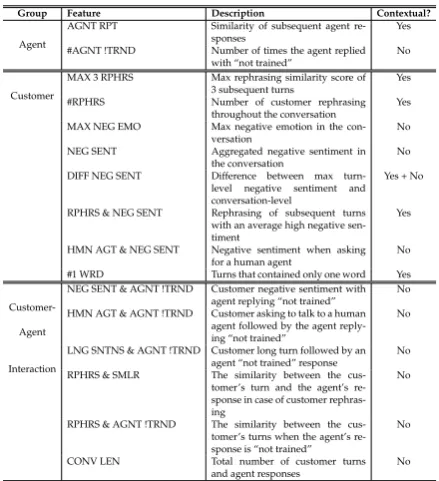
A virtual agent is generally expected to closely simulate interactions with a human operator (Reeves and Nass, 1996; Nass and Moon,Y,2000;Kr¨amer,2008). When the agent starts losing the context of a conversation, fails in understanding the customer intention, or keeps repeating the same responses, the il-lusion of conversing with a human is lost and the conversation may become extremely an-noying. With this in mind, we now describe the analysis of the agent’s responses and as-sociated features (summarized in the top part of Table1).
3.1.1 Repeating Response Analysis
As typically implemented, the virtual agent’s task is to reliably detect the intent of each customer’s utterance and respond meaning-fully. Accurate intent detection is thus a fun-damental characteristic of well-trained vir-tual agents, and incorrect intent analysis is reported as the leading cause of user dissat-isfaction (Sarikaya, 2017). Moreover, since a classifier (e.g., SVM, neural network, etc.) is often used to detect intents, its probabilistic behavior can cause the agent to repeat the same (or semantically similar) response over and over again, despite the user’s attempt to rephrase the same intent.
Such agent repetitions lead to an unnat-ural interaction (Kl ¨uwer, 2011). To identify the agent’s repeating responses, we measured similarity between agent’s subsequent (not necessarily sequential) turns. We represented each sentence by averaging the pre-trained embeddings5 of each word in the sentence, calculating the cosine similarity between the representations. Turns with a high similarity value6are considered as repeating responses.
5https://code.google.com/archive/p/word2vec 6Empirically, similarity values≥0.8
3.1.2 Unsupported Intent Analysis
Given that the knowledge of a virtual agent is necessarily limited, we can expect that train-ing would not cover all customer intents. If the classifier technology provides an estimate of classification confidence, the agent can re-spond with some variant of “I’m not trained on that” when confidence is low. In some cases, customers will accept that not all re-quests are supported. In other cases, un-supported intents can lead to customer dis-satisfaction (Sarikaya, 2017), and cascade to an egregious conversation (as discussed be-low in Section3.3). We extracted the possible variants of the unsupported intent messages directly from the system, and later matched them with the agent responses from the logs.
3.2 Customer Inputs Features
From the customer’s point of view, an in-effective interaction with a virtual agent is clearly undesirable. An ineffective interaction requires the expenditure of relatively large effort from the customer with little return on the investment (Zeithaml et al.,1990; Mi-moun et al.,2012). These efforts can appear as behavioral cues in the customer’s inputs, and include emotions, repetitions, and more. We used the following customer analysis in our model. Customer features are summarized in the middle part of Table1.
3.2.1 Rephrasing Analysis
When a customer repeats or rephrases an ut-terance, it usually indicates a problem with the agent’s understanding of the customer’s intent. This can be caused by different reasons as described in (Sano et al., 2017). To measure the similarity between subse-quent customer turns to detect repetition or rephrasing, we used the same approach as de-scribed in Section 3.1.1. Turns with a high similarity value6are considered as rephrases.
3.2.2 Emotional Analysis
The customer’s emotional state during the conversation is known to correlate with the conversation’s quality (Oliver, 2014). In or-der to analyze the emotions that customers exhibit in each turn, we utilized the IBM Tone Analyzer service, available publicly online7.
This service was trained using customer care interactions, and infers emotions such as frus-tration,sadness,happiness. We focused on neg-ative emotions (denoted as NEG EMO) to identify turns with a negative emotional peak (i.e., single utterances that carried high neg-ative emotional state), as well as to estimate the aggregated negative emotion throughout the conversation (i.e., the averaged negative emotion intensity). In order to get a more robust representation of the customer’s neg-ative emotional state, we summed the score of the negative emotions (such asfrustration, sadness,anger, etc.) into a single negative sen-timent score (denoted as NEG SENT). Note that we used the positive emotions as a fil-ter for other customer features, such as the rephrasing analysis. Usually, high positive emotions capture different styles of “thank-ing the agent”, or indicate that the customer is somewhat satisfied (Rychalski and Hudson,
2017), thus, the conversation is less likely to become egregious.
3.2.3 Asking for a Human Agent
In examining the conversation logs, we no-ticed that it is not unusual to find a customer asking to be transferred to a human agent. Such a request might indicate that the virtual agent is not providing a satisfactory service. Moreover, even if there are human agents, they might not be available at all times, and thus, a rejection of such a request is some-times reasonable, but might still lead to cus-tomer frustration (Amsel,1992).
3.2.4 Unigram Input
In addition to the above analyses, we also de-tected customer turns that contain exactly one word. The assumption is that single word (unigram) sentences are probably short cus-tomer responses (e.g., no, yes, thanks, okay), which in most cases do not contribute to the egregiousness of the conversation. Hence, calculating the percentage of those turns out of the whole conversation gives us another measurable feature.
3.3 Customer-Agent Interaction Features
We also looked at features across conversa-tion utterance-response pairs in order to cap-ture a more complete piccap-ture of the
interac-Group Feature Description Contextual?
Agent
AGNT RPT Similarity of subsequent agent
re-sponses Yes
#AGNT !TRND Number of times the agent replied with “not trained”
No
Customer
MAX 3 RPHRS Max rephrasing similarity score of 3 subsequent turns
Yes
#RPHRS Number of customer rephrasing throughout the conversation Yes MAX NEG EMO Max negative emotion in the
con-versation No
NEG SENT Aggregated negative sentiment in
the conversation No
DIFF NEG SENT Difference between max turn-level negative sentiment and conversation-level
Yes + No
RPHRS & NEG SENT Rephrasing of subsequent turns with an average high negative sen-timent
Yes
HMN AGT & NEG SENT Negative sentiment when asking
for a human agent No
#1 WRD Turns that contained only one word Yes
Customer-NEG SENT & AGNT !TRND Customer negative sentiment with agent replying “not trained”
No
Agent
HMN AGT & AGNT !TRND Customer asking to talk to a human agent followed by the agent reply-ing “not trained”
No
Interaction
LNG SNTNS & AGNT !TRND Customer long turn followed by an agent “not trained” response No RPHRS & SMLR The similarity between the
cus-tomer’s turn and the agent’s re-sponse in case of customer rephras-ing
No
RPHRS & AGNT !TRND The similarity between the cus-tomer’s turns when the agent’s re-sponse is “not trained”
No
[image:5.595.307.527.60.301.2]CONV LEN Total number of customer turns and agent responses No
Table 1: Features sets description.
tion between the customer and the virtual agent. Here, we considered a pair to be customer utterance followed by an agent re-sponse. For example, a pair may contain a turn in which the customer expressed nega-tive emotions and received a response of “not trained” by the agent. In this case, we would leverage the two analyses: emotional and un-supported intent. Figure 1 gives an exam-ple of this in the customer’s penultimate turn. Such interactions may divert the conversation towards becoming egregious. These features are summarized in the last part of Table1.
3.3.1 Similarity Analysis
3.4 Conversation Egregiousness Prediction Classifier
We trained a binary SVM classifier with a lin-ear kernel. A feature vector for a sample in the training data is generated using the scores calculated for the described features, where each feature value is a number between [0,1]. After the model was trained, test conversa-tions are classified by the model, after being transformed to a feature vector in the same way a training sample is transformed. The SVM classification model (denotedEGR) out-puts a label “egregious” or “non-egregious” as a prediction for the conversation.
4 Experiments 4.1 Dataset
We extracted data from two commercial sys-tems that provide customer support via con-versational bots (hereafter denoted as com-pany Aandcompany B). Both agents are us-ing similar underlyus-ing conversation engines, each embedded in a larger system with its own unique business logic. Company A’s system deals with sales support during an online purchase, while company B’s system deals with technical support for purchased software products. Each system logs con-versations, and each conversation is a se-quence of tuples, where each tuple consists of
{conversation id, turn id, customer input, agent
response}. From each system, we randomly extracted 10000 conversations. We further removed conversations that contained fewer than 2 turns, as these are too short to be meaningful since the customer never replied or provided more details about the issue at hand. Figure2depicts the frequencies of con-versation lengths which follow a power-law relationship. The conversations from com-pany A’s system tend to be longer, with an average of 8.4 turns vs. an average of 4.4 turns forcompany B.
4.2 Experimental Setup
The first step in building a classification model is to obtain ground truth data. For this purpose, we randomly sampled conver-sations from our datasets. This sample in-cluded 1100 and 200 conversations for com-pany A and company B respectively. The
1 10 100 1000 10000
0 0 1 0
1 1
F
re
q
u
e
n
cy
Conversa on length
Company A
Company B
Figure 2: Frequency versus conversation length for company A and company B on a log-log scale.
sampled conversations were tagged using an in-house tagging system designed to increase the consistency of human judgements. Each conversation was tagged by four different ex-pert judges8. Given the full conversation, each judge tagged whether the conversation was egregious or not following this guide-line: “Conversations which are extraordinar-ily bad in some way, those conversations where you’d like to see a human jump in and savethe conversation”.
We generated true binary labels by consid-ering a conversation to be egregious if at least three of the four judges agreed. The inter-rater reliability between all judges, measured by Cohen’s Kappa, was 0.72 which indicates high level agreement. This process generated the egregious class sizes of 95 (8.6%) and 16 (8%) forcompany Aandcompany B, respec-tively. This verifies the unbalanced data ex-pectation as previously discussed.
We also implemented two baseline models, rule-based and text-based, as follows:
Rule-based. In this approach, we look for cases in which the virtual agent responded with a “not trained” reply, or occurrences of the customer requesting to talk to a human agent. As discussed earlier, these may be in-dicative of the customer’s dissatisfaction with the nature of the virtual agent’s responses.
[image:6.595.317.520.61.191.2]Egregious Non-Egregious
Model P R F P R F
Rule-based 0.28 0.54 0.37 0.95 0.87 0.91
Text-based 0.46 0.56 0.50 0.96 0.94 0.95
[image:7.595.85.283.62.117.2]EGR 0.47 0.79 0.59 0.98 0.92 0.95
Table 2: Cross-validation results for the base-lines andEGRmodels.
ing the conversation). This model was imple-mented using state-of-the-art textual features as in (Herzig et al., 2017). In (Herzig et al.,
2017) emotions are detected from text, which can be thought of as similar to our task of pre-dicting egregious conversations.
We evaluated these baseline methods against our classifier using 10-fold cross-validation overcompany A’s dataset (we did not use company B’s data for training due to the low number of tagged conversations). Since class distribution is unbalanced, we evaluated classification performance by us-ing precision (P), recall (R) and F1-score (F) for each class. TheEGRclassifier was imple-mented using an SVM with a linear kernel9.
4.3 Classification Results
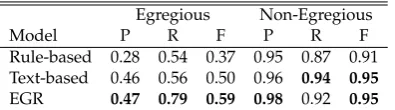
Table 2 depicts the classification results for both classes and the three models we ex-plored. The EGR model significantly out-performed both baselines10. Specifically, for the egregious class, the precision obtained by the text-based and EGR models were simi-lar. This indicates that the text analyzed by both models encodes some information about egregiousness. On the other hand, for the re-call and hence the F1-score, the EGR model relatively improved the text-based model by 41% and 18%, respectively. We will further analyze the models below.
4.4 Feature Set Contribution Analysis
To better understand the contributions of dif-ferent sets of features to ourEGRmodel, we examined various features in an incremental fashion. Based on the groups of feature sets that we defined in Section 3, we tested the performance of different group combinations, added in the following order: agent,customer andcustomer-agent interactions.
9http://scikit-learn.org/stable/modules/svm.html 10EGRwithp<0.001, usingMcNemar’s test.
0 0.1 0.2 0.3 0.4 0.5 0.6 0.7 0.8 0.9
P R F1
agent customer customer-agent interac!on
Figure 3: Precision (P), Recall (R), and F1-score (F) for various group combinations.
Figure 3 depicts the results for the clas-sification task. The x-axis represents spe-cific combinations of groups, and the y-axis represents the performance obtained. Figure
3 shows that adding each group improved performance, which indicates the informative value of each group. The figure also suggests that the most informative group in terms of prediction ability is thecustomergroup.
4.5 Cross-Domain Analysis
We also studied how robust our features were: If our features generalize well, perfor-mance should not drop much when testing company B with the classifier trained exclu-sively on the data fromcompany A. Although company A and company B share similar conversation engine platforms, they are com-pletely different in terms of objectives, do-main, terminology, etc. For this task, we uti-lized the 200 annotated conversations of com-pany B as test data, and experimented with the different models, trained oncompany A’s data. The rule-based baseline does not re-quire training, of course, and could be ap-plied directly.
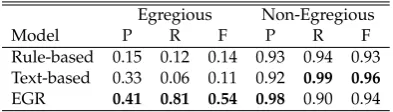
Table 3 summarizes the results showing that the performance of theEGRmodel is rel-atively stable (w.r.t the model’s performance when it was trained and tested on the same domain), with a degradation of only 9% in F1-score11. In addition, the results also show that the text-based model performs poorly when applied to a different domain (F1-score of 0.11). This may occur since textual features are closely tied to the training domain.
11EGRmodel results are statistically significant com-pared to the baselines models with p < 0.001, using
[image:7.595.307.515.64.167.2]Egregious Non-Egregious
Model P R F P R F
Rule-based 0.15 0.12 0.14 0.93 0.94 0.93
Text-based 0.33 0.06 0.11 0.92 0.99 0.96
[image:8.595.84.281.62.118.2]EGR 0.41 0.81 0.54 0.98 0.90 0.94
Table 3: Cross domain performance ( models trained oncompany A’s data, tested on com-pany B’s data).
4.6 Models Analysis
4.6.1 Customer Rephrasing Analysis
Inspired by (Sarikaya,2017;Sano et al.,2017) we analyzed the customer rephrasing mo-tivations for both the egregious and the non-egregious classes. First, we detected customer rephrasing as described in Sec-tion3.2.1, and then assigned to each its mo-tivation. Specifically, in our setting, the rel-evant motivations are12: (1) Natural language understanding (NLU) error - the agent’s in-tent detection is wrong, and thus the agent’s response is semantically far from the cus-tomer’s turn; (2)Language generation (LG) lim-itation- the intent is detected correctly, but the customer is not satisfied by the response (for example, the response was too generic); (3) Unsupported intent error - the customer’s in-tent is not supported by the agent.
In order to detect NLU errors, we mea-sured the similarity between the first cus-tomer turn (before the rephrasing) and the agent response. We followed the methodol-ogy presented in (Jovita et al.,2015) claiming that the best answer given by the system has the highest similarity value between the cus-tomer turn and the agent answer. Thus, if the similarity was < 0.8 we considered this as an erroneous detection. If the similarity was≥0.8 we considered the detection as cor-rect, and thus the rephrasing occurred due to LG limitation. To detectunsupported intent er-ror we used the approach described in Sec-tion 3.1.2. As reported in table 4, rephras-ing due to an unsupported intent is more common in egregious conversations (18% vs. 14%), whereas, rephrasing due to generation limitations (LG limitation) is more common in
12We did not consider other motivations like au-tomatic speech recognition (ASR) errors, fallback to search, and backend failure as they are not relevant to our setting.
Egregious Non-egregious NLU error 48% 48% LG limitation 33% 37% Unsupported intent error 18% 14%
Table 4: Percentage of different customer rephrasing reasons for egregious, and non-egregious conversations.
non-egregious conversations (37% vs. 33%). This indicates that customers are more tol-erant of cases where the system understood their intent, but the response is not exactly what they expected, rather than cases where the system’s response was “not trained”. Fi-nally, the percentage of rephrasing due to wrong intent detection (NLU errors) is similar for both classes, which is somewhat expected as similar underlying systems provided NLU support.
4.6.2 Recall Analysis
We further investigated why theEGRmodel was better at identifying egregious conversa-tions (i.e., its recall was higher compared to the baseline models). We manually examined 26 egregious conversations that were identi-fied justly so by the EGR model, but mis-classified by the other models. Those con-versations were particularly prevalent with the agent’s difficulty to identify correctly the user’s intent due to NLU errorsor LG limita-tion. We did not encounter any unsupported intent errors leading to customer rephrasing, which affected the ability of the rule-based model to classify those conversations as egre-gious. In addition, the customer intents that appeared in those conversations were very diverse. While customer rephrasing was cap-tured by the EGR model, for the text-based model some of the intents were new (did not appear in the training data) and thus were difficult for the model to capture.
5 Conclusions and Future Work
[image:8.595.314.519.63.106.2]cre-ated by exceptionally bad conversations. In this context, future work includes collecting more data and using neural approaches (e.g., RNN, CNN) for analysis, validating our mod-els on a range of domains beyond the two ex-plored here. We also plan to extend the work to detect egregious conversations in real time (e.g., for escalating to a human operators), and create log analysis tools to analyze the root causes of egregious conversations and suggest possible remedies.
References
Abram Amsel. 1992. Frustration Theory: An Analysis of Dispositional Learning and Memory. Problems in the Behavioural Sciences. Cambridge University Press.
https://doi.org/10.1017/CBO9780511665561. Chayan Chakrabarti and George F. Luger. 2013. A
framework for simulating and evaluating arti-ficial chatter bot conversations. InFLAIRS Con-ference.
Ulrich Gnewuch, Stefan Morana, and Alexander Maedche. 2017. Towards designing coopera-tive and social conversational agents for cus-tomer service. InProceedings of the International Conference on Information Systems (ICIS). Melita Hajdinjak and France Mihelic. 2006. The
paradise evaluation framework: Issues and findings. Comput. Linguist.32(2).
Helen Wright Hastie, Rashmi Prasad, and Mari-lyn A. Walker. 2002. What’s the problem: Auto-matically identifying problematic dialogues in DARPA communicator dialogue systems. In Proceedings of the 40th Annual Meeting of the As-sociation for Computational Linguistics, July 6-12, 2002, Philadelphia, PA, USA.. pages 384–391. Jonathan Herzig, Michal Shmueli-Scheuer, and
David Konopnicki. 2017. Emotion detec-tion from text via ensemble classificadetec-tion
us-ing word embeddus-ings. In Proceedings of
the ACM SIGIR International Conference on Theory of Information Retrieval. ACM, New York, NY, USA, ICTIR ’17, pages 269–272.
https://doi.org/10.1145/3121050.3121093. Julia Hirschberg and Christopher D. Manning.
2015. Advances in natural language process-ing. Science349(6245):261–266.
Jiepu Jiang, Ahmed Hassan Awadallah, Rosie Jones, Umut Ozertem, Imed Zitouni, Ran-jitha Gurunath Kulkarni, and Omar Zia Khan. 2015. Automatic online evaluation of intelli-gent assistants. In Proceedings of the 24th Inter-national Conference on World Wide Web, WWW
2015, Florence, Italy, May 18-22, 2015. pages 506– 516.
Jovita, Linda, Andrei Hartawan, and Derwin Suhartono. 2015. Using vector space model in question answering system. Procedia Computer Science59:305 – 311. International Conference on Computer Science and Computational Intel-ligence (ICCSCI 2015).
Julia Kiseleva, Kyle Williams, Ahmed Has-san Awadallah, Aidan C. Crook, Imed Zitouni, and Tasos Anastasakos. 2016a. Predicting user satisfaction with intelligent assistants. In Pro-ceedings of the 39th International ACM SIGIR Con-ference on Research and Development in Informa-tion Retrieval. SIGIR ’16, pages 45–54.
Julia Kiseleva, Kyle Williams, Jiepu Jiang, Ahmed Hassan Awadallah, Aidan C. Crook, Imed Zi-touni, and Tasos Anastasakos. 2016b. Under-standing user satisfaction with intelligent assis-tants. In Proceedings of the 2016 ACM on Con-ference on Human Information Interaction and Re-trieval. CHIIR ’16, pages 121–130.
Tina Kl ¨uwer. 2011. “I Like Your Shirt” - Dialogue Acts for Enabling Social Talk in Conversational Agents, pages 14–27.
Nicole C. Kr¨amer. 2008. Social effects of virtual assistants. a review of empirical results with re-gard to communication. In Proceedings of the 8th International Conference on Intelligent Virtual Agents. IVA ’08.
Chia-Wei Liu, Ryan Lowe, Iulian Serban, Michael Noseworthy, Laurent Charlin, and Joelle Pineau. 2016. How NOT to evaluate your dialogue system: An empirical study of un-supervised evaluation metrics for dialogue response generation. In Proceedings of the 2016 Conference on Empirical Methods in Natural Lan-guage Processing, EMNLP 2016, Austin, Texas, USA, November 1-4, 2016. pages 2122–2132. Mohammed Slim Ben Mimoun, Ingrid Poncin,
and Marion Garnier. 2012. Case study embod-ied virtual agents: An analysis on reasons for failure. Journal of Retailing and Consumer Ser-vices19(6):605 – 612.
C. Nass and Moon,Y. 2000. Machines and mind-lessness: Social responses to computers.Journal of Social Issues56:81–103.
Richard L Oliver. 2014. Satisfaction: A behavioral perspective on the consumer. Routledge.
Aude Rychalski and Sarah Hudson. 2017. Asym-metric effects of customer emotions on satisfac-tion and loyalty in a utilitarian service context. Journal of Business Research71:84 – 91.
Tommy Sandbank, Michal Shmueli-Scheuer, Jonathan Herzig, David Konopnicki, and Rottem Shaul. 2017. Ehctool: Manag-ing emotional hotspots for conversational agents. In Proceedings of the 22nd Inter-national Conference on Intelligent User In-terfaces Companion. ACM, New York, NY, USA, IUI ’17 Companion, pages 125–128.
https://doi.org/10.1145/3030024.3038260. Shumpei Sano, Nobuhiro Kaji, and Manabu
Sas-sano. 2017. Predicting causes of reformulation in intelligent assistants. In Proceedings of the 18th Annual SIGdial Meeting on Discourse and Di-alogue. pages 299–309.
R. Sarikaya. 2017. The technology behind per-sonal digital assistants: An overview of the sys-tem architecture and key components. IEEE Signal Processing Magazine34(1):67–81.
Cicekli I. Saygin A. P. 2002. Pragmatics in human-computer conversations. Journal of Pragmatics 34(3).
Moller Sebastian, Klaus-Peter Engelbrecht, Chris-tine Kuhnel, Ina Wechsung, and Benjamin Weiss. 2009. A taxonomy of quality of ser-vice and quality of experience of multimodal human-machine interaction. InQuality of Mul-timedia Experience, 2009. QoMEx 2009. Interna-tional Workshop on. IEEE.
Stefan Steidl, Christian Hacker, Christine Ruff, Anton Batliner, Elmar N¨oth, and J ¨urgen Haas. 2004. Looking at the Last Two Turns, I’d Say This
Dialogue Is Doomed – Measuring Dialogue Suc-cess, pages 629–636.
Marilyn A. Walker, Diane J. Litman, Candace A. Kamm, and Alicia Abella. 1997. Paradise: A framework for evaluating spoken dialogue agents. InProceedings of the 35th Annual Meet-ing of the Association for Computational LMeet-inguis- Linguis-tics and Eighth Conference of the European Chap-ter of the Association for Computational Linguis-tics. Association for Computational Linguistics, Stroudsburg, PA, USA, ACL ’98, pages 271–280.
https://doi.org/10.3115/976909.979652.
Marilyn A. Walker, Rebecca Passonneau, and Julie E. Boland. 2001. Quantitative and quali-tative evaluation of darpa communicator spo-ken dialogue systems. InProceedings of the 39th Annual Meeting on Association for Computational Linguistics. ACL ’01, pages 515–522.
Marilyn A. Walker, Jeremy H. Wright, and Irene Langkilde. 2000. Using natural language pro-cessing and discourse features to identify un-derstanding errors. InProceedings of the Seven-teenth International Conference on Machine Learn-ing (ICML 2000), Stanford University, Stanford, CA, USA, June 29 - July 2, 2000. pages 1111–1118. Nick Webb, David Benyon, Preben Hansen, and Oil Mival. 2010. Evaluating human-machine conversation for appropriateness. In Proceed-ings of the Seventh International Conference on Language Resources and Evaluation (LREC’10). Valarie Zeithaml, A Parsu Parasuraman, and