Integrating Probabilistic Extraction Models and Data Mining
to Discover Relations and Patterns in Text
Aron Culotta University of Massachusetts
Amherst, MA 01003
Andrew McCallum University of Massachusetts
Amherst, MA 01003
Jonathan Betz Google, Inc. New York, NY 10018
Abstract
In order for relation extraction systems to obtain human-level performance, they must be able to incorporate relational pat-terns inherent in the data (for example, that one’s sister is likely one’s mother’s daughter, or that children are likely to attend the same college as their par-ents). Hand-coding such knowledge can be time-consuming and inadequate. Addi-tionally, there may exist many interesting, unknown relational patterns that both im-prove extraction performance and provide insight into text. We describe a probabilis-tic extraction model that provides mutual benefits to both “top-down” relational pat-tern discovery and “bottom-up” relation extraction.
1 Introduction
Consider these four sentences:
1. George W. Bush’s father is George H. W. Bush.
2. George H. W. Bush’s sister is Nancy Bush Ellis.
3. Nancy Bush Ellis’s son is John Prescott Ellis.
4. John Prescott Ellis analyzed George W. Bush’s campaign.
We would like to build an automated system to extract the set of relations shown in Figure 1.
cousin
Nancy Ellis Bush sibling
George HW Bush
George W Bush son
John Prescott Ellis son
Figure 1: Bush family tree
State of the art extraction algorithms may be able to detect thesonandsiblingrelations from local lan-guage clues. However, the cousin relation is only
implied by the text and requires additional knowl-edge to be extracted. Specifically, the system re-quires knowledge of familial relation patterns.
One could imagine a system that accepts such rules as input (e.g. cousin = father’s sister’s son) and applies them to extract implicit relations. How-ever, exhaustively enumerating all possible rules can be tedious and incomplete. More importantly, many relational patterns unknown a priori may both im-prove extraction accuracy and uncover informative trends in the data (e.g. that children often adopt the religion of their parents). Indeed, the goal of data mining is to learn such patterns from database reg-ularities. Since these patterns will not always hold, we would like to handle them probabilistically.
We propose an integrated supervised machine learning method that learns both contextual and re-lational patterns to extract relations. In particular, we construct a linear-chain conditional random field (Lafferty et al., 2001; Sutton and McCallum, 2006) to extract relations from biographical texts while si-multaneously discovering interesting relational pat-terns that improve extraction performance.
2 Related Work
This work can be viewed as a step toward the in-tegration of information extraction and data mining technology, a direction of growing interest. Nahm and Mooney (2000) present a system that mines as-sociation rules from a database constructed from au-tomatically extracted data, then applies these learned rules to improve data field recall without revisiting the text. Our work attempts to more tightly inte-grate the extraction and mining tasks by learning relational patterns that can be included probabilis-tically into extraction to improve its accuracy; also, our work focuses on mining from relational graphs, rather than single-table databases.
McCallum and Jensen (2003) argue the theoreti-cal benefits of an integrated probabilistic model for extraction and mining, but do not construct such a system. Our work is a step in the direction of their proposal, using an inference procedure based on a closed-loop iteration between extraction and rela-tional pattern discovery.
Most other work in this area mines raw text, rather than a database automatically populated via extrac-tion (Hearst, 1999; Craven et al., 1998).
This work can also be viewed as part of a trend to perform joint inference across multiple language processing tasks (Miller et al., 2000; Roth and tau Yih, 2002; Sutton and McCallum, 2004).
Finally, using relational paths between entities is also examined in (Richards and Mooney, 1992) to escape local maxima in a first-order learning system.
3 Relation Extraction as Sequence
Labeling
Relation extractionis the task of discovering seman-tic connections between entities. In text, this usu-ally amounts to examining pairs of entities in a doc-ument and determining (from local language cues) whether a relation exists between them. Common approaches to this problem include pattern match-ing (Brin, 1998; Agichtein and Gravano, 2000), kernel methods (Zelenko et al., 2003; Culotta and Sorensen, 2004; Bunescu and Mooney, 2006), lo-gistic regression (Kambhatla, 2004), and augmented parsing (Miller et al., 2000).
The pairwise classification approach of kernel methods and logistic regression is commonly a
two-phase method: first the entities in a document are identified, then a relation type is predicted for each pair of entities. This approach presents at least two difficulties: (1) enumerating all pairs of enti-ties, even when restricted to pairs within a sentence, results in a low density of positive relation exam-ples; and (2) errors in the entity recognition phase can propagate to errors in the relation classification stage. As an example of the latter difficulty, if a per-son is mislabeled as a company, then the relation classifier will be unsuccessful in finding a brother
relation, despite local evidence.
We avoid these difficulties by restricting our in-vestigation tobiographical texts, e.g. encyclopedia articles. A biographical text mostly discusses one entity, which we refer to as theprincipal entity. We refer to other mentioned entities assecondary enti-ties. For each secondary entity, our goal is to predict what relation, if any, it has to the principal entity.
This formulation allows us to treat relation ex-traction as asequence labelingtask such as named-entity recognitionorpart-of-speech tagging, and we can now apply models that have been successful on those tasks. By anchoring one argument of relations to be the principal entity, we alleviate the difficulty of enumerating all pairs of entities in a document. By converting to a sequence labeling task, we fold the entity recognition step into the relation extrac-tion task. There is no initial pass to label each entity as a person or company. Instead, an entity’s label is its relation to the principal entity. Below is an exam-ple of a labeled article:
George W. Bush
George is the son of George H. W. Bush
| {z }
father
and Barbara Bush
| {z }
mother
.
3.1 Conditional Random Fields
We build a model to extract relations using linear-chain conditional random fields (CRFs) (Lafferty et al., 2001; Sutton and McCallum, 2006). CRFs are undirected graphical models (i.e. Markov net-works) that are discriminatively-trained to maximize the conditional probability of a set of output vari-ablesygiven a set of input variablesx. This
condi-tional distribution has the form
pΛ(y|x) = 1
Zx Y
c∈C
φc(yc,xc; Λ) (1)
whereφare potential functions parameterized byΛ and Zx = PyQc∈Cφ(yc,xc) is a normalization
factor. Assumingφc factorizes as a log-linear
com-bination of arbitrary features computed over clique c, then φc(yc,xc; Λ) = exp (Pkλkfk(yc,xc)),
wheref is a set of arbitraryfeature functions over the input, each of which has an associate model parameter λk. Parameters Λ = {λk} are a set
of real-valued weights typically estimated from la-beled training data by maximizing the data likeli-hood function using gradient ascent.
In these experiments, we make a first-order Markov assumption on the dependencies amongy,
resulting in a linear-chain CRF.
4 Relational Patterns
The modeling flexibility of CRFs permits the fea-ture functions to be complex, overlapping feafea-tures of the input without requiring additional assumptions on their inter-dependencies. In addition to common language features (e.g. neighboring words and syn-tactic information), in this work we explore features that cull relational patterns from a database of enti-ties.
As described in the introductory example (Figure 1), context alone is often insufficient to extract re-lations. Even in simpler examples, it may be the case that modeling relational patterns can improve extraction accuracy.
To capture this evidence, we compute features from a database to indicate relational connections between entities, similar to the relational path-findingperformed in Richards and Mooney (1992).
Imagine that the four sentence example about the Bush family is included in a training set, and the
en-cousin
father son
X Y
[image:3.612.316.525.58.130.2]sibling
Figure 2: A feature template for thecousinrelation.
tities are labeled with their correct relations. In this case, thecousinrelation in sentence 4 would also be labeled. From this data, we can create a relational database that contains the relations in Figure 1.
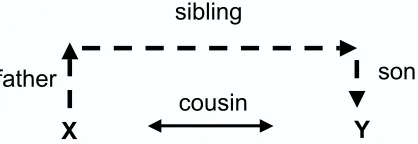
Assume sentence 4 comes from a biography about John Ellis. We calculate a feature for the entity George W. Bush that indicates the path from John Ellis to George W. Bush in the database, annotat-ing each edge in the path with its relation label; i.e.
father-sibling-son. By abstracting away the actual entity names, we have created acousintemplate fea-ture, as shown in Figure 2.
By adding these relational paths as features to the model, we can learn interesting relational pat-terns that may have low precision (e.g. “people are likely to be friends with their classmates”) without hampering extraction performance. This is in con-trast to the system described in Nahm and Mooney (2000), in which patterns are induced from a noisy database and then applied directly to extraction. In our system, since each learned path has an associ-ated weight, it is simply another piece of evidence to help the extractor. Low precision patterns may have lower weights than high precision patterns, but they will still influence the extractor.
A nice property of this approach is that examin-ing highly weighted patterns can provide insight into regularities of the data.
4.1 Feature Induction
During CRF training, weights are learned for each relational pattern. Patterns that increase extraction performance will receive higher weights, while pat-terns that have little effect on performance will re-ceive low weights.
by adding features that are estimated to increase the likelihood function most.
When feature induction is used with relational patterns, we can view this as a type of data mining, in which patterns are created based on their influ-ence on an extraction model. This is similar to work by Dehaspe (1997), whereinductive logic program-mingis embedded as a feature induction technique for a maximum entropy classifier. Our work restricts induced features to conjunctions of base features, rather than using first-order clauses. However, the patterns we learn are based on information extracted from natural language.
4.2 Iterative Database Construction
The top-down knowledge provided by data min-ing algorithms has the potential to improve the per-formance of information extraction systems. Con-versely, bottom-up knowledge generated by ex-traction systems can be used to populate a large database, from which more top-down knowledge can be discovered. By carefully communicating the uncertainty between these systems, we hope to iter-atively expand a knowledge base, while minimizing fallacious inferences.
In this work, the top-down knowledge consists of relational patterns describing the database path be-tween entities in text. The uncertainty of this knowl-edge is handled by associating a real-valued CRF weight with each pattern, which increases when the pattern is predictive of other relations. Thus, the ex-traction model can adapt to noise in these patterns.
Since we also desire to extract relations between entities that appear in text but not in the database, we first populate the database with relations extracted by a CRF that does not use relational patterns. We then do further extraction with a CRF that incorpo-rates the relational patterns found in this automati-cally generated database. In this manner, we create a closed-loop system that alternates between bottom-up extraction and top-down pattern discovery. This approach can be viewed as a type of alternating opti-mization, with analogies to formal methods such as expectation-maximization.
The uncertainty in the bottom-up extraction step is handled by estimating the confidence of each ex-traction and pruning the database to remove en-tries with low confidence. One of the benefits of
a probabilistic extraction model is that confidence estimates can be straight-forwardly obtained. Cu-lotta and McCallum (2004) describe theconstrained forward-backwardalgorithm to efficiently estimate the conditional probability that a segment of text is correctly extracted by a CRF.
Using this algorithm, we associate a confidence value with each relation extracted by the CRF. This confidence value is then used to limit the noise introduced by incorrect extractions. This differs from Nahm and Mooney (2000) and Mooney and Bunescu (2005), in which standard decision tree rule learners are applied to the unfiltered output of ex-traction.
4.3 Extracting Implicit Relations
Animplicit relationis one that does not have direct contextual evidence, for example thecousinrelation in our initial example. Implicit relations generally require some background knowledge to be detected, such as relational patterns (e.g. rules about familial relations). These are the sorts of relations on which current extraction models perform most poorly.
Notably, these are exactly the sorts of relations that are likely to have the biggest impact on informa-tion access. A system that can accurately discover knowledge that is only implied by the text will dra-matically increase the amount of information a user can uncover, effectively providing access to the im-plicationsof a corpus.
We argue that integrating top-down and bottom-up knowledge discovery algorithms discussed in Section 4.2 can enable this technology. By per-forming pattern discovery in conjunction with infor-mation extraction, we can collate facts from multi-ple sources to infer new relations. This is an ex-ample ofcross-document fusion orcross-document information extraction, a growing area of research transforming raw extractions into usable knowledge bases (Mann and Yarowsky, 2005; Masterson and Kushmerik, 2003).
5 Experiments
5.1 Data
We sampled 1127 paragraphs from 271 articles from the online encyclopedia Wikipedia1and labeled a
George W. Bush
Dick Cheney underling
Yale
education
Republican party President
jobTitle George H. W. Bush
son
underling Harken Energy
executive
education party
jobTitle Prescott Bush
son
education
Bill Clinton
rival
Bob Dole rival
education
Democrat party
jobTitle Hillary Clinton
husband
education
party
Halliburton executive education
Pres Medal of Freedom award
party
Nelson Rockefeller
award Elizabeth Dole
wife
WWII participant
award party
party
Martin Luther King, Jr.
[image:5.612.86.531.59.181.2]award
Figure 3: An example of the connectivity of the entities in the data.
birthday birth year death day death year nationality visited birth place death place religion job title member of cousin
friend discovered education employer associate opus participant influence award
brother wife supported idea executive of political party supported person
founder son father rival underling superior role inventor husband grandfather sister brother-in-law
nephew mother daughter granddaughter grandson great-grandson
[image:5.612.104.266.224.353.2]grandmother rival organization owner of uncle descendant ancestor great-grandfather aunt
Table 1: The set of labeled relations.
tal of 4701 relation instances. In addition to a large set of person-to-person relations, we also included links between people and organizations, as well as biographical facts such asbirthdayandjobTitle. In all, there are 53 labels in the training data (Table 1). We sample articles that result in a high density of interesting relations by choosing, for example, a collection of related family members and associates. Figure 3 shows a small example of the type of con-nections in the data. We then split the data into train-ing and testtrain-ing sets (70-30 split), attempttrain-ing to sep-arate the entities into connected components. For example, all Bush family members were placed in the training set, while all Kennedy family members were placed in the testing set. While there are still occasional paths connecting entities in the training set to those in the test set, we believe this method-ology reflects a typical real-world scenario in which we would like to extend an existing database to a different, but slightly related, domain.
The structure of the Wikipedia articles somewhat simplifies the extraction task, since important enti-ties are hyper-linked within the text. This provides
an automated way to detect entities in the text, al-though these entities are not classified by type. This also allows us to easily construct database queries, since we can reason at the entity level, rather than the token level. (Although, see Sarawagi and Cohen (2004) for extensions of CRFs that model the en-tity length distribution.) The results we report here are constrained to predict relations only for hyper-linked entities. Note that despite this property, we still desire to use a sequence model to capture the dependencies between adjacent labels.
We use the MALLET CRF implementation (Mc-Callum, 2002) with the default regularization pa-rameters.
Based on initial experiments, we restrict relational path features to length two or three. Paths of length one will learn trivial paths and can lead to over-fitting. Paths longer than three can increase compu-tational costs without adding much new information.
In addition to the relational pattern features de-scribed in Section 4, the list of local features in-cludes context words (such as the token identity within a 6 word window of the target token), lexi-cons (such as whether a token appears in a list of cities, people, or companies), regular expressions
(such as whether the token is capitalized or contains digits or punctuation),part-of-speech(predicted by a CRF that was trained separately for part of speech tagging),prefix/suffix(such as whether a word ends in-edor begins with ch-), and offset conjunctions
ME CRF0 CRFr CRFr0.9 CRFr0.5 CRFt CRFt0.5
F1 .5489 .5995 .6100 .6008 .6136 .6791 .6363
P .6475 .7019 .6799 .7177 .7095 .7553 .7343
[image:6.612.137.473.57.115.2]R .4763 .5232 .5531 .5166 .5406 .6169 .5614
Table 2: Results comparing the relative benefits of using relational patterns in extraction.
5.2 Extraction Results
We evaluate performance by calculating the preci-sion (P) and recall (R) of extracted relations, as well as theF1 measure, which is the harmonic mean of precision and recall.
CRF0 is the conditional random field constructed
without relational features. Results for CRF0 are
displayed in the second column of Table 2. MEis a maximum entropy classifier trained on the same feature set asCRF0. The difference between these
two models is thatCRF0models the dependence of
relations that appear consecutively in the text. The superior performance ofCRF0suggests that this
de-pendence is important to capture.
The remaining models incorporate the relational patterns described in Section 4. We compare three different confidence thresholds for the construction of the initial testing database, as described in Sec-tion 4.2. CRFr uses no threshold, while CRFr0.9
andCRFr0.5restrict the database to extractions with
confidence greater than0.9and0.5, respectively. As shown by comparing CRF0 andCRFr in
Ta-ble 2, the relational features constructed from the database with no confidence threshold provides a considerable boost in recall (reducing error by 7%), at the cost of a decrease in precision. Here we see the effect of making fallacious inferences on a noisy database.
In column four, we see the opposite effect for the overly conservative threshold ofCRFr0.9. Here,
precision improves slightly overCRF0, and
consid-erably overCRFr (12% error reduction), but this is
accompanied by a drop in recall (8% reduction). Finally, in column five, a confidence of0.5results in the best F1 measure (a 3.5% error reduction over
CRF0).CRFr0.5also obtains better recall and
preci-sion thanCRF0, reducing recall error by 3.6%,
pre-cision error by 2.5%.
Comparing the performance on different relation types, we find that the biggest increase fromCRF0
toCRFr0.5is on thememberOfrelation, for which
the F1 score improves from0.4211to0.6093. We conjecture that the reason for this is that the patterns most useful for thememberOflabel contain relations that are well-detected by the first-pass CRF. Also, the local language context seems inadequate to prop-erly extract this relation, given the low performance ofCRF0.
To better gauge how much relational pattern fea-tures are affected by errors in the database, we run two additional experiments for which the relational features are fixed to be correct. That is, imagine that we construct a database from the true labeling of the testing data, and create the relational pattern features from this database. Note that this does not trivialize the problem, since there are no relational path fea-tures of length one (e.g., if X is the wife of Y, there will be no feature indicating this).
We construct two experiments under this scheme, one where the entire test database is used (CRFt),
and another where only half the relations are in-cluded in the test database, selected uniformly at random (CRFt0.5).
Column six shows the improvements enabled by using the complete testing database. More inter-estingly, column seven shows that even with only half the database accurately known, performance improves considerably over bothCRFandCRFr0.5.
A realistic scenario forCRFt0.5is a semi-automated
system, in which a partially-filled database is used to bootstrap extraction.
5.3 Mining Results
Relation Relational Path Feature
mother father→wife
cousin mother→husband→nephew friend education→student education father→education
boss boss→son
[image:7.612.71.292.57.169.2]memberOf grandfather→memberOf rival politicalParty→member→rival
Table 3: Examples of highly weighted relational pat-terns.
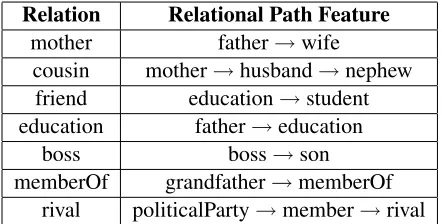
From the familial relations in our training data, we are able to discover many equivalences for mothers, cousins, grandfathers, and husbands. In addition to these high precision patterns, the system also gener-ates interesting, low precision patterns. Row 3-7 of Table 3 can be summarized by the following gener-alizations: friends tend to be classmates; children of alumni often attend the same school as their parents; a boss’ child often becomes the boss; grandchildren are often members of the same organizations as their grandparents; and rivals of a person from one polit-ical party are often rivals of other members of the same political party. While many of these patterns reflect the high concentration of political entities and familial relations in our training database, many will have applicability across domains.
5.4 Implicit Relations
It is difficult to measure system performance on im-plicit relations, since our labeled data does not dis-tinguish between explicit and implicit relations. Ad-ditionally, accurately labeling all implicit relations is challenging even for a human annotator.
We perform a simple exploratory analysis to de-termine how relational patterns can help discover implicit relations. We construct a small set of syn-thetic sentences for which CRF0 successfully
ex-tracts relations using contextual features. We then add sentences with slightly more ambiguous lan-guage and measure whether CRFrcan overcome this
ambiguity using relational pattern features.
For example, we create an article about an en-tity named “Bob Smith” that includes the sentences “His brother, Bill Smith, was a biologist” and “His
companion, Bill Smith, was a biologist.” CRF0
suc-cessfully returns the brother relation in the first
sen-tence, but not the second. After a fact is added to the database that says Bob and Bill have a brother in common named John, CRFris able to correctly label
the second sentence in spite of the ambiguous word “companion,” because CRF0 has a highly-weighted
relational pattern feature for brother.
Similar behavior is observed for low precision patterns like “associates tend to win the same awards.” A synthetic article for the entity “Tom Jones” contains the sentences “He was awarded the Pulitzer Prize in 1998” and “Tom got the Pulitzer Prize in 1998.” Because CRF0 is highly-reliant on
the presence of the verb “awarded” or “won” to indi-cate a prize fact, it fails to label the second sentence correctly. After the database is augmented to include the fact that Tom’s associate Jill received the Pulitzer Prize, CRFrlabels the second sentence correctly.
However, we also observed that CRFr still
quires some contextual clues to extract implicit re-lations. For example, if the Tom Jones article in-stead contains the sentence “The Pulitzer Prize was awarded to him in 1998,” neither CRF labels the prize fact correctly, since this passive construction is rarely seen in the training data.
We conclude from this brief analysis that rela-tional patterns used by CRFr can help extract
im-plicit relations when (1) the database contains ac-curate relational information, and (2) the sentence contains limited contextual clues. Since relational patterns are treated only as additional features by CRFr, they are generally not powerful enough to
overcome a complete absence of contextual clues. From this perspective, relational patterns can be seen as enhancing the signal from contextual clues. This differs from deterministically applying learned rules independent of context, which may boost recall at the cost of precision.
6 Conclusions and Future Work
We have shown that integrating pattern discovery with relation extraction can lead to improved per-formance on each task.
relations in an article. Inference in these highly-connected models will likely require approximate methods. Additionally, we wish to focus on extract-ing implicit relations, dealextract-ing more formally with the precision-recall trade-off inherent in applying noisy rules to improve extraction.
7 Acknowledgments
Thanks to the Google internship program, and to Charles Sutton for providing the CRF POS tagger. This work was supported in part by the Center for Intelligent Information Retrieval, in part by U.S. Government contract #NBCH040171 through a sub-contract with BBNT Solutions LLC, in part by The Central In-telligence Agency, the National Security Agency and National Science Foundation under NSF grant #IIS-0326249, and in part by the Defense Advanced Research Projects Agency (DARPA), through the Department of the Interior, NBC, Acquisition Ser-vices Division, under contract number NBCHD030010. Any opinions, findings and conclusions or recommendations ex-pressed in this material are the author(s) and do not necessarily reflect those of the sponsor.
References
Eugene Agichtein and Luis Gravano. 2000. Snowball: Extract-ing relations from large plain-text collections. In Proceed-ings of the Fifth ACM International Conference on Digital Libraries.
Sergey Brin. 1998. Extracting patterns and relations from the world wide web. InWebDB Workshop at 6th International Conference on Extending Database Technology.
Razvan Bunescu and Raymond Mooney. 2006. Subsequence kernels for relation extraction. In Y. Weiss, B. Sch¨olkopf, and J. Platt, editors, Advances in Neural Information Pro-cessing Systems 18. MIT Press, Cambridge, MA.
Mark Craven, Dan DiPasquo, Dayne Freitag, Andrew K. Mc-Callum, Tom M. Mitchell, Kamal Nigam, and Se´an Slattery. 1998. Learning to extract symbolic knowledge from the World Wide Web. InProceedings of AAAI-98, 15th Confer-ence of the American Association for Artificial IntelligConfer-ence, pages 509–516, Madison, US. AAAI Press, Menlo Park, US.
Aron Culotta and Andrew McCallum. 2004. Confidence es-timation for information extraction. In Human Langauge Technology Conference (HLT 2004), Boston, MA.
Aron Culotta and Jeffrey Sorensen. 2004. Dependency tree kernels for relation extraction. InACL.
L. Dehaspe. 1997. Maximum entropy modeling with clausal constraints. In Proceedings of the Seventh International Workshop on Inductive Logic Programming, pages 109–125, Prague, Czech Republic.
M. Hearst. 1999. Untangling text data mining. In37th Annual Meeting of the Association for Computational Linguistics.
Nanda Kambhatla. 2004. Combining lexical, syntactic, and se-mantic features with maximum entropy models for extract-ing relations. InACL.
John Lafferty, Andrew McCallum, and Fernando Pereira. 2001. Conditional random fields: Probabilistic models for seg-menting and labeling sequence data. InProc. 18th Interna-tional Conf. on Machine Learning, pages 282–289. Morgan Kaufmann, San Francisco, CA.
Gideon Mann and David Yarowsky. 2005. Multi-field informa-tion extracinforma-tion and cross-document fusion. InACL.
D. Masterson and N. Kushmerik. 2003. Information extraction from multi-document threads. InECML-2003: Workshop on Adaptive Text Extraction and Mining, pages 34–41.
Andrew McCallum and David Jensen. 2003. A note on the unification of information extraction and data mining us-ing conditional-probability, relational models. InIJCAI03 Workshop on Learning Statistical Models from Relational Data.
Andrew McCallum. 2002. Mallet: A machine learning for language toolkit. http://mallet.cs.umass.edu.
Andrew McCallum. 2003. Efficiently inducing features of con-ditional random fields. InNineteenth Conference on Uncer-tainty in Artificial Intelligence (UAI03).
Scott Miller, Heidi Fox, Lance A. Ramshaw, and Ralph Weischedel. 2000. A novel use of statistical parsing to ex-tract information from text. InANLP.
Raymond J. Mooney and Razvan Bunescu. 2005. Mining knowledge from text using information extraction.SigKDD Explorations on Text Mining and Natural Language Process-ing.
Un Yong Nahm and Raymond J. Mooney. 2000. A mutually beneficial integration of data mining and information extrac-tion. InAAAI/IAAI.
Bradley L. Richards and Raymond J. Mooney. 1992. Learning relations by pathfinding. InProceedings of the Tenth Na-tional Conference on Artificial Intelligence (AAAI-92), pages 50–55, San Jose, CA.
Dan Roth and Wen tau Yih. 2002. Probabilistic reasoning for entity and relation recognition. InCOLING.
Sunita Sarawagi and William W. Cohen. 2004. Semi-markov conditional random fields for information extraction. In
NIPS 04.
Charles Sutton and Andrew McCallum. 2004. Dynamic condi-tional random fields: Factorized probabilistic models for la-beling and segmenting sequence data. InProceedings of the Twenty-First International Conference on Machine Learning (ICML).
Charles Sutton and Andrew McCallum. 2006. An introduction to conditional random fields for relational learning. In Lise Getoor and Ben Taskar, editors, Introduction to Statistical Relational Learning. MIT Press. To appear.