16
SemEval-2019 Task 2: Unsupervised Lexical Frame Induction
Behrang QasemiZadeh SFB991, Germany [email protected]
Miriam R. L. Petruck ICSI, US
Regina Stodden HHUD, Germany [email protected] Laura Kallmeyer
HHUD, SFB991, Germany [email protected]
Marie Candito
Paris Diderot University - CNRS, France [email protected]
Abstract
This paper presents Unsupervised Lexical Frame Induction, Task 2 of the International Workshop on Semantic Evaluation in 2019. Given a set of prespecified syntactic forms in context, the task requires that verbs and their arguments be clustered to resemble semantic frame structures. Results are useful in iden-tifying polysemous words, i.e., those whose frame structures are not easily distinguished, as well as discerning semantic relations of the arguments. Evaluation of unsupervised frame induction methods fell into two tracks: Task A) Verb Clustering based on FrameNet 1.7; and B)Argument Clustering, with B.1) based on FrameNet’s core frame elements, and B.2) on VerbNet 3.2 semantic roles. The shared task attracted nine teams, of whom three re-ported promising results. This paper describes the task and its data, reports on methods and resources that these systems used, and offers a comparison to human annotation.
1 Introduction
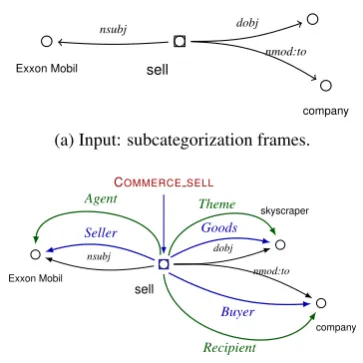
SemEval 2019 Task 2 focused on the unsupervised semantic labeling of a set of prespecified
(seman-tically) unlabeled structures (Figure1).
Unsuper-vised learning methods analyze these structures
(Figure1a) to augment them with semantic labels
(Figure1b). The shape of the manually labeled
in-put frames is constrained to anacyclicconnected
tree of lexical items (words and multi-word units) of maximum depth 1, where just one root gov-erns several arguments. The task used Berkeley
FrameNet (FN) (Ruppenhofer et al.,2016) andQ.
Zadeh and Petruck(2019), guidelines for this task, to determine the arguments and label them with semantic information.
We compared the proposed system results for unsupervised semantic tagging with that of human annotated (or, gold-standard) data in three
differ-ent subtasks (Figure2). To evaluate the systems,
we computed distributional similarities between
Exxon Mobil sell
skyscraper
company
nsubj dobj
nmod:to
(a) Input: subcategorization frames.
Exxon Mobil
sell
COMMERCE SELL
skyscraper
company nsubj
Seller
Agent
dobj Goods
Theme
nmod:to
Buyer
Recipient
[image:1.595.325.507.213.395.2](b) Output: Semantic Frame Tagging using labels learned by Unsupervised methods.
Figure 1: Given semantically unlabeled structures (1a), annotate the input with semantic information learned via unsupervised methods (1b).
their generated unsupervised labeled data and hu-man annotated reference data. For computing sim-ilarities we used general purpose numeral methods
of text clustering, in particular BCUBEDF-SCORE
(Bagga and Baldwin,1998) as the single figure of
merit to rank the systems.
The most important result of the shared task is the creation of a benchmark for a future complex task. This benchmark includes a moderately sized, manually annotated set of frames, where only the
verbs of each were included, along with theircore
frame elements (which uniquely define a frame asRuppenhofer et al. describe). To complement FN’s core frame elements that have highly specific meanings, the benchmark also includes the anno-tated argument structures of the verbs based on the generic semantic roles proposed for verb classes
in VerbNet 3.2 (Kipper et al.,2000;Palmer et al.,
sys-tem with browsing and editing capabilities.1 Com-plementing the benchmarking are several state-of-the-art competing baselines, from the participants, that serve as a point of departure for improvements
in the future.2
The rest of this paper is organized as follows:
Section2contextualizes this task; Section3offers
a detailed task-description; Section 4 describes
the data; Section5introduces the evaluation
met-rics and baselines; Section6characterizes the
par-ticipating systems and unsupervised methods that
participants used; Section 7 provides evaluation
scores and additional insight about the data; and
Section8presents concluding remarks.
2 Background
Frame Semantics (Fillmore, 1976) and other
the-ories (Gamerschlag et al.,2014) that adopt typed
feature structures for representing knowledge and linguistic structures have developed in parallel over several decades in theoretical linguistic stud-ies about the syntax–semantics interface, as well as in empirical corpus-driven applications in natu-ral language processing. Building repositories of (lexical) semantic frames is a core component in all of these efforts. In formal studies, lexical se-mantic frame knowledge bases instantiate foun-dational theories with tangible examples, e.g., to provide supporting evidence for the theory. Prac-tically, frame semantic repositories play a pivotal role in natural language understanding and seman-tic parsing, both as inspiration for a representation format and for training data-driven machine learn-ing systems, which is required for tasks such as information extraction, question-answering, text summarization, among others.
However, manually developing frame semantic databases and annotating corpus-derived illustra-tive examples to support analyses of frames are resource-intensive tasks. The most well-known frame semantic (lexical) resource is FrameNet
(Ruppenhofer et al., 2016), which only covers a
(relatively) small set of the vocabulary of con-temporary English. While NLP research has inte-grated FrameNet data into semantic parsing, e.g., Swayamdipta et al. (2018), these methods can-not extend beyond previously seen training labels,
tagging out-of-domain semantics as unknown at
1
http://sfa.phil.hhu.de/.
2See https://competitions.codalab.org/ competitions/19159for accessing the task’s language resources, tools, and further technical details.
best. This limitation does not hinder unsupervised methods, which will port and extend the coverage of semantic parsers, a common challenge in
se-mantic parsing (Hartmann et al.,2017).
Unsupervised frame induction methods can serve as an assistive semantic analytic tool, to build language resources and facilitate linguis-tic studies. Since the focus is usually to build language resources, most systems (Pennacchiotti et al.(2008);Green et al.(2004)) have used a
lexi-cal semantic resource like WordNet (Miller,1995)
to extend coverage of a resource like FrameNet.
Some methods, e.g., Modi et al. (2012) and
Kallmeyer et al.(2018), tried to extract FrameNet-like resources automatically without additional
se-mantic information. Others (Ustalov et al.(2018);
Materna(2012)) addressed frame induction only for verbs with two arguments.
Lastly, unsupervised frame induction methods can also facilitate linguistic investigations by cap-turing information about the reciprocal relation-ships between statistical features and linguistic or
extra-linguistic observations (e.g.,Reisinger et al.
(2015)). This task aimed to benchmark a class of such unsupervised frame induction methods.
3 Task Description
Exxon Mobil
sell
COMMERCE SELL
skyscraper
company
nsubj dobj
nmod:to
(a) Task A- Identifying Semantic Frames: Unsupervised
learned labels evaluated against FN’s lexical units
Exxon Mobil
sell
COMMERCE SELL skyscraper
company nsubj
Seller
dobj Goods
nmod:to
Buyer
(b)Task B.1- Full Frame Semantic Tagging: Unsupervised labels evaluated against FN’s frames
Exxon Mobil
sell
skyscraper
company nsubj
Agent
dobj
Theme
nmod:to
Recipient
[image:2.595.332.498.460.518.2](c)Task B.2– Case Role Labeling: Unsupervised labels eval-uated against generic semantic roles (VerbNet)
The ambitious goal of this task was the unsuper-vised induction of frame semantic structures from tokenized and morphosyntacally labeled text cor-pora. We sought to achieve this goal by building
an evaluation benchmark for three tasks. Task A
dealt with unsupervised labeling of verb lemmas
with their frame meaning. Task Binvolved
unsu-pervised argument role labeling, whereB.1
bench-marked unsupervised labeling of frame-specific
frame elements (FEs) based on FN, and B.2
benchmarked unsupervised role labeling of
argu-ments in Case Grammar terms (Fillmore, 1968)
and against a set of generic semantic roles, taken primarily from VerbNet.
The task was unsupervised in that it forbade the use of any explicit semantic annotation (only per-mitting morphosyntactic annotation). Instead, we encouraged the use of unsupervised representation learning methods (e.g., word embeddings, brown clusters) to obtain semantic information. Hence, systems learn and assign semantic labels to test records without appealing to any explicit training labels. For development purposes, developers re-ceived a small labeled development set.
3.1 Task A: Clustering Verbs
The goal of this task was to identify verbs that evoke the same frame. The task involved labeling verb uses in context to resemble their
categoriza-tion based on Frame Semantics (Figure2a). Here,
we used FN 1.7 as the reference for frame defini-tions. Hence, the task constituted the unsupervised induction of FN’s lexical units, where a lexical unit (LU) is a pairing of a lemma and a frame. For
example, we expected that the LUsauction.v,
re-tail.v,sell.v, etc., which evoke the typed situation
ofCOMMERCE SELL, be labeled with the same
un-supervised tag.3
The task resembles word sense induction in that it assigns a class (or sense) label to a verb. In word sense induction (WSI), labels are determined and evaluated on word forms (lemma +
part-of-speech e.g.,sell.vorauction.n). WSI evaluations
assume that the inventory of senses (set Sis) for
different word formsf is devised independently.
For instance, assumingf1 is labeled with the set
of senses S1 andf2 withS2, then S1 ∩S2 6= φ
only iff1 = f2; and, iff1 =6 f2 thenS1∩S2 =
φ (as in other SemEval benchmarks, including
Agirre and Soroa(2007);Manandhar et al.(2010);
3Dark red small caps indicate FN frames.
Jurgens and Klapaftis (2013); Navigli and Van-nella (2013)). For instance, in WSI evaluations
based on OntoNotes (Hovy et al., 2006), six
dif-ferent labels fromSsell are assigned to the lemma
sell.v, and one labels0 is assigned to auction.v,
knowing that s0 ∈/ Ssell. Typically, lexical
se-mantic relationships among members ofSis (e.g.,
synonymy, antonymy) are then analyzed
indepen-dently of WSI (e.g., Lenci and Benotto (2012);
Girju et al.(2007);McCarthy and Navigli(2007)). In contrast, this task assumes that the sense inven-tory is defined independent of word forms.
This task involves uncovering mapping between
word formsf and members ofSsuch that
differ-ent word forms (i.e., fi 6= fj) can be mapped to
the same meaning (label), and the same meaning (label) can be mapped to several word forms. We
definedS with respect to FrameNet and assumed
that its typed-situation frames are units of
mean-ing. So, COMMERCE SELL captures the meaning
associated with bothsell.v andauction.v., as well
as other selling-related words. Hence, in some sense, Task A goes beyond the ordinary WSI task as it also demands identifying (unspecified) lexical semantic relationships between verbs.
3.2 Task B.1: Unsupervised Frame Semantic Argument Labeling
Taking the frames as primary and defining roles relative to each frame, the aim of Task B.1 was to cluster prespecified verb-headed argument struc-tures according to the principles of Frame Se-mantics, where FrameNet served as the reference for evaluation. This task amounted to
unsuper-vised labeling of frames and core FEs (Figure2b).
Because FrameNet defines FEs frame-specifically, Task B.1 entails Task A.
Given a set of semantically-unlabelled
argu-ments as input (e.g., Figure 1a), the root nodes
(i.e., verbs) are clustered and assigned to a set of
unsupervised frame labelsπi (1 ≤ i ≤ n, where
nis the number of latent frames). Then, the
argu-ments are labeled with semantic role labels (FEs) interpreted locally given the frame. That is, for
any pair ofπxandπy, the set of assigned rolesRx
to arguments underπxare assumed to be
indepen-dent fromRylabels forπy(Rx∩Ry =φ).
3.3 Task B.2: Unsupervised Case Role Labeling
ar-guments of a verb in a set of prespecified subcat-egorization frames were clustered according to a
common set of generic semantic roles (Figure2c).
Here, the task assumed that semantic roles are uni-versal and generic (e.g., Agent, Patient). Their configuration determines the argument structure of verb-headed phrases. We evaluated this unsuper-vised labeling of arguments with semantic roles independently of the class, sense, and word form of a verb. We compared the role labels against a set of semantic roles from VerbNet 3.2 (Kipper et al., 2000). Given a verb instance, no guarantee ex-ists that input argument structures for B.2 and B.1 would be the same.
4 Evaluation Dataset
The dataset consists of manual annotations for verb-headed frame structures anchored in
tok-enized sentences. These frame structures were
manually annotated using the guidelines for this
task (Q. Zadeh and Petruck,2019). For example,
as already illustrated, the verbcome from.v is
an-notated in terms of FN’sORIGINframe and itscore
FEs, as Example1shows.
(1) Criticism of futures COMES FROM Wall Street.
Criticism come from Wall Street
ORIGIN ENTITY ORIGIN
Also, using the set of 32 generic semantic role
la-bels in VerbNet 3.2 and two additional roles,COG
-NIZERandCONTENT, we annotated arguments of the verb as the following graphic shows.
Criticism come from Wall Street THEME SOURCE
We assumed unique identifiers for sentences,
e.g.,#s1for Example1. The evaluation record for
come from.v (Task A) appears below, where#s1
4 5 specifies the position of the verb in the
sen-tence (Example 1).
A [#s1 4 5 come from.ORIGIN]
Similarly, for Task B.1 and Task B.2, respectively, the evaluation records are as follows here.
B.1 [#s1 4 5 come from.ORIGIN
Criticism-:-1-:-ENTITYWall Street-:-6 7-:-ORIGIN]
B.2 [#s1 4 5 come from.NA Criticism-:-1-:-THEMEWall Street-:-6 7-:-SOURCE]
We stripped off the manually asserted labels from the records and passed them to systems for assign-ing unsupervised labels. Evidently, later a scorer
program (Section 5) compared system-generated
labels with the manually assigned labels.
4.1 Data Sampling
We sampled data from the Wall Street Journal
(WSJ) corpus of the Penn Treebank. Kallmeyer
et al. (2018) provided frame annotations similar to those in this task for a portion of WSJ
sen-tences, using SemLink (Bonial et al., 2013) and
EngVallex (Cinkov´a et al.,2014) to generate frame
semantic annotations semi-automatically. That
work was based on FrameNet and the Prague
Dependency Treebank (PSD) (Hajiˇc et al.,2012)
from the Broad-coverage Semantic Dependency
resource (Oepen et al.,2016). We started by
anno-tating a portion of the records inKallmeyer et al.
(2018), and later deviated from this subset to cre-ate a more representative sample of the overall di-versity and distribution of verbs in the WSJ corpus using a stratified random sampling method.
4.2 Guidelines
The annotation guidelines for this task were slightly different from those of FrameNet and var-ious semantic dependency treebanks. In contrast to FN, which annotates a full span of text as an ar-gument filler, or PropBank, which annotates syn-tactic constituents of arguments of verbs (Palmer et al., 2005), we identified the text spans and only annotated a single word or a multi-word unit (MWU), i.e., the semantic head of the span, like
annotations in Oepen et al. (2016) and Abstract
Meaning Representation (Banarescu et al.,2013).
To illustrate, in Example 1, FN would annotate
Criticism of futures as filling the FE ENTITY.
We only annotatedCriticism, understanding it as
the LU that evokesJUDGMENT COMMUNICATION,
which in turn represents the meaning of the whole
text span. Thus, we assumed that another framefa
fills an argument of a frame. We annotated only
the main content word(s) that evoke(s) fa; these
main words are thesemantic heads.4
Multi-word unit semantic heads (e.g., named entities, word form combinations) are annotated as
if a single word form, such asWall Street(#1),
ex-cluding modifiers. In contrast to semantic
dency structures (e.g., DELPH-IN MRS-Derived Semantic Dependencies, Enju PredicateArgument Structures, and Tectogramatical Representation in
PSD (Oepen et al.,2016)), we did not commit to
the underlying syntactic structure of the sentence since we were not obliged to relabel only syntac-tic structures. Rather, we annotated words and
MWUs if the frame analysis permitted doing so.5
4.3 Annotation Procedure
We annotated the data in a modular manner and in a semi-controlled environment using an annota-tion system developed for this purpose. The proce-dure consisted of four steps: 1) Reading and Com-prehension; 2) Choosing a Frame; 3) Annotating Arguments; and 4) Rating, Commenting, or Re-vising. We tracked and logged all changes in the data as well as annotator interaction with the anno-tation system upon starting to annotate. The tool measured the time that annotators spent on each record and each annotation step, as well as how annotators moved between steps.
In Step 1, annotators viewed a sentence with
one highlighted verb, as in Example2.
(2) Criticism of futuresCOMESfrom Wall Street.
The goal of this step was understanding the meaning of the verb and its semantic function, and identifying semantic heads of arguments and their associated words or MWUs. To continue, an anno-tator must confirm the understanding of the verb’s meaning of the verb, and can identify its seman-tic arguments. Without confirmation, an annotator would terminate the annotation process for that in-put sentence and go to the next one.
If confirmed, Step 2 required the annotator to
choose the frame that the verb evoked. This
step may have included annotating multi-word
phrasal verbs, e.g., COMES+FROM (Example 2).
The annotation system assisted by providing a list of likely frames for the verb, including a LU lookup function (as in FN), an extended set of LUs derived via statistical methods, and previ-ously logged annotations. After reviewing the def-initions of the proposed frames, annotators chose one, or annotated the verb form with a different existing FN frame. Otherwise, the annotator ter-minated the process and the record moved to the list of “skipped items”.
The annotation of arguments, Step 3, required
5Q. Zadeh and Petruckdescribe the issues in detail.
that annotators label the core FEs of the cho-sen frame by first identifying their semantic head, which first may have required marking MWUs,
e.g., Wall+Street in Example3, below.
(3) Criticism of futurescomes fromWall Street.
The tool lists the core FEs and their definitions, and checks the integrity of record annotations to ensure that each core FE is annotated only once. In parallel, annotators add the verb’s subcatego-rization frame and its semantic role. We did not annotate null instantiated FEs (but FN does). Dur-ing step 3, annotators could go back to the previ-ous step and change their choice of frame type.
For Step 4, annotators rated their annotation, stating their opinion on how well the annotated in-stance fit FrameNet’s definition and how it com-pared to other annotated instances. In a sense, an-notators measured their confidence in the assigned labels. They did so by selecting a number on a scale from 1 to 5, with 1 not confident at all and 5 the most confident, i.e., the annotation fit perfectly to the chosen FrameNet frame, its definition, and examples. Annotators had the option to add free text comments on each record.
The annotation procedure was rarely straight-forward. Given the interdependence of Steps 2 and 3, annotators usually moved back and forth between them. In Step 2 an annotator might be-lieve that a target verb did not belong in any ex-isting FN frame. Likewise, annotators could ter-minate the annotation process even upon reaching the last step.
4.3.1 Quality Control
At least two annotators verified all annotation used in the evaluation. A main annotator annotated all records in the dataset; two other annotators veri-fied or disputed those annotations. If annotators could not reach an agreement, we removed the record from the SemEval dataset.
BUILDINGvs.INTENTIONALLY CREATE, related via Inheritance in FN), or identifying metaphorical and non-metaphorical uses of a verb requires sub-tle and sophisticated understanding of the seman-tics of the language, and of Frame Semanseman-tics. At times, disagreements pointed to more complex lin-guistic issues that remain in debate, e.g., choosing the semantic head of a syntactically complex argu-ment, treating quantifiers, conjunctions, etc.
4.4 Summary statistics
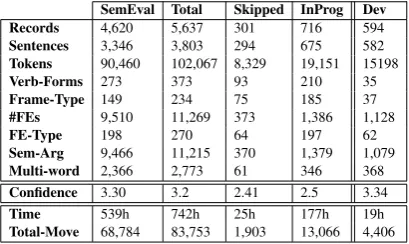
Table1shows a statistical summary of the
annota-tion task. TheSemEvalcolumn reports the
statis-tics for the final set of records, i.e., gold records with double-agreement between annotators, and
which we used to evaluate the systems. Total
re-ports the statistics of all analyzed records, from
which we chose ourSemEvaldata. Skippedand
InProg show the statistics for discarded records and records without a final decision, respectively.
Devshows the statistics for the development set.
Each of the rows reports a value of a compo-nent of the data or annotator interaction with the
data. Records indicates the number of annotated
verbs and their arguments.SentencesandTokens
indicate the size of the sub-corpus of the
anno-tated records. VFis the number of distinct verb
lemmas (273), mapped to the number of distinct
frames that the Frames-Type row shows (149)
(Figure 3 in Appendix A.1 plots their frequency
distribution.) FElements reports the number of
annotated FEs categorized under the number of
FE types shown in the FE-Type row. Sem-Arg
shows the number of annotated verb arguments with VerbNet-like semantic roles, classified into
32 of 41 possible semantic role categories.
Multi-wordlists the number of annotated MWUs
SemEval Total Skipped InProg Dev Records 4,620 5,637 301 716 594
Sentences 3,346 3,803 294 675 582
Tokens 90,460 102,067 8,329 19,151 15198
Verb-Forms 273 373 93 210 35
Frame-Type 149 234 75 185 37
#FEs 9,510 11,269 373 1,386 1,128
FE-Type 198 270 64 197 62
Sem-Arg 9,466 11,215 370 1,379 1,079
Multi-word 2,366 2,773 61 346 368
Confidence 3.30 3.2 2.41 2.5 3.34
Time 539h 742h 25h 177h 19h
[image:6.595.79.284.578.700.2]Total-Move 68,784 83,753 1,903 13,066 4,406
Table 1: Annotation and Data Statistical Summary
Confidence reports the average of annotator-assigned confidence scores for annotations per
record. Although interpreting this measure
de-mands more work, the averages appear to be as
expected. Specifically,SemEvalis higher in value
than bothInProgandSkipped, facts that we
as-sociate with double agreement and the choice re-viewing process. Still, many records with high
confidence scores remained as InProg given the
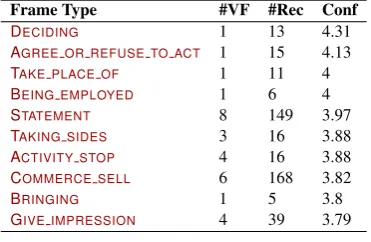
lack of double agreement. Table5(AppendixA.1)
lists the top 10 frames annotated with their respec-tive highest and lowest confidence ratings
aver-aged by their frequency inSemEval.
The last two rows of Table 1 are meta-data on
the annotation process.Timereports the total time
annotators spent in active annotation, engaged in the steps described above (742 hours), excluding
the reviewing process (Section4.3.1) and
includ-ing the time to annotate MWUs. Total-Moveis
the total number of logical moves for frame anno-tation between annotators and the annoanno-tation sys-tem, i.e., logged changes in the process of frame and core FE annotation. This number excludes annotation of verb subcategorization with generic
semantic roles.6
In SemEval, annotated frames had an average of 2.15 arguments, requiring a minimum of five logical moves to annotate (MWU-less sentences).
However, on average, each SemEval record
re-quired 14.8 moves. This number is even higher forInProg(18.2); we believe that it indicates the
complexity of the annotation task. Table4
(Ap-pendixA.1) further details annotator activity, with
time spent and moves per annotation step. As ex-pected, frame annotation of verbs (Step 2), was the most time consuming part of the task.
4.5 Development Dataset
Shared task participants received a development set consisting of 600 records from a total of 4,620
records, where Table 4 shows the statistics. The
development set contained gold annotations for all three subtasks.
5 Evaluation Metrics
For all subtasks, as figure of merit, here we re-port the performance of participating systems with measures for evaluating text clustering techniques,
including the classic measures of Purity (PU),
inverse-Purity (IPU), and their harmonic mean
(PIF) (Steinbach et al.,2000), as well as the
har-monic mean for BCubed precision and recall (i.e.,
BCP, BCR, and BCF, respectively) (Bagga and Baldwin,1998).
To compute these measures for the pairing of reference-labeled data and unsupervised-labeled data (with each having an exact set of annotated
items), we built a contingency table T with rows
for gold labels and columns for unsupervised sys-tem labels. We filled the table with the number of intersecting items, as done in cross-tabulation of results in classification tasks to compute
preci-sion and recall. For Task A (Section3),T tracks
the unsupervised system labels and the gold refer-ence labels assigned to verbs. For Task B.1, we
labeled the rows and columns of T with tuples
(lv, la), wherelvlabels the frame evoking verb and
lalabels the FE filler. For Task B.2, the rows and
columns in T track the unsupervised system
la-bels and the gold reference lala-bels (generic seman-tic roles) assigned to arguments.
These performance measures reflect a notion of similarity between the distribution of unsuper-vised labels and that of the gold reference labels, given certain criteria. Specifically, they define the notions of consistency and completeness of au-tomatically generated clusters based on the eval-uation data. Each method measures consistency and completeness in its own way, and alone may lack sufficient information for a clear understand-ing and analysis of system performance (Amig´o et al.,2009). But, as thesingle metric for system ranking, we used the BCF measure, given its satis-factory behavior in certain situations. Note that we modeled the task and its evaluation as hard cluster-ing, where a record receives only one label, with-out overlap in any generated category of items.
5.1 Baselines
Similar to other clustering tasks, we use
base-lines of random, all-in-one-cluster (AIN1), and
one-cluster-per-instance (1CPI). Additionally, we
adapted the baseline of the most frequent sense
in WSI for these tasks by introducing the one-cluster-per-head (1CPH) baseline in Task
A, and one-cluster-per-syntactic-category (1CPG)
for verb argument clustering in Task B.2.7 For
Task B.1, we built a baseline, 1CPGH for
label-ing verbs with their lemmas (as in 1CPH) and
FEs with grammatical relation to their heads (as in
1CPG). We included two more labels lcmpx and
7We use syntactic dependencies of the Enhanced Univer-sal Dependencies formalism (Schuster and Manning,2016).
rcmpxfor frame fillers with no direct syntactic
re-lation to the head verb, if occurring left of or right of the verb, respectively.
Both 1CPH and 1CPG (and their combination
for Task B.1) are hard to beat because of the long-tailed distribution of the frequency of our test data. E.g., most verbs frequently instantiate one par-ticular frame and rarely other ones. Similarly, a particular role (FE) frequently is filled by words that have a particular grammatical relation to its governing verb; e.g., most subjects of most verb
forms receive the agentlabel in their
subcatego-rization frame (or, an agent-like element in their Frame Semantics representations). Evidently the chosen labels for grammatical relations influences
1CPG and 1CPHG scores. Values reported later
(specifically, Tables 6 and 2) could be improved
by employing heuristics, e.g., relabeling enhanced dependencies using a few rules.
We also employed one unsupervised and a sec-ond supervised system baselines. For the unsuper-vised one, we trained the system with data from Kallmeyer et al.(2018). For the supervised one,
we used OPEN-SESAME, a state-of-the-art
su-pervised FrameNet tagger (Swayamdipta et al., 2018). After converting its output to the format of the present task, we evaluated it similar to other systems. Both systems were trained out-of-the-box with no additional tuning.
6 System Descriptions
We received submissions from nine teams (13 par-ticipants). Only three chose to submit system
de-scription papers. Arefyev et al.(2019) provided a
subtask, we still report its scores. The differences between its results and those of the other systems
may be informative. Still, we consideredArefyev
et al.’s results for Task B only complementarily, not to rank the systems.
Anwar et al.(2019) proposed a method that was
similar to that of Arefyev et al. (2019). Arefyev
et al. used contextualized word embeddings from
the BERT language modeling tool Devlin et al.
(2018), whereasAnwar et al.used pre-trained
em-beddings. They merged the outputs of Tasks A and B.2 for Task B.1. Task A used agglomerative clustering of vectors with concatenated verb rep-resentation vectors and vectors that represent us-age context. Task B.2 employed hand crafted fea-tures, a method to encode syntactic information, and again an agglomerative clustering method.
Ribeiro et al. (2019) also reported results for all subtasks using similar techniques to those
re-ported in the other two submitted papers. Ribeiro
et al.(2019) used the bidirectional neural language
model BERT, which Arefyev et al. (2019) also
used. Task A employed contextualized word
rep-resentations proposed in (Ustalov et al.,2018), and
Biemann’s clustering algorithm (Biemann,2006).
Compared to the two other systems,Ribeiro et al.
(2019) exploited input structures, weighted them, and used them elegantly in its algorithm. With the same method but different hyper-parameters for B.2 along with combining results from Task A,Ribeiro et al.(2019) offered a solution to B.1.
7 Results and Data Analysis
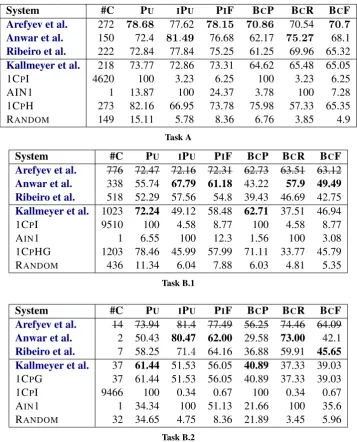
Table2reports the BCF scores for system
submis-sions along with a baseline for each task.8 As the
table shows, each system performs best only in
one of the tasks. We reportArefyev et al.’s
sub-mission for Tasks B.1 and B.2 only to show the benefit of using a small amount of training data and a supervised method together with a cluster-ing algorithm, provided that such traincluster-ing data is available. As readers know, finding the optimal (actual) number of clusters is an open research area. Participants knew the number of clusters:
whereasArefyev et al. andAnwar et al. used this
information, Ribeiro et al. opted for a statistical
method tuned with data that we provided.
The baseline systems, the unsupervised method of Kallmeyer et al. (2018) performed the worst
8The full list of baselines and performance measures ap-pear in Table6of the Appendix.
System BCF
Arefyev et al. 70.70
Anwar et al. 68.10
Ribeiro et al. 65.32
BASELINE 65.35
Task A
BCF
63.12 49.49 42.75 45.79
B.1
BCF
64.09 42.1 45.65 39.03
[image:8.595.317.508.61.140.2] [image:8.595.356.476.519.555.2]B.2
Table 2: Summary of Results. The BASELINEfor
Task A is 1CPH, and for B.1 and B.2 is 1CPHG.
Best results appear in bold face; discarded results
are crossed out. Table6lists all other baselines.
of all systems regarding BCF. This result is not
surprising since that work did not effectively han-dle MWUs in the test, where only the head of the MWU was kept. However, the output of
Open-SESAME, and its low BCF was indeed surprising.
We fed Open-SESAME the sentences from the test set; it identified approximately 5k frames. However, the overlap with the test set was only 1,216 records (identification problem in Open-SESAME). These 1,216 records exhibit a mis-match between 536 of the arguments and their re-spective target verbs. We ignored the system’s extra or incorrectly generated arguments, and
re-placed the missing items with those of the 1CPHG
baseline records. We then used the resulting
records for evaluation against the task’s gold data
as did the task’s participants. As Table3 shows,
the unsupervised method outperforms the super-vised system for all tasks by a wide margin, i.e.,the unsupervised label set can carry more information than does the supervised label set.
BCP BCR BCF Task A 84.52 44.67 58.45 Task B.1 81.04 31.6 45.47 Task B.2 34.26 36.56 35.37
Table 3: Open-SESAME Performance
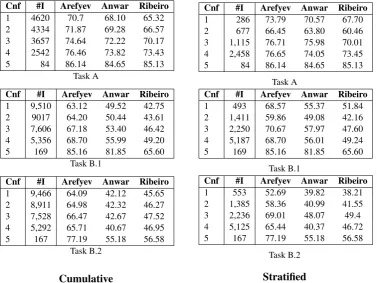
We compared results for confidence measure that annotators assigned to records. First, we split the evaluation records according to their assigned
confidence value into five subsetsEi, 1 ≤i ≤5,
such that subset E1 contained only records with
confidence value 1,E2contained only record with
confidence value 2, etc.. Then we evaluated
sys-tem outputs on each subset Ei and logged that
BCF. Later, we performed this evaluation
cumula-tively using subsetsEi0s by adding records from all
Ejs toEiwherei < j. Interpreting the obtained
cardinality must be taken into account), overall, we observed a similar trend for all systems: as ex-pected, namely a positive correlation between the
confidence value and BCF. Thus, what human
an-notators usually found hard to annotate, automatic systems also found hard to cluster. (The reverse re-lation does not hold). Or, pessimistically, the level of noise in annotation increases as their associated
confidence decreases. (Table 7 in AppendixA.2
details the results.)
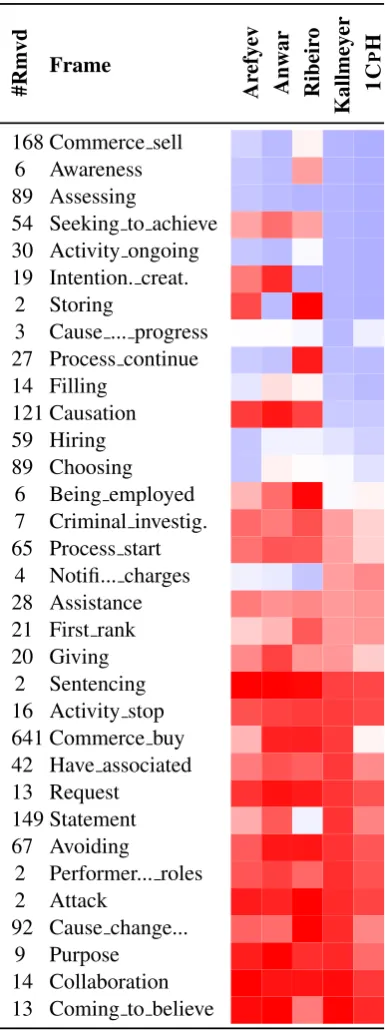
Finally, we wanted to identify the frames that machines found difficult to cluster. To estimate
difficulty we used the differences in BCF under
the following conditions. We repeated the
evalu-ation process 1 ≤ i ≤ n times (where nis the
number of gold labels for a task) for each
sys-tem. In each iteration i, we removed all data
items of a gold category i. We measured and
noted the resulting BCF in the given iteration; we
deduced the score from the system performance over the entire gold set. To cancel frequency ef-fects, we normalized the differences by the num-ber of gold data instances. We removed all records
annotated as COMMERCE SELL from the
evalua-tion set E to form E0. We computed the BCF
of the systems over E0 (E0 ⊂ E), and measured
d = EBCF −E0B
CF. We interpreted a positive
difference as an easy to cluster gold category i,
and a negative difference as a hard to cluster gold
categoryi.
The heat maps in Table 8 and Table 9 show a
summary of the results for Task A and Task B.2, respectively. All systems performed similarly for approximately 30% of the gold classes. Compar-ing differences across systems and the baselines
of 1CPH and 1CPG reveals (possibly)
interest-ing information. Thus, for example, in Task A,
most systems found COMMERCE SELL hard and
COMMERCE BUY easy to cluster. Interestingly, a
set of six verbs evokes each frame: buy,
pur-chase, buy back, buy up, buy out, buy into for
COMMERCE BUY; and sell, retail, auction, place, deal, resellforCOMMERCE SELL. From these two
sets of verbs, three are polysemous:buyin the
for-mer, andplaceanddealin the latter. Does the
mor-phology of the verbs (e.g.,buy-back,resell) make
one easy to cluster? Alternatively, are other fac-tors at play, such as the number of verb instances? How these factors might influence the proposed
naive BCF-difference model is an open question.
8 Concluding Remarks
We have presented the SemEval 2019 task on un-supervised lexical frame induction. We described the task in detail, provided a summary of methods that participants developed, and compared the re-sults. Although much room for improvement of the task remains, we consider it a step forward. It employed a well-motivated typology of lexi-cal frames to distinguish lexilexi-cal frame induction tasks. The evaluation data derived from annota-tions of a well-known resource, namely a portion of WSJ sentences, perhaps the most annotated cor-pus of English. These features provide opportuni-ties for future investigation, in particular in stud-ies related to reciprocal relations between syntac-tic and lexical semansyntac-tic frame structures.
One reason to promote using unsupervised methods is their inherent flexibility to embrace un-known data. These methods have a high margin of
tolerance fornoise, and perform better than
super-vised method with insufficient training data. For unsupervised data, obtaining or generating train-ing data is easier than dotrain-ing so with supervised methods because they simply do not require
an-notation. For example, all participant systems
could collect similar unlabeled training data from only syntactically annotated corpora to generate more unlabeled records. Ultimately, such methods can achieve respectable performance, and produce clusters which are both more informative than the unlabeled input and supervised categories (under certain situations). As shown, unsupervised meth-ods can even outperform a state-of-the-art Frame
Semantics parser by a wide margin (Section 7),
while a very large gap remains for improvements in future work.
Acknowledgements
This research was funded by DFG - SFB991. We thank Timm Lichte, Rainer Oswald, Curt Ander-son, and Kurt Erbach. We also thank the LDC for its generous support, and the NVIDIA Corpora-tion for the Titan Xp GPU used in this work.
References
Enrique Amig´o, Julio Gonzalo, Javier Artiles, and Felisa Verdejo. 2009. A comparison of extrinsic clustering evaluation metrics based on formal con-straints.Inf. Retr., 12(4):461–486.
Saba Anwar, Dmitry Ustalov, Nikolay Arefyev, Si-mone Paolo Ponzetto, Chris Biemann, and Alexan-der Panchenko. 2019. Hm2 at semeval 2019 task
2: Unsupervised frame induction using contextu-alized and uncontextucontextu-alized word embeddings. In Proceedings of The 13th International Workshop on Semantic Evaluation.
Nikolay Arefyev, Boris Sheludko, Adis Davletov, Dmitry Kharchev, Alex Nevidomsky, , and Alexan-der Panchenko. 2019. Neural granny at semeval 2019 task 2: A combined approach for better model-ing of semantic relationships in semantic frame in-duction. In Proceedings of The 13th International Workshop on Semantic Evaluation.
Amit Bagga and Breck Baldwin. 1998. Entity-based cross-document coreferencing using the vec-tor space model. In Proceedings of the 17th International Conference on Computational Linguistics -Volume 1, COLING ’98, pages 79–85, Stroudsburg, PA, USA. Association for Computational Linguis-tics.
Laura Banarescu, Claire Bonial, Shu Cai, Madalina Georgescu, Kira Griffitt, Ulf Hermjakob, Kevin Knight, Philipp Koehn, Martha Palmer, and Nathan Schneider. 2013. Abstract meaning representation for sembanking. InProceedings of the 7th Linguis-tic Annotation Workshop and Interoperability with Discourse, pages 178–186. Association for Compu-tational Linguistics.
Chris Biemann. 2006. Chinese whispers - an efficient graph clustering algorithm and its application to nat-ural language processing problems. InProceedings of TextGraphs: the First Workshop on Graph Based Methods for Natural Language Processing, pages 73–80. Association for Computational Linguistics.
Claire Bonial, Kevin Stowe, and Martha Palmer. 2013. Renewing and revising semlink. InProceedings of the 2nd Workshop on Linked Data in Linguistics (LDL-2013): Representing and linking lexicons, ter-minologies and other language data, pages 9 – 17, Pisa, Italy. Association for Computational Linguis-tics.
Silvie Cinkov´a, Eva Fuˇc´ıkov´a, Jana ˇSindlerov´a, and Jan Hajiˇc. 2014. EngVallex - English valency lex-icon. LINDAT/CLARIN digital library at the In-stitute of Formal and Applied Linguistics, Charles University.
Jacob Devlin, Ming-Wei Chang, Kenton Lee, and Kristina Toutanova. 2018. Bert: Pre-training of deep bidirectional transformers for language understand-ing. arXiv preprint arXiv:1810.04805.
C. J. Fillmore. 1976. Frame Semantics and the Na-ture of Language.Annals of the New York Academy of Sciences, 280(Origins and Evolution of Language and Speech):20–32.
Charles J. Fillmore. 1968. The case for case. In Uni-versals in Linguistic Theory, pages 1–88. Holt Rine-hart and Winston, New York.
Thomas Gamerschlag, Doris Gerland, Rainer Osswald, and Wiebke Petersen, editors. 2014. General Intro-duction. Springer International Publishing, Cham.
Roxana Girju, Preslav Nakov, Vivi Nastase, Stan Sz-pakowicz, Peter Turney, and Deniz Yuret. 2007. Semeval-2007 task 04: Classification of semantic relations between nominals. InProceedings of the Fourth International Workshop on Semantic Evalu-ation (SemEval-2007), pages 13–18. Association for Computational Linguistics.
Rebecca Green, Bonnie J. Dorr, and Philip Resnik. 2004. Inducing frame semantic verb classes from WordNet and LDOCE. InProceedings of the 42Nd Annual Meeting on Association for Computational Linguistics, ACL ’04, Stroudsburg, PA, USA. Asso-ciation for Computational Linguistics.
Jan Hajiˇc, Eva Hajiˇcov´a, Jarmila Panevov´a, Petr Sgall, Ondˇrej Bojar, Silvie Cinkov´a, Eva Fuˇc´ıkov´a, Marie Mikulov´a, Petr Pajas, Jan Popelka, Jiˇr´ı Se-meck´y, Jana ˇSindlerov´a, Jan ˇStˇep´anek, Josef Toman, Zdeˇnka Ureˇsov´a, and Zdenˇek ˇZabokrtsk´y. 2012. Announcing prague czech-english dependency tree-bank 2.0. InProceedings of the Eighth International Conference on Language Resources and Evaluation (LREC-2012). European Language Resources Asso-ciation (ELRA).
Silvana Hartmann, Ilia Kuznetsov, Teresa Martin, and Iryna Gurevych. 2017. Out-of-domain framenet se-mantic role labeling. In Proceedings of the 15th Conference of the European Chapter of the Associa-tion for ComputaAssocia-tional Linguistics: Volume 1, Long Papers, volume 1, pages 471–482.
Eduard Hovy, Mitchell Marcus, Martha Palmer, Lance Ramshaw, and Ralph Weischedel. 2006.OntoNotes: The 90% solution. In Proceedings of the Human Language Technology Conference of the NAACL, Companion Volume: Short Papers, NAACL-Short ’06, pages 57–60, Stroudsburg, PA, USA. Associa-tion for ComputaAssocia-tional Linguistics.
David Jurgens and Ioannis Klapaftis. 2013. Semeval-2013 task 13: Word sense induction for graded and non-graded senses. InSecond Joint Conference on Lexical and Computational Semantics (* SEM), Vol-ume 2: Proceedings of the Seventh International Workshop on Semantic Evaluation (SemEval 2013), volume 2, pages 290–299.
Joint Conference on Lexical and Computational Se-mantics, pages 130–141, New Orleans, Louisiana. Association for Computational Linguistics.
Karin Kipper, Hoa Trang Dang, and Martha Palmer. 2000. Class-based construction of a verb lexicon. InProceedings of the Seventeenth National ence on Artificial Intelligence and Twelfth Confer-ence on Innovative Applications of Artificial Intelli-gence, pages 691–696. AAAI Press.
Alessandro Lenci and Giulia Benotto. 2012. Identify-ing hypernyms in distributional semantic spaces. In SemEval 2012, pages 75–79. Association for Com-putational Linguistics.
Suresh Manandhar, Ioannis Klapaftis, Dmitriy Dligach, and Sameer Pradhan. 2010. Semeval-2010 task 14: Word sense induction & disambiguation. In Pro-ceedings of the 5th International Workshop on Se-mantic Evaluation, pages 63–68, Uppsala, Sweden. Association for Computational Linguistics.
Jiˇr´ı Materna. 2012. Lda-frames: An unsupervised ap-proach togenerating semantic frames. In Compu-tational Linguistics and Intelligent Text Processing, pages 376–387, Berlin, Heidelberg. Springer Berlin Heidelberg.
Diana McCarthy and Roberto Navigli. 2007. Semeval-2007 task 10: English lexical substitution task. In Proceedings of the Fourth International Workshop on Semantic Evaluation (SemEval-2007), pages 48– 53. Association for Computational Linguistics.
George A. Miller. 1995. WordNet: A lexical database for English.Commun. ACM, 38(11):39–41.
Ashutosh Modi, Ivan Titov, and Alexandre Klementiev. 2012. Unsupervised induction of frame-semantic representations. InProceedings of the NAACL-HLT Workshop on the Induction of Linguistic Structure, pages 1–7, Montr´eal, Canada. Association for Com-putational Linguistics.
Roberto Navigli and Daniele Vannella. 2013. Semeval-2013 task 11: Word sense induction and disam-biguation within an end-user application. InSecond Joint Conference on Lexical and Computational Se-mantics (*SEM), Volume 2: Proceedings of the Sev-enth International Workshop on Semantic Evalua-tion (SemEval 2013), pages 193–201, Atlanta, Geor-gia, USA. Association for Computational Linguis-tics.
Stephan Oepen, Marco Kuhlmann, Yusuke Miyao, Daniel Zeman, Silvie Cinkova, Dan Flickinger, Jan Hajic, Angelina Ivanova, and Zdenka Uresova. 2016. Towards comparability of linguistic graph banks for semantic parsing. In LREC 2016, Paris, France. ELRA.
Martha Palmer, Claire Bonial, and Jena Hwang. 2017. Verbnet: Verbnet: Capturing english verb behavior, meaning, and usage. InThe Oxford Handbook of Cognitive Science. Oxford Press.
Martha Palmer, Daniel Gildea, and Paul Kingsbury. 2005. The proposition bank: An annotated corpus of semantic roles.Comput. Linguist., 31(1):71–106.
Marco Pennacchiotti, Diego De Cao, Roberto Basili, Danilo Croce, and Michael Roth. 2008. Automatic induction of framenet lexical units. InProceedings of the Conference on Empirical Methods in Natu-ral Language Processing, EMNLP ’08, pages 457– 465, Stroudsburg, PA, USA. Association for Com-putational Linguistics.
Behrang Q. Zadeh and Miriam R. L. Petruck. 2019. Guidelines for the semantic frame annotation sys-tem. corpus annotation guidelines TR.9.2018, SFB991 - ICSI.
Drew Reisinger, Rachel Rudinger, Francis Ferraro, Craig Harman, Kyle Rawlins, and Benjamin Van Durme. 2015. Semantic proto-roles. Transactions of the Association for Computational Linguistics, 3:475–488.
Eug´enio Ribeiro, Vˆania Mendonc¸a, Ricardo Ribeiro, David Martins de Matos, Alberto Sardinha, Ana L´ucia Santos, and Lu´ısa Coheur. 2019. L2F/INESC-ID at SemEval-2019 Task 2: Un-supervised Lexical Semantic Frame Induction using Contextualized Word Representations. In Proceedings of The 13th International Workshop on Semantic Evaluation.
Josef Ruppenhofer, Michael Ellsworth, Miriam R. L. Petruck, Christopher R. Johnson, Collin F. Baker, and Jan Scheffczyk. 2016. FrameNet II: Extended Theory and Practice. ICSI, Berkeley.
Sebastian Schuster and Christopher D. Manning. 2016. Enhanced English Universal Dependencies: An im-proved representation for natural language under-standing tasks. InProceedings of the Tenth Interna-tional Conference on Language Resources and Eval-uation (LREC 2016), Paris, France. European Lan-guage Resources Association (ELRA).
M. Steinbach, G. Karypis, and V. Kumar. 2000.A com-parison of document clustering techniques. InKDD Workshop on Text Mining.
Swabha Swayamdipta, Sam Thomson, Kenton Lee, Luke Zettlemoyer, Chris Dyer, and Noah A. Smith. 2018. Syntactic scaffolds for semantic structures. In Proceedings of the 2018 Conference on Em-pirical Methods in Natural Language Processing, pages 3772–3782, Brussels, Belgium. Association for Computational Linguistics.
A Appendices
A.1 Appendix I: Annotation Process
A.1.1 Time and Moves per Annotation Step
Table 4 shows the amount of effort to develop
the SemEval dataset in terms of time and moves that the annotation system recorded. (See
Sec-tions4.3,4.4).
Annotator Activity Time Moves
Reading and Comprehension 78 4,795
Choosing a Frame 177 9,737
Annotating Arguments 81 19,510
Rating, Revising, Commenting 115 25,793 Multi-word Unit Annotation 89 8,949
[image:12.595.309.495.325.446.2]Total 539 68,784
Table 4: Total hours and number of moves for each annotation step for the 4,620 record dataset.
A.1.2 Plot of frequency of annotated frames
Figure3plots the frequency distribution of the
an-notated frames in the gold data (SemEval).
641Commerce buy
321 Change
position on
ascale
280 Activity
star t
641
Commerce
b
uy
91
Opinion
65
Process star
t
43
Prohibiting or licensing
32
Man ufactur ing
25
P
ossession
19 Intentionally
create
14 Filling
13 Coming
to belie ve
9Pur pose
6
Aw areness
5
Being in control
4
Imposing
ob
ligation
3
Aiming
3
Comm
unicate
categor
ization
2
Self
motion
2
Affir
m
or
den
[image:12.595.83.281.380.544.2] [image:12.595.310.494.461.586.2]y
Figure 3: Frequency Distribution of Annotated Frames
A.1.3 Some Frames and their Averaged Confidence
Table5 lists FN frames annotated with the
high-est and lowhigh-est confidence. Table 4 details hours
spent to derive the evaluation data set. Section4.3
discusses both tables. The full list of annotations
in human readable form is available to browse
and comment on athttp://corpora.phil.
hhu.de/fi/frames.html.
A.2 Appendix II: Statistical Summary of Evaluation and System Submissions
A.2.1 Unabridged Results Table
Table6extends Table2. Section5defines the
ab-breviations. A horizontal line separates participat-ing systems and the baselines.
A.2.2 Confidence Measures and BCF Performance
Table7shows system BCF scores for confidence.
The table shows changes in the BCF of systems
when altering the evaluation set based on the as-signed confidence for an annotated record. (See
Section7for an explanation).
Frame Type #VF #Rec Conf
DECIDING 1 13 4.31
AGREE OR REFUSE TO ACT 1 15 4.13 TAKE PLACE OF 1 11 4 BEING EMPLOYED 1 6 4
STATEMENT 8 149 3.97
TAKING SIDES 3 16 3.88 ACTIVITY STOP 4 16 3.88 COMMERCE SELL 6 168 3.82
BRINGING 1 5 3.8
GIVE IMPRESSION 4 39 3.79
(a) Frames with Highest Average Confidence
Frame Type #VF #Rec Conf
BEING IN CONTROL 2 5 1.6
COMING TO BE 2 5 1.8
OPERATING A SYSTEM 2 10 1.8
AWARENESS 1 6 1.83
REMOVING 3 8 1.88
INTENTIONALLY CREATE 6 19 1.95
CERTAINTY 1 68 2.03
OPINION 2 91 2.1
THWARTING 2 22 2.32
FIRST RANK 1 21 2.38
(b) Frames with Lowest Average Confidence
Table 5: Frame types with the highest (5a) and
the lowest (5b) confidence (Conf) by number
of records (#Rec) with double annotator
agree-ment. #VF reports the number of distinct verb
System #C PU IPU PIF BCP BCR BCF
Arefyev et al. 272 78.68 77.62 78.15 70.86 70.54 70.7
Anwar et al. 150 72.4 81.49 76.68 62.17 75.27 68.1
Ribeiro et al. 222 72.84 77.84 75.25 61.25 69.96 65.32
Kallmeyer et al. 218 73.77 72.86 73.31 64.62 65.48 65.05
1CPI 4620 100 3.23 6.25 100 3.23 6.25
AIN1 1 13.87 100 24.37 3.78 100 7.28
1CPH 273 82.16 66.95 73.78 75.98 57.33 65.35
RANDOM 149 15.11 5.78 8.36 6.76 3.85 4.9
Task A
System #C PU IPU PIF BCP BCR BCF Arefyev et al. 776 72.47 72.16 72.31 62.73 63.51 63.12
Anwar et al. 338 55.74 67.79 61.18 43.22 57.9 49.49
Ribeiro et al. 518 52.29 57.56 54.8 39.43 46.69 42.75 Kallmeyer et al. 1023 72.24 49.12 58.48 62.71 37.51 46.94
1CPI 9510 100 4.58 8.77 100 4.58 8.77
AIN1 1 6.55 100 12.3 1.56 100 3.08
1CPHG 1203 78.46 45.99 57.99 71.11 33.77 45.79
RANDOM 436 11.34 6.04 7.88 6.03 4.81 5.35
Task B.1
System #C PU IPU PIF BCP BCR BCF
Arefyev et al. 14 73.94 81.4 77.49 56.25 74.46 64.09
Anwar et al. 2 50.43 80.47 62.00 29.58 73.00 42.1
Ribeiro et al. 7 58.25 71.4 64.16 36.88 59.91 45.65
Kallmeyer et al. 37 61.44 51.53 56.05 40.89 37.33 39.03
1CPG 37 61.44 51.53 56.05 40.89 37.33 39.03
1CPI 9466 100 0.34 0.67 100 0.34 0.67
AIN1 1 34.34 100 51.13 21.66 100 35.6
RANDOM 32 34.65 4.75 8.36 21.89 3.45 5.96
[image:13.595.120.478.177.620.2]Task B.2
Cnf #I Arefyev Anwar Ribeiro
1 4620 70.7 68.10 65.32 2 4334 71.87 69.28 66.57 3 3657 74.64 72.22 70.17 4 2542 76.46 73.82 73.43
5 84 86.14 84.65 85.13
Task A
Cnf #I Arefyev Anwar Ribeiro
1 9,510 63.12 49.52 42.75 2 9017 64.20 50.44 43.61 3 7,606 67.18 53.40 46.42 4 5,356 68.70 55.99 49.20 5 169 85.16 81.85 65.60
Task B.1
Cnf #I Arefyev Anwar Ribeiro
1 9,466 64.09 42.12 45.65 2 8,911 64.98 42.32 46.27 3 7,528 66.47 42.67 47.52 4 5,292 65.71 40.67 46.95 5 167 77.19 55.18 56.58
Task B.2
Cumulative
Cnf #I Arefyev Anwar Ribeiro
1 286 73.79 70.57 67.70 2 677 66.45 63.80 60.46 3 1,115 76.71 75.98 70.01 4 2,458 76.65 74.05 73.45
5 84 86.14 84.65 85.13
Task A
Cnf #I Arefyev Anwar Ribeiro
1 493 68.57 55.37 51.84 2 1,411 59.86 49.08 42.16 3 2,250 70.67 57.97 47.60 4 5,187 68.70 56.01 49.24 5 169 85.16 81.85 65.60
Task B.1
Cnf #I Arefyev Anwar Ribeiro
1 553 52.69 39.82 38.21 2 1,385 58.36 40.99 41.55 3 2,236 69.01 48.07 49.4 4 5,125 65.44 40.37 46.72 5 167 77.19 55.18 56.58
Task B.2
[image:14.595.113.491.251.534.2]Stratified
A.3 Examining Clusters by Removing One Gold Cluster at a Time
#Rmvd
Frame
Ar
efy
ev
Anwar Ribeir
o
Kallmey
er
1
C
P
H
168 Commerce sell
6 Awareness
89 Assessing
54 Seeking to achieve 30 Activity ongoing 19 Intention. creat.
2 Storing
3 Cause ... progress
27 Process continue 14 Filling
121 Causation 59 Hiring 89 Choosing
6 Being employed
7 Criminal investig.
65 Process start
4 Notifi... charges
28 Assistance 21 First rank 20 Giving
2 Sentencing
16 Activity stop 641 Commerce buy 42 Have associated 13 Request
149 Statement 67 Avoiding
2 Performer... roles
2 Attack
92 Cause change...
9 Purpose
[image:15.595.323.513.59.711.2]14 Collaboration 13 Coming to believe
Table 8: Task A – Part of a heat map from results
(Section7), with cases that exhibit a range of
dif-ference values. Red denotes a positive and blue a negative difference; white means no change (zero
difference). Differences (normalized by cluster
size) are in domain0.01to−0.01.
#Rmvd
Frame
Ar
efy
ev
Anwar Ribeir
o
Kallmey
er
1
C
P
H
2 Attending
38 Getting 16 Activity stop
63 Becoming a member 641 Commerce buy
6 Retaining
7 Criminal investigation
67 Avoiding 46 Scrutiny 280 Activity start
5 Bringing
2 Change event time
89 Choosing
8 Removing
13 Coming to believe 14 Inspecting
3 Cause to end
3 Communicate categorization
13 Deciding
2 Attack
2 Creating
19 Intentionally act 34 Cause to amalgamate 19 Intentionally create
5 Usefulness
16 Taking sides
4 Notification of charges
3 Aiming
121 Causation
3 Process end
2 Transfer
5 Coming to be
10 Cotheme
7 Hearsay
16 Transition to state
92 Cause change of position on a scale
7 Inclusion
7 Simultaneity
4 Imposing obligation
3 Cause change
3 Distributed position
39 Give impression
[image:15.595.85.278.120.636.2]4 Supporting