61
Second-order contexts from lexical substitutes for few-shot learning of
word representations
Qianchu Liu, Diana McCarthy, Anna Korhonen
Language Technology Lab, University of Cambridge
English Faculty Building, 9 West Road, Cambridge CB3 9DA, United Kingdom
[email protected], [email protected], [email protected]
Abstract
There is a growing awareness of the need to handle rare and unseen words in word rep-resentation modelling. In this paper, we fo-cus on few-shot learning of emerging concepts that fully exploits only a few available con-texts. We introduce a substitute-based context representation technique that can be applied on an existing word embedding space. Pre-vious context-based approaches to modelling unseen words only consider bag-of-word first-order contexts, whereas our method aggre-gates contexts as second-order substitutes that are produced by a sequence-aware sentence completion model. We experimented with three tasks that aim to test the modelling of emerging concepts. We found that these tasks show different emphasis on first and second or-der contexts, and our substitute-based method achieved superior performance on naturally-occurring contexts from corpora.
1 Introduction
As language vocabulary follows the zipfian dis-tribution, we expect to encounter a large number of rare and unseen words no matter how large the training corpus is. The effective handling of such words is thus crucial for Natural Language Pro-cessing (NLP).
Attempts to learn rare and unseen word repre-sentations can be categorized into the following three approaches: (1) constructing target word em-beddings from the subword components (Pinter et al.,2017;Bojanowski et al.,2017), (2). lever-aging definitions or relational structures from ex-ternal resources such as Wordnet (Bahdanau et al.,
2017;Pilehvar and Collier, 2017), and (3) mod-elling the target word from few available contexts. Our paper falls into the last approach.
We demonstrate improvements in performance by employing an alternative context representa-tion, second-order lexical substitutes, as opposed
to the traditional bag of word context representa-tions. In line with previous research in this area, we evaluate our methodology on three tasks that measure the quality of the induced unseen word representation from contexts (Lazaridou et al.,
2017;Herbelot and Baroni,2017;Khodak et al.,
2018). Our results reveal that the three tasks in-volve different types of contexts which put dif-ferent emphasis on first or second order con-texts. Our second-order substitute-based method achieves the best performance for modelling rare words in natural contexts from corpora. In the tasks in which both first order and second order contexts are important, the ensemble of these two types of contexts yields superior performance. 1
2 Related work
2.1 First-order context
The most naive way of inducing new word repre-sentation from contexts is to simply take the av-erage of context word embeddings that co-occur with the target word in a sentence. With stop words removed, this simple method has proven to be a strong baseline as shown inLazaridou et al.
(2017) andHerbelot and Baroni(2017). A poten-tial improvement from the simple additive base-line model is that we weigh words with ISF (in-verse sentence frequency). We follow the defini-tion of ISF inSamardzhiev et al.(2018) and im-plement it as a baseline model in our study. More recently, Khodak et al.(2018) learn a transforma-tion matrix to reconstruct pre-trained word embed-dings, which essentially learns to highlight infor-mative dimensions. Along a different line, Herbe-lot and Baroni(2017) take a high-risk learning rate and processing strategy for new words but would require the contexts that come at the beginning of the training to be maximally informative. Recent
work implements a memory-augmented word em-bedding model (Sun et al.,2018) however our sys-tem shows comparable or superior performance on the two intrinsic tasks that they use (Table1below and Table 1 of their paper).
2.2 Second-order substitute-based context
An alternative to a bag-of-words representation is a second-order substitute vector generated by a language model for the target word’s slot. For example, we can represent the context ‘It is a move.’ as a substitute vector [big 0.35, good 0.28, bold 0.05, ...] with the numbers indicat-ing fitness weights of each substitute in the con-text (Melamud et al., 2015; Yatbaz et al., 2012;
Melamud et al., 2015). Melamud et al. (2016) later on introduced context2vec which trains both context and word embeddings in a similar setup to CBOW (Mikolov et al., 2013) except that the context is represented with a Bidirectional LSTM rather than as a bag of words. In this way, text2vec captures sequence information in the con-text, and is able to produce high-quality substitutes for a sentence-completion task, while overcoming the sparseness issues in the previous substitute-based approaches. Kobayashi et al. (2017) fine-tune this context2vec representation to compute entity representations in a discourse for the lan-guage modelling task.
A related application of second-order substi-tutes is word sense induction. Baskaya et al.
(2013) represent contexts as second-order substi-tutes and apply co-occurrence modelling on top of the instance id - substitute pairs. Alagi´c et al.
(2018) propose a similar method to our paper and showed that second-order lexical substitutes and first-order contexts complement each other in word sense induction. Our paper provides alter-native evidence for the use of lexical substitutes in the setting of rare word modelling with analysis on the effect from different contexts.
.
3 Proposed Method
In this paper, we make a simple modification from the previous work by representing the context of an unseen word as the weighted sum of the lexi-cal substitute vectors in a continuous embedding space such as the word2vec space. This can be seen as a post-processing technique applied on an existing embedding space. The substitutes
and their fitness scores are generated from con-text2vec. Compared with the context2vec repre-sentation itself, our method isolates the effect of the second-order substitutes and can be applied on top of an existing pre-trained embedding space. For each context, we generate the top N most likely substitutes at the slot of the unseen word by computing the nearest neighbours from the con-text2vec context representation.2 We then com-pute the centroid of these substitutes from our base word embedding space, weighted by each substi-tute’s fitness, cosine similarity, to the context rep-resentation. LetContextVec3 be the context representation produced by context2vec,S0be the set of the top 20 substitute target word vectors pro-duced by context2vec, S be the same 20 substitutes that we look up in our base word embedding space, andf(S0i)be the normalized fitness score ofS0ias defined in equation1. The substitute-based con-text (SC), and thus the unseen word representa-tion for this context, is defined in equarepresenta-tion2. If the unseen word occurs multiple times, we average the unseen word representations across the multi-ple contexts.
f(S0i) = cosine(ContextVec,S
0
i)
P20
j=1cosine(ContextVec,S0j) (1)
SC=
20 X
i=1
f(S0i)∗Si (2)
To directly compare with the previous studies, we take the word2vec embedding model and the 1.6B Wikipedia training corpus provided by Her-belot and Baroni (2017) for our substitute-based method and for training Context2vec. Model pa-rameters for training Context2vec, as listed in Ap-pendix A, are fine-tuned on the training sets of the intrinsic tasks as there are no development sets.
4 The definitional Nonce dataset (Nonce)
Nonce is introduced inHerbelot and Baroni(2017) as a task that challenges the models to reconstruct target word embeddings from single wikipedia definitions. The quality of the representations is evaluated by measuring how close they are to the original word embeddings trained from the whole
2
From experiments on the training sets of the tasks (No-tice that there are no development sets), we found that N=20 is optimal.
Nonce Chimera
Methods MRR Med. Rank 2 Sent. 4 Sent. 6 Sent.
word2vec (Lazaridou et al.,2017) 0.00007 111012 0.1459 0.2457 0.2498 Additive (Lazaridou et al.,2017) 0.03686 861 0.3376 0.3624 0.4080
Additive ISF 0.04493 531 0.3964 0.4016 0.4107
nonce2vec (Herbelot and Baroni,2017) 0.04907 623 0.3320 0.3668 0.3890 a la carte (Khodak et al.,2018) 0.07058 166 0.3634 0.3844 0.3941 mem2vec (Sun et al.,2018) 0.05416 518 0.3301 0.3717 0.3897 context2vec(Melamud et al.,2016) 0.04577 536 0.3574 0.3376 0.3692
substitutes 0.05152 1442 0.3946 0.3662 0.4424
[image:3.595.88.515.61.212.2]substitutes + additive ISF 0.06074 577 0.4167 0.3879 0.4469
Table 1: Comparison with baselines and the previously-reported state-of-the-art results on the Chimera and Nonce datasets. The Chimera dataset is evaluated with Spearman Rank coefficients. The top half of the table contains first-order context methods and the bottom half has methods using second-order context or ensemble methods using first and second order.
Wikipedia corpora. Following Herbelot and Ba-roni(2017), we report in the Nonce columns of Ta-ble 1the mean reciprocal rank (MRR) and median rank (Med. Rank) of the gold-vector (trained from the whole Wikipedia) in the ranked list of nearest neighbours from the induced representation in the 300 test cases.
We see strong performance from first-order context representation especially the a la carte method. Manual observations show that defini-tions are designed to be maximally informative with many synonyms, hypernyms or words seman-tically related to the target word in the context, and the first-order context models can easily ex-ploit this information. Also, the sequential con-text around the target word in a definition may not reflect the context in which a target word will be typically used in a corpus. The good performance of first-order context models is therefore to be ex-pected. Furthermore, the Nonce task tests how well the model reconstructs the original embed-ding but does not probe into the semantic prop-erties or relations captured in the induced word representations. A la carte is thus especially suit-able for this task as it has been explicitly trained to match the original embedding. However, we demonstrate in the following experiments that the superior performance from a la carte may not al-ways be transferred to other tasks.
5 The Chimera dataset (Chimera)
In the Chimera dataset,Lazaridou et al.(2017) in-troduce unseen novel concepts (chimeras), each of which is formed by combining two related nouns
Additive ISF substitutes drowning civet
drown tapir
drowns langur shoos crocodile undresses opossum
Table 2: Nearest neighbours produced by additive ISF and substitutes approaches for the Chimera concept elephant bison in the context ‘but his pleasure soon turns to distress when he sees that a baby is stuck in the mud and drowning .’ (from the Chimeras dataset)
(For example, buffalo and elephant). Each novel concept is accompanied by 2, 4 or 6 natural con-texts that originally belong to the related nouns. The model needs to induce representation for these novel concepts from the contexts. The quality of the representations is evaluated by similarity judg-ment with probe words. Following Herbelot and Baroni(2017) andLazaridou et al.(2017), we re-port in the Chimera columns of Table1the average Spearman Rank coefficients against human anno-tations for 110 test cases in each sentence condi-tion .
[image:3.595.355.477.289.373.2]Number of contexts
0.15 0.2 0.25 0.3 0.35 0.4
[image:4.595.91.526.73.331.2]1 2 4 8 16 32 64 128 a la carte additive additive ISF substitutes context2vec
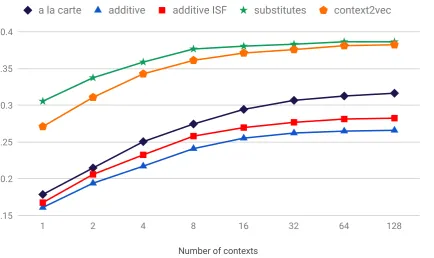
Figure 1: Spearman Rank coefficients averaged across 100 trials on CRW in various context conditions
ensemble method from combining first-order and second-order contexts shows that the two differ-ent contexts capture complemdiffer-entary information in this task. This is especially due to the fact that the contexts were controlled for informativeness so as to have different degrees of overlap with feature norms. Therefore at least some, but not all, contexts will have a high bag-of-word overlap with features that are semantically related to the concepts (Lazaridou et al.,2017). These contexts will easily benefit from first-order contexts alone. However, for the other contexts where there is few or even no overlap with feature norms in the con-text words, it is the concon-textual sequence, and thus second-order context, that will give the maximum information about the target word. We show such an example with the nearest neighbours of the rep-resentations induced by our substitutes model and additive ISF in Table 2. We can see that while the additive ISF representation is easily affected by unrelated words in the sentence, the substitutes approach clearly has at least identified that the tar-get word is likely to be a kind of animal.
6 The Contextual Rare Words dataset (CRW)
The Contextual Rare Words dataset (CRW) was introduced by Khodak et al. (2018). It consists of a subset of 562 word pairs from the original Rare Word (RW) Dataset (Luong et al., 2013). For each pair, the second word is the rare word and is accompanied by 255 contexts. We follow the experiment setup inKhodak et al.(2018) and use their pre-trained vectors on the subcorpus that does not contain any of the rare words from the dataset. This subcorpus is also used to train the context2vec model that generates substitutes. As in Khodak et al. (2018), we randomly choose 2, 4, 6..128 number of contexts as separate condi-tions for 100 trials, and use these contexts to pre-dict the rare word representations. Cosine similar-ity is computed between the rare word representa-tion from the given rare word contexts in the trial (2,4..128) and the embedding of the other word in the pair from the pre-trained vectors. The cosine-similarity of each pair is compared against simi-larity judgments from human annotations. The av-erage Spearman Rank coefficients against human annotations across the trials are reported in Figure
We see dramatic improvement from the substi-tutes method over all the other methods includ-ing the previous state-of-the-art a la carte in this datasets which come from corpora-based natural contexts of rare words. The result here suggests that, in natural contexts, the sequence information rather than bag of words plays a more important role in predicting a target word’s meaning.
We also notice that applying second order in-formation on word2vec space consistently outper-forms Context2vec alone which generates the sec-ond order substitutes. We suspect that this is be-cause the context representation induced by con-text2vec is more syntactically-oriented whereas the tasks in our study mainly test semantic re-lations. We confirm this assumption by follow-ing Herbelot and Baroni(2017) to test the target word embeddings produced by context2vec on the MEN dataset (Bruni et al., 2014). We find that context2vec (Spearmanρ = 0.65) correlates less with human’s semantic relatedness judgment than word2vec (Spearman ρ = 0.75) on this dataset. Isolating the second order information from Con-text2vec and applying it on the word2vec space as an external constraint effectively preserves the semantic relations present in word2vec and at the same time provides a paradigmatic view which finds a both syntactically and semantically appro-priate position for the rare word.
7 Conclusion
To conclude, our paper teases apart the effect of second-order context by proposing a simple second-order substitute-based method that can post-process and improve over an existing embed-ding space. Our substitute-based method achieves the state-of-the-art performance when modelling emerging concepts in natural contexts from cor-pora. This is not surprising as the substitutes con-tain rich linguistic constraints from their surround-ing contextual sequences to inform the word rep-resentation. We plan to investigate whether the second order information is also the key element in the success of the recently-proposed language model embeddings (Peters et al., 2018; Devlin et al.,2018), for example, by testing whether the performance of these contextualized embeddings correlate more with first-order context representa-tion or the second-order substitute context across the different tasks in this study. However, we need further research to find ways to bring type-level
and token-level representations of these contextu-alized embeddings into the same space for these tasks.
Also, as we found that definitions seem to ex-hibit different properties from natural contexts in corpora, it may be advisable to model definitions and corpora contexts differently. An aspect that we did not cover in this paper is the morpholog-ical information from target words. As contexts, definitions and subword information can provide complementary information (Schick and Sch¨utze,
2019), in future work, we plan to leverage sub-words, contexts and definitions together in mod-elling rare or unseen words.
Acknowledgments
We acknowledge Peterhouse College at Univer-sity of Cambridge for funding Qianchu Liu’s PhD research. We also appreciate the helpful discussion and feedback from Dr Ivan Vuli´c, Dr Nigel H. Collier, Dr Taher Pilehvar and Dr Angeliki Lazaridou. We also would like to thank Dr Aur´elie Herbelot for sharing the training corpora and insightful thoughts.
References
Domagoj Alagi´c, Jan ˇSnajder, and Sebastian Pad´o. 2018. Leveraging lexical substitutes for unsuper-vised word sense induction. InThirty-Second AAAI Conference on Artificial Intelligence.
Dzmitry Bahdanau, Tom Bosc, Stanislaw Jastrzebski, Edward Grefenstette, Pascal Vincent, and Yoshua Bengio. 2017. Learning to compute word embed-dings on the fly. arXiv preprint arXiv:1706.00286.
Osman Baskaya, Enis Sert, Volkan Cirik, and Deniz Yuret. 2013. Ai-ku: Using substitute vectors and co-occurrence modeling for word sense induction and disambiguation. In Second Joint Conference on Lexical and Computational Semantics (*SEM), Volume 2: Proceedings of the Seventh International Workshop on Semantic Evaluation (SemEval 2013), pages 300–306, Atlanta, Georgia, USA. Association for Computational Linguistics.
Piotr Bojanowski, Edouard Grave, Armand Joulin, and Tomas Mikolov. 2017. Enriching word vectors with subword information. Transactions of the Associa-tion for ComputaAssocia-tional Linguistics, 5:135–146.
Jacob Devlin, Ming-Wei Chang, Kenton Lee, and Kristina Toutanova. 2018. Bert: Pre-training of deep bidirectional transformers for language understand-ing. arXiv preprint arXiv:1810.04805.
Aur´elie Herbelot and Marco Baroni. 2017. High-risk learning: acquiring new word vectors from tiny data. In Proceedings of the 2017 Conference on Empiri-cal Methods in Natural Language Processing, pages 304–309. Association for Computational Linguis-tics.
Mikhail Khodak, Nikunj Saunshi, Yingyu Liang, Tengyu Ma, Brandon Stewart, and Sanjeev Arora. 2018. A la carte embedding: Cheap but effective induction of semantic feature vectors. In Proceed-ings of the 56th Annual Meeting of the Association for Computational Linguistics (Volume 1: Long Pa-pers), pages 12–22. Association for Computational Linguistics.
Sosuke Kobayashi, Naoaki Okazaki, and Kentaro Inui. 2017. A neural language model for dynamically rep-resenting the meanings of unknown words and enti-ties in a discourse. InProceedings of the Eighth In-ternational Joint Conference on Natural Language Processing (Volume 1: Long Papers), pages 473– 483. Asian Federation of Natural Language Process-ing.
Angeliki Lazaridou, Marco Marelli, and Marco Baroni. 2017. Multimodal word meaning induction from minimal exposure to natural text. Cognitive science, 41:677–705.
Thang Luong, Richard Socher, and Christopher Man-ning. 2013. Better word representations with recur-sive neural networks for morphology. In Proceed-ings of the Seventeenth Conference on Computa-tional Natural Language Learning, pages 104–113. Association for Computational Linguistics.
Oren Melamud, Ido Dagan, and Jacob Goldberger. 2015. Modeling word meaning in context with sub-stitute vectors. InProceedings of the 2015 Confer-ence of the North American Chapter of the Associ-ation for ComputAssoci-ational Linguistics: Human Lan-guage Technologies, pages 472–482. Association for Computational Linguistics.
Oren Melamud, Jacob Goldberger, and Ido Dagan. 2016. context2vec: Learning generic context em-bedding with bidirectional lstm. In Proceedings of The 20th SIGNLL Conference on Computational Natural Language Learning, pages 51–61. Associa-tion for ComputaAssocia-tional Linguistics.
Tomas Mikolov, Kai Chen, Greg Corrado, and Jeffrey Dean. 2013. Efficient estimation of word represen-tations in vector space.CoRR, abs/1301.3781.
Matthew Peters, Mark Neumann, Mohit Iyyer, Matt Gardner, Christopher Clark, Kenton Lee, and Luke Zettlemoyer. 2018. Deep contextualized word repre-sentations. InProceedings of the 2018 Conference
of the North American Chapter of the Association for Computational Linguistics: Human Language Technologies, Volume 1 (Long Papers), pages 2227– 2237. Association for Computational Linguistics.
Mohammad Taher Pilehvar and Nigel Collier. 2017.
Inducing embeddings for rare and unseen words by leveraging lexical resources. InProceedings of the 15th Conference of the European Chapter of the As-sociation for Computational Linguistics: Volume 2, Short Papers, pages 388–393. Association for Com-putational Linguistics.
Yuval Pinter, Robert Guthrie, and Jacob Eisenstein. 2017. Mimicking word embeddings using subword rnns. In Proceedings of the 2017 Conference on Empirical Methods in Natural Language Process-ing, pages 102–112. Association for Computational Linguistics.
Krasen Samardzhiev, Andrew Gargett, and Danushka Bollegala. 2018. Learning neural word salience scores. InProceedings of the Seventh Joint Con-ference on Lexical and Computational Semantics, pages 33–42. Association for Computational Lin-guistics.
Timo Schick and Hinrich Sch¨utze. 2019. Learning se-mantic representations for novel words: Leveraging both form and context. InThirty-Third AAAI Con-ference on Artificial Intelligence.
Jingyuan Sun, Shaonan Wang, and Chengqing Zong. 2018. Memory, show the way: Memory based few shot word representation learning. InProceedings of the 2018 Conference on Empirical Methods in Nat-ural Language Processing, pages 1435–1444. Asso-ciation for Computational Linguistics.
Mehmet Ali Yatbaz, Enis Sert, and Deniz Yuret. 2012.
Learning syntactic categories using paradigmatic representations of word context. InProceedings of the 2012 Joint Conference on Empirical Methods in Natural Language Processing and Computational Natural Language Learning, pages 940–951. Asso-ciation for Computational Linguistics.
A Context2vec model parameters for reproducing the experiments in the paper
1. Nonce:
minimum word freq: 52; dimension units 800; batchsize: 800; learning rate: 0.0001; iteration: 12
2. Chimera:
batchsize: 800; learning rate: 0.0001; iteration: 14
3. CRW
minimum word freq: 100; dimension units 800; batchsize: 600; learning rate: 0.0005; iteration: 8
B Standard deviations in the CRW experiment in the main paper
number of contexts a la carte additive ISF additive substitutes context2vec
1 0.0274 0.0318 0.0357 0.0281 0.0276
2 0.0272 0.0278 0.0314 0.0229 0.0242
4 0.0184 0.0215 0.0218 0.0168 0.0193
8 0.0158 0.0157 0.0193 0.0108 0.0149
16 0.0114 0.0116 0.0123 0.0082 0.0099
32 0.0070 0.0080 0.0099 0.0054 0.0062
64 0.0051 0.0055 0.0062 0.0035 0.0046