(1
E
,4
E
)-1-(3-Nitrophenyl)-5-phenylpenta-1,4-dien-3-one
S. Samshuddin,aRay J. Butcher,bMehmet Akkurt,c* B. Narayana,aB. K. Sarojinidand H. S. Yathirajane
aDepartment of Studies in Chemistry, Mangalore University, Mangalagangotri,
Mangalore 574 199, India,bDepartment of Chemistry, Howard University, 525
College Street NW, Washington, DC 20059, USA,cDepartment of Physics, Faculty of
Sciences, Erciyes University, 38039 Kayseri, Turkey,dDepartment of Chemistry, P. A.
College of Engineering, Nadupadav, Mangalore-574 153, India, andeDepartment of
Studies in Chemistry, University of Mysore, Manasagangotri, Mysore 570 006, India Correspondence e-mail: [email protected]
Received 5 December 2011; accepted 6 December 2011
Key indicators: single-crystal X-ray study;T= 293 K; mean(C–C) = 0.002 A˚; Rfactor = 0.055;wRfactor = 0.128; data-to-parameter ratio = 19.7.
In the title compound, C17H13NO3, the dihedral angle between
the benzene rings is 31.21 (5). In the crystal, inversion dimers
linked by pairs of C—H O hydrogen bonds occur. A C— H interaction is also indicated.
Related literature
For the pharmacological importance of chalcones and bis chalcones, see: Sarojiniet al.(2006); Dhar (1981); Dimmocket al. (1999); Satyanarayana et al. (2004). For our work on synthesis of different derivatives of chalcones, see: Baktıret al. (2011); Funet al.(2010); Jasinskiet al.(2010); Samshuddinet al. (2011a,b,c). For related structures, see: Butcher et al. (2006a,b; 2007a,b,c); Harrisonet al.(2006); Hu et al.(2004); Fischeret al.(2007); Patilet al.(2007); Zhaoet al.(2007).
Experimental
Crystal data
C17H13NO3
Mr= 279.28
Monoclinic,P21=c
a= 11.9806 (6) A˚ b= 9.8955 (4) A˚ c= 12.5562 (7) A˚
= 114.992 (7)
V= 1349.21 (14) A˚3
Z= 4
MoKradiation
= 0.10 mm1 T= 293 K
0.440.340.08 mm
Data collection
Oxford Diffraction Xcalibur Ruby Gemini diffractometer Absorption correction: multi-scan
(CrysAlis RED; Oxford Diffraction, 2007) Tmin= 0.969,Tmax= 1.000
7835 measured reflections 3746 independent reflections 2453 reflections withI> 2(I) Rint= 0.033
Refinement
R[F2> 2(F2)] = 0.055 wR(F2) = 0.128
S= 1.02 3746 reflections
190 parameters
H-atom parameters constrained
max= 0.25 e A˚
3
min=0.26 e A˚
3
Table 1
Hydrogen-bond geometry (A˚ ,).
Cg1 is the centroid of the C12–C17 phenyl ring.
D—H A D—H H A D A D—H A
C2—H2A O3i
0.93 2.59 3.412 (2) 147
C5—H5A Cg1ii
0.93 2.62 3.3915 (19) 141
Symmetry codes: (i)xþ1;y;zþ1; (ii)xþ1;yþ1 2;zþ
3 2.
Data collection: CrysAlis PRO(Oxford Diffraction, 2007); cell refinement: CrysAlis PRO; data reduction: CrysAlis RED (Oxford Diffraction, 2007); program(s) used to solve structure:SHELXS97 (Sheldrick, 2008); program(s) used to refine structure:SHELXL97 (Sheldrick, 2008); molecular graphics: ORTEP-3 (Farrugia, 1997); software used to prepare material for publication:WinGX(Farrugia, 1999),PARST(Nardelli, 1983) andPLATON(Spek, 2009).
BN thanks the UGC for financial assistance through SAP and BSR one-time grants for the purchase of chemicals. HSY thanks the University of Mysore for research facilities. RJB wishes to acknowledge the NSF–MRI program (grant CHE-0619278) for funds to purchase the diffractometer.
Supplementary data and figures for this paper are available from the IUCr electronic archives (Reference: TK5031).
References
Baktır, Z., Akkurt, M., Samshuddin, S., Narayana, B. & Yathirajan, H. S. (2011).Acta Cryst.E67, o1292–o1293.
Butcher, R. J., Jasinski, J. P., Narayana, B., Sarojini, B. K., Bindya, S. & Yathirajan, H. S. (2007c).Acta Cryst.E63, o3270–o3271.
Butcher, R. J., Jasinski, J. P., Sarojini, B. K., Yathirajan, H. S., Bindya, S. & Narayana, B. (2007b).Acta Cryst.E63, o3213–o3214.
Butcher, R. J., Jasinski, J. P., Yathirajan, H. S., Bindya, S., Narayana, B. & Sarojini, B. K. (2007a).Acta Cryst.E63, o3115.
Butcher, R. J., Yathirajan, H. S., Sarojini, B. K., Narayana, B. & Indira, J. (2006a).Acta Cryst.E62, o1910–o1912.
Butcher, R. J., Yathirajan, H. S., Sarojini, B. K., Narayana, B. & Vijaya Raj, K. K. (2006b).Acta Cryst.E62, o1973–o1975.
Dhar, D. N. (1981).The Chemistry of Chalcones and Related Compounds. New York: John Wiley.
Dimmock, J. R., Elias, D. W., Beazely, M. A. & Kandepu, N. M. (1999).Curr. Med. Chem.6, 1125–1149.
Farrugia, L. J. (1997).J. Appl. Cryst.30, 565. Farrugia, L. J. (1999).J. Appl. Cryst.32, 837–838.
Fischer, A., Yathirajan, H. S., Sarojini, B. K., Bindya, S. & Narayana, B. (2007). Acta Cryst.E63, o2832.
Fun, H.-K., Hemamalini, M., Samshuddin, S., Narayana, B. & Yathirajan, H. S. (2010).Acta Cryst.E66, o582–o583.
organic compounds
o74
Samshuddinet al. doi:10.1107/S1600536811052548 Acta Cryst.(2012). E68, o74–o75 Acta Crystallographica Section EStructure Reports
Online
Harrison, W. T. A., Sarojini, B. K., Vijaya Raj, K. K., Yathirajan, H. S. & Narayana, B. (2006).Acta Cryst.E62, o1522–o1523.
Hu, X.-R., Gu, J.-M. & Xu, W.-M. (2004).Acta Cryst.E60, o1437–o1438. Jasinski, J. P., Guild, C. J., Samshuddin, S., Narayana, B. & Yathirajan, H. S.
(2010).Acta Cryst.E66, o2018.
Nardelli, M. (1983).Comput. Chem.7, 95–98.
Oxford Diffraction (2007). CrysAlis PRO and CrysAlis RED. Oxford Diffraction Ltd, Abingdon, England.
Patil, P. S., Teh, J. B.-J., Fun, H.-K., Razak, I. A. & Dharmaprakash, S. M. (2007).Acta Cryst.E63, o2122–o2123.
Samshuddin, S., Butcher, R. J., Akkurt, M., Narayana, B., Yathirajan, H. S. & Sarojini, B. K. (2011c).Acta Cryst.E67, o1954–o1955.
Samshuddin, S., Narayana, B., Sarojini, B. K., Khan, M. T. H., Yathirajan, H. S., Raj, C. G. D. & Raghavendra, R. (2011a).Med Chem Res. doi:10.1007/ s00044-011-9735-9.
Samshuddin, S., Narayana, B., Shetty, D. N. & Raghavendra, R. (2011b).Der Pharm. Chem.3, 232-240.
Sarojini, B. K., Narayana, B., Ashalatha, B. V., Indira, J. & Lobo, K. G. (2006). J. Cryst. Growth,295, 54–59.
Satyanarayana, M., Tiwari, P., Tripathi, B. K., Sriwastava, A. K. & Pratap, R. (2004).Bioorg. Med. Chem.12, 883–887.
Sheldrick, G. M. (2008).Acta Cryst.A64, 112–122. Spek, A. L. (2009).Acta Cryst.D65, 148–155.
supporting information
sup-1
Acta Cryst. (2012). E68, o74–o75
supporting information
Acta Cryst. (2012). E68, o74–o75 [doi:10.1107/S1600536811052548]
(1
E
,4
E
)-1-(3-Nitrophenyl)-5-phenylpenta-1,4-dien-3-one
S. Samshuddin, Ray J. Butcher, Mehmet Akkurt, B. Narayana, B. K. Sarojini and H. S. Yathirajan
S1. Comment
Chalcones are highly reactive substances of varied nature. They have been reported to possess many interesting pharmacological activities (Dhar, 1981) including anti-inflammatory, antimicrobial, antifungal, antioxidant, cytotoxic, antitumor and anticancer activities (Dimmock et al., 1999; Satyanarayana et al., 2004). Chalcones are also finding application as organic nonlinear optical materials (NLO) for their SHG conversion efficiency (Sarojini et al., 2006). The basic skeleton of chalcones which possess α,β-unsaturated carbonyl group is useful for the synthesis of various
biodynamic cyclic derivatives such as pyrazoline, benzodiazepine, 2,4,6-triaryl pyridine, isoxazoline and cyclohexenone derivatives (Samshuddin et al., 2011a,b,c; Fun et al., 2010; Jasinski et al., 2010; Baktır et al., 2011).
The crystal structures of some bis-chalcones viz., 2,6-bis(4-methoxybenzylidene)cyclohexanone (Butcher et al., 2006a), 1,5-bis(4-chlorophenyl)penta-1,4-dien-3-one (Butcher et al., 2006b), 1,5-bis(3,4-dimethoxyphenyl)penta-1,4-dien-3-one (Butcher et al., 2007a), 1,5-bis(4-fluorophenyl)penta-1,4-dien-3-one (Butcher et al., 2007b), 2,5-bis(3,4-dimethoxy-benzylidene)cyclopentanone (Butcher et al., 2007c), 1,5-bis(4-methoxyphenyl)penta-1,4-dien-3-one (Harrison et al., 2006), 2,4-dimethyl-1,5-diphenylpenta-1,4-dien-3-one (Hu et al., 2004) have been reported. In continuation of our work on synthesis of chalcone derivatives, the title compound (I) was prepared and its crystal structure is reported.
In the title molecule (I), (Fig. 1), bond lengths and angles are comparable to closely related structures (Patil et al., 2007; Zhao et al., 2007; Fischer et al., 2007; Butcher et al. (2006a,b, 2007a,b,c); Harrison et al. (2006); Hu et al. (2004). The least-squares plane through the C7–C11/O3 group makes dihedral angles of 8.22 (6) and 32.14 (6)° with the C1–C6 benzene ring and the C12–C17 phenyl ring, respectively. The dihedral angle between these rings is 31.21 (5)° and the nitro group at C3 lies close to the C1–C6 ring plane, with O1–N1–C3–C2 and O2–N1–C3–C4 torsion angles of 6.3 (3) and 7.4 (3)°, respectively.
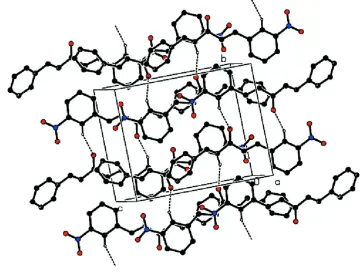
The molecular packing of (I) shown in Fig. 2 is stabilized by C—H···O interactions (Table 1), which lead to the formation of a centrosymmetric dimer, and is further consolidated by C—H···π interactions (Table 1) involving the C12– C17 phenyl ring.
S2. Experimental
Synthesis of title compound was carried out by stirring a mixture of benzylidene acetone (1.46 g, 0.01 mol) and 3-nitro-benzaldehyde (1.51 g, 0.01 mol) in 40 ml of ethanolic sodium hydroxide at 278–283 K for 3 h. The precipitate was collected by filtration and purified by recrystallization from ethanol. The single crystal was grown from 1,4-dioxane by the slow evaporation method and yield of the compound was 80%. (M.pt. 414 K).
S3. Refinement
Figure 1
The molecular structure of the title compound, showing 50% probability displacement ellipsoids and the atom-numbering scheme.
Figure 2
The crystal packing of the title compound, viewed approximately along the a axis. H atoms not involved in the intermolecular interactions (dashed lines) have been omitted for clarity.
(1E,4E)-1-(3-Nitrophenyl)-5-phenylpenta-1,4-dien-3-one
Crystal data
C17H13NO3
Mr = 279.28
Monoclinic, P21/c
Hall symbol: -P 2ybc
a = 11.9806 (6) Å
b = 9.8955 (4) Å
c = 12.5562 (7) Å
β = 114.992 (7)°
V = 1349.21 (14) Å3
Z = 4
F(000) = 584
Dx = 1.375 Mg m−3
[image:4.610.122.485.264.543.2]supporting information
sup-3
Acta Cryst. (2012). E68, o74–o75
θ = 3.1–30.9°
µ = 0.10 mm−1
T = 293 K
Plate, colourless 0.44 × 0.34 × 0.08 mm
Data collection
Oxford Diffraction Xcalibur Ruby Gemini diffractometer
Radiation source: Enhance (Mo) X-ray Source Graphite monochromator
Detector resolution: 10.5081 pixels mm-1
ω scans
Absorption correction: multi-scan
(CrysAlis RED; Oxford Diffraction, 2007)
Tmin = 0.969, Tmax = 1.000
7835 measured reflections 3746 independent reflections 2453 reflections with I > 2σ(I)
Rint = 0.033
θmax = 30.9°, θmin = 3.3°
h = −17→15
k = −13→14
l = −11→18
Refinement
Refinement on F2
Least-squares matrix: full
R[F2 > 2σ(F2)] = 0.055
wR(F2) = 0.128
S = 1.02 3746 reflections 190 parameters 0 restraints
Primary atom site location: structure-invariant direct methods
Secondary atom site location: difference Fourier map
Hydrogen site location: inferred from neighbouring sites
H-atom parameters constrained
w = 1/[σ2(F
o2) + (0.047P)2 + 0.2703P]
where P = (Fo2 + 2Fc2)/3
(Δ/σ)max < 0.001
Δρmax = 0.25 e Å−3
Δρmin = −0.26 e Å−3
Special details
Geometry. Bond distances, angles etc. have been calculated using the rounded fractional coordinates. All su's are estimated from the variances of the (full) variance-covariance matrix. The cell e.s.d.'s are taken into account in the estimation of distances, angles and torsion angles
Refinement. Refinement on F2 for ALL reflections except those flagged by the user for potential systematic errors.
Weighted R-factors wR and all goodnesses of fit S are based on F2, conventional R-factors R are based on F, with F set to
zero for negative F2. The observed criterion of F2 > σ(F2) is used only for calculating -R-factor-obs etc. and is not
relevant to the choice of reflections for refinement. R-factors based on F2 are statistically about twice as large as those
based on F, and R-factors based on ALL data will be even larger.
Fractional atomic coordinates and isotropic or equivalent isotropic displacement parameters (Å2)
x y z Uiso*/Ueq
C10 0.60212 (14) 0.23207 (16) 0.80546 (13) 0.0221 (5) C11 0.70265 (14) 0.17661 (16) 0.88844 (13) 0.0226 (5) C12 0.78098 (14) 0.23472 (16) 1.00356 (13) 0.0211 (4) C13 0.74719 (15) 0.34930 (17) 1.04775 (14) 0.0256 (5) C14 0.82268 (16) 0.39866 (17) 1.15834 (15) 0.0296 (5) C15 0.93264 (16) 0.33433 (18) 1.22672 (15) 0.0307 (5) C16 0.96719 (15) 0.22128 (18) 1.18395 (15) 0.0288 (5) C17 0.89256 (15) 0.17173 (17) 1.07295 (14) 0.0258 (5) H2A 0.30800 0.15890 0.25790 0.0250* H4A 0.16180 0.51670 0.11310 0.0300* H5A 0.25180 0.61710 0.29780 0.0300* H6A 0.36420 0.48870 0.46100 0.0290* H7A 0.43070 0.13480 0.46530 0.0270* H8A 0.44660 0.34770 0.61140 0.0270* H10A 0.57350 0.31380 0.82090 0.0260* H11A 0.72550 0.09230 0.87160 0.0270* H13A 0.67340 0.39290 1.00270 0.0310* H14A 0.79940 0.47530 1.18680 0.0360* H15A 0.98280 0.36730 1.30110 0.0370* H16A 1.04090 0.17790 1.22970 0.0350* H17A 0.91710 0.09590 1.04460 0.0310*
Atomic displacement parameters (Å2)
U11 U22 U33 U12 U13 U23
supporting information
sup-5
Acta Cryst. (2012). E68, o74–o75
Geometric parameters (Å, º)
O1—N1 1.2270 (19) C13—C14 1.387 (2)
O2—N1 1.2202 (19) C14—C15 1.386 (3)
O3—C9 1.2287 (19) C15—C16 1.378 (3)
N1—C3 1.465 (2) C16—C17 1.389 (2)
C1—C2 1.394 (2) C2—H2A 0.9300
C1—C6 1.399 (2) C4—H4A 0.9300
C1—C7 1.467 (2) C5—H5A 0.9300
C2—C3 1.384 (2) C6—H6A 0.9300
C3—C4 1.383 (2) C7—H7A 0.9300
C4—C5 1.385 (2) C8—H8A 0.9300
C5—C6 1.383 (2) C10—H10A 0.9300
C7—C8 1.332 (2) C11—H11A 0.9300
C8—C9 1.482 (2) C13—H13A 0.9300
C9—C10 1.479 (2) C14—H14A 0.9300
C10—C11 1.333 (2) C15—H15A 0.9300
C11—C12 1.468 (2) C16—H16A 0.9300
C12—C13 1.395 (2) C17—H17A 0.9300
C12—C17 1.397 (2)
O1—N1—O2 123.25 (14) C12—C17—C16 120.61 (16)
O1—N1—C3 118.38 (13) C1—C2—H2A 120.00
O2—N1—C3 118.36 (14) C3—C2—H2A 120.00
C2—C1—C6 118.32 (14) C3—C4—H4A 121.00
C2—C1—C7 118.78 (14) C5—C4—H4A 121.00
C6—C1—C7 122.89 (14) C4—C5—H5A 120.00
C1—C2—C3 119.22 (15) C6—C5—H5A 120.00
N1—C3—C2 118.73 (14) C1—C6—H6A 119.00
N1—C3—C4 118.61 (14) C5—C6—H6A 119.00
C2—C3—C4 122.65 (14) C1—C7—H7A 117.00
C3—C4—C5 118.09 (15) C8—C7—H7A 117.00
C4—C5—C6 120.27 (15) C7—C8—H8A 119.00
C1—C6—C5 121.43 (15) C9—C8—H8A 119.00
O1—N1—C3—C2 6.3 (3) C1—C7—C8—C9 −177.47 (17) O1—N1—C3—C4 −172.40 (17) C7—C8—C9—O3 −11.3 (3) O2—N1—C3—C2 −173.88 (18) C7—C8—C9—C10 166.11 (17) O2—N1—C3—C4 7.4 (3) O3—C9—C10—C11 21.9 (3) C6—C1—C2—C3 −1.6 (3) C8—C9—C10—C11 −155.48 (17) C7—C1—C2—C3 177.69 (17) C9—C10—C11—C12 176.13 (16) C2—C1—C6—C5 0.6 (3) C10—C11—C12—C13 10.4 (3) C7—C1—C6—C5 −178.66 (18) C10—C11—C12—C17 −170.91 (18) C2—C1—C7—C8 −173.22 (18) C11—C12—C13—C14 178.32 (17) C6—C1—C7—C8 6.1 (3) C17—C12—C13—C14 −0.3 (3) C1—C2—C3—N1 −177.19 (16) C11—C12—C17—C16 −177.90 (16) C1—C2—C3—C4 1.5 (3) C13—C12—C17—C16 0.8 (3) N1—C3—C4—C5 178.43 (17) C12—C13—C14—C15 −0.3 (3) C2—C3—C4—C5 −0.2 (3) C13—C14—C15—C16 0.4 (3) C3—C4—C5—C6 −0.8 (3) C14—C15—C16—C17 0.0 (3) C4—C5—C6—C1 0.6 (3) C15—C16—C17—C12 −0.7 (3)
Hydrogen-bond geometry (Å, º)
Cg1 is the centroid of the C12–C17 phenyl ring.
D—H···A D—H H···A D···A D—H···A
C2—H2A···O3i 0.93 2.59 3.412 (2) 147
C7—H7A···O3 0.93 2.54 2.858 (2) 100
C11—H11A···O3 0.93 2.57 2.8724 (19) 100 C5—H5A···Cg1ii 0.93 2.62 3.3915 (19) 141