Eiszeitalter und Gegenwart 51 1 1 4 - 1 3 0
7 Abb. Hannover 2002
Loess stratigraphy in Dutch and Belgian Limburg
ERIK P. M . MEIJS*)
MEIJS, E. P. M . (2002): Loess stratigraphy in Dutch and Belgian Limburg. - Eiszeitalter und Gegenwart, 51: 115- 131; Hannover 2002.
Keywords: Loess stratigraphy, quaternary paleopedo- logy, heavy mineral analysis, Belgium, Netherlands.
Abstract: Purpose of this paper is constructing a loess- stratigraphical framework for a small region along the Albert Canal in Dutch and Belgian Limburg. Field ob
servation and heavy mineral analysis are central focus of this study.
The large-scale sediment trap environment, at scarpe foots or between river-terraces led to the conservation of thick and differentiated loess sequences. The exposed walls of the widened Albert Canal, loess sections in the adjacent loess-exploitation zone and excavations at four major archeological sites did provide important data.
By means of characteristic lithological and paleopedo- logical "marker" horizons, mineralogical and chrono
logical data and correlation with loess sections in Ger
many, a reliable loess-stratigraphical framework has been constructed. Beginning with the Holsreinian, it is match
ing marine/ice isotope records and terrestrial lacustrine pollen records. It contains four glacial loess cycles with five intercalated interglacial paleosols on top of the Rothem river terrace of the Maas.
[Lössstratigraphie in Niederländisch und Belgisch Limburg]
Kurzfassung: Ziel dieser Veröffentlichung ist es, für einen Abschnitt entlang des Albert Kanals in Nieder
ländisch und Belgisch Limburg eine Ubersicht zur Löss
stratigraphie zu erstellen.
Die Arbeit gründet sich vor allem auf Feldaufnahmen und Schwermineralanalysen.
An Talhängen und zwischen Flussterrassen kam es zur Sedimentation und Erhaltung mächtiger, reich geglie
derter Lössablagerungen.
Die Wände des Albert Kanals, Lössaufschlüsse im an
grenzenden Gebiet und vier große archäologische Aus
grabungen wurden untersucht. Auf Grund von cha
rakteristischen lithologischen und paläopedologischen Leithorizonten, mineralogischen und chronologischen Daten und deren Korrelation mit Lössaufschlüssen in Hessen wurde eine lössstratigraphische Übersicht für die Zeit seit dem Holstein-Interglazial erstellt, welche sich mit Ozean- und Eisisotopenabfolgen sowie mit
*)Anschrift d e s Verfassers: Drs. E. P. M . MEIJS, A r c h e o g e o l a b , V e u l e n e r b a n k 3 3 , N L - 6 2 1 3 JR Maastricht, T h e N e t h e r l a n d s .
fesdändischen Pollenzonen korrelieren lassen. Es las
sen sich vier glaziale Lösszyklen und fünf interglaziale Paläoböden auf der Rothem Terrasse der Maas ausma
chen.
Introduction
Stratigraphical frameworks for loesses have had to be revised frequendy over the past 40 years (see
HAESAERTS
et al. 1981 and
J U V I G N Eet al. 1996).
Because of the similarity of the sediments, sedi- mentological and cryogenic structures and pale
osols originating from the different warm and cold stages of the Upper Pleistocene, few convincing stratigraphical "marker"-horizons can be detect
ed. This is especially the case with regards to the pre-Weichselian loess-sediments, which until now, have been difficult to subdivide stratigraphically.
In volcanic regions tephra layers can provide ex
tensive lithostratigraphical markers. T h e y often show a distinct mineral suite and are direcdy or indirecdy dated by means of absolute dating meth
ods.
Apart from
1 4C -dating on humic sediments, char
coal or molluscs, different forms of T L - d a t i n g have been developed over the past decades. H o w ever, for both of the last-mentioned dating m e t h ods many methodological problems still exist, es
pecially in loesses, leading to different chronostrati- graphical interpretations.
Since 1945 several researchers demonstrated the importance of heavy mineral analysis for litho
stratigraphical studies on loess sediments.
Over the past years intensified investigations have taken place in new and enlarged quarries i n the study area. T h e results of heavy mineral analysis, in combination with lithological, paleopedologi- cal and chronological data from the extreme long loess sequences along the widened Albert Canal and in adjacent loess-pits, give new insight into the loess stratigraphy of the study area.
Research area
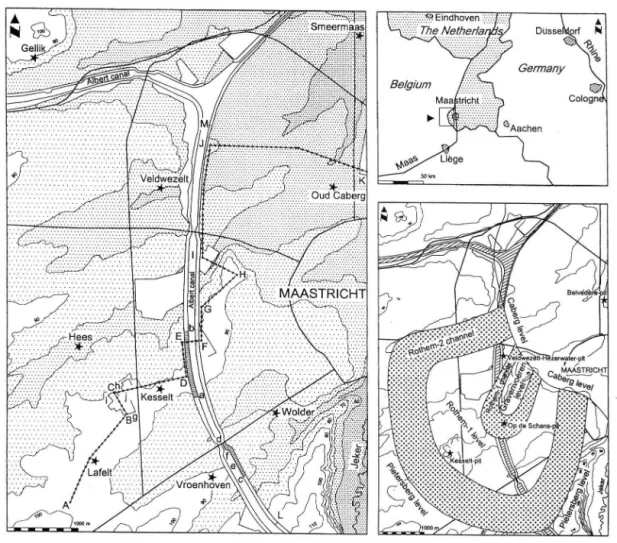
The research area is shown in Fig. 1. It is located
in a part of the drainage basin of the river M a a s .
Since the middle Pliocene (4 ma) the M a a s met
L o e s s stratigraphy in D u t c h and Belgian Limburg
115
the Rhine near Aachen (Germany). Afterwards the Maas moved westwards and started around 800 ka to erode the Cretaceous and Paleocene lime
stones and Oligocene sands in the study area (van den B e r g 1996). The continuous uplift of the area, the alternation of glacial and interglacial periods and the lateral westward shifting of the Maas were responsible for the preservation of an extraordi
nary extended and complete river terrace sequence.
Transition periods between interglacial and glacial times were favourable for river-erosion and inci
sion, while gravel-accumulation took place under cold and severe conditions, on the base of widely observed cryogenic features within the gravel beds
' (van den B e r g 1996). Interglacial regimes favoured the formation of river floodloams and lateral ero
sion. After the retreatment of the Maas from the research area, the preserved river terraces were al
ternately eroded by wind- and water-action and covered by eolian sands and loesses. The bounda
ry between the coversand area in the north and the loess belt in the south is located near Gellik (Fig. 1). T h e present landscape is smoothly undu
lating, with SW-NE orientated valleys, draining to the rivers Jeker and Maas in the east.
Several brickyards are exploiting loess-pits near Kesselt and Veldwezelt (Nelissen pit "Kesselt" and Vandersanden pits "Veldwezelt-Hezerwater" and
^Eindhoven
^--v 777e
NETHERLARY.BELGIUM 1
S/ Dusseft
GERMANY
A torf N 1
^Eindhoven
^--v 777e
NETHERLARY.BELGIUM 1
Maastricht Cologne? W[
• ( i v . v . v . v . v . v . v ;
® Aachen
30 km
Fig. 1: Location o f the study area a n d position of the cross sections L - M , A-K, a-b, d-c, f-e, g-h a n d i - j , w h i c h are shown in Fig.
2, 4, 5 and 6. A t t h e right bottom: t w o fossil meander c h a n n e l - b e d s from R o t h e m - 1 and R o t h e m - 2 river-terraces are indicated on the base o f o u t c r o p and drilling information.
Abb. 1: L a g e des Forschungsgebietes u n d Lokalisierung d e r Aufschlüsse L-M, A-K, a-b, d-c, f-e, g-h u n d i-j in Fig. 2, 4, 5 u n d 6. In der rechten unteren Ecke sind, b a s i e r e n d auf B o h r u n g e n und Aufschlüssen, zwei fossile M ä a n d e r b ö g e n der R o t h e m - 1 und R o t h e m - 2 Flussterrasse w i e d e r g e g e b e n .
1 1 6 ERIK P. M . MEIJS
"Op de Sclians"). In fact the area along the Albert C a n a l is an i m p o r t a n t l o e s s - e x p l o i t a t i o n z o n e which will be further investigated in the future.
T h e Nelissen pit "Kesselt" was, until 1996, the t y p e - l o c a t i o n for the s o - c a l l e d H e s b a y e l o e s s , which induced research by several universities. In the future this site will possibly be assigned as the type-location for the rare Upper Saalian " B - l o e s s "
(see chapter chronostratigraphy). The Vandersand- en c o m p a n y started exploiting the loess-pit " O p de S c h a n s " in March 2000 (Fig. 1). For the study of pre-Weichselian loesses, it is a promising loca
tion because it is situated in line with the most complete and differentiated pre-Weichselian out
crop along the widened Albert Canal (Fig. 2 ) . Between 1975 and 1985 the Albert Canal was wid
ened and detailed research of the exposed walls led to a thorough understanding of the geological and geomorphological genesis of this area. Ex
posed sediments in neighbouring loess-pits were then correlated to the Albert Canal sequences.
T h e discovery of four major archeological sites (Maastricht-Belvedere, Kanne, Kesselt and Veld- wezelt-Hezerwater) in the research area led to ad
ditional stratigraphical and chronological research.
In conclusion, the research area could be consid
ered as a key-region for present and future loess- stratigraphical research.
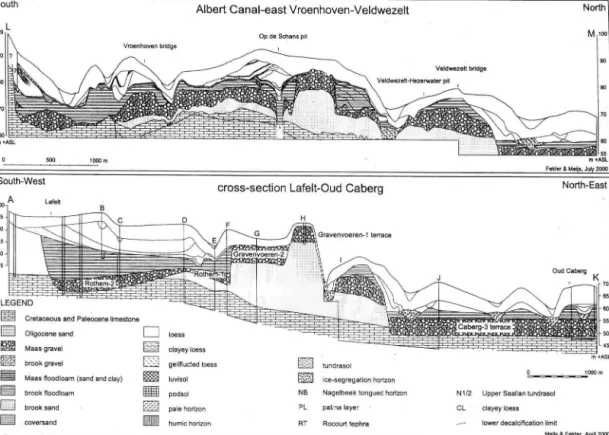
Terrace sequence of the river Maas In Fig. 2 the roughly SW-NE and S-N orientated cross-sections clearly show the strong influence of river erosion and aggradation processes in the area. T h e cross-section Lafelt-Oud Caberg (A-K;
Fig. 2 bottom) is constructed on recorded sections along the Albert Canal and adjacent loess-pits and a d d i t i o n a l d r i l l i n g i n f o r m a t i o n
( H a l e t1 9 3 2 ,
F e l d e r & B o s c h
1989 and
G e o l a b1996), while the Vroenhoven-Veldwezelt cross-section (L-M;
Fig. 2 top) is based on outcrop-information along the w i d e n e d wall of the eastern side of the Albert Canal. Four distinct river terrace sequences can be distinguished. According to gravel-base heights the R o t h e m terrace-level seems to be divided into two sublevels; representing an outward sliding meandercurve-complex (Fig. 1). In a wider con
text,
F e l d e r & B o s c h(1989) deduced from the presence of different gravel-bases and two distinct f l o o d l o a m g e n e r a t i o n s , t h e e x i s t e n c e of two Rothem sub-levels: Rothem-1 and Rothem-2. As well for the Gravenvoeren level, a distinction be
tween Gravenvoeren 1 and 2 seems justified, al
though section F-H in Fig. 2 is the only example
of a terrace-division in the Gravenvoeren sequence throughout the Maas terrace area between Liege in B e l g i u m and Roermond in The Netherlands
( F e l d e r & B o s c h
1989 and
v a n d e n B e r g1996).
According to
F e l d e r & B o s c h(1989) the Pieters- berg and Maarland terrace levels are present over a distance of 100 meters, in a SW direction from point A and in a NE direction from point K seen in the cross-section Lafelt-Oud Caberg, with gravel bases at about 98 m A S L and 38 m A S L (Fig. 1, Fig. 2).
It is clear that during long periods a sediment-trap existed between the heights of the Pietersberg and Gravenvoeren terraces, which resulted in an ex
tremely thick loess cover in between.
H e a v y mineral analysis
As stated above, lithological, sedimentological and paleopedological analyses of loesses are rarely able to discriminate between the different w a r m and cold stages of the Upper Pleistocene. However, correlations between different loess sections can be strengthened and stratigraphical conclusions can be drawn by means of heavy mineral analysis.
In c o m b i n a t i o n with m i c r o m o r p h o l o g i c a l and lithological research, the content of the g r e e n amphibole and volcanic minerals are used to cor
relate individual loess sections and to construct a loess-stratigraphical framework for the research area.
Methods Loess minerals:
T h e investigation of the mineralogical composi
tion of the loess fraction (30-63 g m ) in relation to the loess stratigraphy began in The Netherlands
( v a n D o o r m a e l
1945). This research was continu
ed by
G u l l e n t o p s(1954),
L a u t r i d o u(1968),
J u - v t g n e(1978,1985),
B a l e s c u & H a e s a e r t s(1984),
M e i j s
(1985),
J a n u s(1988) and
H e n z e(1998) in the loess-belt of France, Belgium, The Nether
lands and Germany.
J u v i g n e(1978) proposed the ratio between "green amphibole + garnet / zir
con + rutile" to distinguish Weichselian loess from pre-Weichselian loess. This approach was adopt
ed in G e r m a n y by
H e n z e(1998). Both
G u l l e n t o p s(1954) and
M e i j s(1985) mentioned the i m portance of green amphibole as a discriminating heavy mineral in stratigraphical research. Accord
ing to
B a l e s c uet al. (1986) the West-European
loess-belt is divided into separate regions w i t h
specific mineralogical properties. This implies that
green amphibole percentages may differ slighdy
between these regions. The overall tendencies how-
Loess stratigraphy in Dutch a n d Belgian Limburg
117
Albert Canal-east Vroenhoven-Veldwezelt
M.ioo
FELDER A MEIJS, July 2 0 0 0
S o u t h - W e s t A Lafelt
cross-section Lafelt-Oud Caberg
Gravenvoeren-1 terrace
LEGEND
EPÜ Cretaceous and Paleocene limestone Oligocene sand
Maas gravel brook gravel
Maas floodloam (sand and clay) brook floodloam brook sand coversand
EH •
E3
"7J
loess clayey loess geliflucted loess luvisol pod sol pale horizon humic horizon
3 1
m
tundrasol ice-segregation horizon Nagelbeek tongued horizon patina layer Rocourt tephra
N1/2 Upper Saalian tundrasol CL clayey loess
lower decalcification limit
Moqs & Felder. Ap-D 2000
Fig. 2: S W - N E a n d S-N cross-section showing t h e g e o m o r p h o l o g i c a l a n d geological structure o f t h e study area. T h e role o f fluvial/eolian erosion and a g g r a d a t i o n processes are p o i n t e d out.
A b b . 2: S W - N O u n d S-N Querschnitte, w e l c h e d i e g e o m o r p h o l o g i s c h e u n d g e o l o g i s c h e S t r u k t u r d e s Gebietes darstellen.
Auffallend sind die Hinweise a u f fluviatile u n d ä o l i s c h e Abtragungs- u n d Sedimentationsprozesse.
ever are the same. Even in northern Germany drill
ing data from
HENNINGSEN & STEPHAN ( 2 0 0 0 )showed that the amount of green amphibole in
creases from the Elsterian to the younger Saalian and Weichselian sediment series.
Requivenient for this kind of stratigraphical re
search however, is that the samples should b e of
"real" eolian loess, as loess may have been rede- posited and may be contaminated with older un
derlying material, mixing the green amphibole con
tent.
Wet sieving of chemically untreated samples was carried out to obtain the fraction 3 0 - 6 3 m m . T h e heavy a n d light minerals were separated in bro- moform by using a centrifuge and the heavy min
eral fraction w a s sucked u p using a micropipet.
From each sample about 3 0 0 transparent heavy minerals w e r e counted, using the ribbon-count
ing method as described by
VAN H A R T E N ( 1 9 6 5 ) .The percentage of green amphibole in the frac
tion 3 0 - 6 3 g m was calculated based on the total amount of all counted transparent heavy miner
als.
Volcanic minerals:
Until n o w only three volcanic tephra layers have been found in the research area, all originating in the volcanic Eifel in Germany.
Minerals from the Laacher See tephra have been detected on the archeological site of K a n n e by
PAULISSEN
et al.
( 1 9 8 1 ) ,just on top of the Holocene soil, that was burried b y colluvium. The Laacher See tephra, 1 2 , 2 5 0 calibrated years BP, occurs in more than 5 0 pollen diagrams (Germany, Belgium, France and Italy) in the final phase of the Allerod
oscillation (JUVIGNE 1 9 9 3 ) .
The Eltville tephra is the only tephra-layer visible by eye. It lies just beneath the Nagelbeek tongued horizon (NB) and is dated by
1 4C and T L methods
b e t w e e n 1 6 and 3 0 ka (JUVIGNE 1 9 9 3 ) .
118 ERIK P. M . MEIJS
Like the Laacher See tephra, the Rocourt tephra is only detectable by using microscopical equipment and occurs in secondary position in colluviated humic material, just above the Rocourt pedocom- plex of the last interglacial
( G U L L E N T O P S1954,
J U V I G N E
1977,
M E E S & M E I J S1984). T h e estimat
ed age on the base of indirect
1 4C and
2 3 0T h -
2 3 4U - datings lies between 61.5 and 106 ka
( J U V I G N E1993).
Stratigraphically the Eltville tephra is less interest
ing than the Rocourt tephra because the Nagel- beek tongued horizon (NB), which lies in the same stratigraphical position as the Eltville tephra, is a very characteristic and almost always present mark
er horizon from the French coast to eastern Eu
rope
( H A E S A E R T Set al. 1981,
M E I J Set al. 1983).
For the mineralogical research of tephra-material, the sediment-fractions 63-106 m m (Laacher See tephra) and 106-300 m m (Rocourt tephra) were used. T h e further preparation and counting is sim
ilar to the above-mentioned methods used for the green amphibole analysis.
Description and results
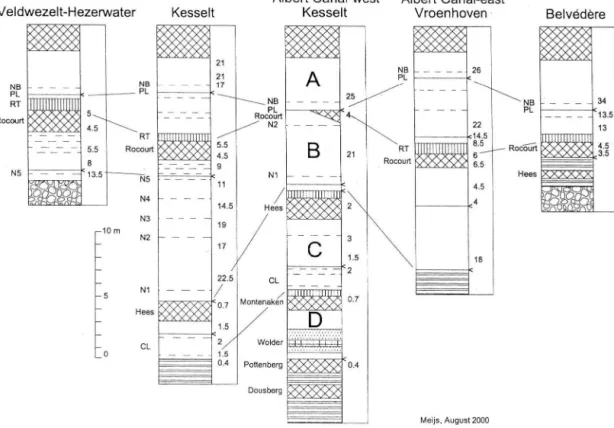
In this chapter four major litho-pedological units are described separately; namely "A-loess", " B - loess", " C - l o e s s " and "D-loess" (Fig. 3). From each unit samples were taken for heavy mineral a n d / o r micromorphological analysis. The results are pre
sented and discussed beneath.
Loess cycle A (max. thickness at location "Veld- wezelt-Hezerwater": 24 meter)
In lower topographical positions and in shallow paleovalleys this sequence often starts with the presence of white-greyish ( 1 0 Y R 5 / 4 ) pale sedi
ment, followed by darkbrown ( 1 0 Y R 4 / 3 ) humic material, most often directly covering the redbrown coloured ( 1 0 Y R 5 / 8 ) Rocourt pedocomplex of the last interglacial. The material predominantly con
sists of redeposited loess-sediment, from the Ro
court p e d o c o m p l e x
( J U V I G N E1 9 7 8 ,
V A N D E N B E R G H E
et al. 1998). The base of both horizons,
especially that of the humic horizon, is of erosive origin (Fig. 5 bottom). The lower part is heavily bioturbated, leading to the formation of a mixed zone between the humic material and the pale se
diment with numerous krotovinas. T h e humic ho
rizon is often divided into three sublevels
( M E E S& M E I J S
1984,
H A E S A E R T Set al. 1999); the bottom and top consisting of dark brown material and the middle part of lightbrown material that may laterally merge in a downslope direction into a grey
ish pale horizon (Fig. 5 bottom). Just on top of
this humic horizon a yellowish loess is sometimes present ("marker-loess"), representing the first eolian loess-supply since the last interglacial peri
od.
Just after the outburst of the Eltville tephra, the climate was extremely cold and dry. As a result, a polar desert pavement ( P L : patina layer) formed, discordantly lying upon the older deposits with windblown gravels at its base. T h e term "patina layer" has been chosen because of the clearly visi
ble wind varnish (patina) present on the recov
ered paleolithic artefacts from this horizon. T h e wind erosion created a totally n e w landscape, dis
regarding the underlying valleys and ridges (Fig. 4 and 6). In fact it formed more or less the present landscape, because only a blanket of pure eolian loess was deposited on top of it afterwards, with no erosion phases in between (Brabant loess). T h e most important soil-formation phase which took place after the formation of the desert pavement r e s u l t e d in t h e f o r m a t i o n of t h e N a g e l b e e k tongued horizon (NB), lying just on top of the desert pavement and showing characteristic cryo- turbation features at its base
( H A E S A E R T Set al.
1981).
In general the underlying Eltville tephra is eroded during this wind erosion phase. Only in excep
tional topographical positions, such as sediment- traps, the tephra is preserved.
The present study and earlier studies
(VAN D O O R - M A E L 1945, G U L L E N T O P S 1954, L A U T R I D O U 1968, J U V I G N E 1978, B A L E S C U & H A E S A E R T S 1984, M E I J S1985,
J A N U S1988 and
H E N Z E1998) reveal that the green amphibole percentages in Weichselian loess deposits range from 8 to 4 0 % . In the study area the mean percentage for the loesses deposited, just above the humic horizon, is around 10%. Above these first loesses the percentage quickly reaches the mean values for the "A-loess" in this region, around 2 0 % (Fig. 5 middle part).
A s seen before, volcanic minerals of the Rocourt tephra have b e e n microscopically traced in the above-mentioned humic horizon. T h e minerals occur in secondary position throughout the hum
ic material but often show a distinct concentra
tion peak on top of the lower h u m i c sublevel
( M E E S & M E I J S 1984, M E I J S & G R O E N E N D I J K 1999,
personal communication
G U L L E N T O P S1999; Fig.
5 bottom).
Apart from the serrated appearance of the clinopy- roxines, the presence of enstatite is very diagnos
tic for the Rocourt tephra
( G U L L E N T O P S1954, J u -
Loess stratigraphy in D u t c h and Belgian Limburg 119
Meijs. August 2000
Fig. 3: M o d e l , showing the proposed litho-pedological relations b e t w e e n the most i m p o r t a n t loess sections. T h e numbers are indicating the percentages of green a m p h i b o l e from l o e s s - s a m p l e s in the fraction 30-63u.m. In this figure the tundrasols are indicated by dashed lines. For legend see Fig. 2.
Abb. 3: Sammelprofile für d a s Untersuchungsgebiet, w e l c h e die litho-pedologischen Z u s a m m e n h ä n g e z w i s c h e n den wichtig
sten Lössaufschlüssen andeuten. Die Zahlen g e b e n den Anteil v o n g r ü n e n A m p h i b o l e n [in % ] am S c h w e r m i n e r a l s p e k t r u m (Fraktion 30-63u.m) wieder. Tundrenböden sind durch punktierte L i n i e n angedeutet. L e g e n d e siehe Fig. 2.
viGNE 1977). T h r o u g h microprobe analysis J u v i g n e et al. (1996) were able to detect the pres
ence of volcanic glass shards in the heavy mineral section.
Recent mineralogical research reveals the presence of the Rocourt-tephra at three locations in the research area (Fig. 3, 5 and 6). Concentration val
ues can decline dramatically in downslope as well in upslope directions in the same stratigraphical position (Fig. 5 bottom; see also Juvigne 1977).
Fig. 5 shows that in extreme cases percentages are tending towards zero. T h e weakly developed hu
mic horizon on the northern side of this section does not show any volcanic minerals at all.
Loess cycle B (max. thickness at location "Kes
selt": 12 meter)
Thick loess sequences situated beneath the Rocourt pedocomplex are very rare. The relative abundance
of these deposits in the research area is explained by the presence of geomorphologically defined se
diment-traps between the different river terraces of the Maas. The most impressive "B-loess"-sequence is present in the Nelissen pit "Kesselt" which has been issue of smdying by several universities dur
ing the past 50 years (Fig. 6). Here, even calcareous
"B-loess" is found which has not been influenced by the soil-formation processes of the last intergla
cial. In the Nelissen pit, the so-called "B-loess" se
quence has been interpreted as middle Weichselian from the first description of the section ( G u l l e n t o p s 1954) until 1996. In 1996, the uncovering of the Rocourt pedocomplex and the presence of the Rocourt tephra on top of it allowed J u v i g n e et al.
(1996) to put the " B - l o e s s " sequence into the time
before last glaciation (see also chapter chronostrati-
graphy).
120 ERIK P. M . M E I J S
The " B - l o e s s " sequence starts with a polar desert pavement, which in general is less pronounced than that of the "A-loess" and shows more features of water activity. Locally, the influence of running water is distinct, showing large and shallow gully systems. This wind and water erosion phase is re
sponsable for an important hiatus in the different loess sections. T h e sequence on top of the desert pavement is representing an alternation of loess- sedimentation and five tundrasol-formation phases (N1-N5). Fossil ice-wedge casts are present at three different levels, starting at about 10-20 c m above the paleo-surface of the middle three tundrasols ( M f . e s & M e i j s 1984). T h e greyish ( 1 0 Y R 5 / 3 ) tun
drasols, especially the lower two, are well devel
oped and have a characteristic appearance some
times showing a whitish to greenish ( 1 0 Y R 7 / 1 ) thin layer on top and a strong orange-like, rusty ( 1 0 Y R 5 / 8 ) horizon at the base. They significantly differ from the over- and underlying tundrasols, present in the "A-loess" and "C-loess". T h e dis
tance between the lower two tundrasols ( N l and N2) varies from 2 to 4 meters and occasionally a faint weak developed tundrasol is present between
them (see also M e e s & M e i j s 1984 a n d H u i j z e r1993).
A n analogue loess sequence, situated below an Eemian paleosol and containing up to six tundra
sols, has been reported by B i b u s (1974, 1980) at several locations in Germany and is indicated as the "Bruchköbeler Nassboden-Komplex". Count
ing from below, the first and the third tundrasol have the most pregnant appearance. In compari
son with the situation in the Nelissen pit "Kes
selt" the similarity is striking, considering the fact that the second G e r m a n tundrasol matches the occasionally appearing tundrasol of Kesselt (be
tween the N l and N 2 ) .
On top of this sequence the Rocourt pedocom
plex is present at times, especially in sediment-traps like paleovalleys and scarp foots (Fig. 3, 5 and 6).
Here periods of colluviation alternated with sub
sequent soil-formation finally produced a complex soil-profile showing several generations of clay- illuviation, leaching and polygonal developement
( H a e s a e r t s & V a n V l i e t - L a n o e 1 9 8 1 , M e s t d a g h& H a e s a e r t s 1 9 9 8 , V a n m o n t f o r t et al. 1998,
S c h i r m e r 2 0 0 0 a n d p e r s o n a l c o m m u n i c a t i o n M O c h e r 1999). T h e issue of chronostratigraphi- cal correlation with M I S - 3 instead of M I S - 5 will be discussed in the chapter dealing with chrono- stratigraphy.
The green amphibole percentages in the "B-loess"
range from about 2 0 % at its base to around 5 % in
the loess-sediments deposited at the e n d of this period, just prior to the onset of the last intergla
cial. In general the " B - l o e s s " is heavily truncated.
In such a situation only the lower amphibole-rich part is preserved from erosion and the overlying tundrasols and Rocourt pedocomplex are missing (Fig. 4 ) . In that case distinction between "A-loess"
and " B - l o e s s " by m e a n s of their green amphibole content is not possible. Until 1984 loess sequenc
es with high green amphibole percentages were assigned to the "A-loess". In the mid-eighties how
ever B a l e s c u & H a e s a e r t s (1984) a n d J u v i g n e
(1985) found in northern France and eastern Bel
g i u m an interglacial paleosol between loess layers with a high green amphibole content a n d it lasted until 1996 that J u v i g n e et al. (1996) discovered the same situation for the sequence in the Nelis
sen pit "Kesselt" (see Fig. 6). Taking into account these n e w insights, the stratigraphical framework had to be revised and a great part of the so-called Hesbaye loess ("A-loess") was interpretated as " B - l o e s s " ( J u v i g n e et al. 1996).
T h e consequent decrease of the green amphibole content from the older to the younger layers is striking (Fig. 6). T h e decrease of these percentag
es towards the end of the "B-loess" period has also been reported in northern France and east
ern Belgium by B a l e s c u & H a e s a e r t s (1984) and J u v i g n e (1985). J u v i g n e (1985) suggests that the
chemical weathering of green amphibole could provide an explanation. However, as shown in Fig.
6 g r e e n amphibole percentages already start to diminish within the calcareaous loess, which has not been influenced by chemical weathering proc
esses at all. Thin section, grain-size and sedimen- tological analyses all point to an upward coarsen
ing, a decrease in mineral sorting, a diminishing soil-stability and an increasing stream power re
g i m e in an upward direction within the " B - l o e s s " -
s e q u e n c e ( H u i j z e r 1 9 9 3 , V a n d e n b e r g h e et al.1998). This implies that the climate w a s changing from d r y towards m o r e moist conditions. In ac
cordance to the study area (Fig. 6) B i b u s (1980) reported wide spread overlandflow activity in the a b o v e m e n t i o n e d G e r m a n loess s e c t i o n s , just above the sixth Bruchköbeler tundrasol, before the onset of the last interglacial. Thus climate change seems a more plausible explanation for decreas
ing amphibole percentages than chemical weath
ering.
As proposed by J u v i g n e (1978), the most proba
ble provenance area for green amphibole is the outwash zone of the Scandinavian icecap. Possi
bly d r y climatic conditions were a dominant fac-
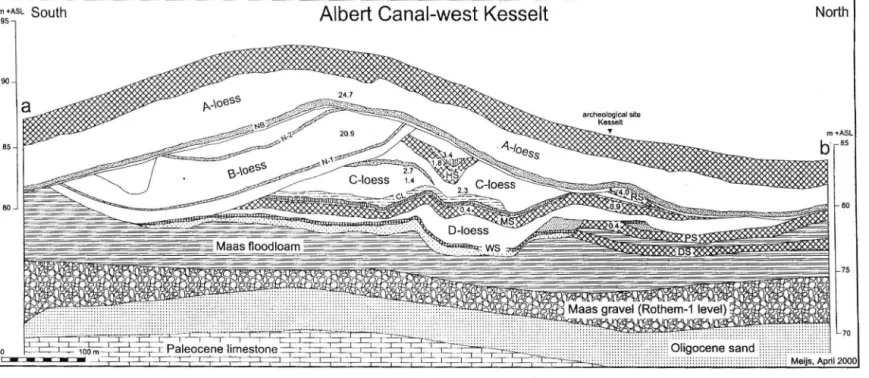
Fig. 4: O u t c r o p of the w e s t e r n side of the w i d e n e d Albert Canal near Kesselt, showing a massive, almost c o m p l e t e loess sequence. Especially the glacial loess-covers of M i d d l e and L o w e r Saalian age (C- and D-loess) and the interglacial luvisols from the m a r i n e isotope stages (MIS) 5, 7, 9, 11 and 13 are represented. T h e g r e e n amphibole percentages from different loess-samples in the fraction 30-63 urn are indicated by numbers. T h e abbreviations R S , HS, M S , W S , PS and D S are respectively u s e d for the Rocout soil, the H e e s soil, the M o n t e n a k e n soil, the Wolder soil, the Pottenberg soil and the D o u s b e r g soil.
For l e g e n d see Fig. 2
Abb. 4: Aufschluss an der W e s t w a n d des Albert Kanals in der N ä h e von Kesselt mit einer der vollständigsten Löss-Serien dieser Region. Besonders die glaziale L ö s s d e c k e der Mittel- u n d Alt-Saalezeit (C- u n d D-Löß) und die interglazialen Luvisols, die d e n Isotopenstadien (MIS) 5, 7, 9, 11 und 13 entsprechen, sind deutlich erkennbar. D i e A b k ü r z u n g e n R S , H S , M S , W S , PS u n d D S stehen für den Rocourt-Boden, den H e e s - B o d e n , den M o n t e n a k e n - B o d e n , den Wolder-Boden, d e n Pottenberg-Boden u n d den D o u s b e r g - B o d e n . Die Zahlen g e b e n den Anteil des G r ü n e n A m p h i b o l s [in % ] a m S c h w e r m i n e r a l s p e k t r u m (Fraktion 30-63 u.m) wieder. L e g e n d e siehe A b b . 2.
122 ERIK P. M . MEIJS
Fig. 5: O u t c r o p on the e a s t e r n side of the w i d e n e d Albert Canal n e a r Voenhoven s h o w i n g a pedo- lithological s e q u e n c e presenting the Weichselian (A-loess) and U p p e r Saalian (B-loess) p e r i o d s . In the upper two drawings, the g r e e n a m p h i b o l e p e r c e n t a g e s from the different loess-samples in the fraction 30-63 u.m are indicated by n u m b e r s . T h e b o t t o m d r a w i n g shows the variation in the volcanic m i n e r a l content o f the R o c o u r t tephra. T h e n u m b e r s indicate the percentages of transparent, volcanic heavy minerals in relation to all c o u n t e d transparent and o p a q u e heavy minerals in the fraction 1 0 6 - 3 0 0 u.m. T h e abbreviation R S and W S are used for the R o c o u r t and Wolder paleosols. For legend see Fig. 2.
Abb. 5: Aufschluss entlang d e r O s t w a n d des A l b e r t - K a n a l s , in der N ä h e von V r o e n h o v e n , m i t einer Abfolge v o n W e i c h s e l (A) und J u n g - S a a l e (B). D i e zwei o b e r e n Z e i c h n u n g e n g e b e n den Anteil d e s G r ü n e n A m p h i b o l s [in % ] a m S c h w e r m i n e r a l s p e k trum (Fraktion 30-63 um) w i e d e r . D i e detaillierte Z e i c h n u n g unten zeigt die Variation des Gehaltes vulkanischer M i n e r a l e des R o c o u r t - T u f f s . D i e Z a h l e n r e p r ä s e n t i e r e n d e n Anteil der t r a n s p a r e n t e n v u l k a n i s c h e n S c h w e r m i n e r a l e an allen g e z ä h l t e n transparenten und opaken S c h w e r m i n e r a l e n (Fraktion 106-300 u.m). D i e A b k ü r z u n g e n R S u n d W S bedeuten R o c o u r t - B o d e n und Wolder-Boden. L e g e n d e siehe A b b . 2.
Loess stratigraphy in D u t c h and Belgian Limburg 123
S o u t h
Nelissen pit Kesselt
N o r t hMeijs. January 2000
Nelissen pit Kesselt
Fig. 6: S-N and W-E cross-sections in the N e l i s s a n pit Kesselt s h o w i n g the most c o m p l e t e U p p e r Saalian loess sequence (B- loess) in this region with at least five intercalated fossil tundrasols. T h e n u m b e r s are representing the g r e e n a m p h i b o l e percent
ages from loess-samples in the fraction 3 0 - 6 3 u.m. T h e a b b r e v i a t i o n s R S and HS are used for the Rocourt a n d H e e s paleosol.
For the l e g e n d see Fig.2.
Abb. 6: S-N- und W-E-Querschnitte durch die Nelissen-Grube b e i Kesselt (einer der Aufschlüsse mit der vollständigsten J u n g - Saale-Lössabfolge (B) der R e g i o n ) , g e k e n n z e i c h n e t durch m i n d e s t e n s fünf fossile T u n d r e n b ö d e n . Die Z a h l e n g e b e n den A n teil des G r ü n e n A m p h i b o l s [in % ] am S c h w e r m i n e r a l s p e k t r u m (Fraktion 30-63 um) wieder. Die A b k ü r z u n g e n R S und H S stehen für den Rocourt-Boden und den H e e s - B o d e n . Legende siehe A b b . 2.
tor in the transport of green amphibole to the research area. During moist to wet climatic condi
tions a long-lasting snow-cover probably prevent
ed large-scale deflation from the braided outwash plains.
The uniformity of the green amphibole percent
ages in the upper part of the " B - l o e s s " and within the Rocourt pedocomplex (4-6%) in the different sections is striking (Fig. 3, 4, 5 and 6). This may mean that at the end of the " B - l o e s s " period an uniform loess blanket was deposited, on which
colluvial and soil-formation processes took place later on.
Loess cycle C (max. thickness at location "Albert Canal-west Kesselt": 7 meter)
Sediments of the " C - l o e s s " sequence are encoun
tered at two locations in the research area (near Kesselt; see Fig. 4 and 6).
T h e sequence starts with a characteristic clayey
loess (CL). In most cases a weak greyish tundrasol
is present at the base as well as on top of this
124 ERIK P. M . MKIJS
clayey loess. Above, laminated and heavily cryo- turbated loess-sediment occurs, which is overlain by more homogeneous loess with another tundra
sol transferring upwards into laminated and geli- flucted sediment (Fig. 4 ) . T h e sequence ends with the formation of a red-brownish ( 8 . 5 Y R 5 / 6 ) inter
glacial soil and overlying pale and humic horizons.
Thin section analysis clearly shows the presence of in situ clay-cutans within the interglacial pale
osol (MEES 1984). Micromorphological research also revealed that the overlying pale and humic horizons consist of eroded and colluviated mate
rial with a lot of transported and rounded ferric nodules derived from the interglacial paleosol be
low (MEES 1984).
According to the mineralogical results presented in Fig. 3 and 4 and on the base of lithological and paleopedological characteristics of the over- and underlying sediments, this interglacial paleosol can no longer be correlated with the Rocourt pedo
complex. We therefore propose to name this pale
osol after the neighbouring village of Hees in Bel
gian Limbourg; the Hees soil.
T h e green amphibole percentages in this sequence are rather constant, ranging from 1-3%. In the Nelissen pit "Kesselt" (Fig. 6) it seems that the p e r c e n t a g e s here also d e c r e a s e u p t h r o u g h the stratigraphy. It may be possible that, given the more laminated and sandy character of the uppermost sediments, this is due to the mixing with older sed
iment-material from below.
Mineralogical research of the Hees soil and over
lying pale and humic horizons in cross-section Albert Canal-west Kesselt (Fig. 4) did not reveal the presence of volcanic minerals.
Loess cycle D (max. thickness at location "Albert Canal-east Op de Schans": 8 meter)
In the research area this sequence represents the first eolian cycle after the formation of the wide spread and massive (sandy) floodloams belonging to the Rothem terrace-level of the river Maas.
These sediments have been recognized at two lo
cations along the widened Albert Canal (near Kes
selt and Vroenhoven; Fig. 4 and 5).
T h e sequence starts with two different sediment fades. In the beginning, formation of broad, shal
low gullys took place, filled up by redeposited sandy floodloam material.
Later, coversand was blown out of these gully sys
tems onto adjacent interfluvia. Locally, a greyish ( 8 . 5 Y R 5 / 3 ) podsolic soil is present on top of both fades, the so-called Wolder soil (FELDER & BOSCH
1988). After the podsol-formation the sedimenta
tion of coversand, continued in places (Fig. 4).
Soon after however, loess-accumulation predomi
nated. A t their base the loesses have a laminated character, becoming more homogeneous, although periods of more overlandflow activity m a y inter
v e n e . T h e s e q u e n c e is closed by a r e d b r o w n ( 1 0 Y R 5 / 6 - 8 ) interglacial paleosol, with a subse
quent grayish ( 1 0 Y R 7 / 2 to 2 . 5 Y R 7 / 4 ) sandy, pale horizon and a darkbrown ( 1 0 Y R 4 / 4 ) h u m i c hori
zon. T h e interglacial paleosol is assigned as the Montenaken soil after FELDER & BOSCH (1988) and thin section analysis revealed the presence of at least two clay-illuviation generations (MEES 1984).
T h e large number of charcoal pieces present in the pale horizon is striking. No micromorphologi
cal indications were found for an existing erosion hiatus between the Montenaken soil and the over
lying pale and humic horizons. However, glauco- nite grains were found within the Montenaken soil, but not in the sediments above (MEES 1984).
T h e percentages of green amphibole are v e r y low (0.5-1%) in this sequence and are difficult to dis
criminate between the sediments from b e l o w (Fig.
3 and 4 ) .
T h e Montenaken soil and the overlying pale and humic horizons, were checked for the presence of volcanic minerals. Here also the result w a s neg
ative.
Rothem river terrace
As mentioned above the Rothem terrace is mould
ed in the study area as an outward bending mean
der-curve, with the deepest incision depth at the outerside of the curve (Fig. 1 and 2). D u r i n g the process of lateral and vertical river erosion huge quantities of Oligocene sand were eroded and re- deposited over short distances. The great sediment load probably lead to the accumulation of an im
portant sequence of alternating clayey a n d sandy floodloams.
This sequence ended with the formation of an intense red-coloured ( 5 Y R 5 / 8 ) interglacial pale
osol, the so-called Pottenberg soil (FELDER &
BOSCH 1988). In some sections of the widened Albert-canal another redbrown coloured luvisol is present beneath the Pottenberg soil, w i t h inter
calated floodloam in between (Fig. 2, 4 ) . Probably local river activity of the " C a b e r g - 1 " M a a s gave rise to a thin floodloam cover on top of this pale
osol. It is representing the equivalent of the warm
period between the formation of the Rothem-2
and Caberg-1 terraces. T h e luvisol is assigned to
L o e s s stratigraphy in D u t c h and Belgian L i m b u r g 125
the neighbouring Dousberg and will be named Dousberg soil (Fig. 4).
T h e earlier results of
B U S T A M E N T E S A N T A C R U Z(1973), which show negligible green amphibole percentages for the Maas terrace sequences, can be supported by the present study, where the per
centages range from 0-0.5% (Fig. 4, 6).
Chronostratigraphy
By m e a n s of characteristic "marker" horizons, in combination with mineralogical and chronologi
cal data and in correlation with the "Bruchköbel
er" loess sections in Germany ( B i b u s l 9 7 4 , 1980) it is attempted to construct an extended chrono- stratigraphical framework for the research area, which is related to the river terrace sequence of the M a a s , the standard Marine Isotope Stages (MIS) of the astronomical calibrated ocean records O D P - 6 7 7 and M D 9 0 0 9 6 3
( B A S S I N O Tet al. 1994), the dust and temperature successions in the Vos- tok ice core
( P E T I Tet al. 1990,1999) and the long continental pollen records from Massif Central, France
( R E I L L Eet al. 1998) (Fig. 7).
In this respect the Vostok dust record is of major i m p o r t a n c e , indicating continental aridity, dust mobilization and dust transport were most preva
lent in the full glacial stages. This is also reflected by m a n y other dust records from for instance Greenland (GRIP
M E M B E R S1993), Africa
( D E M E N - O C A L1995) and China
( V A N D E N B E R G H Eet al. 1997).
It is obvious that the extreme cold oscillations at the end of interglacial stages were too short to g e n e r a t e l a r g e - s c a l e l o e s s d e f l a t i o n (see also
S C H I R M E R
1999). Both the ice core sequence
( P E T -rr et al. 1999) as well as the terrestrial pollen records
( T Z E D A K I S
et al. 1997,
R E I L L Eet al. 1998) confirm the presence of four major climatic cycles during the past 400,000 years. Each climatic cycle is start
ing with an extreme w a r m and humid stage
( R E I L L Eet al. 1998; M I S 11.3, 9.5, 7.5 and 5.5; Fig. 7) and ends with an extreme cold and dry stage
( P E T I Tet
al. 1999, B A S S I N O T et al. 1994, L O Y E R et al. 1995;
MIS 10.2, 8.2, 6.2 and 2.2; Fig. 7).
Weichselian
For the Weichselian period (MIS 2-4) recent mulridis- ciplinary research at the archeological site Veldwezelt- Hezerwater is of great importance. Together with the standard sequences of Harmignies and Remicourt in Belgium
( H A E S A E R T S1974,
H A E S A E R T Set al. 1999), this is one of the most complete Weichselian loess sequenc
es in western Europe
( G U L L E N T O P Set al. 1998).
The present study focuses however on MIS-stages 5- 12.
Upper Saalian
TL-dating of the " B - l o e s s " sequence, containing the characteristic tundrasols beneath the (part of the) Rocourt pedocomplex with related Rocourt tephra, did provide mean ages of 130-140 ka in the Nelissen pit "Kesselt"
( V A N D E N H A U T Eet al.
1998,
W I N T L Ein
V A N D E N H A U T Eet al. 1998). These ages are in accordance with mean TL-dating re
sults of around 140 ka from several loess sections in middle Germany, containing tundrasols of the
" B r u c h k ö b e l e r N a s s b o d e n - K o m p l e x " present beneath a redbrown interglacial paleosol
( Z Ö L L E Rin
F R E C H E N1991). A t the archeological site Maas
tricht-Belvedere, T L - d a t i n g of the first eolian loesses, present above Caberg-3 floodloams and influenced by soil-formation processes of the last interglacial, gives a m e a n minimum age of 115 ka
( D E B E N H A M
1993). In fact, these results clearly demonstrate that the " B - l o e s s " , containing the characteristic tundrasols and showing green am
phibole percentages from 20-5%, perfectly fits into MIS-6 (Fig. 7).
However, loesses deposited during the period of strong overlandflow and gully-formation, just be
fore the onset of the last interglacial period (see Nelissen pit "Kesselt", Fig. 6) yielded TL-ages of 50-60 ka
( V A N D E N H A U T E1998,
W I N T L Ein
V A N D E N H A U T E1998). On the base of these TL-ages
V A N D E N H A U T E
et al. ( 1 9 9 8 ) a n d
M E I J S &G R O E N E N D I J K
(1999) assumed an important ero
sion hiatus between the guUy-filling and underly
ing tundrasol-sequence N 1 - N 5 . In contrary to
J U V I G N E
et al. (1996),
V A N D E N B E R G H Eet al. (1998) did not correlate the interglacial-like paleosol to the Rocourt pedocomplex (MIS-5). On the base of numerous
1 4C - dates of the N 1 - N 5 tundrasols (30-37 ka) and the above mentioned TL-results of 50-60 ka they proposed for correlation with MIS-3 and assigned it as the Lafelt soil.
According to new chronological data from a sim
ilar sequence at the archeological site Veldwezelt- Hezerwater, it seems reasonable to accept the cor
relation with MIS-5 after
J U V I G N Eet al. (1996). A thorough study is prepared on this subject in co
operation with the universities of Gent (Belgium) and Amsterdam (The Netherlands). T h e chrono
logical results from the archeological site Veld- wezelt-Hezerwater will be published in a later pa
per.
Middle Saalian
TL-dating done on burnt flints and calcareous tufa
and ESR-dating of molluscs, all found in relation
to interglacial soil-formation on top of the Ca-
126 ERIK P. M . MEIJS
Fig. 7: Chronostratigraphical framework constructed by correlation o f l o e s s , river terrace, pollen, dust and m a r i n e / i c e i s o t o p e s e q u e n c e s , o n the base of lithological and paleopedological characteristics and mineralogical a n d chronological data. T h e dust and t e m p e r a t u r e records are a d o p t e d from PETIT et al.(1999), while the pollen and i c e - v o l u m e sequences are a c q u i r e d from REILLK et al. (1998) and BASSINOT et al. (1994).
For l e g e n d see Fig. 2.
Fig. 7: Chronostratigraphische Übersicht, entwickelt auf der Basis von D a t e n zur L ö s s s e d i m e n t a ü o n , Bildung v o n F l u s s t e r r a s sen, Staubabfolge, Pollenanalytik, Mineralogie u n d Chronologie. S t a u b - u n d T e m p e r a t u r d a t e n n a c h PETIT et al. ( 1 9 9 9 ) , Pollen
daten u n d D a t e n z u m E i s v o l u m e n nach REILLE et al. (1998) und BASSINOT et al. (1994). L e g e n d e siehe Abb. 2.
Loess stratigraphy in D u t c h and Belgian Limburg 127
b e r g - 3 floodloams, s h o w average ages ranging from 2 2 0 ka (ESR) to 2 5 0 ka (TL; with a mini
m u m age of
1 7 5ka for molluscs:
V A N K O L F S C H O -T E N et al. 1 9 9 3 ) . According to m e a n TL-data of around 2 4 5 ka for Middle Saalian loess sequences m m i d d l e Germany, present beneath two intergla
cial paleosols
( Z Ö L L E Ret al.
1 9 8 8 )1and the above- indicated data for the archeological site Maastricht- Belvedere, it seems m o s t logical to assign the grav
el-aggradation phase of the C a b e r g - 3 terrace lev
el and the " C - l o e s s " with green amphibole per
centages ranging from 1 - 3 % , to M J S - 8 (Fig. 7 , see also
V A N K O L F S C H O T E Net al.
1 9 9 3 ) .This implies that the Hees soil m a t c h e s with M J S - 7 a n d the Montenaken soil with MTS-9.
L o w e r Saalian
For correlating the Weichselian a n d Saalian river terraces with the m a n n e / i c e isotopic records and the terrestnal pollen sequences, only two convinc
ing reference points are present: the Maasmeche- len terrace (first p r e s e n c e of R o c o u r t tephra;
P A U L I S S E N 1 9 7 3 )
and the Caberg-3 terrace (ESR and T L darings; see above). In d o w n w a r d direc
tion only the Pietersberg-2 ( 8 0 0 k a ) , Geertruid-2 ( 1 . 1 m a ) and Simpelveld-1 ( 2 . 1 m a ) terrace levels form important fixing points by their paleomag- netical polanty a n d / o r pollen content (VAN D E N
B E R G 1 9 9 6 ) .
Recent studies by
F E L D E R & B O S C H ( 1 9 8 8 , 1 9 8 9 ) , J U V I G N E & R E N A R D ( 1 9 9 2 ) and V A N D E N B E R G ( 1 9 9 6 )reported no further chronostrati
graphical data that can support m o r e detailed cor
relation. On the base of these fixing points and climo-tectomc modelling studies
V A N D E N B E R G( 1 9 9 6 ) found a correlation between the five lower river terraces of the Maas and the glacial manne isotopic stages 2 / 4 , 6 , 8 , 1 0 and 1 2 , denoting that only long-lasting full glacial stages generate major river terrace systems (see Fig. 7 ) . According to u r a n i u m senes dating and biostratigraphical re
search
M E I J E R A N D P R E E C E ( 2 0 0 0 )discovered ex
actly the same situation for the l o w e r terrace se
quence of the nver T h a m e s in England. On the base of these two studies the strongly developed, reddish Pottenberg soil, which has been found in m a n y sections along the widened A l b e r t Canal on top of the R o t h e m - 1 , Rothem-2 a n d Caberg-1 floodloams, should be attnbuted to MTS-11. Re
cent chronometncal andpollen-stratigraphical re
search on lacustnne dnlling cores in France, Italy and Greece and alluvial sediments in England, re
veals strong evidence for assigning M I S - 1 1 to the Holsteiman p e n o d
( T Z E D A K I Set al.
1 9 9 7 , R E I L L Eet al.
1 9 9 8and
M E I J E R A N D P R E E C E 2 0 0 0 ) .In plac
es the Pottenberg soil is underlain by a redbrown luvisol (Dousberg soil), which represents the warm period (MIS-13) between the formation of the Rothem-2 and Caberg-1 river terraces (VAN D E N
B E R G
1996).
T h i s implies that the " D - l o e s s " correlates with J M J S - I O and that the Pottenberg soil and Wolder soil are equivalent to respectively MIS-11.3 and MIS-11.1 (Fig. 7 ) .
Conclusions
T h o r o u g h lithological, m i n e r a l o g i c a l and pale- opedological examinations of numerous loess sec
tions in the study area, the application of recent chronological data and extended correlation with loess sections in middle Germany, m a d e it possi
ble to construct a reliable loess-stratigraphical framework, which begins with the Holsteinian and matches with the manne/ice isotopic and terres
tnal pollen records. It contains four glacial loess cycles with five intercalated interglacial paleosols on top of the R o t h e m nver terrace of the Maas.
A c k n o w l e d g e m e n t s
I wish to thank A.
G R O E N E N D I J Kfor his full coop
eration in the exhausting leveling and drawing ses
sions of the n u m e r o u s loess sections in the field.
He was very helpfull in discussing and lnterpre- tating the recorded data.
Prof. P.
V A N D E N H A U T E ,Prof. J.
V A N D E N B E R G H Eand Prof. E.
( U V I G N Eare thanked for providing constructive comments on the manuscript.
Appreciation g o e s out to prof. F.
G U L L E N T O P S ,A.
G R O E N E N D I J K
a n d J-P.
D E W A R R I M O N Tfor their positive cnticism and discussions in the field.
Great thanks are also due to W
F E L D E Rand P.
B O S C H
who supplied data from both sides of the
widened Albert Canal, which w a s of emense val
ue for this study.
Appreciation is extended to H.
V A N N I E U W E N B O R Gof the company of Geolab for supplying dnllmg- data from the potential loess-exploitation zone between Kesselt and Lafelt.
S H A W N B U B E L , F R E D E R I C C L A S S O N and E L K E S C H L E - P Ü T Z
were so kind to correct the English text.
128 ERIK P. M . MEIJS
References
A N T O I N E ,
P. [Ed.] (1998): Le Quaternaire de la vallee de la Somme et du littoral piccard. - Exc. Assoc.
Franc;, pour l'Etude du Quaternaire, 21-23 mai 1998, 162 S., 72 Abb.
A N T O I N E ,
P.,
L A U T R I D O U ,J.,
S O M M E ,J. et al. (1998): Les formations quaternaires de la France du Nord - Ouest: Limites et correlations. - Quaternaire, 9:
227-241, 3 Abb, 2 T a b , 1 Kte.; Paris.
B A L E S C U ,
S. &
H A E S A E R T S ,P. (1984): The Sangatte raised beach and the age of the opening of the Strait of Dover. - Geologie en Mijnbouw, 63: 355-362;
Utrecht.
— DUPUTS, C. & QUINIF, Y. (1986): La thermolumi- nescence du quartz: un marqueur stratigraphique et paleogeographique des loess saaliens et weichseiiens du NW de l'Europe. - C. R. Acad.
Sc. Paris, 302 serie II, (12): 779-784; Paris.
B A S S I N O T , F. C , L A B E Y R I E , L. D , V I N C E N T , E , Q U I D E L - L E U R , X , S H A C K L F . T O N ,
N.J. &
L A N C E L O T , Y.(1994):
The astronomical theory of climate and the age of the Brunhes-Matuyama magnetic reversal. - Earth and Planetary Science Letters, 126: 91-108; Amster
dam.
B E R G ,
M. W.
VAN D E N(1996): Fluvial sequences of the Maas: a 10 Ma record of neotectonics and climate change at various time-scales. - Thesis University Wageningen: 181 p.; Wageningen.
B I B U S ,
E. (1974): Abtragungs- und Bodenbildungspha
sen im Risslöss. - Eiszeitalter und Gegenwart, 25:
166-182; Stuttgart.
— (1980): Zur Relief-, Boden- und Sedimententwick
lung am unteren Mittelrhein. - Frankfurter Geo
wiss. Arb., Dl: 295 p.; Frankfurt a. M.
B U S T A M A N T F . S A N T A C R U Z ,
L. (1973): Les mineraux lourds des alluvions sableuses du bassin de la Meuse.
- Diss. Katholieke Universiteit Leuven: 355 p.
D F B E N H A M ,
N. (1993): A short note on thermolumi- nescence data of sediments from the Palaeolithic site Maastricht-Belvedere. - Mededelingen Rijks Geologische Dienst, 47: 45-46.; Maastricht.
D O O R M A E L ,
J.
VAN(1945): Onderzoekingen betreffende de loessgronden van Zuid-Limburg. - Dissertatie Wageningen.
F E L D E R ,
W M. &
B O S C H ,P. W (1988): Geologische kaart van Zuid-Umburg en omgeving: Oppervlaktekaart.
- Rijks Geologische Dienst Heerlen.
— (1989): Geologische kaart van Zuid-Limburg en omgeving: Afzettingen van de Maas. - Rijks Geol
ogische Dienst Heerlen.
F R E C H E N ,
M. (1991): Thermolumineszenz-Datierungen an Lössen des Mittelrheingebiets. - Sonder
veröffentlichungen Geol. Inst. Univ. Köln, 79: 137 p.; Köln.
GEOLAB (1996): Boringen ten behoeve van ontginning- szone Kesselt voor Gewestplan L i m b u r g s Maasland, gemeente Lanaken, kaartblad 34/2. - Geolab b. v. b. a. Boringen-Bodemonderzoek, Plaanstraat 1, 9810 Eke-Nazareth, Belgium.
GRIP
M E M B E R S(Greenland Ice-core Project) (1993):
Climate instability during the last interglacial peri
od recorded in the GRIP ice core. - Nature, 364:
203-207; London.
G U L L E N T O P S ,
F. (1954): Contributions ä la chronologie du pleistocene et des formes du relief en Belgique.
- Memoires de lTnstitut Geologique de l'Universite de Louvain, 18: 125-166; Louvain.
— G R O E N E N D I J K , A. J , M E I J S , E. P. M , M Ü C H E R , H. J , V E R M E E R S C H
P.
M . & D E W A R R I M O N T , J .P. (1998):
Preliminary report of an exceptional palaeosol cat
ena of the last interglacial in the loess area of Bel
gian Limburg near Veldwezelt. - The Eemian Ex
cursion guide 1998, Local sequences, global per
spectives: 35-39.
H A E S A E R T S ,
P. (1974): Sequence paleoclimatique du Pleis
tocene superieur du bassin de la Haine (Belgique) - Ann. Soc. Geol. Belg, 97: 105-139; Liege.
— & V A N V L I E T - L A N O E , B .
(1981): Phenomenes periglaciaires et sols fossiles observes ä Maisieres- Canal, a Harmignies et Rocourt. - Biuletyn Pery- glacjalny, 28: 291-325; Wroclaw.
— J U V I G N E , E , K U Y L , O, M Ü C H E R , M . & R O E B R O E K S ,
W (1981): Compte rendu de l'Excursion du 13 juin 1981, en Hesbaye et au Limbourg Neerlandais, con- sacree ä la chronostratigraphie des loess du Pleis
tocene Superieur. - Ann. Soc. Geol. Belg, 104: 223- 240; Liege.
— M E S T D A G H , H. & B O S Q U E T ,
D. (1999): The sequence of Remicourt (Hesbaye, Belgium): New insights on the pedo- and chronostratigraphy of the Rocourt soil - Geologica Belgica, 2/3-4: 5-27; Brussels.
HALFT, E (1932): La Geologie du flanc occidental de la vallee de la Meuse ä l'Ouest de l'enclave de Maas
tricht d'apres les sondages d etude du Canal Al
bert. - Bull. Soc. Beige Geol., 42: 195-225; Brus
sels.
H A R T E N ,
D.
VAN(1965): On the estimation of relative grain frequencies in heavy mineral slides. - Geolo
gie en Mjnbouw, 44: 357-363; Utrecht.
H E N N I N G S E N ,
D. &
S T E P H A N , H.J.(2000): Die Schwer- mineral-Verteilung im Quartärprofil der For
schungsbohrung Tüschenbek (Schlewig-Holstein).
- Eiszeitalter und Gegenwart, 50: 50-55; Hanno
ver.
H E N Z E ,
N. (1998): Kennzeichnung des Oberwürmlösses der Niederrheinischen Bucht. - Kölner Forum Geol. Paläontol, 1: 212 p.; Köln.
H U I J Z E R ,
A. S. (1993): Cryogenic microfabrics and mac- rostructures: Interrelations, processes and paleoen- vironmental significance. - Thesis Vrije Universiteit Amsterdam: 245 p.
J A N U S ,
U. (1988): Löss der südlichen Niederrheinischen Bucht - Kölner Geographische Arbeiten, 49: 174 p.; Köln.
J U V I G N E ,
E. (1977): Zone de dispersion et age des pous- sieres volcaniques du tuf de Rocourt - Ann. Soc.
Geol. Belg, 100: 13-22; Liege.
— (1978): Les mineraux denses transparents des loess de Belgique. Zeitschrift für Geomorphologie, 22:
68-88; Berlin.
L o e s s stratigraphy in D u t c h and Belgian L i m b u r g 129
— (1985): The use of heavy mineral suites for loess stratigraphy. - Geologie en Mijnbouw, 64: 333-336;
Utrecht.
— (1993): Contribution ä la tephrostratigraphie du quaternaire et son application a la geomorpholo- gie. - Toelichrende Verhandelingen voor de Geolo
gische en Mijnkaarten van Belgie, 36: 66 p.; Brus
sels.
— & R E N A R D ,
F. (1992): Les terrasses de la Meuse de Liege a Maastricht. - Ann. Soc. Geol. Belg, 115, (1):
167-186; Liege.
— H A E S A E R T S , P, M E S T D A G H , H , P I S S A R T , A , & B A L E S C U ,
S. (1996): Revision du stratotype loessique de Kesselt (Limbourg, Belgique). - C. R. Acad. Sei.
Paris, 323: 801-807; Paris.
L A U T R I D O U , J .
P. (1968): Les loess de Saint-Romain et de Mesnil-Esnard (Pays de Caux). - Bull. C. Geo
morph, 2: 56 p.
K O L F S C H O T E N , T. V A N , R o E B R O E K S , W. & V A N D E N B E R G H E ,
J. (1993): The Middle and Late Pleistocene sequence at Maastricht-Belvedere: the Type Local
ity of the Belvedere Interglacial. - Mededelingen Rijks Geologische Dienst, 47: 81-91; Maastricht.
L O Y E R , S , V A N V L I E T - L A N O E , B , M O N N I E R , J - L , H A L - L E G O U E T ,
B. &
M E R C I E R ,N. (1995): La coupe de Nantois (Baie de Saint-Brieuc, France): Datations par thermolutninescence (TL) et donnees paleoen- vironnementales nouvelles pour te Pleistocene de Bretagne. - Quaternaire, 6 (1): 21-33; Paris.
M E E S ,
R. P. R. (1984): Paleobodems in de loss in West- en Midden-Europa. - Doctoraal scriptae, Instituut voor Bodemkunde, Rijksuniversiteit Utrecht: 72 p.
— & M E I J S ,
E. P. M. (1984): Note on the presence of pre-Weichselian loess deposits along the Albert Canal near Kesselt and Vroenhoven (Belgian Lim
bourg). - Geologie en Mijnbouw, 63: 7-11; Utrecht.
M E I J E R ,
T. &
P R E E C E ,R. C (2000): A review of the oc
curence of Corbicula in the Pleistocene of North- West Europe. - Geologie en Mijnbouw / Nether
lands Journal of Geosciences, 79 (2/3): 241-255;
Utrecht.
M E I J S ,
E. P. M. (1985): Loess stratigraphical research at the paleolithic site Maastricht-Belvedere. - Med
edelingen Rijks Geologische Dienst, 39 (1): 31-34;
Maastricht.
— M Ü C H E R , H. J , O U W E R K E R K , G, R O M E I N , A. &
S T O L T E N B E R G ,
H. (1983): Evidence for the presence of the Eltville tuff layer in Dutch and Belgian Lim- bourg and the consequences for the loess stratigra
phy. - Eiszeitalter und Gegenwart, 33: 59-78; Han
nover.
— & G R O E N E N D I J K ,
A. J. (1999): Midden-Paleolitische vondst in een nieuwe geologische context. - Arche- ologie in Limburg, 79: 1-6; Limburg.
D E M E N O C A L ,
P. B. (1995): Plio-Pleistocene African cli
mate - Science, 270: 53-59.
M E S T D A G H ,
H. &
H A E S A E R T S ,P. (1998): The Rocourt Soil: a pedo-stratigraphic marker for the Last Inter
glacial. - The Eemian Excursion guide 1998, Local
sequences, global perspectives: 27-34.
P A U L I S S E N ,
E. (1973): De morfologie en de kwartairstrati- grafie van de Maasvallei in Belgisch Limburg. - Ver
handelingen van de Koninklijke Academie voor Wetenschappen, Letteren en Schone Künsten van Belgie 35: 127 p.; Brussels.
— G U L L E N T O P S , F, V E R M E E R S C H , P.M., G E U R T S , M,-A, G I L O T , E , N E E R , W V A N , V O O R E N , E. VAN & W A G E - M A N S ,
E. (1981): Evolution holocene d'un flanc de vallee sur substrat permeable (Hesbaye seche, Belgique). - Mem. Inst. Geol. Univ. Louvain, 31:
23-75.
P E T I T , J. R , M O U N I E R , L , J O U Z E L , J , K O R O T K E V I C H , Y
S ,
K O T L Y A K O V ,V. I. &
L O R I U S ,C (1990): Palaeocli- matological and chronological implications of the Vostok core dust record. - Nature, 343: 56-58; Lon
don.
— J O U Z E L , J , R A Y N A U D , D, B A R K O V , N. I , B A R N O I . A , J.- M , B A S I L E , I , B E N D E R S , M , C H A P P E L L A Z , J , D A V I S , M , D E L A Y G U E , G, D E L M O T T E , M , K O T L Y A K O V , V.
M , L E G R A N D , M , L I P E N K O V , V Y , L O R I U S , C , P E P I N ,
L ,
R I T Z ,C ,
S A L T Z M A N ,E. &
S T T E V E N A R D ,M. (1999):
Climate and atmosferic history of the past 420,000 years from the Vostok ice core, Antarctica - Na
ture, 399: 429-436; London.
R E I L L E , M , A N D R I E U , V, B E A U L I E U D E , J.-L, G U E N E T , P.
& G O E U R Y ,
C (1998): A long pollen record from Lac du Bouchet, Massif Central, France: for the period ca. 325 to 100 ka BP (OIS 9c to OIS 5e). - Quaternary Science Reviews, 17: 1107-1123; Am
sterdam.
S C H I R M E R ,
W. (1999): Kaltzeiten und Warmzeiten im Löss - Terrestrische Quartärgeologie, 81-100.
— (2000): Eine Klimakurve des Oberpleistozäns aus dem rheinischen Löss - Eiszeitalter und Gegenwart, 50: 25-49; Hannover.
T Z E D A K I S , P. C , A N D R I E U , V, B E A U L I E U D E , J.-L, C R O W - H U R S T , S , F O L L I E R I , M , H O O G H I E M S T R A , H , M A G R I , D , R E I L L E , M , S A D O R I , L , S H A C K L E T O N , N. J. &
W I J M S T R A ,
T. A. (1997): Comparison of terrestrial and marine records of changing climate of the last 500,000 years. - Earth and Planetary Science Let
ters, 150: 171-176; Amsterdam.
V A N D E N B E R G H E , J , Z H I S H E N G , A , N U G T E R E N , G, H U A N - Y U , L. & V A N H U I S S T E D E N ,
K. (1997): New absolute time scale for the Quaternary climate in the Chi
nese loess region by grain-size analysis. - Geology, 25 (1): 35-38.
— H U I J Z E R ,
B ,
M Ü C H E R ,H. &
L A A N ,W (1998): Short climatic oscillations in a western European loess sequence (Kesselt, Belgium). - Journal of Quater
nary science, 13 (5): 471-485; Harlow.
V A N D E N H A U T E , P, Y A N C R A E Y N E S T , L. & D E C O R T E , F.
(1998): The Late Pleistocene loess deposits and palaeosols of eastern Belgium: new T L age deter
minations. -Journal of Quaternary science, 13 (5):
487-497; Harlow.
V A N M O N T F O R T , B , V E R M E E R S C H , P. M , G R O E N E N D I J K , A. J , M E I J S , E. P. M , D E W A R R I M O N T , J.-P. & G U L L E N T O P S ,
F. (1998): The Middle Palaeolithic site of
Veldwezelt-Hezerwater, Belgian Limbourg. - No-
130 ERIK P. M . MEIJS
tae Praehistoricae, 18: 5-11; Brussels.
ZÖLLER, L , STREMME, H. & WAGNER, G. A. (1988): Ther-
molurruneszenz-Datierung an Löss-Paläoboden- sequenzen von Nieder-, Mittel- und Oberrhein/
Bundesrepublik Deutschland.- Chemical Geology (Isotope Geoscience Section), 73: 39-62; Amster
dam.
1