Evolution of Lamayuru palaeolake in the Trans Himalaya: Palaeoecological implications
BAHADUR SINGH KOTLIA, INGELORE HINZ-SCHALLREUTER, ROGER SCHALLREUTER & JÜRGEN SCHWARZ*) Palaeolake deposits, neotectonics, Lamayuru (Ladakh), Late Pleistocene,
fossils, palaeoecology
A b s t r a c t : About 35,000-40,000 yr B P , an episode o f n e o - tectonic activity o n the Indus Suture Zone created a lake at Lamayuru (Ladakh) that h a s preserved a n over 105 m thick s e q u e n c e of fluvio-lacustrine deposits. T h e lacustrine horizons (carbonaceous muds) and a n u m b e r o f carbonate-rich strata interlayered with c l a y / silt/sand have yielded freshwater ostracods, gastropods and charophytes. A total o f nine fossiliferous h o r i z o n s are located. T h e prominent ostracod taxa are llyocypris (I. gibba and /. bradyi), Eucypris and Candona. T h e gastropods are dominated by Lymnaea, Succinea a n d Gyraulus. T h e charophytes c a n b e identified as Chara globularis. T h e palaeoecological interpretation is based on the characteristic faunal a n d floral content a n d the nature o f deposits. It is suggested that the lake, throughout its existence, was shallow with cold, e x t r e mely low salinity and slow flowing plant-rich waters. As an open basin, it may have had continuous outflow du
ring its existence. The depletion o f the lake was c a u s e d by structural disruption of the lake floor and by d e p o s i tion of a huge mass of debris flow, triggered by a further pulse of tectonic instability in t h e Late Holocene.
[ E n t w i c k l u n g d e s L a m a y u r u - P a l ä o s e e s i m T r a n s - H i m a l a y a : P a l ä o ö k o l o g i s c h e B e d e u t u n g ] K u r z f a s s u n g : Vor etwa 35 0 0 0 - 4 0 0 0 0 Jahren s c h u f e i n e Episode neotektonischer Aktivität a n der Indus-Sutur bei Lamayuru (Ladakh) einen See, v o n d e m eine über 1 0 5 m mächtige Abfolge fluviolakustriner Ablagerungen erhal
ten ist. Die zwischen Ton/Silt/Sand eingelagerten laku- strinen Horizonte (Kalkschlämme) und karbonatreichen Schichten h a b e n Süßwasser-Ostrakoden, G a s t r o p o d e n und Charophyten geliefert. Insgesamt wurden 9 Fossil
horizonte angetroffen. Die hauptsächlichen O s t r a k o - dentaxa sind llyocypris (l. gibba und /. bradyi), Eucypris und Candona. B e i den Gastropoden dominieren Lym
naea, SuccineaunA Gyraulus. Die Charophyten w e r d e n durch Chara globularis vertreten. D i e paläoökologische Interpretation basiert auf den charakteristischen Fau
nen- und Florenelementen und a u f der Natur d e r Sedi
mente. Es wird vermutet, daß der S e e während seiner ganzen Existenz ziemlich flach war und kaltes,
*) Addresses o f Authors: Dr. B . S. KOTUA, Department o f Geology, Durham House, Kumaun University, Nainital (U.P.), 263 0 0 2 , India; PD Dr. I. HINZ-SCIIALLREUTHR, Museum für Naturkunde, Invalidenstr. 43, D-10115 B e r lin, Gennany; PD Dr. R. SCHALLREUTER, G e o l o g i s c h - Paläontologisches Institut und Museum, Bundesstr. 5 5 , D-20146 Hamburg, Germany; Dr. J . SCHWARZ, Habsbur
gerallee 106, D-60385, Frankfurt a m Main, G e n n a n y
extrem salzarmes, langsam fließendes, pflanzenreiches Wasser führte. Als ein offenes B e c k e n mag er einen k o n tinuierlichen Abfluß während seiner ganzen Existenz g e habt haben. D i e Entleerung d e s Sees wurde verursacht durch eine strukturelle Zerrüttung des Seebodens u n d die Ausfüllung durch riesige, durch einen weiteren I m puls tektonischer Aktivität ausgelöste Schuttmassen.
1 I n t r o d u c t i o n
Northward movement o f the fndian plate has caus
ed accumulation of stress which is periodically released and results in the tectonic activity along the major faults/thrusts/tectonic zones (NAKATA, 1975).
The Quaternary time witnessed the intense oroge- nic movements in the Himalaya (GEE, 1989). Such movements, episodic in nature, especially during the Pliocene-Quaternary Period, have been respon
sible for complex architecture o f the Himalaya. T h e Himalayan mountains o f northern Pakistan have e x perienced probably world's most active uplifts and records o f Quaternary basins (SHRODERet al., 1989).
Around 1.5 ma BP, major uplifting and thmsting o c curred in the Salt Range, northwest Himalaya and the thrusting was also active in near regions (BUTLER et al., 1987; BURBANK & BECK, 1989). A number o f Hi
malayan sedimentary basins, such as Peshawar (BURBANK, 1983), Kashmir (BURBANK & JOHNSON, 1982; AGRAWAL et a l , 1989; HOLMES et al., 1992), Ku
maun (KOTUA et al., 1997a) and Kathmandu (FORT, 1980) have evolved during the Plio-Pleistocene as a result o f tectonic movements, and are still experien
cing continued tectonism. Similarly, in Ladakh Hi
malaya, the Indus Suture Z o n e represents one o f the most spectacular tectonic zones o f the globe (GANS- SER, 1964, 1977; FRANK et al., 1977; SRIKANTIA &
RAZDAN, 1980; THAKUR, 1981). Northward, the uplifts along Nanga Parbat-Haramosh syntaxis and along northeastern margin o f the Himalayan seismic- zones have contributed to the ponding of the Indus river in the Skardu basin (CRONIN, 1989).
During the Upper Quaternary, reactivations o f ma
jor thmsts/faults in a number o f Himalayan sectors have produced an enormous amount of debris avalanches resulting from slope failures and these have caused a blockade o f ancient drainages and
178 BAHADUR SINGH KOTLIA, INGELORE HINZ-SCHALLREUTER, ROGER SCHALLREUTER & JÜRGEN SCHWARZ
formation o f palaeolake basins (BURBANK, 1983;
VALDIYA et al., 1992; KOTLIA et a l , 1997a). In the
tectonically and seismically active Himalayan domain, such slope failures and impoundment o f rivers are very common (CRONIN, 1982, 1987;
VALDIYA
et al., 1992, 1996). Similarly, the Indus Suture Zone in the Trans-Himalaya has also b e e n considered as tectonically active during the Qua
ternary period (KOTLIA et al., 1997b). A number o f palaeolakes formed by damming o f ancient drain
ages in Ladakh in the northern Himalayan crest (e.g., at Skardu, CRONIN, 1982, 1989; at Jalipur on the Indus river, SHRODER et al., 1986, at Khaltse and along Gilgit river, BÜRGISSER et al., 1982; in the up
per Indus valley, OWEN, 1988) and at Lamayuru
( F O R T et al., 1989; SANGODE & BAGATI et al., 1996;
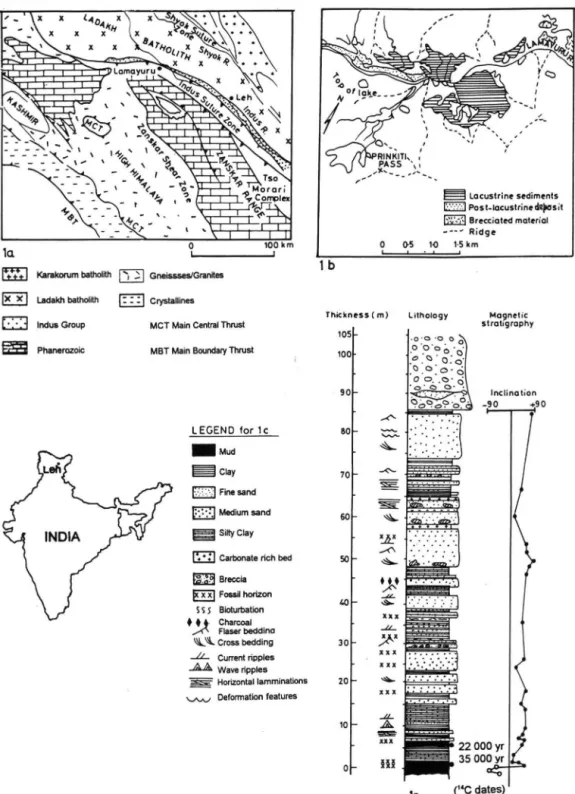
KOTLIA et al., 1997b) resulted from a reactivation of this zone in the Late Pleistocene. In western Ladakh (Fig. l a ) , at an altitude o f 3600 m, a lake was formed b y damming of the River Lamayuru (a tributary o f Indus) as a result o f tectonic upheaval on the Indus Suture Zone in the Late Pleistocene.
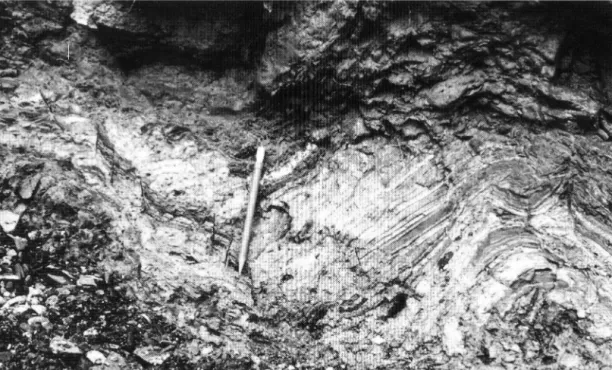
The spectacular lake deposits (Fig. 2) are locally called „Moonland rocks". Contemporary to the La
mayuru lake, another lake (we shall call it Pitok la
ke) was formed at Leh (Fig. 3) due to damming o f the Indus river. About 10-11 k m in length and 3-4 km in width, Pitok palaeolake deposits, exposed by the modern Indus at an altitude o f about 3090 m are under study.
The neotectonic movements around Lamayuru are evidenced b y various geomorphic features, such as the formation of river terraces developed along the Lamayuru and Indus rivers, the modification o f drainage including steep waterfalls on the western side o f the Lamayuru village, the nature o f linea
ment running parallel to the Lamayuru river, the formation o f gorge (600 m deep) and entrenched meanders within the course o f the river. Extensive shattering, crushing and weathering o f the country rocks at the contact of overlying lake deposits, and soft sedimentary deformational structures (e.g., micro-faulting, composite contortions, anticlinal/
synclinal features) within the basalmost part o f the palaeolake profile (Fig. 4 ) may further indicate the tectonic activity at the time o f formation o f the lake. Although similar deformational structures are also related to seismic or glacial processes, a va
riety o f geomorphological features as mentioned in the text, favour neotectonic processes in the Lamayuru valley.
The lacustrine muds, strata rich in biogenic activity and rapidly filled clastic deposits form the bulk o f the fuvio-lacustrine profile (Fig. l c ) at Lamayuru. A
further episode o f neotectonic activity, a sudden pulse of which was responsible for depositing a very thick (ca. 25-50 m) debris flow from the steep adjacent slopes may have caused breaching o f the dam. T h e debris flow is characterised by highly angular and ill-sorted pebbles to granules with sandy/muddy matrix and periglacial detritus.
Although a precise date for this tectonic activity is not known, it may have occurred about 1,000 yr BP
(BÜRGISSER et al. , 1 9 8 2 ; FORT et al., 1989). Out of the
two levels o f prominent terraces exposed along the Indus river between Khaltse and Leh, the younger terrace which is composed of river terrace deposits with rounded to angular gravels and clay/sand and with abundant matrix appears to be synchronous with this event.
2 L i t h o l o g y a n d Age o f Deposits The basalmost part (5-10 cm thick) is a mixture o f crushed and weathered country rocks and car
bonaceous mud. The whole litho-sequence can b e divided into four major lithological units. The l o wer part (0-13 m) is composed mainly of upward coarsening cycles of organic rich lacustrine muds/clays/silty clays and fine sands. The deposit between 13-45 m is dominated by recurring cycles of silty muds and medium sands, interbedded with numerous mm-cm scale carbonate layers or lenses and a few thick carbonate beds. Excellent preser
vation of plant remains, e.g., fragile leaves, stems, twigs and seeds, also characterises this lithological unit. Between 45 and 75 m, medium-coarse sands showing cross and flaser beddings are dominant.
Although not frequently, carbonate layers/hori
zons are also found in this unit. T h e uppermost part of the sequence is characterised by colluvial depo
sit of poorly sorted debris flow with several lenses of coarse sand and occasional clay lenses. Alth
ough there are plenty of carbonate-rich strata throughout the section, major and thick (up to 7 0 cm) horizons are at 36, 57, 64 and 72 m levels.
A gastropod-rich horizon, dated 35,000 yr BP b y FORT et al. (1989) is close to the top of the basalmost mud in our section (see Fig. l c ) . A further carbo
naceous horizon, dated 25,500 yr BP (FORT et al., 1989) seems to b e correlatable with a deposit about 5 m above the base in our section. BAGATI et al.
(1996) dated a charcoal-rich mud at Rong Gongh- ka locality o f 40,000 yr BP and suggested a little ol
der date for the basalmost beds. W e have obtained an age o f 22,000 yr BP on a charcoal-rich carbo
naceous mud at 5.3 m level in the section (age a c cording to G. RAJAGOPALAN, Radiocarbon Labora
tory, BSIP, Lucknow, India). O n the basis of these
I V A I Karakorum batholith | - , ^ | Gneissses/Granites
|X X | Ladakh bathotith | : : : | Crystallines
[•l'H Indus Group MCT Main Central Thrust
Phanerozoic MBT Main Boundary Thrust
LEGEND f o r 1c
H
Mud[•'•' -I Fine sand Medium sand Silty Clay
\ \ ° * \ Carbonate rich bed H23 Breccia B x x| Fossil horizon
S 5 s Bioturbation
• • 4 Charcoal Flaser beddina
*SU*. Cross bedding
— C u r r e n t ripples -AA wave ripples
Horizontal lamminations Deformation features
Inclination -90 +.90
("C dates)
Fig. 1: a) Geological map around Lamayuru (simplified from SHRODER et al., 1989).
b ) Extent o f Lamayuru palaeolake (simplified from FORT et al., 1989-
c ) Lithocolum of the profile showing fossiliferous horizons (magnetostratigraphy after KOTLIA et al., 1997b).
Abb. 1: a ) G e o l o g i s c h e Übersichtskarte der U m g e b u n g v o n Lamayuru (vereinfacht nach SCHRÖDER et al., 1989).
b ) Ausdehnung des Lamayuru-Paläosees (vereinfacht nach FORT et al., 1989).
c ) Lithologie des Profils u n d Lage der fossilführenden Horizonte (Magnetostratigraphie nach KOTLIA et al., 1997b)
ISO BAHADUR SINGH KOTLIA, INGELORE HINZ-SCHALLREUTER, ROGER SCHALLREITKR &)\ u< .IN SCHW AKZ
Figure 3: Leh (Ladakh) Quaternary deposits in the Vally (The road is leading to Khardungla, the highest pass of the world).
Abb. 3: Leh (Ladakh) Quartäre Ablageaingen im Tal (Die Straße führt nach Khardungla, clem höchsten Paß d e r Welt).
these dates, it is not realistic to assume the secli- A detailed palaeomagnetic chronology o f the
mentation rate because o f varied sedimentation sequence was carried out by KOTLIA et al. ( 1 9 9 8 )
pattern throughout the sequence. who reported a magnetic reversal at the base ( s e e
Figure 5: Chara globularis; histograms of some parameters, measured on 1 0 0 gyrogonites from M V 4 ho
rizon in the sequence.
Abb. 5: Cham globularis, Histogramme einiger Parameter, ermittelt an 100 Gyrogoniten aus d e m Horizont MV 4 innerhalb der Abfolge.
Fig. l c ) . Prior to this work, the only known mag
netic reversal event within the upper Quaternary in south Asia around this time from Indian Ocean
sediments has b e e n dated to 4 0 , 0 0 0 yr BP ( O P D Y K E
et al., 1 9 7 4 ) , and both the Lamayuru and Indian
Ocean events are correlatable (KOTLIAet al., 1 9 9 8 ) .
Thus, the available data suggest that the initiation of lacustrine sedimentation at Lamayuru took place around 3 5 , 0 0 0 - 4 0 , 0 0 0 yr BP, and that the fos
sil horizons, M V 3 - M V 9 are younger than 2 2 , 0 0 0 yr
182 BAHADUR SINGH KOTLIA, INGF.LORE HINZ-SCHALLREUTER, ROGER SCHALLREUTER & JÜRGEN SCHWARZ
Table 1: Lithology of various fossil horizons and recovered fossils.
Tab. 1: Lithologie der fossilführenden Horizonte und registrierte Fossilien.
Hori- Heigh Lithology
zon from base Ostracods
Invertebrate fossils Gastropods
Charophytes
MV1 30 cm Fine-medium, bluish sand layers (upto 5 m m thick) within lake mud, rich in organic debris, charcoal abundant
Ilyocyprisgibba(RAMDOHR) Succineasp.
/. bradyi, SARS
Eucypris afghanistanensis, HARTMANN
Candona candita, ( O . F. Mueller)
Chara globularis, THUILLIER ( G )
MV2 1.5 m Medium grained sand within carbonaceous mud, rich in organic debris
/. bradyi
E. afghanistanensis
Lymnaea sp.
Succinea sp.
Gyraulussp.
C. globularis ( o )
MV3 6.4 m Greyish medium sand E. afghanistanensis Lymnaea sp. C globularis(G) e m b e d d e d within bluish Succinea sp.
clay, plant remains and charcoal
MV4 17.0 m Fine coarse sand lenses E. afghanistanensis Succinea sp. C. globularis
within bluish silty clay, (MG) interlayered with
carbonate strata, abundant plant remains,
charcoal
MV5 24.8 m Yellow, cm thick silty clay interbedded with sand and carbonate layers, abundant plant remains
E. afghanistanensis Lymnaea sp.
Succinea sp.
C. globularis (MG, O)
MV6 27.8 m
Silty clay interbedded with sand layers, abundant plant remains
Succinea sp.
MV7 3 1 7 m Yellowish silty clay E. afghanistanensis Succinea sp.
lenses within medium sand and carbonate
layers, rich plant remains
MV8 37.0 m 70 c m thick carbonate E. afghanistanensis Lymnaea sp. c. globularis (O)
jaye r Succineasp.
r, , , ,• , • , j E. afghanistanensis MV9 56.0 m Medium sand interlayered
with slity clay/carbonate
G = gyrogonites, O = oospores, M = mass occurrence
BP. Although the recovered fossils are no precise indicator of age, the ostracods found in the se
q u e n c e have generally b e e n reported from Pleisto- cene-Holocene sediments in various parts o f the world (BHATIA, 1 9 6 8 ; SIDDIQUI, 1 9 7 1 ; DELORME,
1 9 7 1 ; SINGH, 1 9 7 4 ; DIEBEL & PIETRZENIUK, 1 9 7 5 ; L Ö F - FLER, 1 9 7 7 ; ROBINSON, 1 9 7 8 ; D E DECKKER, 1 9 7 9 ; K R - STIC, 1 9 8 8 ; FRAUSUM&WOUTERS, 1 9 9 0 ) .
3 D e s c r i p t i o n o f F a u n a l a n d F l o r a l F i n d s
In the lithocolumn, nine fossiliferous horizons (Fig. l c ) , yielding ostracods, gastropods, and c h a rophytes with their gyrogonites and/or o o s p o r e s were located (Table 1). MV1-MV3, rich in organic debris, were located within the lacustral unit, sediments o f which were deposited b e l o w w a v e
(fossil). Mean values in parentheses.
Tab. 2: Vergleich der biometrischen Daten von Cha- raglobularis(subiossi\) u n d Chara elongata (fossil).
Mittelwerte in Klammern.
Chara globularis 100 gyrogonites
(sample MV4)
Chara elongata ca. 100 gyrogonites (from SCHWAKZ 1985) length o f
polar axis [pm]
740-970 ( 8 2 5 - 9 0 0 ) 660-1010 ( 7 5 0 - 8 5 0 )
largest equatorial diameter [pm]
520-660 ( 5 5 0 - 6 2 5 ) 420-740 ( 4 5 0 - 5 2 5 )
iso- polarity index
122-170(135-145) 125-200 ( 1 5 0 - 1 7 0 )
equatorial cell diameter [pm]
60-100 ( 8 0 ) 6 0 - 1 1 0 ( 8 0 - 9 0 )
number of
convolutions
9 - 1 3 ( 1 1 ) 9 - 1 3 ( 1 0 - 1 1 )
diameter o f basal pore [pm]
30-70 ( 5 0 - 6 0 ) 30-100 ( 4 0 - 6 0 )
base conditions. MV4-MV8 were located within a unit, the deposition of which took place while the delta building activity in the lake was in process (KOTLIA et al., 1997b). In addition to the above mentioned characteristics, these horizons also contain oncoliths as well as numerous plant remains (e.g., leaf imprints, stems, twigs, seeds) preserved along the bedding planes. MV4-MV8 have also yielded unidentifiable b o n e fragments o f microvertebrates. MV9 was located within the fluvial deposit of channel sands in which compara
tively less carbonate deposition is found.
Among the gastropods, Lymnaeasp. (Plate 1, figs, a-b) is large-sized with a sharp elongate spire and a characteristic aperture. Morphologically, it is very similar to Lymnaea (Galba) andersoniana which is common in the Pleistocene lacustrine de
posits o f Kashmir, N W Himalaya (BHATIA, 1974).
Succinea sp. (Plate 1, fig. c ) has one whorl with oval shaped aperture. It is essentially the Hima
layan form and is known from Kashmir, Panjab and Kumaun Himalayas (PRASAD, 1937). Gyraulus sp.
(Planorbidae) comprises o f gradually opening whorls (Plate 1, fig. d) with concave dorsal side and
lake deposits o f Panjab and Kashmir respectively
(BHATIA & MATHUR, 1 9 7 3 ) .Even today, Gyraulus lives in the modem lakes o f Ladakh at an altitude o f 3 , 0 0 0 - 3 , 5 0 0 m in cold climate with temperatures between 5 and 8 °C.
Among ostracods, abundance o f llyocypris (I. gib- ba
RAMDOHRand /. bradyi,
SARS)in
M V 1 - M V 2and widespread occurrence o f Eucypris afghanista
nensis,
HARTMANNthroughout the sequence is recorded. T h e difficulties in identification o f the representatives o f llyocypris have been commen
ted upon by a number o f workers (SIDDIQUI, 1 9 7 1 ;
SINGH, 1 9 7 4 ; VAN HARTEN, 1 9 7 9 ; PREECE et al., 1 9 8 6 ; ROBINSON, 1 9 9 0 ) . On o n e hand, the noded andsmooth forms are considered as two extremes o f a single genus, while on the other hand, two such forms are regarded as two distinct species. Fol
lowing HOLMES ( 1 9 9 6 ) , w e have, in this study,
assigned tuberculate forms to L. gibba (Plate 1, figs, e-h) and non-tuberculate forms to /. bradyi (Plate 1, figs. i-j). Although /. gibba has some degree o f variation in tubercle strength, the major dorsal scars are more or less fused and the mandi
bular scars are roundish. In external view its ven- trum is slightly concave and the dorsum is oblique tapering posteriorly.
In /. bradyi, the dorsum is somewhat straight and the ventrum is concave. It lacks strong tubercles and the major dorsal scars are not fused.
Eucypris afghanistanensis
HARTMANNis the first report from the Pleistocene o f northwest India.
The shell is arched on the dorsal side. The greatest height is slightly before the middle from where the anterior side forms a shallower slope compared to that towards the posterior side (Plate 1, figs. k-p).
The anterior border is flat and has its maximum convexity in the lower third of the valve. The po
sterior end is narrow and more acute than the an
terior end. The ventral margin is distinctly concave in the median part. Candona candita (O. F.
MUELLER) has an elongate carapace outline (Plate 1, fig.
t). The dorsum is strongly curved while the ven
trum is centrally concave. The anterior margin is narrowly rounded while the posterior margin is so
mewhat truncated.
The charophytes, represented by both oospores and gyrogonites (Plate 2 , figs, a-p), are assignable to the Recent Chara globularis
THUILLIER 1 7 9 9 ( =Chara fragilis
DESVAUX 1 8 1 0 ) ,a species of the sec
tion Grovesia of the genus Chara (cf.
W O O D & IMA- HORI 1 9 6 5 ) . The gyrogonites, sometimes veryabundant (e.g., in M V 4 - M V 5 ) , can be described as
184 BAHADUR SINGH KOTLIA, INGELORE HINZ-SCHALLREUTER, ROGER SCHALLREUTER & JÜRGEN SCHWARZ
follows: The general shape of the gyrogonites is el
liptic to oval. T h e apical pole, as a rule, is well rounded, not standing out against the general outline, in rare cases a little protruding. The basal pole is generally slightly tapering, subtruncate at the very tip and rarely well rounded. The spiral cells are smooth, without ornamentation, predo
minantly flat, occasionally faintly concave or con
vex, and the intercellular ridges are very fine, so
mewhat more conspicuous only in the apical area.
In the apical periphery, the spiral cells are slightly decreased in width without reduction in thickness.
They are distinctly concave without exception, even in gyrogonites with otherwise flat spiral cells.
A marked enlargement of spiral cells is observed in the apical centre, those partly resting concave, partly conspicuously thickened at their ends and forming an indistinct "apical rosette", more so in gyrogonites with strongly calcified spirals. T h e basal pore is pentagonal, superficial, sometimes with a shallow crateriform depression. The basal plug is pentagonal, plate shaped, ca. 45 pm in height with the upper surface ca. 120 pm in width.
The biometric data (Table 2) and the morphology of these sub-fossil gyrogonites perfectly match with the description and illustrations o f Recent gyrogonites of Chara globularis, reported by ear
lier workers (e.g., HORN AF RANTZIEN, 1959; KRAUSE,
1986, SOULIE-MÄRSCHE, 1989). The present gyro
gonites show very close morphological resem
blance with Chara elongata from the Upper Oli- gocene/Lower Miocene o f Central Europe (cf.
SCHWARZ, 1985). However, Chara elongata has more elongated gyrogonites; it thus has a greater isopolarity index (see Table 2).
4 P a l a e o e c o l o g i c a l R e m a r k s
Ostracods are common constituents o f the carbo
nate sediments and their occurrence along with charophytes in this sequence add palaeoecologi
cal significance. Such an ideal combination o f ostracods-charophytes, for the first time, was re
ported from a fresthwater Late-glacial lake in Strathmore (LYELL, 1824). A number of factors, e.g., size, turbidity, permanence o f water body and its temperature, nature of lithological units etc. may control the occurrence o f ostracods. llyocypris is abundant in MV1, present in MV2 and absent the
reafter. I. bradyi, a typical cold water species
(FRAUSUM & WOUTERS, 1 9 9 0 ) is stenothermal ( D E DECKKER, 1 9 7 9 ) and holarctic (DIEBEL & PIETRZENI-
UK, 1977). It is reported in abundance from open water deposits o f shallow palaeolakes (HOLMES et al., 1992), generally associated with a rich vegeta
tion (BHATIA, 1 9 6 8 ; SINGH, 1 9 7 4 ) and is found pre
dominantly burrowing or crawling among aquatic plants and organic debris (PREECE et al., 1 9 8 6 ) . It prefers water o f low salinity (DIEBEL & PIETRZENIUK, 1 9 7 5 ) and is abundant in the sediments of a Hima
layan palaeolake which had permanent outflow
during its existence (HOLMES et al., 1 9 9 2 ) .However, /. gibba is an active swimmer
(VAN HARTEN, 1 9 7 9 ; PREECE
et al.;
1 9 8 6 )and /. bradyi notab
ly can not swim (VAN HARTEN, 1 9 7 9 ) , so that
the abundance o f both in M V 1 appears to be o f pa
laeoecological significance. /. gibba is common in slow flowing waters with temperatures between 4
and 1 9 . 5 ° C (ALM, 1 9 1 6 cited in DIEBEL & PIETRENIUK, 1 9 7 5 ; D E DECKKER, 1 9 7 9 ) . W e think that
during the lacustrine deposition, /. gibba may have lived in the water column, whereas /. bradyi preferred the lake margins. A number of shells o f Pisidium (a bivalve which according to
BHATIA( 1 9 7 4 ) is indicative o f lacustrine conditions) in the M V 1 - M V 2 horizons provides additional support, in addition to the nature of the sedimentation pattern, for a lacustrine environment during the deposition of the basal beds in the sequence.
Eucypris afghanistanensis, present almost throughout the sequence, is cold stenothermal and lives in cold water springs and streams (HARTMANN,
1 9 6 4 ) .
It is a poor swimmer. All species of Eucypris (except E. lutariä) are cold water forms and h e n c e are significant climatic indicators (HARTMANN,
1 9 6 4 ) .
Today, E. afghanistanensis or similar forms live in the Himalayas at an altitude o f up to 4 , 5 0 0 m
(HARTMANN, 1 9 7 5 ) .
E. pigra, a cold and
stenothermal species ( D I E B E L & PIETRZENIUK, 1 9 7 7 )lives in the higher altitudes of the Alps at tempera
tures below 1 2 °C (LÜTTIG, 1 9 5 9 ) , and is found together with E. virens at altitutes of
2 , 0 0 0m or more
(HARTMANN, 1 9 7 5 ) .E. zenkeri, another similar species, is a characteristic form o f slowly flowing, cold, shallow, and plant-rich waters (SIDDIQUI,
1 9 7 1 ) .
Today, a number o f species o f Eucypris from China are found in cold climate with annual mean temperatures between -5 and -8°C with a salinity below 5 %o (YANG, 1 9 8 8 ) although it is also present up to + 2 ° C in certain areas. On the basis of the widespread presence of E. afghanistanensis almost throughout the existence o f the Lamayuru lake, we suggest that the palaeolake was shallow with abundant plant material around, and the slow flowing water was cold, probably colder than to
day and in which cold loving ostracods, e.g., Eucy
pris and llyocypris flourished. Candona candita
also registers its presence in the Lamayuru s e
quence. A cold water form of freshwater environ-
organic debris on the beds o f lakes and ponds
(HOLMES, 1996). It has holarctic distribution (DIEBEL& PIETRZENIUK, 1 9 7 5 , 1 9 7 7 ) .
Earlier mention of Parastenocypris,
HARTMANN from these deposits (FORT et a l , 1989; KOTLIA et al.,1997b) also supports our palaeoecological inter
pretation. Parastenocypris is characteristic o f shal
lower channels of cold waters (SINGH, 1974), and is frequently found in the freshwaters of India (HART-
MANN, 1975).Today, Chara globularis has nearly cosmopolitan
distribution (CORILLION, 1957; HORN AF RANTZIEN,1959) but is centered around the northern hemi
sphere. It ranges from arctic regions (Greenland, Iceland) to tropical latitudes. In India, it is part o f the Recent flora (VAIDYA, 1967), and has b e e n reported to occur in several Holocene palaeolakes in north India, dated from 8,500 to 2,800 y r . B P
(BHATIA & SINGH, 1989). As can b e expected from itspresent geographic distribution, Chara globularis tolerates a wide range of ecological factors. How
ever, slow flowing, calm, slightly carbonaceous waters without heavy currents offer optimum growing conditions. But, unlike most other species of Chara, it adapts to fairly low calcium levels
(HORN AE RANTZIEN, 1959) and even ventures intoslightly acidic waters. It is often found growing intermingled with phanerogamic plants in rather eutrophic environments (KRAUSE, 1997), a feature seldom encountered with charophytes, which tend to form pure submerse "chara stands". T h e maximum water depth suited for colonisation is controlled by transparency o f the water body; thus, shallow water (normally below 5-10 m) is favour
ed. Although freshwater not is preferred, LUTHER (1951) mentioned finds from even mesohaline conditions in the Baltic Sea. Chara globularis has been reported from shallow waters beneath the ice cover as well as from hot springs.
Abundance o f oncoliths (as in MV4-MV8) indicates shallow water conditions. T h e deposition o f organically rich carbonate which probably favour
ed the growth of oncoliths may typify the semiarid to arid alpine environment (FORT et al., 1989) in delta platforms (as MV4-MV8 horizons in our sec
tion), in areas which only occasionally receive the clastic influx (OVIATT et al., 1994). The assumed shallow water conditions for the depositon o f MV4-MV8 may further be strengthened by the pre
sence o f abundant plant material on the bedding planes as such a situation would demand shallow enough shoreline conditions for plants to flourish
5 D i s c u s s i o n a n d C o n c l u s i o n The Lamayum lake was formed sometime b e tween 35,000-40,000 yr BP either due to heavy landslides (FORT et al. 1989) or due to tectonically induced damming o f the Lamayum drainage. An event o f formation o f various tectonic lakes in the Central Himalaya (e.g., Bhimtal, 40,000 yr BP, KOT
LIA et al., 1997a), Kumaun Himalaya (Wadda lake, 37,000 yr BP, KOTLIA et al., communicated), Tethys
Himalaya (Late Pleistocene, MOHINDRA & BAGATI,1996), eastern Ladakh (e.g., Tsokar ca. 35,000 yr BP, BHATTACHARYYA, 1989) and western Ladakh (e.g., Lamayum) provides evidence for a promi
nent tectonic activity throughout the Indian Hima
layas between 35,000 and 40,000 yr BP. Evolution of a series of tectonic lake basins around this time in China (FANG, 1991) and western China (RHODES et al., 1996) probably adds to the significance of this tectonic event in Asia.
In the palaeolake, the sedimentation took place in form o f lacustrine muds, deltas, fluvial sands and colluvial debris flow. During the lacustrine sedi
mentation, the swimming ostracods may have lived in running/moving waters, whereas, the non- swimmers may have occupied the lake margins burrowing on aquatic plants and organic debris. During the delta building, highly dissolved carbonate favoured the growth of charophytes and ostracods. Under semiarid to arid conditions, the lake may have had low salinity because o f conti
nuous outflow. This is evidenced by the wide
spread occurrence o f Eucypris which according to HOLMES (1992) prefers very low salinity waters. The shallow water conditions are evidenced by the presence o f numerous oncoliths, the majority of weak or non-swimmer ostracod species, the abundance of Chara globularis in most o f the fos
sil horizons and the occurrence of shallow shoreli
ne produced plant remains. The temperature o f the lake may have been low as most ostracods found in our sequence are characteristic of cold waters.
A number o f Ladakhi palaeolake profiles in the Main Himalayan crest, as mentioned in the text, bear a striking similarity with Lamayuru deposits in sedimentation pattern including carbonate-rich layers. However, if compared with the deposits of closed inland basins o f the Himalaya, there ap
pears to b e a contrast. While the closed inland
basins are characterised by carbonaceous muds
and extensive peat deposits with low frequency o f
fossil ostracods, the Lamayum deposits are domi-
186
BAHADUR SINGH KOTUA, INGELORE HINZ-SCHALLREUTER, ROGER SCHALLREUTER & JÜRGEN SCHWARZnated by oxidized and biologically rich carbonates which are very rich in ostracods. An example for such a situation is the Karewa lake basin of Kashmir on the southwestern side of the Himalaya.
The Lower Karewa lake profile is composed o f mainly blue/black massive muds and has a poor ostracod fauna. On the other hand, the Upper Kar
ewa lake sediments, interpreted as open-water de
posits o f a shallow lake with associated lake mar
gins and fluvio-deltaic facies (HOLMES et al., 1992), consist o f variable proportions of oxidized carbo
nate o f biogenic and detrital origin, and have yiel
ded an extremely rich ostracod fauna.
Approximately around 1000 yr BP (FORT et al., 1989), a sudden pulse o f tectonic uplift may have caused the instability in the area which resulted in a considerable mass of debris flow from adjacent mountain slopes that was poured into the valley and breached the lake. Our observations suggest that the structural disruption of the lake floor prior to the onset of debris flow may have b e e n tectoni
cally induced. Nevertheless, because o f the ob
literated top of the debris flow deposit, a precise date for the depletion of lake is not available at the moment and is under study. Characterised by polymodal palaeocurrent patterns (KOTLIA et al., 1997b), this poorly sorted deposit was supplied from nearby sources, e.g., surrounding mountains, without long distance transportation. W e think that this tectonic event may be synchronous with the formation of the younger of the two prominent terraces along the Indus river. This river terrace, 10-40 m in thickness, is composed of ill-sorted col
luvial gravel with brownish clay and sand horizons and an enormous sandy/muddy matrix and is ex
posed extensively along the Indus and Lamayum rivers. This terrace, symmetrically arranged on both sides of the Indus and Lamayum rivers, is composed of fluvial gravels in addition to angular and sub-angular rock fragments and does not show any characteristic feature (e. g. striations, polishing etc.) of glacial deposits. T h e termination of a number o f Himalayan palaeolakes as a result of tectonic instability has been demonstrated by a number o f workers in India (VALDIYA et al., 1992,
1996; KOTLIA, 1995; KOTLIA et al., 1997a) as well asin the Pakistan Himalayas (BURBANK, 1983).
A c k n o w l e d g e m e n t s
Financial assistance for field trips was provided by the University Grants Commission and Depart
ment o f Science and Technology, New Delhi. The
laboratory work was supported by the Alexander von Humboldt Stiftung, Germany through a ge
nerous grant in form o f AvH fellowship to BSK. W e are most grateful to Dr. Erika Pietrzeniuk, Berlin for improving our identification of ostracods as well as for providing the required literature, to Prof. Dr. W.
v. KOENIGSWALD, B o n n for encouragement, and to Dr. G. RAJAGOPALAN, Lucknow for providing a ra
diocarbon date. Help given by Mr. B . S. DHAILA in several ways is thankfully acknowledged.
6 References
AGRAWAL, D.P. DODIA, R., KOTLIA, B.S., RAZDAN, H. & SAH- NI, A. ( 1 9 8 9 ) : T h e Plio-Pleistocene geologic and cli
matic record o f the Kashmir valley: A review and n e w data. Palaeogeogr. Palaeoclimatol. Palaeoecol., 7 3 : 2 6 7 - 2 8 6 ; Amsterdam.
BAGATI, T.N., MAZARI, R.K. & RAJAGOPALAN, G. ( 1 9 9 6 ) : Pa- laeotectonic implication o f Lamayuru lake (Ladakh).
Curr. Sei., 7 1 ( 6 ) : 4 7 9 - 4 8 2 ; Bangalore.
BHATIA, S.B. ( 1 9 6 8 ) : Pleistocene ostracods from the Up
per Karewas o f Kashmir. MicropaL, 1 4 ( 4 ) : 4 6 5 - 4 8 3 ; New York.
— ( 1 9 7 4 ) : Some Pleistocene molluscs from Kashmir, In
dia. Him. Geol., 4: 3 7 1 - 3 9 5 ; Dehradun.
— & MATHUR, A.K. ( 1 9 7 3 ) : Some Upper Siwalik and Late Pleistocene molluscs from Punjab. Him. Geol. 3 : 2 4 - 5 8 ; Dehradun.
— & SINGH, N. ( 1 9 8 9 ) : Holocene charophytic flora o f parts o f Uttar Pradesh, India; Biogeographical impli
cations. First Intern. Symp. on Charophytes, 4 - 8 July, 1 9 8 9 , Montpellier, Abstracts, p. 5; France.
BHATTACHARYYA, A. ( 1 9 8 9 ) : Vegetation and climate dur
ing the last 3 0 , 0 0 0 years in Ladakh. Palaeogeogr. Pa
laeoclimatol. Palaeoecol., 7 3 : 2 5 - 3 8 ; Amsterdam BURBANK, D. W. ( 1 9 8 3 ) : Multiple episodes o f catastrophic
flooding in the Peshawar basin during the past 7 0 0 , 0 0 0 years. Geol. Bull. Univ. Peshawar, 1 6 : 4 3 - 4 9 ; Pakistan.
— & BECK, R. A. ( 1 9 8 9 ) : Early Pliocene uplift o f the Salt Range; Temporal constraints on thrust wedge deve
lopment, northwest Himalaya, Pakistan. Geol. S o c . Amer. Spl. Papers, 232: 1 1 3 - 1 2 8 ; Boulder.
— & JOHNSON, G. D. ( 1 9 8 2 ) : Intermontane-basin d e v e lopment in the past 4 Myr in the north-west Hima
laya. Nature, 2 9 8 ( 5 8 7 3 ) : 4 3 2 - 4 3 6 ; London.
BÜRGISSER, H. M. GANSSER, A. & PIKA; J . ( 1 9 8 2 ) : Late glacial lake sediments of the Indus valley area, north
western Himalaya. Eclogae Geologica Helvet, 7 5 ( 1 ) : 5 1 - 6 3 ; Basel.
BUTLER, R.W. H., COWARD, N.P., HARWOOD, G.M. & KNIPE, R.J. ( 1 9 8 7 ) : Salt, its control on thrust geometry, struc
tural style and gravitational collapse along the Hima
layan mountain front in the Salt Range of Pakistan.
In: O'BRIEN, J . J . & LESCHE, L. (eds.)-Dynamical G e o logy of Salt and Related Stmctures, Austin, Academic Press: 3 9 9 - 4 1 8 . ; T e x a s .
CORILLION, R. ( 1 9 5 7 ) : Sur la repartition geographique des Charophycees Vivantes. C R . Seanc. Soc. Biogeogr., 2 9 9 - 3 0 1 ; 1 2 2 - 1 5 6 ; Paris.
Pakistan. Master's Thesis, Dartouth College; Hano
ver.
— ( 1 9 8 9 ) : Structural setting o f the Skardu intermontane basin, Karakoram Himalaya, Pakistan. Geol. Soc.
Amer. Spl. Papers, 232: 183-201; Boulder.
DE DECKKER, P. (1979): Middle Pleistocene ostracod fau
na o f the west Runton freshwater bed, Norfolk. Pala
eontology, 22: 293-316; London.
DELORME, L.D. (1971): Palaeoecological determinations using Pleistocene freshwater ostracods. In: OERTLI.
H.J. (ed.)-Palaeoecologie Ostracodes ( 1 9 7 0 ) . Bull.
Centre de Res. Pau-SNPA, 5: 341-347, Pau.
DIEBEL, V.K. & PIETRZENIUK, E. (1975): Ostracoden aus d e m holozänen Travertin von Bad Langensalza.
Quartarpaläontologie, 1: 27-55; Berlin.
— ( 1 9 7 7 ) : Ostracoden aus dem Travertin von Taubach bei Weimar. Quartarpaläontologie. 2: 1 1 9 - 1 3 7 ; Ber
lin.
FANG, J . Q . (1991): Lake evolution during the past 30,000 years in China and its application for environmental change. Quat. Res., 36: 37-60; Washington.
FORT, M. (1980): Les formations quaternaires lacustres de la basse Thakkhola Himalaya du Nepal: interet paleogeographique. neotectonique et chronolo- gique. Comptes Rendus de l'Academie des Sciences de Paris, Hindustan Publ. Corporation 2: 39-58; New Delhi.
— BURBANK, D.W. & FREYTET, P. (1989): Lacustrine sedimentation in a semiarid alpine setting: An e x a m ple from Ladakh, northwestern Himalaya. Quat.
Res., 3 1 : 332-350; Washington.
FRANK, W., GANSSER, A & TROMMSDORFF, V. (1977): G e o l o gical observations in the Ladakh area (Himalayas).-A preliminary report. Schweiz. Min. Pet. Mitt., 57: 89- 1 1 3 ; Switzerland.
FRAUSUM, A. V. & Wot ITERS, K. (1990): Ostracoda from Ho
l o c e n e calcareous tufa deposits in southern Belgium:
a palaeoenvironmental analysis. In: Ostracoda and Global Events (eds.)- WHATLEV. R. & MAYBURY. C . CHAPMAN and HALL: 5 0 5 - 5 1 1 ; London.
GANSSER, A. (1964): Geology o f the Himalayas. Inter- s c i e n c e Publishers, p. 2 8 9 ; London.
— ( 1 9 7 7 ) : The great suture z o n e between Himalaya and Tibet. A preliminary account. Himalaya-Sciences de la terre Colloqes Internationaux. Ed. du Centre Na
tional de la Recherche Scientifique, 268: 181-192.;
Paris.
GEE, E.R. (1989): Overview o f geology and structure o f the Salt Range, with observations on related areas o f north Pakistan. Geol. S o c . Amer. Spl. Papers, 2 3 2 : 9 5 - 1 1 2 . : Washington.
HARTMANN, G. (1964): Asiatische Ostracoden, systemati
s c h e und zoogeograhphische Untersuchungen. In
tern. Revue Hydrobiol., 3: 54-59; Berlin.
— ( 1 9 7 5 ) : Klassen und Ordnungen des Tierreichs:
Ostracoda, VEB Gustav Fischer Verlag, J e n a , 2 ( 4 ) : 569-786; Berlin.
HOLMES, J . A. (1992): Nonmarine ostracods as Quaternary palaeoenvironmental indicators. Progress Physical Geogr., 1 6 ( 4 ) : 4 0 5 - 4 3 1 ; London.
ton-on-Sea (Essex, U.K.). In: KEEN, M.C. ( e d s . ) - Proc.
2nd Europe. Ostracod. Meet., British Micropalaeon- tal. Soc. Publ: 135-140; London.
— HALES, P. E. & STREET-PERROTT, F. A. ( 1 9 9 2 ) : T r a c e ele
ment chemistry o f non-marine ostracods as a means o f palaeolimnological reconstruction: An example from the Quaternary o f Kashmir, northern India.
Chem. Geol., 95: 177-186; Amsterdam.
HORN AF RANTZIEN, H. ( 1 9 5 9 ) : Recent charophyte fructica- tions and their relations to fossil charophyte gyrogo
nites. K. Svenska Vet. Akad. Arkiv. Bot. ser., 2, 4 ( 7 ) : 165-332; Lund.
KLIE, W. (1938): Ostracoda. Tierwelt Deutschlands, 3 4 : 1 - 2 3 0 , J e n a .
KOTLIA, B . S. (1995): Upper Pleistocene Soricidae and Muridae from Bhimtal-Bilaspur deposits, Kumaun Himalaya, India. Jour. Geol. Soc. India. 4 6 ( 2 ) : 177- 190; Bangalore.
— BHALLA, M. S., SHARMA, C , RAJAGOPALAN, G., RAMESH, R., CHAUHAN, M. S., MATHUR, P. U , BHANDARJ, S. &
CHACKO, S. T. (1997A): Palaeoclimatic conditions in the Upper Pleistocene and Holocene Bhimtal-Nau- kuchiatal lake basin in south-central Kumaun, north India. Palaeogeogr. Palaeoclimatol. Palaeoecol., 130: 307-322; Amsterdam.
— SHUKLA, U. K . BHALLA, M. S., MATHUR. P. D. and PANT, C C . (1997b): Quaternary fluvio-lacustrine deposits o f the Lamayum basin, Ladakh Himalaya: Prelimi
nary multidisciplinary investigations. G e o l . Mag., 1 3 4 ( 6 ) : 807-815; Cambridge.
— BHALLA. M. S., SHAH, N. & RAJAGOPALAN, G. ( 1 9 9 8 ) : Pa- laeomagnetic results from the Pleistocene-Holocene lake deposits o f Bhimtal and Bhowali (Kumaun) and Lamayum (Ladakh) Himalaya with reference to the reversal events. J o u r G e o l . Soc. India, 51 ( 1 ) : 7-20;
Bangalore.
— SHARMA, C , BHALLA, M.S., RAJAGOPALAN, G., SUBRAH- MANYAM, K , BHATTACHARYYA, A. & VALDIYA, K.S. Pala
eoclimatic conditions in the Late Pleistocene Wadda lake (Pithoragarh), Kumaun Lesser Himalaya. Pala
e o g e o g r . Palaeoclimatol. Palaeoecol. ( c o m m u n i c a ted); Amserdam.
KRAUSE, W. (1986): Zur Bestimmungsmöglichkeit subfos
siler Characeen-Oosporen an Beispielen aus Schweizer Seen. Vjschr. Naturforsch. G e s . Zürich, 1 3 1 ( 4 ) : 295-313; Zürich.
— ( 1 9 9 7 ) : Charales (Charophyceae). In: ETTL, H., GÄRT
NER, G., HEYNIG, H. & MOLLENHAUER, D. (Eds.)-Süß- wasserflora von Mitteleuropa, 18, 202p.; J e n a , Stutt
gart, Lübeck, Ulm (Gustav Fischer).
KRSTIC, N. (1988): S o m e Quaternary ostacods o f the Pan- nonian basin with a review o f few neglectoida. In:
HENAI, T., IKEYA, N. &ISHIZAKI, K. (eds.)- Evolutionary Biology of Ostracoda: Its Fundamentals and Appli
cations, 1063-1085; Amsterdam.
LÖFFLER, H. (1977). Fossil meromixis in Kleinsee (Ca- rinthia) indicated by ostracods. In: LÖFFLER, H. & DA- NIELOPOL, D. (eds.)- Aspects of Ecology and Z o o g e o graphy o f Recent and Fossil Ostracods. J u n k b.v. Pu
blishers: 321-326; T h e Hague.
ISS BAHADUR SINGH KOTUA, INGELORE HINZ-SCHAI.I.REI TER, ROGER SCIIAI .I.RIT TICK & ] \ HGEN SCHWARZ
LUTHER, H. (1951): Verbreitung und Ö k o l o g i e der höhe
ren Wasserpflanzen im Brackwasser der Ekenäa- egend in Südfinnland. Acta Botanica Fennica, 49:
1-23 and 50:1-370;; Helsingfors.
L i n i e . G. (1959): Die Ostracoden des Spätglazials von Tatzmannsdorf (Burgenland). Paläontol. Z.,33: 185-
197; Stuttgart.
LYELL, C. (1824): On a recent formation o f freshwater limestone in Forfarshire and on s o m e recent depos
its o f freshwater marl with a comparison of recent with ancient freshwater formations, and an appen
dix on the Gyrogonite or seed-vessel o f the Chara.
Trans. Geol. Society, London, ser. 2 ( 2 ) : 73-96;
London.
MOHINDRA, R. & BAGATI, T.N. (1996): Seismically induced soft-sediment deformation structures (seismites) around Sumdo in the lower Spiti valley (Tethys Hi
malaya). Sed. Geol.. 101: 69-83:
NAKATA, T. (1975): On Quaternary tectonics around the Himalayas. Sei. Report Tohoku Univ., ser. 7, 25 ( 1 ) : 111-118; Hiroshima.
OPDYKE, N.D.. SHACKLETON, N.J. & H A Y S , J . D . (1974): The details o f a magnetic excursion as seen in a piston c o re from the southern Indian Ocean. Trans. Amer. Ge- ophys. Union, 55: 237-242.
OVIATT, C. G , SACK, D. & CURREY, D. R. (1994): T h e Bon
neville basin, western United States. In: GIERLOW SKI- KORDESCH, E. & KELTS, K. (eds.)- Global Geological Records o f Lake Basins, Cambridge Univ. Press. 1:
3 7 1 - 3 7 5 ; Cambridge.
OWEN, L.A. (1988): Terraces, uplift and climate in Kara- korum mountains, northern Pakistan. Unpublished P.h.D. Thesis, LIniversity o f Leicester.
PRASAD, B . (1937): Scientific results o f Yale North India Expedition, biological Report. Ree. Ind. Mus.. 39(3):
261-280; Calcutta.
PREECE. R.C.. THORPE. P.M. & ROBINSON, J . E . (1986): Con
firmation o f an interglacial age for the Condat Tufa (Dordogne, France) from biostratigraphic and isoto- pic data. Jour. Quat. Sei., 1: 57-65; Oxford.
RHODES, T.E., GASSE, F., RUIFEN, L., FONTES, J.C., KEQIN, W., BERTRAND. P.. GILBERT, E., MELIERES, F., TUCHOLKA, P., ZIIIXIANG, W. & ZHI-YUAN. C. (1996): A Late Pleis- t o c e n e - H o l o c e n e lacustrine record from lake Manas, Zunggar (northern Xinjiang, western China). Palaeo
geogr. Palaeoclimatol. Palaeoecol., 120: 105-121;
Amsterdam.
ROBINSON, E. (1978): THE PLEISTOCENE. In: BATE, R. H. & RO
BINSON, E. (eds.)- A Stratigraphie Index o f British Ostracoda. Geol. Jour. Spl. Issue No. 8, Seel House Press, 6: 457-472; Liverpool.
ROBINSON, J . E . (1990): T h e ostracod fauna o f the Middle Pleistocene interglacial deposits at Little Oakley, Es
sex. Phil. Trans. Royal S o c , B 328: 4 0 9 - 4 2 3 ; London.
SANGODE, S.J. & BAGATI, T.N. (1995): Tectono-climatic signatures in higher Himalayan lakes: A palaeomag- netic/rock magnetic approach in the lacustrine sedi
ments o f Lamayuru, Ladakh. India. Jour. Him. Geol., 6 ( 1 ) : 51-60; Dehradun.
SCHWARZ, J . (1985): Revision der Charophyten-Flora der SülSwasserschichten und des Kalkteriärs im Mainzer B e c k e n (Ober-Oligozän-Unter Miozän). Mainzer Geowiss. Mitt., 14: 7-98; Mainz.
SHRODER, J . F., KHAN. S.M., LAWRENCE, R. D. & MADIN, I. P.
( 1 9 8 6 ) : Chronology and deformation o f Quaternary sediments, middle and upper Indus. Pakistan. Geol.
Soc. Amer. (Abstracts with Programs). 18: 7 4 9 ; Boul
der.
— HlGGlNS, S.M. ( 1 9 8 9 ) : Quaternary glacial chronology and neotectonics in the Himalaya o f northern Pakistan. Geol. Soc. Amer. Spl. Papers, 232:
275-294; Boulder.
SIDDIQUI, Q. A. (1971): T h e palaeoecology o f non-marine Pleistocene ostracoda from Fladbuiy, Worcestershi
re and Islewoith. Middlesex. In: OERTLI. H . J . (ed.)- Palaeoecologie Ostracodes (1970), Bull. Centre de- Res. Pau-SNPA, 5: 331-339, Pau.
SINGH, D., (1974): S o m e n e w freshwater ostacods from Kashmir. India. Bull. Ind. Geol. Assoc., 6: 157-176;
Chandigarh.
SOULIE-MÄRSCHE, I. ( 1 9 8 9 ) : Etude c o m p a r e e de gyrogoni
tes de Charophytes actuelles et fossiles et phylogenie des genres actuels. Edition revisee de la T h e s e d'Etat, Univ. Montpellier, 1979:257 pp; Milan, France.
SRIKANTIA, S.V. N; RAZDAN, M.L. (1980): G e o l o g y o f part of central Ladakh Himalaya with particular reference to Indus Suture Zone. Jour. Geol. Soc. India. 21: 523- 545; Bangalore.
THAKUR, V.C. (1981): Regional framework geodynamic evolution of the Indus Tsangpo Suture Z o n e in the Ladakh Himalaya. Earth Sei., 72: 89-97: Calcutta.
VAIDYA, B.S. ( 1967): Study of some environmental factors affecting the occurrence o f charophytes in western India. Hydrobiologia, 2 9 : 256-262: The Hauge.
VALDIYA. K. S., KOTUA. IL S., PANT, P. D., SHAH. M., MUN- GALI, N.,TEWARI, S.,SIIAII,N.&UPRETI, M. ( 1 9 9 6 ) : Q u a ternary palaeolakes in Kumaun Lesser Himalaya:
Finds of neotectonic and palaeoclimatic significan
ce. Curr. Sei., 7 0 ( 2 ) : 157-160; Bangalore.
— RANA. R. S.. SHARMA. P. K. & DEY, P. ( 1 9 9 2 ) : Active Frontal Fault. Main Boundary Thrust and Ramgarh Thrust in southern Kumaun. Jour. G e o l . Soc. India.
4 0 ( 6 ) : 509-528; Bangalore.
VAN HARTEN. D. ( 1 9 7 9 ) : S o m e new shell characters to dia
gnose the species o f llyocypris gihha-hiplicala-hra- dyi group and their ecological significance. In: KR- STIC, N. (ed.)- T a x o n o m y , Biostratigraphy and Distri
bution o f Ostracodes. Serbian Geol. S o c . 71-76; Beograd.
WOOD, R.D. & IMAHORI, K. (1965): A revision of the Cha- raceae. 2 vol., 9 0 4 p., 394 pi.; Weinheim (J. Cramer).
YANG, F. (1988): Distribution of the brackish-salt water ostracods in northwestern Qinghai Plateau and its geological significance. In: HENAI, T . IKEYA, N. & Ls- HIZAKI, K. (eds.)- Evolutionary Biology o f Ostraco
des, Elsevier: 519-530; Amsterdam.
Manuskript eingegangen am 19. März 1998
a) Lymnaeasp., x35 (sp. no. 1225, horizon MV5) b) Lymnaeasp., x37 (sp. no. 1248, horizon MV8) c ) Succineasp., x 5 0 (sp. no. 1250, horizon MV8) d) Gyraulussp., x 5 0 (sp. no. 1200, horizon MV2) e ) llyocypris gibba (RAMDOUR), X55, LV ext. (sp. no.
1173, horizon MV1)
f) /. gibba, x69, LV, int. (sp. no. 1172, horizon MV1) g) /. gibba, x71, RV, ext. (sp. no. 1170, horizon MV1) h) I. gibba, x69, RV, int. (sp. no. 1175, horizon MV1) i) /. bradyi, SARS, x 6 l , LV, ext. (sp. no. 1178,
horizon MV1)
j) /. bradyi, x63, RV, ext. (sp. no. 1177, horizon MV1) k) Eucypris afghanistanensis, HARTMANN, x50, RV,
ext. (sp. no. 1181, horizon MV1)
1) E. afghanistanensis, x40, RV, int. (sp. no. 1215, horizon MV4), female
m) E. afghanistanensis, x50, LV, ext. (sp. no. 1 1 5 1 , horizon MV1)
n) E. afghanistanensis, x45, LV. int. (sp. no. 1244, horizon MV8), male
o ) E. afghanistanensis, x36, LV, ext. (sp. no. 1235, horizon MV7)
p ) E. afghanistanensis, x45, LV, int. (sp. no. 1234, horizon MV7)
q) E. cf. afghanistanensis, x79, LV, ext. (sp. no. 1183, horizon MV1)
r) E. cf. afghanistanensis. x62, IV, ext. (sp. no. 1257, horizon MV9)
s) E. cf. afghanistanensis, x56, LV, ext. (sp. no. 1214, horizon MV4)
t) Candonacandita(O.F. MUELLER), x55, carapace, ext (sp. no. 1186, horizon MV1)
LV = left valve, RV = right valve, ext. = external view, int
= internal view
a) gyrogonite, x 7 0 , a p e x lacking, lateral view (sp. no.
1212, horizon MV3)
b ) gyrogonite, x60, lateral view (sp. no. 1220, horizon MV4)
c) gyrogonite, x63, lateral view (sp. no. 1224, horizon MV4)
d) oospore, x 8 0 , lateral view (sp. no. 1233, horizon MV5)
e ) gyrogonite with protruding apex, x56, lateral view (sp. no. 1231, horizon MV5)
f) oospore x89, lateral view (sp. no. 1221, horizon MV4)
g) oospore, x l l l , semi apical view (sp. no. 1222, horizon MV4)
h) oospore, x 170, semi basal view (sp. no. 1254, horizon MV8)
i) gyrogonite, x 8 2 , apical view (sp. no. 1223, horizon MV4)
j) gyrogonite, x80, apical view (sp. no. 1219, horizon MV4)
k) gyrogonite, x l l 4 , apical view (sp. no. 1232, horizon MV5)
1) oospore, x55, lateral view (sp. no. 1189, horizon MV1)
m) oospore, x 8 8 , lateral view (sp. no. 1188, horizon MV1)
n) oospore, x60, lateral view (sp. no. 1192, horizon MV1)
o ) oospore with protruding apex, x 9 6 , lateral v i e w t s p . no. 1190, horizon MV1) p) oospore, x64, lateral view (sp. no. 1209,
horizon MV2)