Evaluation of APeLS - An Adaptive eLearning Service
based on the Multi-model, Metadata-driven Approach
Owen Conlan and Vincent Wade
Knowledge and Data Engineering Group Trinity College, Dublin Ireland
{Owen.Conlan, Vincent.Wade}@cs.tcd.ie http://kdeg.cs.tcd.ie
Abstract. The evaluation of learner and tutor feedback is essential in the pro-duction of high quality personalized eLearning services. There are few evalua-tions available in the Adaptive Hypermedia domain relative to the amount of research interest this domain is attracting. Many of the papers in this domain focus on the technological design of systems without justifying the designs through the lessons learned from evaluations. This paper evaluates the usability and effectiveness of using the multi-model, metadata-driven approach for pro-ducing rich adaptive eLearning solutions that remain content and domain inde-pendent. Through this independence, the eLearning services developed can util-ize many pedagogical approaches and a variety of models to produce a wide range of highly flexible solutions. This paper identifies benefits to learners brought through adopting the multi-model approach gathered over four years of student evaluation. It briefly describes the evaluation of the Adaptive Personal-ized eLearning Service (APeLS), a personalPersonal-ized eLearning service based on a generic adaptive engine.
1 Introduction
Adaptive content systems are generally either systems that provide high levels of adaptivity on a specific content domain, such as ELM-ART II [4] or are generic adap-tive systems that provide fundamental levels of adaptivity on non-specific domains AHA! [2]. A general problem with the application of many Adaptive Hypermedia systems to the area of eLearning is that the role of pedagogy is often undermined or ignored. Twenty years of using ICT for learning has shown repeatedly that favoring technological solutions over pedagogical soundness results in beautifully crafted systems that are unusable.
reused. Similarly, it becomes difficult, if not impossible, to apply different pedagogi-cal approaches in the personalization of the content. Conversely, many of the non-domain specific adaptive solutions sometimes facilitate the reuse of content. How-ever, this reuse often comes at the cost of limiting the adaptive effects to light-weight approaches such as conditional fragments and link hiding.
Over the past four years the Adaptive Personalized eLearning Service (APeLS) [1] has been used as a personalized teaching tool as part of undergraduate degree level courses in Trinity College, Dublin. The development and improvement of this application has been based on the evolving Adaptive Engine (AE) at its core. The multi-model, metadata-driven approach, which aims to alleviate many the issues described above, is the methodology used in the design of the AE and APeLS. The use of this adaptive system has been evaluated over this period and some of the find-ings from the student evaluation are presented in this paper.
2
Trial and Evaluation
In Trinity College, Dublin (TCD) SQL is taught as part of seven degree programs across ten different courses. Each course differs based on the degree focus and ethos, objectives, student experience and complexity. Each of these courses have different subject emphasis and different lecturers responsible for teaching on the courses. Jun-ior and SenJun-ior Sophister (3rd and 4th year) students in four degree courses degree courses at TCD utilize a personalized SQL (Structured Query Language) course as part of their studies on data storage and database design. A goal of the personalized SQL course is to facilitate the teaching of Structured Query Language as part of these diverse courses, supporting different objects, pedagogical styles, prior knowledge and academic scope. In 1998 and 1999 a non-adaptive SQL online resource, [3] also de-veloped by TCD, was blended into the teaching of the database courses for the Com-puter Science and ComCom-puter Science Language and Linguistic students. This non-adaptive resource offered students a structured online course in SQL with supplemen-tary features such as a live database that they could query via a web browser inter-face, a detailed case study that formed the basis of many of the examples found in the course and a project reference section.
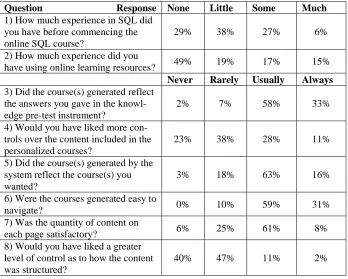
Table 1. Summary of Student Evaluation Questionnaires, 2000 – 2003
Question Response None Little Some Much
1) How much experience in SQL did you have before commencing the online SQL course?
29% 38% 27% 6%
2) How much experience did you
have using online learning resources? 49% 19% 17% 15%
Never Rarely Usually Always 3) Did the course(s) generated reflect
the answers you gave in the knowl-edge pre-test instrument?
2% 7% 58% 33%
4) Would you have liked more con-trols over the content included in the personalized courses?
23% 38% 28% 11%
5) Did the course(s) generated by the system reflect the course(s) you wanted?
3% 18% 63% 16%
6) Were the courses generated easy to
navigate? 0% 10% 59% 31%
7) Was the quantity of content on
each page satisfactory? 6% 25% 61% 8%
8) Would you have liked a greater level of control as to how the content was structured?
40% 47% 11% 2%
The evaluations have been carried out over the past four years (2000 – 2003, in-clusive) and include two separate evaluations – student and tutor. The student evalua-tion, which is the focus of this paper, was carried out on over 500 students and at-tempts to determine the usability of the personalized SQL course, in particular focus-ing on learner satisfaction and the effectiveness of the service. Each of the students was presented with the same paper-based questionnaire giving them an opportunity to evaluate the personalized SQL course they had just completed. The questionnaire comprised thirty one mostly multiple choice questions (some of which are repre-sented in Table 1, above) and an open comments section. Each question also had space for the student to elaborate on their answers.
while the latter metric shows how in the same peer groups the adaptive course af-fected their performance.
8 9 10 11 12 13 14 15
1998 1999 2000 2001* 2002 2003
Year
Q
u
e
s
ti
on Sc
or
e
(
out
of
2
0
)
[image:4.595.139.468.174.403.2]Related Questions Unrelated Questions
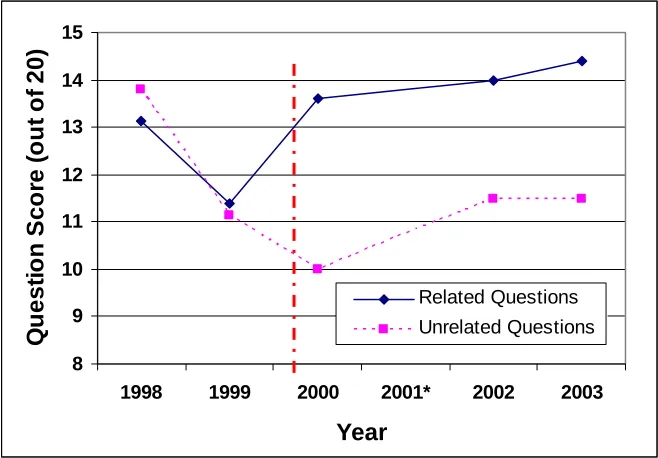
Fig. 1. Average Question Scores on Database Examinations, 1998 – 2003
Figure 1, above, summarizes the performance of six classes of final year students in two degree courses. Both of these courses receive a common lecture course, similar examinations and both use online tools to learn SQL. In 1998 and 1999 the online tools were non-adaptive. The personalized SQL course was first introduced in 2000 (signified by the vertical dotted line). The Question Score axis shows the average question score out of a possible twenty marks. The two lines shown on the graph represent the average question scores in questions related and unrelated to the mate-rial taught in the online SQL courses. The questions were not the same from year to year, but were similar and of comparable difficulty. * 2001 results are interpolated as statistics were.
3
Initial Findings and Conclusion
course, the scores in questions related to SQL have risen steadily and the scores in these questions display an increase of 2-3 marks over the questions unrelated to SQL. In a question worth 20 marks this represents approximately a 10-15% increase in performance by the students. This difference may be attributed to the benefits of the personalized SQL course, as the SQL content presented shared a common basis with that of the non-adaptive course.
Most students felt that the courses generated based on the prior knowledge pre-test instrument produced courses they expected and desired (Questions 3 & 5), how-ever approximately 40% of students stated that they desired more control over the course content (Question 4). This was reflected in the comments of a number of stu-dents where they stated that they ‘played’ the pre-test instrument to create short per-sonalized courses that could be tackled in short periods of time. They would re-personalize the course for each session with this aim. This finding highlights the innovation some learners can display in utilizing personalized eLearning.
This paper has briefly described the evaluation process of a personalized SQL course based on the Adaptive Personalized Learning Service (APeLS) and presented some initial findings from this evaluation.
References
1. Conlan, O., Wade, V., Bruen, C., Gargan, M. (2002) Multi-Model, Metadata Driven Ap-proach to Adaptive Hypermedia Ser-vices for Personalized eLearning. In the Proceedings of Second International Conference on Adaptive Hypermedia and Adap-tive Web-Based Systems, AH 2002, 100-111.
2. De Bra, P., Aerts, A., Berden, B., De Lange, B., Rousseau, B., Santic, T., Smits, D., Stash, N., (2003) AHA! The Adaptive Hypermedia Architecture. In the Proceedings of the ACM Hypertext Conference, Nottingham, UK, August 2003.
3. Wade, V., Power, C. (1998) Evaluating the design and delivery of WWW based educa-tional environments and courseware. In the Proceedings of the 6th annual conference on the teaching of computing and the 3rd annual conference on Integrating tech-nology into computer science education, 243 - 248 .