Abstract— This paper models the group decisions for bankruptcy of firms with supply relationship facing financial distress when price uncertainty evolves downwards as a stochastic geometric Brownian motion. Compared with the previously published work focusing on single firm’s bankruptcy decision, this paper analytically derives optimal default thresholds for all member firms in a supply chain system. Following the optimal default strategy proposed by this paper, all firms would collaboratively obtain their optimized individual firm value in return. The conclusions of this paper suggest that the optimal default threshold for each member firm could be derived by optimal shutdown of its business. By doing so could a member firm preserve its maximum firm value when the economic situation is anticipated to be continuously worsening. The optimal default threshold for each member firm are also proved to be significantly affected by other member firms’ financial decisions. It is also indicated that market competition has its great impact on bankruptcy decisions of each member firm in the supply chain system.
Index Terms—group decision, optimal default threshold, price uncertainty, supply chain system
I. INTRODUCTION
here is a significant amount of research on the efficiency and success of supply chain management. Most studies have investigated causality from a specific aspect, such as logistics or process facilitation. Dyer and Singh [1] proposed a comprehensive framework to analyze the success of strategic alliances within networks of firms and concluded that success lies primarily in the attainment of an inter-organizational competitive advantage, which they describe as having four critical factors: relationship-specific assets, a knowledge-sharing routine, complementary resources or capabilities, and effective governance. Thus, Dyer and Singh’s framework lays a foundation for vertical integration in supply chain management in terms of the micro aspects. In contrast, other scholars have focused on the impact of macro factors (such as industry structure) on the collective behavior of a strategic alliance of firms. For example, Audretsch [2] analyzed the longitudinal data of a cohort of 12,000 plants over a 10-year period and found empirically that industry environment affects the likelihood that a start-up firm will subsequently exit.
Manuscript received April 29, 2014; revised Aug. 10, 2014.
Po-yuan Chen serves as Chairman at Department of Financial and Tax Planning, Jinwen University of Science and Technology, 99, Anchung Rd., Sindian District, New Taipei City 23154, Taiwan, R.O.C. (Contact the corresponding author by e-mail: [email protected]).
After considering the empirical evidence presented in previous works, Agarwal and Gort [3] investigated patterns of entry, exit, and the number of firms in various markets at different stages of product development. Agarwal [4] then attempted to apply firms’ entry and exit strategies to supply chain survival. Schmitz et al. [5] concluded that a successful supply chain requires a competent leader firm to coordinate the members of the supply chain. Ellram and Cooper [6] found that mandatory participation in a supply chain may be followed by a favorable exit from the supply chain in the event that supply chain members face an unexpected downturn in market conditions. The later works of Novack et al. [7], Cooper et al. [8], Cooper et al. [9], and Tyndall et al. [10] each confirmed the argument of Ellram and Cooper [6] as it relates to logistics management.
Recognizing that supply chain management encompasses a number of different aspects, Murphy et al. [11] argued that supply chain integration or disintegration occurs in a highly dynamic environment and varies based on the supply chain’s stage of development. Later, William et al. [12], Birou et al. [13], and Brewer and Hensher [14] each addressed and emphasized the importance of interdisciplinary integration to supply chain efficiency. Mentzer et al. [15] proposed a framework to describe the prerequisites of a successful supply chain, one of which is inter-functional coordination, and suggested that there was an urgent need for a theoretical framework to guide further exploration of the interactions between different functions in the supply chain. Despite this suggestion, we find that the supply chain literature has continued to focus on logistics and operations management. For example, Stonebraker and Liao [16] argued that there is little research on the impact of environmental variables (such as complexity) on supply chain integration. Carter and Rogers [17] found that the correlation between uncertainty and resource dependency is a major factor in the vertical integration of supply chains. Similarly, Williamson [18] confirmed that firms facing greater uncertainty are more likely to integrate vertically and to adopt more governance-oriented mechanisms in operations. However, the financial integration of supply chains was not emphasized in any of the aforementioned works. Indeed, a theoretical framework addressing interdisciplinary topics, such as the interplay between operational decisions and financial decisions, was rarely even proposed until Chu [19] was motivated by the recent worldwide spread of bankruptcy and economic depression to study the interaction between collective divestment decisions and financial arrangements in an uncertain environment. However, Chu’s [19] investigation was limited to the divestment decision of a single downstream firm (retailer) that faces price uncertainty in a supply chain comprising many suppliers that dedicate their respective resources to specific investments.
The Optimal Group Decisions for Firms Facing
Price Uncertainty in a Supply Chain System
Po-yuan Chen
Fundamentally inspired by the work of Chu [19] and in light of the difficulties that so many companies and states continue to experience today, we intend to develop an extended version of Chu’s work to investigate the optimal operational (exit) strategy and the optimal financial (debt) strategy for a network of firms (comprising a downstream firm, e.g., one retailer, and many upstream firms, e.g., N suppliers) with relationship-specific investments. By adhering to the operational and financial strategies suggested by the proposed model, efforts by these firms to conquer uncertainty in the supply chain may prevent additional operational and financial catastrophes in the future by allowing the firms to optimally exit the market (divestment) in a timely manner if economic prospects remain uncertain and the economic downturn may last for an extended period of time.
II. THEMODEL A. Notation
The following table 1 describes the notations of the proposed model.
B. Formulation
Based on the above definitions, an extended version of Chu’s model is proposed by us as the following equations.
1 1
1 1 1
1
1
n
x
n
c
x
(1) Equation (1) is the optimal joint profits of N+1 members along the supply chain under the optimization of the profit function with respect to qi. Based on (1), the combined value of all equity holders of UFs and DF could be expressed as the following equations, which are in the form of ROA. In (2), we assume that UFs are symmetric firms as Chu did in his model.
1
( )
1
c n d ui
n
x
b
nb
V
x
B
x
r
r
,(2) According to the arguments of ROA method, (2) and three corresponding boundary conditions in (3)-(5) could be used to derive coefficient
B
1and defaultthresholds
x
dandx
ui.
0
cn d
V
x
, (3)
'
0
cn d
V
x
, (4)and
,
c c
n ui n i ui
V
x
V
x
. (5)Equation (3) describes the condition that when the price stochastically goes downwards to the level of DF’s default threshold, it should declare bankruptcy immediately in order to maximize its own firm value. At the same time, all existing UFs also fail to deliver goods to DF due to their making relationship investments in the framework. In other words, the supply chain breaks and the combined value is worth nothing. Similarly, the increment of the combined value with respect to the price is zero after the failure of the supply chain as demonstrated in (4). Equation (5) describes the fact that the combined value stays the same with or without the ith UF when it declares bankruptcy at its default level which the price hits.
Once
B
1is derived, substituting it into (2) allows us to obtain the analytical solution of the combined value for all equity holders in the supply chain as follows.
1 1
1
1 1 1 1
1 1 1 1 1 1
1
1
1
1 .
ui uj uj
c d ui
n
uj
d ui
c
n
x x
x
b nb
x
V x
r
r
x
c n
x
b nb
r
r
where
i
1, 2,3,
,
n
. (6)The analytical solutions for default thresholds of UFs and DF are also derived as follows:
TABLE I
NOTATIONSFORTHEMODEL
Symbol Definition Description
n number of upstream
firms in the system
firms make specific relation investments in order to enter as a supplier in the system
t
x stochastic product
price at time t
the stochastic price evolves as a geometric Brownian motion and serves as the source of uncertainty in the system
ui
x default threshold for the ith upstream firm
the optimal price threshold for the firm to go bankrupt in order to retain its maximum firm value
d
x default threshold for the downstream firm
the optimal price threshold for the firm to go bankrupt in order to retain its maximum firm value
t
combined profit at
time t for the supply chain system
the combined profit is the sum of the profits from all upstream firms and the downstream firm
volatility of the stochastic price
a constant volatility in the geometric Brownian motion
C n
V combined value of
all firms in the supply chain system
the combined value for all upstream firms and the downstream firm
,
u n i
E
the optimal firm value for the ith upstream firm
combined value is divided and distributed to the ith upstream firm according to its bargaining power
d n
E
the optimal firm value for the downstream firmdownstream firm’s optimal value as a percentage of the whole combined value
*
ui
t
optimal bankruptcy time for the ith upstream firm
the ithupstream firm goes bankrupt at this moment in order to retain its maximum firm value
*
d
t
optimal bankruptcy time for the downstream firm
1 1 1 1 11
1
1
1
ui ui
r
i
b
x
r
c
i
where
i
1, 2,3,
,
n
; (7)and
1 1 1 1 11
1
d ui dr
b
jb
x
r
j
c
. (8)Moreover, we can further derive equity value for the ithUFby the following (9). The equity value depends on the
bargaining power of the ithUFand its marginal contribution
(
MC
i) to the combined value of the supply chain.
,
;
,u c c
n i ui i i i n n i
E
x b
MC
V
x
V
x
.(9) By substituting (6) into (9), we can derive analytical
solution for the equity value of the ith UF.
, , 1
1 1
1 1
1 1 1
1
;
1
1
1
.
u c c
ni ui i n n
i
E x b
V x V
x
c
n
n
x
r
(10) Similarly, the equity value for the DF could be derived bythe following equation, saying that DF’s equity value is the difference between the combined value and the total UFs’ equity values as demonstrated in the following equation.
, 1 ,;
;
;
d n d n c un n i ui
i
c u
n n i ui
E
x b
V
x
E
x b
V
x
nE
x b
. (11)By substituting (6) and (10) into (11), we can derive analytical solution for the equity value of DF.
1 11 1 1
1 1 1
1 1
1 1
;
1
1 1
1 1 .
d n d i i d d d ui d
E x b
c r
n n x
x
n x
x
b nb x
r x
(12)The liquidation value for DF and UFs can be derived as follows:
1 1 1
1
1 1 1 1
1
1
1
1
1
d d j
j j
d ui
L
c
j
j
x
r
b jb
r
, (13) and
1 1 1 11 1 1 1
1
1
1
uj uj j
c
j
j
x
L
r
. (14) The value of debt for the ith UF is derived as the followingequation.
,
;
u ui ui
n i ui ui
ui
b
x
b
D
x b
L
r
x
r
. (15)By the similar method, the value of debt for DF is described as (16).
;
d d d
n ui d
d
b
x
b
D
x b
L
r
x
r
. (16)
*
, 0
, ,
arg max
;
arg max
ui
ui
ui
u n i ui b
u u
n i ui n i ui b
b
V
b
x
E
b
D
b
(17)
After repeating the similar procedures, we could obtain (18) for the optimal interest payment of DF.
*
0
arg max
;
arg max
d
ui
d
d
n d
b
d d
n d n d
b
b
V
b x
E
b
D
b
(18)
At the end, we could obtain the optimal default time for each UF and DF by Mote Carlo simulations using the following two equations.
*
inf
ui t ui
t
t x
x
, (19)and
*
inf
d t d
t
t x
x
,where t
t
dx
dt
dz
x
is a Geometric BrownianMotion. (20) Equations (17) and (18) are related to financial
(leverage) decisions for UFs and DF, while (19) and (20) are related to operational (default) decisions for UFs and DF respectively.
III. RESEARCHMETHOD
There are two stages of derivations in our research procedures. The approach employed at the first stage is a real option approach for the derivation of combined value of the supply chain and derivations of equity values for all member firms along the supply chain, including a downstream firm (one retailer) and N upstream firms (N suppliers). Subsequently, solutions of the optimal debts for both upstream firms and the downstream firm are obtained analytically. At the same time, optimal default thresholds for all members along the supply chain are also derived analytically. Based on these default thresholds, optimal divestment strategy could be implemented. At the second stage, the maximized equity values for each member firm along the supply chain could be numerically derived by checking the first and the second conditions for the function of equity value of each member. Research procedures for the derivations of optimal solutions are described as follows.
In the beginning , we employ ordinary calculus to optimize the joint profit of the overall supply chain with n suppliers and one retailer (buyer in a business-to-business market). We analytically obtain the optimal profit flow at each time moment. By using stochastic calculus, we intend to optimize the combined value of the supply chain and analytically obtain the optimal real option value, as well as the corresponding default thresholds in terms of an operational decision. Using the bargaining power to divide the optimal combined value of the supply chain and analytically determine the sharing scheme among all members of the supply chain. Again, we use ordinary
calculus to optimize the firm values for both UFs and DF. By doing so, we numerically obtain the corresponding optimal coupons in terms of a financial decision. Then by using Monte Carlo method to simulate the stochastic price process, we can numerically obtain the optimal default time for each member firm in the supply chain.
IV. RESULT
Based on the analytical and numerical results from our derivations in section 2, sensitivity analyses of optimal coupons and optimal default thresholds for UFs and DF are illustrated in figures 1-4.
In figure 1, we found that the optimal coupon of UF affects DF’s firm value, which indicates that some interactions exist between UFs and DF when we discuss financing and bankruptcy decisions. That is, we should take into account the collaboration among member firms in a supply chain. This phenomena gives rise to the attention to the potential study for any financial decision as a complex interacting system.
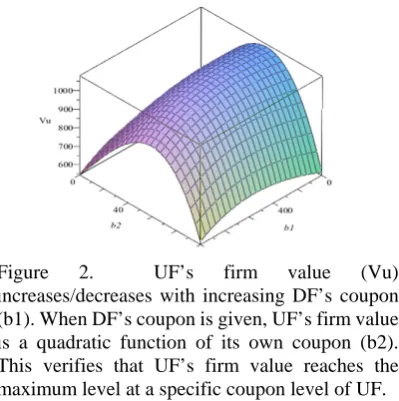
[image:4.595.339.491.353.488.2]Figure 2 also demonstrates that UF’s firm value is affected by the optimal coupon of DF. The result reveals that interactions among member firms in a supply chain should be properly investigated.
Figure 1. DF’s firm value (Vd) decreases with UF’s increasing coupon (b2). When UF’s coupon is given, DF’s firm value is a quadratic function of its own coupon (b1).
[image:4.595.322.522.571.772.2]Figures 3-4 demonstrate that competition in terms of number of UFs affects the optimal coupon. Besides, we found that substitutability between input goods, denoted byρ,and degree of return to scale, denoted byγ, jointly affect the optimal coupon. In other words, we should consider market factors in our financing and investment decisions.
[image:5.595.318.542.294.692.2]Based on the above analytical results, we can understand the factors impacting the optimal bankruptcy thresholds for both upstream and downstream firms under price uncertainty. The derived optimal bankruptcy threshold is sometimes referred to as the exit threshold. In other words, the group decision of bankruptcy is the exit strategy for each member firm in the supply chain. Similarly, we can propose another framework dealing with the group decision of investment, which is also referred to as the entry strategy for each member firm in the dynamic supply chain system. As a result, we can then propose an algorithm (depicted in figure 5) describing the process of investment and bankruptcy by conceptually combining these two strategies: entry and exit strategies for all member firms facing uncertainty in a supply chain system. In the combined process, there are two stages of decisions with two different thresholds (entry and exit), but one common uncertainty source to be observed: stochastic price.
Figure 3. Under the condition ρ>γ, DF’s optimal coupon (b1) is larger than UF’s optimal coupon (b2) when the market is much more competitive with 10 UFs. However, the phenomena is reversed when the market is less competitive with number of UFs less than 3.
Figure 4. Under the condition ρ<γ, DF’s optimal coupon (b1) is larger than UF’s optimal coupon (b2) when the market is much more competitive with 10 UFs. However, the phenomena is reversed when the market is less competitive with number of UFs less than 2.
[image:5.595.52.289.507.679.2]V. CONCLUSION
This paper formulates a proposed model that integrates operational and financial decisions and then solves the model analytically and numerically to determine the optimal coupon and default strategies for each member firm in a supply chain. Although Chu performed the original work on this topic when he analyzed operational decisions relating to optimal default time and financial decisions relating to debt service, he focused exclusively on a single downstream firm by assuming that all upstream firms are debt free. However, a situation in which a downstream firm dominates the supplier-buyer relationship is not commonly observed in practice. Inspired by Chu’s work, we extend his analysis by assuming that all firms in the supply chain have debts. Therefore, we extend Chu’s model in two aspects: (1) in terms of operational decisions, each firm (upstream and downstream) has its own optimal default threshold, and (2) in terms of financial decisions, each firm (upstream and downstream) has its own optimal debt, optimal equity, and optimal capital structure.
The analytical results of our model may be used as benchmarks to guide financing and bankruptcy decisions for firms with supply-chain relationships. One important result indicates that the lower the UF’s coupon is, the greater DF’s firm value is. DF’s firm value is affected by UF’s coupon because UF’s coupon payment decreases UF’s contribution to the combined value of the supply chain. However, DF’s firm value is a share of the combined value of the supply chain and depends on DF’s bargaining power in the supply chain. As a result, if UF pays less for its coupon, we can anticipate a larger combined value of the supply chain. DF is also expected to receive a larger value as a result of the larger combined value even though its bargaining power remains unchanged. Another significant result indicates that optimal coupons are affected by market competition. For example, DF’s optimal coupon increases as competition increases (with an increasing number of UFs in the supply chain). However, UF’s optimal coupon decreases as competition increases when substitutability is greater than the degree of returns to scale, whereas UF’s optimal coupon increases as competition increases when substitutability is less than the degree of returns to scale. Finally, another noteworthy result indicates that UF’s optimal default threshold decreases as competition increases. This result suggests that UF is less likely to default in a more competitive market due to a lower default threshold because a lower default threshold makes it less likely that the stochastic price will reach the threshold. The same rule applies to the bankruptcy strategy of DF except in the case of a monopolistic market (with only one UF).
The above conclusions are drawn based on our model and derivations of analytical solutions, which are based on the rigorous work of Chu. Our model not only generalizes the previous framework but also provides insights into the interaction between the financing and divestment decisions of firms with supply-chain relationships. The results also indicate that future research should focus on the financial decisions of a more complex and interconnected network of firms facing uncertainty and competition in today’s business environment.
ACKNOWLEDGEMENT
I deeply appreciate the financial grant from Ministry of Science and Technology (MOST) in Taiwan to support the development of this model. I also appreciate the concise and helpful comments of Professor S.S. Chen.
REFERENCES
[1] J. H. Dyer, and H. Singh, “The Relational View: Cooperative Strategy and Sources of Inter-organizational Competitive Advantage,” Academy of Management Review, Vol. 23, No. 4, pp. 660-679. 1998.
[2] D. B. Audretsch, “Business Survival and the Decision to Exit,”
International Journal of the Economics of Business, Vol. 1, No. 1, pp. 125-137, 1994.
[3] R. Agarwal, and M. Gort, “The Evolution of Markets and Entry, Exit and Survival of Firms,” The Review of Economics and Statistics, Vol. 78, No. 3, pp. 489-498, 1996.
[4] R. Agarwal, “Survival of Firms over the Product Life Cycle,”
Southern Economic Journal, Vol. 63, No. 3, pp. 571-584, 1997. [5] J. M. Schmitz, R. Frankel, and D. J. Frayer, “Vertical Integration
without Ownership: The Alliance Alternative,” in Conference Proceedings for Association of Marketing Theory and Practice Annual, Spring, 1994, pp. 391-396.
[6] L. M. Ellram, and M. C. Cooper, “Supply Chain Management, Partnerships, and the Shipper-Third-Party Relationship,”
International Journal of Logistics Management, Vol. 1, No. 2, pp. 1-10, 1990.
[7] R. A. Novack, C. J. Langley, and L. M. Rinehart, “Creating Logistics Value,” Oak Book, IL: Council of Logistics Management, 1995.
[8] Cooper, C. Martha, M. Douglas, Lambert, and J. D. Pagh, “Supply Chain Management: More Than a New Name for Logistics,”
International Journal of Logistics Management, Vol. 8, No. 1, pp. 1-14, 1997a.
[9] Cooper, C. Martha, L. M. Ellram, J. T. Gardner, and A. M. Hanks, “Meshing Multiple Alliances,” Journal of Business Logistics, Vol. 18, No.1, pp. 67-89, 1997b.
[10] Tyndall, Gene, C. Gopal, W. Partsch, and J. Kamauff, “Supercharging Supply Chains: New Ways to Increase Value Through Global Operational Excellence,” New York, NY: John Wiley & Sons, 1998.
[11] P. R. Murphy, J. M. Daley, and P. K. Hall, “EDI Issues in Logistics: A User and Carrier Perspective,” Journal of Business Logistics, Vol. 19, No. 2, pp. 89-102, 1998.
[12] L. R. Williams, A. Nibbs, D. Irby, and T. Finley, T, “Logistics Integration: the Effect of Information Technology, Team Composition, and Corporate Competitive Positioning,” Journal of Business Logistics, Vol. 18, No. 2, pp. 31-41, 1997.
[13] L.M. Birou, S. E. Fawcett, and G. M. Magnan, “The Product Life Cycle: A Tool for Functional Strategic Alignment,” International Journal of Purchasing and Materials Management, Vol. 34, No. 2, pp. 37-51, 1998.
[14] A. M., Brewer, and D. A. Hensher, “Identifying the Overarching Logistics Strategy of Business Processes: An Exploratory Analysis,”
International Journal of Logistics Research and Applications, Vol. 4, No. 1, pp. 1-41, 2001.
[15] J. T. Mentzer, W. D. Witt, J. S. Keebler, S. Min, N. W. Nix, and C. D. Smith, “Defining Supply Chain Management,” Journal of Business Logistics, Vol. 22, No. 2, pp. 1-25, 2001.
[16] P. W. Stonebraker, and J. Liao, “Supply Chain Integration: Exploring Product and Environmental Contingencies,” Supply Chain Management, Vol. 11, No. 1, pp. 34-43, 2006.
[17] C. R. Carter, and D. S. Rogers, “A Framework of Sustainable Supply Chain Management: Moving toward New Theory,” International Journal of Physical Distribution & Logistics Management, Vol. 38, No. 5, pp. 360-387, 2008.
[18] O. E. Williamson, “Outsourcing: Transaction Cost Economics and Supply Chain Management,” Journal of Supply Chain Management, Vol. 44, No. 3, pp. 5-16, 2008.