Abstract—While both wiki and Facebook(FB) has been said to be supportive of e-learning, further studies of them in collaboration aspects and the related comparison were not addressed, leaving a significant research gap.
This project involved 114 students using either wiki or FB for project collaboration. The relationship between the tools and collaboration effectiveness, performance and user experience would be studied. Both tools were separately evaluated and compared altogether.
In both tool, the technology barrier strongly and negatively impacted the user experience and the perceived collaboration effectiveness. A higher actual usage level could enhance the performance for both wiki and FB, while self-reported and measured figure can bring different results. FB were more preferred for collaboration, in terms of technology barrier, user experience and perceived collaboration effectiveness, while students in the wiki group performed better.
Index Terms—Facebook, Wiki, project collaboration, e-learning, social networking site, technology implementation
I. INTRODUCTION
he social media and web applications has become hot topics in e-learning. [1][2]. Web 2.0 tools, such as Wiki and Facebook has been said as a revolutionary web-based applications that support e-learning and welcomed by students [3]-[6] It was said that they could build dynamic environment and act as more interesting teaching tool. [7] But previous researches on both tool in collaboration aspects were both limited. The aspects of collaboration effectiveness, process students’ attitude and performance were rarely covered, leading to research gap about using them for project collaboration, which would be explored in this project.
114 students used either wiki or FB for project collaboration, and complete a post-course survey about the project collaboration, with their activities also observed. The observations and feedback were analyzed and brought into the research model. Comparison between wiki and FB as a collaboration tool was also made.
Manuscript received July 20, 2014; revised August 5, 2014.
Cheuk-Hang AU (Email: [email protected]) is a final year undergraduate student, with the Department of Management and Marketing, Hong Kong Polytechnic University, Hong Kong SAR.
Wei HE(Email: [email protected]) is an Assistant Professor in Management Information System, with the Department of Management and Marketing, Hong Kong Polytechnic University, Hong Kong SAR.
II. LITERATURE REVIEW A. About Facebook
Created in 2004, Facebook(FB) is a multi-feature Social Networking site.[8][9] Initially targeted to students’ communities [10], FB has become hot in recent years and stood out of the competitors. [10][11] Researchers has been interested in FB in different aspects, such as the privacy issues and using FB as teaching environment [10][12].
Most students were positive for using FB in learning. They would interact with each other on FB and work on course-related questions. Secondly, FB friends helped answering the course logistics issues, sharing notes, and connecting others for projects. Besides, FB allowed instant, informal access to tutors and lecturers in a relaxed online environment. Last but not least, students’ interest on FB would increase the intrinsic learning motivation. [7][12][13]
For the disadvantages, firstly, lecturers and students might not want to “friend” each other, and FB might affect the perceptions of students and lecturers towards each other. Some students may feel unsafe for potential privacy leakage. Besides, some file formats were not supported, and the discussion was not organized in a threaded structure. FB might also be perceived primarily for entertainment or social technology purposes, but not educational. On top, students might be distracted while on FB, spending time online fruitlessly instead of focusing on the studies. [7][12]-[14]
B. About Wiki
Wiki is an application allowing users to freely create and edit webpage content by browser, with different functions such as hyperlinks, cross-links among wiki pages, text-formatting, and image inclusions. Among different version of wiki, "Open-editing" has been a core common and important feature, encouraging democratic use of web and content creation. [7][15]
For the advantages, firstly, wiki could create a fast, convenient, time-and-place-independent environment. Next, most students’ interest in new tool bring higher motivation. Besides, requiring no HTML coding, the WYSIWYG interface visualized the collaboration. For the learning experience, wiki supported wider topics range, and a relaxed and democratic atmosphere, favoring the expression of opinion and better work submission. Students would therefore feel themselves equally treated based on the quality. On top, by making the students’ effort visible to others, wikis could built the inter-peer relationship and the high-level thinking skills. Students might also be happy with their efforts recognized [7][16]-[18]
Using Wiki for Project Collaboration - with
Comparison on Facebook
Cheuk-Hang AU and Wei HE
However, some students might avoid new technology. Secondly, when the students were not required to directly use HTML coding, the HTML functionality might not be utilized. Some students might be depressed if their edits are changed. Students might feel “too free” and expect a more structured learning experience, and extra effort were to lead the learning direction. The ”Open Editing” nature made editing others’ contribution, impersonation and vandalism easier without real consequence. Moreover, students might only read their own contribution, or only a few students contributed while others only read, leading no discussion or collaboration, thus negating the original objective. [7][17]-[19]
C. About collaboration, collaborative learning and collaboration tools
Collaboration is the working practice whereby individuals work together for common goal and overall benefit. [20] Originally, collaboration linked with communication and coordination, but more concepts has been linked along the technology advancement.[21][22] Advantages included better division of labor, higher creativity and synergistic effect[23]. Disadvantages included working styles conflicts and higher cost.[24]The approaches and the tool applications has become the research topics about collaboration[24]-[26]. The term “collaborative learning” were varyingly defined. The broadest definition was “Two or more people learn or attempt to learn something together[27]. Some interpretation linked with concepts of “social process”, “common goal” and “exchange of ideas”, increasing the interest and promoting critical thinking. [28][29] Possible collaboration tools included “Document Sharing”, “Instant Messaging”, whiteboards and discussion board[22], with social media for e-learning recognized for bringing good collaboration.[30]
D. Technology Barrier
Computer technology barrier in education, which could impede the effective use of the tool, could be categorized as first-order or second-order barriers.[31] First-order barriers were mainly resources-related issues, such as equipment, training, support, cost and technology access. The second-order barriers included cultural factors and teacher-level factors, such as resistance to change, teachers’ anxiety, lack of time and motivation.[31]-[33][36][37]
In the light of the high internet and technological infrastructure development level in Hong Kong[34], this project would focus on the second-order barrier.
III. THEORETICAL MODEL AND HYPOTHESIS
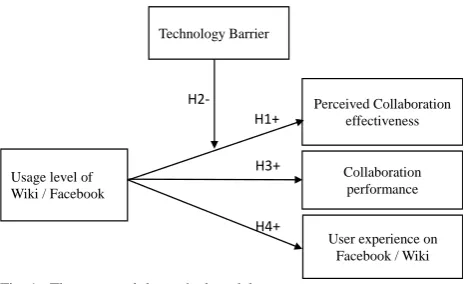
The proposed theoretical model are shown in Fig. 1, with the constructs defined as follows,
Usage level of wiki / Facebook and Perceived collaboration effectiveness
The usage level is the extent how the group of students uses wiki or FB for project collaboration. The perceived collaboration effectiveness means the effectiveness of the overall collaboration, with the use of the specific tool (i.e FB / Wiki), in the students’ perception. Previous findings stated that the effectiveness of a technological tool were positively related to the usage level[35], which might also be applicable to both Facebook and wiki. Therefore, we proposed,
Hypothesis 1(H1) - Students with a higher level of usage of wiki / Facebook as the collaboration tool will have a higher level of perceived collaboration effectiveness.
Technology Barrier
In this project, it refers to the second-order barriers when using Wiki and FB for collaboration. It was said that technology barriers can either directly impede the effective use of the technological tools [31], or act as a moderator of performance and effectiveness.[38][39] While both direct effect and moderating effect were possible, we propose the following hypothesis, trying to prove a moderating effect,
Hypothesis 2(H2) –With wiki / Facebook group as the project collaboration tool, the technology barrier would moderate the relationship between the usage level of the tool and perceived collaboration effectiveness; such that when technology barrier is high, the positive impact of usage level of wiki / Facebook would be weaker.
Collaboration performance
It is the project score given by the lecturer. It was said that the actual usage may be the link between the technological tools and performance.[40] Therefore, we propose,
Hypothesis 3(H3) – The collaboration performance has been enhanced because of the higher usage level of Facebook / Wiki as the project collaboration tool.
User Experience(UX)
Definition of UX varied, but generally included different aspects of the end-user's interaction in a technological tool, which can be dynamic, context-dependent, and subjective. [41][42] It was found that the usage level may significantly impact on UX and attitude.[43] Therefore, we propose,
Hypothesis 4(H4) – The user experience has been enhanced because of the higher usage level of Facebook / Wiki as the project collaboration tool.
IV. RESEARCH METHODOLOGY
114 undergraduate students (with their demographic profiles in Table I) finished a course group project with wiki or FB groups as collaboration tool. A post-course survey covering the usage level, technology barrier, perceived
H1+
H4+ H3+ H2-
Usage level of Wiki / Facebook
Collaboration performance
User experience on Facebook / Wiki Perceived Collaboration
[image:2.595.43.278.630.772.2]effectiveness Technology Barrier
collaboration effectiveness and user experience would be issued to them to collect their feedback.
The survey was mainly set on the 7 point Likert-scale, with 1 means strongly disagree and 7 means strongly agree. Questions were mainly built based on previous studies in similar situation but different context. Due to the previous literature limitation, some were questions originally proposed. On top of their feedback, observations on their activities were also made to measure the actual usage level.
The hypotheses testing and theoretical model building would be done by stepwise linear regression. Comparison between FB and wiki were made by simple statistics and independent samples T-test.
Measures of Constructs
Except the collaboration performance and measured usage, a reliability test was done for the 4 remaining constructs to confirm the consistency. The returned Cronbach’s alpha for were all larger than 0.7, confirming the construct consistency. (See Table II) For the same 4 constructs, the sum of the points received would be treated as the construct raw score, and normalized by dividing it by the maximum possible raw score.
A. Usage level
The usage level were both measured and self-reported because of the potentially significant discrepancy.[44]. The self-reported figure was collected from the survey in section II of the survey, while the measured level were the no. of edits on pages(wiki) and the no. of messages on wall(FB) respectively, based on previous studies. [45]
B. Technology Barrier
The statements were based on previous studies with modification.[45][46](The 1st and 3rd statement in section I of survey, with the 3rd statement reversely coded).
C. Perceived Collaboration effectiveness
Questions were based on a self-evaluation checklist for collaboration proposed previously[47], with the following aspects excluded due to the course nature, “sustainability” (Limited duration and one-time-off nature of the collaboration relationship, about 3 months) and “catalysts” (Reason for the collaboration - to complete the assessment), making a total number of 11 statements (Statement 8-18 in section I). A higher point meant a higher effectiveness.
D. Performance
It is the score given by the lecturer, divided by the maximum possible score (Facebook – 30, Wiki – 100).
E. User experience on Facebook / Wiki
Based on a previous studies about FB in learning [46], statement were prepared with modification due to the research context(the 4th and 5th statement in section I of the survey).
V. INDIVIDUAL CONSTRUCTS ANALYSIS AND COMPARISON The constructs were reviewed separately in terms of two tools and compared by simple statistics (Table III) and independent sample t-test (Table IV). For t-test, considering the results of the Levene's Test for Equality of Variances for all constructs, equal variances were assumed. Reviewing the
TABLEI
DEMOGRAPHIC PROFILES AND DESCRIPTIVE STATISTICS OF THE SURVEYORS
Item Wiki(n=83) Facebook(n=31)
Gender Male 23 10
Female 57 21
Missing 3 0
Age 18 1 0
19 33 0
20 30 1
21 8 12
22 5 8
23 0 6
24 0 1
Missing 6 3
TABLEII
RESULTS OF T-TEST FOR INDIVIDUAL CONSTRUCTS (EXCEPT MEASURED USAGE)
Cronbach’s alpha
Self-reported usage level .792
Technology Barrier .766
Perceived Collaboration effectiveness .922
User Experience .813
TABLEIII
INDIVIDUAL CONSTRUCT COMPARISON (EXCEPT MEASURED USAGE) N Mean Std. Dev. Self-reported usage Wiki 83 .5387 .16557
FB 31 .8111 .14232
Technology Barrier Wiki 83 .4716 .18192
FB 31 .2373 .15799
Perceived Collaboration effectiveness
Wiki 83 .4927 .08136
FB 31 .7403 .09590
User Experience Wiki 83 .6141 .14178
FB 31 .7765 .14374
Collaboration Performance
Wiki 15 .7580 .09229
FB 7 .6167 .06161
TABLEIV
RESULTS OF T-TEST FOR INDIVIDUAL CONSTRUCTS (EXCEPT MEASURED USAGE)
Sig. for Levene's Test for Equality of Variances
Sig. (2-tailed) for t-test for Equality
of Means
Self-reported usage .108 .000
Technology Barrier .142 .000
Perceived Collaboration effectiveness
.216 .000
User Experience .896 .000
Collaboration Performance .535 .002
sig. (2-tailed) value, significant difference could be confirmed between two groups of all constructs.
A. Measured usage level
The measured usage information has been given in Table V and Table VI, but not directly compared due to different nature. No. of wiki-edits and students’ post & reply in the FB group were used for the measured usage figure.
B. Other constructs
The student in FB group reported a higher collaboration effectiveness, higher self-reported usage level and lower technology barrier and better user experience. Reviewing the self-reported expertise level in two groups (Table VII), students were more familiar with FB, which might explain the lower technology barrier of FB.
The performance were group-based. Students in wiki group reported a better performance.
VI. HYPOTHESIS TESTING
Stepwise linear regression analysis was done between the constructs, with the control variables input. The beta coefficient indicates relationship between the constructs, their strength and directions. The p-value indicated if the null hypothesis should be rejected. (Null hypothesis rejection condition in this project: p-value
≤
0.05).A. About control variables
It included GPA, the no. of project that used the same tool concurrently, gender, self-reported expertize level and age. The percentages that the control variables account for the variance of the constructs has been shown in Table VIII.
B. Hypothesis 1 & 2
To test the moderating effect, a temporary item equivalent to the product of technology barrier and self-reported usage was created. Adding the self-reported usage on top of the control variables in the model did not significantly increase the R square value. However, adding the technology barrier has increased the R square value significantly. (Wiki: 60.3%, FB:75.9%) Finally, when further adding the timed item, the R square value only changed slightly. Considering the coefficient information and p-value (Wiki : p= .000, beta coefficient = -.718; FB: p=.006, beta coefficient = -.524), technology barrier had a direct and significant negative effect on learning effectiveness in both wiki and FB.
C. Hypothesis 3
Considering the R-square value difference, beta coefficient and p-value, the actual usage strongly and significantly impacted the performance. (Wiki: beta coefficient: .641, p-value = .000; FB: beta coefficient: .871, p-value= .000)
D. Hypothesis 4
In the light of the small changes of the R square value and high p-value, no correlation could be proven between the usage level and the user experience.
E. Ad-hoc analysis on linear regression
Regarding the linear regression results on hypothesis 1 and 2, an ad-hoc linear regression between the technology barrier and user experience was done in both wiki and FB.
Fig. 2. The proven theoretical model(Technology Barrier)
Fig. 3. The proven theoretical model(Measured Usage)
When adding the technology barrier on top of the control variables (with the user experience and dependent variables), the R square value become 62.2%(wiki) and 37.6%(FB). Reviewing the beta coefficient and p-value (Wiki: beta coefficient :-.720, p-value:.000 ; FB :beta coefficient :-.550, p-value:.042), a strong and negative impact on the user experience by that technology barrier could be confirmed.
F. A short conclusion from linear regression
Using the actual usage figure, only hypothesis 3 was supported in the results. Considering the results of ad-hoc linear regression and the linear regression on hypothesis 1&2, we might conclude that technology barrier negatively and significantly impact on both the user experience and the perceived collaboration effectiveness, leading to the theoretical model (as shown in Fig. 2. and Fig 3)
VII. CONCLUSION AND FURTHER RESEARCH DIRECTION As a project collaboration tool, wiki was mainly used for drafting and editing the deliverable instead of communication. Wiki developer may consider introducing new functions for communications, to make the future wiki a more comprehensive collaboration tool. Regarding FB as a communication tool, FB’s acquisition on Whatsapp in early 2014[48] may potentially make FB a better collaboration tool in communication aspects by the integrating Whatsapp into FB, which can be further investigated.
TABLEV
MEASURED USAGE LEVEL INFORMATION FOR WIKI
No. of edits
No. of messages
No. of non-testing wiki page
Mean 37.4 14.33 4.53
Median 34 4 3
SD 23.61 16.23 4.56
Total 561 215 68
TABLEVI
STATISTICS SUMMARY OF USAGE LEVEL (FACEBOOK)
No. of Mean
Min. Max. Statistic Std. Error
Message 19 66 39.14 5.946
Reply 6 59 25.86 6.909
TABLEVII
STATISTICAL INFORMATION OF SELF-REPORTED EXPERTISE LEVEL
Facebook Wiki
Novice 0(0.0%) 39(47.0%)
Immediate 15(48.4%) 41(49.4%) Advanced 14(45.2%) 1(1.2%) (Missing) 2(6.5%) 2(2.4%)
TABLEVIII
THE PERCENTAGE THAT THE CONTROL VARIABLES AND USAGE FIGURE ACCOUNT FOR THE VARIANCE OF THE DEPENDENT CONSTRUCTS
Percentage accounted for the variance (R square value) Control
variable only
After adding the usage figure Perceived
Collaboration effectiveness
Wiki 16.8% 19.8%
FB 52.9% 57.6%
User Experience
Wiki 16.3% 22.4%
FB 17.1% 18.1%
Collaboration Performance
Wiki 16.1% 47.2%
FB 26.0% 84.2%
While it was said that wiki is easy to use, FB were considered an easier tool for collaboration according to the reported technology barrier instead. Teachers may consider teaching the student how to use wiki before starting the project, if wiki is one of the collaboration tool options
For both wiki and FB, the technology barrier strongly and negatively impacted on the user experience and the perceived collaboration effectiveness. Besides, a higher actual usage could bring a better performance for both wiki and FB.
While students enjoyed using FB in different aspects, students in wiki group performed better. It may be highlighted that a collaboration tool less-preferred by students may eventually bring better performance. Other than collaboration, similar test may be conducted for other e-learning tools.
Alternative collaboration tools suggested by the students, including Google Drive and Adobe Connect, can be tested by similar setting, with re-definition of measured usage figure.
APPENDIX I -SURVEY DISTRIBUTED TO STUDENTS The survey for both group are basically the same, except “Facebook” changed into “Wiki”, according to the tool used.
Team Learning & Collaboration Feedback
(Facebook Users)
Section I:
The following sentences are some descriptions of your project collaboration experience in Facebook (FB).
Please read carefully and circle a number that best describes your opinion.
S
tr
on
gly
Dis
agr
ee
Ne
u
tr
al
S
tr
on
gly
Agr
ee
1. I am motivated to use FB for project collaboration.
1 2 3 4 5 6 7
2. I have enough time to get familiar with FB for
project collaboration. 1 2 3 4 5 6 7 3. I feel anxious when knowing that I need to use
FB for collaboration. 1 2 3 4 5 6 7 4. It would be convenient to use FB for
collaboration. 1 2 3 4 5 6 7 5. I welcome the opportunity to connect with peers
on FB.
1 2 3 4 5 6 7
6. FB is personal and social, instead of
educational. 1 2 3 4 5 6 7 7. My privacy would be invaded because of using
FB for project. 1 2 3 4 5 6 7 8. There was an established process for
communication between meetings.
1 2 3 4 5 6 7
9. Need assessment has been conducted and we have obtained information to establish our goals.
1 2 3 4 5 6 7
10. We keep collecting data to measure our goal achievement.
1 2 3 4 5 6 7
11. The environment surrounding decision making in this collaboration
is positive.
1 2 3 4 5 6 7
12. We have access to needed resources for the
project. 1 2 3 4 5 6 7
13. FB allows our project collaboration to function
effectively. 1 2 3 4 5 6 7
14. Our group worked cooperatively to solve
problems. 1 2 3 4 5 6 7
15. Members of this team are connected by formal
and informal networks at all levels. 1 2 3 4 5 6 7 16. Leadership exists to facilitate and support team
building.
1 2 3 4 5 6 7
17. There is a communication system and formal information channel in
our team that permits the exploration of issues, goals and objectives.
1 2 3 4 5 6 7
18. The collaboration has allowed understanding
between team members. 1 2 3 4 5 6 7
Section II:
(1 = Never, 4 = Sometimes , 7=Always)
1 In general, I ...use FB for doing this project. 1 2 3 4 5 6 7
2 So far my usage of FB for doing project is…. 1 2 3 4 5 6 7
For doing this project, approximately how frequently and for how long, in total, you interact with your team members using approaches other than FB:
Total frequency, how
many times Total time spent, in hours
1 Face-to-face, in-person meetings ... ___ # meetings
2 Email ... ___ # mails
3 Telephone call ... ___ # calls
4 Other Instant Messenger (except for FB)… ___ # sessions
5 Any other approach (please specify): _______ ___ #
Section III:
1. In your opinion, what are the most valuablebenefits from using FB in conducting
group project?
□Efficiency (save time)
□Help manage information and
documents
□Improve student learning
□Other benefit I value the most:
___________________________
□Improve student-to-student
communication
□Improve student-to-lecturer
communication
□Improve lecturer-to-student
communication
□No benefit
2. Is there any problem/difficulty you encountered in using FB as a platform for group project?
3. Any suggestion or comment for improvement if we adopt FB in the future teaching & learning?
Group # ________ (For aggregating within-group members’ responses only)
Ge n d e r :
□
Male□
Female A g e : _ _ _ _ _F a c u l t y:
□
Business□
Non-businessL e v e l o f y o u r e x p e r t i s e i n u s i n g F B :
□
novice□
intermediate□
advancedI n t h e c u r r e n t a c a d e m i c y e a r , h o w m a n y s u b j e c t s
y o u u s e d ( i n c l u d i n g a r e u s i n g ) F B g r o u p f o r d o i n g p r o j e c t:
Y o u r a c c u mu l a t i v e G P A i n l a s t s e me s t e r : (a control variable )
ACKNOWLEDGMENT
REFERENCES
[1] D. Parsons, H. Ryu & M.Cranshaw, "A design requirements framework for mobile learning environments," J. Computers, vol. 2, no. 4, pp. 1–8, 2007.
[2] J.P. Tucker & G.R. Gentry, "Developing an e-learning strategy in higher education," Foresight, vol. 11, no. 2, 2009.
[3] R.A. Noe, Employee Training and Development. 5th ed., McGraw-Hill Education, 2010.
[4] D. Terdiman. How wikis are changing our view of the world - CNET News. Internet: http://news.cnet.com/2009-1025-5944453.html, Oct. 25, 2005 [Mar. 1, 2014].
[5] W. Alrahmi & M. Othman, "The Impact of Social Media use on Academic Performance among university students: A Pilot Study," J. Inform. Service Syst. Innovation, 2013
[6] U. Avci & P. Askar, "The Comparison of the Opinions of the University Students on the Usage of Blog and Wiki for Their Courses," Educational Technology & Society, vol. 15, no. 2, p. 194, 2012. [7] Raitman, N. Augar & W.Zhou, "Employing wikis for online
collaboration in the e-learning environment: Case study," Inform. Technology Applications, vol. 2, pp. 142–146, July. 2005..
[8] S.M. Bergman, M.E. Fearrington, S.W. Davenport & J.Z. Bergman, "Millennials, narcissism, and social networking: What narcissists do on social networking sites and why," Personality and Individual Differences, vol. 50, no. 5, pp. 706–711, 2011.
[9] R.E. Wilson, S.D. Gosling & L.T. Graham, "A review of Facebook research in the social sciences. Perspectives on Psychological Science," Perspectives On Psychological Science, vol. 7, no. 3, pp. 203–220, 2012..
[10] N.B. Ellison, C. Steinfield & C.Lampe, "The benefits of Facebook “friends:” Social capital and college students’ use of online social network sites. Journal of Computer‐ Mediated Communication," J. Comput.‐ mediated Communication, vol. 12, no. 4, pp. 1143–1168, 2007..
[11] S. Raice, "Facebook sets historic IPO," Wall Street J., 2012.. [12] B. Baran, "Facebook as a formal instructional environment," British J.
Educational Technology, vol. 41, no. 6, pp. 146–149, 2010.. [13] T.E. Bosch, "Using online social networking for teaching and learning:
Facebook use at the University of Cape Town.," Communicatio: South African J. for Communication Theory Research, vol. 35, no. 2, pp. 185–200, 2009..
[14] Q. Wang, H.L. Woo, C.L. Quek, Y. Lang & M. Liu "Using the Facebook group as a learning management system: An exploratory study," British J. Educational Technology, vol. 43, no. 3, pp. 428–438, 2012. .
[15] B. Leuf & W. Cunningham, "The Wiki way: quick collaboration on the Web," 2001.
[16] C. Dalsgaard, "Social software: E-learning beyond learning management systems," European J. Open, Distance E-learning, no. 2, 2006. .
[17] S. Downes, "Feature: E-learning 2.0," Elearn Mag., vol. 10, 2005. [18] S. Wheeler, P. Yeomans & D.Wheeier, "The good, the bad and the wiki:
Evaluating student‐ generated content for collaborative learning," British J. Educational Technology, vol. 39, no. 6, pp. 987–995, 2008. [19] A. Ebersbach, A. Adelung, G. Dueck, M. Glaser, R. Heigl & A. Warta
Wiki: web collaboration. 2nd ed., Springer, 2008.
[20] What is Collaboration? Internet: www.aiim.org/What-is-Collaboration, 2014[Jan. 5, 2014]
[21] M. Gotta. "Collaboration Life-Cycle(Collaborative Thinking)." Internet:
mikeg.typepad.com/perceptions/2005/09/collaboration_l.html, Sep 06 2005[Jan. 5, 2014].
[22] P. Hinston Walker & K. Elberson, "Collaboration: Leadership in a global technological environment.," Online J. Issues Nursing, vol. 10, no. 1, 2005.
[23] W.W. Powell, "Learning from collaboration.," California Management Rev., vol. 40, no. 3, pp. 228–240, 1998.
[24] L. M. Belcher. "Advantages & Disadvantages of Collaboration in the Workplace | Chron.com", 2014[Jan. 30, 2014].
[25] A. Augustine. "Deciding on Collaboration Tools? There are Pros and Cons for Small and Large Groups." Internet: collaboration.about.com/od/projectmanagement/a/Deciding-On-Colla boration-Tools.htm, 2014[Jan. 30, 2014].
[26] .J. E. Casteele. "How to Collaborate Effectively - Tips for
Collaborative Teams. Internet:
www.brighthub.com/office/collaboration/articles/71430.aspx, May. 17, 2010[Jan. 30, 2014]
[27] Dillenbourg P. (1999) What do yuo mean by collaborative leraning?. In P. Dillenbourg (Ed) Collaborative-learning: Cognitive and Computational Approaches. (pp.1-19). Oxford: Elsevier
[28] M. Alavi, "Computer-mediated collaborative learning: An empirical evaluation.," Mis Quarterly, vol. 18, no. 2, pp. 159–174, 1994. [29] A.A. Gokhale, "Collaborative Learning Enhances Critical Thinking," J.
Technology Education, vol. 7, no. 1, 1995.
[30] M. M. Brio, "5 Leadership Secrets Of Collaboration Success. Internet: www.forbes.com/sites/meghanbiro/2013/07/28/5-leadership-secrets-o f-collaboration-success/, Jul. 28, 2013 [Feb. 14, 2014]
[31] D.L. Fabry & J.R. Higgs, "Barriers to the effective use of technology in education: Current status.," J. Educational Comput. Research, vol. 17, no. 4, pp. 385–395, 1997.
[32] J. Keengwe, G. Onchwari & P.Wachira, "Computer technology integration and student learning: Barriers and promise.," J. Science Education Technology, vol. 17, no. 6, pp. 560–565, 2008.
[33] R. Snoeyink & P.A. Ertmer, "Thrust into technology: How veteran teachers respond.," J. Educational Technology Syst., vol. 30, no. 1, pp. 85–111, 2002.
[34] J. Lam & C.G. Duan, "A Review of Mobile Learning Environment in Higher Education Sector of Hong Kong: Technological and Social Perspectives," Lecture Notes Comput. Science, vol. 7411, pp. 165–173, Aug. 2012.
[35] C.O. Egbu & C. Botterill, "Information technologies for knowledge management: their usage and effectiveness," Ict for Knowledge Management in Construction, vol. 7, pp. 125–137, Aug. 2002. [36] T.A. Beggs, "ERIC," Influences and Barriers to the Adoption of
Instructional Technology., 2000.
[37] L.B. Dias, "Integrating technology," Learning and Leading With Technology, vol. 27, no. 3, pp. 10–21, Nov. 1999.
[38] C.C. Chou, "A model of learner-centered computer-mediated interaction for collaborative distance learning," Int. J. E-learning, vol. 3, no. 1, pp. 11–18, 2004.
[39] R.G. Richey Jr, H. Chen, R.Upreti, S. E. Fawcett & F. G. Adams, "The moderating role of barriers on the relationship between drivers to supply chain integration and firm performance.," Int. J. Physical Distribution & Logistics Management, vol. 39, no. 10, pp. 826–840, 2009.
[40] S. Devaraj & R. Kohli, "Performance impacts of information technology: is actual usage the missing link?" Management Science, vol. 49, no. 3, pp. 273–289, Mar. 2003.
[41] J. Nielsen & D. Norman, "The Definition of User Experience (UX), 2004[Jun. 24, 2014]
[42] E. Law, L.C. Roto & M.Hassenzahl, "Understanding, Scoping and Defining User experience: A Survey Approach," Proc. Sigchi Conf. Human Factors Comput. Syst., pp. 719–728, Apr. 2009.E. Law, V. Roto & A.P. Vermeeren, "Towards a Shared Definition of User Experience," Chi'08 Extended Abstracts Human Factors Comput. Syst., pp. 2395–2398, Apr. 2008.
[43] T.R. Chou, The relationships among computer usage, experience with the computer, computer anxiety, and attitudes toward computers for secondary agricultural education teachers in the United States., 1997, [44] R. Junco, "Comparing actual and self-reported measures of Facebook use.," Computers in Human Behavior, vol. 29, no. 3, pp. 626–631, 2013.
[45] P. Ractham & D. Firpo, "Using social networking technology to enhance learning in higher education: A case study using Facebook," Syst. Sciences (hicss), 2011 44th Hawaii Int. Conf. , pp. 1–10, Jan. 2011.
[46] M.D. Roblyer, M. Mcdaniel, M. Webb, J. Jerman, & J.V. Witty, "Findings on Facebook in higher education: A comparison of college faculty and student uses and perceptions of social networking sites," The Internet and Higher Education, vol. 13, no. 3, pp. 134–140, Jun 2010.
[47] L.M. Borden & D.F. Perkins, "Assessing your collaboration: A self-evaluation tool," J. Extension, vol. 37, no. 2, pp. 67–72, Apr 1999. [48] M. Panzarino. "Facebook Buying WhatsApp For $19B, Will Keep The