Original Article
CREB1 gene polymorphisms combined
with environmental risk factors increase
susceptibility to major depressive disorder (MDD)
Peng Wang
1, Yanjie Yang
1, Xiuxian Yang
1, Xiaohui Qiu
1, Zhengxue Qiao
1, Lin Wang
1, Xiongzhao Zhu
2, Hong
Sui
1, Jingsong Ma
11Department of Psychology, Public Health Institute, Harbin Medical University, 157 Baojian Road, Nangang, Har-bin 150081, China; 2Medical Psychological Institute, Second Xiangya Hospital, Central South University, Chang-sha, Hunan, China
Received October 31, 2014; Accepted December 22, 2014; Epub January 1, 2015; Published January 15, 2015
Abstract: Major depressive disorder (MDD) is one of the most severe psychiatric disorders. The objective of this study was to explore the effects of CREB1 gene polymorphisms on risk of developing MDD and the joint effects of gene-environment interactions. Genotyping was performed by Taqman allelic discrimination assay among 586
pa-tients and 586 healthy controls. A significant impact on rs6740584 genotype distribution was found for childhood
trauma (P = 0.015). We did not find an association of CREB1 polymorphisms with MDD susceptibility. However, we
found a significantly increased risk associated with the interactions of CREB1 polymorphisms and drinking (OR =
11.67, 95% CI = 2.52-54.18; OR = 11.52, 95% CI = 2.55-51.95 for rs11904814; OR = 4.18, 95% CI = 1.87-9.38; OR = 5.02, 95% CI = 2.27-11.14 for rs6740584; OR = 7.58, 95% CI = 2.05-27.98; OR = 7.59, 95% CI = 2.12-27.14 for rs2553206; OR = 8.37, 95% CI = 3.02-23.23; OR = 7.84, 95% CI = 2.93-20.98 for rs2551941). We also noted that
CREB polymorphisms combined with family harmony and childhood trauma conferred increased susceptibility for MDD. In conclusion, polymorphisms in the CREB gene may not be independently associated with MDD risk, but they are likely to confer increased susceptibility by interacting with environmental risk factors in the Chinese population.
Keywords: Polymorphism, CREB1, environmental risk factors, MDD, susceptibility
Introduction
CREB1
(cAMP response element-binding
pro-tein) is a transcription factor and plays an
important role in neuronal signal transduction
[1-3].
CREB1
protein, encoded by the
CREB1
gene located on human chromosome 2q34,
belongs to the leucine zipper family that serves
as DNA-binding proteins [4]. The cAMP signal
transduction pathway is induced by the
activa-tion of G-protein-coupled receptors and
pro-moted through phosphorylation of the CREB
protein [4, 5]. Zubenko et al. reported a clear
association of the loci in 2q33-35
chromosom-al region with mood disorders in women [6] and
identified that
CREB1
predisposes to major
depressive disorder (MDD) in a sex-specific
manner [7]. An increasing body of literature
confirmed that
CREB1
might be involved in
sui-cide [8-10], and antidepressant response in
patients suffering from MDD [11-13]. Recently,
Zubenko et al. identified a significant contribu
-tion of genetic varia-tions in
CREB1
to MDD in
women [7]. Subsequent studies provided fur
-ther support for the significant involvement of
single nucleotide polymorphisms (SNP) at
CRE-
B1
locus in suicidal behaviors, anger
expres-sion and MDD, including rs467590, rs7569963
and G(-656)A [14-16].
MDD is a well-known mental disease resulting
in cognitive dysfunction [17]. Many groups have
demonstrated data on the substantial
impor-tance of SNPs in candidate genes in MDD
pathogenesis and antidepressant response
[18-20]. Results from family, twins and
in the SLC6A4 gene regulate the effects of
SLEs, including childhood maltreatment
associ-ated with MDD [23]. In recent years, a broad
range of human genes and their interactions
with exogenous variables have been identified
to have an impact on the risk of developing
MDD, such as FKBP5, CRHR1 and 5-HTTLPR
[image:2.612.91.384.82.402.2]the same hospital for physical examination and
matched with cases in age (± 5 years),
educa-tion and career. Their families had no
sub-stance dependent member, genetic diseases
or interracial marriage in three generations.
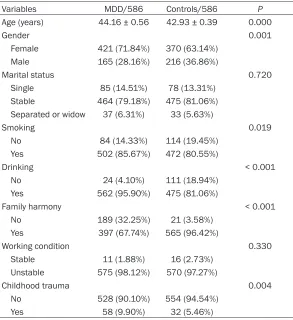
The baseline information is detailed in
Table 1
.
The Research Ethics Committee of China
Table 1.
Characteristics of the controls and MDD patients
Variables MDD/586 Controls/586 P
Age (years) 44.16 ± 0.56 42.93 ± 0.39 0.000
Gender 0.001
Female 421 (71.84%) 370 (63.14%)
Male 165 (28.16%) 216 (36.86%)
Marital status 0.720
Single 85 (14.51%) 78 (13.31%)
Stable 464 (79.18%) 475 (81.06%)
Separated or widow 37 (6.31%) 33 (5.63%)
Smoking 0.019
No 84 (14.33%) 114 (19.45%)
Yes 502 (85.67%) 472 (80.55%)
Drinking < 0.001
No 24 (4.10%) 111 (18.94%)
Yes 562 (95.90%) 475 (81.06%)
Family harmony < 0.001 No 189 (32.25%) 21 (3.58%)
Yes 397 (67.74%) 565 (96.42%)
Working condition 0.330 Stable 11 (1.88%) 16 (2.73%)
Unstable 575 (98.12%) 570 (97.27%)
Childhood trauma 0.004
No 528 (90.10%) 554 (94.54%)
Yes 58 (9.90%) 32 (5.46%)
Table 2.
Association between
CREB1
SNPs and MDD susceptibility
rs number Genotype MDD Control OR (95% CI) ORa (95% CI) rs11904814 TT 83 86 1
TG 300 287 1.08 (0.77-1.53) 1.12 (0.76-1.65)
GG 203 213 0.99 (0.69-1.42) 1.04 (0.69-1.55)
rs6740584 TT 206 220 1
TC 299 282 1.13 (0.88-1.45) 1.15 (0.86-1.53) CC 81 84 1.03 (0.72-1.48) 1.00 (0.66-1.49) rs2253206 GG 86 89 1
GA 293 286 1.06 (0.76-1.49) 1.08 (0.74-1.59)
AA 207 211 1.02 (0.71-1.45) 1.04 (0.70-1.55)
rs2551941 AA 105 111 1
AT 293 281 0.87 (0.63-1.20) 1.12 (0.79-1.60)
TT 188 194 0.76 (0.54-1.07) 1.04 (0.71-1.52)
aAdjusted by age, gender, marital status, smoking, drinking, family harmony, working condition and childhood trauma.
[24-26]. However, few
stud-ies have previously focused
on the joint effect of
CREB1
gene polymorphisms and
environmental factors. He-
rein, we studied the
associ-ation of
CREB1
SNPs with
MDD and investigated the
effects of common
con-founding factors in
conjunc-tion with these SNPs on the
susceptibility to the disea-
se.
Materials and methods
Participants
586 Chinese Han patients
with MDD were recruited
from Psychiatry Department
of First Affiliated Hospital of
Harbin Medical University.
The patients were diagno-
sed by 2 experienced
psy-chiatrists according to Dia-
gnostic and Statistical
man-ual of Disorders Fourth Edi-
tion (DMS-IV). All patients
got more than 21 points in
Hamilton’s Depression Sca-
le Test and received no
anti-depression treatment
with-in 2 weeks before
participa-tion. We excluded the pa-
tients in case of the
follow-ing conditions, brain
organ-ic mental disorders, other
mental disease, and family
history of genetic disease,
mental retardation,
demen-tia or physical disease. We
also excluded the patients
who provided insufficient
[image:2.612.90.382.433.606.2]approved the study and all participants signed
the informed consent form.
Measure of stressful life events
Life event scale (LES) proposed by Desen Yang
and Yalin Zhang was used to evaluate stressful
life events, such as serious illness,
relation-ships, housing and social difficulties, relation
-ship breakdowns, unemployment and financial
crisis. This scale assessed four aspects of
neg-ative life events: when the life events occurred
(absent = 1, 1 year earlier = 2, in a year = 3,
chronicity = 4), how the life events were
charac-Table 3.
Association between demographic factors and genotype distribution in MDD patients
Factor/genotype rs11904814 P rs6740584 P rs2253206 P rs2551941 P
TT TG/GG TT TC/CC GG GA/AA AA AT/TT Gender
Female 62 359 0.533 149 272 0.847 62 359 0.956 76 345 0.893 Male 21 144 57 108 24 141 29 136
Smoking
No 11 73 0.762 23 61 0.107 13 71 0.823 13 71 0.529 Yes 72 430 183 319 73 429 92 410
Drinking
No 3 21 0.812 11 13 0.264 2 22 0.371 4 20 0.871
Yes 80 482 195 367 84 478 101 461 Family harmony
No 28 161 0.756 71 118 0.400 27 162 0.854 35 154 0.794
Yes 55 342 135 262 59 338 70 327
Childhood trauma
No 79 449 0.095 194 334 0.015* 82 446 0.078 99 429 0.113
Yes 4 54 12 46 4 54 6 52
[image:3.612.92.522.83.310.2]*indicate a significant (P < 0.05) difference.
Table 4.
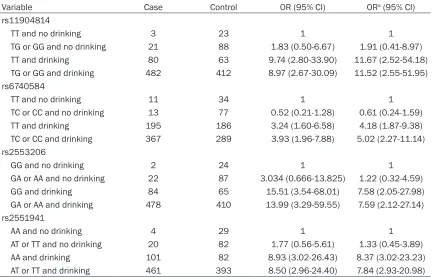
Interaction between drinking and
CREB1
genetic polymorphisms
Variable Case Control OR (95% CI) ORa (95% CI) rs11904814
TT and no drinking 3 23 1 1
TG or GG and no drinking 21 88 1.83 (0.50-6.67) 1.91 (0.41-8.97)
TT and drinking 80 63 9.74 (2.80-33.90) 11.67 (2.52-54.18)
TG or GG and drinking 482 412 8.97 (2.67-30.09) 11.52 (2.55-51.95)
rs6740584
TT and no drinking 11 34 1 1 TC or CC and no drinking 13 77 0.52 (0.21-1.28) 0.61 (0.24-1.59) TT and drinking 195 186 3.24 (1.60-6.58) 4.18 (1.87-9.38)
TC or CC and drinking 367 289 3.93 (1.96-7.88) 5.02 (2.27-11.14)
rs2553206
GG and no drinking 2 24 1 1
GA or AA and no drinking 22 87 3.034 (0.666-13.825) 1.22 (0.32-4.59) GG and drinking 84 65 15.51 (3.54-68.01) 7.58 (2.05-27.98)
GA or AA and drinking 478 410 13.99 (3.29-59.55) 7.59 (2.12-27.14)
rs2551941
AA and no drinking 4 29 1 1
AT or TT and no drinking 20 82 1.77 (0.56-5.61) 1.33 (0.45-3.89) AA and drinking 101 82 8.93 (3.02-26.43) 8.37 (3.02-23.23)
[image:3.612.91.524.353.630.2]terized (good = 1, bad = 2), to what extent the
respondent was affected (absent = 1, mild = 2,
moderate = 3, severe = 4, extreme = 5), and
how long the influence lasted (less than 3
months = 1, 3-6 months = 2, 6-12 months = 3,
more than 12 months = 4). A 75% percentile (a
score of 4) in controls was taken as a cutoff
value to group the events into the high or low
level categories.
Measure of child maltreatment
Self-reported childhood maltreatment
includ-ing abuse and neglect was recorded accordinclud-ing
to childhood trauma questionnaire (CTQ). It
comprises 28 items graded on a five-point
Likert scale, with higher scores corresponding
to higher degree of traumatic experience. The
scores were critical evidence to measure the
degree of maltreatment: none = 0, low = 1,
moderate = 2, severe and above = 3.
DNA isolation and genotyping
Genomic DNA was isolated from blood samples
using a MagNA Pure DNA Isolator (Roche, In-
dianapolis, IN). Extracted DNA was used for ge-
notyping. We selected 4 tag SNPs (rs11904814,
rs6740584, rs2551941, rs2253206) from the
whole-gene region of
CREB1
using Haploview’s
program. Analyses of SNPs were performed
using Taqman allelic discrimination assay on a
7900 system (Applied Biosystem Inc) according
to the manufacturer’s instructions. To ensure
the allele discrimination accuracy, all samples
were measured in triplicate, and the results
yielded a 100% concordance rate.
Statistical analysis
Hardy-Weinberg equilibrium was evaluated for
each polymorphism using χ
2test in both
patients and controls. T-test was used to
assess age difference between cases and
con-trols. χ
2-test was used to assess the
between-group differences in gender, marital status,
smoking, drinking, family harmony and working
condition. Multi-factor variance analysis was
performed to evaluate the association of
demo-graphic factors with genotype distribution.
Logistic regression was used to test the SNP
associations and the joint effects of
gene-envi-ronment interactions. All analyses were carried
out using SPSS 18.0. The values of
P
< 0.05
[image:4.612.89.524.84.363.2]were considered statistically significant.
Table 5.
Interaction between family harmony and
CREB1
genetic polymorphisms
Variable Case Control OR (95% CI) ORa (95% CI) rs11904814
TT and harmony 55 85 1 1
TT and no harmony 28 1 43.27 (5.72-327.28) 40.91 (5.40-309.81) TG or GG and harmony 342 480 1.10 (0.76-1.58) 1.07 (0.74-1.55)
TG or GG and no harmony 161 20 12.41 (7.00-22.12) 12.71 (7.07-22.85) rs6740584
TT and harmony 135 213 1 1
TT and no harmony 71 7 16.00 (7.15-35.82) 16.77 (7.47-37.66)
TC or CC and harmony 262 352 1.17 (0.90-1.54) 1.24 (0.94-1.62) TC or CC and no harmony 118 14 13.30 (7.34-24.10) 13.78 (7.59-25.01)
rs2253206
GG and harmony 59 86 1 1
GG and no harmony 27 3 13.12 (3.80-45.24) 38.13 (5.04-288.68) GA or AA and harmony 338 479 1.03 (0.72-1.47) 1.03 (0.72-1.47)
GA or AA and no harmony 162 18 13.12 (7.28-23.64) 11.69 (6.59-20.72)
rs2551941
AA and harmony 70 105 1 1
AA and no harmony 35 6 8.75 (3.50-21.90) 14.55 (4.96-42.67)
Results
Demographic and clinical data on study
sub-jects
The characteristics of study subjects are listed
in
Table 1
. The mean age was 44.16 in cases
(male/female 28.2%/71.8%) and 42.93 in con
-trols (male/female 36.9%/63.1%). A significant
difference in gender distribution was detected
between the two groups (
P
= 0.002). Most
sub-jects were smokers (cases 85.7%, controls
80.6%) and alcohol drinkers (cases 95.9%, con
-trols 81.1%). The cases were statistically differ
-ent from controls both in alcohol consumption
(
P
< 0.001) and tobacco smoking (
P
= 0.019).
No significant difference was found in family
harmony, marital status and working condition
(
P
> 0.05).
Effect of CREB1 SNPs on MDD susceptibility
To evaluate the effects of
CREB1
SNPs, we
per-formed logistic regression. The results
indicat-ed no association between
CREB1
polymo-prhisms and MDD susceptibility (
Table 2
). We
then explored the effects of demographic
fac-tors on genotype distribution (
Table 3
) and the
data showed that childhood trauma was signifi
-cantly associated with genotype distribution of
rs6740584 in MDD patients (
P
= 0.015).
Combined effects of SNPs and drinking, family
harmony and childhood trauma
Considering that the SNPs of
CREB1
alone did
not show any impact on MDD susceptibility, we
analyzed the interactions between SNPs and
drinking, family harmony and childhood trauma
(
Table 4
). We found significantly increased risk
of MDD associated with rs11904814
geno-types among drinkers (OR = 11.67, 95% CI =
2.52-54.18; OR = 11.52, 95% CI = 2.55-51.95).
A similar trend was indicated for rs6740584,
rs2253206 and rs2551941. These results
demonstrated that drinking served as an
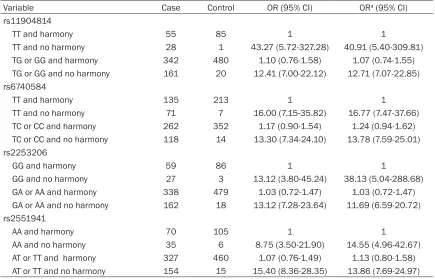
impor-tant risk factor for MDD. We also found a signifi
-cant role of family harmony in the risk of MDD.
As shown in
Table 5
, lack of family harmony
significantly promoted the development of
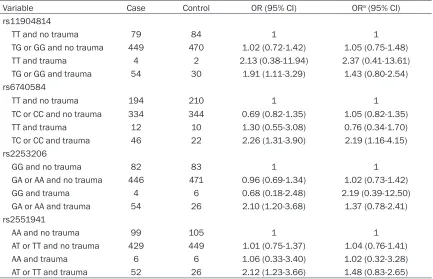
MDD. In addition, we identified a 2.19-fold
increased risk in relation to TC/CC genotypes of
rs6740584 in conjunction with childhood trau
-ma (OR = 2.19, 95% CI = 1.16-4.15,
Table 6
).
Discussion
[image:5.612.90.523.83.362.2]As genetic polymorphisms are usually
impossi-ble to work alone in predisposing human
dis-eases, analysis of gene-environment
interac-tions is frequently used to test the combined
effects conferred by genetic polymorphsims
Table 6.
Interaction between childhood trauma and
CREB1
genetic polymorphisms
Variable Case Control OR (95% CI) ORa (95% CI) rs11904814
TT and no trauma 79 84 1 1
TG or GG and no trauma 449 470 1.02 (0.72-1.42) 1.05 (0.75-1.48)
TT and trauma 4 2 2.13 (0.38-11.94) 2.37 (0.41-13.61)
TG or GG and trauma 54 30 1.91 (1.11-3.29) 1.43 (0.80-2.54)
rs6740584
TT and no trauma 194 210 1 1 TC or CC and no trauma 334 344 0.69 (0.82-1.35) 1.05 (0.82-1.35) TT and trauma 12 10 1.30 (0.55-3.08) 0.76 (0.34-1.70)
TC or CC and trauma 46 22 2.26 (1.31-3.90) 2.19 (1.16-4.15) rs2253206
GG and no trauma 82 83 1 1
GA or AA and no trauma 446 471 0.96 (0.69-1.34) 1.02 (0.73-1.42)
GG and trauma 4 6 0.68 (0.18-2.48) 2.19 (0.39-12.50) GA or AA and trauma 54 26 2.10 (1.20-3.68) 1.37 (0.78-2.41)
rs2551941
AA and no trauma 99 105 1 1 AT or TT and no trauma 429 449 1.01 (0.75-1.37) 1.04 (0.76-1.41)
and environment variables. It is reported that
environmental factors such as emotional
abuse, emotional and physical neglect are
important components in the pathogenesis of
depression [27, 28]. Either high- or low-predis
-posing genes always function in combination
with many exogenous substances [29]. Rice et
al. found that candidate genes exert strong
effects on depressive symptoms, stronger in
males than in females [30]. Grabe et al. also
reported that interaction of TAT-haolotype of
CRHR1 and childhood physical neglect has a
role in MDD pathogenesis [31]. Actually,
vari-ous environmental factors are involved in the
etiology of MDD, including gender, age and
marital status as substantiated by Benitez et
al. [32], neighborhood environment (OR = 2.2,
95% CI = 1.2-3.9) as suggested by Kessler et
al. [33], and low self-esteem family depression,
childhood abuse, traumatic experiences
educa-tion state as indicated by Blanco et al. [34].
These data highlight the important role of
exog-enous substances in the development of MDD
and identification of the risk factors may con
-tribute to an increased understanding of the
mechanisms that underlie this disease.
In the present study, we explored the effects of
SNPs in
CREB1
gene and gene-environment
interactions on MDD susceptibility, and showed
evidence of no association between MDD and
CREB1
SNPs, a finding that contradicts
Zuben-ko et al., indicating that
CREB1
is a potential
susceptibility locus for MDD [7], and Guo et al.
reporting that rs6740584 of
CREB1
has an
effect on selective attention and retrieval [35].
As expected, we found a significantly increased
risk when both polymorphisms and exogenous
variables were considered. This joint effect is
supported by Perlis et al., who found a strong,
gender-specific association between variation
at
CREB1
locus and anger expression in MDD
[15]. Although we cannot exclude the possibility
that the lack of an association between
CREB1
polymorphisms and MDD susceptibility is a
false negative finding, it seems likely that the
polymorphisms at
CREB1
do not function alone
in predisposing MDD, as suggested by Hettema
et al. and Crisafulli et al. [36].
In addition, we evaluated the impact of
demo-graphic factors on the genotype distribution in
MDD patients and only childhood trauma was
identified as a regulatory factor of rs6740584
genotypes (
P
= 0.015). To obtain a more
com-prehensive understanding of MDD etiology, we
assessed the association of MDD risk with
gen-der, smoking, drinking, family harmony and
childhood trauma (
Table 1
). A significant inter
-action was detected for drinking, family
harmo-ny and childhood trauma, which were found to
increase genetic susceptibility to MDD by
inter-playing with various
CREB1
SNPs. Appel et al.
uncovered interactions between physical
abuse and rs1360780 in the FKBP5 gene and
confirmed its role in depression susceptibility
[24]. Moreover, significant interactions between
stressful life events and 5-HTTPR and BDNF
genotypes were observed in patients with
depression [26]. A recent study carried out by
Wong et al. provided further evidence
support-ing the impact of exogenous factors (smoksupport-ing,
marriage status, age, alcohol abuse and
gen-der) on susceptibility to major depression [37].
The previous studies along with the present
study suggest that MDD is a heterogeneous
disease and both genetic variations and a large
repertoire of exogenous variables may have
modulating effects on the susceptibility.
In conclusion, presence of
CREB1
gene
poly-morphisms combined with exogenous factors
including drinking, family harmony and
child-hood trauma may increase the risk of
develop-ing MDD. Further large-scale studies are
war-ranted to identify the role of environment-genetic
risk factors in the etiology of MDD, thus
facili-tating better understandings of MDD
pathogen-esis and subsequent preventive measures and
treatment.
Acknowledgements
This research was supported by the National
Natural Science Foundation of China
(3127-1093, 81473054) to Prof. Yanjie Yang and the
National Natural Science Foundation of China
(81202213) to Xiuxian Yang.
Disclosure of conflict of interest
None.
Address correspondence to: Dr. Yanjie Yang, Depart- ment of Psychology, Public Health Institute, Harbin
Medical University, 157 Baojian Road, Harbin
150081, China. E-mail: [email protected]
References
cascade in male germ cells. J Endocrinol Invest 2000; 23: 592-596.
[2] Mayr B and Montminy M. Transcriptional regu-lation by the phosphoryregu-lation-dependent fac-tor CREB. Nat Rev Mol Cell Biol 2001; 2: 599-609.
[3] Lonze BE and Ginty DD. Function and regula-tion of CREB family transcripregula-tion factors in the nervous system. Neuron 2002; 35: 605-623. [4] Sands WA and Palmer TM. Regulating gene
transcription in response to cyclic AMP eleva-tion. Cell Signal 2008; 20: 460-466.
[5] Mamdani F, Alda M, Grof P, Young LT, Rouleau G and Turecki G. Lithium response and genetic variation in the CREB family of genes. Am J Med Genet B Neuropsychiatr Genet 2008;
147B: 500-504.
[6] Zubenko GS, Maher B, Hughes HB 3rd,
Zuben-ko WN, Stiffler JS, Kaplan BB and Marazita ML.
Genome-wide linkage survey for genetic loci
that influence the development of depressive
disorders in families with recurrent, early-on-set, major depression. Am J Med Genet B Neu-ropsychiatr Genet 2003; 123B: 1-18.
[7] Zubenko GS, Hughes HB 3rd, Stiffler JS, Brech -biel A, Zubenko WN, Maher BS and Marazita ML. Sequence variations in CREB1 cosegre-gate with depressive disorders in women. Mol Psychiatry 2003; 8: 611-618.
[8] Dwivedi Y, Rao JS, Rizavi HS, Kotowski J, Con-ley RR, Roberts RC, Tamminga CA and Pandey GN. Abnormal expression and functional char-acteristics of cyclic adenosine monophosphate response element binding protein in postmor-tem brain of suicide subjects. Arch Gen
Psy-chiatry 2003; 60: 273-282.
[9] Odagaki Y, Garcia-Sevilla JA, Huguelet P, La Harpe R, Koyama T and Guimon J. Cyclic AMP-mediated signaling components are upregu-lated in the prefrontal cortex of depressed sui-cide victims. Brain Res 2001; 898: 224-231. [10] Young LT, Bezchlibnyk YB, Chen B, Wang JF
and MacQueen GM. Amygdala cyclic adenos-ine monophosphate response element binding protein phosphorylation in patients with mood disorders: effects of diagnosis, suicide, and
drug treatment. Biol Psychiatry 2004; 55: 570-577.
[11] Dowlatshahi D, MacQueen GM, Wang JF and Young LT. Increased temporal cortex CREB concentrations and antidepressant treatment
in major depression. Lancet 1998; 352: 1754-1755.
[12] Koch JM, Kell S, Hinze-Selch D and Aldenhoff JB. Changes in CREB-phosphorylation during recovery from major depression. J Psychiatr
Res 2002; 36: 369-375.
[13] Yamada S, Yamamoto M, Ozawa H, Riederer P and Saito T. Reduced phosphorylation of cyclic
AMP-responsive element binding protein in the postmortem orbitofrontal cortex of patients with major depressive disorder. J Neural
Transm 2003; 110: 671-680.
[14] Perlis RH, Purcell S, Fava M, Fagerness J, Rush AJ, Trivedi MH and Smoller JW. Association be-tween treatment-emergent suicidal ideation with citalopram and polymorphisms near cyclic adenosine monophosphate response element binding protein in the STAR*D study. Arch Gen
Psychiatry 2007; 64: 689-697.
[15] Perlis RH, Purcell S, Fagerness J, Cusin C, Ya-maki L, Fava M and Smoller JW. Clinical and genetic dissection of anger expression and CREB1 polymorphisms in major depressive
disorder. Biol Psychiatry 2007; 62: 536-540.
[16] Zubenko GS and Hughes HB 3rd. Effects of the G(-656)A variant on CREB1 promoter activity in a glial cell line: interactions with gonadal ste-roids and stress. Am J Med Genet B
Neuropsy-chiatr Genet 2008; 147B: 579-585.
[17] Zubenko GS and Hughes HB 3rd. Effects of the G(-656)A variant on CREB1 promoter activity in a neuronal cell line: interactions with gonadal steroids and stress. Mol Psychiatry 2009; 14:
390-397.
[18] Hammar A and Ardal G. Cognitive functioning in major depression--a summary. Front Hum Neurosci 2009; 3: 26.
[19] Angst J. The Prognosis of Antidepressive Treat-ments: Longitudinal and Genetic Studies.
An-glo Ger Med Rev 1965; 2: 733-751.
[20] Pare CM, Rees L and Sainsbury MJ.
Differenti-ation of two genetically specific types of de -pression by the response to anti-depressants. Lancet 1962; 2: 1340-1343.
[21] Serretti A, Franchini L, Gasperini M, Rampoldi R and Smeraldi E. Mode of inheritance in
mood disorder families according to fluvox -amine response. Acta Psychiatr Scand 1998; 98: 443-450.
[22] Kendler KS, Walters EE, Neale MC, Kessler RC, Heath AC and Eaves LJ. The structure of the genetic and environmental risk factors for six major psychiatric disorders in women. Phobia, generalized anxiety disorder, panic disorder, bulimia, major depression, and alcoholism.
Arch Gen Psychiatry 1995; 52: 374-383.
[23] Kendler KS, Kessler RC, Walters EE, MacLean C, Neale MC, Heath AC and Eaves LJ. Stressful life events, genetic liability, and onset of an episode of major depression in women. Am J Psychiatry 1995; 152: 833-842.
gen-eral population. Neuropsychopharmacology 2011; 36: 1982-1991.
[25] Ressler KJ, Bradley B, Mercer KB, Deveau TC, Smith AK, Gillespie CF, Nemeroff CB, Cubells JF and Binder EB. Polymorphisms in CRHR1 and the serotonin transporter loci: gene x gene x environment interactions on depressive symptoms. Am J Med Genet B Neuropsychiatr Genet 2010; 153B: 812-824.
[26] Kim JM, Stewart R, Kim SW, Yang SJ, Shin IS, Kim YH and Yoon JS. Interactions between life stressors and susceptibility genes (5-HTTLPR and BDNF) on depression in Korean elders.
Biol Psychiatry 2007; 62: 423-428.
[27] Kendler KS and Baker JH. Genetic influences
on measures of the environment: a systematic
review. Psychol Med 2007; 37: 615-626.
[28] Heim C and Binder EB. Current research trends in early life stress and depression: review of human studies on sensitive periods, gene-en-vironment interactions, and epigenetics. Exp Neurol 2012; 233: 102-111.
[29] Meyer-Lindenberg A and Tost H. Neural mecha-nisms of social risk for psychiatric disorders. Nat Neurosci 2012; 15: 663-668.
[30] Rice F, Harold G and Thapar A. The genetic ae-tiology of childhood depression: a review. J
Child Psychol Psychiatry 2002; 43: 65-79.
[31] Grabe HJ, Schwahn C, Appel K, Mahler J, Schulz A, Spitzer C, Fenske K, Barnow S, Lucht M, Freyberger HJ, John U, Teumer A, Wallas-chofski H, Nauck M and Volzke H. Childhood maltreatment, the corticotropin-releasing hor-mone receptor gene and adult depression in the general population. Am J Med Genet B Neuropsychiatr Genet 2010; 153B: 1483-1493.
[32] Hernandez-Benitez CT, Garcia-Rodriguez A, Le-al-Ugarte E, Peralta-Leal V and Duran-Gonzalez J. [Enviromental factors related to depressive disorders]. Rev Med Inst Mex Seguro Soc
2014; 52: 574-579.
[33] Kessler RC, Duncan GJ, Gennetian LA, Katz LF, Kling JR, Sampson NA, Sanbonmatsu L, Zaslavsky AM and Ludwig J. Associations of housing mobility interventions for children in high-poverty neighborhoods with subsequent mental disorders during adolescence. JAMA
2014; 311: 937-948.
[34] Blanco C, Rubio J, Wall M, Wang S, Jiu CJ and Kendler KS. Risk factors for anxiety disorders:
common and specific effects in a national sample. Depress Anxiety 2014; 31: 756-764.
[35] Guo J, Liu Z, Dai H, Zhu Z, Wang H, Yang C, Xiao L, Huang Y and Wang G. Preliminary
investiga-tion of the influence of CREB1 gene polymor -phisms on cognitive dysfunction in Chinese patients with major depression. Int J Neurosci 2014; 124: 22-29.
[36] Hettema JM, An SS, van den Oord EJ, Neale MC, Kendler KS and Chen X. Association study of CREB1 with Major Depressive Disorder and related phenotypes. Am J Med Genet B Neuro-psychiatr Genet 2009; 150B: 1128-1132.
[37] Wong ML, Dong C, Andreev V, Arcos-Burgos M and Licinio J. Prediction of susceptibility to ma-jor depression by a model of interactions of multiple functional genetic variants and
envi-ronmental factors. Mol Psychiatry 2012; 17: