Effect of phenolic acid content on acceptance
of hazel cultivars by filbert aphid
Magdalena Gantner
1, Agnieszka Najda
2*, Dariusz Piesik
3*
1Department of Functional Food, Ecological Food and Commodities,Warsaw University of Life Sciences, Warsaw, Poland; 2Department of Vegetable Crops and Medicinal Plants, University of Life Sciences in Lublin, Lublin, Poland; 3Department of Entomology and MolecularPhytopathology, UTP University of Science and Technology, Bydgoszcz, Poland *Corresponding authors: [email protected]; [email protected]
Citation: Gantner M., Najda A., Piesik D. (2019): Effect of phenolic acid content on acceptance of hazel cultivars by filbert
aphid. Plant Protect. Sci., 55: 116–122.
Abstract: The allelopatic effect of phenolic acids contents in the leaves of six cultivars of hazel (Corylus L.) on the choi-ce of plants by Myzocallis coryli Goetze (filbert aphid), one of the most important pest of hazel in Poland and throughout the world, was identified. The cvs White Filbert, Mogulnus, and Luizen Zellernus were more resistant to the feeding of aphids in all the years than cvs Minnas, Barra, and Halls Giant. The highest content of total phenolic acids was repor-ted in the leaves of cvs White Filbert and Luizen Zellernuss, with a low level of acceptance by aphids. These cultivars demonstrated a high concentration of gallic acid and caffeic acid. In the leaves of cvs Minnas and Halls Giant, much infested by aphids, the total content of phenolic acids was significantly lower. Moreover, gallic and caffeic acids occurred at significantly lower concentrations. The chromatographic analysis of hazel leaf extracts revealed the presence of eight phenolic acids: gallic, protocatechuic, p-hydroxybenzoic, salicylic, chlorogenic, ferrulic, caffeic, and α-resorcinolic. The leaves of the tested cultivars, irrespective of the level of resistance to filbert aphid, showed a definitely higher concen-tration of acids, derivatives of trans-cinnamic acid, if compared to the amount of acids – derivatives of benzoic acid.
Keywords: Corylus L.; Myzocallis coryli; chromatographic analyse
Secondary plant metabolites are considered the key source of plant resistance to pests. They act both dur-ing the plant selection and durdur-ing the physiological pest–plant relations, conditioning the phenomenon of natural resistance (Gatehouse 2002; Bernards & Bastrup-Spohr 2008). Their mechanisms vary since they involve both the substances which occur in peripheral tissues (epidermis, mesophyll) and in the vascular bundles (Leszczyński 2001a, b; Goggin & Zhu-Salzman 2015). They affect olfactory, tactile, and taste receptors in the herbivores. In that group of secondary metabolites the derivatives of shikimic acid and acetate prevail, however, in woody plants the derivatives of shikimic acid are more important (Leszczyński 2001b).
Their effect on pests is usually toxic and they are considered as food attractants (Harborne 1997;
Péllisié et al. 2018). In the leaves of the common
hazel (Corylusavellana L.) flavonoids (myricitrin
and quercetin as well as tannins) have been
identi-fied and determined (Fraisse et al. 1999; Amaral
et al. 2005). In the research performed in Portugal the content and the composition of phenolic acids in the leaves of three cvs of cultivable hazel were
determined (Oliveira et al. 2006).
response may also involve such reactions as synthe-sis of pathogenesynthe-sis related (PR) proteins, phenolic compounds (e.g. phytoalexins), lignin deposition, the production of signalling compounds, and the generation of reactive oxygen species (ROS), e.g.
hydrogen peroxide. H2O2 increases the synthesis of
another phenolic compound – salicylic acid, a known elicitor of plant defense response to stresses and is also a substrate for peroxidases oxidising phenolic alcohols, which subsequently polymerise to lignins
(Bolwell et al. 2002).
Phenolic compounds: phenols, alcohols, phenolic acids, phenylopropenoids, coumarins, flavonoids, and tannins are recognised as the most active groups of plant allelocompounds. Phenols are plant proteo-lytic inhibitors of enzymes of insects (Leszczyński 2001b). Their higher concentration, often observed in the plants of resistant cvs, may inhibit the digestive processes of phytophages, decrease the availability of the feed uptaken by irritating the walls of the alimentary canal, and decrease permeability of the
intestine for digested nutrients (Czerniewicz et al.
2017). It was demonstrated that the higher level of phenols positively correlated with the resistance of
hazel cultivars to Curculionucum (Piskornik 1994),
or wheat to Sitobionavenae and Oulema melanopus
(Czerniewicz et al. 2017). A negative effect of
phenolic compounds can be observed in a form of prolonged pre-reproduction period, a decrease in the fertility and the population growth rate. A gradual decrease in the content of phenols in the seedlings of maize and barley occurred together with the
develop-ment of the population of aphids Rhopalosiphumpadi
and Sitobionavenae (Eleftherianos et al. 2006), which confirms the hypothesis that young plant leaves are more abundant in secondary metabolites than older leaves (Walczyńska 2009).
The aim of the study was to identify the allelopatic effect of phenolic acids contents in the leaves of
six cultivars of hazel (Corylus L.) on the choice of
plants by Myzocallis coryli Goetze (filbert aphid),
one of the most important pest of hazel in Poland and throughout the world.
MATERIAL AND METHODS
Plant and insect material. The level of leaves
colonisation by M. coryli was determined over 2008–
2009 under field conditions on an experimental plantation at Motycz, in the vicinity of Lublin (eastern
Poland, 51°14'N; 22°34'E), with no chemicals applied.
The studies were performed in five shrubs of six hazel cvs: Minnas, Barra, Halls Giant Luizen Zellernuss, Mogulus, and White Filbert, demonstrating a different resistance to the pest.
The population of filbert aphid was monitored from early spring till the occurrence of the first larvae on hazel leaves. The method used involved counting the aphids on 100 leaves of each plant. The aphid population was controlled with 10-day intervals until complete disappearance. The number of larvae and winged females as well as the number of colonized leaves were noted. The level of the pest population on the cultivars tested was expressed as a cumulative aphid index (the sum of aphids on 100 leaves) and the mean percentage of the colonised leaves was established.
Besides, the abundance of aphids under insectarium conditions was determined, too. To do so, in late May, on the shoots of the same trees as above (of all six cultivars), 10 bags per each were placed. They were made of the flour mesh and tied with a ribbon. In each isolator 20 leaves non-infected by aphids
together with one larva of M. coryli, feeding on a
given hazel cultivar, were closed. Population growth observations were made every 5 days, each time adult individuals and new born larvae were counted. The
population growth of M. coryli on the cultivars tested
was expressed with the so-called aphid index (the total number of larvae and adult individuals) as well as the larval index (the number of the larvae born). The acceptance of the host by feeding aphids was evaluated with the significant differences between the values of both indicators analysed.
Phenolic acid analyses. The study material were the leaves of the six above-mentioned hazel cultivars. The leaves (undamaged by aphids) were collected in June upon the maximum occurrence of aphids. The leaves were covered due to the abundant aphid honeydew. The plant material was obtained before noon, on sunny and dry days. Directly after the har-vest, the material was dried at 35°C in natural shade and in the air flow.
The content of phenolic acids in healthy plant material was compared. For this purpose, the leaves were left uncontrolled (previously covered with in-sulators) and colonised by the aphids, which were then subjected to laboratory analysis. About 50 mg of the powdered leaf samples were weighed in tripli-cates and extracted with 1.5 ml 50% ethanol (purity
99.98%) containing 0.05 mol/l H3PO4 in water. The
extracts were vortexed and sonicated in an ultrasonic bath (Bandelin Sonorex, Berlin, Germany) at room
temperature for 15 min and centrifuged at 15 300 g
for 10 minutes. The supernatant was transferred to
a vial prior to HPLC analyses (Najda et al. 2014).
The isolation and purification of phenolic acids in the tested raw materials was carried out using the HPLC method. The chromatographic analysis was performed in a reversed phase system using a liquid chromatograph with a DAD diode detector (L-7450) and a LiChrospher 100 RP-C18 steel column. The mobile phase was the solvent gradient of the solu-tions: acetonitrile + water + 1% acetic acid (Najda 2004). Identification of phenolic acids was carried out by comparing their retention times (tR) with standards and spectroscopically determining their spectra in the UV range (220–400 nm) (Nollet 2000). The content of individual phenolic acids in the tested raw materials was calculated on the basis of a calibration curve determined for each identified phenolic acid. The HPLC analyses were performed using three technical replicates for each cultivar and thereafter means of the three replicates.
Statistical analysis. For all the statistical labo-ratory experiments and analysis of the results, the software package STATISTICA 9.1 (StatSoft, Tulsa, USA) was used. ANOVA with the Tukey simultaneous
test was applied, with P < 0.05. The average results
on the figures were determined with standard devia-tion (± SD). The correladevia-tion coefficients between the total aphid population and the number of the leaves colonized were calculated. All the determinations were performed in pentaplicates (5 reps, field experi-ments) and in triplicate (laboratory experiexperi-ments).
RESULTS
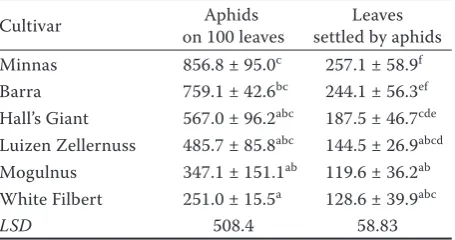
The field observations showed that the hazel cultivar plants demonstrate a varied resistance to colonization by filbert aphid. More individuals were recorded on cvs Minnas, Barra, and Halls Giant. A significantly lower number of aphids were recorded on cvs Luizen
Zellernuss, Mogulusand, and White Filbert (Ta-ble 1). The cultivars differed also significantly with the mean number of leaves infested by aphids. The
largest number of leaves infested by M. coryli was
reported on cvs Minnas and Barra, and the lowest number on cvs Mogulnus, White Filbert, and Luizen Zellernuss (Table 1).
[image:3.595.298.526.140.260.2]The comparison of the aphid index (the total num-ber of adults and larvae individuals on the leaves of the plant throughout the observations) and the larval index (the number of larvae born) across the cultivars shows that the larval development and feeding of filbert aphid appears with a varied intensity on the cultivars. The largest values of both indicators were recorded on leaves of cvs Minnas, Barra, and Halls Giant. Different and rather worse conditions for the colony development and feeding of the aphids were
Table 1. Total mean number (–x ± SD) of M. coryli individu-als on 100 leaves and of settled leaves of hazelnut cultivars in field conditions in years 2007–2008
Cultivar on 100 leaves Aphids settled by aphids Leaves
Minnas 856.8 ± 95.0c 257.1 ± 58.9f
Barra 759.1 ± 42.6bc 244.1 ± 56.3ef
Hall’s Giant 567.0 ± 96.2abc 187.5 ± 46.7cde
Luizen Zellernuss 485.7 ± 85.8abc 144.5 ± 26.9abcd
Mogulnus 347.1 ± 151.1ab 119.6 ± 36.2ab
White Filbert 251.0 ± 15.5a 128.6 ± 39.9abc
LSD 508.4 58.83
Cultivars marked with different letters differ significantly at P = 0.05
Figure 1. Increase in M. coryli population in chiffon in-sulators in hazel leaves (cultivars marked with different letters differ significantly at P = 0.05)
0 100 200 300 400 500 600 700
Minnas Ba
rra
H
all's
Gia
nt
Lu
iz
en
Ze
lle
tnu
ss
M
oguln
us
White
F
ilbert
Number
of
individuals
Total index of aphids
Index of larvae a
a a a a a
b
b b b c
[image:3.595.298.518.529.709.2]noted on cvs Luizen Zellernuss and Mogulus, but the lowest value of both indicators were reported on the cv. White Filbert (Figure 1).
Based on the chromatographic analysis of the ex-tracts made from hazel leaves, the presence of eight phenolic acids (four representing the derivatives of
benzoic acid: gallic, protocatechuic, p
-hydroxybenzo-ic, and salicylic acid; four representing the derivatives of trans-cinnamic acid: chlorogenic, feluric, caffeic, and α-resolcylic acid) was documented. The presence of salicylic acid in the leaves of cvs Halls Giant and Luizen Zellernusswas not identified (Table 2). Total
phenolic acids content ranged from 142.54 µg/gin
the leaves of Halls Giant to 264.92 and 268.27 µg/g in the leaves of cvs Luizen Zellernuss and White Filbert, respectively (Table 2).
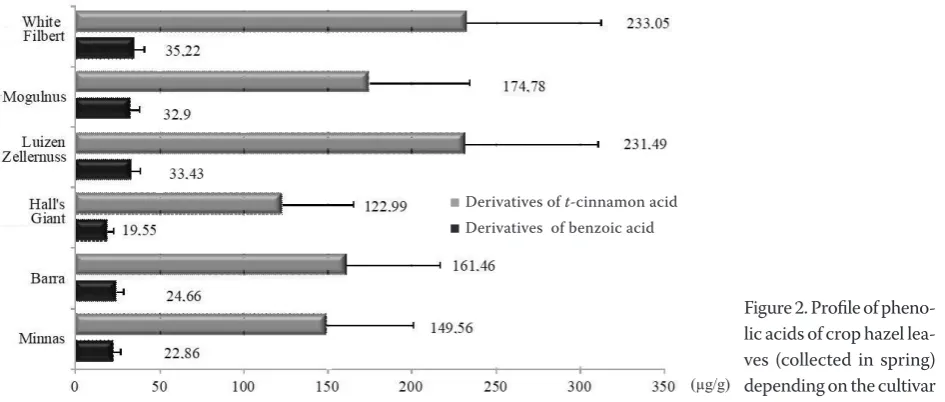
The leaves of the tested cultivars, irrespective of the level of resistance to filbert aphid, showed defi-nitely higher concentration of acids, derivatives of
trans-cinnamic acid, if compared to the amount of acids – derivatives of benzoic acid (Figure 2).
Of all the phenolic acids identified, caffeic acid was dominant and its mean content varied from 120.35 µg/g to 226.71 µg/g in the leaves of cvs Halls Giant and White Filber, respectively. It was also
found that p-hydroxybenzoic acid occurred at the
lowest concentration in the extracts, regardless of tested cultivar (Table 2).
The leaves of the hazel cultivars differed significantly in concentration of all phenolic compounds. Only
the content of p-hydroxybenzoic acid was the same
[image:4.595.64.534.112.280.2]in the tested cultivars (Table 2). The highest content of total phenolic acids was reported in the leaves of cvs White Filbert and Luizen Zellernuss, with a low level of acceptance by aphids. These cultivars dem-onstrated a high concentration of gallic acid and caf-feic acid. In the leaves of cvs Minnas and Halls Giant the total content of phenolic acids was significantly
Table 2. Content of phenolic acids (µg/g dry weight) in non-infested leaves of hazel cultivars in 2007 and 2008
Phenolic acid Hazel cultivar (P = 0.01)LSD
Minnas Barra Hall’s Giant ZellernussLuizen Mogulnus FilbertWhite
Gallic 20.71 ± 2.24a 22.19 ± 0.78ab 18.89 ± 6.39a 32.58± 9.02c 29.98 ± 7.08bc 32.12 ± 7.09c 8.23
Protocatechuic 0.61 ± 0.01ab 0.78 ± 0.04c 0.51 ± 0.21a 0.73 ± 0.09bc 0.58 ± 0.03a 0.69 ± 0.03b 0.11
p-Hydroxy-benzoic 0.15 ± 0.13a 0.16 ± 0.17a 0.16 ± 0.15a 0.13 ± 0.11a 0.12 ± 0.08a 0.14 ± 0.12a 0.08
Salicylic 1.40± 0.55a 1.54 ± 0.70ac 0.00 ± 0.00a 0.00 ± 0.00a 2.23 ± 1.19bc 2.28 ± 1.48c 0.82
Chlorogenic 0.33 ± 0.00b 0.21 ± 0.00b 0.19 ± 0.00b 0.03 ± 0.00a 0.04 ± 0.00a 0.67 ± 0.00c 0.15
Feluric 7.60 ± 2.28b 5.96 ± 2.30b 1.94 ± 0.67a 2.34 ± 1.73a 2.04 ± 0.87a 2.69 ± 1.63a 2.56
Cafeic 139.61 ± 54.87ab152.97 ± 69.84bc 120.35 ± 22.28a 228.38 ± 156.03d171.62 ± 68.38c 226.71 ± 147.72d 25.44
α-Resorcylic 2.02 ± 0.54b 2.33 ± 0.66bc 0.52 ± 0.20a 0.75 ± 0.09a 1.09 ± 0.71a 2.99 ± 1.45c 0.77
Total 172.42 ± 56.12 186.11 ± 72.85 142.54 ± 15.77 264.92± 167.08 207.68 ± 78.34 268.27 ± 159.45
Cultivars marked with different letters differ significantly at P = 0.05
Figure 2. Profile of pheno-lic acids of crop hazel lea-ves (collected in spring) depending on the cultivar ■ Derivatives of t-cinnamon acid
■ Derivatives of benzoic acid
[image:4.595.63.536.560.761.2]lower. Moreover, gallic and caffeic acids occurred at significantly lower concentrations (Table 2).
DISCUSSION
Host plant resistance is an efficient and environ-mentally friendly means of controlling insects,
in-cluding aphids (Lombardo et al. 2016). However,
in Poland, the selection of hazel cultivars does not consider the resistance to diseases and pests, except
for the nut weevil (Curculio nucum) (Piskornik
1994). The global studies are mostly focused on the cultivar-specific hazel resistance to diseases caused
by endemic fungus Anisogramma anomala or bacteria
Pseudomonas syringae pv. avellanae. Growing hazel cultivars with an increased resistance could decrease the abundance of pests and decrease losses caused by pesticides (Gantner 2000, 2008),
The observations showed that the cultivars dem-onstrated a different level of resistance to aphid Myzocallis coryli. A partial resistance to filbert aphid was found in cvs White Filbert, Mogulnus, and Luizen Zellernuss. Significantly more larvae and adult individuals were noted on the leaves of cvs Barra and Halls Giant, what is not in agreement with Wojciechowicz-Żitko (2003), but is in accord with other reports (Gantner 2000, 2008).
The research shows that the level of phenolic acids plays an important role in developing the resistance of hazel cultivars on the occurrence of filbert aphid.
According to Qawasmeh et al. (2012a), phenolic
acids are the key group of compounds responsible for protecting the plants from pest attack. Induction of phenol production and antioxidative potential are crucial mechanisms that enhance the plant
resist-ance to oxidative stress (Qawasmeh et al. 2012b).
Pańka et al. (2013) found that Neotyphodium lolii was
involved in the production of phenolic compounds by colonised plants before contact with the patho-gen. The level of these chemicals was significantly higher in plants colonised by the endophyte. This suggests the strong influence of the plant and fungal
genotype on phenolics production. Qawasmeh et al.
(2012a) observed a significant influence of infection
of perennial ryegrass with Neotyphodium lolii on the
phenolics content and antioxidant activity.
Phenolic acids represent secondary metabolites affecting the development and feeding of insects
(Mallikarjuna et al. 2004; Cipollini et al. 2008). In
the leaves of the tested hazel cvs eight phenolic acids
(gallic, protocatechuic, p-hydroxybenzoic, salicylic,
chlorogenic, feluric acid, caffeic, and α-resolcylic acid) were identified. To compare our findings, Oli-
veira et al. (2006) detected five phenolic acids in
hazelnut leaves: 3-, 4-, and 5-caffeoylquinic acids,
caffeoyltartaric acid, and p-coumaroyltartaric acid.
Moreover, their presence, except for 4-caffeoylquinic
acid, was reported in earlier research by Amaral et
al. (2005). Oliveira et al. (2006) demonstrated a
quantitative variation in the phenolic acids identified in tested cultivars, what suggests that the cultivar is an important factor affecting both the quantity and the quality of phenolic acids. The available data confirms the important role of phenolic compounds in the defense reaction of plants to pathogen attacks
(Lei et al. 2014).
Plants defend themselves against insect attacks using three possible mechanisms: antibiosis, when host plant constituents cause adverse effects in the pest life cycle; antixenosis, in which plant acts as bad host so the insect shifts to another plant; and toler-ance or ability to withstand or recover from insect
damage is possible (Tefera et al. 2016). Thus, both
constitutive and induced defenses may contribute to the protection of the plant against herbivorous enemies (Smith 2007). Gantner (2008) reported
the partial and complex resistance to M. coryli in
some cultivars of hazel, qualified both by the fully-developed mechanism of lack of acceptance and mostly by mechanism of antibiosis. The leaves of cv. Luizen Zellernuss were generally not attractive for aphids, because they had a thick leaf blade, small quantity of stomata, and very long mechanical and secretory trichomes. The mechanism of antibiosis was affected by the unfavourable level of protein in relation to sugars, high proportion of saccharose in total sugars, as well as high content of tannins. In our research, the leaves of cv. Minnas, abundantly infested by aphids, showed the lowest content of all the phenolic acids. While the leaves of cvs White Filbert and Luizen Zellernuss demonstrated partial resistance to hazel aphid. A similar outcome concerning the resistance of plants to aphids was reported by others
(Mallikarjuna et al. 2004; Elephtherianos et al.
(2008). A similar chlorogenic acid relationship was
reported by Mao et al. (2007) who demonstrated
clear anti-feedant properties of chlorogenic acid for Ostrinia nubilalis feeding on Zea mays. In the present research the largest content of chlorogenic acid was found in the leaves of cv. White Filbert, with the lowest susceptibility to filbert aphid feeding. As reported by Chrzanowski and Leszczyński (2008), a cultivar with a larger resistance to aphid feeding contained higher concentration of feluric and
o-coumaric acid compared to more susceptible wheat
cultivars. The present research demonstrated that cvs Minnas and Barra, more susceptible to aphids, showed a high concentration of feluric acid (7.60 and 5.96 µg/g, respectively) compared to more resistant cultivars such as Mogulnus or Luizen Zellernus (2.04
and 2.34 µg/g,respectively). As reported by Cabrera
et al. (1995), feluric acid decreases the survival rate of aphids and limits their reproduction potential, however, it is one of the components of induced plant resistance to pest feeding. Under the field conditions, we could not affect the total number of aphids occurring on the tree analysed, despite cov-ering the parts of leaves with an insulator and this may be the reason of its high concentration in the leaves of cultivars heavily infested by individuals of M. coryli aphids. Czerniewicz et al. (2017) identi-fied five phenylpropanoid acids (caffeic, chlorogenic,
o-coumaric, p-coumaric, and ferulic) in seedlings of
winter triticale cultivars. The grain aphid feeding on resistant cv. Lamberto caused an increase in the content of four phenolic acids, and only the level of ferulic acid was unaltered. The research performed by the authors show that a low acceptability of hazel cultivars by hazel aphid was determined by the total phenolic acids, which affect a lack of acceptability of a given hazel cultivar by hazel aphid females. The aphid index and the larval index recorded the lowest values in leaves of cv. White Filbert, with the largest content of the total phenolic acids identified.
Czerniewicz et al. (2017) reported new insight
into the role of phenolic compounds during anti-oxidative responses of the winter triticale plants colonised with pierce-sucking or chewing insects. The earliest response of plants to insects attack is the generation of ROS, which can elicit oxidative burst within plant tissues, and plants employ antioxidant systems against these radicals. Due to their chemi-cal structures, polyphenols are able to diminish the level of ROS and enhance antibiosis against insects in resistant plants.
References
Amaral J.S., Ferreres F., Andrade P.B., Valentaõ P., Pinheiro C., Santos A., Seabra R. (2005): Phenolic of hazel (Corylus avellana L.) leaves cultivars grown in Portugal. Natural Product Research,19: 157–163.
Bernards M., Båstrup-Spohr L. (2008): Phenylpropanoid metabolism induced by wounding and insect herbivory. In: Schaller A. (ed.): Induced Plant Resistance to Her-bivory. Springer Science+Business Media B.V.: 189–211. Bolwell G.P., Bindschedler L.V., Blee K., Butt V.S., Davies
D.R., Gardner S.L. Gerrish C., Minibayeva F. (2002): The apoplastic oxidative burst in response to biotic stress in plants: a three-component system. Journal of Experimen-tal Botany, 53: 1367–1376.
Cabrera H.M., Munoz O., Zuniga G.E., Corcuera L.J., Ar-gandona V.H. (1995): Changes in ferulic acid and lipid content in aphid-infested barley. Phytochemistry, 39: 1023–1029.
Chrzanowski G., Leszczyński B. (2008): Induced accumu-lation of phenolic acids in winter triticale (Triticosecale
Wittm.) under insects feeding. Herba Polonica, 54: 33–41 Cipollini D., Stevenson R., Enright S., Eyles A., Bonello P.
(2008): Phenolic metabolites in leaves of the invasive shrub,
Lonicera maackii, and their potential phytotoxic and anti-herbivore effects. Journal of Chemical Ecology, 34: 144–152.
Czerniewicz P., Sytykiewicz H., Durak R., Borowiak-Sob-kowiak B., Chrzanowski G. (2017): Role of phenolic compounds during antioxidative responses of winter triticale to aphid and beetle attack. Plant Physiology and Biochemistry, 118: 529–540.
De Vos M., Jander G. (2010): Volatile communication in plant–aphid interactions. Current Opinion in Plant Biol-ogy, 13: 366–371.
Eleftherianos I., Vamvatsikos P., Ward D., Gravanis F. (2006): Changes in the levels of plant total phenols and free amino acids induced by two cereal aphids and ef-fects on aphid fecundity. Journal of Applied Entomology, 130: 1–15.
Fraisse D., Carnat A., Carnat A.P., Lamaison J.L. (1999): Standardization of hazel leaf. Annales Pharmaceutiques Francaises, 57: 406–409.
Gantner M. (2000): Aphidofauna of hazel bushes (
Gatehouse J.A. (2002): Plant resistance towards insect herbivores: a dynamic interaction. New Phytologist, 156: 145–169.
Goggin F.L., Zhu-Salzman K. (2015): Editorial overview: Pests and resistance: social networking – Studying the web of plant-insect interactions to improve host plant resistance. Current Opinion in Insect Science, 9: v-viii. Harborne J.B. (1997): Ekologia biochemiczna. Introduction
to Ecological Biochemistry.Warsaw, PWN.
Lei J., Finlayson S,A, Salzman R.A., Shan L., Zhu-Salzman
K. (2014): BOTRYTIS-INDUCED KINASE1 modulates
Arabidopsis resistance to green peach aphids via Phy-toalexin Deficient4. Plant Physiology, 165: 1657–1670. Leszczyński B. (2001a): The role of allelochemicals in
in-sectplant interactions. In: Biochemical Interactions in Environment. Lublin, Medical University: 61–85. Leszczyński B. (2001b): Naturalna odporność roślin na
szkodniki. In: Biochemical Interactions in Environment. Lublin, Medical University: 87–108.
Lombardo L. Coppola G., Zelasco S. (2016): New technolo-gies for insect-resistant and herbicide-tolerant plants. Trends in Biotechnology, 34: 49–57.
Mallikarjuna N., Kranthi K.R., Jadhav D.R., Kranthi S., Chandra S. (2004): Influence of foliar chemical com-pounds on the development of Spodoptera litura (Fab.) in interspecific derivatives of groundnut. Journal of Applied Entomology, 128: 321–328.
Mao J.Q., Burt A.J., Ramputh A.I., Simmonds J., Cass L., Habbard K., Miller S., Altosaar I., Arnason J.T. (2007): Diverted secondary metabolism and improved resistance to European corn borer (Ostrinia nubilalis) in maize (Zea mays L.) transformed with wheat oxalate oxidase. Journal of Agricultural and Food Chemistry, 55: 2582–2589. Najda A. (2004): Plonowanie i ocena fitochemiczna roślin
w różnych fazach wzrostu dwu odmian selera naciowego (Apium graveolens L. var. dulce Mill./Pers.). [PhD Thesis.] University of Life Science in Lublin.
Najda A., Dyduch- Siemińska M., Dyduch J., Gantner M. (2014): Comparative analysis of secondary metabolites contents in Fragaria vesca L. fruits. The Annals of Ag-ricultural and Environmental Medicine, 21: 339–343. Nollet L.M. (ed.) (2000): Food Analysis by HPLC. Basel,
Marcel Dekker: 511–587.
Oliveira I., Sousa A., Valenta P., Andrade P.B., Ferreira I.C.F.R., Ferreres F., Bento A., Seabra R., Estevinho L.,
Pereira J.A. (2006): Hazel (Corylus avellana L.) leaves as source of antimicrobial and antioxidative compounds. Food Chemistry, 105: 1018–1025.
Pańka D., Piesik D., Jeske M., Baturo-Cieśniewska A. (2013): Production of phenolics and the emission of volatile
organic compounds by perennial ryegrass (Lolium
pe-renne L.)/Neotyphodium lolii association as a response to infection by Fusarium poae. Journal of Plant Physiology, 170: 1010–1019.
Pélissié B., Crossley M.S., Cohen Z.P., Schoville S.D. (2018): Rapid evolution in insect pests: the importance of space and time in population genomics studies. Current Opin-ion in Insect Science, 26: 8–16.
Piskornik Z. (1994): Relationships between the resistance of hazelnut cultivars to the hazelnut weevil and the content of sugars, amino acids, and phenols in the endocarp tis-sue of growing nuts. Acta Horticulturae, 351: 617–624. Qawasmeh A., Obied H.K., Raman A., Wheatley W. (2012a):
Influence of fungal endophyte infection on phenolic content and antioxidant activity in grasses: interaction between Lolium perenne and different strains of Neoty-phodium lolii. Journal of Agricultural and Food Chemistry, 60: 3381–3388.
Qawasmeh A., Raman A., Wheatley W., Nicol H. (2012b): Antioxidative capacity of phenolic compounds extracted from Lolium perenne and Lolium arundinaceum infected with Neotyphodium (Hypocreales: Clavicipitaceae). Acta Physiologiae Plantarum, 34: 827–833.
Smith C.M., Boyko E.V. (2007): The molecular bases of plant resistance and defense responses to aphid feeding: current status. Entomologia Experimentalis et Applicata, 122: 1–16.
Tefera T., Mugo S., Beyene Y. (2016): Developing and de-ploying insect resistant maize varieties to reduce pre-and post-harvest food losses in Africa. Food Security. 8: 211–220.
Walczyńska A. (2009): Bioenergetic strategy of a xylem-feeder. Journal of Insect Physiology, 55: 1107–1117. Wojciechowicz-Żytko E. (2003): Development of Myzocallis
coryli Goetze (Homoptera, Aphidodea) on the different hazel (Corylus L.) cultivars. Journal of Plant Protection Research, 43: 369–374.