Development of a Triplex Real-Time PCR Assay
for Simultaneous Detection of Allergenic Ingredients
in Processed Food
Wenju ZHANG, Yulei ZHAO, Qingjin XU and Qin CHEN*
Shanghai Key Laboratory of Bio-Energy Crops, School of Life Sciences, Shanghai University, Shanghai, P.R. China
*Corresponding author: [email protected]
Abstract
Zhang W., Zhao Y., Xu Q., Chen Q. (2018): Development of a triplex real-time PCR for simultaneous detection of allergenic ingredients in processed food. Czech J. Food Sci., 36: 22–27.
SYBR Green real-time or quantitative PCR (Q-PCR) is a suitable system in which to establish a multiplex method to detect allergenic ingredients in food. In this study, a triplex Q-PCR method was developed to detect trace amounts of peanut, soybean and sesame in processed food. Specific PCR primer sets were designed and the concentration of the primers used in the triplex PCR was optimised. The triplex method showed high specificity and sensitivity which were similar to those of the simplex method, and it was applied for the detection of allergenic ingredients in commercially available processed food. The results demonstrate that the developed triplex Q-PCR is a quick, reliable and efficient method for the detection of allergenic ingredients in processed food.
Keywords: peanut; sesame; soybean; SYBR Green; triplex Q-PCR
Supported by the National Natural Science Foundation of China, Grant No. 31201306, the project of the Food Science Discipline Construction of Shanghai University, and National Key Technology Support Program of China, Grant No. 2013BAD12B06.
Food allergies can lead to a series of symptoms such as acute vomiting, hives, shock or even death in sensitive individuals (Sicherer & Sampson 2014). Until now, there is no universal effective therapy for food allergies. The treatment strategy for most allergic diseases is based on pharmacological therapy, and on rare occasions, allergen-specific immunotherapy (Bousquet et al. 1998). Thus, the most effective option for sensitive individuals is to avoid the con-sumption of allergen-containing food (Zhang et al. 2015). Several factors in the food production process can lead to the contamination of the food product by allergenic ingredients, such as the contamination of raw food or the sharing of the production line with the allergenic food (Redmond & Griffith 2003; Sicherer & Sampson 2007). Therefore, it is important to develop reliable, quick, and
inexpen-sive multiplex methods to detect the various kinds of allergenic ingredients in food.
allergens (Herrero et al. 2014). Generally, Q-PCR methods include the Taqman and SYBR-Green assays. The Taqman assay provides higher sensitivity than that provided by the SYBR Green assay, but it is more expensive and not suitable for the establishment of multiplex detection methods because of the possible extensive overlap of the emission spectrum of the dye commonly used in Taqman assays (Pafundo et al. 2010; Navarro et al. 2015). However, SYBR Green Q-PCR is a suitable system for the development of a multiplex PCR method as distinct melting tempera-tures (Tm) can be established for each amplicon of the chosen target genes. Several SYBR Green multiplex PCR methods have been established for detecting various ingredients in foods (Pafundo et al. 2010; Agrimonti et al. 2015; Palle-Reisch et al. 2015; Shin et al. 2016; Xu et al. 2017).
Here, we described the development of a triplex SYBR Green Q-PCR method to detect trace amounts of peanut, soybean and sesame ingredients in food. The chosen targets were those genes that encode allergenic proteins. Following optimisation, speci-ficity and sensitivity analysis, this method was ap-plied for the detection of allergenic ingredients in commercial food.
MATERIAL AND METHODS
Sample preparation and pre-treatment. All sam-ples used in this study were purchased from a local supermarket. The samples, which included peanut (Arachis hypogaea), soybean (Glycine max), sesame (Sesamum indicum), sorghum (Sorghum bicolor), corn (Zea mays), barley (Hordeum vulgare), wheat (Triticum aestivum), buckwheat (Fagopyrum esculen-tum), oat (Avena sativa), rice (Oryza sativa), millet (Setaria italica), pea (Pisum sativum), celery (Apium graveolens), tomato (Solanum lycopersicum), apple (Malus domestica), and pear (Pyrus bretschneideri) plants as well as two kinds of biscuits were ground into powder form for DNA extraction.
DNA extraction. Samples of plant DNA (including mixed samples used for sensitivity analysis, except sesame), were extracted by the modified cetyltri-methylammonium bromide (CTAB) method (Zhang et al. 2015). Then, 0.2 g of samples were ground and incubated in 800 µl TES (with 100 mM Tris, pH 8.0, 10 mM EDTA, and 2% SDS), including 50 µg Pro-teinase K at 60°C for 1 hour. The salt concentration was adjusted to 1.4 M with 5 M NaCl; 1/10 volume
10% CTAB was added followed by incubation for 30 min at 65°C and centrifugation for 10 minutes. Supernatant was transferred to a new tube and an equal volume of phenol-chloroform-isoamyl alcohol (phenol : chloroform : isoamyl alcohol, 25 : 24 : 1, v/v) was added followed by centrifugation. The super-natant was transferred to a fresh tube, and an equal volume of SEVAG (chloroform : isoamyl alcohol, 24 : 1, v/v) was added followed by centrifugation. The supernatant was again transferred to a fresh tube, 3 µl RNase (10 mg/ml) was added, and the sample was incubated at 37°C for 30 minutes. Then, 0.7 volume isopropanol was added to precipitate DNA, and the sample was incubated at –20°C for 1 h followed by centrifugation. The supernatant was removed and pellets were washed twice with cold 70% ethanol, dried at ambient temperature and dissolved in 50 µl of double distilled water. The Plant Genomic DNA Kit (China) was used to extract DNA from sesame, according to the manufacturer’s instructions. The GMO food DNA Extraction Kit (Tiangen, China) was used to extract DNA from various commercial food products according to the manufacturer’s instruc-tions. The DNA extractions were repeated three times and the DNA was pooled for the following experi-ments. DNA concentrations were determined using a NanoDropTM 1000 spectrophotometer (Thermo
Scientific, USA).
Primers. Primer sets for soybean, sesame and peanut were designed using Primer Premier 5.0 (Premier, USA) based on the soy28k (AB046874), sesi1 (AF240005) and Arah1 (AF432231) gene se-quences. The sequences of the specific 18S rRNA-F/R primers based on the nuclear 18S rRNA gene were derived from previous research (Zhang et al. 2015). All primers were synthesised by Sangon Biotech (China). Primer sequences are the follow-ing: Soy28k-F, CTAGAAACATTGGAAACACC; Soy28k-R, ATCACATACCCTCAAGACAT; Ses i 1-F, TGAGGAACGTGGACGAGAG; Ses i 1-R, CCC TAG CCC TC TG GTAAACC; Ara h 1-F, CCATCATTTCACCATCCACAC; Ara h 1-R, CTCT-CATTGCTCCTGCTACTA; 18S rRNA-F, TCTGC-CCTATCAACTTTCGATGGTA; 18S rRNA-R, AATTTGCGCGCCTGCTGCCTTCCTT.
The reaction was carried out in a CFX96 Real-time PCR System (Bio-Rad, USA), using the following PCR programme: initial denaturation at 95°C for 30 s; 40 cycles consisting of denaturation at 95°C for 10 s, annealing at 55°C for 15 s and extension at 72°C for 15 s; data acquisition of the signal took place every 0.5°C, continuously for 5 s during the annealing and elongation steps of each cycle from 55–95°C.
RESULTS AND DISCUSSION
DNA extraction and PCR targeting 18S rRNA. The purity of the DNA is the basis of PCR technol-ogy. The processing of commercial food under high temperature or pressure leads to the clumping or ag-gregation of the ingredients in food. This procedure usually renders the extraction or purification of the DNA difficult (Hird et al. 2003). Thus, in this study, proper DNA extraction methods were applied for the different kinds of samples. On the other hand, in order to avoid the appearance of the ‘false negative results’ resulting from DNA impurities that could inhibit PCR amplification, 18S rRNA primer sets were used to amplify an amplicon of about 140 bp, which could be obtained from all the eukaryotic samples (Wei et al. 2014; Zhang et al. 2015). The results showed
that all the DNA samples that were extracted from plant materials (Table 1) or the commercial foods (Table 3) yielded amplicons of similar size (about 140 bp), indicating that all the samples harboured DNA that was PCR amplification-competent.
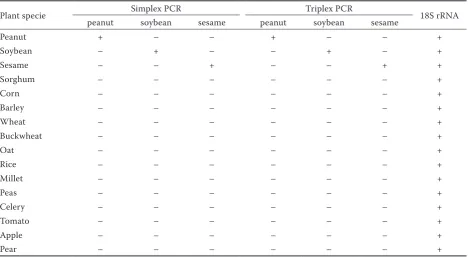
[image:3.595.64.533.490.747.2]Simplex PCR. Specific primer pairs were designed based on the genomic sequences of soy28k (soybean), 2S albumin (sesame) and Ara h 1 (peanut) genes, and amplicon lengths were 147, 126, and 82 bp, respec-tively. The specificity of the simplex PCR assay was verified by using the DNA from 16 common plant species. Only peaks were observed for the targets genes, demonstrating that the assay possessed good specificity for detecting soybean, sesame and peanut ingredients (Table 1). For sensitivity limit detection, two kinds of dilutions were employed. Firstly, the tar-get DNA solution was serially diluted with the DNA solution from wheat, and the other two plant species and distilled water was used as a control solution. The results showed that the detection limit reached 0.1 ng for peanut DNA and 0.01 ng for soybean and sesame DNA, and the dilution solution had no obvi-ous impact on the detection limit of the target DNA. Secondly, the target plant was ground to powder form and diluted with different kinds of plant pow-ders; this mixture was used for DNA extraction and Q-PCR analysis. The results showed that the detection
Table 1. Specificity
Plant specie Simplex PCR Triplex PCR 18S rRNA
peanut soybean sesame peanut soybean sesame
Peanut + – – + – – +
Soybean – + – – + – +
Sesame – – + – – + +
Sorghum – – – – – – +
Corn – – – – – – +
Barley – – – – – – +
Wheat – – – – – – +
Buckwheat – – – – – – +
Oat – – – – – – +
Rice – – – – – – +
Millet – – – – – – +
Peas – – – – – – +
Celery – – – – – – +
Tomato – – – – – – +
Apple – – – – – – +
Pear – – – – – – +
limit was 0.05% for peanut and 0.005% for soybean and sesame. There was no obvious influence of the mixing of plant powders on the detection limit of peanut, soybean and sesame.
Triplex PCR. The SYBR Green Q-PCR method is suitable for the construction of a multiplex method, because each amplicon generates a single peak in the melting curve and each specific peak indicates a distinct PCR amplicon (Pafundo et al. 2010; Wei et al. 2014). However, in order to make the peaks
more distinguishable, the gaps in Tm values between the different amplicons should be greater than 3°C. In this study, the Q-PCR results showed that the Tm values were 73.5, 79.3 and 82.7°C for each am-plicon, which was suitable for the establishment of a triplex PCR method.
[image:4.595.62.535.125.287.2]Several parameters could influence the amplifica-tion efficiency in a simplex PCR reacamplifica-tion, including the size of the amplicon, primer concentration and GC content of the primer (Reed et al. 2007). However,
Table 2. Sensitivity
The dilution ways of the samples Simplex PCR Triplex PCR
peanut soybean sesame peanut soybean sesame
DNA samples1 (ng)
distilled water 0.1 0.01 0.01 0.1 0.01 0.1
wheat 0.1 0.01 0.01 0.1 0.01 0.1
peanut – 0.01 0.01 – 0.01 0.1
soybean 0.1 – 0.01 0.1 – 0.1**
sesame 0.1 0.01 – 0.1 0.01 –
Plant material powders2 (%)
wheat 0.05 0.005 0.005 0.05 0.005 0.005
peanut – 0.005 0.005 – 0.005 0.05**
soybean 0.05 – 0.005 0.05 – 0.005
sesame 0.05 0.005 – 0.05 0.005 –
1target DNA samples were serially diluted with water and reference DNA (in amounts of 10, 1, 0.1, 0.01, 0.001, and 0.0001 ng target DNA in a total of 50 ng DNA, respectively); 2target plant tissue powders were serially diluted with reference plant powers, at percentages of 5, 0.5, 0.05, 0.005, and 0.0005, respectively; total amount of DNA for each PCR was also 50 ng; **when applied in triplex PCR, the LOD of sesame was increased compared to the simplex PCR in some circumstances, to 0.1 ng and 0.05%
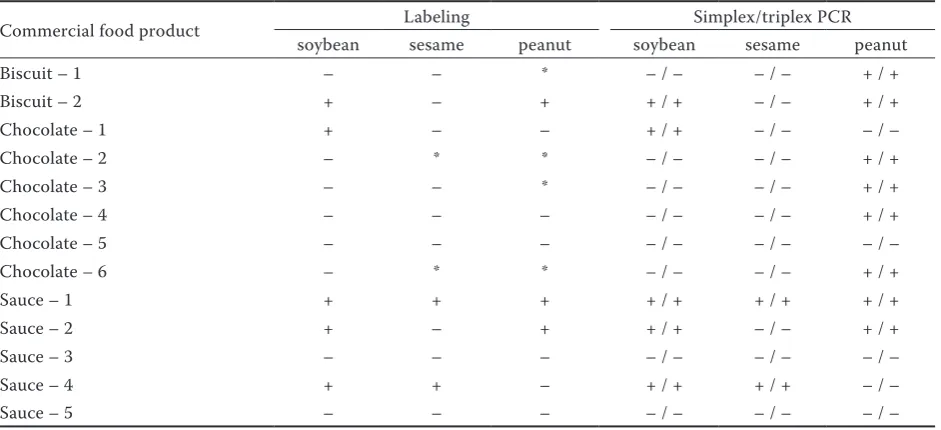
Table 3. Application
Commercial food product Labeling Simplex/triplex PCR
soybean sesame peanut soybean sesame peanut
Biscuit – 1 – – * – / – – / – + / +
Biscuit – 2 + – + + / + – / – + / +
Chocolate – 1 + – – + / + – / – – / –
Chocolate – 2 – * * – / – – / – + / +
Chocolate – 3 – – * – / – – / – + / +
Chocolate – 4 – – – – / – – / – + / +
Chocolate – 5 – – – – / – – / – – / –
Chocolate – 6 – * * – / – – / – + / +
Sauce – 1 + + + + / + + / + + / +
Sauce – 2 + – + + / + – / – + / +
Sauce – 3 – – – – / – – / – – / –
Sauce – 4 + + – + / + + / + – / –
Sauce – 5 – – – – / – – / – – / –
[image:4.595.64.535.518.733.2]when a multiplex PCR system is constructed, except for the parameters mentioned above, the dominant factor which would influence the detection efficiency would be the preference for the amplification of a specific amplicon during the PCR process, due to competition between individual PCR amplifications (Pafundo et al. 2010; Agrimonti et al. 2015). In order to reduce the negative influence of competi-tion on the deteccompeti-tion limit, the key parameters of the
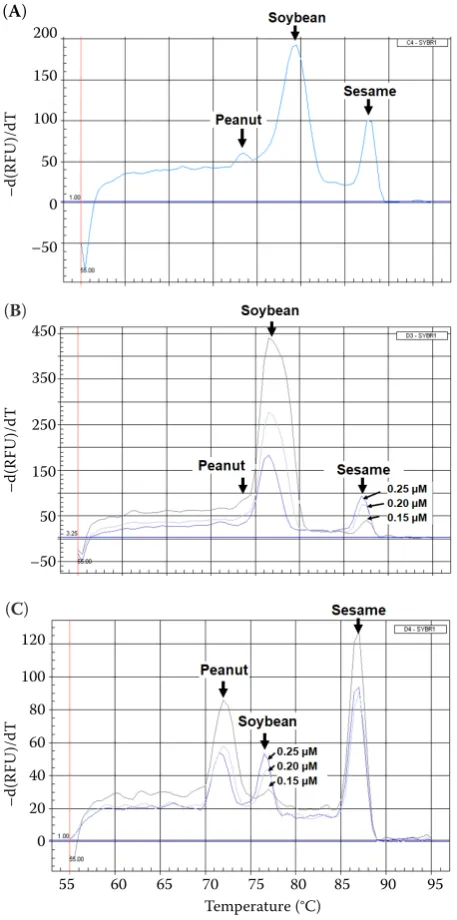
triplex Q-PCR should be optimised. In this study, the concentration of each primer pair was found to have a significant impact on the detection limit of the target. Firstly, an equal amount of each primer pair of 0.3 µM was used, and the results showed that the peak for peanut was significantly inhib-ited (Figure 1A). Then, we attempted to reduce the primer pair concentration for sesame and soybean. When the concentration of the sesame primer pair was reduced, the peak for peanut was still inhib-ited (Figure 1B). However, when the primer pair concentration of soybean was reduced to 0.2 µM, there was a significant enhancement in the peanut signal (Figure 1C). In conclusion, the triplex Q-PCR method was able to detect peanut, soybean and sesame in foods efficiently when the concentration of the primer pairs for peanut, soybean and sesame were 0.3, 0.2, and 0.25 µM, respectively. Further, the specificity and the sensitivity of the triplex method were analysed. The results are shown in Table 2. The triplex PCR method showed good specificity, similar to the simplex method. As for the sensitivity, the detection limit of the triplex method was identical to that of the simplex method in most cases with the following exceptions: when the dilution solution was soybean DNA, the detection limit of sesame was reduced to 0.1 ng DNA, and when sesame was diluted with peanut powders, the detection limit of sesame was raised to 0.05%.
Application. The established simplex and triplex Q-PCR methods were applied to detect the peanut, soybean and sesame ingredients in processed food. The results are listed in Table 3. All results from the triplex method were consistent with the simplex method, indicating that the established triplex method was reliable and accurate. Most of the results were consistent with the precautionary labels. Among all the samples, all three kinds of allergenic ingredients could be detected in sauce 1. However, the peanut ingredient was detected in the chocolate 4 sample, even though there was no clear declaration that this food contained peanut. This suggests that stringent investigation of allergen information remains an important priority.
CONCLUSIONS
[image:5.595.62.291.106.567.2]In this study, A SYBR Green-based triplex Q-PCR method was constructed to detect trace amounts of peanut, soybean and sesame ingredients in processed
Figure 1. Optimisation of the concentration of primer sets for triplex Q-PCR: (A) all primer pairs were used at concentration of 0.3 µM, (B) and (C) the concentrations of the primer pairs for sesame and soybean were reduced to 0.25, 0.2, and 0.15 µM, respectively
(A)
(B)
(C)
–d(R
FU
)/dT
–d(R
FU
)/dT
–d(R
FU
)/dT
55 60 65 70 75 80 85 90 95 Temperature (°C)
200
150
100
50
0
–50
120
100 80 60 40 20 0 450
350
250
150
50
food. The method showed high specificity and sen-sitivity. Applying the method to the analysis of com-mercial foodstuffs demonstrated that the established method was a reliable, accurate and effective way to detect allergenic ingredients in processed food.
References
Agrimonti C., Pirondini A., Marmiroli M., Marmiroli N. (2015): A quadruplex PCR (qxPCR) assay for adulteration in dairy products. Food Chemistry, 187: 58–64.
Bousquet J., Lockey R., Malling H.J. (1998): Allergen im-munotherapy: Therapeutic vaccines for allergic diseases. A WHO position paper. Journal of Allergy and Clinical Immunology, 102: 558–562.
Davis P.J., Smales C.M., James D.C. (2001): How can thermal processing modify the antigenicity of proteins? Allergy, 56: 56–60.
Hernandez M., Esteve T., Pla M. (2005): Real-time polymer-ase chain reaction bpolymer-ased assays for quantitative detection of barley, rice, sunflower, and wheat. Journal of Agricul-tural and Food Chemistry, 53: 7003–7009.
Herrero B., Vieites J.M., Espineira M. (2014): Development of an in-house fast real-time PCR method for detection of fish allergen in foods and comparison with a commercial kit. Food Chemistry, 151: 415–420.
Hird H., Lloyd J., Goodier R., Brown J., Reece P. (2003): Detection of peanut using real-time polymerase chain reaction. European Food Research and Technology, 217: 265–268.
Navarro E., Serrano-Heras G., Castano M.J., Solera J. (2015): Real-time PCR detection chemistry. Clinica Chimica Acta, 439: 231–250.
Pafundo S., Gulli M., Marmiroli N. (2010): Multiplex real-time PCR using SYBR® GreenERTM for the detection of DNA allergens in food. Analytical and Bioanalytical Chemistry, 396: 1831–1839.
Palle-Reisch M., Hochegger R., Cichna-Markl M. (2015): Development and validation of a triplex real-time PCR assay for the simultaneous detection of three mustard species and three celery varieties in food. Food Chem-istry, 184: 46–56.
Poms R.E., Klein C.L., Anklam E. (2004): Methods for al-lergen analysis in food: a review. Food Additives & Con-taminants, 21: 1–31.
Rastogi N.K., Raghavarao K., Balasubramaniam V.M., Niranjan K., Knorr D. (2007): Opportunities and chal-lenges in high pressure processing of foods. Critical Re-views in Food Science and Nutrition, 47: 69–112. Redmond E.C., Griffith C.J. (2003): Consumer food
han-dling in the home: A review of food safety studies. Journal of Food Protection, 66: 130–161.
Reed G.H., Kent J.O., Wittwer C.T. (2007): High-resolution DNA melting analysis for simple and efficient molecular diagnostics. Pharmacogenomics, 8: 597–608.
Shin S.P., Ishitani H., Shirakashi S. (2016): Development of a multiplex PCR to detect Kudoa spp. and to distinguish
Kudoa septempunctata in olive flounder Paralichthys olivaceus. Aquaculture, 464: 37–41.
Sicherer S.H., Sampson H.A. (2007): Peanut allergy: Emerg-ing concepts and approaches for an apparent epidemic. Journal of Allergy and Clinical Immunology, 120: 491–503. Sicherer S.H., Sampson H.A. (2014): Food allergy: Epidemi-ology, pathogenesis, diagnosis, and treatment. Journal of Allergy and Clinical Immunology, 133: 291–307. Wei S., Zhao H., Xian Y.Y., Hussain M.A., Wu X.Y. (2014):
Multiplex PCR assays for the detection of Vibrio algino-lyticus, Vibrio parahaemolyticus, Vibrio vulnificus, and
Vibrio cholerae with an internal amplification control. Diagnostic Microbiology and Infectious Disease, 79: 115–118.
Xu Y.G., Sun L.M., Wang Y.S., Chen P.P., Liu Z.M., Li Y.J., Tang L.J. (2017): Simultaneous detection of Vibrio chol-erae, Vibrio alginolyticus, Vibrio parahaemolyticus and
Vibrio vulnificus in seafood using dual priming oligonu-cleotide (DPO) system-based multiplex PCR assay. Food Control, 71: 64–70.
Zhang W.J., Cai Q., Guan X., Chen Q. (2015): Detection of peanut (Arachis hypogaea) allergen by Real-time PCR method with internal amplification control. Food Chem-istry, 174: 547–552.