Abstract— Scientists are working on machines to make them more intelligent in a way that they can respond to the humans in a better way. People having disabilities cannot sometimes, take advantage of these inventions being limited in one or more ways to use the technology as a normal person. Research is also being done to make machines have other skills that can be used to help people develop different abilities and assess their behaviors that contribute to emotional intelligence (EI). This study focuses on designing a tool which helps the people having Down Syndrome (DS) to analyze and learn to use their emotions intelligently based on the different situations they face in their day to day life.
A design for an Assessment tool for EI is proposed based on the cognitive limitations of the people having Down Syndrome (DS) and their slow motor skills. This tool may help them become an active part of society.
Index Terms— Cognitive disability, Digital Learning, Down Syndrome, Emotion Analysis, Emotional Intelligence
I. INTRODUCTION
CIENTISTS all over the world are working on machines to make them begin to hold abilities to identify emotional states of humans, to react to situations with improved skillset so that positive emotions are more likely to raise and negative emotions are less. Research is also being done to make machines having social and emotional skills that may help people develop different abilities and determine their behaviours that is an important factor for emotional intelligence. This type of skill sets are changing the trend of applications and the way the computers interact with people. When put in any situation, agents will take into account the people‟s feelings and take steps to respond in the desired way which may develop the user‟s interest in the communication and retain it to get better results. Applications are to be developed that deal with customers in a better way and will give empathetic response to the respective feelings by recognizing the emotions and changing their own behaviour using emotional intelligence. Scientists could begin to build interactive scenarios which may test emotional intelligence by testing their behaviour
Manuscript received February 20, 2017; revised April 10, 2017. This work was done in collaboration with Karachi Down syndrome Program (KDSP). The authors are with the Shaheed Zulfikar Ali Bhutto Institute of Science and Technology, Karachi, Pakistan (phone: 92-21-111-922-478; e-mail: [email protected]).
and not merely cognitive reasoning [1].
People having Down Syndrome are referred as „Cognitively impaired‟ by some researchers [2]. „Down Syndrome is a genetic disorder caused by the presence of an extra copy in some or all cells of the body, of chromosome 21, due to nondisjunction during cell division‟ [3]. A person having Down Syndrome possess and show specific capabilities which determine the way a person will response to different situations. Their patterns have also been analyzed which may set a foundation to build specific application for them.
Motivated by an Affective Learning Companion, the proposed research focuses on designing a prototype tool to develop an Assessment Companion prototype tool for Emotional Intelligence specifically for the people having Down Syndrome. This will help in developing specialized tools for them to boost their abilities and manage emotions.
A variety of tools available online have been used to evaluate the personality of DS people. Some data collection is also available online that is done for creating the better learning tool for them. These resources helped in better evaluation of their limitations. Different simulation games were also reviewed which were built on the basis of the imitation of children with Down Syndrome.
MSCEIT was used to identify the areas to focus for evaluating the Emotional Intelligence. The evaluation criteria and the measurement scales were also available online to be used as a reference.
II. BACKGROUND
Cognitive activity is necessary in the form of thoughts, or while solving problems, for an emotion to occur. That activity may be deliberate or undeliberate which is required in the interpretation of an emotional context. Richard Lazarus' theory is quite influential in saying that emotions have „cognitive intentionality‟. The popular researcher Plutchik also suggests in his research that „emotion is a disturbance that occurs in the following order of Cognitive appraisal, physiological changes, and actions‟ [1]. The user will evaluate each of the given situations on the basis of their cognition levels, for example to feel shy or nervous when interacting a stranger and that will cue the right emotion. Cognitive reaction also triggers some physical and biological changes like experiencing palpitations. How does an individual chooses to respond to any situation depends upon the way he does feel the emotion [3].
People having Down Syndrome tend to be more sensitive as compared to other people at the same age. Since their
An Assessment Companion Tool for Emotional
Intelligence for the People having Down
Syndrome
Faria Jameel, SZABIST Karachi
mental age is same but just due to their low cognitive abilities, they are slow as compared to other people of the same age, they feel frustrated when they cannot express themselves properly. The therapists involved with these people have identified similar kind of emotions in them as any other person may have, i.e., they feel happy and sad just like any other person but their way of showing emotion is different. They may start throwing out things out of excitement and in some cases, their behavior is compared with the children of smaller age because of the physical limitations they have in their body. Social development for individuals with Down syndrome
Some studies suggest that face-to-face social and interactive games are more fun for the small babies having Down syndrome and they find it more interesting to play with a partner for longer than is typical. The delay in their development of basic attention skills and motor skills may be a reason for this [5].
Young children having Down syndrome do understand the stimulus in different real life situations that is not verbal. „They also show interest and good skills in learning to behave well in social situations which happen regularly and repeatedly, where they identify and know what is expected by copying other children‟ [5]. For example, the children with Down syndrome learn quite well by setting the daily routines like getting ready every day at a fixed time, like reading their lessons, arriving at school, assembling up, sitting for meals, and even sitting on the mat for story-time since these activities are repeated every day and they can imitate other family members and children at school [5].
A. Understanding emotions
Recent studies suggest that „photographs of facial expressions or puppet faces designed to convey different emotions are difficult to understand and interpret for the children having Down syndrome‟ [5]. One possibility is that the children are not always quite familiar with all the labels for emotions, such as 'angry', 'sad', 'happy', 'frightened', and 'surprised', as it has been observed that parents, therapists and instructors may not use these and other mental state words very often when talking with their children with Down syndrome. Another possibility is that, in real life situations, children have hints available to identify emotions correctly, for example tone of voice, body language and body movements as well as situational cues as to what is happening. „They may not be familiar with the names for all the emotions but they may still respond to a variety of emotions with a proper emotional and behavioral reaction, as may have been described by those around them. They may still not be able to identify the emotions from facial expressions alone‟ [5]
A parent/child behavior, boyfriend/girlfriend behaviors, boss/subordinate behaviors, and some other more adult social behaviors are a good way for these children to learn about relationships. This well explains the social behavior of many teenagers and young adults having Down syndrome is often competent and age-appropriate, despite their speech and cognitive delays. „They learn by watching, imitating and then 'doing' - and their understanding increases by
participation, practice and feedback rather than by explanation‟ [5].
III. RESEARCH METHODOLOGY
Empirical methodology was used in this study by designing a tool and then designing a prototype for an application based on that. Scenarios were created based on the assessment criteria for Emotional Intelligence and understanding level of the people having Down Syndrome [7].
The parents of children were asked to help them fill in the questionnaire due to the limitations these children may face while understanding the questions and filling out their response.
A. Research Design
The Research design is based on the studies available about the DS people and the prototype tool has been designed based on their mental and emotion levels.
A questionnaire was given to the students having Down Syndrome and their responses were evaluated through the prescribed scales. The results were evaluated to have a clear idea of the personality of people having Down Syndrome. The results were then compared to identify the differences in personalities and to identify the weak areas of the students where they needed improvement.
The following Ability Scores were taken from MSCEIT [12] and were used in our design as well.
• Identifying • Using
• Understanding • Managing
B. Research Process
The research process is based on identifying performance criteria indicators for DS people and then designing an appropriate tool based on the data received by the study.
On the basis of the observations made during the questionnaire filling sessions, the design of the prototype tool was conceived. With the help of primary and secondary data available, the tool was designed to fit the needs of the people having Down syndrome. A comparison was made on the way the students filled the questionnaire and the way they used the newly designed tool.
C. Analysis
The DS people were analysed on the basis of performance criteria indicators and their mental age was compared with their physical age and then compared with the studies [10].
access to any proper resources or were not aware of any. They treated their children having DS as „special‟ children and hence deprived them of many learning abilities and skills which a typical child receives naturally through a normal environment.
The following criteria in Figure 1 has been used in designing the tool and to evaluate the emotional intelligence (EI) in the people having Down Syndrome. The criteria has been taken from the standard MSCEIT which has been tested and used by multiple researchers in their studies.
Ability
Question Types
How the Ability May be Used
Test Section Accurately identify emotions of people and elicited by objects Identify emotions in landscapes, and designs. “Read” people‟s moods for feedback. Faces, Pictures Generate an emotion and solve problems with that emotion.. How moods impact thinking; relate feelings to thoughts.
Create the right feeling to assist in problem solving, communicate a vision, lead people. Facilitation, Sensations Understand the causes of
emotions. Multiple choice emotion vocabulary questions.
Be able to predict how people will
emotionally react.
Changes, Blends
[image:3.595.46.292.178.477.2]Stay open to emotions and integrate emotions with thinking. Indicate effectiveness of various solutions to problems Integrate emotion and thought to make effective decisions. Emotion Management, Emotional Relationship
Fig. 1. Skills measured by MSCEIT [12].
IV. IMPLEMENTATION TECHNIQUES
The tool was designed with the help of experts on board such as the Occupational therapists and the physiological therapists, speech therapists and psychologists and even the doctors and paediatricians. The cognitive limitations of the people having Down Syndrome were kept under consideration and the tool was designed to keep their interest in using the tool intact and getting the results out of it.
The people having Down Syndrome tend to lose interest quite frequently and therefore, in order to keep their interest intact, the tool was supposed to be short in length and quite engaging for them. At any moment, if they would lose interest, they will not be able to respond properly. It was supposed to be very easy to use so that it makes sense to the people having low cognitive abilities. Having slow motor skills was another consideration.
The tool identifies the four areas of emotional Intelligence in these people and helps them understand the environment and the scenario correctly and then let them select the best option they may feel appropriate for that question.
As the users continue using the tool, their responses are added up to their individual Emotional Intelligence (EI) scores. The individual responses are then compared with the standard to rate their level of emotional Intelligence. It also guides them about their weak areas and suggests how they may improve them. It even compares the emotional intelligence of each individual with others in the same age group having Down Syndrome and the typical individual.
The user‟s personality and the emotional intelligence may be obtained on the basis of the results of this prototype. The results may help them gain a better insight into their own personalities and it even suggests them what should be the appropriate behaviour in certain situations that demand emotional Intelligence.
Since Individual Educational Programs (IEP) are designed for the DS children who go for early intervention, they may take the advantage by using this tool to focus on the individual‟s weak areas and to design the curriculum accordingly. By getting the custom made curriculum, these individuals may overcome many of their weaknesses and may be polished to become a more active part of our society. Responsive teaching is also included as a part of early intervention curriculums and it focuses on the learning of children by guiding them on their responses to different situations. This tool may also become useful for guiding their proper responses in daily life.
A. The Prototype
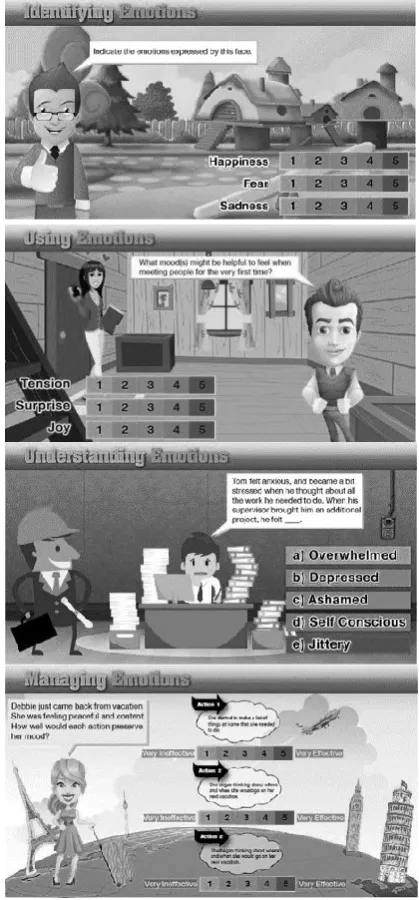
Emotion is based on cognition, deliberate or not, that may or may not take the form of conceptual processing [1]. Since the respondents had limited or delayed cognition, they were needed to be guided to give their actual instinctive cognitive responses rather than what they might think or feel should be the response. The results have to be natural and based on their true instincts. The individuals need to understand and get trained to use the correct response by understanding the cause and effect and their respective instinct of cognition. To achieve this objective, this prototype has been designed which aims to guide the user step by step at one time and while doing that measures their response and Cognitive accuracy. In the beginning, the individuals are encouraged to identify and work on for practical realization of emotions and calculate their scores as it proceeds as given in Figure 2. Playful activities are given to reduce stress and anxiety and ensure motivation.
Fig. 2 Flow chart for the prototype.
For the next area, the prototype provides scenarios for stimulating different emotions to be recorded by the user as their input for a scenario which needs identification of that emotion. This helps them identify their own level and generate the right emotion to be used in that situation and to deal with that situation intelligently and in the best possible way.
For the third area, real world content was shown to make the people understand the right causes of different emotions for the given situation. The user was required to identify the right emotion for the given situation. This may help in understanding the cause and effect in real life and may help them respond accordingly.
[image:4.595.318.528.125.576.2]In the last area, different situations were given which required emotion management. The individuals may learn to apply Emotional Intelligence based on these situations. They are given different situations and are required to deal with it successfully and using the right emotion. These instances tests their Emotional intelligence and at the same time may guide them to improve their cognitive accuracy. Figure 3 shows screenshots of all the four areas.
V. FINDINGS
Interviews were conducted of the parents, the occupational therapists, the physical therapists, doctors and paediatrician, and the people involved in the individual curriculum development and the overall team. The therapists informed on the basis of their observation that the DS people have a higher level of anger and that is caused due to the frustration caused by the limitations they have to face while expressing themselves. The usual questionnaires available in textual form or pictorial forms are not suitable for these people due to their slow cognition levels. In order to fill out the online questionnaires, they needed the help of
either their parents or the therapists which may not be accurate in some cases since the understanding of their parents or the therapists may be different. It may even be biased in some cases since the parents would always want to give a good impression of their children.
.
Fig. 3 Design images of the Prototype .
Since the DS people are a bit hyperactive and cannot concentrate for long, the usual questionnaires are difficult for them to use. Studies suggest that DS people are very good at imitating and are good at understanding repetitive instructions. They use colours and visuals to understand and respond. Since they take some time to understand due to their cognitive limitations, they need to be given instructions in a slow and repetitive form.
cognition levels e.g., HATLE [3], JECRIPE [14], EMODIANA [10], MSCEIT [13]. No time constraints were given to avoid stress in these individuals. Test sums were quantitative. Responses were judgmental and the scores ranged from 0-10.
The therapists informed that the children who were treated „special‟ in their families were different from those getting early intervention. The children undergoing early intervention were giving far better results due to the proper and timely therapies given to them to polish their skills. Due to the slow cognitive levels, the people having Down Syndrome are slow to understand and respond to any given situation. The prototype tool was designed keeping in mind their cognition level and different studies were followed where these people were observed and their computer skills were also analysed. Individuals with cognitive impairment tend to have more functional challenges in their daily lives [11] as compared to other people and that adds to their frustration level in general.
All the people/children who participated in survey were able to understand and respond to the situations in a better way. They were able to link their own emotion to the given scenario and choose the option/emotion they thought would be appropriate for any given situation. Although the individuals had to learn about the emotions and expression used in the tool since many of them were not quite familiar with them prior to this experience. Most of them were aware of the basic emotions like joy and sadness but not the other emotions like fear, depression etc. The results found from our prototype tool were almost same as that of the questionnaire with an exception of a few cases where the respondents gave a different answer based on their own understanding. The tool was easy to use for DS people since many directions were given at each level. The slow cognition level of the DS people was supported by the slow stories and repetition of scenarios to make them understand the situation better.
A. Empirical Results
Eight young adults were taken as a sample between the ages of 18-28 years and they were initially given the online text based test and then the same adults were given our prototype tool to record their responses. They were given the online text based questionnaires for their EI evaluations and to check their interest and ease of use level. For the text based tests, they needed a detailed descriptions about the questions asked in order to understand the situation clearly and then give a proper response. In contrast, they found the situations given in our tool easier to understand and were able to choose their appropriate responses. However, they found it hard and confusing to answer the situations where more than one question was asked on one screen, e.g. in the last screen, multiple situations were given simultaneously and it became tough for them to understand and relate each situation with the right emotion. Six out of eight respondents got an „Average‟ score while one got „Need Improvement” and only one got „Excellent‟. The detailed results showed an in depth analysis to their weak areas and suggested how to improve by working on those areas. The results were in accordance with their personalities.
The Observation technique was also used to understand
and compare the behavior of the students as analyzed by the therapists and their respective test results. The results were quite synchronized with their personalities. The suggestions given would help them improve their personalities even further. Table 1 shows the comparison in detail. Overall, the people having Down syndrome were found to possess strong social skills (with a few exceptions), their only limitation was their slow motor skills and low cognition ability, which makes them different from the typical people. They were very friendly and committed to their work but shy to talk and interact with strangers. Their weaknesses may be improved by giving them customized scenarios where they get familiar with all the different kinds of emotions and learn how to tackle different situations with the right kind of emotion using their Emotional Intelligence (EI).
TABLEI
COMPARISON
Text Based typical Our Prototype
Need assistance Little assistance needed Find Tiring/Frustrating Find Interesting More time consuming Less time
Difficulty in reading Easy to understand scenarios
Calculates EI scores only Calculates scores and creates awareness
No insight Scenarios help boosting EI
VI. CONCLUSION
This prototype design will be very useful in making the DS people emotionally intelligent. So much research is being conducted in developing learning special tools and computer aided devices for them but not much work is done on making machines help them emotionally as well. By making them more intelligent emotionally, they can become an active part of society and they may be able to overcome their weaknesses while polishing their strengths. Studies show a positive improvement in their behavior depending upon the early intervention and the therapies they receive well in time. If they are guided to overcome the social and emotional issues, they may become more confident and they may know how to deal with different situations in life. By being able to identify their emotions correctly and knowing how to use their emotions intelligently, they may be able to learn better and proper learning tools and Individual Education Programs (IEP) may also be designed for them based on the level of their individual emotional Intelligence.
VII. FUTURE WORK
this research. The tool may further be enhanced by adding voice to introduce the scenarios and ask questions. An app may be developed based on playful activities to boost EI amongst these individuals.
ACKNOWLEDGMENT
This research has been done in collaboration with Karachi Down Syndrome Program (KDSP) and their cooperation and coordination is appreciated.
REFERENCES
[1] R. Plutchik, "The Nature of Emotions," in American Scientist, 2001. [2] I. Albrecht, M. Scroder, J. Haber and H.-P. Seidel, "Mixed Feelings: expression of non-basic emotions in a muscle-based talking head," Virtual Reality, vol. 8, pp. 201-202, 2995.
[3] L. J. M. R. O. G. E. M. Vanessa G. Felix, "A pilot study of the use of emerging computer technologies to improve the effectivesness of reading and writing therapies in children with Down Syndrome," British Journal of Educational Technology, vol. 00, no. 00, 2016. [4] R. Plutchik, vol. 7, M. W. Rupert Riedl, Ed., Vienna: Konrad Lorenz
Institut für & WUV-Universitätsverlag/Vienna University Press, 2001.
[5] N. D. S. Society, "ndss.org," 2012. [Online]. Available: http://www.ndss.org/. [Accessed 15 12 2016].
[6] D. S. E. International, "down-syndrome.org," December 2016. [Online]. Available: https://www.dseinternational.org/en-us/. [Accessed 14 12 2016].
[7] L. K. J. H. F. Jonathan Lazar, "Understanding the Computer Skills of Adult Expert Users with Down Syndrome: An Exploratory Study," in Proceedings of ACM 2011 Conference on Assistive Technology (ASSETS), Halifax, Nova Scotia, Canada, 2011.
[8] E. V. a. J. H. Rosalind W. Picard, "Toward Machine Emotional Intelligence: Analysis of Affective Physiological State," IEEE Transactions on Pattern Analysis and Machine Intelligence. [9] P. N. Jose Serra, "Personality Simulation in Interactive Agents
through Emotional Biases," in 27th European conference on Modelling and Simulation, 2013.
[10] C. G.-G. P. Torres-Carrion, "Facial Emotion Analysis in Down's Syndrome children in classroom," in XVI Congreso Internacional de Interaccion Persona-Ordenador.
[11] L. K. A. O. Jijuan Feng, "Computer Usage by Young individuals with Down syndrome: An Exploratory Study," in ASSETTS, Halifax, Nova Scotia, Canada, 2008.
[12] R. C. Crabbe, "Emotion in Sports," Blacksburg, VA, 2007.
[13] D. R. Caruso, "MSCEIT Resource Report," MHS, Toronto, ON, 2002.
[14] E. P. A. C. E. C. C. V. Andre Brandao, "Simulating imitation of children with Down Syndrome using a game approach," Brasil. [15] M. B. E. P. B. R. C. S. Maria Claudia, "Learning Games for the
Cognitively Impaired People," in ACM, 2010.
[16] M. Dawe, "Desperately Seeking Simplicity: How Young Adults with Cognitive Disabilities and Their Families Adopt Assisitve
![Fig. 1. Skills measured by MSCEIT [12].](https://thumb-us.123doks.com/thumbv2/123dok_us/417632.539315/3.595.46.292.178.477/fig-skills-measured-msceit.webp)