Abstract— Historical thinking skill is important in historical
learning. Although this overall skill includes various skills acquired through historical learning, this research focuses on reasoning skill. This skill is the ability to apply patterns of historical events to predict future situations. Historical events consist of problem situations, solutions that were found by historical people, and the results. To infer about future situations using historical events, first, we need to grasp the conditions in which the solution in the historical events was applied. Then, we need to compare the conditions with the modern situation so as to find the solutions in the historical events to be applied. The purpose of this research is to propose a learning method to follow the above steps for fostering reasoning skill in historical learning. In our learning method, the learning activity of creating a story based on a historical event is introduced. To create similar or different stories from the historical events, learners need to consider conditions in which to apply the solution in the historical events in detail. Thus, this learning method is expected to improve reasoning skill. We have also developed a learning system to support this learning activity. The experimental result indicated that our learning method is effective for grasping a historical event from an abstract point of view and understanding the condition in which to apply the solution in the historical events.
Index Terms—historical thinking, reasoning skill, story
creation
I. INTRODUCTION
ISTORICAL thinking skill is a reasoning skill for analyzing and explaining historical events [1, 2]. This skill is important for inferring about events that will occur in the future [3, 4]. Abbott and Adler reviewed the learning method of planning for urban design from history [5]. To infer the future events, learners should understand the intentions and background of historical people [6], consider the similarity between historical events and modern situations, and infer what will happen if similar events occur in modern times. Such skill should be learned through historical learning. However, especially in Japan, learners tend to memorize facts in historical learning, and historical thinking skill is merely acquired passively.
Several studies have tried to foster historical thinking skill. Seixas and Peck proposed a learning method to have learners consider important events by comparing two historical events [7]. This research succeeded in making
This work was supported in part by the JSPS KAKENHI Grant-in-Aid for Scientific Research (B) (No. 16H03089).
Y. Miki and T. Kojiri are with the Kansai University, 3-3-35, Suita, Osaka, JAPAN (corresponding author to provide phone: +81-6-6368-0968; fax: +81-6-6368-0968; e-mail: k867858@ kansai-u.ac.jp).
learners focus on the background of historical events, such as lifestyle, politics and technology. However, this method did not focus on applying historical events to modern problems. Ikejiri developed card game-based teaching material that makes learners consider the differences and similarities between a historical event and a modern situation [8]. This teaching material only provides similar cards and whether derived differences and similarities are correct or not should be judged by learners subjectively. In addition, it requires more than two people to play, so learners are not able to study by themselves. Therefore, a learning method for individual study should be developed.
On the other hand, learning by problem/question generation is one of the hottest learning methods for improving the skill of applying acquired knowledge to other problems [9]. Yu et al. developed an environment for posing the questions generated by learners and assessing questions of other learners [10]. This learning environment was shown to be potentially effective in improving cognitive skill to apply the solution in the problems. Historical events contain solutions to the problems that historical people encounter. Therefore, when we regard solutions in the historical event as knowledge to solve a worse situation (problem situation), learning by problem/question generation is one of the appropriate learning methods to improve the skill of applying the knowledge. However, few studies apply this learning activity to learning history.
This study proposes a learning method based on problem generation for enhancing the skill of applying reasoning skill in historical learning. Generally, the problem consists of the problem sentence and the solution. Sometimes explanation sentences are also provided that indicate the reason for applying the solution to the problem. In the context of history, the solution is an important action taken in the historical event, and the problem sentence corresponds to the situation in which action was taken. The situation after applying the action is regarded as the explanation of taking valid action for the problem situation. Therefore, our learning method makes learners generate a new situation where the action in the given historical event can be applied, and the situation changes after applying it. This is regarded as creating a new story based on a given historical event; thus, we call our learning activity “story creation”.
We have developed a system for supporting this story creation activity. A situation is represented by three components: characters, states of the characters, and relationship between characters. Our system provides an environment for creating these components individually. In addition, the system provides a support environment for creating the situation changes easily, only by defining the
Story Creation for Fostering Historical Thinking
Skill and its Support System
Yuta Miki and Tomoko Kojiri
actions and indicating the order of applying the actions. By creating stories of similar or different results with the given historical event using the system, learners can improve the ability for applying the historical event to the modern situation.
II. APPLYING SOLUTION IN HISTORICAL EVENT TO MODERN PROBLEMS
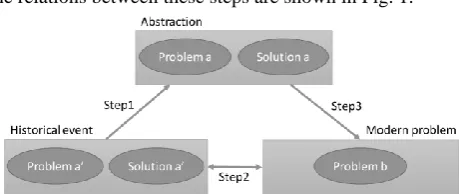
Historical events contain problem situations and solutions that were taken by historical people. To apply solutions to a modern situation, learners need to take the following three steps:
Step 1: abstraction of historical events,
Step 2: understanding the similarity between problems in historical events and modern situations, and
Step 3: specialization of solutions so as to apply them to modern situations.
The relations between these steps are shown in Fig. 1.
Let‟s consider the Tokusei Edict of the Kamakura period in Japan as a historical event and a modern situation in which “a friend is suffering from the burden of a student loan”. A brief description of the Tokusei Edict is given in Table 1. The Tokusei Edict is a debt of samurai cancellation order issued by the shogun. In this historical event, the Tokusei Edict is the solution. In the situation in which the Tokusei Edict was applied, there were three types of characters, the samurai, doso, and shogun. The economic situation of the samurai was not good and they borrowed money from the doso. The shogun had power over the samurai and doso.
In step 1, the problem situation and solution of the Tokusei Edict are abstracted. As an example of the abstraction of the problem, the samurai are regarded as debtors and the doso are creditors. As for the abstraction of the solution, the Tokusei Edict is changed to a law that voids the contract of the lending and borrowing. In step 2, the situation of the samurai in the Tokusei Edict and that of a modern friend are discovered as similar from the economical viewpoint. In addition, the shogun and the government in the modern situation are similar in that they both have the power to issue laws. In step 3, the law that voids the contract of the lending and borrowing is modified by replacing the samurai with the friend, and the doso with the government.
TABLE I
KAMAKURA BAKUFU‟S TOKUSEI EDICT
Samurai became impoverished in the aftermath of the Mongol invasions and became indebted to moneylenders, the doso.With the goal of helping impoverished samurai, the shogun issued Tokusei Edict cancelling samurai debt. Initially, this helped the samurai. Instead, doso got angry because their loans were not repaid.
Several studies have tried to support steps 1 and 2. For step 1, Knoblock insisted that abstracting is effective when people search for solutions of problems [11]. Our research group has proposed the learning method for acquiring lessons from historical events by abstracting them [12]. As for supporting step 2, Yoshida et al. proposed the Kit-Build concept map [13]. In this map, nodes and links are prepared by teachers and are given to learners. Learners are able to focus on relationships between nodes. Our research group has also proposed the If-thinking learning method for supporting step 2 in the historical learning. This method makes learners consider the “if” situation of the given historical event [14]; for example, “If England acquired much money in the worldwide financial crisis, how will the states of England and the other countries change?” To answer this question, learners need to consider the situation of the historical event and necessary conditions to apply the solution.
There are few studies that focus on step 3. To specialize a general solution to the specific situation, one must consider whether the modern situation satisfies the problem situation of the solution. Therefore, in the learning method for supporting step 3, it is important to make learners aware of the condition situation of the given solution. This way of thinking corresponds to the thinking in learning by problem/question generation.
As for the research of learning by problem/question generation, Kojima et al. classified generated problems into four types according to the differences from the given problem: 1) same situation and same solution, 2) same situation and different solution, 3) different situation and same solution, and 4) different situation and different solution [15]. This research insisted that changing the situation is rather easier than changing the solutions in the context of mathematics. Mathematical problems usually consist of conditions only necessary to apply the solution so that learners can easily find the solution to change. On the contrary, in history learning, the situation contains several characters, states of characters and their relations, and most of them are not related to the solution. Therefore, it is difficult to change the solution because learners need to select the condition in which to apply the solution before changing the situation.
Our learning method gives learners the opportunity to consider the conditions of the solution by creating a situation of the story.
III. SUPPORT FOR GENERALIZATION OF HISTORICAL EVENT BY CREATING STORY
Akaishi asserted that story is made up of five components: world model, story, scene, event, and character [16]. The world model is a set of stories, and a story is a sequence of scenes. A scene is a chunk of events. Events correspond to actions, and characters are people. Characters are defined as a set of properties, such as name, gender, feeling, power, amount of money, and so on. Properties have values, which are called states. Also, characters have relations with other characters.
[image:2.595.56.286.270.367.2]events are defined as the points at which the states of properties of characters are changed. Therefore, the scene is regarded as a set of state changes of characters.
Events occur not only by the intended actions of the characters but also by the indirect effect from actions of others. For instance, when a citizen becomes rich, the country also becomes rich because the citizen is a member of the country. This indirect effect is caused by the relation between characters. In the above example, the government owns the citizen, which means that when the citizen‟s money increases, the government‟s money is also increased.
In applying the historical event to the modern situation, it is important to compare characters, states of the characters, and their relations in the historical event with those of the modern situation. Also, in order to check whether the applied solution is appropriate for the modern situation, state changes after applying the solution should be examined carefully. Therefore, in the story creation based on the historical event, character, properties of characters, relationship between characters, and event should be defined. In addition, the state transitions need to be represented according to the events or relationships.
[image:3.595.318.546.56.92.2]Table 2 shows components of history that learners need to describe in our learning method. Properties of the character are determined according to the character‟s type. For example, a “country” has “power”, “land” and “money” as its properties. Necessary properties to describe in the story are determined by the given historical event. That is, properties that are changed by events or relations in the given historical event should be included in the created story. For example, one property needed to deal with the Tokusei Edict is money, since money of the samurai is focused on. Relationships between characters are described by the name of the relationship and the state of properties that the relationship affects. Events are also defined by the state changes that the corresponding action derives. Figure 2 shows an example of the event, in this case the Tokusei Edict. This event changes the money and land of samurai from little to normal. Figure 3 is an example of a relationship, in this case the debtor-creditor relationship. It defines that as the money of the creditor decreases, that of the debtor increases.
TABLE II
COMPONENTS OF HISTORY
Components Explanation
Character People appearing in history
State of character Values of properties of character, indicating the kind of character Relationship between
characters
Relationship between characters. State changes of one character affects the state of the other
Event Action that changes the state of characters
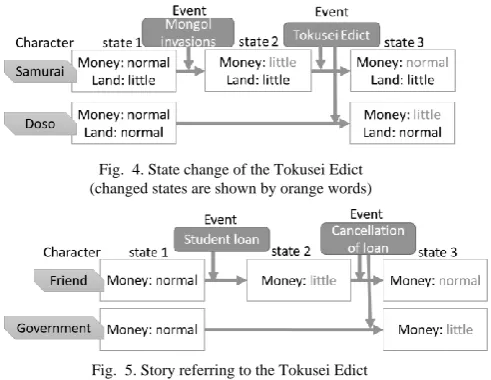
History can be represented as a transition of states occurring by events or relationships. Creating a story based on a given history means creating the same state changes as the given history. For example, state changes of the Tokusei Edict are shown in Fig. 4, and an example of a story created from the Tokusei Edict is shown in Fig. 5. In this story, the friend corresponds to samurai and the government corresponds to doso. This story shows that because of the cancellation of the loan by the government, the friend who took out a student loan has survived while the government‟s economic situation worsened.
There are various stories that learners can create. Learners can add more characters or more events as long as they do not change the state of the given history. By considering the relations among relations, events, and characters‟ state changes, learners are able to be conscious of the conditions in which the historical solution can apply.
IV. SUPPORT SYSTEM FOR CREATING STORY
We have developed a support system for creating stories based on state changes of given history. The history to give students were prepared by us that contains one effective solutions to learn. An overview of the system is shown in Fig. 6. It contains two databases. One is the history database that contains components of historical events. The other is the story database that has information regarding the story created by learners. In addition, the system consists of two interfaces. The “Story & history view” interface shows a selected story in the story database or history in the history database. The “Story creation support” interface provides an environment in which to create a story based on components of history. Learners create characters, their properties, and their relations with other characters. They can also define initial states of the characters and represent state changes by creating events or applying relations. Stories created by learners are stored in the story database.
[image:3.595.313.559.251.441.2]Fig. 3. Example of relationship “debtor-creditor”
Fig. 4. State change of the Tokusei Edict (changed states are shown by orange words)
Fig. 2. Example of event "Tokusei Edict"
[image:3.595.41.293.572.746.2]In the “Story & history view” interface, after the learner selects a historical event from a list, a text that explains the historical event and its state changes is shown in the history view window (Fig. 7). Learners are able to learn about the historical event by reading the text and observing the state changes. In addition, they can see the stories that they created previously through this window.
Fig. 7. Story & history view window
The “Story creation support” window is shown in Fig. 8. This window consists of four tabs. They correspond to the creation of characters, events, relationships, and scenes individually. Learners are able to create these components of the story by selecting each tab and filling in the forms shown in the tabs. State changes that leaners create in the scene tabs are shown on the state change area. If the show-story button is pushed, a new window pops up, and the system transforms the input components to story sentences. For example, when Tom and Bob are created as characters and their types are selected as human, the system shows “There is a person named Tom. There is a person named Bob.” If the state of Tom‟s money is changed to “much” by an event named “part-time job”, the system shows “Tom‟s money increases by part-time job.”
Following shows the way to create each components.
1) Character tab
The “Story creation support” window with character tab is shown in Fig. 9. Learners can input names of characters into the character-name textbox and determine their types by selecting types from the character-type list. They can create new characters by pushing the add button. Typical types of characters are prepared, such as human or country. Learners can also create a new type by pushing the add-type button on Fig. 8. When a new type is created, the created type is added to the character-type list in Fig. 9. When learners push the create button, a new character is created and its initial state appears in the initial-state-change area. The states that a property can take are much, normal and little. If learners are not satisfied with the assigned initial state, they can change it by clicking the initial-state-change box.
2) Event tab
[image:4.595.317.535.260.419.2]The “Story creation support” window with event tab is shown in Fig. 10. Learners can input an event name into the event name textbox. Events change the state of characters, so learners need to indicate whose and what properties are changed and how they are changed by the created event. After the event is created by pushing the add button, the created event is shown in the show-created-event area as a circle. Its contents are shown by placing the mouse cursor on the circle. In addition, learners can delete created events by pushing the delete button beside the circle.
Fig. 9. Character tab
[image:4.595.53.279.271.397.2]Fig. 8. Story creation support window
[image:4.595.315.558.592.748.2] [image:4.595.49.281.616.761.2]3) Relationship tab
[image:5.595.311.549.186.480.2]The “Story creation support” window with relationship tab is shown in Fig. 11. In the create-relationship area, learners first create the relationships between types and then attach the created relations to the characters. In creating relationships, learners need to input the relationship name and select the pairs of properties of character types. For example, as a creditor-lender relationship, “creditor‟s money increases and lender‟s money decreases” is indicated. When learners push the create button, the system draws the created relationship as a circle in the created-relationship area. Its contents are shown by placing the mouse cursor on the circle. The created relationship can be deleted by pushing the delete button beside the circle.
Fig. 11. Relationship tab
When clicking the circle, the window for selecting characters appears (Fig. 12). Learners can assign the created relationships to the characters. Assigned relationships appear in the decided-relationship area in Fig. 11 so that learners are able to grasp which relationships are not assigned.
4) Scene tab
The “Story creation support” window with scene tab is shown in Fig. 13. In this window, learners select events or relations that occur in the story and create state changes of characters according to these events or relations. In the window, created events and relationships are represented as green and blue circles in the state-transition-creation area, respectively. Learners select events or relations by
their applied order. When the events or relations are selected, states of characters are automatically changed according to the definition of the events or relations. Colors of the selected events or relations become lighter. The sequence of events or relations is shown in the order-of-events-and-relationships area. Learners can check the state changes in the state-change area of the “Story creation support” window (Fig. 8). In this area, changed properties are highlighted with a green color as in Fig. 14.
V. EXPERIMENT
We have evaluated a potentially effective system for supporting story creation as well as usability of the system. The experiment was conducted with eight university students as participants who were willing to learn history. Participants were given the Tokusei Edict of the Kamakura period as history and were asked to create two stories. One is a “success” story, in which the solution (Tokusei Edict) can solve the problem situation. The other is a “failure” story, in which the solution cannot solve the problem situation.
First, participants were asked to create the stories using paper and pencil. Then, they were asked to create the stories with the system. After creating the stories, they were asked to answer questionnaires. Questionnaire items were as follows: Question 1: Was “to create story” useful for thinking about conditions of success or failure of the solution in the given historical event?
Question 2: Was “to create story using the system” useful for thinking about the condition of success or failure of the solution in the given historical event?
Question 3: Was the system easy to use?
These questions were rated on a four-point Likert scale. 1 is Fig. 13. Application tab
[image:5.595.47.291.249.414.2]Fig. 14. Example of state-change area
[image:5.595.45.284.521.648.2]negative and 4 is positive.
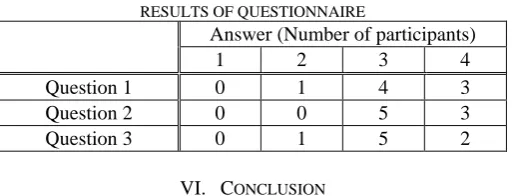
The results of the questionnaires are shown in Table 3. According to the results for question 1, many participants could consider conditions of success or failure by creating a story. For question 2, many participants answered that the system was useful for considering conditions. Some participants commented that representing state changes makes them recognize the mistake of their understanding for the states of the characters. This comment indicated that participants could grasp the state of characters more accurately through the story creation. Therefore, story creation has the potential effect of fostering reasoning skill in historical thinking.
[image:6.595.42.299.268.366.2]In question 3, many participants answered that they could use the system easily. According to this result, our system may have potential for supporting the learning activity of story creation.
TABLE III
RESULTS OF QUESTIONNAIRE
Answer (Number of participants)
1 2 3 4
Question 1 0 1 4 3
Question 2 0 0 5 3
Question 3 0 1 5 2
VI. CONCLUSION
In this study, we proposed a learning method for fostering historical thinking skill by creating a story based on a given historical event. We have also developed a system for supporting the proposed learning method. History is composed of the state change of historical characters, so users need to consider states of characters, events and relationships by creating similar stories to a given history. This encourages learners to consider the historical events in detail, and to analyze the problem situations and solutions so that the historical solutions may be applied to modern problems. According to the experimental result, our learning method was shown to be effective for fostering historical thinking skill. Also, the system was well designed to support story creation.
In the current experiment, we evaluated the effectiveness of the learning method and the system only by the questionnaire results. To evaluate them more precisely, we need to check if they deepened users‟ understanding of history. Therefore, we need to prepare a pre-test and post-test for measuring the understanding of the historical solution. In addition, we should gather more participants to conduct further experiments.
Created stories were different among learners. They reflected the conditions that learners thought important. By observing the stories of others, learners were able to assess the validity of their own choices. Thus, we plan to embed a collaboration function into the system and encourage learners to discuss the differences among their stories.
REFERENCES
[1] Linda Elder, Meg Gorzycki and Richard Paul, “Student Guide to Historical Thinking”, Foundation for Critical Thinking (2012)
[2] Ryohei Ikejiri and Yuhei Yamauchi, “Categorization of Historical Thinking and Effective Training Methods”, 28th
national convention of Japan Society for Educational Technology, pp.495-496 (in Japanese) (2012)
[3] Peter Lee, “Historical Literacy: Theory and Research”, International Journal of Historical Learning, Teaching and Research, Vol.5, No.1, pp.25-40 (2005)
[4] Robert J. Parkes and Debra Donnelly, “Changing conceptions of historical thinking in History education: an Australian case study”, Revista Tempo e Argumento, Florianópolis, Vol.6, No.11, pp.113-136 (2014)
[5] Carl Abbott and Sy Adler, “Historical Analysis as a Planning Tool”, Journal of American Planning Association, Vol.55, No.4, pp.467-473 (1989)
[6] Caria van Boxtel and Jannet Van Drie, “Historical Reasoning: A Comparison of How Experts and Novices Contextualise Historical Sources”, International Journal of Historical Learning, Teaching and Research, Vol.4, No.2, pp.84-91 (2004)
[7] Peter Seixas and Carla Peck, “Teaching Historical Thinking”, Challenges and Prospects for Canadian Social Studies, pp.109-117 (2004)
[8] Ryohei Ikejiri, Toru Fujimoto, Mio Tsubakimoto and Yuhei Yamauchi, “Designing and Evaluating a Card Game to Support High School Students in Applying Their Knowledge of World History to Solve Modern Political Issues”, International Conference of Media Education (2012)
[9] Edward A. Silver, Joanna Mamona-Downs, Shukkwan S. Leung and Patricia Ann Kenney, “Posing Mathematical Problems: An Exploratory Study”, Journal for Research in Mathematics Education, Vol.27, No.3, pp.293-309 (1996) [10] Fu-Yun Yu, Yu-Hsin Liu and Tak-Wai Chan, “A web-based
learning system for question-posing and peer assessment”, Innovations in Education and Teaching International, Vol.42, No.4, pp.337-348 (2005)
[11] Craig A. Knoblock, “Learning Abstraction Hierarchies for Problem Solving”, Eighth National Conference on Artificial Intelligence, Vol.2, pp.923-928 (1990)
[12] Tomoko Kojiri, Yusuke Nogami and Kazuhisa Seta, “Lesson Discovery Support Based on Generalization of Historical Events”, Proceedings of 17th International Conference on Artificial Intelligence in Education, LNAI 9112, pp.674–677 (2015)
[13] Kan Yoshida, Kouta Sugihara, Yoshiaki Nino, Masakuni Shida and Tshukasa Hirashima, “Practical Use of Kit-Build Concept Map System for Formative Assessment of Learners‟ Comprehension in a Lecture”, Proceedings of 21st
International Conference on Computers in Education, pp.906-913 (2013) [14] Yuta Miki, Tomoko Kojiri and Kazuhisa Seta, “„If Thinking”
Support System for Training Historical Thinking”, Proceedings of 19th International Conference on Knowledge Based and Intelligent Information and Engineering Systems, Procedia Computer Science 60, pp.1542–1551 (2015) [15] Kazuaki Kojima, Kazuhisa Miwa and Tatsuinori Matsui,
“Study on Support of Learning from Examples in Problem Posing as a Production Task”, Proceedings of the 17th International Conference on Computers in Education, pp.75-82 (2009)