Abstract— Knowledge of moment of inertia and potential energy of human arm is necessary to optimize its usage and performance. In this paper, human arm is modelled as geometric shapes. The potential energy and the moment of inertial of different segments of the arm were analysed in order to predict the inertial properties of the human arm in a fixed position.
Index Terms— Fixed Position, Moment of Inertia, Human Arm. Mathematical Analysis.
I.INTRODUCTION
HE
exploration and utilization of space is meaningless without man. Man utilizes his parts, including the arm, to perform support, supply, protect, and operational undertakings in the weightless condition of space [1]. The inertia property of human body, all in all, and human arm specifically is important to accomplish the ideal outline for such a unit [1]. A circle is a flawlessly round geometrical question in three-dimensional space that is the surface of a completely round ball[2]. Like a circle, which geometrically is a question in two-dimensional space, a circle is characterized scientifically as the arrangement of focuses that are all at a similar distance, r, from a given point, however in three-dimensional space. This r is the range of the ball, and the given point is the focal point of the scientific ball. The longest straight line through the ball, interfacing two purposes of the circle, goes through the middle and its length is in this manner double the radius; it is a width of the ball.[2]A frustum of a cone (truncated cone) is a strong like a chamber, with the exception of that the roundabout end planes are not of equivalent sizes. Besides, both end planes' centre focuses are situated straightforwardly over each other [2]. A frustum might be shaped from a correct round cone by removing the tip of the cone with a slice opposite to the stature, framing a lower base and an upper base that are roundabout and parallel [2].
A sphere is an impeccably round geometrical object in three-dimensional space that is the surface of a totally round ball, comparable to a circular object in two dimensions). Like a circle, which geometrically is an object in two-dimensional space, a sphere is characterized numerically as
Manuscript received July 1, 2017; revised July 30, 2017. This work was supported in full by Covenant University.
M.C. Agarana is with the Department of Mathematics, Covenant University,Nigeria,+2348023214236,michael.agarana@covenantu niversity.edu.ng
O.O. Ajayi is with the Department of Mechanical Engineering,
the arrangement of focuses that are all at a similar distance r from a given point, however in three-dimensional space. This distance r is the radius known as the centre of the ball, and the given point is the focal point of the scientific ball. The longest straight line through the ball, associating two points of the sphere, goes through the middle and its length is in this manner double the radius; it is a diameter of the ball.[2]
The moment of inertia, also known as the rotational inertia, of a rigid body, such as human arm, is a tensor that determines the torque needed for a desired angular acceleration about a rotational axis[2,3,4,5].It relies on upon the body's mass distribution and the axis picked, with bigger moments requiring more torque to change the body's rotation[5,6]. It is a quantity expressing a body's tendency to resist angular acceleration, which is the sum of the products of the mass of each particle in the body with the square of its distance from the axis of rotation.[6] For bodies constrained to rotate in a plane, it is sufficient to consider their moment of inertia about an axis perpendicular to the plane[6,7,8,9,10]. This study is concerned with the analysis of the Mathematical model of human arm at rest based on a simulated mass and the anthropometric data of the individual person’s arm. This paper did not consider the following:
(i) The variation of the inertia properties during a change of body position or a change of body.
(ii) The variation of the inertia properties while the body is subjected to external forces which displace tissue from the rest position
(iii) The asymmetrical location of internal organs of the body.
Within these limitations, the analysis of the mathematical model of an individual arm at a fixed position is carried out to predict its inertia properties
A. Assumptions:
(i)The human arm as part of the body can be represented by a set of rigid bodies of simple geometric shape and uniform density.
(ii)The different segments of the human arm move about fixed pivot points when body changes position.
The first assumption is an analytical determination of the inertial properties of the human body using a Mathematical model.
The second assumption is made to simplify the configuration of the model.
With the given assumptions, human arm is modelled as geometric shapes - frustum and spheres
T
Mathematical Analysis of Moment of Inertia of
Human Arm at Fixed Position
II. MODELFORMULATION
The mathematical model is made up of three simple geometric solids numbered as indicated in Fig.1. Each solid represents a segment of the arm. The segments are:
(1) Upper arm (2) Forearm (3) Hand
Both the upper arm and forearm are represented by solid frustums, of different sizes, while the hand is represented by a sphere.
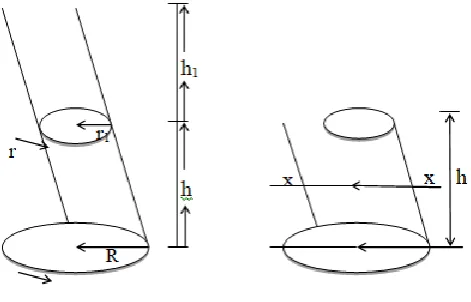
Fig.1 Right Circular Cone and its Frustum
[image:2.595.48.284.200.351.2]Fig.2 Model of human arm and Schematic of the Model
Fig. 3 Solid Sphere
A. Notations
2
radius of small circle
radius of big circle
Surface length
Fist circumference
Axillary arm circumference
Elbow circumference
Wrist circumference
UAL= Upper arm length
FL= Fore arm length
h
r
R
SL
FC
AAC
EC
WC
1
= height of small cone
h = height of big cone
B. Hand
The third part of the human arm, the hand, is modelled as a solid sphere as shown in figure 2. The dimension and properties of the hand are:
(1)
2
FC
R
(2)
2 (3)
R
r
SL
R
C. Upper Arm:
The upper arm is modelled as a frustum of a right circular cone. The cross section is a circle when the cutting plane is parallel to the X-Y plane. The dimensions and properties of the upper arm are:
(4)
2
RR=
(5)
2
SL=UAL (6)
AC
R
EC
D. Forearm
The forearm modelled as frustum of a solid right circular cone. The cross section is a circle when the cutting plane is parallel to the X-Y plane. The dimensions and properties of the forearm are
(7)
2
(8)
(9)
EC
R
r
WC
SL
FL
III. PROPERTIESOFAFRUSTUMOFARIGHT CIRCULARCONE
The right circular cone in Fig. 5 and frustum of a right circular cone in Fig. 6 are related by
1 2 1 1
(10)
(11)
This implies
h =
(12)
h
h
h
h
h
h
R
r
R
r
hR
R
r
2 2 2 2 2h =
(13)
The centroid of the frustum is given by:
2
3
x =
(14)
4
hr
R
r
h R
Rr
r
R
Rr
r
2
(15)
1
(16)
(17)
Let
r
R
x
h
Substituting equations (14). (15) and (16) into (17) gives
2
1 2
3
(18)
4
A. Mass of the Frustum
The mass of the big cone and the small cone are given respectively as follows:
2 1 2 2
(19)
3
(20)
3
is the density of the cones
M
R h
m
r h
where
Substituting equations (12) and (13) into Equations (19) and (20) gives: 3 3
(21)
3(
)
(22)
3(
)
R
M
h
R r
r
m
h
R r
The mass of the frustum of height h, and density
, is therefore, given as
3 3
3 3
(23)
(24)
3(
)
3(
)
=
(25)
3(
)
f
M
M
m
R
r
h
h
R
r
R
r
h
R
r
R
r
Equation (25) can be written after simplification as:
2
(26)
3
f
M
R h
IV. MOMENT OF INERTIA OF FRUSTUM OF A RIGHT CIRCULAR CONE
A Frustum of height h, has moment of inertia about the axis XX, determined by the difference of the moment of inertia of then large and small cone about the axis. The moment of inertia of the frustum is given by:
2 2
1 1 2 2
2 2 1 1 2 2 2 2 1 1
( ) (27)
3 (28) 20 4 3 (29) 20 4 0.25
XX cc bb
cc
bb
I I M x I M x h
where M h I R M h I r x h 2 2 2 (30) 0.25 (31)
(32) ( ) f f x h M R M R r M r m
(33) (Rr)
After rearranging by using equations (12),(13), (14), (15), (32) and (33), equation (27) becomes:
3 2
2 3 4 2
3
1 (1 3 6 ) (34)
20 10
xx f
R h
I M
1
1
2 2
22
1
22
2
2
7
2
7
22
88
2
2
2
7
7
5
22
7
1
7
88
4
1
1
21
1
1
4
4
16
r
r
R
R
h
r
R
Equation (34) becomes:
3
2 3 4 2 2
88 3
1 1 1 1 5 1 1
7
1 1 (1 3 6 )
21 4 4 4 4 21 4 4
20 10
16 16
xx f
I
M
5960.40
=
1.332 4.048
26.25
1221.6
(35)
f
xx f
M
I
M
A. Moment of Inertia of a Solid Sphere
The moment of inertia of a solid sphere is given as 2
2
(36)
5
mr
I
Where m and r represent mass and radius of the solid sphere respectively
V. RESULTSANDDISCUSSION
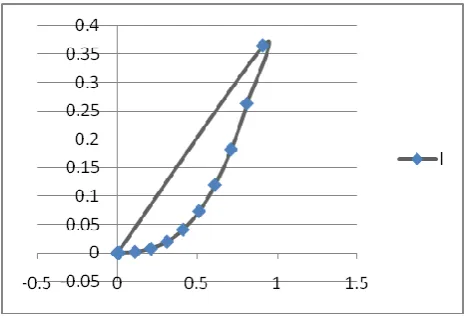
There is a positive correlation between the mass of the frustum and the moment of inertia as shown in figure 4. This implies that the density of the frustum has positive influence on the moment of inertia of the human arm modelled as a frustum. Figure 5 shows the relationship between the radius of slid sphere and the moment of inertia. The higher the value of radius, the higher the moment of inertia. The increase in moment of inertia becomes more pronounced as the radius value approaches 1.
Similarly, there is a positive correlation between the mass of the solid sphere and its moment of inertia. The relationship behaved almost the same way. These implies that higher the mass of the hand, forearm and
[image:4.595.304.543.48.211.2]the upper arm, the higher the moment of inertia. Also the longer the length of human arm, the more the moment of inertia.
[image:4.595.303.541.267.444.2]Fig. 4. Relationship between mass and moment of inertia of frustum
Fig.5. Relationship between radius and moment of inertia (I) of solid sphere
[image:4.595.305.539.500.659.2]Fig.7. Moment of inertia (I) of solid sphere as its mass and radius (r) increase in a similar way.
VI. CONCLUSION
Human arm is a form of kinetic chain. It is important to be familiar with the dynamic moment of inertia of the arm as a specific chain, due to its place in biomechanical analysis of open and closed kinetic chains [10]. Dynamic moment of inertia for arm, which is a specific body part was investigated. For human arm configuration as a solid body parts of simple geometric shapes (circular, frustum of a cone spherical) were used. The suggested model for the hand was modelled with the help of the sphere; the model for the forearm, upper arm, was modelled with the help of frustum.. Based on these, models for modelling moments of inertia for specific kinetic chains were presented.
REFERENCES
[1] Ernest P. Hanavan (1964), A Mathematical Model of Human Body. Behavioral Sciences Laboratory Aerospace Medical Re-search La boratories Aerospace Medical Division . Air-force Base, Ohio, USA.
[2] Sphere, From Wikipedia, the free encyclopedia
[3] Agarana M.C., and Ede A., "Free Vibration Analysis of Elas-tic Orthotropic Rectangular Inclined Damped Highway Sup-ported by Pasternak Foundation under Moving Aerodynamic Automobile," Lecture Notes in Engineering and Computer Science: Proceedings of The World Congress on Engineering 2016, 29 June - 1 July, 2016, London, U.K., pp978-981 [4] Agarana, M. C. and Agboola, O.O. (2015) Dynamic Analysis
of Damped Driven Pendulum using Laplace Transform Method. Interna tional Journal of Mathe , 26 (3). ISSN 0974-570X (online) 0974- 5718(Print)
[5] Michael C. Agarana, and Oluseyi O. Ajayi, "Analytical Mod-elling of Human Arm Locomotion during Dance as a Dy-namical Multiple Pendulum System," Lecture Notes in Engi-neering and Computer Science: Proceedings of The World Congress on Engineering 2017, 5-7 July, 2017, London, U.K., pp885-890
[6] Michael C. Agarana, and Oluseyi O. Ajayi, "Dynamic Model-ing and Analysis of Inverted Pendulum usModel-ing Lagrangian-Differential Transform Method," Lecture Notes in Engineer-ing and Computer Science: ProceedEngineer-ings of The World Con-gress on Engineering 2017, 5-7 July, 2017, London, U.K.,
small displace ment International Journal of Physical Sci-ences, 10 (12). pp. 364-370. ISSN 1992 – 1950
[8] Zatsiorsky, V.M., Seluyanov, V.N. and Chugunova, L.G., ‘‘Methods of determining massinertial characteristics of hu-man body segments,’’ In Contemporary Problems of Biome-chanics, (Ed. Chemyi, G. G. and Regirer, S. A.), CRC Press, MA, pp. 272–291, 1990
[9] Dodig, M., Relations between Anthropometric Dimensions and Overcome Resistance in Individual Motion. Global Jour-nal of Science Frontier Research (0975-5896) 14, E-2; 27-32, 2014.