Procedia - Social and Behavioral Sciences 191 ( 2015 ) 1014 – 1018
1877-0428 © 2015 The Authors. Published by Elsevier Ltd. This is an open access article under the CC BY-NC-ND license (http://creativecommons.org/licenses/by-nc-nd/4.0/).
Selection and peer-review under responsibility of the Organizing Committee of WCES 2014 doi: 10.1016/j.sbspro.2015.04.650
ScienceDirect
WCES 2014
Evaluating A Guidance Counsellor Education Programme: The
Methodological Complexities
J. Liston
a*
, T. Geary
aa Department of Education and Professional Studies, University of Limerick, Ireland.
Abstract
The focus of this paper is on the methodological considerations of a PhD study which evaluated a guidance counsellor education programme, offered by a University in Ireland. The programme is offered as a two-year part-time course, which is delivered over four semesters and two summer schools. Good practice and areas for improvement were identified, acknowledged and affirmed throughout the study. However in doing so a number of methodological complexities were considered. The model selected for evaluating the programme negotiated the sensitive nature and the contextual dimensions of guidance counselling while also
ensuring a depth in findings. Underlying the term ‘evaluation’ in the context of the study was the motivation to seek knowledge, explore and illuminate new learning in the area of guidance counsellor education. Therefore the study can be described as principally an evaluation with illuminative and exploratory characteristics. This paper explores the strengths and limitations of the methodological approach adopted.
© 2014 The Authors. Published by Elsevier Ltd.
Selection and peer-review under responsibility of the Organizing Committee of WCES 2014.
Keywords: Guidance Counsellor Education; Programme Evaluation; Guidance Counsellor Personal Development; The Irish Perspective.
1. Introduction
In Ireland, guidance counsellors provide a service within the whole school guidance and adult guidance sectors. The guidance counsellor has a significant function within the Irish education system as they provide for the personal, social, educational and vocational development of both young and adult learners. The focus of the study is on evaluating an initial education programme for guidance counsellors A mixed methodology approach was taken to the evaluation of the programme, using an adapted model of evaluation informed mainly by the ‘3Ps’ (Presage, Process, Product) Model of Teaching and Learning (Biggs, 2001). The adapted model explored the input, process
* Dr. Jennifer Liston. Tel.+353-(0)61-234314 E-mail address: [email protected]
© 2015 The Authors. Published by Elsevier Ltd. This is an open access article under the CC BY-NC-ND license (http://creativecommons.org/licenses/by-nc-nd/4.0/).
and output factors of the programme and the findings are discussed considering each of the factors. Emerging themes evolved such as, the complexity of the implementation of the guidance counsellor education course and of the challenges of the three-dimensional role (educational, vocational/career, personal/social) of the guidance counsellor in Irish secondary education. Past literature (OECD, 2002; Sultana, 2004; Bimrose et al, 2006; Hughes & Gration, 2009; Hearne, 2010; and Hughes, 2011) has emphasised the importance of quality assurance and evaluation studies in the area of guidance and counselling. It has been recognised nationally that changes are occurring in the provision, the practice and the profile of the guidance counsellor. The National Guidance Forum indicate that ‘quality graduates’ play a part in the provision of an effective guidance service. It also suggests that, effective guidance provision is also considered to play a key role in promoting social inclusion, equality, and active citizenship by encouraging and supporting individuals’ participation in education and training and in assisting them to attain self-fulfilment (2007: 35). In order to achieve effective guidance provision, the NGF report suggests that the natureand extent of current guidance services must bereviewed and such a review must include anevaluation of the training and qualificationrequirements for all guidance workers (2007: 35). This paper discusses the selection of the term evaluation, the framework applied in order to conduct the evaluation, the importance of considering the context of a guidance counsellor education programme and the ontological and epistemological concerns relating to the PhD study.
2. Methodological Considerations: The Nature of Evaluation
The first methodological consideration involved selecting the term ‘evaluation’ as the nature of the PhD study was strongly influenced by the selection of this term. As identified in the introduction to this paper, the study is an evaluation with illuminative and exploratory characteristics. Illuminative evaluation is described as focusing upon the holistic study of educational programmes in order to throw light on what was happening, as it happened, from the perspective of all those involved (Burden, 2008: 222). Exploratory research is said to begin with a ‘phenomenon of interest’ (Polit et al., 2001: 19). It entails the study of the full nature of the phenomenon and any additional factors with which it relates. At the outset of the study it was proposed that the study was exploratory in nature. The study was appropriately exploratory during the earlier stages as the researcher was primarily motivated to search for knowledge surrounding the area of guidance counselling and guidance counsellor education. During the search for knowledge, questions requiring illumination emerged and challenged the exploratory nature of the research. As Cohen et al., (2000: 39) put it ‘the researcher is motivated by a search for knowledge; the evaluator is motivated by the need to solve problems, allocate resources and make decisions’. However, the term ‘evaluation’ can be interpreted differently in various settings. Methodological research literature clearly defines the difference between evaluating a programme and conducting research into a programme. Smith and Glass (1987), cited in Cohen et al.
3. A Model to Evaluate a Guidance Counsellor Education Programme
The adapted framework for the PhD study is based on two models. The first model that strongly influences the adapted framework is known as the Presage-Process-Product (3P) Model of Learning and Teaching. This model
elaborates on Dunkin and Biddle’s (1974) linear model of teaching to include approaches to learning creating an
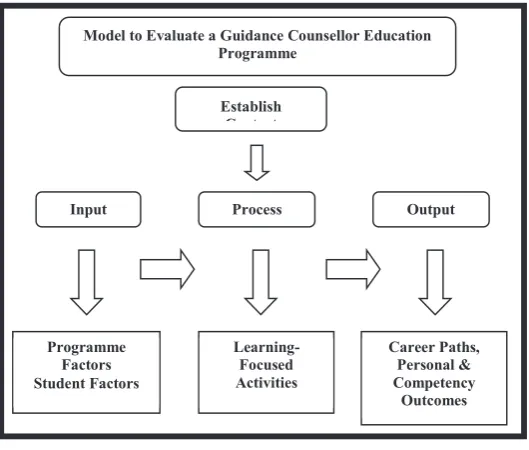
[image:3.544.141.406.321.546.2]interactive system. The model focuses strongly on learning and therefore appropriate for an evaluation of a learning programme. In order to stay close to the nature of guidance counselling, the research also draws on an evaluation framework developed by The Canadian Research Working Group on Evidence-Based Practice in Career Development (Borgen, Hiebert and Michaud, 2009), which was presented at the 2009 International Association of Educational and Vocational Guidance Conference. This framework is considered as it focuses on evaluation within the guidance counselling context. Bimrose et al. (2006: 4) and den Boer et al. (2005: 13) describe how quality assurance in career guidance is often conceptualised in terms of an input-process-output model. Hearne (2010: 73) illustrates how these models are categorised in terms of the individual service level, organisational level and national level. Models offered by the guidance counselling research community focus strongly on quality management and financial means policy, whereas this paper describes a study which is more concerned with evaluating the guidance counsellor education programme from a teaching, learning and personal process perspective. Hearne (2010: 79) describes how, despite increasing pressure to demonstrate inputs-processes-outputs in economically defensible ways in order to ensure continuance in funding in career guidance programmes, there has been little progress toward the development of accountability or evaluation models in career guidance, regardless of public demands for accountability. The adapted approach used in this research plays a central part in the development of an evaluation model for guidance counsellor education programmes. This adapted model is illustrated below;
Figure 1: Adapted model informed by Biggs (The ‘3P’ Model of Teaching and Learning) and a framework developed by The Canadian Research Working Group (Borgen, Hiebert and Michaud, 2009) on Evidence-Based Practice in Career Development
4.The Importance of Context: A Social Constructivist Consideration
Creemers and Scheerens (1994) describe the importance of establishing the context as the first level for research using the input-process-output approach, and how such a multi-level approach adds robustness to the research: As they put it, educational effectiveness as a research programme moved from an input-output paradigm to
Model to Evaluate a Guidance Counsellor Education Programme
Input Process Output
Programme Factors Student Factors
Learning-Focused Activities
Career Paths, Personal & Competency
Outcomes Establish
an input-process-output paradigm and, in view of the fact that so-called contextual school effectiveness is gaining importance, this might be more properly termed a context-input-process-output-based approach (1994: 125). The benefit of having a contextual dimension is recognised by literature in research methodology, but also in specific guidance counselling literature. McLeod describes how, to understand what counselling is, and what counsellors do, it is necessary to have an appreciation of the historical origins and development of this form of helping (1998: 29). Lambie and Williamson (2004) explain how countries, events and people are often defined by their histories, and the same can be said for school guidance counselling: The school guidance counselling historical narrative constructs the lens through which individuals interpret the profession. To understand and possibly alleviate the current incongruence between the actual and the ideal professional identity of PSC’s ‘school guidance counsellors’, the historical narrative configuring the profession needs to be understood, appreciated, and then possibly reconstructed (2004: 124). A context chapter which focused on the historical development of guidance counselling nationally and internationally was included in the PhD document. It proved to have two underlying purposes. The first was in allowing the researcher to gain an understanding of the broader pastoral influences, the narrative (particularly that of the course directors), complexity and discourse surrounding the development of a guidance counsellor education programme; the second was to set the foundation (context level) for the research model (input, process, output levels) adding to the robustness of research study.
5. Ontological and Epistemological Considerations
The researchers ontological position is based on their assumptions about how the world is made up and the nature of the world. The ontological perspective or worldview influencing the PhD study is heavily influenced by the researchers understanding of the need for and potential benefits of guidance counselling as part of education. The researcher also believes guidance counselling can be utilised in a way that embraces its potential value even further. Corey (2009) indicates that a guidance counsellor must have a theoretical foundation approach that is close to a practitioner’s own ‘worldview’ in order to successfully implement an integrative model of counselling. Considering this concept the researcher chose to underpin the methodological framework for this study with interpretive foundations, drawing on elements of positivist approaches in order to add depth and reinforce and strengthen findings rather than broaden. The epistemological stance considers beliefs about how one might discover knowledge about the world. The epistemology adopted to the PhD study is described as social constructivist in nature as the researcher believes that people generate knowledge and meaning from an interaction between their experiences and their ideas, and the context in which the learning occurs is central to the learning itself. Social constructivism emphasizes the importance of culture and context. McMahon and Watson (2007) discuss how, career psychology has witnessed a shift from approaches informed by tenets of the modern world to include approaches informed by the post-modern world as it strives to remain relevant. This shift is most evident in career theory and practice where developments reflect the influence of constructivism, but it is less evident in career research which has remained dominated by methodologies of the positivist worldview. These predominantly empirical methodologies seem incongruent with post-modern tenets. (2007: 169) In order to stay true to the contemporary theoretical contexts of guidance counselling and to acknowledge the researchers worldview, the PhD study takes a social constructivist approach to the methodology applied. According to Usher, what we can conclude from this is that methods are embedded in commitments to a particular version of the world (an ontology) and ways of knowing that world (an epistemology) (1996: 13). The methodological approach is affected by the ontological and epistemological perspectives the researcher has adopted. Carefully considering these perspectives has contributed to a more strengthened study as the methodological, ontological and epistemological concepts underpinning the study are accurately represented.
6.Conclusion
existed. It also emerged that by focusing on the depth of personal counselling rather than covering all aspects of the guidance counselling role equally the course is devised in a way that is “emphasising depth of learning rather than breadth of coverage” (Biggs 1999: 17). However, expressions of a lack of career knowledge, sensitivity to the counselling areas and holding back from the learning process were indicated by some graduates. These comments, while in the minority, were important to explore as they indicate a gap in the learning process. Biggs describes how, In order to improve learning the positive and/or negative factors which exist during the learning process must be identified (1999: 17). Positive aspects of the programme which were expressed by graduates related to the personal development, counselling focus of the programme and the experiential teaching methodologies used. The PhD document discusses findings considering the 3P’s model and it is concluded that the programme models good practice in terms of being constructively aligned and providing quality graduates who have participated in an education programme which promotes and facilitates a deep level of learning. The objective of the study, to conduct an evaluation of the programme, was reached. The methodology used for this evaluation showed considerable strength. As the primary concern of illuminative evaluation is with description and interpretation rather than measurement and prediction (Burden, 2008), the learning milieu surrounding the programme is well represented. The model for evaluation used in this study can be used to evaluate other guidance counselling education or general education programmes. Variations of the model have been used previously but considering the contextual dimension significantly increases the illuminative qualities of the study and leads to a deeper understanding of the learning milieu. Research methodologies in guidance counselling and programme evaluation can be served by educational models of evaluation rather than economic accountability models.
References
Biggs, J. (2001) 'The reflective institution: Assuring and enhancing the quality of teaching and learning', Higher Education, 41(3), 221-238. Bimrose, J. (2006) The Changing Context of Career Practice: Guidance, Counselling or Coaching? Occasional Paper. University of Derby:
CeGS, available: http://www.derby.ac.uk/files/counselling-or-coaching.pdf
Bimrose, J., Hughes, D., & Collin, A (2006) A critical review of quality assurance mechanisms for Information, Advice and Guidance, Commissioned by the University for Industry (UfI) Sheffield: learndirect. pp. 1 – 48. www2.warwick.ac.uk
Borgen, W., Heibert, B. and Michaud, G. (2009) 'Professional Identity; What we do defines who we are', presented at the International Association for Educational and Vocational Guidance conference, University of Jyvaskyla
Burden, B (2008) ‘Illuminative Evaluation’ in Kelly, B., Woolfson, L., and Boyle, J., eds., Frameworks for practice in Educational Psychology,
London: Jessica Kingsley Publishers, 218-230.
Cohen, L., Manion, L. and Morrison, K. (2000) Research methods in Education, London:Routledge. Corey, G. (2009) The Art of Integrative Counselling, 2nd ed., Belmont, CA:Cole Publishing Company.
Creemers, B. and Scheerens, J. (1994) 'Developments in the educational effectiveness research programme', International Journal of Educational Research, 21(2), 125-140.
Hearne, L. (2010) Towards an Understanding of the Measurement of Progression in Adult Education, Unpublished thesis (Ph.D), Waterford Institute of Technology.
Hughes, D. and Gration, G. (2009) Evidence and impact: Careers and guidance-related interventions, Reading: CfBT Education Trust. Hughes, D. (2011) Building the Evidence-base for Careers Work: In search of the Holy Grail? in Professionalisation of Career Guidance in
Europe: Training, Guidance Research, Service Organisation and Mobility. Dgvt Verlag, Tübingen
Lambie, G. W., and Williamson, L. L. (2004) ‘The challenge to change from guidance counseling to professional school counseling: A historical proposition’, ProfessionalSchoolCounseling 8(2), 124-132.
McLeod, J. (1998) An Introduction to Counselling, Philadelphia:Open University Press.
McMahon, M. and Watson, M. (2007) ‘The systems theory framework of career development: expanding its research influence’, Australian
Journal of Career Development, 16(3), 47-54.
National Guidance Forum (2007) Guidance for Life, An Integrated Framework for Lifelong Guidance in Ireland, Dublin: National Guidance Forum.
Organisation of Economic Co-Operation and Development (2002) Review of Career Guidance Policies; Ireland Country Note, Dublin: OECD/European Communities
Parlett, M. and Hamilton, D. (1977). ‘Evaluation as illumination: a new approach to the study of innovatory programmes’ in Hamilton, D. et al. eds.,. Beyond the numbers game. London: Macmillan.
Robson, C. (1993) Real World Research: A Resource for Social Scientists and Practitioner –Researchers. Oxford: Blackwell Publishing. Sultana, R.G. (2004) Guidance Policies in the Knowledge Society; Trends, Challenges and Responses across Europe, A Cedefop Synthesis Report. Luxembourg: Office for the Publications of the European Communities.
Thomas, G. (2010) How to Do Your Case Study: A Guide for Students, London: Sage Publications.
Usher, R. (1996) ‘A critique of the neglected epistemological assumptions of educational research’, in Scott, D., and Usher, R., Understanding