Author:
Corine Hofstra (s0200557)
Master of Science in Communication Studies Faculty of Behavioral Sciences
University of Twente, the Netherlands
1st Supervisor: Dr. J. Karreman
Faculty of Behavioral Sciences University of Twente, the Netherlands
2nd Supervisor: Dr. J.F. Gosselt
Faculty of Behavioral Sciences University of Twente, the Netherlands
Abstract
Background
The amount of activities with which children can fill their leisure time has steadily increased over the years. Youth associations have also noticed this, because their number of memberships is decreasing. To attract new members, it is possible to use persuasive communication. The question is how to design this communication in such a way that it suits the preferences of the children? The type of evidence and the type of perspective that are used in the persuasive message can influence the preferences of children. This study is focused on tweens: children in the interim phase from child to teenager.Purpose
The purpose of this research is to create more insight in the preferences of type of evidence and the type of perspective of tweens regarding flyers for youth associations. In order to make a text more persuasive, the probability and desirability have to be made evident. This can be done by providing evidence. Evidence can be divided into four types (statistical, anecdotal, causal and expert), of which in this study statistical and anecdotal evidence are central. Statistical evidence is based on a summary of numbers to illustrate a story of specific cases, whereas anecdotal evidence is based on giving an example or a particular case. Based on previous literature concerning television commercials directed at children, it is expected that tweens can create a favorable attitude towards anecdotal evidence. The second variable that is central in this study is the perspective with which a text is written. In previous literature it is examined which aspects tweens consider as important. A distinction is made between the social perspective (a text focusing on social interaction and social belonging) and the individual perspective (a text focusing on personal fulfillment of a tween). In this qualitative research tweens themselves are the experts by determining their preferences in flyers.Method
This study is built on qualitative research; 6 focus groups have been organized. A total of 29 tweens (8-12 years) participated in this study. A distinction was made between young and old tweens and boys and girls. The focus groups were aimed to get insight in the general knowledge about flyers and, additionally, to identify the preferences of tweens in flyers, regarding evidence and perspective. In addition, they were asked to fulfill an interactive task: design a text on a flyer to persuade as many members as possible to become a member. In this way it could be seen what tweens themselves consider as important in designing texts on flyers.Results Texts written with statistical evidence are preferred more by the tweens than texts written with anecdotal
evidence. Differences between boys and girls and between young and old tweens regarding the preference of evidence cannot be found. On the other hand, the individual perspective is only preferred by young tweens and boys, whereas the social perspective is neither preferred by boys nor girls and young nor old tweens. It can be concluded that the individual perspective is preferred by tweens.Samenvatting
Achtergrond Het aantal activiteiten waarmee kinderen hun vrije tijd kunnen invullen is gegroeid door de jaren heen. Jeugdorganisaties merken dat ook, want hun ledenaantal daalt. Om nieuwe leden aan te trekken, is het verstanding gebruik te maken van persuasieve communicatie. De vraag is echter: op welke manier moet deze communicatie worden ingevuld zodat het past bij de voorkeuren van kinderen? Verschillende kenmerken kunnen invloed hebben op de persuasieve communicatie, zoals het type evidentie en het type perspectief dat wordt gebruikt. Dit onderzoek is gericht op tweens: dit zijn kinderen in de tussenfase van kind naar tiener.
DoelHet doel van dit onderzoek is om meer inzicht te verkrijgen in de voorkeuren van tweens met betrekking op het type evidentie en het type perspectief in flyers voor jeugdverengingen. Om een tekst meer persuasief te maken, moeten de waarschijnlijkheid en wenselijkheid duidelijk worden gemaakt. Dit kan aan de hand van evidentie. Evidentie bestaat uit vier types (statistisch, anekdotisch, causale en expert), waarbij in dit onderzoek statistische en anekdotische evidentie centraal staan. Statistische evidentie wordt gevormd door een getalsmatige samenvatting van een aantal specifieke gevallen en anekdotische evidentie bestaat uit het aanvoeren van één specifiek geval of voorbeeld. Op basis van voorgaande literatuur naar televisiecommercials voor kinderen, wordt er verwacht dat tweens een positieve houding kunnen creëren ten opzichte van anekdotische evidentie. De tweede variabele die centraal staat is het perspectief waarmee de tekst geschreven wordt. In voorgaande literatuur is er gekeken welke aspecten tweens als belangrijk beschouwen. Op basis daarvan is er onderscheid gemaakt tussen het sociale perspectief (een tekst die zich focust op sociale interactie en het ‘erbij willen horen’) en het individuele perspectief (een tekst die zich focust op persoonlijke ontwikkeling van een tween). In dit kwalitatieve onderzoek worden tweens zelf als experts ingezet om te bepalen wat hun voorkeuren zijn in flyers voor jeugdverenigingen.
MethodeIn deze studie is er gebruik gemaakt van kwalitatief onderzoek en zijn er 6 focusgroepen uitgevoerd. In totaal hebben 29 tweens in de leeftijd van 8 tot en met 12 jaar meegewerkt aan dit onderzoek. Er is een verdeling gemaakt tussen jonge en oude tweens en tussen jongens en meisjes. De focusgroepen hadden tot doel een beeld te vormen van de algemene kennis van flyers en daarnaast de voorkeuren, met betrekking tot evidentie en perspectief, die tweens hebben in flyers te achterhalen. Daarnaast kregen ze een interactieve opdracht om zelf een tekst op een flyer te ontwerpen om zoveel mogelijk nieuwe leden over te halen om lid te worden. Op deze manier wordt het duidelijk wat de tweens zelf belangrijk achtten in persuasieve communicatie.
ResultatenTeksten geschreven met statistische evidentie worden geprefereerd door de tweens. Op gebied van evidentie is er geen verschil te vinden tussen jongens en meisjes of tussen oude en jonge tweens. Daarentegen had het individuele perspectief de voorkeur van jonge tweens en van jongens. Het sociale perspectief had niet overwegend de voorkeur van oude tweens en van meisjes. Er kan daarom worden geconcludeerd dat het individuele perspectief de voorkeur heeft van tweens.
Voorwoord
Na een afstudeerperiode van acht maanden ligt hier mijn scriptie ter afronding van mijn masteropleiding ‘Communication Studies’ aan de Universiteit Twente. Dag en nacht was ik fysiek en geestelijk bezig met mijn scriptie en keek ik af en toe weemoedig naar het moment dat ik eindelijk mijn voorwoord kon gaan schrijven. Nu is het moment dan eindelijk daar.
Ondanks het feit dat het afstuderen intensief en stressvol is geweest, kijk ik er met een goed gevoel op terug. Onderzoek doen met kinderen is een uitdaging, maar wel één die ik zeker weten zo weer aan zou gaan. Het enthousiasme, het verrassende, maar vooral het onvoorspelbare van deze doelgroep, maakte van mijn onderzoek soms net een feestje. Wat heerlijk om te zien hoe eerlijk kinderen kunnen zijn in hun mening, maar ook dat ze dingen vanuit een hele andere hoek bekijken dan wij volwassenen. Dat de uitkomsten niet aansluiten bij de verwachtingen die ik had is juist alleen maar interessant en bewijst maar weer: kinderen zijn onvoorspelbaar.
Het schrijven van mijn scriptie had ik niet alleen gekund. Uiteraard wil ik mijn begeleiders van de Universiteit Twente, Joyce Karreman en Jordy Gosselt bedanken. Joyce heeft me gedurende het hele proces bij gestaan, mij voorzien van goed bruikbare feedback en gaf me elke keer weer vertrouwen dat het me zou lukken. Daarnaast wil ik Jordy bedanken voor het kritisch bestuderen van mijn onderzoeksrapport. Marleen, jij bedankt voor de kritische blik op mijn ‘twengelse’ taalgebruik, door jou is het een stuk leesbaarder geworden! Vrolijke en enthousiaste leden van CJV: super fijn dat jullie me wilden helpen met mijn onderzoek, zonder jullie had deze scriptie er niet gelegen.
Tot slot wil ik graag mijn broer en zussen bedanken voor hun interesse en plagerijtjes die er voor zorgden dat ik elke keer nog harder ging werken. Bedankt lieve Michel, zonder jouw steun, vertrouwen en rust was deze periode nog zoveel stressvoller geweest. Vanaf hier wil ik ook mijn vader bedanken wiens stem ik nog steeds kan horen zeggen: ‘Ik zal altijd trots op je zijn’, ik hoor het, ik geloof het, ik voel het: dankjewel. Van de mogelijkheid tot kunnen studeren, tot de energie, liefde en rotsvaste vertrouwen die je me hebt gegeven, lieve mam: duizendmaal dank is nog niet genoeg.
Corine Hofstra,
Table of content
§ 1. Introduction ... 8
§ 1.1 Research question ... 10
§ 1.2 Research context ... 10
§ 2. Theoretical framework ... 11
§ 2.1 Evidence: anecdotal vs. statistical ... 11
§ 2.2 Evidence and tweens ... 18
§ 2.2.1 Celebrity endorsement & promotional characters ... 18
§ 2.2.2 Identifying characteristics ... 19
§ 2.3 Perspective of the message ... 20
§ 2.4 Perspective and tweens ... 21
§ 2.5 Differences between tweens ... 22
§ 2.6 Recapitalization ... 23
§ 3. Research method ... 25
§ 3.1 A method directed at children ... 25
§ 3.2 Participants ... 26
§ 3.3 Materials ... 26
§ 3.4 Procedure ... 28
§ 3.5 Data analysis ... 30
§ 3.5.1 Codebook content analysis ... 30
§ 3.5.2 Codebook focus group ... 31
§ 4. Results – part 1 – Content analysis ... 33
§ 4.1 Content analysis: the results ... 34
§ 4.2 Reason text own flyer ... 36
§ 4.3 Appreciation other designed flyers ... 37
§ 4.4 Young vs. old tweens ... 37
§ 5. Results – part 2 – citations focus groups ... 40
§ 5.1 General knowledge flyers & persuasion ... 40
§ 5.2 Preferences anecdotal evidence vs. statistical evidence ... 41
§ 5.3 Preferences individual perspective vs. social perspective ... 44
§ 5.4 characteristics of a flyer ... 46
§ 5.5 Young vs. old tweens ... 46
§ 5.6 Girls vs. boys. ... 47
§ 6. Conclusion & Discussion ... 49
§ 6.1 General conclusion ... 49
6.1.1. The preferences of evidence in flyers ... 49
6.1.2 The preferences of perspectives in flyers ... 51
6.1.3 Differences between groups ... 52
§ 6.2 Limitations ... 54
§ 6.3 Suggestions for further research ... 56
References ... 58
Appendix A – Focus group protocol (in dutch) ... 67
Appendix B – Research material (in dutch) ... 69
Appendix C – Codebook content analysis ... 70
Appendix D – Codebook focus group ... 73
§
1.
I
NTRODUCTION
In 2002 Stichting Ideële Reclame (SIRE) started a campaign to ask attention for the full leisure agendas of children nowadays. The amount of activities with which children can fill their leisure time has steadily increased over the years. It is therefore hard for several institutions, like, sport clubs and-, youth associations such as scouting and music schools, to attract children and to keep them once they have been attracted. Changes in these kinds of institutions, which are mostly built on the commitment of volunteers, seem to be necessary in order to meet the changing needs and demands of the children (and their parents). It is hard to insert changes in associations that have already existed for a long time, especially because the numbers of volunteers is also decreasing (Dekker, de Hart & Faulk; 2007). This decline is due to the major social changes through budget cuts, the aging and discoloration of the society and also the individualization: voluntary work has developed from an organized moral duty to individual unpaid services (Dekker & de Hart, 2010).
Zeijl, Crone, Wiefferink, Keuzenkamp and Reijneveld (2005) found out after the campaign of SIRE, which resulted in a lot of debate, that there were hardly no studies on the issue. Zeijl et. al (2005) therefore provided an overview of the living conditions, well-being, pastime and the use of facilities of young children (0-12 years), in order to describe the situation concerning children. The study showed that 54% of the children aged 8-12 are members of one or more leisure associations. In this percentage they distinguish between members of a sport association (77%), sing-, music-, theater association (23%), nature and environment association (10%) and youth or hobby association (10%).
of Jeugdmonitor Zeeland (2012), for example, show a steady downward trend already starting in 2010 concerning the participation in associations of 9- and 10-year olds.
Van den Berg and de Hart (2008) state that through a full agenda, an extensive entertainment industry and the introduction of television and computer, children are less occupied with social contacts and collective activities on a regular and organized basis. The voluntary sector notices this too and is trying to attract new children in order to ensure that the organizations can continue to exist. The youth associations (which attract only 10 % of the children that are members of a leisure association) are struggling to attract and to retain members, because there is a growing range of leisure facilities.
The main problem in youth associations is, therefore, the decrease in the number of members. It is a matter of retaining and (potential) recruitment of new members. One way to try to achieve a raise in members is to use persuasive communication. The question is: what is the best way to design this kind of communication? Several matters can affect the effectiveness of persuasive communication, for example the perspective of the message and the type of evidence. This study attempts to find answers regarding what kind of persuasive communication children prefer. An example of persuasive communication is a flyer. A flyer contains a short persuasive, understandable message that potential members can easily process and understand. When trying to persuade new members in youth associations, the children themselves are the ones with the most expertise. In this study the expertise of children will be the key to find out their preferences regarding persuasive communication in youth associations.
§
1.1
R
ESEARCH QUESTION
The main goal of this research is to determine the preferences of tweens regarding flyers. This leads to the following main research question:
In this study qualitative research will be used to find an answer to the main question.
§
1.2
R
ESEARCH CONTEXT
The decrease in members is also noticeable at CJV (‘Christelijke Jongeren Verbond’). CJV is a local department of the worldwide organization YMCA (Young Men’s Christian Associations). “YMCA offers children, teenagers and adolescents a place where they feel at home and have the possibility to
develop themselves. They can laugh together, discover their talents and are able to learn to work
together during activities that fit with their age and interests. In this way YMCA can contribute to the
society in which there is space and attention for everyone” (YMCA Jeugdwerk, 2012).
The decrease in members also has an influence on the financial budget and therefore makes it harder to realize the activities that CJV aspires (because of the low budget that is left). It is important for CJV that the number of memberships starts increasing again. For that reason they could benefit from the use of a flyer to attract potential members. CJV will therefore be used as context in this study into preferences of tweens regarding flyers.
What are the preferences of tweens regarding flyers for youth organizations?
§
2.
T
HEORETICAL FRAMEWORK
One way to attract new members is to use persuasive communication. Persuasive texts are designed to induce the receiver to act in a certain way, for example: ‘use public transport more often’ (Hornikx, 2005). The goal of persuasive communication is thus to persuade individuals with a message and thereby to affect their attitude and behavior (de Pelsmacker, Geuens & van den Bergh, 2008).
§
2.1
E
VIDENCE
:
ANECDOTAL VS
.
STATISTICAL
To support the message, the designer can make use of arguments. According to Hoeken and Hustinx (2002) these arguments should clearly demonstrate that the consequences of the message (for example: using medicine X) are more plausible, desirable and likely than the consequences of the alternative (not using medicine X). To reinforce the arguments or to make the outcome more desirable and plausible, different forms of evidence can be used. Evidence can be defined ‘as data (facts and opinions) presented as proof for an assertion’ (Reynolds & Reynolds, 2002). This implies that evidence consists of data (facts and opinions) that make the occurrence of a particular consequence plausible. Hoeken, Hornikx and Hunstinx (2009) state that to persuade, people need to hear evidence in the message.
According to Hoeken and Hustinx (2002) there are 4 different types of evidence. The 4 types of evidence are illustrated with examples of Hornikx (2003), who provides examples about how the data can be presented per evidence type (illustrating a case in which the reader must be persuaded to drink less cognac because one will suffer from nausea).
• Anecdotal evidence is giving an example or a particular case within a message. For example: “During the birthday of his daughter Johan (47) drunk about 6 glasses of cognac. The morning after he experienced nausea” (Hornikx, 2003, p. 208)
• Authority evidence is formed by an opinion of an expert in a given area. For example: “According to alcohol expert Dr. F. Klasen, drinking of too much cognac leads to nausea” (Hornikx, 2003, p. 208)
• Causal evidence is explaining the occurrence of an effect based on a cause-effect relationship. For example: “Alcohol ends up in the blood and affects the stomach and the vestibular system in the brains” (Hornikx 2003, p. 208)
A more specific definition of anecdotal evidence (also called narrative evidence, a case or an exemplar) is that it presents the experience of a particular person or case that provides details allowing the reader to make a mental visualization of the person and the situation (Green, Campo & Barnerjee, 2010). A typical exemplar provides a small story with a main character that shows that an (un) desirable effect will occur.
A message based on statistical evidence contains numeric information about, for example, someone’s relative risk of a condition or a positive effect that will occur in a specific case (Green et al., 2010). A message like this is generally based on numbers and (scientific) facts. A typical statistical evidence based message is ‘65 % of people who show a particular behavior, avoid getting a particular disease’ or ‘the chance to successfully participate in an education is 6 times higher when someone has a lot of discipline’.
evidence types have shown contrasts in the findings of less recent reviews on evidence (Hornikx, 2007).
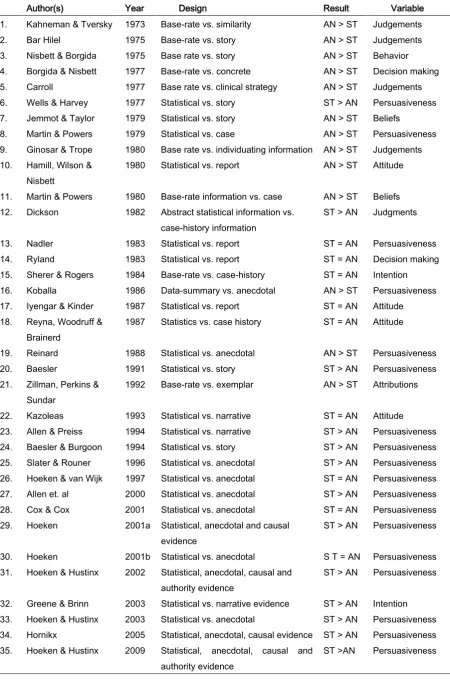
Table 1 – Overview studies statistical vs. anecdotal evidence
Author(s) Year Design Result Variable
1. Kahneman & Tversky 1973 Base-rate vs. similarity AN > ST Judgements 2. Bar Hilel 1975 Base-rate vs. story AN > ST Judgements 3. Nisbett & Borgida 1975 Base rate vs. story AN > ST Behavior 4. Borgida & Nisbett 1977 Base-rate vs. concrete AN > ST Decision making 5. Carroll 1977 Base rate vs. clinical strategy AN > ST Judgements 6. Wells & Harvey 1977 Statistical vs. story ST > AN Persuasiveness 7. Jemmot & Taylor 1979 Statistical vs. story AN > ST Beliefs
8. Martin & Powers 1979 Statistical vs. case AN > ST Persuasiveness 9. Ginosar & Trope 1980 Base rate vs. individuating information AN > ST Judgements 10. Hamill, Wilson &
Nisbett
1980 Statistical vs. report AN > ST Attitude
11. Martin & Powers 1980 Base-rate information vs. case AN > ST Beliefs 12. Dickson 1982 Abstract statistical information vs.
case-history information
ST > AN Judgments
13. Nadler 1983 Statistical vs. report ST = AN Persuasiveness 14. Ryland 1983 Statistical vs. report ST = AN Decision making 15. Sherer & Rogers 1984 Base-rate vs. case-history ST = AN Intention 16. Koballa 1986 Data-summary vs. anecdotal AN > ST Persuasiveness 17. Iyengar & Kinder 1987 Statistical vs. report ST = AN Attitude
18. Reyna, Woodruff & Brainerd
1987 Statistics vs. case history ST = AN Attitude
19. Reinard 1988 Statistical vs. anecdotal AN > ST Persuasiveness 20. Baesler 1991 Statistical vs. story ST > AN Persuasiveness 21. Zillman, Perkins &
Sundar
1992 Base-rate vs. exemplar AN > ST Attributions
22. Kazoleas 1993 Statistical vs. narrative ST = AN Attitude 23. Allen & Preiss 1994 Statistical vs. narrative ST > AN Persuasiveness 24. Baesler & Burgoon 1994 Statistical vs. story ST > AN Persuasiveness 25. Slater & Rouner 1996 Statistical vs. anecdotal ST > AN Persuasiveness 26. Hoeken & van Wijk 1997 Statistical vs. anecdotal ST = AN Persuasiveness 27. Allen et. al 2000 Statistical vs. anecdotal ST > AN Persuasiveness 28. Cox & Cox 2001 Statistical vs. anecdotal ST = AN Persuasiveness 29. Hoeken 2001a Statistical, anecdotal and causal
evidence
ST > AN Persuasiveness
30. Hoeken 2001b Statistical vs. anecdotal S T = AN Persuasiveness 31. Hoeken & Hustinx 2002 Statistical, anecdotal, causal and
authority evidence
ST > AN Persuasiveness
32. Greene & Brinn 2003 Statistical vs. narrative evidence ST > AN Intention 33. Hoeken & Hustinx 2003 Statistical vs. anecdotal ST > AN Persuasiveness 34. Hornikx 2005 Statistical, anecdotal, causal evidence ST > AN Persuasiveness 35. Hoeken & Hustinx 2009 Statistical, anecdotal, causal and
authority evidence
Table 1 shows that an equal amount of the studies stated that statistical evidence (N=13) is more convincing than anecdotal evidence (N=13) and the other way around. In 9 studies a difference could not be found between the two types of evidence. This overview shows indeed that recent studies in persuasiveness show contrasts in findings of less recent views on evidence, just as has been said by Hornikx (2007). Until 1992 the studies concluded that anecdotal evidence is more persuasive than statistical evidence, but since 1994 the studies conclude that statistical evidence is more persuasive. It must be kept in mind that several factors may influence persuasiveness and are therefore possible explanations of why the studies have shown contrasts. Hornikx (2005) concluded in his study that it is useful to gain more insight into relative persuasiveness of evidence types, by determining the factors that influence persuasiveness. A few of those important factors are:
1. The quality of evidence itself (Reynolds & Reynolds, 2002):
Evidence should meet normative criteria to be persuasive. Normative criteria are criteria that are formulated as evaluation questions that can be asked to assess the quality of the arguments. Evidence is strong, if it meets normative criteria (Hornikx, 2005). To determine the quality of evidence, manipulations must be taken into account to make a fair comparison of the types of evidence. For example: In case of statistical evidence the normative criterion is that the message contains a large sample size for the argument by generalization. Statistical evidence should therefore consist of numerical information that is based on large sample size before it can be seen as normatively strong. In addition, the size of the large sample sizes in statistical evidence also has an influence on how peoples judgments were affected. Several studies showed that judgments differ according to variations in sample sizes (Darke, Chaiken, Bohner, Einwiller, Erb & Hazlewood, 1998; Doosje, Spears & Komen, 1995). In their studies they found out that “people were more willing to assume that
the population resembles the sample when N is larger”. Hornikx & Hoeken (2007) also found that
statistical evidence with large sample sizes (e.g. 300 persons) was more persuasive than statistical evidence with smaller sample sizes (e.g. 50 persons). In order to meet de normative criteria for statistical evidence, the sample size thus has to be large.
shown many similarities and only a few differences between the two cases (e.g. the main character and person who has to be persuaded), concluded Garssen (1997) and Hornikx (2007). Another explanation for the great differences between studies concerning which type of evidence is more persuasive, is that the level of the representativeness namely can differ (which concerns the homogeneity of the characteristics or cases). Krantz, Jepson, Kunda & Nisbett (1983) demonstrated in their study that people were able to generalize the used evidence more when the population was homogenous, with respect to relevant characteristics, than when it was heterogeneous. So, the level of representativeness concerns in fact the amount of similarities people can perceive. This could also have an influence on how people react on the types of evidence and, therefore, can be an explanation for the great differences in persuasiveness. Only by keeping the normative criteria in mind and by determining that both texts meet the criteria, a fair comparison can be made.
2. Vividness and comprehensiveness of the text (Baesler & Burgoon; 1994 and Hoeken & van Wijk; 1997) Vividness can be defined as follows: “information that’s emotionally interesting, concrete and imagery
provoking, proximate in a sensor, temporal, or spatial way”, according to Nisbett and Ross, 1980). A
3. Later research on explanatory mechanisms
Baesler and Burgoon (1994) stated that only Kahneman and Tversky (1973) provided a theoretical explanation for their results, because they stated that heuristics (mental shortcuts) are the explanatory mechanisms. It would be a major contribution to existing knowledge, when researchers would take several things into account like; mediating variables, qualification of heuristics and, for example, additional explanations of belief effects based on evidence type, concluded Baesler and Burgoon (1994).
Before 1994 researchers did not look to explanatory mechanisms, but after 1994 many researchers did in their (replicating) studies and referred to Baesler and Burgoon for multiple times (for example Hoeken & van Wijk, 1997; Hoeken, 2001; Hornikx, 2005) by taking quality of evidence and vividness into account. In table 1 it can be seen that the switch from the more persuasive anecdotal evidence to the more persuasive statistical evidence was in 1994. It seems that by controlling these factors from then on the statistical evidence was more persuasive. It is possible that before 1994, if the researchers had had the knowledge about the factors that could influence the persuasiveness, statistical evidence would have been more persuasive. The fact that researchers have not taken these factors into account until 1994 is something that must be kept in mind and could also explain the contrasts in results.
4. Different contexts
Finally, different contexts in which the evidence types have been researched, can explain why anecdotal evidence sometimes turned out to be more persuasive than statistical evidence and vice-versa (Hornikx, 2007). Above, different explanations have been presented that could explain the great contrasts that have been found by determining which type of evidence is more persuasive.
literature with this new context, it can be examined what the preferences are of tweens (another target group than normal) by using different types of evidence in a flyer.
§
2.2
E
VIDENCE AND TWEENS
Anecdotal evidence is based on one specific case, often translated into a personal story, whereas statistical evidence is based on a large sample size (numerical summary or a number of cases). Although there has not been any research into the effects of types of evidence on tweens in written communication, there has been much research into the effects of television commercials on children.
§
2.2.1
C
ELEBRITY ENDORSEMENT&
PROMOTIONAL CHARACTERSAdvertisers use several persuasive techniques in television commercials to appeal to children and young people. One technique that affects the popularity of the advert with children is the use of celebrity endorsement (‘a famous person who uses public recognition to recommend or co-present a
product in an advert’) and promotional characters (Nash, Pine & Messer, 2009). The fact that only one
main character can have an effect is also stated by Boyland, Harrold, Kirkham & Halford (2011) who conducted research into the field of television advertising directed at children. When a celebrity appears in an advertisement it enhances a products’ worth and can increase sale for two reasons: 1) they heighten attention to adverts by virtue of the visual and aural cues associated with celebrity endorsements, and 2) the credibility that celebrities have in their area, has a positive impact on children’s attitude towards the brand (Ganz, Schwartz, Angelini & Rideout, 2007).
Celebrities in advertisements are often well-liked because this (possibly) leads to identification and consumer persuasion in an attempt to establish some kind of relationship with the celebrity (Belch and Belch, 2007). Because this appeals to tweens so much, the use of celebrity endorsement and promotional characters is widespread amongst food advertising on popular commercial channels (Bouland, Harrold, Kirkham & Halford, 2012). Although a television commercial and a flyer are not similar, the intention is the same: to persuade children to act in a certain way (for a television commercial this means to persuade to buy brand X, for a flyer of CJV this means to persuade children to become a member of CJV).
Celebrity endorsement as a persuasive technique should not be confused with authority evidence. The latter is based on evidence that is formed on an opinion of an expert in his/her area (for example: the alcohol expert who provides disadvantages of using alcohol), while celebrity endorsement is based on a influential consumer who recommend/oversell a product or service (Hawkins & Mothersbaugh, 2010). In case of celebrity endorsement a famous person recommends a specific product based on his or her experience with the product. A celebrity is, in this case, not per se an expert in some kind of area or someone with a lot of knowledge, but just a powerful consumer with a specific experience.
§
2.2.2
I
DENTIFYING CHARACTERISTICSStudies have shown that children and young adults often “are drawn to, like, and/or identify with media
characters that they perceive as demographically similar to themselves” (Hofner & Buchanan, 2005;
Smith, Pieper, Granados & Choueite, 2010). Also, according to the SAH (Similarity Attraction Hypothesis), people are more attracted to others who match their personality and other human characteristics than those who mismatch (Byrne & Nelson, 1965). This attraction leads to increased interaction and attention (Hartz, 1996). If, in this case, a tween can identify with the main character of the anecdotal evidence, anecdotal evidence can increase their attention.
of facts, particularly when the characters with whom individuals may readily identify. This means that, if the reader can relate to the person in the story, the use of anecdotal evidence is effective (Green et al., 2010).
If the main character in the story is well established and is recognizable, demographically similar (e.g. someone of the same age, education), and of the same sex (SAH), in such a way that the tweens are able to identify with the main character, anecdotal evidence can increase the attention and even create a favorable attitude towards the text.
It lacks studies on statistical evidence in combination with children, tweens and/or teenagers. There is also no information available if the law of large numbers has an effect on children/tweens in (written) communication. From this point of view it is expected that tweens like anecdotal evidence, because it is known that anecdotal evidence may have the possibility to create a favorable attitude towards the text. It is unknown if statistical evidence can create the same effect. Qualitative research will reveal which type of evidence tweens prefer.
§
2.3
P
ERSPECTIVE OF THE MESSAGE
It is clear that the use of evidence is important in a persuasive message, but it is also important to know the perspective from which the arguments should be described. That the perspective of a message is important is concluded by Auty & Lewis (2004) who stated that, by ‘wrapping’ a product into entertaining content, it can create a favorable attitude towards the product without the user being aware. The content of a persuasive message can be written with different perspectives (‘wrappings’), which thus can have an influence on the attitude. The perspective of a message is therefore an interesting factor of persuasive communication to examine, but how to fill in this perspective in communication?
business will probably not work in deciding which content is particular good for tweens. The question arises which perspective could be used to persuade potential members to choose for a youth organization. For this reason, the factors that can have an influence in deciding whether or not to become a member will be examined. By taking that what tweens consider as important as a starting point, an important step can be taken towards a targeted approach of marketing communication.
§
2.4
P
ERSPECTIVE AND TWEENS
First of all, as children develop and move into adolescence, social relationships become increasingly important and peer relationships expand to take a particularly central role in the life of young people (Kaare, Brandtzæg, Heim & Endestad, 2007).At this age, parents become less important than peers in their decision-making processes, identity formation and in validation of their behavior, concluded Harter (1998). Peer groups, therefore, play a central role in the transition of their socialization and identify-forming processes (Meyers, Fisher & Marcoux, 2007). It seems that social relationships are important for the development of tweens. Jones (2002) identified seven developmental needs for early adolescents (tweens) by describing how to establish the service in library, especially for youth, in such a way that is able to attract young adults to actually use these services, because the use of these services can lead to positive outcomes for tweens. One of these seven developmental needs
social clues, including dressing like them for example, in order to be accepted by peers (Forney & Forney, 1995). So part of targeting tweens is knowing that they are motivated by the feeling that they need to belong. Does the need to belong and being able to build more social relationships also appeal in texts on flyers? It is relevant to explore whether tweens are appealed to social content in texts. The social perspective in a text concentrates for example on the feeling that they need to belong or the ability to make new friends and be around peers.
On the other hand, Jones (2002) stated in the seven developmental needs that tweens also need a chance to prove themselves (competence and achievement), to explore a widening world and reflect on their roles and experiences (self-definition) and to express their interests, which helps them to understand and accept themselves (creative expression). All these developmental needs of tweens point in the direction of a more individual perspective in which questions like the following are raised: where do I belong? Which role do I take? And how long do I take this particular role? (Dekker, de Hart & Faulk; 2007). The individual perspective in a text concentrates more on the personal fulfilment of the tweens, for example a text about learning to be creative.
In existing literature there has not been made a direct comparison of a social perspective vs. an individual perspective. Both perspectives seem to be important for tweens, so this study should point out if the tweens give a preference to one of the two perspectives in persuasive communication.
§
2.5
D
IFFERENCES BETWEEN TWEENS
“Up to 7 years children are living in a fantasy world. From 8 years old they learn ‘reading
comprehension’ and it opens a whole new perspective for them. Those children are becoming wiser
and get their own opinion”. (Beuving, 2010).
more in life than 8-year-olds.“That’s like comparing a 60 year old with a 40 year old”, according to Siegel et al. (2001). In addition, the differentiation is also necessary because the older tweens may have started with puberty already. Zimbardo, Johnson & McCann (2009) state that with girls puberty starts in the age of 11 until 15, but according to Westenberg (2007) this is even earlier, namely from 10 years old for girls and 11,5 years old for boys. Whatever the level of the child is, it is important to take puberty into account, because during puberty children make a genuine intellectual leap. Delfos (2004) concluded that the intellectual capacity of children increases strongly. Thereby, through puberty, their thought processes are becoming more logical, flexible and organized, closely resembling those of adults (Piaget, 1969). Just like adults, they develop the skill to think hypothetically, which means that they are capable of thinking of all kinds of alternatives and to test these to concrete facts (Delfos, 2004). Furthermore, as their cognitive skills develop, they start to develop an interest in social and cultural issues (Berk, 1994), which is facilitated by the availability of greater levels of information from the internet, the media, as well as peers and parents. Younger and older tweens therefore differ in their experience and cognitive skills. In this study the distinction between old and young tweens will therefore be taken into account. To make it clear whether girls and boys differ in their opinions regarding persuasive communication (puberty starts for example earlier in girls than in boys, which affects cognitive skills), the distinction between these sexes will also be taken into account.
§
2.6
R
ECAPITALIZATION
evidence turned out to be more persuasive. Evidence has not been examined in context of tweens. Further research is required to complete this limited information.
The first sub question is therefore stated as:
1. What are the preferences of tweens regarding the type of evidence (anecdotal vs. statistical)?
The perspective of the message is also an important factor that can have an effect on persuasive communication. This study focuses also on the preferences on the perspective (individual vs. social) of tweens. The second sub question is therefore stated as:
2. What are the preferences of tweens regarding the type of perspective (individual vs. social)?
Due to the fact that younger and older tweens differ in their experience and cognitive skills, this study also makes a distinction between younger (8- and 9-year-olds) and older (10- till 12-year-olds) tweens by examining their preferences. Also, in order to make it clear if there are differences between boys and girls, there is made a distinction between boys and girls. This leads to the following sub questions:
3. What are the differences in preferences of a flyer of young tweens and old tweens? 4. What are the differences in preferences of a flyer of boys and girls?
These sub questions will help to answer the main question of this study, formulated as followed:
By examining these two types of evidence and the two types of perspective regarding the preferences of tweens, this study can contribute and serve as an introduction to the field of evidence in persuasive communication. This study can, therefore, be seen as scientifically relevant.
What are the preferences of tweens regarding the evidence (anecdotal vs. statistical) and perspective (social vs. individual) in flyers for youth organizations?
§
3.
R
ESEARCH METHOD
This chapter will give insight in the research design of this study. The study was an explorative qualitative study. Focus groups were organized with each group containing 4 to 6 participants of the same age (8-9 and 10-12-year-olds) and single-sex to discover the preferences of the children regarding the perspective and evidence of the flyers. A total overview (protocol) of the focus groups can be found in appendix A.
§
3.1
A
METHOD DIRECTED AT CHILDREN
Tweens have a completely different view of things: they act differently, talk differently and see the world differently (McNeal, 1999). The insights that children can provide regarding their preferences are very valuable. However there is a catch: research with children requires other skills than research with adults. Owen (1997) concluded that questionnaires may be inappropriate when measuring children’s knowledge, perception and attitudes. Questionnaires may not be an adequate method of inquiry as children’s ability to read, write and understand depends on age and cognitive development (Owen, 1997).
Observations techniques, role-play and in-depth interviews are techniques that are more suitable when there is already an amount of information about the matter, but what requires more exploration. All in all are focus groups a great way to bring the knowledge and perceptions of the children to light. For this reason this study makes use of focus groups. The focus groups are intended to exploit the preferences of tweens regarding the perspective and evidence of the flyer.
According to Shaw, Brady and Davey (2011) and Gunter and Furnham (1998) there are certain rules that must be taken into account when conducting research among children. For instance, groups should generally be smaller than for adult participants (5-8 is optimal). Another principle taken into account is that joining a group of strangers is daunting for children and young people, so making use of friendship pairs will work better. For this reason, the focus groups took place during the regular evening the members visited CJV. In this way the participants in the focus group all knew each other and it was possible to let children participate in the focus groups with their friends.
§
3.2
P
ARTICIPANTS
A total of 6 focus groups took place during the evenings the members visited CJV. A distinction was made between young tweens (8-9 years) and old tweens (10-12 years). In the three groups with young tweens the mean age was 8.2. The mean age in the three groups with old tweens was 10.7.
In addition, girls and boys were separated in order to work with single-sex groups. This finally resulted in 2 groups with girls (old tweens), 1 group with girls (young tweens), 1 group with boys (old tweens) and 2 groups with boys (young tweens). With a total of 29 participants, this means that almost every focus group consisted of 5 participants. Prior to the participation, the parents of each child gave permission.
§
3.3
M
ATERIALS
Already 100 children have,because they became a member at CJV, learned which things they are very good at.These 100 childrenhave discovered through CJV that they are quite good at working together or that they are very creative. What are you good at? Drop by at club and discover it!
It is a lot of fun at CJV. Last year, therefore, 99 new children have become members! All the children have made new friends, which means that in 2012 at least 99 new friendships were
the evidence is guaranteed, the evidence should meet normative criteria.
Normatively strong statistical evidence should consist of a large sample of cases that is representative for the population in the claim that it supports (Hornikx, 2008). To meet this criterion the statistical texts were based on a 100 children as a large sample size. Depending on the perspective, the statistical text is a summary of the number of friendships that have been made (social perspective), or the statistical text is based on a 100 children discovering what they are good at (individual perspective).
Normatively strong anecdotal evidence should consist of only one case supporting the general claim about a whole population (Hornikx, 2008), in which there has to be shown many similarities and only a few differences between the cases (e.g. the main character and the person who has to be persuaded). The anecdotal evidence consisted therefore of 4 or 5 sentences about one person who had experienced the consequence (e.g. the benefits you have from membership at CJV), as a result of behavior (e.g. becoming a member of CJV). That one person was, depending on the sex of the group, Jesse or Marieke and was 10 years old. In this way the participant who read the text was similar to the main character in the story. Depending on the perspective, the anecdotal text was a story about knowing friends at CJV (social perspective), or the anecdotal text was a story about how he/she learned new things (individual perspective). In order to make a fair comparison, the vividness and comprehensiveness were taken into account by designing each text and there is tried to make them similar to each other. The examples of the anecdotal and statistical texts are presented in figure 1 through 4.
Figure 1 – Statistical social text
Jesse/Marieke (10 years old) has already been member of CJV for 3 years: “I became a member, because all of my friends were members and said nice things about it every time.I became curious and also went to CJV. Now I can talk with them about what we did!Almost everyone I know is also a member, so that’s very nice!”
Jesse/Marieke (10 years) has already been a member of CJV for 3 years: ‘Since I became a member at CJV I have learned all kinds of things, for example how to play games in another way and which funny things you can tinker. In this way I discovered that I am very creative. I like to invent new things to create.
Figure 3 – Anecdotal social text
Figure 4 – Anecdotal individualistic text
§
3.4
P
ROCEDURE
After a short introduction in which instructions and explanation was given, the participants had to introduce themselves. After a discussion about flyers in general to determine if they were familiar with flyers (Do they know the meaning of a flyer? Have they seen a flyer before?) and the effect of flyers (Do they read the texts on flyers? What they do pay attention to? Did they ever become a member after seeing a flyer?), the creative and interactive part started. Shaw et al. (2011) concluded that it is necessary to avoid using a ‘question and answer’ format for the entire session. As a result the use of more interactive and creative activities is recommended. The tweens were asked to design a flyer with a persuasive text for CJV. The task they received was that they had to imagine they were the boss of CJV. This ‘boss’ had to design a flyer in such a way that as many children as possible would become members. The tweens were asked to think about a text they would put on the flyer in order to increase the amount of memberships. The tweens were allowed to use their own imagination, but they could also make use of the words to create a text that were printed by the researcher.
Figure 5 - Coolmeter tweens. The arguments the tweens had, gave the researcher insights about what tweens focus on in deciding which flyer they liked the most.
After this discussion, they were told that the researcher also designed a few flyers and that they had to discuss which text they liked the most. The flyers were part of the experiment to determine which kind of evidence tweens prefer (anecdotal or statistical) and which perspective tweens prefer (social or individual). The two variables resulted in 4 conditions, so the tweens had to discuss 4 different flyers.
Since the use of more interactive activities is recommended (Shaw et al., 2011), the tweens had to use a cool meter for this part of the study. The researcher designed a thermometer on a magnetic board. The thermometer was divided in four sections. The section at the top of the thermometer represented ‘very cool’ and the section on the bottom of the thermometer represented ‘not cool’. With the use of magnetic hands they had to put the flyer in one of the sections, ranging from ‘not cool’ and ‘a little cool’ and ‘pretty cool’ to ‘very cool’. Figure 5 shows the used cool meter. Using a strategy, like a cool meter, creates an informal setting where children feel comfortable (Dawson, 2013). Wherever possible it is useful to
incorporate active components that use all senses, concludes Dawson (2013), who provides a short summary about focus groups with children. By the use of a ‘cool meter’ the researcher could determine whether the participants liked or disliked something. For this reason the tweens had to use the cool meter for determining which flyer they liked the best. One by one they were allowed to place the flyers in their correct order (from not cool to very cool).
The focus group session ended with the discussion of which items the tweens missed on the four flyers of the experiment. In this way the researcher got an indirect overview of which items on a flyer the tweens consider as important.
audio and video files were transcribed. The first step in many approaches in the analysis of focus group data is to have the entire interview transcribed (Stewart, Shamdasani & Rook, 2007). Transcription not only facilitates further analysis, but it also provides a permanent written record of the focus group discussion.
§
3.5
D
ATA ANALYSIS
During the focus groups data was collected. One set of data consists of the 29 flyers, designed by the tweens. Content analysis was the most suitable form of analysis for examining these flyers (§ 3.5.1). The other set of data consists of the citations of the tweens. The citations of the tweens were analyzed through the use of another codebook (3.5.2).
§
3.5.1
C
ODEBOOK CONTENT ANALYSISContent analysis is defined as an observation method that is used to systematically analyze the symbolic content of a message (Kolbe & Burnett, 1991). Therefore, this study involved a content analysis of 29 flyers, designed by the tweens. Within qualitative content analysis the codebook represents the research instrument. In the coding scheme it should be clear how a particular ‘unit’ or ‘citation’ should be distinguished (Wester, 2006).
The codebook was developed using an inductive approach, to make it more abstract and generally applicable (Thomas, 2003; Elo & Kyngäs, 2007). Due to the fact of minimal research on persuasive communication from children, the codes could not be derived from previous literature, so they were created based on the texts the tweens have written. The codebook finally consisted of 6 categories. The first category was ‘experiences’, which was divided in social and non-social citations. In this category citations were coded like “CJV is cool” (non-social) or “You are together” (social). The second category was ‘attempts to persuade’, in which citations were coded like: “Come to CJV” or
“Become a member too!”. The third category was ‘activities’, which was divided in general information
‘information’, in which the coder had to indicate if the tween provide practical information, for example, about costs: “Indicate if the child mentions something about costs. This can be determined as ‘The
costs each month are...”. The fifth category was ‘members’, in which the coder had to indicate if the
tweens said something positive or negative about girls and boys at CJV or about having and/or making friends at CJV. The last category was ‘additional’, in this category citations were coded that had not anything to do with flyers, CJV or persuasive communication. The codebook mainly provides an overview of what tweens consider as important in persuading other tweens. It shows the perspective they used in their flyer, for example, did they focus on the social part (making friends, being together) or did they focus on more actively related information (naming particular activities that are organized. The complete codebook can be found in appendix C.
The first 10 flyers were coded with a pre-compiled codebook. During the coding of these 10 flyers, several codes were added. The researcher and an independent person discussed the new codes and when they agreed, the codes were added. This process was repeated twice. Through these processes, the completeness, unambiguousness and reliability of the codebook (Neuendorf, 2002) have been ensured. In this way, new findings were discussed and added or modified with particular attention to the internal homogeneity and external heterogeneity, which had to be maintained. This means that the text fragments within a category have a high degree of agreement and the differences between the categories should be obvious and clear (Patton, 2002). Once the codes in the codebook were refined, another independent second assessor coded a third of the flyers (N=10) to see if the scheme was reliable. The inter-rater reliability was estimated by calculating Cohen’s Kappa, to measure the reliability of the codebook. With a Cohen’s Kappa of .898 the codebook turned out ‘very good’ and therefore very reliable, because coefficients greater than .80 are acceptable (Lombard, Snyder-Duch & Bracken, 2002).
§
3.5.2
C
ODEBOOK FOCUS GROUPexample of a main theme is ‘Preference type of evidence’ with codes like “I like it that it is about so
many children” and “I think the story of Jesse/Marieke is less fun”. The codebook that has been used
can be found in appendix D.
§
4.
R
ESULTS
–
PART
1
–
C
ONTENT ANALYSIS
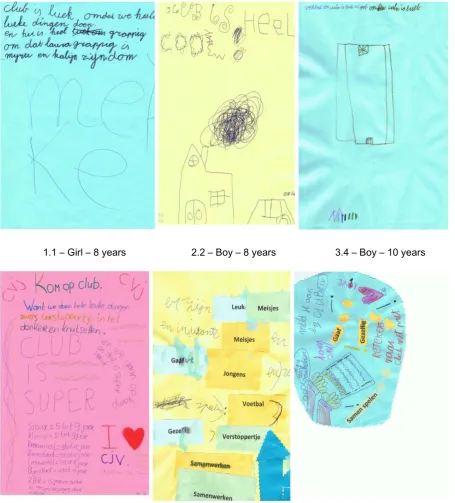
Content analysis aims to provide insight in what kind of content tweens consider important in persuasive communication. In order to find out what tweens indirectly consider as important in persuasive communication, they were asked to design a flyer for their club. This flyer had to be designed in such a way, that other tweens would become members after reading it. The result of these flyers can be seen in figure 6 and appendix E. By the use of a codebook for content analysis several things become clear, which will be described in the paragraph’s below.
1.1 – Girl – 8 years 2.2 – Boy – 8 years 3.4 – Boy – 10 years
[image:33.595.69.525.225.729.2]§
4.1
C
ONTENT ANALYSIS
:
THE RESULTS
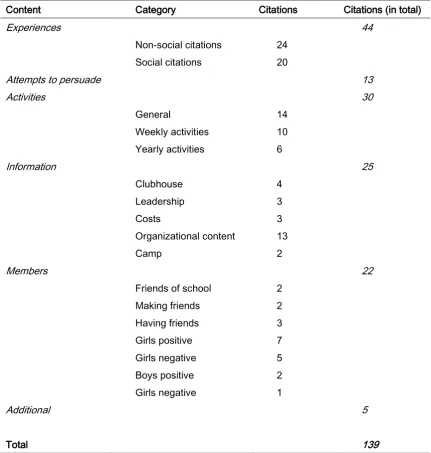
[image:34.595.65.497.306.760.2]The codebook has been divided into 5 main categories (‘experiences’, ‘attempts to persuade’, ‘activities’, ‘information’ and ‘members’) and 1 last category, ‘additional’, in which the citations were categorized that did not had anything to do with the subject or did not have any similarity with the other codes. There was a total of 139 citations spread over 29 flyers. Analyzing the designed flyers was based on the citations in the texts (N=139). Table 2 shows the number of times the tweens wrote about the different categories.
Table 2 – Citations per category (N=139)
Content Category Citations Citations (in total)
Experiences 44
Non-social citations 24
Social citations 20
Attempts to persuade 13
Activities 30
General 14
Weekly activities 10
Yearly activities 6
Information 25
Clubhouse 4
Leadership Costs
3 3 Organizational content 13
Camp 2
Members 22
Friends of school 2
Making friends 2
Having friends 3
Girls positive 7
Girls negative 5
Boys positive 2
Girls negative 1
Additional 5
It can be seen that in 44 citations the tweens wrote about an experience with CJV. The 44 citations can be divided in 24 non-social citations and 20 social citations. In the non-social citations the tweens provided, for example, a positive view regarding their experience with CJV, like: “Club is nice”, “I love
club” or “Club is good for entertainment”. The social citations were about the social part of CJV (like
being together in a group), for example: “It is cozy” and “you are together”. Moreover, 13 citations contained a persuasive message, like “Come to club” or “Become a member!”.
The table shows that 30 citations were about the organized activities at CJV. In part of these citations (N=14) tweens wrote about activities in general, for example, “We play nice games at CJV” and “At
CJV we do a lot of nice games”. Of the 30 citations, 10 citations were about the weekly activities that
are organized at CJV. In these citations the tweens were more specific about the activities and they provided examples of games they play on a regular club night like “Nachtwacht” and “We play hide
and seek in the dark”. The last 6 citations about activities were about a yearly activity, namely camp.
The tweens wrote citations like: “every year we go camping” or “in summer break camp is organized”.
Table 2 also shows the number of times in which tweens provided information about practical things, like the clubhouse, the costs etcetera. In a total of 25 citations tweens conveyed some form of information. In 4 of these 25 citations tweens wrote about the new clubhouse, which, at the time they had to design the flyer, had not been opened yet. In 3 of the 25 citations the tweens mentioned the leadership at CJV, for example “The leaders from the groups are sweet”. Another 3 citations were about the costs, like “It costs only 5 euros per month”. Of the 25 citations, 13 citations mentioned organization content, in the form of presenting the names (of the different groups at CJV) and the ages of club members, or, for example, a list of names of the children who were a member in their group at that moment. Finally, the last 2 citations in the category “information” conveyed practical information about summercamp, like how many days you go to camp, but also what other children can expect
(“You are in a group and you try to win games, and if you are in a good team you can win a price at
The last main category ‘members’, indicates the amount of citations tweens produced about the members of CJV, namely 22 citations. This was, among others, about knowing friends from school at CJV (N=2), the ability to make friends (N=2) and having friends at CJV (N=3). In 7 citations of these 22 citations the tweens wrote something positive about girls, like “The girls at CJV are so nice”. However, in 5 citations the tweens wrote something unkind, like “Karlijn is often irritating” or “The girls are also
sometimes stupid and annoying”. The girls only wrote about girls, but boys wrote about boys and girls.
In 2 citations the boys wrote positively about boys and there was 1 negative citation about boys, namely: “the boys could be irritating too”.
In the last category ‘additional’ citations were placed which did not have anything to do with the codes that have been shown, but also did not seem to have a relation with persuasive communication. There were 5 citations that tweens had written which could not be coded properly. These were statements like “We are cool crickets and listen well” or “zombie man”.
Besides the fact that 2 citations contained a social perspective (making friends), this analysis shows that tweens did not make use of a clear perspective or use some kind of a type of evidence.
§
4.2
R
EASON TEXT OWN FLYER
While the designing of the flyer took place during the focus groups, the researcher was able to ask the tweens what their motivation for their design was. For the record: analyzing the designed flyers was based on the citations in the texts (N=139), since it was not possible to do this per tween because some tweens wrote extensive texts. Analyzing the citations in the focus groups was done per each tween (N=29).
explained it ‘just the way it is’ which mostly contained phrases like “Simple: that”s the way it is” or “Well, that”s just the way it is”. Due to the fact that the cognitive skills and experiences differ for young and old tweens, it can be expected that, perhaps, young tweens find it more difficult to think of reasons why they wrote something down. However, not having a real motivation did not only emerge in the groups with young tweens. The statements emerged at focus group 1 (mean age 8.2 years), 3 (mean age 10.5 years) and 6 (mean age 10.9 years). Another 6 tweens said they wrote more based on their feeling, for example “this came first into my mind” or “this was actually the first thing I thought of”. It was mostly the girls who motivated from their sense (5 girls vs. 1 boy). A total of 4 children stated as motivation that they liked club so much, so for that reason they wrote their particular text. Only 2 girls wrote their text focusing on sharing of knowledge: “I just want to let everyone know that it is so much fun” and “I think it is important that they know about what clubs there are and how you can join them”.
§
4.3
A
PPRECIATION OTHER DESIGNED FLYERS
In order to find out indirectly what they consider as important in persuasive communication on flyers, the tweens got the task to view the other designed flyers in their group and to decide who did the best job. It is interesting to note that a great majority pointed out their own flyer to be the best. The most frequent answer to the question: “Which flyer do you like the most?” was “my own flyer” or “mine”. The older girls were better able to state that their own flyer “had failed” and to point out other flyers as the best. Two tweens pointed out that the flyer with the most information had to be the best flyer, because it was more useful. A few tweens (N=2) said that the best flyer was the flyer which would made potential members curious the most. One boy determined that his flyer was the best, because he had used the most words. There were also 2 tweens who did not have an opinion.
§
4.4
Y
OUNG VS
.
OLD TWEENS
Looking at young tweens and old tweens it can be seen that the young tweens wrote mainly about their experience, like “club is nice” and a little about the organized activities, like “we play hide and
friends, or to provide practical information, so they wrote more extensively. Young tweens seemed not to have thought of that at all and were also the tweens who provided the most statements that did not have anything to do with CJV in particular, but more with the people that were around (for example: talking mainly negative about their group members, in ways of “Karlijn is irritating” or “boys are stupid”).
In the motivations considering why they designed the text the way they did, differences between young and old tweens cannot be found. Young tweens used just as many different motivations than the old tweens. By deciding which flyer they appreciated the most, a difference was found. It could be noticed that more than half of the young tweens liked their own text better than the other designed texts.
Looking at the designs it can be concluded that young tweens seem to be more visually oriented than the old tweens, regarding the fact that young tweens used drawings (for example of the clubhouse) a lot more than old tweens. Although the fact that all the groups were told many times that the focus should be on the texts, the young tweens frequently asked if they, “please”, could make a drawing too.
§
4.5
B
OYS VS
.
GIRLS
Some differences were found between boys and girls concerning the design of their own flyer. The first thing that can be noticed is that girls are more extensive in writing than boys. Most boys used just one or two sentences on the flyers, while the girls used a minimum of two sentences (most of the time many more). The boys provided a mainly positive view of their experience with club and wrote about organized activities. The girls, on the other hand, wrote about their experiences extensively (positive view, social part and persuasive arguments), their opinion about activities, the members at CJV (the ability of making friends and having friends) and were mainly busy with providing practical information about costs and organizational content.
§
5.
R
ESULTS
–
PART
2
–
CITATIONS FOCUS GROUPS
In the next paragraphs the results of the 6 organized focus groups will be discussed. First the general knowledge about flyers will be discussed (5.1), followed by the preferences of evidence of the tweens (5.2), the preferences of perspective of the tweens (5.3), characteristics of a flyer (5.4) and ends with the differences between groups (5.5 & 5.6). As previously stated, the analyzing of the focus group was done per each tween (N=29).
§
5.1
G
ENERAL KNOWLEDGE FLYERS
&
PERSUASION
Approximately 23 tweens had heard of a flyer or seen a flyer before. Most of them had seen flyers during festivities in local villages, on walls and in schools. The question if they read the text on flyers had different outcomes. Only 6 tweens mentioned that they read the text on a flyer and 10 tweens said they never read the text (“deadly boring”, “not interested”). All the others noted that it depends whether they read a flyer or not. It depends on where the flyer is from and what the flyer is about, after that they consider if they want to read it or not. During the talk about flyers, 20 flyers of different associations and institutions were on the table. When the researcher asked which one they liked the most (to determine indirectly what they look at: text or pictures), they pointed mainly to flyers that were familiar to them. The flyer from the local volleyball club, the theatre school and the local music association were most pointed at. When they were asked why they liked those particularly flyers the most, they told something about a neighbor (“Yes, children and their parents in my street are members of that.
And uncle Ron and Armin, who helps uncle Ron, are members too”), a friend or themselves (“Yes, we
are members there”, or “Yes I was a member of theatre school Luna. Hated it.”), who they knew as
members of the association. Recognition/familiarity and liking are very close to each other in the eyes of tweens.
becoming a member provided more insight about the reasons why tweens become members. A lot of tweens stated that they become a member because “my friends were already member”, or “because
my friend asked me to come and look for once” and “I became a member because I knew no one at
the other gymnastic club, so I changed to where I knew other children”. It looks like becoming a
member depends on whether the boys and girls are familiar with an association.
§
5.2
P
REFERENCES ANECDOTAL EVIDENCE VS
.
STATISTICAL EVIDENCE
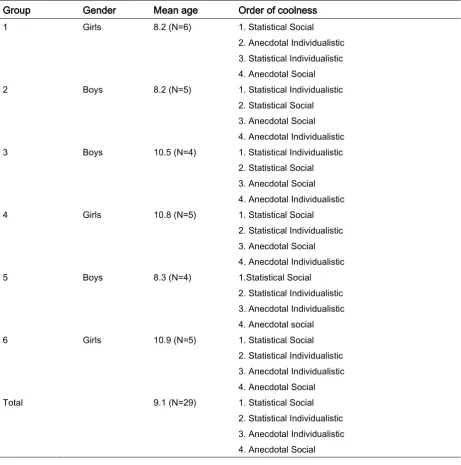
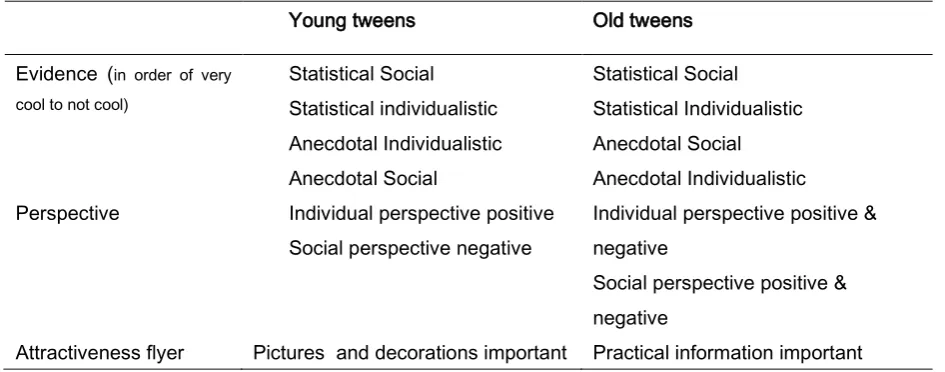
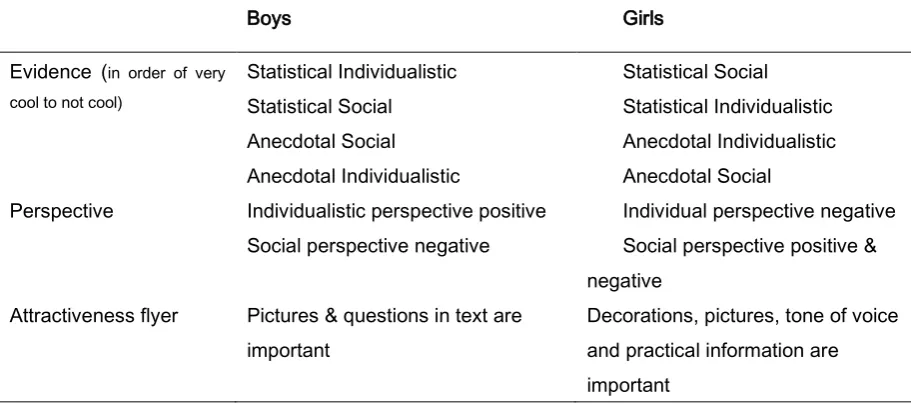
The tweens obviously did not like the texts written with anecdotal evidence. The story in which Jesse or Marieke told of their own experiences with CJV delivered the most negative results. Most of the time the tweens stated that “the stories of Jesse were not so nice” and “the stories sounded boring”. Some tweens even stated that the “stories were annoying” and in recommendations for flyers, they even said that there should be “less Marieke, more club”. The only girls who liked the text written with anecdotal evidence, according to the citations in the focus group, where those who had to decide which one they liked more for section 2 and 3 on the cool meter (respectively “pretty cool” and “a little cool”). Although it was expected that anecdotal evidence would be preferred by tweens, this was not the case. In table 3 (page 43) an overview is presented of the results regarding the cool meter. Number 1 through number 4 present the order of coolness, in which number 1 is a very cool text according to the tweens and number 4 is the least cool text. They had to order the texts by group, so they had to discuss which flyer should be on top and why. In this way the researcher was able to find out the underlying arguments why one flyer should be above the other.
It is quite obvious that anecdotal texts are rated less cool than the statistical texts. There is only one exception, because group 1 did rate an anecdotal text as “pretty cool”. The differences between the perspectives (anecdotal social and anecdotal individualistic) are minimal: both texts did not score high on the cool meter. Therefore, the perspective may vary in the anecdotal evidence text: this does not seem to have an influence on preference of the evidence.
statistical texts, varying from “it is nice because it is about so many children” to “if 99 people are
already members, you become very curious”. Some tweens were also very enthusiastic because the
number of members was high (“I like this text too, 100 children are so many!”). Not one boy or girl was negative about the statistical texts. In 5 of the 6 groups the two statistical texts were rated as coolest, which means the tweens preferred the statistical texts more. In almost every focus group after reading the texts out loud, the first reaction was that the one about the 100 children should be on top (“The
one about 100 children is very cool!”). The difference between statistical social and statistical
Table 3 – Overview order of coolness
Group Gender Mean age Order of coolness
1 Girls 8.2 (N=6) 1. Statistical Social
2. Anecdotal Individualistic 3. Statistical Individualistic 4. Anecdotal Social 2 Boys 8.2 (N=5) 1. Statistical Individualistic
2. Statistical Social 3. Anecdotal Social 4. Anecdotal Individualistic 3 Boys 10.5 (N=4) 1. Statistical Individualistic
2. Statistical Social 3. Anecdotal Social 4. Anecdotal Individualistic
4 Girls 10.8 (N=5) 1. Statistical Social
2. Statistical Individualistic 3. Anecdotal Social 4. Anecdotal Individualistic
5 Boys 8.3 (N=4) 1.Statistical Social
2. Statistical Individualistic 3. Anecdotal Individualistic 4. Anecdotal social
6 Girls 10.9 (N=5) 1. Statistical Social
2. Statistical Individualistic 3. Anecdotal Individualistic 4. Anecdotal Social
Total 9.1 (N=29) 1. Statistical Social
2. Statistical Individualistic 3. Anecdotal Individualistic 4. Anecdotal Social
In summary, the tweens preferred the text written with statistical evidence more than anecdotal evidence, due to certain reasons: