ISSN Online: 1940-9907 ISSN Print: 1940-9893
DOI: 10.4236/jssm.2018.111001 Jan. 10, 2018 1 Journal of Service Science and Management
Collaborative Logistics Information Service
Framework and Reference Model: Based on the
Perspective of Service Ecosystem
Yingliang Wu, Jie Chen
*School of Economics and Commerce, South China University of Technology, Guangzhou, China
Abstract
This paper analyzed the system features and model constructs of collaborative logistics information services from the perspective of service ecosystem. With the example of public logistics services platform, this paper discussed the contents of its features, classified its technology realization and business mod-el and put forward the corresponding system structure and key realization technologies, which provide reference model for collaborative logistics infor-mation development.
Keywords
Services Ecosystem, Logistics Information Services, Collaborative, System Structure, Business Model
1. Introduction
Informatization and logistics information services accelerated the technological innovation and model transformation of services science on the level of tech-nologies, systems and business models, which results quickly development of technical application and business model in new field that have a significant ef-fect on transformation and upgrading of modern industrial society and evolu-tionary technology path [1] [2] [3], which was demonstrated in IOT (Internet of Things), MI (Mobile Internet) and CC (Cloud Computing). Research and prac-tices indicated that innovation and application of information technology will initiate the transformation of new technologies and industries of services science. The transformation in the emerging areas has a significant influence on the development and operation mode of informatization and information ser-vices, which is also a challenge to the traditional concept of informatization and How to cite this paper: Wu, Y.L. and
Chen, J. (2018) Collaborative Logistics Information Service Framework and Ref-erence Model: Based on the Perspective of Service Ecosystem. Journal of Service Science and Management, 11, 1-12. https://doi.org/10.4236/jssm.2018.111001
Received: November 19, 2017 Accepted: January 7, 2018 Published: January 10, 2018
Copyright © 2018 by authors and Scientific Research Publishing Inc. This work is licensed under the Creative Commons Attribution International License (CC BY 4.0).
http://creativecommons.org/licenses/by/4.0/
DOI: 10.4236/jssm.2018.111001 2 Journal of Service Science and Management collaborative information services [4] [5]. Below I will introduce the development institution and direction of collaborative logistics information for you first.
1.1. Complexities of Collaborative Logistics Information Services
System
Logistics information services system is a complex, dynamic, open and inte-grated information ecosystem, and it is also a cross-enterprise, cross-department and cross-region value net that has self-organizations, behaviors and develop-ment models, which surpasses the supply chain and value chain. We must study its dynamic growth law in order to avoid blindness in the construction and de-velopment of information service system [6] [7].
More attention needs to be attached to peoples, organizations and informa-tion, coordination and sustainable development of information environment. The innovation development of China’s logistics services needs the information services’ construct upgraded to a new level, and with corresponding to it, it’s ur-gent to construct the sustainable development of collaborative logistics informa-tion services ecosystem [8].
1.2. Development Direction of Collaborative Logistics Information
Service: Service Oriented
The model of developing third generation of “information-users oriented” is transforming to “services oriented” owing to the technical advancement, services managerial transformation and innovational development. The services oriented model reflects future development of collaborative logistics information services and its realization demanding features of integration, intellectualization, perso-nalization and unification. Only this new model in which essence is the know-ledge service mode which people pursue can meets the collaborative logistics in-formation services’ innovation development [9].
We researched and built the system of collaborative logistics information ser-vices which is a dynamic, open, integrated, smart and personalized system. Those are the target and mission of collaborative logistics information services, which provides reference model for collaborative logistics information development.
2. Systematic Analysis of Collaborative Logistics
Information Service
prac-DOI: 10.4236/jssm.2018.111001 3 Journal of Service Science and Management tices of Airport logistics information services platform with the theories and methods of collaborative logistic information services system.
2.1. Features of Collaborative Logistics Information Services
Strengthen the studies and applications of collaborative logistics information services could help logistics enterprises reduce production costs, optimize the inventory, reduce tying of capital and shorten production cycle [11]. Therefore, it is necessary to analyze collaborative logistics information services. Below I will introduce some technical terms for you:1) Integration. A convenient unified logistics information services platform is needed in order to collect, transmit and process massive amounts of information immediately. Therefore, the construction of an efficient intelligent logistics in-formation services platform becomes the key link for services integration, which is a vital logistics services model in the innovation of services. At that stage, the logistics enterprises could easily interact with each other, integrate information of “objects” and break the boundary of single enterprise to optimize the alloca-tion of logistics resources, which leads to an integraalloca-tion of services. The integra-tion of services can be specified in four aspects, which is the intelligent entire trace of products, the integrated supply chain’s logistics driven by the end-customers, customized the logistics solutions for the overall optimization of supply chain’s efficiency and construction of supply chain with modern logistics services as the core.
2) Personalization. The personalization of logistics services means the institu-tions of logistics information services can collect, arrange and update demand interests of business participants’ initiative, and also push the logistics informa-tion services to participants based on their interests and characterize. Compared with the traditional information searching, the personalized services have two distinct features: one is pertinence which means provide customized services to users based on their personalized information needs; another is proactive. The platform can push the users’ needed information to them initiative, which is dif-ferent from traditional services model of “people search information”. The aims of personalized logistics information services are to meets users’ needs with their demands. It can be divided into three steps: firstly, analyze users’ interests based on the collected information, and then to build users’ interest database with the determined users’ information needs; Secondary, by using the Internet technol-ogies with the accordingly algorithms, extracting the users’ accordant informa-tion in order to build the informainforma-tion database; Finally, pushing the informainforma-tion to the corresponding users.
DOI: 10.4236/jssm.2018.111001 4 Journal of Service Science and Management specialization of logistics information services. That is because socialization and specialization are each other’s premises and they are interdependence. Only by specialization, we can provide services to social in a socialization way, and socia-lization is the inevitable result of speciasocia-lization development. As the important premier of socialization of logistics information services which specialization and value added logistics information services are its future direction, demands of logistics information services’ socialization includes socialization of logistics infrastructure platforms. As the significant prerequisite of logistics industrializa-tion and marketizaindustrializa-tion, pushing logistics informaindustrializa-tion services socializaindustrializa-tion is helpful for efficient specialized social division of labor and promotes marketiza-tion of logistics informamarketiza-tion services and development of specialized third-party logistics enterprises.
4) Intelligent. The intelligent logistics information services could provide ser-vices such as transactions and throughout monitoring. Compared with tradi-tional way of marketing transaction, the intelligent logistics information services have two advantages: it can provide the complete information of markets and ef-ficiently reduce the transaction costs. The logistics information services platform can collect the needs of logistics information services and the supply of logistics information services of small and medium-sized logistics enterprises, and there-fore formed a transparent logistics information services market including these two industries. Each enterprise could get its needed marketing information ac-cording to their demands from this platform because its’ open and transparency. To ensure the credibility of transactions between enterprises, this platform will certify the participant enterprises and evaluate its’ logistics information services for regulating enterprises reputation mechanism, which will reduce their trans-action costs largely. For lots of small and medium-sized enterprises, the logistics information services platform could provide an efficient and zero-cost way to obtain marketing resources, which helped them to solve the big problem of large cost in establishing new partnership prevented companies from acquiring new market resources.
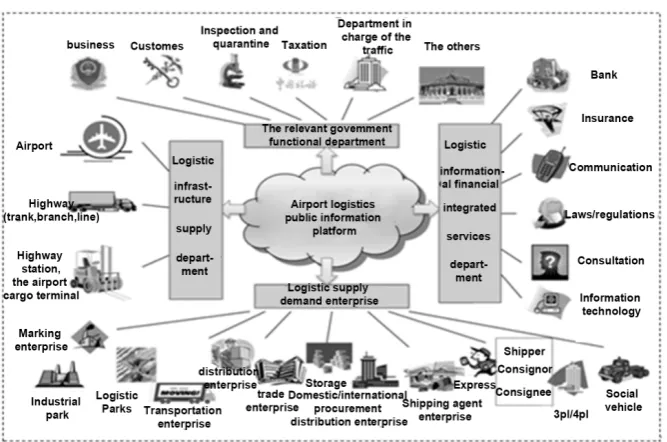
The vital task is to ensure the object of logistics information services is the us-ers of this platform, which are not only determined the platform’s needs but also are essential for platform’s construction and future sustainable development in the analysis of system needs. Through deep investigate and analysis, we put the services objects into four categories, which involved a wide range of related businesses, governments and individuals. There are logistics infrastructure pro-viders, logistics supply or demand enterprises, services sectors in logistics indus-tries and government-related functional department respectively, which was dis-played in Figure 1.
2.2. Collaborative Logistics Information Services Based on
Services Ecosystem
DOI: 10.4236/jssm.2018.111001 5 Journal of Service Science and Management
Figure 1. The service objects of the public information service platform of airport
logis-tics.
ecosystem, services ecosystem is a kind of social ecosystem which has mutual interaction with others, and its’ aim is to coordinate services providers and en-vironment in order to have a sustainable development [12]-[17]. We realized the features of China’s logistics information services industry by systematical ana-lyzing collaborative logistics services system, and then elaborated collaborative logistics services on the perspective of services ecosystem.
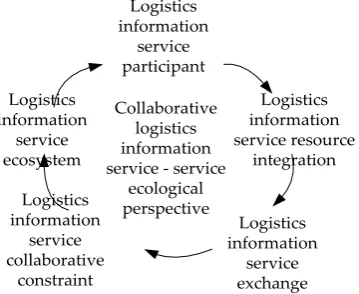
DOI: 10.4236/jssm.2018.111001 6 Journal of Service Science and Management logistics information services behaviors of social economy extensive participants included in services ecosystem based on big data and digital and resources of In-ternet and study how to promote resources reorganization and interaction be-tween logistics services subjects through intelligent connect. The creation process of collaborative logistics information services based on the perspectives of services ecosystem was showed in Figure 2.
3. Systematic Designs of Collaborative Logistics Information
Services
According to the methodology of system life cycle, this paper aims to discuss the overall framework, program and design of the overall function systems of colla-borative logistics information services with the example of Airport logistics pub-lic information services platform.
3.1. Overall Frameworks
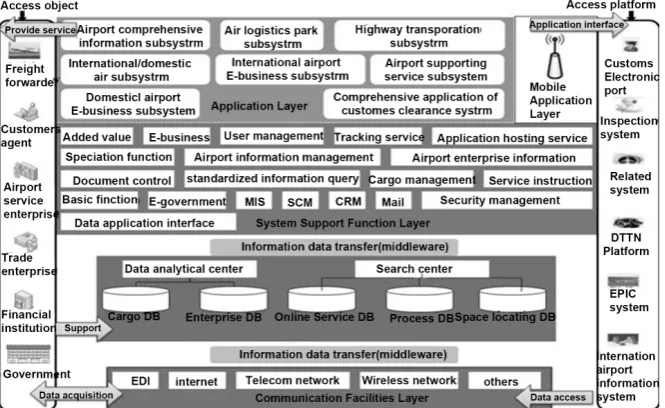
This paper has pointed out that an open, collaborative and sustainable develop-ment system framework is vital for the developdevelop-ment of logistics information ser-vices. According to the system’s need of its’ construction aims, services de-mands, technology developments and integrated innovation, this paper put for-ward the overall framework of collaborative logistics information services, which was showed in Figure 3.
This framework fully reflected the system thought and methodology of logis-tics information services, and presented the distributed integration system, in-teractive operation mechanism, collaborative technologies mode and the varie-ties and personalized services mode of that complex system of Airport public information services platform.
3.2. Function Systems
The systems’ function directly determines its services level and users’ satisfaction. By systematic analysis, we studied the function system of Airport collaborative
Figure 2. Creation of collaborative logistics
in-formation services from the perspective of ser-vices ecosystem.
Collaborative logistics information service - service
[image:6.595.285.465.534.681.2]DOI: 10.4236/jssm.2018.111001 7 Journal of Service Science and Management
Figure 3. System framework of airport logistics public information service platform.
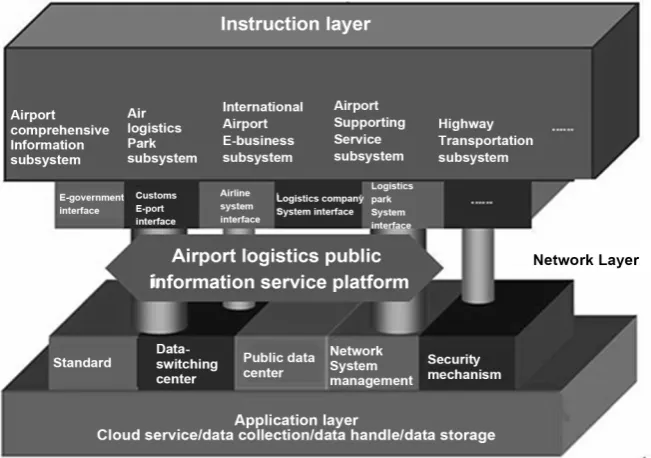
logistics information services platform. Figure 4 depicts the structural and col-laborative services, configuration, composition, and distribution and acquisition model.
The significance of determining system’s functions of collaborative logistics information services is to explicit the top-level design of system’s functions, and then to design the collaborative logistics information services’ function structure based on it.
4. Key Implementation Technologies of Collaborative
Logistics Information Services
4.1. Technologies Configuration of System
Such a complex information system needs application of large amounts of tech-nologies innovation especially application of the core techtech-nologies in the area of IT. In line with the needs of construction and development of this system, this paper pictured the implementation of technologies configuration mode, which was showed in Figure 5.
4.2. Internet of Things
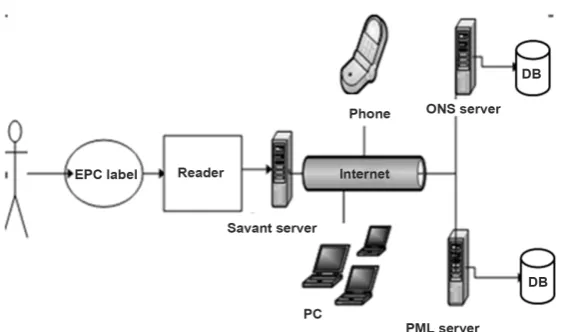
Internet of things means real objects Internet which was consisted by EPC tags, readers, Savant server, ONS server, PML server, and many databases, and it use EPC and RFID technologies to achieve the automatic recognition and real-time sharing of information of global objects [23] [24]. The application system of In-ternet of Things is the extension, deepening and integration of InIn-ternet compu-ting model. The principle of operation was showed in Figure 6.
DOI: 10.4236/jssm.2018.111001 8 Journal of Service Science and Management
Figure 4. A system function design of the public information service platform for airport
logistics.
Figure 5. Technical realization configuration system of airport logistics public
informa-tion service platform.
expressions. Such elements contains Savant server, namely software of network data exchange, which was used for collecting, storing, dealing and exchanging EPC information; objects naming server which function is equivalent to DNS; entities expression languages that was used to describe objects in standard.
4.3. Mobile Internet Technologies
[image:8.595.210.539.353.543.2]DOI: 10.4236/jssm.2018.111001 9 Journal of Service Science and Management
Figure 6. Internet computing model of IOT (application architecture).
network, and the terminals users’ get access to traditional network through mo-bile communication network; in another aspect of it, momo-bile network possess a large amount of new application services and business, and it can provide a va-riety of personalized services [25] to users according to the terminals characters such as mobility, localizability and convenience.
From the perspective of macroscopic view, the structure of mobile network consisted of mobile subnet; access network and core network. The mobile ter-minals and subnets is the subject of mobile network; the access network is mainly responsible for providing access services for heterogeneous mobile ter-minals and mobile subnets as well as shielding complex mediums features of mobile terminals and subnets which have influence on the core network [26]; the core network is mainly responsible for maintaining backbone network to-pology and routing information of traditional network, and also provides an unified standard for route switching. The system structure of mobile network was showed in Figure 7.
4.4. Cloud Computing Technology
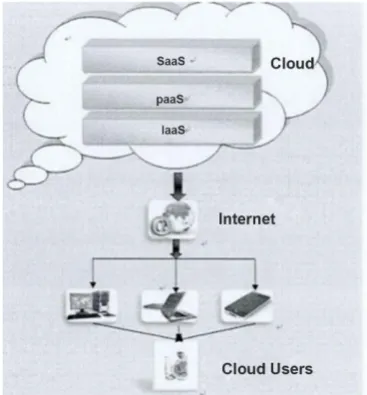
Cloud computing based on the increase, usage and delivery mode of related ser-vice of Internet. It usually refers to a kind of dynamic and virtual resource which can be easily extended. It’s a pay-per-use service which providing usable and convenient network access as needed and could enter a configurable computing resources shared pool. Those resources included network, server, storage, appli-cation software and services which can be provided quickly, requiring minimal administration and interoperating a little with service provider.
DOI: 10.4236/jssm.2018.111001 10 Journal of Service Science and Management
Figure 7. System structure of mobile network.
Figure 8. Cloud computing services model.
With the wide spread of Internet, more and more large scale complex Internet applications have appeared and gradually developed towards the trend of colla-borating. The rapid development of cloud computing can meet the need of flexi-ble and efficient collaboration, and provide high availability and scalability for applications. Cloud computing services model was showed in Figure 8.
5. Conclusion
The thought, the theory and the methods of the system of collaborative logistics information services will play an important role on the development of the logis-tics informatization in our country. Both information technology and reforma-tion of business model are challenging the development of logistics informareforma-tion services. Collaborative logistics must adapt for the informatization, e-commerce technology and the needs of the development of the services. It also needs to adapt for industrial transformation and promotion. We researched and built the system of collaborative logistics information services which is a dynamic, open, integrated, smart and personalized system. Those are the target and mission of
Mobile terminals and mobile subnets
Core network
[image:10.595.286.470.256.454.2]DOI: 10.4236/jssm.2018.111001 11 Journal of Service Science and Management collaborative logistics information services. This research also has several limita-tions. First, this paper just put forward the framework of collaborative logistics information service system and there are lacks of formal description of each part; Second, we proposed this framework for future reference but it also need to be tested whether it’s adoptable, or it’s a safety system; Third, this paper put forward this model only with one example of public logistics services platform. Future research could adopt more examples to testify it.
Acknowledgements
Supported by “National Natural Science Foundation of China (70440011)”, “Na-tional Social Science Foundation of China (16BGL190)”, “Na“Na-tional Social Science Foundation of China (15BJY149)”.
References
[1] Amardeo, C. and Sarma, J.G. (2009) Identities in the Future Internet of Things. Wireless Personal Communications, 49, 353-363.
https://doi.org/10.1007/s11277-009-9697-0
[2] Liu, Z.Y. and Du, S.F. (2008) Services Science, Management and Engineering: An Emerging Research Field. Chinese Journal of Management, 5, 607-615.
[3] Maglio, P.P., Vargo, S.L., Caswell, N., et al. (2009) The Service System Is the Basic Abstraction of Service Science. Information Systems and e-Business Management, 7, 395-406.https://doi.org/10.1007/s10257-008-0105-1
[4] Stauss, B., Engelmann, K., Kremer, A. and Luhn, A. (2008) Service Science: Funda-mentals, Challenges and Future Developments. Springer-Verlag Berlin Heidelberg, Berlin. https://doi.org/10.1007/978-3-540-74489-4
[5] Liu, Z.Y. (2009) The Discussion about IOT Business Critical Technology and the Model. Guangdong Communication Technology, 29, 2-7.
[6] Yuan, Y. and Wang, P. (2009) A Summary on the Research Achievement of Infor-mation Ecological Theory. Information Science, 27, 1114-1119.
[7] FitzPatrick, M., Varey, R.J., Grönroos, C., et al. (2015) Relationality in the Service Logic of Value Creation. Journal of Services Marketing, 29, 463-471.
https://doi.org/10.1108/JSM-01-2015-0038
[8] Zhou, Y. (2013) Study on Multi-Dimensional Collaborative Logistics Management under IOT Environment. Central South University, Changsha.
[9] Xing, D.N., Zhao, Q.L. and Song, Z.G. (2016) A Study of Service Model Innovation for Logistics Information Platform Based on Cloud Ecosystem. Journal of Business Economics, 298, 5-15.
[10] Han, J. (2014) Research on the Development and Coordination Mechanism of Chi-na Express Industry under the Background of E-commerce. Beijing University of Posts and Telecommunications, Beijing.
[11] Yang, S.Y. (2014) Study on Logistics Service’s Innovation and Pricing Strategies in IOT Environment. Huazhong University of Science and Technology, Wuhan. [12] Jian, Z.Q., Linghu, K.R. and Li, L. (2016) The Evolution and Prospects of Value
Co-creation Research: A Perspective from Customer Experience to Service Ecosys-tems. Foreign Economies & Management, 38, 3-20.
DOI: 10.4236/jssm.2018.111001 12 Journal of Service Science and Management Service Ecosystems Perspective. Marketing Theory, 14, 327-351.
https://doi.org/10.1177/1470593114534346
[14] Teng, X.H., Wu, Y.L. and Li, C.G. (2015) Research on Development Model of Mod-ern Information Service Industry Cluster: A Perspective of Information Ecology. Science and Technology Management Research, 15, 165-171.
[15] Wu, Y.L, Wang, X.L. and Chen, D. M. (2013) The Development Mode of Regional Integration of Modern Information Service Industry from the Perspective of Infor-mation Ecology: a Research Frame. Science and Technology Management Research, 11, 112-118.
[16] Wu, Y.L, Chen, D.M. and Li, C.N. (2013) An Information Ecosystem Model of Re-gional Integration Oriented Information Service System. Science and Technology Management Research, 32, 157-160.
[17] Akaka, M.A., Vargo, S.L. and Lusch, R.F. (2013) The Complexity of Context: A Ser-vice Ecosystems Approach for International Marketing. Journal of International Marketing, 21, 1-20.https://doi.org/10.1509/jim.13.0032
[18] Guo, Z.Y., Xu, H.J. and Guo, H.L. (2012) Service Dominant Logic Evolution Tra-jectory Tracking and Research Review. Foreign Economies & Management, 34, 17-24.
[19] Lusch, R.F. and Nambisan, S. (2015) Service Innovation: A Service-Dominant Logic Perspective. Management Information Systems Quarterly, 39, 155-171.
https://doi.org/10.25300/MISQ/2015/39.1.07
[20] Wu, Y.L. and Cai, K.J. (2016) A Value Innovation Analysis Model Based on Service Dominant Logic—Taking An Example of Crowdfunding. Forum on Science and Technology in China, 7, 23-29.
[21] Li, L., Jian, Z. and Zhang, L. (2013) An Analysis of Causes and Core Viewpoints of Service Dominant Logic and Future Prospects. Foreign Economies & Management, 35, 2-12.
[22] Akaka, M.A. and Vargo, S.L. (2014) Technology as an Operant Resource in Service (Eco) Systems. Information Systems and e-Business Management, 12, 367-384. https://doi.org/10.1007/s10257-013-0220-5
[23] Gustavo, R.G., Mario, M.O. and Carlos, D.K. (2008) Early Infrastructure of an In-ternet of Things in Spaces for Learning. 8th IEEE International Conference on Ad-vanced Learning Technologies, Cantabria, 1-5 July 2008, 381-383.
[24] Zhang, Y. (2010) Discussion on the Business Model of Internet of Things. Tele-communication Science, 26, 6-11.
[25] Wen, J., Zhang, S. and Li, T. (2014) Overview on Developing Status Quo and Trend of Mobile Internet Technology. Communications Technology, 47, 977-984. [26] Zhang, X. and Yuan, P. (2013) The Platform and Collaborative Operating Model of