COORDINATION OF NITROGEN-CONTAINING LIGANDS
A thesis presented for the
Jegree of Doctor of Philosophy in Chemistry in the University of Canterbury,
Christchurch, New Zealand.
hy
GILLIAN M. J)RYANT
ACKNOWLEDGEMENTS
A wide range of complexes of divalent and trivalent iron, ruthenium and osmium containing coordinated
2.2'-bipyridine have been prepared.
These are all six coordinate and are ~f general formulae (M(bipy)
3}n+ ~ (M(bipy) 2
x
2)n+,('M
(1>ipy) 2XY)n+ (M(bipy)X4)n+, (M(htpy)X2Y2)n±, where X and Y include a wide range of monodentate and bidentate ligands including
cyanide, oxalate, ammonia, pyridine and the halogens. Several complexes containing 4,4'-dimethylbipyridine have also been prepared,
The electronic absorption spectra of these complexes in solution have been measured, and a number of assignments made for the observed transitions. Both the divalent and
the trivalent complexes show intense intraligand transitions of hipyridyl in the ultraviolet region. In the visible
region, the divalent complexes show intense metal to ligand charge transfer transitions, while the trivalent complexes exhibit ligand to metal charge transfer transitions of different types.
complexes containing 4,4'-dimethylbipyridine have been measuredt and these are correlated with the electronic
INTRODUCTION
CHAPTER I. Preparative Studies
Review of previous work 6
Preparation of new bipyridyl complexes 12 Preparation of substituted bipyridyl complexes 22 Experimental details of preparative work 27
Other ruthenium complexes 47
CHAPTER II. Introduction to the Spectra of Hipyridyl Coi'!P.lexes
Introduction 52
The bonding of bipyridyl to metal ions 53 Theoretical studies made on bipyridyl complexes 56
Symmetry of the complexes 59
Spin-orbit coupling 61
CHAPTER I I I. ple_ctro__EJc Absorption Spectra of Coml'.!_exe:~ of Bipyrj.dyl w_i th JHvalent Iron, __ Ruthenium ~nd O:?mium
Introduction 63
Intraligand transitions 66
Lml/er energy 'JI'-+'11'* ( 1) Transition~ Energy Trends 67 Lower energy '11'-+'11'*(1) Transition-Band Structure 71 High energy '11'-+'11'*(2) Transition 73
Lower energy t
2 g +'lf*(l) transition 75 High energy t 2g+n*(2) transition 79
The effects of solvent 83
Ligand Field bands 85
Visible spectra of the divalent osmium complexes 86
CHAPTER IV. Electronic AbsorEtion Spectra of Comp~es of Bipyridyl with Trivalent Iron, Ruthenium and Osmium
Introduction 90
The (M(bipy) 3)
3
+ group 91
Intraligand transitions 92
Ligand to metal charge transfer band 96
Other bands in the complexes 101
The complex cations (Ru(bipy) 2(H2o)2) 3+ and (Ru(bipy)
2acac) 2+ 102
The bipyridyl halogeno-complexes 104
Intraligand transitions 104
Visible spectra 10 8
The bipyridyl acetylacetonato-complexes 114 CHAPTER V. Electronic Abs
Com,E.lexes of other Metals Intraligand transitions Charge transfer transition
N.M.R. of the tris-(4,4'-diMethylbipyridyl) complexes
N,M.R. of the iron complex
(Fe(4,4'-diMebipy)(CN) 4)2
-N,M.R. of the bis-(4,4'-diMethylbipyridyl) ruthenium complexes
APPENDIX. pxperim.ental Methods Electronic absorption spectra
Nuclear magnetic resonance spectra Solvents
Infra red spectra Analyses
124
127
128
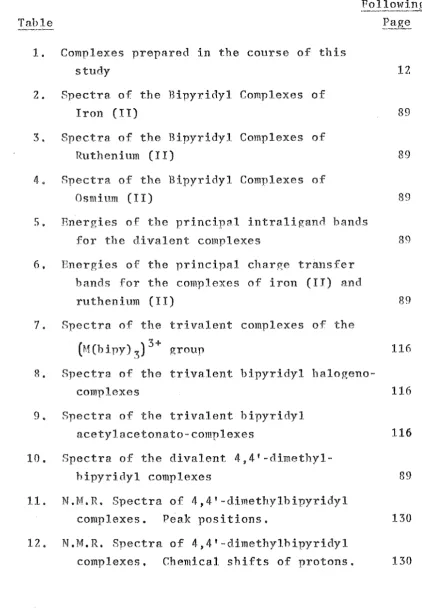
Table .Page 1. Complexes prepared in the course of this
study 12
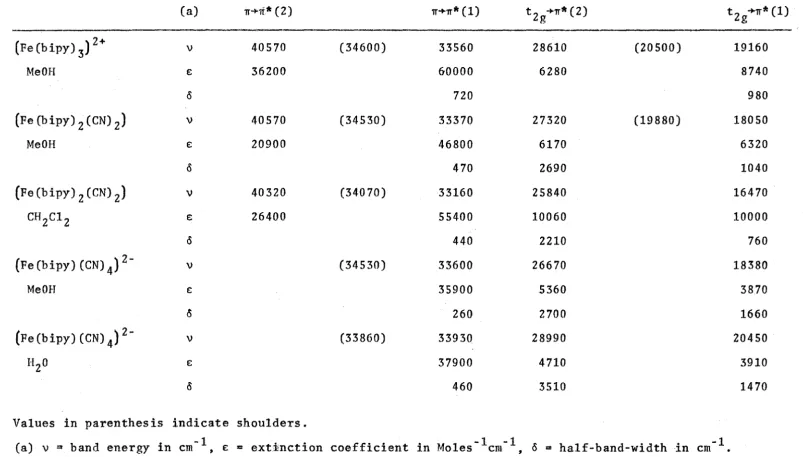
2. Spectra of the Bipyridyl Complexes of Iron (II)
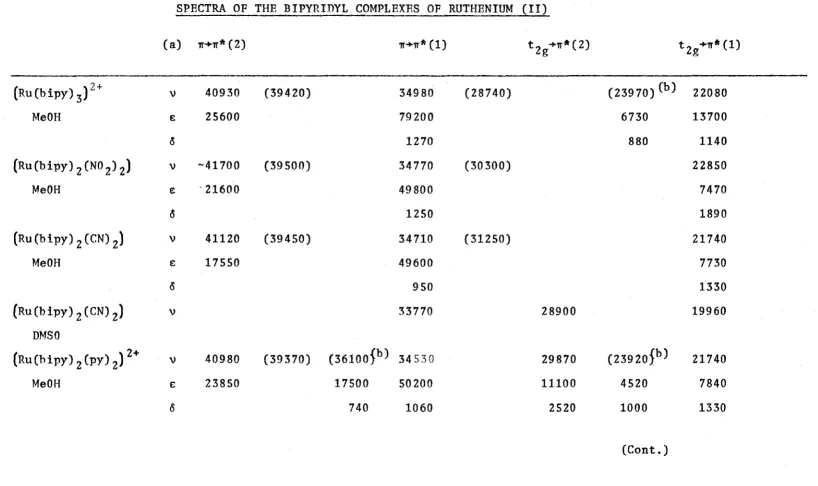
3. Spectra of the Bipyridyl Complexes of Ruthenium (II)
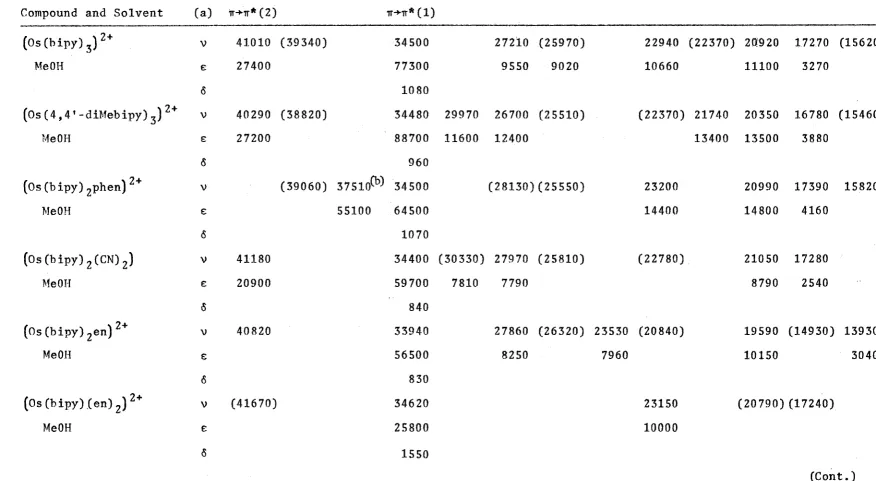
4. Spectra of the Hipyridyl Complexes of Osmium (II)
5. Energies of the principal :i.ntraligand bands for the divalent complexes
6, Energies of the principal charge transfer bands for the complexes of iron (I J) and ruthenium (II)
7. Spectra of the trivalent complexes of the (M(hipy)
3)
3+ group
8. Spectra of the trivalent hipyridyl halogeno-complexes
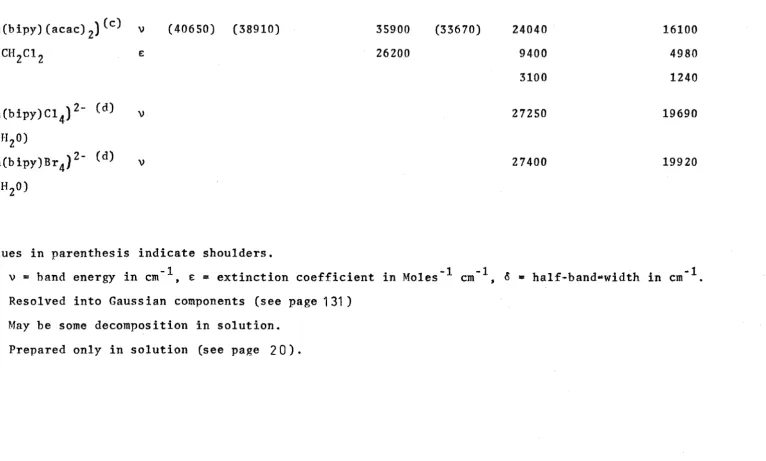
9. Spectra of the trivalent hipyridyl acetylacetonato-complexes
10. Spectra of the divalent 4,4'-dimethyl-hipyridyl complexes
11. N.M.R. Spectra of 4,4'-dimethylhipyridyl complexes. Peak positions,
12. N.M.R. Spectra of 4~4'-dimethylhipyridyl
89
89
89
89
89
116
116
116
89
130
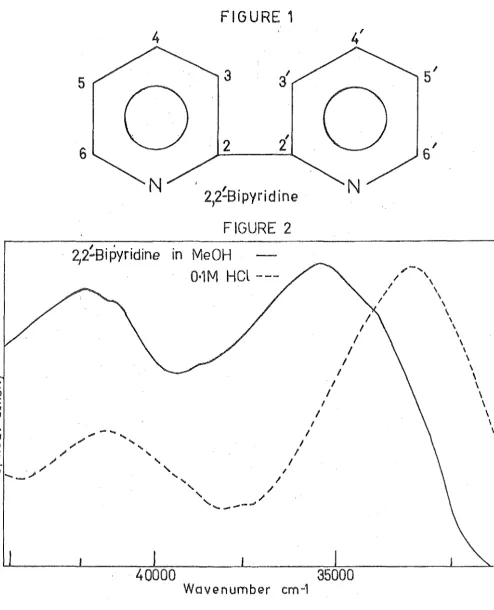
[image:8.595.73.496.145.758.2]1. Diagram of 2,2 1-bipyridine
2. Ultraviolet spectrum of 2,2'-bipyridine
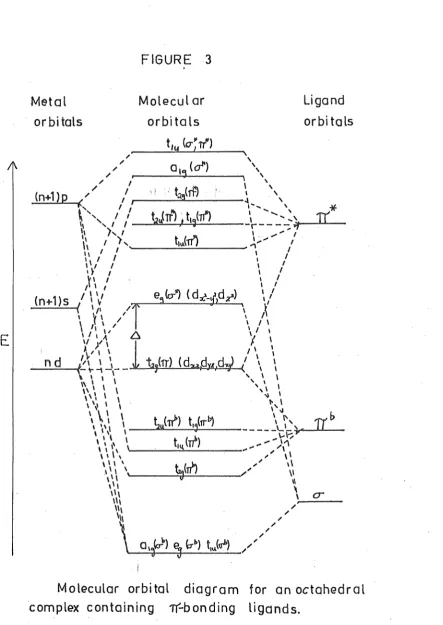
3. Molecular orbital diagram for an octahedral complex with w-honding ligands
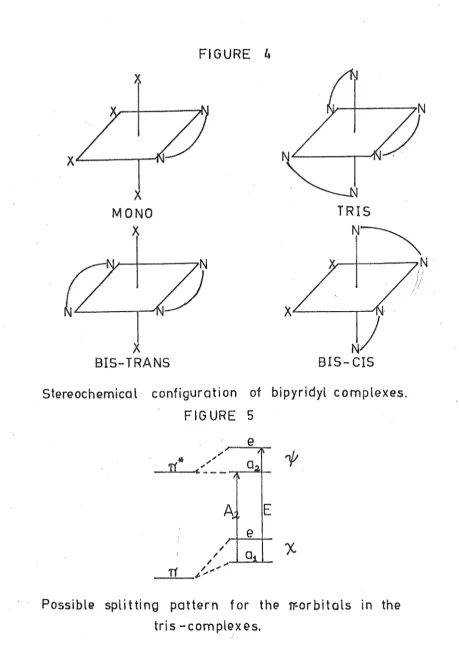
4. Stereochemical configuration of bipyridyl complexes
5. Possible splitting pattern for the w-orbitals
_:rage
53 53
58
59
in tris-bipyridyl complexes 59
6. Ultraviolet spectra of (os(hipy)3)2+, (Ru (bipy) :) Z+, and (Fe (h ipy)
3) Z+ 66
7. Ultraviolet spectra of (Ru(bipy) 2(CN) 2), (Ru (h ipy) 2 (NH
3) 2) Z+ and (Ru (b ipy) 2c12) 66 8. Visible spectra of (os(bipy) 3)2+,
(Ru (bipy)
3) Z+ a.nd (Fe (hi py) 3) 2+ 7 5
9. Visible spectra of (Ru(bipy) 2(CN)
2)-(Ru(bi.py)2(NH3)2)2+ and (Ru(bipy) 2c1 2) 75 10. Visible spectra of (Ru(bipy)2(py) 2)2+ and
(Ru(bipy)(py)
4) 2+ 80
11. Visible spectra of (Fe(bipy) 2 (CN) 2) in methanol and dichloromethane and of
(Fe(bipy)(CN) 4) 2- in methanol
12. Reduct:ton of (Ru(hi.py)Br4)- to give (Ru (b ipy) Br
4)
2-80
2 2 2 14. Visible spectra of (os(bipy)(py)
4) 2+. (os(bipy)
2(py) 2)
2+ and (os(bipy)
2pycl)+ 86
15, Visible spectra of (Os(hipy) 2acac)+ and (os (b ipy)
2
c
2o
4) 8616. Oxidation of (Ru(bipy) 3)
2+ to (Ru(bipy) 3)
3+
96 17. Oxidation of (Ru(hipy) 2(py)2)2+ to
(Ru(bipy)
2(py) 2) 3+
96 18. Oxidation of (Ru(bipy)2acac)+ to
(Ru (b ipy)
2acac) Z+ 10 2
19. Visible spectra of (os(bipy) 3)
3+ and
(os
(b:i.py)2 (py) 2) :i+ 96
20. Visible spectra of (Fe(bipy)
3
) 3+~ (Fe(bipy)2(cN) 2)+ and (Fe(hipy)(CN)4)- 96
21. Ultraviolet spectra of (Fe(hipy)3) 3+, (Fe (b ipy)
2 (CN) 2) +, (Fe (b ipy) (CN) 4)- and
(os
(b ipy)3) 3+ 9 2
· 22. Plot of oxidation potential against the energy of the n+t
2g transition for the (M (bipy) 3) 3+ group complexes
23. Ultraviolet spectra of (Ru(bipy)Cl4)-, (Ru(hipy)Br
4)- and (Ru(hipy) 2cl2)+ 24. Ultraviolet spectra of (os(bipy)2cl2)+,
(os(bipy)2Br2)+ and (os(bipy) 2
r
2)+96
105
26. Visible spectra of (os(bipy)
2
ct
2)+,
(Os(bipy)
2Br2
)+,
(Os(bipy) 2I2)+
and(Os(hipy)C1
4)- 109
27. Ultraviolet spectra of (Ru(bipy)(acac)2)+,
(os(bipy) 2acac) 2
+
and {os~ipy)(acac)2
)+ 114 28. Visible spectra of (Ru(bipy)(acac)2)+,The electronic absorption spectra of transition
metal complexes have been studied by many workers. There are three main types of bandst some or all of which may occur in the visible and ultraviolet spectral regions. They are;
a. Ligand field bands of low intensity which are Laporte forbidden transitions involving the d.-orbitals of the metal.
b. Intra-ligand bands, generally of high intensity, which are also observed ln the free ligand, and are
transitions involving orbitals localised on the ligand.
c. Charge transfer bands, also often of high intensity~
which are not present in either the free ligand or the free metal ion. These are transitions in which an electron is
transferred from an orbital localised on the metal to an orbital localised on the ligand, or the reverse.
Of these th~ee types of transitions, ligand field
systematic studies of such factors as the effects of metal ion, metal ion charge, substituents in the ligands~ and the presence of other ligands not directly involved in the charge transfer transitions in the coordination sphere.
Molecular orbital theory is necessary for a theoretical understanding of charge transfer and intra-ligand spectra, hut the complexity of the systems involved gives rise to many difficulties in calculations (some of which are discussed in Chapter II).
There is an alternative approach which can give at least a qualitative understanding of the transitions.
This involves taking a closely related series of complexes and studying the effects of changes in such factors as coordinated ligands, substituents and metal ion on the spectra. This can then be related to earlier work and to other non-spectroscopic data, and should enable assign-ments to be made for some of the bands, and give some idea of the factors that influence the spectra. This was the approach adopted in the present work.
Heterocyclic ligands such as pyridine, 2p21-bipyridine
(see Fig.l) and 1,10-phenanthroline have been found to form stable complexes with many transition metals. Many of
The divalent and trivalent complexes of iron, ruthenium and osmium with 2,2'~bipyridine are very suitable in this respect. It is also possible to prepare quite a large range of complexes of these metals of general formulae {M(bipy) 3) n+, (M(bipy) 2
xY)
n+, (M(bipy)X2 Y 2) n+ where X and Y include a wide range of bidentate and monodentate ligands (see Table 1).The present work describes the preparation of a number of such complexes, both ones previously reported in the literature and new ones. These preparative studies are described in Chapter I.
The ultraviolet and visible absorption spectra of these complexes were then studied, and are described in Chapters III and IV. Both the divalent and the trivalent metal complexes showed the intraligand transitions of bipyridyl in the ultraviolet region, In the visible, the trivalent complexes showed metal-reduction charge transfer spectra, while the divalent complexes showed metal
oxidation bands. The observed energy changes in the spectra could~ in some cases, be related to such factors as the metal ion present, or the ligand field strength of the coordinated ligands.
with reference to previous work on systems involving other metal ions in Chapter V. Chapter VI discusses the proton magnetic resonance spectra of complexes containing
INTRODUCTION
In recent years there has been considerable interest shown in the preparation and properties of complexes of iron, ruthenium and osmium~ t~ith ligands such as
2, 2'- bipyridyl
*
an(l 1, 10-phenanthroline. A number of preparative routes to these complexes have been reported, and are discussed in Part 1 of this chapter.The preparative studies carried out in the present work are described in Parts 2, 3 and 4. In Part 2 the
preparation of new compounds of divalent and trivalent iron, ruthenium ancl osmium with bipyrid.yl are discussed. Part 3 contains a discussion of the complexes of iron, ruthenium and osmium prepared with the substituted bipyridyls,
4,4'-dimethylbipyridine and 4,4'-diphenylbipyridine. The experimental details of the preparative work are given in Part 4. Finally, the reactions and compounds produced in the preparation of potassium pentachloroaquoruthenate (III),
K2RuC1 5H2
o.
are discussed in Part 5. This compound is an important starting material for the preparation of ruthenium complexes.1. Review of Previous Work Iron_ill). Bis-bipyr.!Atl complexes
The intensely red coloured complex cation
(Fe(bipy)3) 2+ has been known since 1898.! Mono- and his· complexes of 2,2'-bipyridyl were postulated as intermediates in the formation of the tris~complexes.l Recent workers have isolated an extensive series of complexes which may be formulated as (Fe(amine)2
x
2)n+, where the amine is
2,2'~bipyridyl or 1,10-phenanthroline. and
x
2 includes a wide range of monodentate and bidentate ligands. These complexes have recently been reviewed by E. Konig.
When the ligand X produces a strong ligand field
(e.g. X= CN~) the complexes are spin paired and diamagnetic, hut with weak field ligands (e.g. X
=
Cl-) they are spinfree. Some complexes show intermediate magnetic behaviour at room temperature- (e.g. (Fe(bipy)
2
c
2o
4) has l-1=
3.76 B.M • .!) while the thiocyanate complex(Fe(bipy) 2(SCN)
2), is spin~£ree at high temperatures and spin-paired at low temperatures. In solution the spin free complexes (e.g. (Fe(bipy) 2C1 2)) rapidly disproportion-ate to the diamagnetic tris-complex. The greater stability of the tris·complex is attributed to orbital stabilisation
-Iron (I I). Mono-.b ipyridy:l complexes
Few mono·bipyridyl complexes of iron (II) are known. The complex K2{Fe(bipy)(CN) 4}
2.
has been well characterised and is stable in aqueous and acid. solution. It is spin paired and shows no tendency to disproportionate.Broomhead and Dwyer !!.. have prepared a complex
formulated as (Fe(bipy)Cl2) by reacting bipyridyl with a large excess of ferrous chloride in one normal hydrochlorlc acid. Vacuum pyrolysis of tris~bipyridyl iron (II) halides has produced compounds formulated as (Fe(bipy)c1 2) and
(Fe(bipy)Br 2)
l.
However the preparations are often not reproducible, complexes of varying stoichiometry being obtained. It has been shown that pyrolys techniques may lead to a mixture of products.!,
9 The compounds arespin free and readily revert to the tris-hipyridyl cation in solution. They would be unlikely to be simple
octahedral complexes, and until further data are available their stoichiometry and formulation remain uncertain.
Iron (I I I)
The trivalent complex ions (Fe(bipy) 3)3+,
(Fe(bipy)2(CN)2)+. and (Fe(bipy)(CNJ 4)- can all be.
There have been several attempts to prepare the ferric complexes dlrcctly from iron (III). Harris and Lockyer
!Q.
prepared spin free complex cation.(Feiii(phen)
2c12
)+
by reacting 1,10 phenanthrollne with anhydrous ferric chloride in glacial acetic acid. Attempts to prepare the trivalent complexes in aqueous solution have led to the formation of binuclear species which appear to have either a hydroxy- or an oxy-bridge 1inkageg,g,t3 .. Driver and Walker11, and Anderegg±! postulate the formula(Fc 2(0H) 2L4)4+, L I'll
bipy~
phen. However, Khedekar et a113 formulate the compounds as (Pe 2oL4)X 2Y2.nH2
o,
i.e. with an oxo-linkage. In the absence of more conclusive evidence definite assignment of a structure is not yet possible.Broomhead and Dwyer§. have reported the preparation of a yellow trivalent mono-bipyridyl complex from the reaction of ferric chloride and bipyridyl in dimethylformamide, but they give no analytical data or physical measurements.
HarTis and Lockyer!Q. have reported the preparation of (N(C 2H5) 4) (Fe phen c14) from the reaction of 1,10-phenanthroline with N(C
2H5) 4 (Fec14) in a.n acetone-dioxan
mixture. This compound is spin free, and undergoes
auto-reduction follm11ed by disproportionation to give the ion
2+
cation, (Ru (bipy)
3) Z+, has been known for some time, 14
' 15 '16
but the isolation of bis~bipyridyl and bis-1,10-phenantholine complexes of ruthenium is a more recent development. The complex (Ru(bipy)2c1
2) can be prepared in low yield by
pyrolysis in vacuo of (Ru(hipy)3
)ct
2.6H2
o .
..!l
Dwyer~
al .!.§. prepared. (hipy H) (Ru lbipy )Cl4) by the addi ti.on of bipyridyl
to K
2Ruc,l5H2o in acid. Pyrolysis of the :former compound gives (Ru (bipy) 2c12) •19 It can also be formed. in high yield by
heating (bipy H)(Ru(bipy)C14) under reflux in dimethylforma-20
mide.~
Since all the ruthenium complexes are spin paired, they show little tendency to undergo the disproportionation
reactions of the spin-free iron complexes. For this reason (Ru(bipy) 2Cl 2) and (Ru(phen) 2
c1
2) are suitable as precursors for the preparation of further ruthenium (II) complexes. The halide ions are readily replaced in aqueous solution,f-1'l-.rhile the bipyridyl ligands shm'f little tendency to undergo
replacement reactions. Quite an extensive series of compounds
or
the type (Ru11(amine)2XY)n+ have now been prepared.
19~~W,
Mono !!_ipyridyl complexes
Oxidation of (bipy H) (Ru(hipy)Cl4) with chlorine gives a black, insoluble compound (Ru(bipy)Cl4).1 In the
presence of alcohol which acts as a reducing agent for
(Ru(bipy)Cl4) 1 the halides can progressively he replaced by
other ligands such as pyridine to give mono-bipyridyl complexes with ruthenium in both the divalent
(e.g. (Ru(bipy)(py) 4)
2+) and the trivalent states 18 (e.g. (R~(bipy)(acac)
2
)+).Ruthenium
The blue tris-bipyridyl ruthenium (III) cation can he obtained in solution by oxidation of the corresponding ruthenium (II) derivative with a strong oxidising agent
(Eo > 1.2eV). The oxidation potential and reaction kinetics for this react. ion have been s tudi .?_~ 2
'.2
S_, 26 However, the complex has not been isolated in the solid state.A number of trivalent mono-hipyridyl complexes are known. They include K(Ru(hipy)C14), K(Ru(bipy)Br 4),
(Ru( b:l.py)(acac) 2) Cl (Ru (bipy) acac c1 2), and
(Ru(bipy)py 2X2
)+
X"' Cl~ Br, I. !:._B_ Of these, theHowever~ very few· bis bipyridyl ruthenium (I I I) derivatives are known. The complex (Ru(bipy) 2cl2)cl has been prepared by oxidation of (Ru(bipy)2c12) with chlorine. 1 Brandt et al 2 isolated the green complex,
Osmium
Buckingham et al 28 , 29 , 30 have made extensive studies of the preparation of bipyridyl and 1,10-phenanthroline complexes of osmium. Very little other significant work has been done.
The mono-bipyridyl complexes are very similar to the ruthenium derivatives. The complexes K(Os(hipy)C14), and in some cases (Os(bipy)C14), are used as precursors for the preparation of a range of compounds very similar to those known for ruthenium.
D.M.F.
+
Heat (os (bipy) 2c12) Cl
+
sodium dithionite(os
(bipy) 2c1 2)
From this, further bis-bipyridyl osmium complexes can be prepared by a method similar to that used for the
Tuthenium complexes. HoweveT~ because the halide ions in the osmium complex seem less labile~ longer reaction times 6r more extreme conditions are required.
The range of complexes of osmium (III) known is much greater than the range known for ruthenium (III). The his halide compounds, (os(bipy) 2
x
2)x
are all stable in aqueous solution.
- - - 7
(X= Cl ,Br ,I ),-(os (bipy)
3)
3+ can be isolated in the solid state, though it undergoes
auto-reduction in solution. Trivalent complexes of osmium containing ligands such as bipyridyl. 1J10-phenanthroline~
and pyridine in various combinations can also be isolated. Other complexes known include (Os(bipy) 2pyX) 2+,
Complexes prepa.red in the course of this study. Iron (II)
Tris (Fe(bipy) 3
)ct
2.6H 2o
Bis (Fe(bipy) 2(cN)2)3H 2o
Ruthenium (I I) Tris (Ru(bipy)3
)c1
2.6H 20 Bis (Ru(bipy)
2c1 2)n2o*
(Ru (bipy) 2 (CN) 2) 2H20* (Ru(bipy)2
c
2o
4)4H20 (Ru(bipy) 2(No2) 2} zH2o* (Ru(bipy) 2(SCN) 2)*
Iron (III) (Fe(bipy) 3)(Cl04) 3 (Fe(bipy)
2(CN) 2)No3 .4H 20 (Fe(bipy)2c1 2) (Pe c1 4
)*
H(Fe(bipy)(CN) 4
).2H
20Ruthenium (III) (Ru (b ipy) 3) 3+ t
(Ru(bipy) 2C1 2)Cl.2H2
o
(Ru(bipy) 2en)(clo 4) 2
*
(Ru(bipy)2(NH 3) 2)(C104) 2.3H 20* (Ru (bipy) 2 (py) 2) (ClO
4) 2 (Ru (bipy) 2 (py) 2) 3+
·r
(Ru(bipy)2pycl)clo 4.3H2o(Ru(bipy)(py) 2Br2).2H2
o
(Ru(bipy)(py)2r2).zH2o
(Ru(bipy)(acac) 2)(Ru (bipy) C1 4)
2- ·t (Ru(bipy)Br
4) 2- t
Osmium (II)
Tris (os(bipy) 3)(clo 4) 2.2H2
o
Bis (os(bipy) 2c1
2)n
2o
(Os(bipy) 2(py) 2) (CI0 4) 2
(Ru(bipy)(acac)2)c1.3H2o (Ru(bipy)acacc1 2).H2
o
K(Ru(bipy)Cl
4
)~H2
oK(Ru(bipy)Br 4).H20
Osmium (III) (Os(bipy) 3)(CI04) 3
(os(bipy) 2c1 2)cl.2H2o (os(bipy) 2(py) 2) (C1D 4l3
(os(bipy)2phen)(clo 4) 2H2
o
(os(bipy) 2phen)(clo 4) 3.zH2D (os(bipy) 2acac)C1.3H2o
(os(bipy) 2acac)(Cl0 4) 2.H20* (os(bipy) 2en)(clo 4) 2(os(bipy) 2c2
o
4).3H
2o
(os(bipy) 2pyCl)I.H2o
(os(bipy) 2pyBr)r.H2o
(Os(bipy) 2(SCN) 2).2H
20* (os(bipy) 2(CN)2).3H 2o•
Mono K(Os(bipy)CI4) .4II
2
o
(os(hipy)(py) 4) (Clo 4) 2.2H2o(os(bipy)(en) 2)(CI0 4) 2
(Os(bipy)(acac) 2
)c1o
(Fe(4,4'-diMebipy) 3)c1 2.6H20 (Pe(4,4'-diMebipy) 2(CN) 2) .CHC13
*
K2(Pe(4,4'-diMebipy)(CN)4) .4H20*
Ruthenium
(Ru(4,4'-diMebipy) 3) (Cl0 4) 2.2H2
o
(Ru(4,4'-diMebipy)2ci2).H 20* (Ru(4y4'-diMebipy)2(CN)2).4HzO* (Ru(4,4'-diMebipy)2NH
3)2)(Cl04)2.2H20* (Ru(4,4'-diMebipy)2acac)Cl.2H2
o*
(Ru(4p4'-diMebipy)
2
(N02
)2
).H2
0~Osmium
(os(4,4'-diMebipy)3
)Cclo
4) 2.zH 2o*
(Os(4,4'-diMebipy)3)(Cl0 4) 3 .3H 20**
New compounds or prepared by a new method.2. Preparation of ~mplexes
In this section the preparative studies on the complexes of bipyridyl with iron, ruthenium and osmium made in the course of this work are discussed. A list of the complexes prepared is given in Table I. Only those complexes which are new or which have been prepared by methods different from those outlined in the literature will be discussed in any detail. In several cases, although numerous attempts were made, certain desired
complexes could not be isolated. A discussion of a number of these systems is also included in this section.
Iron_j) I). Bis-~rid~)- complexes
Many bis-bipyridyl iron (II) complexes have been
reported. 3 However the spin free complexes disproportion-ate readily in solution, and their spectra must be measured in the solid state. Unfortunately, in spite of repeated efforts~ it was not possible to obtain good solid state, e.g. diffuse reflectance, spectra of the intense charge transfer bands. For this reason little attempt was made to prepare these complexes.
Early in this w-ork a number of attempts were made to prepare the his-thiocyanate complex of iron (II),
(Fe(bipy)
These involved:
(i) preparation of the complex from (Fe(py)4(SCN) 2) (which has since been found to consist of a mixture of compounds 35,36) in pyridine or chloroform.
(ii) heating the tris~complex (Fe(bipy)
3)(SCN) 2 in vacuo. (iii) preparation in aqueous media.
Several compounds with varying analyses and infra ... red spectra were obtained.
Calculated for (Fe(bipy)2(SCN) 2)
c
~ 54.S~ H=
3.3%.C%
50.48 57.51 49.30
H%
3.75 3.84 4,16
Method (i) (ii) (iii)
\l ( C ~ N) (em- 1)
2106 2060
2060 (br) Conductivity measurements indicated. decomposition in solution. In nitrobenzene, the conductivity is high and there is a gradual increase with time, although the compound is expected to be a nonelectrolyte.
Time A
0 17.3
5 mins. 20. 5
2 days 26.3.
from preparation to preparation. It was concluded that the complex is unstable in solution and that in many preparations mixtures of compounds tvere being produced. Later studies have show·n this is often the case, and the complex has
. 37 38 39 40,3
recently been well characterised. --'-'~'·-.··
~-Iron (II)_.
The complex, (Fe(bipy) 2c1 2) (Fect 4) was prepared in a similar manner to that used for the analogous
1,10-phenanthroline complex by Harris and Lockyer.10 The yellow complex was found to be quite stable in dry, non-aqueous solvents, but in water reduction followed by disproportion occurred to give the red (Fe(bipy)
3) 2+ cation. The complex was found to be a 1:1 electrolyte in
-1 -1 2
dimethylformamide ( A25 oc
=
63.3 ohms moles em), but the conductivity was considerably higher in methanol indicating perhaps some dissociationof
the (FeC14)- ion.
As mentioned in Part 1, the complex (Ru(bipy) 2cl 2) is
an important starting material in the preparation of other ruthenium (I I) compounds. A nel<~ method for the preparation. of this compound was developed.
hydrochloric acid was reduced with zinc. The divalent bis-biptridyl complex so formed was purified by
recrystall-isation from aqueous solution in the presence of excess lithium chloride. This method is also applicable to the preparation of d.imethyl-substituted-bipyridyl complexes where other methods appear to give rise to complexes
containing coordinated carbonyl (see Part 3)~
A wide range of bis-bipyridyl complexes of ruthenium (II)
W'as prepared by heating
(Ru
(bipy) 2c1
2) in aqueous methanol with an excess of the appropriate ligand. With ligands such
as cyanide or nitrite, where the final complex is a non-electrolyte, the complexes could generally be isolated
readily by evaporation of the methanol, followed by cooling, Cationic complexes were isolated as the perchlorate salts, most of these being fairly insoluble. Iodide was originally used as a precipitating anion but it was found that ligands such as ammonia, pyridine and ethylenediamine in these
complexes tend to be replaced by halide ions in aqueous solution, espe.cially when heated.
~u.theni_um (III), B~-b~J2Yri.d.Y:1 complexes
Except for the chloro-complex, (Ru(bipy) 2
c1
2)c1,
ruthenium (II) complexes to give ruthenium (III) compounds are quite complex in many cases.
The compound (Ru(bipy) 2(H2o)
2)(CI0 4) 3 was prepared by converting an aqueous methanol solution of (Ru(bipy) 2c12) to the diaquo-complex, (Ru(bipy)2(H2o) 2) 2+, by heating with excess silver nitrate. After removal of the silver chloride precipitated, the solution was heated until it turned dark blue, silver being precipitated in the reaction. The trivalent dark blue complex was isolated as the
triperchlorate, (Ru(bipy) 2(H2o)2)(Clo 4) 3• However, on
recrystallisation from water, it tended to go dark green, and form a compound which is less soluble in water.
The complex cation (Ru(bipy)2acac) 2+ was formed from
the complex (Ru(bipy) 2acac)Cl in water by ox:i.dat.ion with ammonium eerie nitrate. The blue-green complex ~11as
isolated as the diperchlorate, (Ru(bipy) 2acac) (Clo 4) 2• However, it could not be recrystallised as it was readily reduced in solution.
The preparation does not always proceed smoothly. An excess of eerie ions is always required to effect the oxidation, but too large an excess leads to the formation of an orange~brown solution, presumably containing
methods were unsuccessful. Oxidation of the oxalato-complex (Ru(bipy) 2
c
2o
4) in methan& with cerium (IV) gives an orange species, perhaps ruthenium (IV), which onstanding turns green. However, it was not possible to isolate a pure sample of the green compound.
The chloro-complex (Ru(bipy) 2cl 2)cl is readily
prepared~ but the corresponding bromo-cation (Ru(bipy) 2Br 2
)+
could not be isolated. Oxidation of the divalent complex, (Ru(bipy) 2Br2) with bromine in a number of reaction media including water, dilute and concentrated hydrobromic acid failed to give a product. Oxidation with cerium (IV) and mercuric salts also failed to give a product, although an
isobiestic point at 22,480 em -l could be observed t'lhen
eerie ions were added to a methanol solution of (Ru(bipy) 2Br2). Several other trivalent complexes could be prepared in solution, and their formation followed by means of visible absorption spectra. In each case the divalent complex was dissolved in either water or in a few cases methanol, and eerie ions added gradually. Visible spectra were recorded after each addition (see Figs 16 and 17). In several
cases isobiestic points could be observed at energies below
~23,800 cm-lp indicating the presence of only two absorbing
These included:
Isobiestic point (cm- 1)
(Ru(bipy) 3) 3+ 17,54-0
(Ru(bipy) 2(pyJ 2)3+ 17,450
(Ru(bipy)(py) 4) 3+ 17,790
(Ru(bipy) 2acac) 2+ 16,210
Dxcept for (Ru(bipy) 2acac) 2+, these cations were too readily reduced to be isolated.
The divalent compounds (Ru(bipy)2
c
2o
4) ,(Ru(bipy)2(COOH) 2), (Ru(bipy) 2(CN) 2), (Ru(bipy) 2(SCN) 2), (Ru(bipy) 2r2) all gave orange solutions when oxidised.
No isobiestic points were observed in the visible and no pure compounds could be isolated from these solutions.
Ruthenium. fv!ono~ bipyr:ii!Y.l comp_lexes.
Whereas bis-bipyridyl ruthenium (II) complexes can he formed readily with a. variety of ligands (see Table I), the mono-bipyridyl complexes known are restricted to
pyridinet acetylacetone and halide ions as ligands.
(Ru(bipy)C1 4) ~ pure samples of the divalent bis-bipyridyl ruthenium complexes were isolated. Attempts to isolate complexes after a shorter reaction time were also
unsuccessful, a mixture of unidentified products being obtained. The reaction of bipyridyl with K3(Ru(C2
o
4) 3) and (Ru(en) 3) 2+ also failed to give mono-bipyridyl complexes.Preparation of a nitrite complex by heating aqueous (RubipyCt 4) with silver nitrite led to the formation of a
~1
product with a strong infra-red band at 1880 em , presumably containing coordinate nitrosyl.
An attempt was also made to prepare the divalent mono-bipyridyl tetra halogeno· complex anions, (Ru(bipy)C1
4)
2-, (Ru(bipy)Br4)2-. Attempts to isolate the complexes after reduction of the corresponding trivalent complexes with hydl'azine were unsuccessful, but the formation o£ a violet complex could he followed spectrophotometrically (seeFig.12).
Osmium. Bis-bipyridyl complex_~
The osmium (II) bis-bipyriclyl complexes were prepared by heating a solution of the chloro·complex, (os(bipy) 2ci2),
described by Buckingham. 29 The new complexes
(os(bipy)2(SCN)2) and (os(bipy) 2(CN)2) were also prepared by similar methods.
Osmium. Mono- bim.r:ridyl com:elexel_
These were prepared by methods very similar to those described by Buckingham.~ The starting material for the mono-bipyridyl complexes, (os bipy c14) was isolated in a slightly different manner. Buckingham's method involves pyrolysis of the complex (bipy H2) (Os c16). The brown
residue from the pyrolysis is reduced to the soluble trivalent anion (os bipy c1
4)- by heating it under reflux for about twelve hours with hypophosphorous acid. A pure sample of (Os(bipy)Cl
4) can then be obtained by oxidising the solution with chlorine. However, it was found that the reduction of the residue could also be effected with a solution of sodium dithionite.
It was also found that the complexes which were prepared from K(Os bipy c14) by Buckingham could be
prepared by refluxing the appropriate ligand in an ethanolic suspension of (Os(bipy)Cl 4)- a method analogous to that
A considerable number of complexes of iron with substituted bipyridyls has been prepared. Complexes containing methyl-substituted ligands have been studied in the greatest detail. The effects of steric interactions of substituents on the formation of complexes have been investigated •
.i!.
Stability constants and electronic absorption spectra of many of the complexes have been measured. 4~'~'
434
Little 1rmrk has been done on ruthenium and osmium complexes, and often preparative details have not been published. 45 ,46
!.d..~.:..~5methylbipyridyl complexes
The 4,4'-dimethylbipyridyl complexes of iron are similar to the analogous bipyridyl complexes, as might be expected. The methyl groups in the 4,4'- positions
(see Fig.l) will not be subject to the steric interactions found in 3,3'- and 6,6'- disubstltuted bipyridyls. The electronic effects of the methyl groups are reasonably small. (pK
8 pyridine= 5.17, pK8 para-methylpyridine
=
47
6.02)
could be prepared by the same methods as those used for bipyridyl (see Part 4). The complexg
(os(4,4'-diMebipy) 3)(Cl0 4) 2 was also prepared hy the same method as that used for the bipyridyl complex (see Part 4).
However, this is not always the case for ruthenium. The tris-complex, (Ru(4p41-diMebipy)
3
)c1
2 could not be prepared by heating the ligand. with ruthenium trichloride to 150°c in a sealed tube. A yellow compound which was not identified was obtained. However, the less severe method of preparation from the hydroxy ruthenateK2(RuC15
oH)
1 worked well (see Part 4).The compound (4,4'-diMebipyH)(Ru(4,4'-diMebipy)C14) can be prepared in the same way as for the unsubstituted bipyridyl complex. However, when this complex is heated under reflux in dimethyl-formamide in order to obtain the his-complex, (Ru(4,4'-diMebipy) 2c12), a complex which has
a strong absorption at "'1950 cm- 1 , indicating coordinated carbonyl (see Part 5), is obtained. A similar result has been observed with methyl-substituted 1,10-phenanthroline complexes.!!! Presumably the reaction involves the
obtained by the reduction of ( 4, 4 •- cliMeb ipyH)
(Ru(4,4'-diMebipy)Cl
4) with zinc in hydrochloric acid. Further his-complexes could be prepared from the dichloro-complex using the methods developed for bipyridyl (see
Part 4),
The coordination ability of this ligand is consider-ably different from bipyridyl and no pure complexes of definite composition could be isolated in the course of this work. The phenyl substituents would be expected to exert much greater steric and electronic effects than the corresponding methyl groups. The ligand itself is much less soluble in alcohol or acid than bipyridyl, and in most cases this necessitated slightly different reaction conditions.
Preparation of the tris-iron complexes was attempted by adding a slight excess of the ligand in benzene to an
alcoholic solution of ferrous chloride. A purple complex precipitated on the addition of ether. This was washed well with benzene to remove any excess ligand, then
recrystallised several times from solvents such as
a bis(4,4'-diphenylbipyrid.yl)iron complex, rather than
a tris •·
ct
H%Calculated for
(Fe(4,4'-diphenylbipy)
3)c12 75.2 4.56
(Pe(4,4'-diphenylbip~)
2
cl2
) 73.7 4.31Cl%
6.75 9.69
Found (i) 68.91 4.78 11.03
(ii) 64.36 4.54
(iii) 60.04 4.36
Calculated. for
(Fe(4,4'-diphenylbipy)2Br2) 65.9 3.85
Found 62.04 4.64
A ligand to metal ratio of 1.8:1 was obtained from a Job titration, also suggesting a
bis(4,4'-dipheny1-bipyridyl) complex.
The solid product w·hich is diamagnetic is conducting in a variety of solvents. Assuming the formulation
Solvent Conductivity (ohms "1 moles ··1 em') 2 Methanol
Nitrobenzene Acetone
Acetonitrile
95.3 27.2 94.0 137
As it was not possible to isolate a compound of constant stoichiometry this work was discontinued.
A complex of ruthenium l-lli th 4, 4'-diphenylbipyridyl
could not be prepared by any of the methods used for (Ru(bipy) 3) 2+ oT ·(Ru(bipy) 2ct 2). However, when this ligand was added to an alcoholic solution of ruthenium trichloride a purple-black precipitate was formed. This was recrystallised from chloroform. It is a
non-electro-lyte in netrobenzene, and is not decomposed by dilute acids. However, the analytical figures again failed to suggest a reasonable formulation.
C% H%
Calculated for
(Ru ( 4) 4'- diphenylbipy) c12) 54.9 4.57 {Ru(4 ,4'-diphenylbipy) 2c12) 67.0 5.58 (Ru(4,4'-diphenylbipy) 1•5ct2) 62.3 5.20 (Ru(4,4'-diphenylbipy) 1• 5
c1
3) 59.0 4.92~ ExpetJmental. Details o£ Preparative Work
In this section the preparative methods used are described. Analytical figures (percentage by weight) and some other relevant data are also presented. The complexes were all dried either under vacuum or over calcium chloride, and the presence of the appropriate ligands verified by
infra-red spectra. Iron
The cyano~complexes of iron were prepared by the
methods used by Schilt. The reaction schemes involved
in the preparations are outlined below.
(Fe (bipy) 3) Z+
H20
+ KCN(excess) + (Fe(bipy)
2
(CN)2
)~ stand ZhrsH 20
(Fe(bipy)2(cN)2) + KCN(excess) + K
2(Fe(bipy)(CN)4)
heat gently "'12hrs
(Fe(bipy) 2 (CN) 2)
(Pe(bipy) (CN)
Compound Found Analyses
C% H% C% H%
(Fe(bipy) 2(CN) 2)3H2
o
56.40 4.SSss.s
4.64K
2
(Fe(bipy)(CN)~3H2
0 38.40 2.99 38.S 3.12 (Fe(bipy)2(CN)2)No3.4H20 46.96 3.99 47.4 4.33
H(Fe(bipy)(CN)4).2H20 4 7. 49 3.88 47.6 3.12
!?.ichlorobis (bipyridyl) ;iron.(I !I) tetrachloro~ ron (I I I) 9
(Fe(bipy) 2c1 2) (FeC14)
Bipyridyl (0.156 gms) was added to anhydrous ferric chloride (.16 gms) in glacial acetic acid (10 mls). The yellow precipitate obtained was washed with glacial acetic acid.
Analysis: Found: c~ 37.68, H a 2.51~ N
=
8.78, Cl=
33.4Calc. for (Fe(bipy) 2c1 2) (FeC14)
C
=
38.07, H=
2.50, N=
8.30t Cl = 31.9% Conductivity in dimethylformamide indicated a 1:1electrolyte
j\
25 oc=
63.3 oh.ms- 1 moles- 1 cm 2Ruthenium (II)
The complex (bipyH) (Ru(bipy)C1 4) was prepared from K2RuC1 5H20 by the same method as that used by Bosnich and
This was then converted to the his compleX
(Ru(bipy) 2c1 2) by refluxing in dimethylformamidell or by the method described on page 29.
Further his-complexes were prepared by heating the dichloride, (Ru(bipy) 2cl 2) with an excess of the
appropriate ligand. Many of the preparations are very
similar to those given for the analogous 1,10-phenanthroline complexes by Dwyer, Goodwin and Gyarfas,ll and by
Bosnich and Dwyer.~
Further experimental details are given in the
following section. In cases where previously described techniques which involve heating of the appropriate ligand with (Ru(bipy) 2c1 2) are used only brief details are given.
In those complexes where a hydrate was indicated by the analysis, the presence of water was confirmed by infra-red spectra.
!i.~s-bipyridyl comnlexes
Dichlorobis(bipyridyl)ruthenium(II)hydrate (Ru(bipy) 2C1 2)H 2
o
(bipyH)(RubipyC1 4) was suspended in 3 molarhydro-chloric acid (25 mls). Granulated zinc (1 gm) was added, and the solution heated gently on a water bath. The
(bipyH) (RubipyC1 4) was still present a little more
hydrochloric acid was added. The solution was filtered. An excess of lithium chloride (2 gms) was added, and the
solution evaporated to a small volume on a water bath. Purple (Ru(bipy) 2Cl2)H2o crystallised. This was washed with water and ether_
Analysis: Found
c
II$ 47.47 H • 4.76C
=
47.7Biscyanobis (bipyridyl) ruthenium( I I) d.ihydrate, (Ru(bipy) 2(CN) 2
)zu
2o
H • 4.77
(Ru (bipy) 2
clz)C.
2 gms) in methanol (10 mls) and water (10 mls) was heated under reflux with excess potassium cyanide (1 gm). The initial purple brm'in solution soon turned bright orange. After one hour, the solution was filtered, and the methanol evaporated off on a water bath. On cooling bright orange crystals of (Ru(bipy) 2(CN) 2) were deposited. These were washed with water~ then recrystallised from methanol/ether.Analysis: Found
c.
52.58 H • 3.74Bis(nitrite)bis(bipyridyl)ruthenium(II)dihydrate,
Ru(bipy) 2(No 2) 22H2o
This was prepared by a method analogous to that used for (Ru(bipy)2(CN) 2)2H2
o
Analysis: Found.
c ...
44.50~ H=
3.82c •
44.3The compound is a nonelectrolyte in methanol.
-1 ,.1 2
A25oc "" 2.0 ohms moles em •
Bis(thiocyanate)bis(bipyridyl)ruthenium(II), (Ru(bipy)2(SCN) 2)
H • 3. 79.
(Ru(bipy) 2c1
2) ('2 gms) in water (10 mls) and methanol
(10 mls) was -reflux.ed with excess potassium thiocyanate
(1 gm) for two hours. The solution gradually darkened, and deep purple crystals were deposited. After cooling, the crystals were filtered off, and washed with water and
ether. They were recrystallised from dichloromethane/ether.
Analysis: Found C • 50.36
H • 3.14
Ethylened.iaminebis(bipyridyl)ruthenium(II)diperchlorate, (Ru(bipy)2en)(Cl04)2
The compound was prepared by a method analogous to
that used for the corresponding 1,10-phenanthroline complex.19 It was precipitated
as
the perchlorate, and recrystallised from water.Analysis: Found C
=
39.16 H=
4.05 Calc.for (Ru(bipy)2en)(Cl04) 2
c
lllll 39.2 H=
3.56Diaminebis(bipyridyl)ruthenium(II)diperchlorate'trihydrate, (Ru(bipy) 2(NH3)2)(Cl04) 23H20
The complex was prepared by a method similar to that used :fo-r the 1,10-phenanthroline complex19 . Ru(bipy) 2cl 2
(.2 gms) in methanol (10 mls) and water (S mls) was heated with concentrated ammonia solution (2 mls ".88011
) on a
water bath for one hour~
The
solution turned dark -red. It was then filtered, and on the addition of sodium perchlorate, the required complex crystallised. Thecrystals were filtered, then washed with a small amount of water. They were recrystallised from methanol/ether.
Analysis: Pound
c
=
34.19 H = 3.B6Acetylacetonatobis(bipyridyl)ruthenium(II)chloride--trihydrate (Ru(bipy) 2acac) Cl. 3H 2
o
The complex was prepared by a method analogous to that used fo't' the corresponding 1,10-phenanthroline complex.19
It was recrystallised from methanol/ether.
Analysis: Found
c •
49.56, H • 4.61 Calc.for (Ru(bipy)2acac)C13H2o
c.
49.7Oxalatobis(bipyridyl)ruthenium(II)tetrahydrate, (Ru (bipy) 2
c
2o
4) 4H2
o
H • 4.82
The oxalate complex was prepared by a method analogous to that used for the corresponding 1,10-phenanthroline
complex •
.!!
Analysis: Found
c ...
46.28 H=
4.08C • 46.0S H.,. 4.18
Bispyridinebis(bipyridyl)ruthenium(II)diperchlorate (Ru(bipy) 2(py) 2)(Cl0 4) 2
(Ru(bipy)
(Ru(bipy) 2(py) 2)c12 in methanol. The precipitate was washed with a little water, then recrystallised from methanol/ether.
Analysis: Found
c ,.
46.44 H = 3.67 Calc.for (Ru(bipy)2(py)2)CCI04) 2
c
= 46.7 H=
3.36Chloropyridinebis(bipyridyl)ruthenium(II)perchlorate~ trihydrate, (Ru (bipy)
2pyCI) ClO 4• 3H20
This was prepared by a method analogous to that used for the corresponding 1,10-phenanthroline complex~~.
Analysis: Found
c
= 43.10 H=
3.68c
&I 43.05 H"" 3.94Conductivity in methanol A25oc = 110 ohms -1 moles ~1 em 2. indicating a 1:1 electrolyte.
,guth~ium III.
pi~_-bi)2yridyl complexe_!
Diaquobis(bipyridyl)ruthenium(III)triperchloratedihydrate~
(Ru(bipy) 2(H2
o)
2)Ccio 4) 3.zu
2o
further hour, until it was dark blue in colour and the
methanol ha.d evaporated. On addition of sodium perchlorate the required complex precipitated.
Analysis: Found
c ""
30.24 H=
2.77Acetylacetonatobis(bipyridyl)ruthenium(III)diperchlorate-hydrate (Ru(bipy) 2acac)(Cl0 4)2.H20
(Ru(bipy) 2acac)Cl (0.2 gms) was disolved in water
(5 mls). A concentrated aqueous solution of ammonium eerie nitrate was added dropwise until the red colour disappeared and the solution was dark blue. On the addition of sodium perchlorate, dark blue (Ru(bipy)
2
aca~(Cl04
)2
.H2
ocrystallised. This was washed with water and ether. Analysis: Found
c
= 41.40 H • 3.48Calc. for (Ru(bipy) 2acac)(Cl.O 4) 2H20
c
= 41.10 H=
3.43.Ruthenium.
Mono~bipyridyl compJexes
These were all prepared by methods used by Dwyer
et a1.1 The complex (bipyH) (RubipyCI 4) was oxidised with chlorine to give the mono~cmnplex (Ru(bipy)Cl 4). This was then suspended in an aqueous alcoholic solution, and
The bromo complex, K(Ru(b:ipy)Br 4) was prepared by heating (Ru(bipy)Cl 4) l>iith hydrobromic acid. The halo· complexes (Ru (bipy) (py)
2X2) were prepared by heating the tetrapyt:idine eo~p1e~, (Ru(bipy)(py) 4) (Cio4) 2 with the
appropriate halide.. The nonel'ectrolyte complexes soon precipitated, The trivalent complex,
(Ru(bipy)(py) 2
c1
2)clo
4 was prepared by oxidising the · divalent complex with chlorine.The analytical figures are tabulated below.
Calculated
Compound Found Analyses
Ct H% C% H%
K(RubipyC1 4
)H
2o
27.03 2.22 26.27 2.19 K(RubipyBr4)H
20 19.05 1. 58 18.9 1. 57 (Ru (b:i.py) acac C12 )H2o
40.84 3.34 41.2 3.9 (Ru(bipy)(acac) 2)cl.3H
2o
43.27 4.79 43.9 5.13 (Ru(bipy)(py) 4)(Cl04)z
46.55 4.29 46.6 3.63 (Ru(bipy)(py) 2ci
2)H
2o
46.69 3.72 47.5 3.9 (Ru(bipy)(py) 2Br2)2H2o
38.76 3.20 39.2 3.6 (Ru(bipy)(py) 2r
2)zH
2o
33.97 2.57 33.97 3.1 (Ru(bipy)(py) 2C1 2)Cl043H 2o
Osmium_jii)_
B~s-bipyridyl complexes
Several of these were prepared by methods outlined by Buckingham et a1. 29 These involved heating under reflux a solution of (Os(bipy) 2Cl 2) with the appropriate ligand. The electrolyte complexes were isolated as the perchlorates.
Several new complexes were also prepared using similar methods.
The analytical figures for the complexes previously prepared are tabulated below.
Compound
(os(bipy) 2acac)C1.2H2
o
and (Os(bipy) 2en)(Cl04)2
(Os{bipy)2(py)2)(Cl04)2 (Os(bipy)2c2o4)3H2o
(os(bipy)2phen)(clo4)2.H2
o
(os(bipy)3)(clo 4) 2.zu
2o
C% 43.07 42.83 34.45 41.77 41.16 39.52 40.38 39.82 42.84 40.22 Found Ht 4.15 3.92 :),88 3.43 3.95 3.42 3.38 3.42 3.18 3.14 N% 8.44 7.95 9.74 8.80 8.74 9.50 9.40 9.42 Calculated Analyses C% H% N% 44.55 4.16 8.32
34.3 3.15
41.9 3.03 9,79 41.0 3.42 8.70
40.6 3.04 9.47
Bis(thiocyanate)bis(bipyridyl)osmium(II)dihydrate, (os(bipy)2(scN) 2)2H2o.
(Os(bipy) 2ct 2)
(.2
gm) in water (10 mls) and ethanol (10 mls) was ref'luxed with excess potassium thiocyanate (1 gm) for twelve hours. A dark red precipitate slowly formed. The solution was filtered, and the complex washed with water9 ethanol and ether.It
is
only slightly soluble in alcohol and chloroform, 'but is soluble in dimethylformamide.Analysis: Found C
=
40.86 H = 3.22 N ~ 12.67C ~ 40.4 H • 3.06 N • 12.85.
Biscyanobis (bipyridyl) osmium (I I) trihydrate, (os(bipy)2 (cN) 2)3H2o
(Os(bipy) 2cl2) in ethanol (10 mls) and water (10 rnls) was refluxed with excess potassium cyanide for eight hours. The solution gradually turned brown. It was then filtered,
and after evaporation. of the ethanol on a water bath, the complex crystallised. It was washed with water, then recrystallised from methanol/ether.
Analysis: Found C • 43.15 H • 3.95 N • 13.07
C • 43.4 H a 3.62 N • 13.8
Conductivity in methanol indicated a nonelectrolyte •
.-1 -1 2
The complexes were prepared by oxidation with chlorine of the corresponding divalent complexes.~ They were
isolated as the perchlorates. Analytical figures are tabulated below.
Calculated Compound
Analyses Found
C% H% N% C% H%
Nt
(Os(bipy)
3) (CI0
4)
3 35.6 2.97 8.32 35.69 2.98 8,30 (Os(bipy) 2(py)2)(Cl04) 3 37.56 2.64 8.76 37.41 2.88 8.79 (os(bipy)2phen)(Cto4)33H2o
37.8 2.76 37.55 2.88Acetylacetonatobis(bipyridyl)osmium(III)diperchloratehydrate, (os(bipy) 2acac)(Cl04) 2.H2
o
(os(bipy)
2acac)Cl (.2 gms) in water (5 mls) was
oxidised with a saturated solution of ammonium eerie nitrate added dropwise. The colour changed from red to orange-brown. The complex was precipitated by adding sodium perchlorate,
and washed with water and ether.
Osm~.
Mono" bipyridyl complex~s.
Tetrachlorobipyridylosmium(IV), (OsbipyC1 4)
(bipyH 2) (OsC16)(1 gm) was pyrolysed in the manner described by Buckingham.!!! The brown residue was
suspended in ltJater (150 mls) and sodium dithionite (2 gms) added. The solution was filtered, and the residue again suspended in water, and dithionite added. The filtrates were oxidised with chlorine~ and orange . OsbipyC1 4
precipitated. This was washed with water and ether.
Potassiumtet:rachlorobipyridylosmium(III)tetrahydrate, K(OsbipyC1 4)4H20
The complex was prepared as described by Buckingham, 28 by reduction of the tetravalent complex, (osbipyC14) with hypophosphorous acid.
Analysis: Found C
=
20.24 H • 2.94Calc.for K(OsbipyC14)4H2
o
C c 20.20 H • 2.68.Bisethylenediaminebipyridylosmium(II)diperchlorate (os(bipy)(en) 2)CCI0 4) 2
(osbipyC14) (0.2 gms) was suspended in ethanol (10 mls) and water (10 mls) and refluxed with ethylenediamine
evaporated to dryness on the water bath. The residue was dissolved in water (5 mls) and the complex precipitated on the addition of sodium perchlorate. It was
recrystallised from methanol/ether.
Analysis: Found C
=
26.07 H m 3.75Calc.for (osbipy(en)2) (Cl0 4) 2
c
=
27.23 H=
3.61Bisacetylacetonatobipyridylosmium(III)perchloratetrihydrate, (Os(bipy)(acac) 2
)clo
4.3H 2o
(Os(bipy)C1 4) (0.2 gms) was suspended in ethanol
(10 mls) and water (10 mls) and refluxed with acetylacetone (0.5 mls) in the presence of calcium carbonate. After
eight hours the solution was filtered, and
(Os(bipy)(acac)2)CI04.3H 2
o
crystallised on the addition of sodium perchlorate.Analysis: Found C
=
33.01 H n 3.88Calc.for (Osbipy(acac) 2
)cto
4.3H 2o c
=
33.98 H=
3.98Tetrapyridinebipyridylosmium(II)diperchloratedihydrate (os(bipy)(py) 4
)Ccto
4) 22H 2o
(Os(bipy)C1 4) in ethanol (10 mls) and water (10 mls) was heated on the water bath for one hour with pyridine
brown (os (bipy)Cl 3py). This solution was eva.porated to small volume, and (os(bipy)C13py) precipitated on the addition of ether. This was then used to prepare the tetrapyridine complex as described by Buckingham. 28
Analysis: Found N;:! 9.59
~·, 4' ~~dimethylbipyridyl complexes
The 4,4'~dimethylbipyridyl complexes were generally
prepared by methods similar to those used for the corresponding unsubstituted bipyridyl complexes.
Iron.
Tris(4,4'-dimethylbipyridyl)iron(II)dichloridehexahydrate, (Fe(4,4'-diMebipy)3)Cl2.6H20
The compound was prepared by adding a slight excess of 4t4'-dimethylbipyridine (0.56 gms) in 1M hydrochloric acid (5 mls) to a solution of ferrous chloride (0.2 gms) in 1M hydrochloric acid (3 mls). The required complex slowly crystallised on cooling. It was washed well with ether to remove any excess ligand. It could be
recrystallised from water or from methanol/ether. Analysis: Found
c""
56.18 H 1111 6.39Biscyanobis(4,4'~dimethylbipyridyl)iron(II)chloroform,
(Pe(4,4'-diMebipy)2(CN) 2)CHC1 3
This compound was prepared. by the method described by
Schilt~
for the unsubstituted bipyridyl complex. Excess potassium cyanide l"as added to an aqueous solution of the tris (4,4'-dimethylbipyridine) complex. The violet complex which precipitated on standing was recrystallised fromchloroform. The
N.M.R.
spectrum o£ the complex inmethanol indicated chloroform was present in the complex. A~alysis: Pound C ~ 55.25 H
=
5.31Calc.for (Fe(4,4'•diMebipy) 2(CN)
2)CHC13 C • 54.4 H • 4.2
Dipotassiumtetracyano4,4'-dimethylbipyridineiron(II)-tetrahydrate, K
2(Fe(4,4'-diMebipy)(CN)4)4H2
o
This compound was prepared by the method described by Schilt2. f:or the unsubstituted bipyridyl. Excess potassium cyanide w~s added tri an aqueous suspension of the bis
complex, (Fe(4,4'-diMebipy)2(CN)
2), and the solution heated on the water hath for about twelve hours. After filtration and the evaporation of excess solvent the complex
crystallised. It was recrystallised from a small quantity of water.
Analysis: Found
c
::1 38. 89H
=
4.49Calc. for K
Ruthenium
Dichlorobis(4,4'~dimethylbipyridyl)ruthenium(II)hydrate9 (Ru(4 ,4' -diMebipy) 2c1
2)H2o
The complex (4,4'-diMebipyH) (Ru(4,4'-diMebipy)C1 4) was prepared from potassium pentachloroaquoruthenate,
K2 (RuC15H20) by the method used by Bosnich and Dwyer20 -for the analogous 1,10-phenantholine complex. This was converted to the bis-chloro complex (Ru(4,4'-diMebipy)2c1 2) by reduction with zinc ·as described for the corresponding unsubsti tuted bipyridyl complex (see page 29). It was recrystallised from dichloromethane/ether.
Analysis: Found
c
=
50.79 H=
4.72Calc.for (Ru(4,4'-diMebipy)2C1 2)H2o C ~ 51.6 H m 4.65
Several other 4,4'-dimethylbipyridyl complexes were prepared from the dichloro-complex by methods used for the corresponding unsubstituted bipyridyl complexes
Compound Found C% H% (Ru ( 4, 4'-diMebipy)
2 (CN) 2) 4H20 52.24 5.48 (Ru ( 4 ~ 4 I -diMebipy) 2 (NH3) z¥C10 4) 2. 2Hz0
38.51 4.39
(Ru(4,4'~diMebipy)
2
acac)Cl.2H2
o 47.97 5.6850.14 4.32
Analyses C% H% 52.6 5.38
39.0 4.60 47.5 5.40 49.75 4.50
Tris(4,4'-dimethylbipyridyl)ruthenium(!I)diperchlorate-dihydrate, (Ru(4,4'-diMebipy) 3)(Cl0 4) 2.2H2
o
This complex 't'las prepared by a method used by Dwyer et al1! for the preparation of the unsubstituted bipyridyl complex. The ligand was heated under reflux with anaqueous alcoholic solution of potassium pentachloro-hydroxyruthenate K2(RuC150H) and sodium hypophosphite. The complex was isolated as the diperchlorate. It was recrystallised from methanol/ether or from water.
Osmium.
Tris(4,4'-dimethylbipyridyl)osmium(II)diperchloratedihydrate, (os ( 4, 4 t -diMebipy)
3) (ClO 4)
z.
2H2o
This was prepared by the method described by
h 30 b • .
Bucking am-- for the unsu st1tuted bipyridyl complex. The bromo-complex, K2 (osBr6) l<Tas heated under reflux with the ligand in dimethylformamide and later in aqueous
dimethyl formamide. The complex wa.s isolated as the diperchlorate, and was recrystallised from water.
Analysis: Found N "" 8.38
N
=
8.59Tris(4,4'-dimethylbipyridyl)osmium(III)triperchlor.ate-trihydrate, (os(4,4'-diMebipy)3)(Cl0
4)3.3H2
o
This was prepared by oxidation of an aqueous solution of the corresponding divalent complex,
(os(4,4'-diMebipy)3)(Cl04)2 with chlorine.29 The complex crystallised. on the addition of sodium perchlorate.
_!L_.Q_!her Ruthenium Complexes
PreEaration of Potassium ~entachloroaquoruthenate(III)
K2 (Rucl 5H2
o).
The pentachlorohydroxyruthenate (IV), K2 (RuC1 5
0H),
can be prepared by Charronet's~ method. The reduction of this compound with formaldehyde gives thepentachloroaquoruthenate, K2 (RuC1 5
n
2o)
(see page 43). Hm.vever, a simpler method giving the same product wasdeveloped, using the methods described for the preparation of Howe's salt and Miolotti's
salt~
51Ruthenium trichloride (2.1 gm) was dissolved in
concentrated hydrochloric acid (30 mls) and water (50 mls). Excess potassium chloride was then added, and the solution warmed for a few minutes on the water bath. Dark red
crystals formed, These were filtered off and washed with a little water. The red crystals (0.6 g) were then
were obtained in high yield.
A Rut~nium Carbonyl Com12.lex
The usual method of obtaining the pentachloroaquo-ruthenate (III), K2(RuC1 5H2
o)
is by reducing an acidic(1 Molar HC1) solution of K2(RuC1 50H) with formaldehyde. Often a red solution was produced from which K2 (RuC1 5H2
o)
~rystallised. However, in some cases a blue green solutionresulted. On crystallisation two compounds, one green, the other redp were obtained in varying proportions. The green complex was slightly more soluble in water than the red one. but the solution turned red on standing, and efforts to separate the two were unsuccessful. The infra red spectra of the red/green mixture and the red complex were very similar> both showing a broad band at approxi-mately 1940cm- 1 • Repeated efforts to determine the factors
leading to this complex in preference to K
2(RuC1 5H2
o)
were unsuccessful, although a high concentration of K2(:Rucl 50H) did seem to favour the formation of the complex with the infra red band at 1940cm- 1 . Occa.sionally another compound, almost identical to that described above, but with tl>w
other almost cubic - were formed. Both had identical infra red spectra, with a band at 1920cm- 1 •
Species which could give rise to the band at "'1940cm-1 include a metal hydride, coordinated molecular nitrogen, nitric oxide or carbon monoxide. On oxidation with eerie
ions, the complexes gave an insoluble brmm complex with a strong infra red band at
2041cm~
1.
Hydride and nitrogen complexes would be unli:k:ely to exist under such strongoxidising conditions. Coordinated nitric oxide in unlikely as at no stage in the preparation is there any source from which it can come. Also nitric oxide stretching frequencies
50 in the infra red are generally lower than those observed.--A metal carbonyl appears most likely, especially as
formaldehyde could act as a source of CO.
The complexes were difficult to obtain pure as the carbonyl derivatives were not easily separated from the usual products of the reactions, e.g. K2(RuC15H
2
o)
and (bipyH)(Ru(bipy)C14). Samples containing the maximum amount of carbonyl compound, as denoted by the intensity the infra red band at 1920cm ~1 , were studied. The infra spectra also showed two bands at 1603cm-l and 1582cm -1 •of red The first band is characteristic of coordinated bipyridyl, and the second is characteristic of the bipyridylinium cation,
The analytical figures were:
Carbon m 42.58%, Hydrogen= 3.29%, Nitrogen= 9.57% and 9.42%.
A possible formulation is (bipyH) (Ru(bipy)COC1 3), which has the analytical composition:
Carbon= 43.0%, Hydrogen • 3.59%, Nitrogen= 9.55%. The complex was conVerted to a potassium derivative of
lesser purity by warming (bipyH) (Ru(bipy)COC1 3) in water or dilute acid. After filtering, excess potassium chloride was added, and fine brown crystals formed. The infra red band at 1582cm- 1 (indicative of (bipyH)+) was not
obviously visible. The analytical figures for this
material were not cons tent, and were high for the complex K(Ru(bipy)COC1~), perhaps indicating incomplete removal of
,)
the bipyridinium cation.
Carbon= 34.061 and 32.61%. Hydrogen= 2.76% and 2.50% •. Figures calculated for K(Ru(bipy)COC1 3) are:
Carbon
=
30.6%, Hydrogen=
1. 85%.It was also observed that when (bipyH) (Ru(bipy)COC1 3) is heated in solution, an insoluble yellow compound is
precipitated, indicating that interconversion of the cations is not necessarily the only reaction occurring. The
~1