"Printed in Great Britain
A FIELD STUDY OF
FLIGHT TEMPERATURES IN MOTHS IN RELATION TO
BODY WEIGHT AND WING LOADING
BY GEORGE A. BARTHOLOMEW AND BERND HEINRICH
Department of Zoology, University of California, Los Angeles 90024, and Division of Entomology, University of California, Berkeley 94720
(Received 21 June 1972)
INTRODUCTION
It has long been known that during flight some moths maintain thoracic tempera-tures many degrees above ambient. Some information is now available on the physio-logical basis of this phenomenon, but data on the flight temperatures of moths are limited and are based on few taxa. Moreover, ecologically relevant data of a comparative nature are scarce.
This study reports the body temperatures during flight in tropical moths of a number of different families and examines the relation of flight temperatures to ambient temperature, body weight and wing-loading between and within the taxa represented. It was in part stimulated by the findings of Dorsett (1962) that in some sphingids flight temperature is a linear function of wing loading.
MATERIALS AND METHODS
The field-work was carried out during June 1971, on the Pacific slope of Costa Rica, along the Pan American Highway between La Georgina and San Isidro del General. One study site was at an elevation of 1400 m; the other was at 3100 m. Both were on steep hillsides overlooking dense stands of forest. The instruments, power pack and collecting lights were protected from the rain by a plastic shelter.
124 G. A. BARTHOLOMEW AND B. HEINRICH
Wing areas were determined after our return to the University of California. Thej moths were relaxed and pinned with their fore- and hind-wings overlapping in the normal manner (Fig. i). After drying, the moths were photographed together with a millimetre scale. Prints enlarged to natural size were made and the total wing area of each moth was determined from the photograph with a planimeter.
Data were processed either at the UCLA computer centre, or with a Hewlett-Packard 9100A Calculator-Plotter.
Identifications were made by Julian P. Donahue of the Entomology Section at the Natural History Museum of Los Angeles County, where all of the moths have been deposited. The moth fauna of tropical America is incompletely known. Many of the animals used, particularly the noctuids and geometrids, have proved to be difficult or impossible to identify to species.
Adequate sampling is often difficult in field studies. The moths we measured were simply those that could be captured while in flight. We attempted to obtain large samples of several species in different families and to capture as many saturniids and sphingids as possible. Some of the species considered are represented by 30 or more individuals, others by only one or two. Similar differences in sample size exist between the various families. We have treated the pooled values, regardless of sample size, as the best available estimates for the taxa involved. We recognize the statistical in-adequacies of such an approach, but since this study is a reconnaissance of an almost unexplored sector of insect biology, even limited samples can yield helpful insights if cautiously interpreted.
RESULTS
Heavy rain fell every night during at least part of the collecting period and our study sites were often shrouded in heavy fog. However, in every case, even during torrential rainfall, large numbers of moths of a wide variety of sizes and body forms were attracted to our light (Fig. 1). We detected no obvious effects of ambient temperature on the general level of activity of the moths attracted to our light even though at our study site with an altitude of 3100 m air temperature was 7 °C, while at the study site at 1400 m, air temperature was 15-17 °C.
Thoracic flight temperature in relation to ambient temperature
We measured the flight temperatures of substantial numbers of moths of the families Sphingidae, Arctiidae, Noctuidae and Geometridae, at ambient temperatures of both 7 ° and 15-17 °C. In the geometrids the mean thoracic temperature of moths flying at an air temperature of 7 °C was significantly lower than of those flying in air tempera-tures of 15-17 °C. However, at the lower air temperature thoracic flight temperatempera-tures averaged 10 °C above ambient, while at the higher they averaged only about 6 °C above ambient (Table 1). In the Sphingidae, Arctiidae and Noctuidae mean thoracic flight temperatures at an air temperature of 7 °C did not differ significantly at the 5% level from those at 15-17 °C.
Fig. 1. Representative wing shapes and body forms traced from photographs used to determine wing areas (see Methods); 1, Ophiima tropicalis (Noctuidae); 2, Ennominae sp. (Geometridae); 3, Cosmotoma sp. (Ctenuchidae); 4, Machatrosema norax (Satumiidae); 5, Pholus trianguktm (Sphingidae); 6, Pericopis fortis (Pericopidae); 7, Prorifrons near muelUri (Lasiocampidae); 8, Amastui acoma (Arctiidae).
flight temperatures of moths of a given species at the two sites were statistically indistinguishable.
From these data we draw the following inferences: (1) In these sphingids, arctiids, and noctuids thoracic flight temperatures are regulated within a narrow range that is characteristic for each species and is independent of ambient temperature at least between 7 and 17 °C. (2) In geometrids thoracic flight temperature remains above ambient but decreases with decreasing ambient temperature, and the difference between flight and ambient temperatures is inversely related to ambient.
Thoracic flight temperatures of various species
126 G. A. BARTHOLOMEW AND B. HEINRICH
Table i. Relation of mean thoracic flight temperatures (TTH) to ambient
temperature (TA) in °C
(N is number of individuals.)
Family Sphingidae Arctiidae Noctuidae Geometridae TA 7 15-17 7 15-17 7 15-17 7 15-17 X
3 9 4
3 8 1
2 9 9 2 8 6
28-5 3 0 2 16-9 2 3 2
S.E.
0 8 1 0 4 8
0 6 3 0-60
0-30 0 5 3 0-83 0 4 5
N 7 4 2 13 6 0 52 81 17 I O I
families: Sphingidae, Lasiocampidae, Pericopidae, Geometridae and Arctiidae. Each species had characteristic ranges of temperatures, and within each species thoracic flight temperatures of the individual moths appeared to be independent of body weight, wing area and wing loading, at least over the range of these parameters included in our samples (Figs. 2, 3). A similar situation was observed in species of the Saturniidae and Ctenuchidae, although in these cases sample sizes were smaller.
Comparison of thoracic flight temperatures of species in the same family
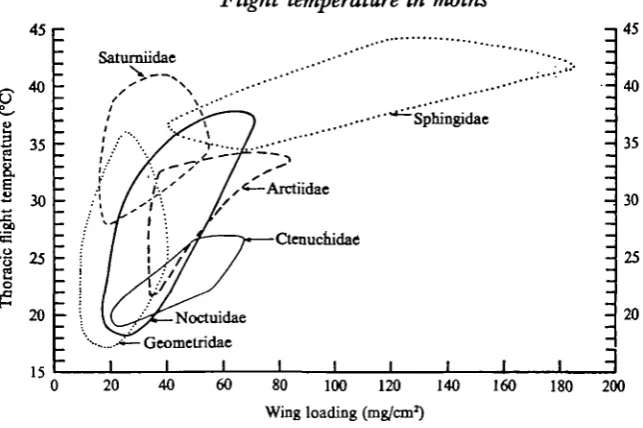
In each of the families sampled thoracic flight temperatures, body weight, and wing loading vary over a considerable range. In the Sphingidae, Noctuidae, Arctiidae, Geometridae, Saturniidae, and Ctenuchidae the mean thoracic flight temperatures of the various species increased directly with wing loading (Table 2, Fig. 4). In our collections the Pericopidae and Lasiocampidae were represented almost exclusively by single species so in these families interspecies comparisons were not made.
There was no apparent correlation between thoracic flight temperature and body weight within the sphingids, noctuids, geometrids and saturniids, but the two were correlated at the 5 % level of significance in arctiids and ctenuchids (Fig. 5). It should be noted that in the Arctudae and Ctenuchidae body weight and wing loading are correlated positively with a statistical significance at the 1 % level. Consequently, in these two families we cannot separate the effects of body weight and wing loading on flight temperature.
Comparison of thoracic flight temperatures between families
Body weight. In general, when the families of moths are considered as entities,
40
35
30
25
20
15
Prorifrons
near muelleri (Lasiocampidae)
J-Ennominae sp. (Geometridae)
Pericopis forlis
(Pericopidae)
200 400 600 800
o
40
35
30
25
20
15
Amplypterus donysa
(Sphingidae)
Phaenarete diana *%+ (Ctenuchidae)
Amaslus aconia
(Arctiidae)
200 400 600
Body weight (rag)
800
Fig. 2. Relation of thoracic flight temperature to body weight in species from six families of moths. Ambient temperature, 15-17 °C.
weight, thoracic flight temperatures approach 40 °C, and beyond this point they are relatively unaffected by further increases in body weight.
Wing loading. Within each of the families for which samples containing 12 or more
128 G. A. BARTHOLOMEW AND B. HEENRICH
40
35
30
25
£20
E
I 15
I 40
o
e
30 k
25
r-
20Y-15 0
Prorifrons near mtielleri (Lasiocampidae)
Pericopis fortis (Pericopidae)
+ •*•, •? Ennonunae sp. + + + (Geometridae)
20 40 60 80
o : °* a
o °o
o
1 1
1 1 1
1
1
+
: M t *
+ ^
i i 1 1
Amplypterus donysa o (Sphingidae) o
• Amastus aconia (Arctiidae) — ^ - ~ t ^ * •
Phaenarete diana + * (Ctenuchidae)
i i i i
20 40 60 80
Wing loading (mg/cm2)
Fig. 3. Relation of thoracic flight temperature to wing loading in species from six families of moths. Ambient temperature, 15—17 °C.
flight temperatures rarely exceed 44 °C, the dependence of flight temperature on wing loading diminishes at higher wing loadings such as those characteristic of many sphingids.
Abdominal flight temperature. Abdominal flight temperatures were measured at air
temperatures of 15-17 °C in i n moths belonging to eight families (Sphingidae, Noctuidae, Arctiidae, Geometridae, Lasiocampidae, Ctenuchidae, Saturniidae and Pericopidae). In this sample the mean abdominal temperature of the sphingids was 23-3 °C while the means for the other families ranged from 18-4 to 21-1 °C.
Thoracic flight temperature and behaviour. We gathered no quantitative data on
Table 2. Regression of thoracic flight temperature (°C) on wing hading (mg/cm)
(N is number of species. Temperature measurement of geometrids made at 15-17° C;
other families measured at both 7 and 15-17° C.)
Mean Family Sphingidae Saturniidae Arctiidae Noctuidae Geometridae Ctenuchidae Intercept 3 4 O 3 2 2 1 9 5 2 1 4 1 8 3
17-4 Slope 0055 0-141 0173 0-178 0227 0-125 N 1 3 1 3 16 1 1 2 56 1 3 P < 0-05 < o-io < o-oi < o-oi < o-oi < o-oi wt. (mg) 1260 572 342 2 2 5 1 2 7 IOI
45 r
40
u
3 35 e 8.
B 30
I
in
i
2 5
o 15 o o Ctenuchidae C=17-4 m = 0125
20 40 60 80 100 120 140 Wing loading (mg/cm2)
160 180 200
Fig. 4. Linear least-squares regressions of thoracic flight temperature on wing loading in three families of moths. Each point represents the mean value for a species. C is the intercept and m is the slope. See also Table 2.
45 2 35 ^ 30 « 25 5 e o 20 15 Arctiidae C=25-96 m=001046 gjy'o ' Ctenuchidae C=20-91 m=001953 Sphingidae C=3917
m = 000026 (6250 mg)
500 1000 1500 2000
Body weight (rag)
2500 3000
Fig. 5. Linear leatt-squares regressions of thoracic flight temperature on body weight in three families of moths. Each point represents the mean value for a species. C is the intercept and m is the slope. See also Table 2.
130 G. A. BARTHOLOMEW AND B. HEINRICH 45 I
-3 40
•S 3 0
e
o
25
20
Lasiocampidae o
- Notodontidae^,'
- Noctuidae
, Ctenuchidae Po Geometridae - /OPyralidae
0 200 1000 1200
—i 4 5
40
35
30
25
20 400 600 800
Mean body weight (mg)
Fig. 6. The relation of mean thoracic flight temperature to mean body weight in ten families of moths. Pyralids, notodontids, geometrids, pericopids and lasiocampids measured at 15-17 °C; other families measured at both 7 and 15-17 °C. The correlation coefficients of both the linear and exponential least-square regressions are significant at the 1% level but the exponential curve has the higher value for r (0-905 versus 0-852).
45 r
.40
35
30
25
20
15
Sphingidae
}*- Saturniidae
Arctiidae Ctenuchidae
-Noctuidae
- Geometridae
500 1000 1500 2000
Body weight (mg)
2500 3000 6000
Fig. 7. The relation of thoracic flight temperature to body weight in six families of moths. The enclosures encompass the mean values for each species studied in each family, except for Tky-tania sp., an unusually large noctuid weighing more than 2 e. Geometrids measured at 15-17 °C; others measured at both 7 and 15-17 °C.
40
30
-•§ 25
e
o
15 0
I Saturniidae
_ 1 ;
I ' •' V • J _ ; i
_ : /
— \ I t
.-'Of *]
& h
^ j v - N o c t u i d a e •— Geometridae
1 1
-Arctiidae
—Ctenuchidae
1 i
• " '
s j
Sphingidae
1 l |
.1
-, q
20 40 60
40
35
30
25
20
[image:9.451.47.369.52.266.2]80 100 120 140 160 180 200 Wing loading (mg/cm2)
Fig. 8. The relation of thoracic flight temperature to wing loading in six families of moths. T h e geometric figures enclose the mean values for each of the species studied in each family. Ambient temperatures as in Fig. 7.
35
-G1 30
D.
u
£ 2 5 1
20
-O Saturniidae ^
Noctuidae ' O , '
~_ s ' OArctiidae s ' O Geometridae
° Ctenuchidae
1 1 I I
s ' O
x ' Sphingidae
i 1 1
200 400 600 800 1000 Mean body weight (mg)
1200 1400
Fig. 9. The intercepts of the regression of mean thoracic flight temperature on wing loading (see Table 2) plotted against mean body weight for sir families of moths. The line is fitted by the method of least squares and is significant at the 5% level.
[image:9.451.52.371.314.545.2]I32 G. A. BARTHOLOMEW AND B. HEINRICH
0-25
0-20
015
U 010
005
O Geometridae
Noctuidae
O Arctiidae
O Ctenuchidae
Saturniidac
o
Sphingidae
200 400 600 800 1000 Mean body weight (mg)
1200 1400
Fig. i o . The slopes of the regression of mean thoracic flight temperature on wing loading (see Table 2) plotted against mean body weight for six families of moths. The line is fitted by the method of least squares and is significant at the 5 % level.
The responses of moths which came to rest near our lights followed several distinct patterns. When disturbed, the pyralids and geometrids took off immediately. The noctuids and the lasiocampid, Prorifrons near muelleri, released their footholds and fell to the ground as if feigning death. The saturniids performed their familiar display (Blest, 1957) of exposing the eye spots on their hind-wings. The locally most abundant pericopid {Pericopis fortis) dropped to the ground and lay motionless, and in addition exuded a fluid with an acrid odour which caused inflammation and itching of our hands and arms. The larger arctiids also exuded a noxious fluid. The adaptive signifi-cance of these patterns of behaviour in relation to flight temperature seems obvious (see Discussion).
DISCUSSION
Body weight and flight temperature. A flying moth produces heat by the contraction
[image:10.451.46.380.43.324.2]tempera-above ICXJ-ISO mg, body weightier se does not constitute a major constraint on the attainment of high flight temperatures for moths, at least in the family Noctuidae. There is a maximum flight temperature (about 45 °C) which is normally never exceeded. Since some moths weigh 5 g or more, it is apparent that flight temperature must be a non-linear function of body weight. From Fig. 7 it is apparent that thoracic flight temperature is relatively unaffected by increases in weight beyond a critical value which is less than 1 g.
Wing loading and flight temperature. In synchronous fliers like moths (Kammer,
1968) the heat produced by wing muscles of given mass will depend in part on freq-uency of contraction (i.e. on rate of wing beat). In theory, a moth of a given weight can fly either by having small wings that beat rapidly or large wings that beat slowly. If one considers only the frequency of muscle contraction, a small-winged moth of a given weight will produce more heat than a large-winged moth of the same weight. This is to say, heat production should increase directly with wing loading (see Dorsett, 1962, for a more extended discussion).
Although the mean thoracic temperatures of moths increase directly with mean wing loading, this correlation has some dependence on body weight. The slopes of the linear regression of mean thoracic flight temperature on mean wing loading of the various families are inversely related to mean body weight, while the intercepts of the slopes of these regressions increase directly with mean body weight (Figs. 9, 10).
Thoracic flight temperatures correlate nicely with wing loading when the regressions are based on species of the same family, but species that have the same wing loading but belong to different families can have markedly different flight temperatures. For example, a ctenuchid with a wing loading of 60 mg/cms has a flight temperature of 25 °C, while arctiids and sphingids with the same wing loading have flight tempera-tures of 30 and 37 °C respectively (Fig. 4).
Obviously, flight temperature is affected by body weight and insulation as well as by wing loading. Most of the ctenuchids shown in Fig. 4 weigh less than 100 mg; all of the sphingids weigh more than 500 mg, while the arctiids are of intermediate weight. Moreover, sphingids are heavily insulated; the ctenuchids are lightly insulated while the arctiids are intermediate. Saturniids have higher body temperatures, and ctenuchids have lower body temperatures, than would be expected on the basis of wing loading alone (Fig. 8). It is noteworthy that saturniids have a dense covering of long scales while the wasp-like ctenuchids are only sparsely covered with scales.
Among the families considered in the present study, only in the Arctiidae and the Ctenuchidae was there positive correlation between the mean thoracic temperature and mean body weight (Fig. 5). However, in these two closely related families wing loading and body weight were significantly correlated, so the effects of wing loading and body weight cannot be separated on the basis of our data.
134 G. A. BARTHOLOMEW AND B. H E I N R I C H
and linear regressions of thoracic temperature on wing loading are almost identicsi (0-70 versus o-68).
Escape behaviour and flight temperature. When compared with the geometrids and
pyralids, which at moderate ambient temperatures can fly without prior warm-up, resting sphingids or lasiocampids which must warm up before flying must be relatively vulnerable to terrestrial predators such as frogs, lizards, mice and shrews. Moreover, the wing vibrations which accompany pre-flight warm-up are both audible and visible.
Moths which undergo pre-flight warm-up have evolved several strategies which could reduce their vulnerability to predation. Most of them are cryptically coloured when at rest. When disturbed, some large forms such as saturniids and sphingids perform a threat display, often involving eye spots on the hind-wings. Smaller forms, such as some of the noctuids and lasiocampids, drop to the ground and lie motionless with folded wings. Many ctenuchids mimic wasps, while some arctiids and pericopids produce noxious secretions.
The geometrids and pyralids which we observed were characterized by both small size and light wing loading and could fly with thoracic temperatures near 20 °C. They showed none of the responses described above. At ambient temperatures of 15-17 °C they simply flew away as soon as they were disturbed. The capacity for instant take-off has apparently minimized or eliminated the selective advantage of the various strategies for reducing vulnerability to predation that were shown by moths with high flight temperatures.
SUMMARY
1. Flight temperatures were measured in representatives of ten families of moths -Sphingidae, Noctuidae, Geometridae, Arctiidae, Saturniidae, Ctenuchidae, Peri-copidae, Lasiocampidae, Notodontidae and Pyralidae.
2. In all cases thoracic flight temperatures and abdominal flight temperatures were higher than ambient, and thoracic temperatures far exceeded abdominal tempera-tures.
3. Within the individual species, thoracic flight temperature was relatively uniform, and independent of ambient temperatures from 7 to 17 °C.
4. Within the various families, flight temperature was independent of body weight except in the Ctenuchidae and Arctiidae; in these two closely related families, in contrast to all the others, body weight and wing loading were positively correlated. When the families are considered as units, mean thoracic flight temperature increased with mean body weight.
5. Between species in the same family and between families thoracic flight tures increased directly with wing loading. However, because thoracic flight tempera-ture is affected by insulation and body weight, species with the same wing loading but belonging in different families may have markedly different flight temperatures.
Casey and Robert J. Epting for help in data processing, and to Julian P. Donahue for identification of specimens. This study was supported in part by a grant, GB 18744, from the U.S. National Science Foundation.
REFERENCES
BLEST, A. D. (1957). The function of eyespot patterns in the Lepidoptera. Behaviour 11, 209-56. DORSETT, D. A. (1962). Preparation for flight by hawk-moths. J. exp. Biol. 39, 579-88.
HANEGAN, J. L. & HEATH, J. E. (1970). Mechanisms for control of body temperature in the moth, Hyalophora cecropia. J. exp. Biol. 53, 349-62.
HEINRICH, B. & BARTHOLOMEW, G. A. (1971). An analysis of pre-flight warm-up in the sphinx moth, Mandxua sexta. J. exp. Biol. 55, 223-39.