Interobserver Reliability
J. M. Wardlaw and R. Sellar
PURPOSE: To test the interobserver reliability of a simple method of classifying cerebral infarcts as seen on CT brain scans, which might allow differentiation of the site and size of the infarct from infarct swelling and hemorrhagic transformation. METHOD: Two experienced neuroradiologists independently reviewed 119 CT brain scans showing recent small to large cortical and subcortical
cerebral infarcts and classified each for site and size, amount of swelling, and hemorrhagic transformation blind to clinical information. Six less experienced general radiologists in training
classified 33 of the CT scans blind to clinical information. lnterobserver agreement was calculated
using unweighted K statistics. RESULTS: The K statistics between the two experienced neuroradi -ologists were: (a) 0.78 for site and size (95% confidence interval, 0.69-0.87); (b) 0.8 for swelling
(95% confidence interval, 0.68-0.92); and (c) 0.3 for hemorrhagic transformation (95% confi -dence interval, 0-0.77); indicating "good," "excellent," and "fair" agreement, respectively. Agree
-ment for the less experienced radiologists was fair to excellent. CONCLUSION: The cerebral infarct
morphologic classification is simple, quick, and reliable and therefore practical. It usefully distin
-guishes between infarcts of similar site and size but with different amounts of swelling and
hemorrhagic transformation, thus facilitating study of factors such as the influence of drug trea t-ment on infarct swelling, which might influence clinical outcome. Although developed for CT, it could be used equally for MR imaging and has applications in research and clinical practice.
Index terms: Brain, computed tomography; Brain, edema; Brain, infarction; Cerebral hemorrhage
AJNR Am J Neuroradio/15:1933-1939, Nov 1994
Patterns of cerebral infarction
of
the major
arterial territories as seen on computed
tomog-raphy
(CT) brain scans have been described
previously, but these are by necessity detailed
and complex and do not include a
measure
of
infarct
swelling or hemorrhagic transformation
( 1-4).
Although some
variability
occurs
in the
areas of the brain supplied by the
major
arteries,
they are reasonably constant
(5)
.
Previously
de-scribed methods of assessing
cerebral
infarcts
on CT brain scans simply
measured infarct
vol-Received December 30, 1993: accepted after revision April 5, 1994. From the Departments of Clinical Neurosciences (J.M.W.) and Neuro-radiology (R.S.), Western General Hospital, Edinburgh, United Kingdom.
J.M.W. was a Medical Research Council Research Training Fellow in Neuroradiology.
Address reprint requests to Dr J.M. Wardlaw, Consultant Neuroradiolo-gist, Department of Clinical Neuroradiology, Institute of Neurologic Sci-ences, Southern General Hospital, Govan Road, Glasgow G51 4TF, United Kingdom.
AJNR 15:1933-1939, Nov 1994 0195-6108/94/1510-1933 © American Society of Neuroradiology
ume
or assessed swelling
by
the presence of
midline shift,
thereby
not
dissociating
the site in
the brain
and the amount of tissue involved in
the
infarct (site and size) from the amount of
swelling of the infarct (mass effect) or
hemor-rhagic transformation (
6-10).
Our
intention was to devise a method of
clas-sifying infarcts on CT that was not only reliable
for the
presenceof an infarct (ie, its site and
size) when one is blind to clinical information,
but
also was reliable for identifying
different amounts of infarct swelling and hemorrhagic transformationfor any given
infarct size.Method
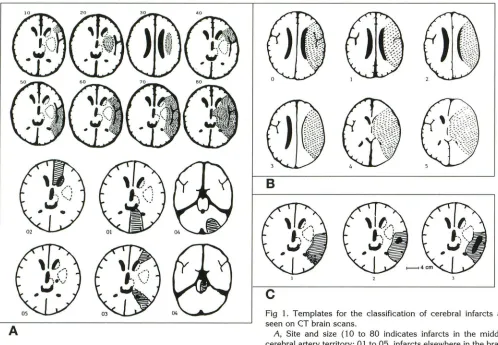
The classification was devised after reviewing more than 100 CT brain scans showing cerebral infarction and observing that the appearance of cerebral infarcts tended to follow recurring patterns, despite the recognized vari-ability in territories supplied by the major arteries (5). Figure 1 shows templates devised to illustrate these typical patterns of infarction: (a) site and size, (b) swelling, and (c) hemorrhagic transformation of the infarct. There were
1934 WARDLAW AJNR: 15, November 1994
c
Fig 1. Templates for the classification of cerebral infarcts as seen on CT brain scans.
A
A, Site and size ( 10 to 80 indicates infarcts in the middle cerebral artery territory; 01 to 05, infarcts elsewhere in the brain and lacunar and border zone infarcts).B, Swelling (0 indicates no swelling; 1, effacement of cortical sulci; 2, 1 + minor effacement of the ipsilateral lateral ventricle; 3, 1 + complete effacement of the ipsilateral lateral ventricle; 4, 3+ effacement of the third ventricle; 5, shift of the midline away from the side of the infarction; and 6 (not shown], 5+ effacement of basal cisterns).
C, Hemorrhagic transformation (0 indicates no hemorrhage; 1, petechial hemorrhage; 2, small hematoma less than 2 em in diameter;
and 3, hematoma greater than 2 em in diameter).
more categories for infarcts in the middle cerebral artery territory because the middle cerebral artery supplies the largest part of the brain and is the territory most frequently involved in infarction ( 11 ) .
Over a 9-month period, 180 consecutive patients with symptoms of acute stroke were admitted to our hospital and had a CT brain scan unless the attending physician did not feel that the CT was justified clinically (30 patients) or the patient died or was discharged soon after admission (5). All patients were examined by a physician with an interest in stroke to confirm that they had had a stroke clinically. Patients with a previous stroke were included. Patients whose CT brain scan showed primary intracere-bral hemorrhage (30), subarachnoid hemorrhage (5), tu-mor (4), or abscess (2) (ie, not an infarct as the cause of recent symptoms) were excluded. Fifteen patients had 2 CT scans within the first 3 weeks of admission as part of a separate study, giving a total of 119 CT scans.
A recent infarct was defined as an area of hypodensity relative to adjacent normal brain (possibly associated with mass effect or areas of hemorrhage) whose shape
indi-cated vascular ongm (whether cortical or subcortical).
Density was assessed subjectively to simulate a clinical
[image:2.612.56.554.74.419.2]TABLE 1: lnterobserver agreement between the two experienced neuroradiologists
Parameter of Infarct
(95% Confidence Interval)
Examined K
Infarct site and extent, 0.78 (0.69 to 0.87) all scans
Infarct site and extent, 0.87 (0.77 to 0.97) medium and large cortical
and subcortical infarcts
Infarct site and extent, small 0.59 (0.42 to 0.76) cortical and subcortical
infarcts
Infarct swelling 0.8 (0.68 to 0.92) Infarct hemorrhagic 0.3 (0.0 to 0.77)
transformation
Six less experienced general radiologists in training (first to fifth year of a general radiology training program) were asked to apply the classification to a selection of the study CT scans showing a variety of recent small and large
cerebral infarcts with variable amounts of swelling and
hemorrhagic transformation mingled with some normal
scans. They also were blind to the clinical information. The general radiologists were not familiar with the classifica
-tion and were not given an opportunity to practice with it
before reviewing the CT scans. Therefore, their results are for first-ever use.
The interobserver agreement between the two experi
-enced neuroradiologists and between one of the two ex pe-rienced neuroradiologists (J.M.W.) and the general
radiol-ogists was calculated using unweighted K statistics (13). The K statistic is a measure of agreement between two observers beyond that expected from chance alone. A K
A
B
value of 0 indicates agreement no better than chance, and a value of 1 indicates perfect agreement. Values of 0 to 0.2
generally are thought to indicate poor agreement; 0.21 to
0.40, fair agreement; 0.41 to 0.6, moderate agreement;
0.61 to 0.8, good agreement; and 0.81 to 1, excellent agreement ( 13).
Results
There were 119 CT
brain
scans included in
the study. The mean age of the patients was 72
years (range, 19 to 93 years)
.
The CT scans
were obtained between 2 hours and 3 months
after
the stroke
, although the majority were
ob-tained within the first 2 weeks.
lnterobserver
agreement
(K)
between the two
experienced neuroradiologists was
"good
"
for
infarct site and size;
"excellent" for infarct
swell-ing; and
"fair" for
hemorrhagic
transformation
of the infarct (Table 1 ). The poorer
interob-server agreement for hemorrhagic
transforma-tion was caused by disagreement about minor
amounts of petechial hemorrhage, not about
the
presence
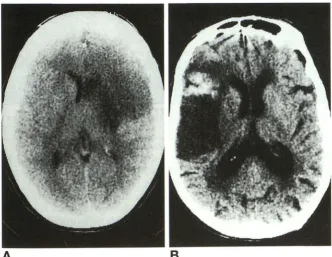
of focal hematomas (Fig 2). There
was no disagreement about the presence of fo
-cal hematomas more than 1 em in diameter
within the infarct. The
Kvalue for infarct site and
size for the subgroup of patients with medium to
large cortical and subcortical infarcts (72 CT
scans) was
0.87
(95% confidence interval 0
.
77
to
0.97)
and was
0.59
(95
% confidence interval
Fig 2. Examples of hemorrhagic tr ans-formation.
A, Increased density at the margin of a 40 cortical infarct (anterior half of the pe-ripheral part of the middle cerebral artery territory not including the basal ganglia,
amount of swelling is 3)-? petechial hem -orrhage (code 1) or luxury perfusion.
[image:3.615.53.297.98.245.2] [image:3.615.52.384.474.731.2]1936 WARDLAW
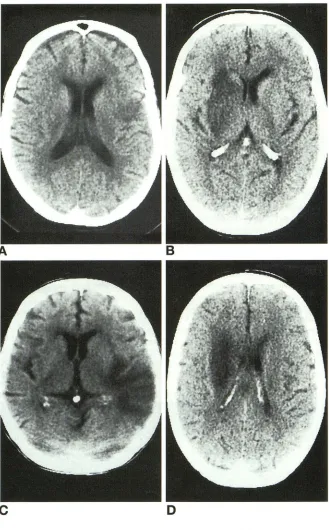
Fig 3. Other examples of infarcts in the middle cerebral artery territory.
A, A 10 small cortical infarct (swelling is 1 ).
8, A 20 large subcortical (striatocapsu-lar) infarct (swelling, 2).
C, A 50 cortical infarct in the posterior half of the middle cerebral artery territory not involving the basal ganglia (swelling, 1 ). D, A 30 large subcortical infarct in the white matter lateral to the lateral ventricle (swelling, 2). None of these examples shows any hemorrhage.
c
0.42 to 0.76) for the subgroup of patients with
small to medium cortical or small subcortical
infarcts ( 4 7 CT
scans).
Examples of middle
ce-rebral artery infarcts are shown
in
Figure 3. The
interobserver
agreement for patients with
me-dium
to large cortical
infarcts
(codes
40
to 80 in
Fig
1)
and large subcortical
infarcts
(codes 20
to
30 in
Fig 1)
was excellent
for
both site and
size and
for
swelling of the
infarct, indicating
AJNR: 15, November 1994
D
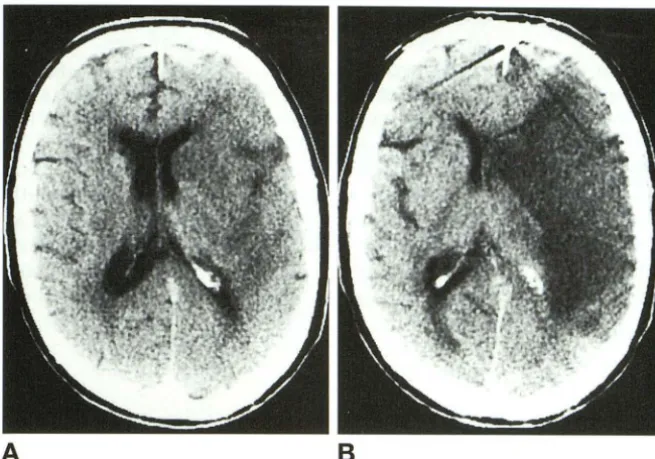
that the method does allow differentiation
be-tween infarcts of the same size but different
amounts of swelling (see Fig 4).
Agreement among the six less experienced
general radiologists on first-ever use of the
clas-sification and one of the neuroradiologists
(J.M.W.) was moderate to good for
infarct
site
and size,
fair to
moderate for
infarct
swelling,
[image:4.612.233.562.75.605.2]A
B
(Ta
b
le 2)
.
The poorer agreement for infarct
swe
ll
ing was caused by minor disagreement
about the am
o
unt of swelling ( eg
,
coding a 2
inste
a
d of a 3), not major (eg, coding a 2
in-stead of a
5
)
.
When classified simply as major
amounts of infarct swelling (ie,
code
3 to 6) or
minor (ie, code 0 to 2) the
Kvalues improved to
good to excellent (Table 2). The poor
agree-ment for hemorrhagic transformation again was
caused by disagreement about minor amounts
of petechial hemorrhage
.
There was no dis
-agreement a
b
out the presence of focal
hemato-mas more than 1 em in diameter.
Discussion
This simple classification of cerebral
infarct
morphology as seen on CT brain scans has
good
interobserver
reliability
,
even on first-ever
Fig 4. Example of sequential CT scans
from the same patient.
A, Twelve hours after symptom onset and B, 4 days after symptom onset. Note
that infarct site and size is the same (80 is whole middle cerebral artery territory), but
there is a different amount of infarct swell -ing, 1 in A and 5 in B. Hemorrhagic
trans-formation was 0 in both A and B.
use by relatively inexperienced radiologists in
training. The agreement for infarct
site, size,
and
swelling
between
experienced
neuroradi-ologists was excellent
.
Agreement for hemor
-rhagic transformation was not as good
,
but this
was attributable to disagreement about
the
presence of minor amounts of petechial hemor
-rhage, not about focal hematomas (Fig 2)
.
The
cortical
margins of an infarct may appear
denser
than
surrounding normal brain partly be
-cause of a visual effect from the low density of
infarct making the adjacent normal
cortex
ap
-pear brighter
,
or
there may be a genuine
in-crease in tissue density around the margin
of
an
infarct
ascribed to
"
luxury perfusion" (
12), or
there may be true petechial hemorrhage(
14).
The disagreement
over
the presence of
pete-chial
hemorrhage
,
which was
consistent
throughout
our group
of
observers, may
explain
TABLE 2: Interobserver agreement between one of the two experienced neuroradiologists (J.M.W.) and the six general radiologists in training
K for
Amount of CT Experience Infarct Infarct
of the General Radiologists Infarct Site Swelling Infarct Swelling Hemorrhagic
and Extent
(Exact) (Major or Minor) Transformation
5 years 0.52 0.56 0.85 0.56
4 years 0.56 0.46 0.93 0.4
4 years 0.74 0.41 0.55 0.13
3 years 0.67 0.56 0.93 0.7
2 years 0.53 0.31 0.65 0.21
[image:5.617.54.382.74.303.2] [image:5.617.57.561.610.730.2]1938 WARDLAW
some of the large differences in hemorrhagic
transformation
rates reported
in different CT
(and
recently
MR) studies. Some studies have
reported rates of petechial hemorrhage up to
45%
(15,
16),
whereas others found it in only 5%
of patients (1 0). Other possible
reasons
for the
wide variation in reported
rates
of hemorrhagic
transformation
include
bias in patient selection,
use of antithrombotic drugs, differences
be-tween CT scanners, and scanning at different
times after the stroke, but poor
interobserver
agreement may have contributed.
Measure-ment of the
tissue
density on the CT console
would
reduce error caused
by visual effects but
would not be practical to obtain routinely, which
is why
the
density of
the
infarcts was not
mea-sured in this study.
Pathologic studies show
some degree of petechial hemorrhage in most
infarcts (1 0). Similar
findings
are demonstrated
by modern
imaging
techniques ( 16).
Interobserver reliability for site and size of the
infarct
for
the two experienced
neuroradiolo-gists was lower for the subgroup of patients with
small
cortical
and lacunar infarcts
than for
me-dium
to
large
infarcts.
The mean age of patients
in
the
study
was 72 years when generalized
cerebral
atrophy, periventricular white matter
lucencies, and enlarged perivascular spaces (in
the internal capsule
and basal ganglia) are
common (17). Although a previous study found
no evidence
of bias
in
reporting lacunar
infarcts
on CT brain scans
from
accompanying patient
information (18), without
any clinical
informa-tion
it
can
be difficult
to
discriminate small
cor-tical
infarcts from
enlarged cortical sulci and if
there
are
numerous
"holes in the
brain" to
de-cide which is
most likely
the
cause of
recent
symptoms.
The
agreement for
infarct
swelling
was
excel-lent
for the experienced
neuroradiologists,
meaning that for a given infarct
site and size,
the
change with time in
the
amount
of
swelling in
the acute phase of
the
infarct can
be assessed
reliably (Fig 4A and
B).
The
classification of
infarct swelling was intended primarily for
use
in
describing medium to large infarcts in the
mid-dle cerebral artery territory but could
be
applied
to small infarcts also. It was
not
intended to
describe mass effect from large hematomas.
The interobserver agreement for the general
radiologists in training, who had never seen or
used the method before, was
lower
but was still
in
the moderate to excellent categories when
minor disagreements were
ignored.
The
inter-AJNR: 15, November 1994
observer agreement was better for the CT
in-farct classification than has been described for
experienced clinicians using clinical stroke
classifications ( 19, 20). The classification
con-ceivably could be used to classify cerebral in
-farcts as seen on MR imaging.
Use of the infarct morphology classification
would allow study of the effect of therapeutic
maneuvers for acute ischemic stroke such as
thrombolysis, neuroprotective agents, and
anti-thrombotic drugs on infarct morphology as
sur-rogate
,
but useful, endpoints. It also would allow
study of the relationships between infarct
swell-ing and hemorrhagic transformation and
reper-fusion (21).
Acknowledgments
We thank Mr Jim Slattery for advice on the use of the
Kappa statistics and Miss L. Weir and Mrs G. Clark for
typing the manuscript. Dr M.S. Dennis and Dr R. Lindley of
the Neurosciences Trials Unit in the Western General
Hos-pital, Edinburgh, examined all the patients.
References
1. Damasio H. A computed tomographic guide to the identification of cerebrolvascular territories. Arch Neural 1983;40: 138-142
2. Berman SA, Hayman LA, Hinck VC. Correlation of CT cere-brolvascular territories with function, 1: anterior cerebral artery.
AJNR Am J Neuroradiol 1980;1:259-263
3. Zeumer H, Ringelstein EB. Computed tomography patterns of brain infarctions as a pathogenetic key. In: Poeck K, Ringelstein EB, Hache W, eds. New Trends in the Diagnosis and the
Manage-ment of Stroke. Berlin, NY: Springer-Verlag, 1987:75-85
4. Graeber MC, Jordon JE, Mishra SK, Nadeau SE. Watershed in-farction on computed tomographic scan: an unreliable sign of haemodynamic stroke. Arch Neural 1992;49:311-313
5. van der Zwan A, Hillen B. Review of the variability of the territories of the major cerebal arteries. Stroke 1991 ;22: 1078-1084
6. Brott T, Marler JR, Olinger CP, et al. Measurements of acute cerebral infarction: lesion size by computed tomography. Stroke 1989;20:871-875
7. Okada Y, Sadoshima S, Nakane H, et al. Early computed tomo-graphic findings for thrombolytic therapy in patients with acute brain embolism. Stroke 1992;23:20-23
8. Terent A, Ronquist G, Bergstrom K, et al. lschaemic oedema in stroke: a parallel study with computed tomography and cerebro-spinal fluid markers of disturbed brain cell metabolism. Stroke 1981; 12:33-40
9. Skriver EB, Olsen TS, McNair P. Mass affect and atrophy after stroke. Acta Radio/1990;31:431-438
10. Ladder J. CT-detected haemorrhagic infarction: relation with the size of the infarct, and the presence of midline shift. Acta Neural Scand 1984;70:329-335
12. Inoue Y, Takemoto K, Miyamoto T, et al. Sequential computed tomography scans in acute cerebral infarction. Radiology 1980; 135:655-662
13. Brennan P, Silman A. Statistical methods for assessing observer variability in clinical measures. Br Med J 1992;304:1491-1494 14. Pessin MS, Teal PA, Caplan LR. Haemorrhagic infarction: guilt by
association? AJNR Am J Neuroradiol 1991:12:1123-1236 15. Hornig CR, Dorndorf W, Agnoli AL. Haemorrhagic cerebral
infarc-tion: prospective study. Stroke 1986;17:179-185
16. Hornig CR, Bauer T, Simon C, et al. Haemorrhagic transformation in cardio-embolic cerebral infarction. Stroke 1993;24:465-468 17. Meyer JS, Kawamura J, Terayama Y. White matter lesions in the
elderly. J Neural Sci 1992;110:1-7
18. Bonke B, Koudstaal PJ, Dijkstra G, et al. Detection of lacunar
infarction in brain CT scans: no evidence of bias from
accompa-nying patient information. Neuroradiology 1989;31: 170-173
19. Shinar D, Gross CR, Mohr JP, et al. Inter-observer variability in the assessment of neurologic history and examination in the Stroke
Data Bank. Arch Neurol 1985;42:557-565
20. Lindley Rl, Dennis MS, Wardlaw J, et al. Interobserver variation in the classification of subtypes of cerebral infarction. J Neural Neu-rosurg and Psychiat 1993;56:730
21. Wardlaw JM, Dennis MS, Lindley Rl, et al. Does early reperfusion of a cerebral infarct influence cerebral infarct swelling in the acute