Abstract
In this paper two games are created, both were projected on a life size playground that we could use where four Kinects track user positions. The aim was to influence play behaviour through enticing visualizations. The visualizations are enticing as they only act as embellishment and do not interact with the core game play, as such reacting on those elements did not influence the players’ score. For the first game it was tested whether it is possible to steer positions of players by seducing players to walk towards a colourful spot in the playfield, this was not possible as the players did not observe the enticed parts of the background. Another goal was to let the
Summary
Influencing behaviour can be done in various ways, to place importance on autonomy we opt to choose the subtle way of enticing behaviour instead of requiring it. The context upon which the enticing elements will be applied are interactive jump-based games, driven by an existing system of four Kinect track positions and one beamer projects the game on a lifesize
playground. Jump-based games are chosen since they require substantial active effort, not only physically but also cognitively due to the coordination it requires. Finally it benefits players on the social front as players urge others to join and when playing they need to attune their behaviour to each other by means of either verbal or physical communication.
An initial play concept was derived by means of combining eight playground games with eight jumping rope variations, resulting in 64 newly derived games. From these games, criteria have been imposed by means of a three-point Likert scale (simplicity, scalability, variability and originality) to trim the games down to eight games with the highest rankings. From these, one winner is chosen by also taking the requirements with respect to enticing elements into account.
The main requirement was that the game should have both passive and active players such that passive players can be seduced to action through the enticing elements.
The resulting game was tested on a primary school class with children aged between seven and eight. Their play was curious-natured as well as explorative which resulted in them making connections between the game elements that were not intended by the designer, nonetheless this creativity did lead to the children having fun whilst playing. However the game rules and the enticing elements were generally not observed by the young players and as a consequence the outcomes lead to new requirements but no statements could be made about the unobserved enticing elements. Their goal to aspire players towards active behaviour by guiding them towards the location where the action peaked was not obtained.
people can walk around whilst they are urged by enticing elements to stand still when jumping for optimal recognition of jumps while they are not bound to a specific position. The enticing elements should be created so that they are clearly visible by amongst other reasons having a good contrast against the background.
Acknowledgements
Many thanks for Robby Van Delden for being the backbone of this project and for applying an enticing, instead of forcing, method to steer my behaviour with respect to this project. At times however, Robby shifted from enticing towards requiring so that the paper as a whole would benefit from it. One of the most underrated characteristics of a teacher is to be someone who inspires and I happen to think Robby has done just that. Also thanks to Dennis Reidsma for being the project leader for a project in year two of my study Creative Technology, where our team created a game that was used on the same playground setup as this project was played on. The feedback for that project was always direct and clear and I am sure that seeds of it have been continued in this paper.
This study seeks to investigate whether aesthetic elements can prove sufficient to steer behaviour. With respect to the importance of autonomy, this steering will be done by means of nudging, that is to say that the exerted influence is non-forcing and the subject has the freedom to ignore the elements that entice him to change course. For this to be of practical use, there has to be an incentive to change behaviour.
The behaviour we want to change is to make it more likely for passive children to play. This is especially important for games where less skilled players are out of the game quicker due to rules that punish mistakes, were on the other hand those who are skilled make fewer mistakes and therefore get more playtime on average. According to Schell (2015), one of the reasons to be aware of varying playtime is that players might or might not benefit from increased
confidence of being able to beat the game by having incremental successes. As such, the skill gap can become bigger as more games are being played, where an escalation of confidence and success is contrasted with players who are battling with discouragement and losses. Schell indicates how this positive feedback loop (positive as changes are amplified, whereas a
negative feedback loop would lead to an equilibrium) is enforced by the observation of psychological studies that punishments are less effective for reinforcement learning than rewards. As a result, the loss of confidence and low motivational effectiveness of punishments makes it difficult for less skilled players to keep up with their more skilled co-players who get more and more confident, motivated and skilled as time pass by.
To make players change from sedentary to active behaviour as a way to bridge the gap
By using either of the strategies, more players will reap the benefit of active play as in both the nudging and visual reward the passive players are encouraged to join the active players. With respect to the target-group, not only does it involve individuals who are inclined to show passive behaviour unless participation is stimulated but also potential players in general. To have more players in general participate in active play is beneficial since unenergetic activities as watching television and playing behind game consoles are on the rise (Singer and Singer 2005). When people endorse in active play, research shows that it can lead to improvements of (a) physical skills, such as coordination, (b) cognitive skills, for example problem solving (c) psychological attitudes, in particular self-esteem and self-efficacy and finally (d) social factors, for instance peer support and interactions (Lieberman et al. 2011) .
The goal of this study is twofold. One objective is short termed, namely the creation of a game where children are more inclined to reap the diverse benefits of active play. The second objective is to provide guidelines for the use and development of enticing elements to subtly steer player behaviour. This study starts from the premises that behaviour can be influenced to the extent that the targeted early-out-of-the-game child did have an internal motivation to play, such as having fun, but lacked the external incentive such as an open and inviting attitude from those already playing. The following chapter, the State of The Art, shows (a) what has already been done in the field of steering, and more specifically enticing, physical play behaviour; along with argumentations for the relevance of applying these methods in this project (b) a structural analysis of traditional jump-based playground games; including viewpoints on the
positive/escalating feedback loop which influences play negatively (c) examples how traditional jump-based playground games are currently augmented in the domain of digital playgrounds.
To build further on these preliminary findings, a mix-and-match method is applied on the traditional games and as a result the initially limited set of play methods diverges. The resulting larger set is in turn filtered by an assessment on how fit the individual games are for application of enticing methods. Finally, a single concept came out that proved, with respect to the
2.1 Enticing Strategies
Steering by means of enticing elements forms a central part of the research, in order to get a good grasp on the possibilities that can be implemented, it is useful to first take a closer look on existing steering strategies. One of these strategies was skill-balancing, an adaptation of gameplay for an interactive tag playground (Moreno et al., 2016), based on cues sensed from each player, which resulted in different experiences for each game round. The players were individually followed by a projected circle that would lead to a change of role when a tagger’s circle touched the circle of a runner. The skill-balancing meditation adjusted the size of the circles such that those having a hard time were helped additionally by adjusting the circle size, dependent on the context of the player being a tagger or a runner. A year later, the circles also had the possibility build in to become increasingly more aesthetic as players collected particles that were projected on the playground (van Delden et al., 2017).
These interventions to normal play did not insist nor require change of behaviour, furthermore the enticing strategies were detached from core mechanics. This decoupling from core
The argument for autonomy by placing the final decision power at the individual level is opposed by Berlin (2016) who mentions that some parties believe that the interest of the whole
community is more important than that of the individual. As a result authority should steer the behaviour of the individuals. Monitoring behaviour and using strong steering forces from a centralized monitoring is argued by Berlin to eventually benefit the collective of individuals more than if they all were to decide their choices separately. This phenomenon is comparable to the workings of game theory where the best overall result is obtained when each decision-maker anticipates the reaction of those affected by decisions, due to the benefits of having a central system do the anticipation and steering, a centralized monitoring and steering of choices can help to steer actions and in doing so guide towards an optimal outcome.
This might seem an argumentation that is distant from playground games, but in essence even the difference on the macro level such as communism versus capitalism can be related back to technological implementations. For example a game computer that processes data from
multiple sources and in turn adapts the playfield accordingly uses a data processing strategy that can be compared to centralized powers observed in a communist state, at the other end of the spectrum setting your alarm clock is a more distributed form of data processing mimicking capitalism on the micro level. More directly related to game mechanics, Schell (2015) adds to the argumentation that providing too much decision power to the players tends to fail in practise. As players benefit from winning a challenge but the value that they place on recognition leads them to change the game such that they can win it easily and thus avoid the challenge that might benefit them.
Verbeek steps in between the boundaries of society as a whole and the playground, by
2.2 Traditional Games
Common playground games
Now we know that changing behaviour can be a beneficial addition to games, to be considered along with its implications for the flow of the game, it is useful to take a step back and learn more about rudimentary games that are not yet externally influenced. Specifically, this section takes a closer look at a selection of populair jump-based playground games that are being played without the interference of technology, for some examples the date of origin extends far back. For example the popular gameSimon Sayswas already played by the romans (Glover, n.d.). Considering the influence of the roman empire, it is safe to assume that this game has been played across a variety of countries for an extended period of time. Another game with Roman origin is Hopscotch, where either the soldiers or roman children were the first players of the now ubiquitous game, albeit in western society. Whereas some games have been around for long that does not imply that the manner in which they are being played is rigid.
It can be speculated how the environment of upbringing leads children to give their own twist to the skeleton of games such as tag, to enhance it to for example TV-tag.
A preference for play methods, based upon the living area is confirmed by Singer et al. (Singer, et al., 2009). The researchers monitored differences in play for 16 different countries on five different continents, between children living in industrialized and rural areas. Their study concluded that pretend play occurred more often in urban environments whereas painting, drawing and toy play, which can be categorized as creative activities, were found to be more popular for children growing up on the countryside. How romans played Hopscotch is also likely to differ from how it is currently played. It is safe to assume that time, demographics and
geographics are all factors exerting influence on the attitude towards games.
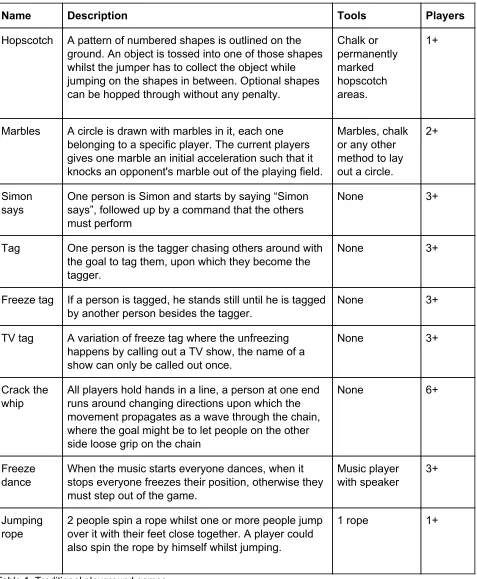
Name Description Tools Players
Hopscotch A pattern of numbered shapes is outlined on the ground. An object is tossed into one of those shapes whilst the jumper has to collect the object while jumping on the shapes in between. Optional shapes can be hopped through without any penalty.
Chalk or permanently marked hopscotch areas. 1+
Marbles A circle is drawn with marbles in it, each one belonging to a specific player. The current players gives one marble an initial acceleration such that it knocks an opponent's marble out of the playing field.
Marbles, chalk or any other method to lay out a circle.
2+
Simon says
One person is Simon and starts by saying “Simon says”, followed up by a command that the others must perform
None 3+
Tag One person is the tagger chasing others around with the goal to tag them, upon which they become the tagger.
None 3+
Freeze tag If a person is tagged, he stands still until he is tagged by another person besides the tagger.
None 3+
TV tag A variation of freeze tag where the unfreezing happens by calling out a TV show, the name of a show can only be called out once.
None 3+
Crack the whip
All players hold hands in a line, a person at one end runs around changing directions upon which the movement propagates as a wave through the chain, where the goal might be to let people on the other side loose grip on the chain
None 6+
Freeze dance
When the music starts everyone dances, when it stops everyone freezes their position, otherwise they must step out of the game.
Music player with speaker
3+
Jumping rope
2 people spin a rope whilst one or more people jump over it with their feet close together. A player could also spin the rope by himself whilst jumping.
[image:11.612.76.553.112.691.2]1 rope 1+
Jumping rope alternatives
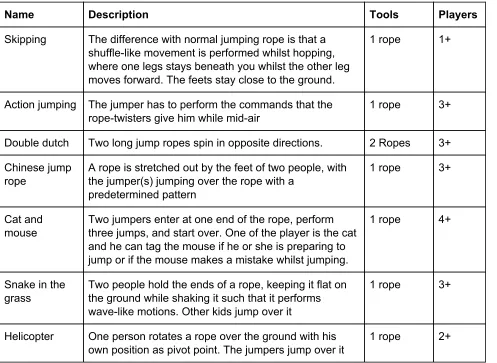
With respect to one of the objectives to have more children reap benefits of exergaming by means of jump-based games, jumping rope seems an ideal candidate due to its simplicity in concept and potential for physical effort. The popularity of skipping, a jumping rope variation, amongst the fitness industry confirms its applicability for the argument of exertion. Matt Hopkins, a former teacher, competitive speed jumper and jump rope coach is well aware of the variety of games that children can play with merely a rope, a selection of these adaptations of jumping rope (“12 Fun Jump Rope Games for Kids,” n.d.) are described in Table 2.
The games show differences concerning the minimum amount of required players, as well as their competitive versus noncompetitive nature, which has not been quantified further since the conversion to digital play can still alter these characteristics.
Name Description Tools Players
Skipping The difference with normal jumping rope is that a shuffle-like movement is performed whilst hopping, where one legs stays beneath you whilst the other leg moves forward. The feets stay close to the ground.
1 rope 1+
Action jumping The jumper has to perform the commands that the rope-twisters give him while mid-air
1 rope 3+
Double dutch Two long jump ropes spin in opposite directions. 2 Ropes 3+ Chinese jump
rope
A rope is stretched out by the feet of two people, with the jumper(s) jumping over the rope with a
predetermined pattern
1 rope 3+
Cat and mouse
Two jumpers enter at one end of the rope, perform three jumps, and start over. One of the player is the cat and he can tag the mouse if he or she is preparing to jump or if the mouse makes a mistake whilst jumping.
1 rope 4+
Snake in the grass
Two people hold the ends of a rope, keeping it flat on the ground while shaking it such that it performs wave-like motions. Other kids jump over it
1 rope 3+
Helicopter One person rotates a rope over the ground with his own position as pivot point. The jumpers jump over it
[image:12.612.73.570.302.665.2]1 rope 2+
2.3 Electronic Games
General
A defining feature of playground games are that they are played within a social setting and children can easily join or leave the game. Furthermore they are relatively simple, in the sense that a minimum amount of tools is required, if any, and explanation of the rules and methods can be done quickly. This creates a low barrier for play which has been picked up by institutions that saw opportunities in the digitalization of games with these typicalities. The intuitive aspects of the games allow for absence of an instructor, while the fun is not diminished.
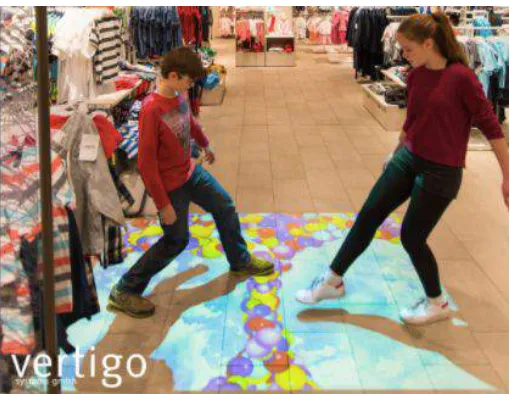
[image:13.612.74.329.462.659.2]Companies that use digital projected games, responding to motion, are amongst others EyeClick (“BEAM” n.d.), TouchMagix (“MotionMagixTM” , n.d.), Vertigo (“living floor” n.d.) and LumoPlay (“Lumo Play” n.d.). These projected games have applications for fitness, waiting rooms, low-barrier entertainment and physiotherapy. Due to the simple requirements of having a projector and additionally a sensor to measure player position in the case of an interactive environment (used for example with Vertigo’s entertaining living floor as shown in Figure 1), the products allow a large amount of playable games since the hardware does not need to change. Despite the variety of games, the elements and game mechanics of each game are fixed and often the sole variable is the position of the players.
Beyond commercial games, there are also more research-oriented translations of traditional playground games to the digital domain. The game "Interactive tag" (van Delden et al., 2017), investigated behaviour in regards to required aspects (for example power ups such as shields) and enticing elements. The enticing aspect was created by adding particles that can be
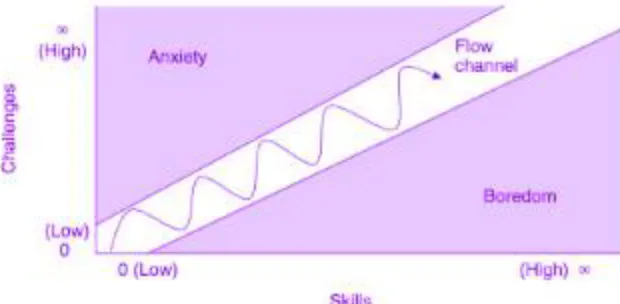
collected, upon which their collection resulted in positive, implicit feedback by means of the circles that follow the player show more visual complexity (Figure 2). The researchers hoped to bring the tagger and runners closer together, as the tagger and runners normaliter avoid each other by staying either close to the center or borders of the playfield respectively. This enticing strategy influences game dynamics, social factors and activity levels as the increased tension and decreased proxemics between runners and taggers increases the risk of being tagged and demands faster and more accurate adjustment to other players. As the strategy uses weak forces, players can choose to either ignore or act upon them, dependent on their confidence of collecting the particles without being tagged whilst finding enough satisfaction in the visual feedback. Due to the available option, players can tune the difficulty of the game such that they can end up in a flow state where the degree of anxiety and boredom are attuned to each other (Figure 3). The takeaway is that alluring methods can be applied to let players cocreate the play environment whilst not allowing interference with the carefully considered core game
[image:14.612.89.399.522.674.2]mechanics.
Figure 2. Upon collecting particles (left), the players circle get more complex (van Delden et al., 2017) .
Jump-based
To switch from electronic games to jump-based games, additional difficulties arise as not only changes in horizontal position but also adaptations of player height need to be measured. Moreover a general increase in required equipment can be the case as will be highlighted further on this section. Furthermore, commercial games often provide a large plethora of playable undertakings per platform due to their customizable nature and a larger pool of games to base the concept around, for example whack-a-mole, ice-hockey and soccer. In the case of jump-based games, they seem to be inspired by either regular jumping rope or hopscotch. Despite these complications, jump-based interactive playground's show potential for contributions to a variety of research domains.
[image:15.612.75.388.454.647.2]Examples of jump-based games include Magic Hopscotch (Figure 4, left), with hopscotch played in a room where the room itself is projected on the wall whilst it slowly turns into a forest. Experiences and reactions of the blend between reality and virtuality lie in the interest of Human Computer Interaction studies. Another example is Hopscotch for Exer-learning (Figure 4, right), where the pads contain letters of the alphabet for increasing the vocabulary of children in a playful manner, which can stimulate the modernisation of education.
Another project is named GlowSteps (Figure 5, left), with embedded pressure sensors and LED’s that stimulate movement through enticing color combinations that invite to action. Potential domains include the fitness industry, education and HCI.
Intelligent trampolines (Figure 5, right) has ‘satellites’ spread around the protective foil that track the jumpers and give feedback through LEDs dependent on the played game. It is created with the philosophy that play equipment should work even when the technology is shut down. Games are aimed either at energising, encouraging tactic play and reacting physically to the rhythm of music. For the trampoline, multiple jumpers stimulate activity and social dynamics whilst also increasing risk of injury, most notably for the smaller kids. Another project that uses various sensing equipment is Multi-Jump(Figure 9, left), where the social interaction is
observed whilst jump-roping over a distance. Equipment includes amongst others a projector, camera, acceleration sensor, pressure sensors and led-strips. Sociology and telemedicine might benefit from the communication over distance whilst doing physical exercises.
[image:16.612.79.517.506.620.2]The games mentioned in this section are useful for different research domains (in particular HCI) as well as industrial fields (for example the fitness industry). However despite the variety in measured variables such as vertical position of the player and exerted force on the pressure sensor, the elements remain fixed and do not mediate dependent on the skills of the player nor is the player's data used beyond immediate feedback. With the exception of learning english with hopscotch although the feedback for the game is only visible on a screen and no other players can join.
In other projects the Kinect is involved to monitor jumping, thereby increasing the
correspondence to this project. The game shown in Figure 6 on the left displays the jumping rope on the screen and the timing of the jump is tracked by Kinect’s and processed by the computer. It aims to enhance cooperation between children by means of full-body multiplayer interaction. Several strategies are used to let the players coordinate their jumping dependent on each other. For example, if one player jumps, his or her co-player should too. Likewise the kinect is involved in a projected jump-based playground, namely Clemens Grunewald's variation of the game 'the floor is lava' with 'capture the flag' mechanics'' (Figure 6). In the game, players were assigned a time and had to jump on a stone, stand on it until and changed color and thereby the players had collected the stone. Standing too long on the stone would deactivate the stone upon which the games rules insisted that they return to a specific position for a
recharge. The examples use jump-based playgrounds whilst using the Kinect as monitor device however neither of them use enticing elements to steer behaviour.
Jumping in video games as a result of jumping in real life, has encountered
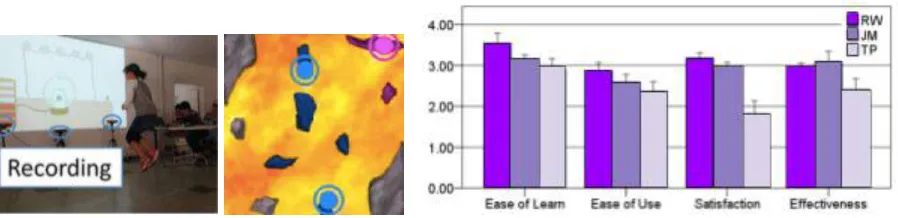
[image:17.612.83.532.506.615.2]commercial availability by means of the Microsoft Kinect. Bolte et al. (2011) mention how jumping through games allows for faster travel of distances without the use of teleportation. However they also note that walking is a more basic and intuitive way of moving and therefore jumping should be an addition instead of a replacement for walking. The authors conducted a preliminary user study with 11 participants to evaluate jumping (JM) on a digital display while being triggered by physical jumps, with real walking (RW) and teleportation (TP). According to the results shown in Figure 6 on ease of learning, ease of use, satisfaction and effectiveness, jumping scores higher than teleportation, with effectiveness being the only factor to rank higher than walking. Nonetheless, considering the importance that jumping can have with respect to game mechanics, the differences with real walking are rather minimal and jumping can be a good addition with positive effects on gameplay.
Besides looking at forms of active play with physical jumps as a component, it is also good to look at how jumping can be detected by the Kinect to provide feedback to such interactive systems. To start of with, the Kinect has a RGB and depth sensor, to extract jumps from the data the Kinect body tracking software can be used. To determine whether a person jumps, 20 vertices that resemble skeleton-based positions are provided by the Kinect for motion
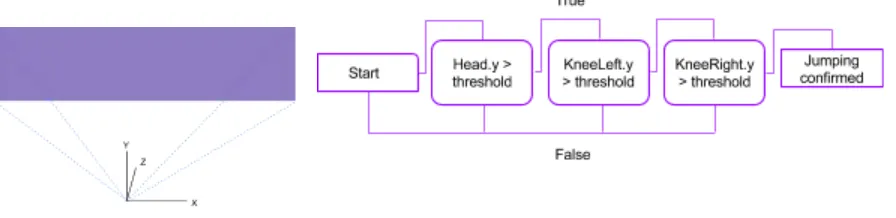
monitoring. To acquire these data points the Kinect uses the coordinate system (Figure 7) with the line in the direction to the horizon as the Z axis, the width of the horizon as the X axis and the y axis as an extraction of a line from the bottom to the top of the Kinect.
Huang et al. (2016) use an Unity plugin to bind the skeleton into a running model on the
computer. Upon which they determine the action that the model makes by means of the relative position of these sample points. Huang et al. (2016) use the algorithm shown in Figure 7 to determine jumping. Whenever the head, left and right knee articulation points exceed a threshold on the vertical exas, the action of jumping can be identified.
Researchers have also used the skeleton points provided by the kinect to identify the
[image:18.612.75.523.468.577.2]preparation for the jump (peak flexion) and the landing (initial contact) (Gray et al.,2017). For the preparation, the researchers measure the distance between the knees as well as the distance between the ankles. This accurate measurement was obtained by using a controlled setting and providing the participant instructions for the ideal proper jump beforehand. A more rudimentary measurement was the initial contact with the floor, which was calculated by finding the first frame where the velocity of the ankle and foot joint decreases. Based on this, the knee position is not possible to track with respect to the particular hardware setup that is intended for this project (Figure 8). However tracking the head position might suffice and should be possible.
Figure 7. Kinects coordinate system (left) and the process for confirming whether an observed person jumps (Huang, Yu, Si, & Lv, 2016).
3.1 Ranked Combination Matrix
Table 1 of the State of The Art showed seven jumping rope variations whereas Table 2
described nine common playground games. Combining these traditional playground games with the jumping rope variations lead to 63 new games that have been described in Appendix A. To narrow down to a game, that fitted well within the objective of the project to investigate the effect of enticing elements, it is useful to have a selection based upon common criteria based upon the state of the art. A Three-Point-Likert Scale is used since it is applied to general concepts, a ranking of 1 is a low score, 2 an average score and 3 is a good score.
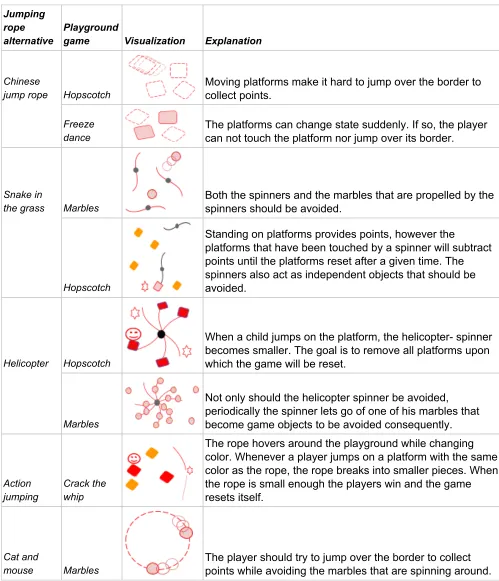
These criteria are (a) simplicity, how easy is it to grasp the concept such that children can play without requiring instructions, (b) scalability, can children join and leave the game without affecting the flow of the game, (c) variation, for more enjoyable play and (d) originality, to rank the creativity in concept and in how far the concept differs from existing games. The ranking of the 63 combinations is shown in Appendix B, From these rankings, the combinations with more than 10 points are shown in Table 4, the exact score has been left out since a concept with 10 points might seem better fit after further inspection than one with a score of 11 or 12. For correct interpretation of the used symbols see the legend of Table 3.
A player
Moving objects Objects that can
not be touched
Platforms upon which the player can stand.
A pivot point for
angular rotation. An event has occurred that triggers an action.
[image:19.612.16.605.10.213.2]The player should jump over the border without actually touching it.
Jumping rope alternative
Playground
game Visualization Explanation
Chinese
jump rope Hopscotch
Moving platforms make it hard to jump over the border to collect points.
Freeze dance
The platforms can change state suddenly. If so, the player can not touch the platform nor jump over its border.
Snake in
the grass Marbles
Both the spinners and the marbles that are propelled by the spinners should be avoided.
Hopscotch
Standing on platforms provides points, however the
platforms that have been touched by a spinner will subtract points until the platforms reset after a given time. The spinners also act as independent objects that should be avoided.
Helicopter Hopscotch
When a child jumps on the platform, the helicopter- spinner becomes smaller. The goal is to remove all platforms upon which the game will be reset.
Marbles
Not only should the helicopter spinner be avoided, periodically the spinner lets go of one of his marbles that become game objects to be avoided consequently.
Action jumping
Crack the whip
The rope hovers around the playground while changing color. Whenever a player jumps on a platform with the same color as the rope, the rope breaks into smaller pieces. When the rope is small enough the players win and the game resets itself.
Cat and
mouse Marbles
[image:20.612.71.570.102.683.2]The player should try to jump over the border to collect points while avoiding the marbles that are spinning around.
By taking the average of the cumulative score of jumping rope alternatives for each playground game, rounded to one digit as shown in Table 5, patterns emerge per set of jumping rope variations. An example is the low score on simplicity for cat and mouse score, since it involves rules for tagging as well as jumping, whereas regular jumping rope uses much simpler methods. As for the total score, snake in the grass scores highest, most notably due to its ease of joining in since the length of a ‘snake’ as well as the amount of ‘snakes’ is independent of the amount of active players.
Playground game Simplicity Scalability Variation Originality Total
Cat and mouse 1.8 2.3 2.3 2.4 8.8
Regular 2.3 2.3 2 1.6 8.1
Action jumping 1.6 2.3 2 2.4 8.3
Double under 1.7 2.6 2.1 2.3 8.7
Chinese jump rope 1.9 2,4 2.3 2.6 9.1
Helicopter 1.7 2.6 2.4 2.6 9.3
Snake in the grass 2.1 2.8 2 2.5 9.4
Table 5. Ranking of jumping rope variations.
To make a final selection of combinations, it is useful to lay them against the concepts of insisting, requiring or enticing behaviour, as mentioned in the State of The Art. With regards to the scope of this project, insisting will be left out of the equation to keep the game relatively simple and to minimise the pressure for children to perform actions. This leaves requiring, the explicit steering of actions while not having it deemed necessary for proper play, as well as enticing strategies which involve subtle stimulation of desired behaviour. In doing so, the game is allowed to have a reward/punishment system as well as the possibility to apply alluring elements. To entice behaviour, there should be possibility for player to both be passive as well as active without consequences for gameplay. If we were to zoom in on the combination action jumping and crack the whip, this would not be possible since the sweeping of the rope over the complete playfield will lead to negative feedback when children choose to stand still whilst the rope approaches. Likewise negative feedback is possible with Chinese Jump Rope - Hopscotch due to the always present possibility of collision with moving platforms. Composite games that allow for passive behaviour without feedback are freeze dance and marbles. Due to similarity with the Floor is Lava game, as shown in Figure 6 of the state of the art, the game Cat and Mouse - Marbles remains, which will be the game further develop in the specification. It is important to note that the combination scored a 3 on simplicity, which is the most optimal
4.1 Concept development
Brainstorm
Figure 9, the winning combination.From the previous Chapter, the combination Cat and Mouse - Marbles, shown in Figure 9, seemed to be the optimal choice with regards to the possibility for enticing elements and a proper distribution of active and passive gameplay. Note that there can still be a winning and losing condition, but the fact that the whole team wins or loses simultaneously makes it so that all players have equal playtime and can play continuously if desired.
The game motivates players to jump over the borders whilst avoiding the spinning elements, which circulate around the border. Thus we can decompose the game into a circular track that should be jumped over as well as elements that are speeding and can not be touched.
As is made clear by Schell (2015), the separate elements should be based on a unifying and resonant theme as a way to create powerful experiences. Therefore we will have a short look at the right theme and metaphor and how the theme can be reinforced in all the elements of the game.
which can be aimed at those trying to ‘jump’ over the canyon. A fun effect could be to try to make the planes shoot each other out of the sky by careful timing of the jumps. Finally, a mid atlantic ridge/shark environment can be created such that when one jumps from the European to the American tectonic plate or in the reverse direction, it will lead to vibrations of the plate that will bring them closer together. If this is done often enough, the players can bring the plates so close together that the sharks can't swim anymore. From these ideas, the NASCAR track is considered the best option since children are drawn to the idea of NASCAR races wrapped in a more child friendly theme, which can make use of the popularity of Pixar’s movie Cars
(Appendix C provides more arguments and a comparison with the turtle game).
Game mechanics
To simulate jumping there should be a cause and effect relationship, for example jumping might lead to cars spinning out of control, cars ending up in the playfield, the collapsing of the
surrounding stage or the occurrence of cracks in the track. For simplicity, the concept can be such that children might jump over a NASCAR track. Since the cars spinning out of control is an effect, the cause of these events should be clear to the players. To simulate jumping, an image of a trampoline can be used, where the protection foil can function as the track upon which the cars race. However, this would still not suggest that the players should jump over the track, instead of merely on the trampoline itself. Nonetheless, how people jump is not of strict importance thus for simplification the game mechanics can be such that jumping on the trampoline, without jumping over the tracks, would suffice.
With respect to the curious nature of children to try out all possible options, the rules should be clear to minimise chaos. Furthermore children might be inclined to form their own opinion on whether feedback is negative or positive, for example boys can be motivated by cars crashing whilst girls might be more tempted to keep the cars undamaged. Schell (2015) confirms this by stating that males like destroying things, where he makes an example of young boys building a tower but receiving the greatest enjoyment of knocking the tower over when built. The virtual possibilities for amplified destruction only add up to the boys excitement. Therefore negative and positive feedback should not be applied simultaneously since that might be hard to trace back whether an action is desired or not. According to this reasoning, it is advantageous to have only one effect that is related to jumping, which in this case will be the cars spinning out of control. But as described, this is not per definition negative or positive. A logical option would be to add collectables to the game from which collecting them is almost always perceived as positive.
To stimulate competition, there will be two cars of different colours as shown in Figure 10 (right). The players are followed by a circle when they enter the playfield, and the colour of their circle will be arbitrarily be matched to the colour of one of the two cars so that teams are automatically created. As for the collectables, they will appear in one of the two colours as well, where each team can only control the cars that matches their circle colour, and these cars can collect only the collectables that appear in the matching colour as well.
The collectables consist of fuel and nitro. The nitro gives the cars a temporary speed boost, which may lead to more collection of fuel collectables. The fuel is of higher importance since it determines how fast the cars drive, whenever a car stands still, it has lost the game. Losing the game provides negative feedback. However the instant reset of the game which leads to a refuel of the cars does not undermine continuous gameplay, consequently there will not be a moment where a child is not able to play. A GUI shows the amount of fuel left with the red bar, whereas the blue bar shows the amount of nitro. Whenever the red bar, resembling the fuel, is empty, one tank station icon as shown in figure 11 will disappear until none of them are left. When the icons are spawned on the playfield, they will appear in either a grey or red colour.
Figure 10, implemented view on the game elements (left) as well as the symbolic connections.
Enticing elements
As for the enticing elements, the players should be seduced to perform an action whilst they are not required to do so, thus the elements will be independent of the core game mechanics. The elements can influence for example proxemics and the timing of jumps, but they can also be applied to simulate a more even division of gameplay between passive and active players. For the initial playtesting, proxemics are more applicable since it can be recognized more easily than jumps and proper timing thereof. Furthermore, currently proper timing of jumps requires manual checking and therefore we opt to do let the system report behavioural data by using proxemics.
To influence proxemics with enticing elements, the players can be seduced by a more stimulating or attractive environment when they navigate towards the desired position.
Hence, there should be a central position where the aesthetic aspects are optimal, with colours becoming more grim as they are located farther away from that specific spot. Another option would be to have an inviting trail from the players position to the central point, however due to the inclination of children to run in different directions, this can be computationally expensive as the trail needs to be recalculated for every new position. The interactive tag game as described in the State of The Art, makes use of circles following the players, when the circle corresponding to the tagger touches a circle of a runner, the runner is tagged. In his research the author
To translate the torch analogie into a game, we can use a background divided in rectangular sections with alluring colours, where the transparency of the sections has a minimum point and gets more transparent as it moves away from this point. To do so, I implemented in Processing, a software sketchbook, initially a field of squares that decay as they move from the center with a white background (Figure 12, left) and afterwards I applied the algorithm in Unity, this time with a black background (Figure 12, center). Now we have a resemblance of a garden, where the wanderer might be drawn towards a specific position because that is where the colours are the brightest. However, now there is no reason to walk towards the most brightly coloured position, since it is colourful despite the position of the person. Now to complete the analogy we can give the wanderers a spotlight, which allows them to see the space around them, but it only gets interesting as they move towards the hotspot. In The players position is visualised in Figure 12 (right), where the right image shows eight players with the four lowest positioned players walking around the bright area which they can admire with help of their ‘torch’ and the other players walking around the dim area. Figure 13 shows the complete concept of the car game, where the image on the left lures players towards the center, whereas the right image allures them to the bottom of the playfield
Figure 12, backgrounds where the brightness of the rectangles peaks around the center, with the left image being the most general whereas the outer right image adapts to positions.
.
4.2 Jump recognition
The playground sends pre-processed data from four Kinects over the internet to a central computer, included in this data are the coordinates of the players. Figure 14 shows a 3D representation I made of a coordination test round where the observed person jumped five times at six different locations. Each dot is a recorded position from a given time frame. There are six visible positions with a high density of dots, which means that the person has stood still for a longer duration at those positions, which one can expect when one jumps at those
positions. From these dense positions, a hunch (lower dots) followed by a jump (higher dots) can be extracted, additionally the lower dots have a higher density which implies that more time is spent in the ‘preparing to jump’ phase then jumping itself.
To extract jumps, the average depth from the kinect to the player of each player is stored as well as the standard deviation of the depth. Whenever the measured depth of multiple following frames (to prevent outliers triggering jumps) is lower than the average height minus the
standard deviation, the system recognizes this a jump. For increased control, this standard deviation can be multiplied by a factor to tune the threshold for reporting jumps. Appendix D shows an test simulation in Processing to test the algorithm in a simplified manner, where the applet tracks the vertical position of a finger to see if a change of height, similar to that of a jump, is indeed confirmed by the system. This intermediate test gave more insight in the workings of the Kinect such as the different ways to visualize the data, it also provided an
[image:27.612.73.360.523.676.2]increased awareness of boundary cases of minimal and maximum changes in height that trigger jumps. Additionally, it became clear that the SD needs to be calibrated a bit, since when no change in height has occurred yet, the SD is still close to zero and thus the threshold for jumps is easily exceeded, resulting in too many false positives. Another option would be too recreate the playgrounds default tracking system by hanging up a Kinect on the walls and directly streaming the data to Unity or processing, in case the default system would fail.
4.3 Initial concept
The concept used for the playtest is shown in figure 15, it shows a nitro collectable for the grey car as well as fuel for the red car. Note that the grey team is lucky since the grey collectable is positioned on the track of the cars and will thus be collected automatically To collect the red fuel, the red team should time their jumps carefully such that the car is swinging at the moment that it passes the item positioned outside the track so it can be collected. If the item were to be positioned at a greater distance from the track, one person can jump first to give the car initial motion, with a second player jumping soon after to increase the swing effect to allow the team to catch items that are dropped further away from the track. As for the circle, it is currently green, which is an indication that the corresponding player has jumped. The jump can also be
[image:28.612.72.487.479.693.2]observed by monitoring the size of the circle since scales proportionally to the players vertical position. From the image we can also observe that the circle has grey as its inactive colour, since the grey car shows sparks and is pushed outside of the track, which means that a player of the grey team has jumped.
4.4 Playtesting
Participants
To playtest the concept, children from a primary school who did a field trip to the university around the age of seven and eight, were asked in groups of circa 4 players to participate in the game.
Methods
Beforehand, consent was asked to make observations when they were playing. The rules were initially not explained such that the understanding with regards to the game mechanics could be analyzed. Once it turned out that they did not grasp the game or concepts, explanation was given by another facilitator of the university and myself. Non-anonymous data as video recordings were not used for privacy reasons.
Observed actions, verbal statements and responses to informally asked questions were noted and categorized into understanding of the concept, enjoyment, exertion and improvisation as shown in Appendix E. Human observations were supported by those of the system, were logged data resulted in a separately recorded data set of the movements of the children from which horizontal and vertical position could be extracted. The questions were relevant to the direct observations, for example children jumping on cars lead to the question how they could make the cars wiggle. If this resulted in an answer incoherent with how the game worked (“ you should jump on the cars”, “when you hit the icons”, “if you don’t stand still”), further instruction could be given to how it should be played since the observation was made that the steps were too
Results
Game mechanics
As the playtesting progressed, questions shifted from game mechanics to uncover more detailed aspects such as whether a trampoline is a good fit to encourage jumps (which resulted in general answers such as jumping, but also a more specific, less applicable, memorie of falling of the trampoline and breaking an arm). On the question if children preferred other icons such as a car, responses mainly fell into the category of an animal from which pets such as a dog and cat and bunny were named fairly often, this can be caused by the fact that their relation with those animals is more close than that of an object as a car, which can also not be their property as opposed to a pet.
However, the most prominent problems or misunderstandings were tied to game mechanics, the collection of items was not always evident as the mere reposition of an item did not give enough confidence that this was positive feedback as a result of collection.
Secondly, no associations were made between circle colour and the ability to only control the car with the corresponding colour, which in turn can in fact only pick up collectables of the matching color. The effect of jumping was not linked to the wiggling of the cars either, and the function of the wiggling of the cars was unclear as well. Instead a large variety of children taught that collectables could be collected by jumping on them.
Furthermore, one child did point out that picking up fuel did not lead to a change in the corresponding GUI slider. This was not a technical error but rather conceptual.
As figure 17 shows, the grey and red car have their own separate GUI. But the size of the playground made it hard to keep track of both images. Combined with the fact that Nitro collection was hardly noticeable, the child only saw the grey GUI and figured that the upper slider represented the fuel for the red car, and the bottom, blue, slider the fuel for the blue car. However, it was observed that when the fuel was empty, one tank station icon would disappear. On the other hand, the game was created such that when one team has lost all of its tank
Enticing elements
[image:31.612.156.314.548.687.2]As for the enticing elements, they were not observed by the children due to lack of visibility. The lack of visual presence lead to the fact that enticing elements did not influence proxemics, furthermore no child mentioned them By that, further details with regards to its effectiveness were not tested since visibility and awareness were prerequisites for researching their effects. Additionally, the children were moving fast over the playground. This would not exclude the possibility that players can be guided towards a central location, but their position would be more likely to deviate from this point. Thereby would it be overall more challenging to allure players when they are moving swiftly over the playfield. Figure 17 shows the horizontal movements of three players that were playing simultaneously, the results do show that the children do have a preference to wander around a given area of the playfield. For example one child walks more on the west side while the others stay on the east side of the playground. This shows that it could be possible for these three players to guide them as no individual trail covers the entire playground.
Jump recognition
With respect to jump recognition, the system did not recognise them properly. The left image of figure 17 shows the depth data of a bin that is pushed around the playground by a facilitator of the university, one spike is circled in red but apart from this incongruence in height the
approximately the same depth is measured over the playfield. This would suggest that the position on the playground did have a relatively small influence on the measured depth. This leaves the problem with the algorithm of setting a depth threshold for jump recognition based on standard deviation.
[image:32.612.90.440.538.655.2]The right image of Figure 18 shows the measured depth for two playing children. The blue graph follows, with the exception of the start and end of the game, stability in the measured depth whereas the red graph seems to consist of plateaus rather than a stable line. The higher plateaus could be linked to the observation that players often tried to sit on a car or collectable which would increase the depth from their head to the Kinect. The plateaus indicating a lower than average depth would suggest jumps but for that their duration is too long and spikes would be more logical than plateaus in the case of jumping. The low probability that the above average height for an extended time period would be caused by jumping, might leave us with the guess that some plateaus are are caused by peaks such as the circled one in the left image of Figure 18. To minimise the effect of distortions on the depth measurements related to the position in the playground instead of actual player height, the players could remain on a single position to increase the probability that deviations in depth data are caused by actual higher or lower positions of the player. Setting the threshold for jump recognition according to the standard deviation is also error prone since the SD will initially be close to zero until children have moved up and down to get data points that deviate from the averaged depth. Beyond that, children that tend to crouch, sit on the floor or jump very often will have a relatively large standard deviation whilst in real life you would not let such factors influence whether someone jumps high enough to classify it as a jump. Conclusively, determining the jump threshold based on the average height times a tuning factor (f.e. jump threshold = average height * factor) would be a more stable solution.
4.5 Conclusions
Jump recognition is hard to do when players change their positions swiftly, since it affects the measured depth. Moreover, the distinction of two teams, as indicated by the colours grey and red, was not observed and the children played as one team. The elements of the GUI were not linked properly to their function and required that the children were aware of their team color (grey or red). Links were also not made whenever a collectable was collected (a car bumping against a collectable of the corresponding colour), what the effect of jumping was (cars
[image:33.612.74.513.374.673.2]wiggling), what wiggling cars could lead to (picking up collectables that were positioned outside the race track) and the function of the collectable (fuel or nitro). Human explanation was also necessary for a proper understanding of game mechanics. Although the playtest uncovered many points of improvements, if the goal were solely to provide a fun and active experience that stimulates the creative mind, a selection children’s statements from Appendix E are shown in Figure 19 and show some examples that this goal has been accomplished. On a more technical note, for further prototypes the concept should adhere to the conditions as described in the simplified MoSCoW method of table 6.
Must Should Could
Everyone plays cooperatively in a single team. Since no link is made between the color of the circle, the wiggling of the cars and jumping.
The state distinction between jumping and standing should be evident. Children responded that the circles should wiggle.
The necessity of a GUI could be minimized as it lead to confusion between the colours of the cars and the colour of Nitro and fuel as indicated by the GUI.
The game mechanics must be such that children stay as much as possible in one place when
jumping. As horizontal movements affect the measured depth. Thus standing in one place will maximize changes that variations in height are due to actual crouching or jumps.
Jumps should be triggered by a threshold directly derived from the average height, instead of the standard deviation. Due to the standard deviation needing to be calibrated properly which leads to unnecessary steps before
gameplay can take place.
Players are nudged with enticing elements to perform actions that don’t require horizontal movement. This is necessary, as a result of players standing primarily on the same spot.
It should be clear when collectables are collected. Children indicated that they did not know why the icons
disappeared after a car with matching colour touched them.
Items must be clearly visible on the playground.
The enticing elements blended too much with the background colours and that being so they were not observed.
[image:34.612.65.570.111.605.2]The game should build up tension as playtime progresses. No tension was built up as there was no win-lose state, which could increase the level of engagement and peer pressure for active play.
No distinction between teams.
The colours of the player’s circles are the same and they all influence the same object. The relatedness between grey or red elements was not recognized in the playtest, and competition is not a necessary part to play a game such that it can be left out without
consequences, such that with respect to simplicity it is a better option to play with one team.
The game mechanics must be such that children stay in one place as much as possible
when jumping.
[image:35.612.73.191.528.672.2]By having jump platforms as shown on the right, where jumps will only be triggered as long as the players touch the platform, the depth data will be more regular since changes in depth will be mostly from vertical changes in position instead of horizontal ones. Four platforms are chosen because it allows for proper supervision of gameplay whilst still having a large enough group for dynamic social interaction. With the playtest concept, the enticing aspect consisted of a background with increasing aesthetics around a specific position as players moved towards that center point. By having the players jump on the same location, the enticing element of position has become the required element.
Players are nudged with enticing elements to perform actions that don’t require
horizontal movement.
[image:36.612.74.460.490.688.2]To simulate actions whilst staying on the same position, the participants can be not be allured to change proxemics, as a results the undertakings should be tied to jumping. This can be further extracted into variations in time or vertical distance. As for the latter, the system will not be precise enough as of now to extract detailed information concerning the height of the jumps or depth of the crouches. As for jumping with respect to the time domain, the time at which players jump can be either measured dependently or independently. For the first, specific patterns in jumping can be encouraged. However, division in teams lead to confusion whilst playtesting, moreover one single team might positively affect a feeling of cooperation and as a result positively affect the group dynamics. The initial game required that players jump together simultaneously or soon after each other to increase the swing of the cars and thereby to collect items positioned further from the track. The current setup does not require those synchronized jumps, but rather aims to allure them through enticing elements. To simulate synchronized jumping, there should be an effect whenever multiple person jump at the same time. To enhance the feeling of cooperation, the effects can be such that they connect the players by means of connecting elements. Figure 20 shows the early prototypes of the elements and their application in the final game. The elements are triggered whenever multiple players jump simultaneously or at least within a given time zone from each other. The elements also create the illusion that they move, whilst in fact this effect is obtained by timed disappearance of one single element at a time. For example the first frame would show elements 1, 2, 4 and 5, while after a few frames 1, 2, 3 and 5 would be visible. In doing so, the elements give the appearance of all shifting one spot.
Items should be clearly visible on the playground.
The resolution is set beforehand to 1920 * 2400 pixels, which equals that required for running it on the playground. As for the colours, blue is used for the platforms in their standard state whilst they turn red when a player jumps on them. The neon elements are blue and thereby contrast the complementary coloured orange background The track is grey with a white/purple
collectable and a blue car. When I was trying to recreate the new game based on the objects of the original concept, I used intermediate objects such as bare circles as a stepping stone for the final concept. However I found that the ‘placeholders’ showed an interesting futuristic effect and its simplicity might lead players to put place more focus on the game mechanics and the
neon-like elements. As a result, I decided to keep the placeholders and with respect to Schell’s (2015) notion of unification of theme all components were created in the same style using basic forms of hexagons and circles. Schell also notes how a designer can lever on the imagination of players, and thereby objects might benefit from staying minimal as it invokes more of the
imagination which often is more creative than realistic objects.
The state distinction between jumping and standing should be evident.
[image:37.612.75.337.600.681.2]The player has a following circle with an enclosing hexagon which opacity has a linear relation with the vertical position of the associated player. Whenever the player jumps, the hexagon will rotate around as to indicate that a jump has occurred as shown in Figure 21. Figure 20 shows how the platforms additionally turn red to further emphasize jumps.
Jumps should be triggered by a threshold directly derived from the average height,
instead of the standard deviation.
By scaling the average height with a factor to set the threshold, the resulting threshold will be less dependent on change of movement and therefore be more reliable. Listening for jump is done when a player stands on a platform, only then does the program monitor jumps. When he or she exits the platform, the data concerning the player height is reset and will be updated whenever a player reaches the platform again. If a player is standing on a platform and his or her height exceeds the threshold, the game controller is notified of the jump, along with the platform upon which the player jumped so that the enticing elements can be connected to the proper platform.
It should be clear when items are collected.
[image:38.612.68.513.597.691.2]When the driver touches a collectable, the collectable will spin around and get increasingly smaller. At its smallest point, as seen in the middle picture of figure 22, it will relocate itself to a new position whilst maintaining its rotation as it returns to its original size. As for now, sound is not included as to avoid annoyance often caused by repeated sounds. This can be avoided by choosing sounds randomly from a ‘pool’ of sounds but as the location of the design lab where the project will be run has many working students who might be distracted by it, it is avoided as of now.
The game should build up tension as playtime progresses.
Initially, the requirement is to collect one collectable. When this objective is completed the players go to the next round, at which they have to collect one collectable more than in the previous round to proceed. For example, round 2 (visualized through the GUI as shown in Figure 23) requires the collection of two items, round 3 three etc. The caveat is that the car is also slowing down over time, when it has halted the game is over but players can reset the cars speed by making it to the next round. When the car stops and the game over text shows up, the game resets soon after such that players can continue playing. Nonetheless it can induce some tension to increase the engagement of players and to have them striving for a shared goal to increase a feeling of cooperation.
The GUI should be minimized.
[image:39.612.74.427.479.696.2]The function of the GUI was to show how much fuel and nitro the car has. As the nitro was mainly serving for an increased potential in collecting fuel, it was not a necessary functionality and therefore it has been left out. In the former concept, the fuel collection was also not always directly tied to an increase in speed by the players therefore in the new concept the change in speed is more abrupt. Either collecting the item result in no change in speed if not enough have been collected or it results in full speed reset and an indication that the next round has started when enough have been collected. Figure 23 shows the functions of the GUI, namely to inform of the round number and the game over state.
6.1 Participants
Four groups of three students have played the game, as well as four groups of two students. All participants were students from the University of Twente, and consequently they belong to a well educated group with an age ranging from around 18 to 26 years old.
As for the gender, 10 women and 13 man participated.
6.2 Methods
Each group initially played the game with enticing elements turned off, after which they played the game with enticing elements turned on. This made it a within-subject test as the difference between the games with and without enticing elements were both tested on each group.
To analyze the percentage of the jumps that were executed as a synchronized jump (SJ) with respect to the total amount of jumps (TJ). Three methods were used to report SJ and TJ. First, reports were automatically provided by the game’s code itself, secondly logged data was extracted from a graph and finally video recording were used as explained below.
The game itself adapted its environment according to synchronized and normal jumps, as such a simple increment whenever such a (synchronized) jump occurred would report the necessary statistics. Beyond this, the game also logged the coordinates of the players, this data has been visualized in a graph from which the synchronized jumps could roughly be estimated.
effect. The null hypothesis is as following: “applying enticing elements to jump-based game will not stimulate synchronized jumps”.
For the video recordings, I counted the total amount of jumps as well as the jumps that were involved in a synchronized jumps. For example when a pair jumped simultaneous, I
incremented the count with two as two people jumped at the same time. It would not be valid to count by pairs, as one paired jump and two people has a different SJ to TJ ratio (½) then two paired jumps and three people (⅔).
To determine whether enticing elements affect the percentage of synchronized jumps per total amount of jumps, we need to perform a paired t-test as the setup was within-subject. The alpha will be 0.05 as it is small enough to indicate a difference whilst not being so critical that the difference between both playtest has to be very large as would be the case with an alpha of 0.01.
The extracted data from the video recordings are also compared with the system reports as well as the graphed data to make a statement about whether the game has been able to accurately extract (synchronized) jump data. To make a statement about the validity of research methods, it will suffice to make a rough observation by comparing the relatedness of the different
6.3 Measurements
Enticing elements
Table 7 shows the logged jumps from the video recordings, for the recorded SJ I counted the amount of jumps that were involved in synchronized jumps (when two people jump at the same time, I added two to the amount of synchronized jumps), the total jumps and the percentage of synchronized to normal jumps. One of the participants of playtest seven did not give permission to video record the gameplay. Applying a one-tailed, paired t-test to the percentage of SJ with respect to TJ for both default and enticed games, the result was a p-value of 0.16. Which is larger than the formerly established alpha value of 0.05, therefore the null hypothesis can not be rejected. This means that we have not been able to confirm that enticing elements can lead to more synchronized jumps in the context of a jump based game.
Playtest Participants Default SJ Default TJ
Default SJ /
TJ * 100% Enticed SJ Enticed TJ
Enticed SJ / TJ * 100%
1 3 32 66 50% 23 38 60%
2 3 14 30 50% 38 50 80%
3 3 39 72 50% 36 70 50%
4 2 24 69 30% 16 69 20%
5 2 16 39 40% 10 55 20%
6 3 11 101 10% 10 40 30%
8* 2 12 54 20% 32 78 40%
[image:42.612.73.541.488.687.2]Average 21.1 61.6 31.3% 23.6 57.1 37.5%
Table 7, Comparing SJ and TJ and their relationship for default and enticed games.
Jump extraction
Table 8 shows the SJ and TJ extracted from the system, video recordings or graphs (video data from group 7 is missing and the individual jumps from the graph could not be extracted as described in the Method section). The difference with table 7, besides the measurement methods, is that the SJ’s are counted by pairs (two or three people jumping at the same time counts as one synchronized jump). By analyzing the data we can see that the video recordings give the highest amount of TJ and SJ. To compare it with the lower averaged values of the system reports, the difference is most likely due to the system counting jumps according to the average height times a factor, this might exclude the small jumps that did not exceed the threshold to be counted as a jump. These small jumps could however still be extracted from the video recordings as humans do not measure according to a set value but rather according to an indication that the person was attempting a jump, albeit a small one. The graph reports the lowest value of SJ, which is most likely related to the fact that it was hard to properly extract jumps from the graph, as such not all synchronized jumps were counted as such. Nonetheless, the difference between the average of the SJ as measured by the system and video recording is (9.4 - 7.6) 1.8, for TJ it is (61.6 - 55.9) 5.7. The difference between video recordings and the graph extractions is (9.4 - 6.9) 2.5. From this we can conclude that the logged coordinates visualized in a graph lead to a rough estimation of the actual amount of jumps, with the games inbuilt code being more precise and reporting jumps accurate enough for enjoyable gameplay but not so precise that it can be used for scientific research.
Playtest Participants
System SJ’s
System TJ
Video recorded SJ’s
Video Recorded TJ
Graph extracted SJ’s
1 3 14 60 14 66 7
2 3 3 35 6 30 5
3 3 14 79 17 72 11
4 2 15 64 12 69 7
5 2 11 46 8 39 6
6 3 0 94 3 101 5
7 2 0 17 N.P.* N.P. 6
8 2 4 52 6 54 8
[image:43.612.71.511.455.690.2]Average 7.6 55.9 9.4 61.6 6.9