University of Warwick institutional repository: http://go.warwick.ac.uk/wrap
This paper is made available online in accordance with
publisher policies. Please scroll down to view the document
itself. Please refer to the repository record for this item and our
policy information available from the repository home page for
further information.
To see the final version of this paper please visit the publisher’s website.
Access to the published version may require a subscription.
Author(s): Bo Edvardsson, Bo Enquist and Robert Johnston
Article Title: Design dimensions of experience rooms for service test
drives: Case studies in several service contexts
Year of publication: 2010
Link to published article:
http://dx.doi.org/10.1108/09604521011057469
Design Dimensions of Experience Rooms for
Service Test Drives: Case Studies in Several
Service Contexts
Bo Edvardsson
Service Research Center
Karlstad University
Sweden
Tel +46 54 700 15 57
Fax +46 54 83 65 52
e-mail: [email protected]
Bo Enquist
Service Research Center
Karlstad University
Sweden
Tel +46 54 700 15 35
Fax +46 54 83 65 52
e-mail: [email protected]
Robert Johnston
Warwick Business School
University of Warwick
Coventry
England
Tel +44 2476 524218
Fax +44 2476572583
Design Dimensions of Experience Rooms for
Service Test Drives: Case Studies in Several
Service Contexts
Structured abstract
Objective: The objective of this exploratory study was to analyse „test drives‟ of service offerings in a variety of service contexts by applying existing design dimensions of experience rooms in order to develop some principles to assist service designers who are interested in developing such „test drives‟ for their potential customers
Methodology/approach: An exploratory qualitative study is undertaken using three case studies with varying levels of simulation/artificiality. Data were collected from documents and interviews with service providers and customers and analysed using a framework of six dimensions.
Findings: The study added a sixth dimension to the existing five dimensions or experience rooms found in the literature. It also proposed seven principles to guide designers who seek to create new service „test drives‟. The study also introduced the new notion of „value in pre-use‟ (a development of „value in use‟) to describe the potential value of „real‟ services yet to be purchased. Finally the study documented some of the advantages and disadvantages of using „test drives‟.
Research limitations/implications: The exploratory and interpretive nature of the research, and the limited number of cases and respondents, limits the generalisability of the findings.
Practical implications: The study provides several principles that can be used in the design of service „test drives‟.
Originality/value of paper: This is the first paper to analyse the design dimensions of service „test drives‟ and to propose the notion of „value in pre-use‟.
1. Introduction
Because emotions play an important role in service experiences (Mattila and Enz 2002),
services must be designed to ensure that both the functional and the affective aspects of the
service experience are carefully considered (Pullman and Gross 2004). However, because
many services can only be experienced by customers „in use‟, it can be difficult to predict the
experiential aspects of a service and thus provide potential customers with a clear
pre-purchase understanding of what they might be buying. To address this problem, some
organisations now enable potential customers to „test drive‟ a service prior to purchase.
Such an approach is relatively new. Although consumers are familiar with test-driving a
product (such as a new car) or having a 21-day free trial of an appliance (such as a vacuum
cleaner), the notion of „test-driving‟ a service experience (such as a holiday or an educational
service) is not commonplace.
The „test-driving‟ of a service is similar to, but usually goes beyond, the limited „previews‟ of a service that are already common in many service industries—such as the
many brochures, videos, explanatory leaflets, and websites that are offered to help
customers gain some information about the services they are about to purchase and/or use.
In contrast to these approaches, all of which provide information about a service, the notion
of „test-driving‟ a service represents a „hands-on‟ experience of the service that is potentially
much more powerful.
To enable their customers to have some actual experience of a service before
purchase, an increasing number of service providers have begun to offer a „test drive‟ of the service experience they are offering. Examples of such „test drives‟ include business
consultants providing an initial free service for a new client, schools allowing parents and
children to experience the school routine for a day or so before formal enrolment, airlines
running short flights to help nervous passengers experience flying before they book a
holiday, hotels offering 3D technology to allow potential customers to take a virtual tour of
the hotel and ask questions via chat options. Despite the increasing utilisation of such ad
hoc „test drives‟, and their marketing potential, there has been very little formal research into
how such „test drives‟ could be designed to optimise customers‟ experiences of services
before purchase and consumption.
The objective of this study is therefore to analyse „test drives‟ of service offerings in a variety
of service contexts by applying existing design dimensions of experience rooms in order to
develop some principles to guide the designers of such „test drives‟. It is important to note
that the focus of this study is not on virtualservices (DeSancris and Monge, 1990; Turner et
al., 2001; Santos, 2003) nor service simulations (Zolfagharian and Hirunyawipada, 2005);
The next section presents the theoretical framework for the study. The section after
that explains the methodology for the empirical study. This is followed by a description and
analysis of the case studies. The findings of the case studies are then presented and
discussed. In the final section, the paper discusses the research contribution, managerial
implications, and suggested areas for future research.
2. Theoretical framework
2.1 Service experience
The term „service experience‟ refers to the customer‟s personal experience of the service
process as a result of interactions with the service organisation and its frontline staff,
facilities, and technology (Meyer and Schwager 2007, Johnston and Clark 2008). Meyer
(2007, p. 65) stressed the affective aspect of the service experience in defining it as “ how
the delivery of [a service] makes its recipient feel.” In a similar vein, Berry et al. (2002, p. 88)
noted that:
Customers always have an experience—good, bad or indifferent—whenever they purchase a product or service from a company. The key is how effectively the company manages the experience.
Given that most, if not all, services are co-created with the customer (Bendapudi and
Leone, 2003; Vargo and Lusch, 2004a, 2008), it is not possible (in theory or in practice) to
separate the experience of the service from the customer. As Schembri (2006, p. 389)
noted, the customer is “required to co-construct the meaning of services”. Lusch et al. (2007) adopted a similar view when they contended that „value-in-use‟, which is a crucial
concept of service-dominant (S-D) logic, is closely related to customer experience in the
consumption process.
The fact that value-in-use and the service experience are inextricably linked is the
ultimate rationale for the desirability of service „test drives‟. Because the customer cannot experience the real service in isolation from use or consumption, a „pre-service‟ of some
description is required to provide customers with some key experiences that enable them to
assess the potential value-in-use of the real service. This is the role of the service „test
drive‟.
2.2 Hyper-reality and hyper-real services
In test-driving a tangible product (such as a car or a vacuum cleaner), customers can use
the real product in a real situation to assess „value-in-use‟ and thus make an informed purchase decision. However, if a customer were to „test drive‟ an intangible service (such as
a holiday) in a real situation, they would be actually experiencing the real service without
having paid for it! It is thus apparent that a key difference between test-driving a physical
must be simulated in the latter. (In product test-drives some or all of the use may be
simulated but it is not necessary.) The simulation of all or part of an experience has been
referred to as „hyper-reality‟.
According to Hirshman and Holbrook (1982, p. 92), the term „hyper-reality‟ refers to “
the multi-sensory, fantasy and emotive aspects of one‟s experience”. Applying this concept to a service experience, several authors have suggested that „hyper-reality‟ refers to a
simulated (or partially simulated) service reality (Baudrillard 1994; Edvardsson et al. 2005;
Grove and Fisk 1997; Martin 2004; Venkatesh 1999). Indeed, such „hyper-real‟ (or simulated) experiences are common in many „everyday‟ services. For example, people
experience dramas on television or at the theatre in which life is simulated in various ways.
Other people visit theme parks to experience simulated settings and events of various sorts.
According to Edvardsson et al. (2005, p. 3):
These experiences and settings are engineered to allow consumers to vicariously experience some other place, time, or reality. As such, a customer‟s interaction with a hyper-real service can create an experience that is more distinct and more unambiguous than reality the end result is a powerful, believable hyper-reality that can have a profound impact on individuals.
In the context of „test-driving‟ a service, it is the contention of the present study that service organisations can construct a „hyper-reality‟ to enable customers to test a service
before they commit to buying or experiencing the real thing. According to Edvardsson et al.
(2005), organisations do this by creating an „experience room‟ in which the „hyper-real‟
service experience takes place. Such „test drives‟, which can be independent of time and place, may have a significant impact on the customer‟s willingness to purchase.
2.3 Dimensions of experience rooms for service test drives
Following a review of the relevant literature, Edvardsson et al. (2005) posited that an
„experience room‟ (the physical or virtual environment within which a „hyper-real‟ service
experience is created) has the following five dimensions:
* physical artefacts: the physical signs, symbols, and infrastructure of the „experience
room‟ (Bitner, 1992; Rafaeli and Vilnai-Yavetz, 2004);
* intangible artefacts: the non-physical infrastructure of the „experience room‟—
including mental images, brand reputation, narratives, norms, and values
(Edvardsson and Enquist 2002; Normann, 2001);
* technology: the technological equipment with which customers interact, either
actively or passively (Prahalad and Ramaswamy, 2004; Venkatesh, 1999);
* customer placement: the „staging‟ of the customer in the „experience room‟ (Sherry
* customer involvement: the role(s) taken and enacted by the customer(s) in the
„experience room‟ (Swaminathan et al., 1996; Prahalad and Ramaswamy, 2004).
The empirical study that follows employs these dimensions of an „experience room‟ to analyse how service organisations go about designing „test drives‟ of service experiences for
their customers.
3. Methodology of empirical study
3.1 Research methodology and selected cases
Because the notion of „test-driving‟ service experiences is a relatively new area of research,
it was deemed appropriate to undertake an exploratory, qualitative, case-based approach to
the present empirical analysis of this novel phenomenon (Yin, 2003; Brignall et al., 1999,
Johnston and Mehra, 2002; Glaser 1995; Strauss and Corbin 1990).
Three cases were selected on the basis of recent contacts and convenience to provide
varying levels of simulation/hyper-reality:
* a website for academics who were considering possible attendance at the annual
„Quality Management and Organisational Development‟ (QMOD) international research conference; this „service test drive‟ offered only visual, non-tangible
artefacts through interaction with the website;
* an IKEA store at which customers were welcome to try out furniture items that were
offered as „service solutions‟ to real-life domestic problems; in addition to the
physical artefacts of the store and its furniture, this service „test drive‟ offered visual,
non-tangible artefacts (such as an IKEA catalogue and interaction with a website);
and
* an open day at a business school offering a master‟s degree in business
administration (MBA) at which prospective students were invited to „test drive‟ the
educational service by interacting with other prospective students, inspecting the
facilities, and attending a lecture.
All of the selected cases offered services that can be characterised as interactive
„destination services‟. Such „destination services‟ can be differentiated from „transaction services‟ (such as a taxi service or a car repair) in that they typically offer multiple
experiences (Voss et al., 2008) and involve customers spending a significant amount of time
in a so-called „experience room‟ (which, in these cases, were the academic conference, the
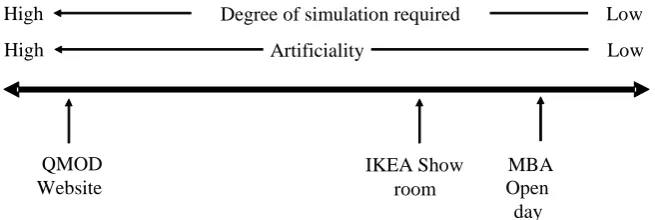
IKEA showroom, and the MBA university). However, although all three cases did ultimately
offer experiential „destination services‟, the „test drives‟ for the three cases differed with
regard to the relative degree of artificiality/simulation that was involved; in particular, one of
an indication of the differences between the three „test drives‟ in terms of artificiality and
[image:8.595.106.434.161.271.2]simulation.
Figure 1: Relative degrees of artificiality of the three service ‘test drives’
3.2 Data collection and analysis
Data were collected in three ways: (i) from relevant documents (the QMOD website, the
IKEA catalogue and website, and documents describing the MBA program); (ii) from
interviews with representatives of the service providers (using an informal interview guide);
and (iii) from semi-structured interviews and a questionnaire survey (with both open and
closed questions) with customers of the services.
The three authors collected the data independently. In addition, the first phase of the
interpretation of the data was also carried out independently. The open coding and
subsequent analyses were conducted collaboratively in the second phase of the empirical
analysis.
4. Case studies
4.1 Case 1: QMOD website
The Quality Management and Organisational Development (QMOD) conference is an
important annual international research gathering. The aim of the conference is to “provide
a unique international forum to exchange knowledge on the multidisciplinary nature of
research and practice related to Quality Management for Organizational Development”
(Dahlgaard 2003, p12).
The QMOD website provides prospective conference participants with a wide range of
information—including the history of QMOD, programs from earlier conferences, current
conference topics and program, calls for papers, templates for papers, deadlines for
abstracts and completed submissions, and travel/accommodation information. Visitors to the
website can also see numerous pictures of the conference and the accommodation facilities.
Prospective delegates could thus acquire a good understanding of the size, scope, and
nature of the conference from the website. This information is available for 12 months
High Artificiality Low High Degree of simulation required Low
QMOD Website
IKEA Show room
MBA Open
before the conference. In addition, conference papers are uploaded onto the website (and
made available for download by visitors) during and after the conference itself.
The design and content of the website was studied by one of the authors of this paper,
who also undertook various „test drives‟ of the website service. The people responsible for
maintenance of the website were also interviewed about the objectives and role of the site
as part of the annual QMOD conference. Finally, data were collected from users by: (i)
semi-structured interviews with five users of the website; and (ii) a questionnaire survey of 20
users of the website.
4.2 Case 2: IKEA showroom
Although IKEA is recognised as a global leader in supplying home furniture and decorations,
the firm portrays itself as a service provider of „solutions to real-life problems‟ rather than as
a simple goods retailer. Through its catalogue, website and showrooms (which are the
„experience rooms‟), IKEA attempts to provide service experiences for its customers.
The present case study was undertaken in one of the newer IKEA stores in Karlstad,
Sweden, in spring 2009. The various „experience rooms‟ in this store, which are also
depicted in the IKEA catalogue and the company website, represent a variety of household
rooms. In these „experience rooms‟, customers are provided with an opportunity to experience solutions to the „problems of everyday life‟. For example, the „living rooms‟ in the
showroom are designed to simulate a real domestic living room in terms of furniture, fabrics,
and lighting.
During this case study, one of the authors and an assistant observed and interviewed
customers in different parts of the store showroom to ensure that a variety of customer
needs were taken into consideration. Seven couples, two families with children, and one
single customer were selected for interview in the store using a semi-structured interview
guide.
Case 3: Open day for MBA program
The highly regarded MBA program of the Warwick Business School (WBS) recruits
approximately 600 postgraduate students annually. Students are selected for the course
from interested applicants on the basis of rigorous selection criteria. The objective of the
WBS open days is to allow prospective students to „test-drive‟ the MBA program and thus
make an informed choice about whether they wish to apply. In addition to brochures and
website material, students are given an opportunity to experience the facilities, talk to staff
and other prospective students, and to experience a real lecture given by a professor.
According to the MBA operations manager at the university, the aim of the open day is “ to
provide an insight [into] the friendly, approachable, personalised service that they can expect
Data for this case study were gathered from interviews with the university staff
members who were responsible for the open day—the MBA operations manager and the
assistant manager for marketing and recruitment. Information was also gathered by
questionnaire from prospective students who had attended an open day in 2006. A total of
26 completed questionnaires were returned by the 98 prospective students who attended.
5. Findings
5.1 Case 1: QMOD website
The QMOD website was designed to provide visitors with the information they required to
decide whether to attend the conference. To this end, detailed information was provided to
ensure that a prospective customer could get not just information but also a „feel‟ for the
conference experience. The user of the website was therefore provided with „test-drive‟
experiences that related not only to the core service (that is, the conference), but also to
accommodation, transport, and tourism activities, through numerous pictures, text, and links
to other websites. In addition the ease of use of the site and the look of the event and
accommodation, for example, provided users with an indication of the style and nature of the
experience to follow. Some quotes from the interviews included “The web site gives
relevant information on the conference program and a feel for who will participate and how
well the conference will be run” and “it provides me with information on the nature of the
conference facilities, accommodation including the style of the hotels, tourist attractions and
after conference tours”.
Most of the respondents talked about their use of the web site as an important part of
the pre- (and post-) conference experience. They felt that the website information about the
conference itself was more important (and better presented) than the information relating to
logistics and tourism (which was generally considered to be less important and less well
presented). Some respondents had suggestions for improvements, including: (i) more
pictures; (ii) video-clips; (iii) a map showing where the hotels are located; (iv) facility to
download a flyer; and (v) a phone number for assistance with problems.
Most of the users reported that navigating the website was easy (although some did
report problems downloading certain information). Most reported that downloading published
papers after the conference was easy.
5.2 Case 2: IKEA showroom
The customer experience in the IKEA store was designed to show „solutions‟ that would improve customers‟ domestic lives. Through its various „experience rooms‟, IKEA attempted
to demonstrate how its expertise and products could create a better environment in the
All of the interviewees were active buyers who had previous experience of visiting an
IKEA store. Indeed, most of the customers reported that there was no need for them to ask
for help from IKEA staff when exploring the various „experience rooms‟. As one respondent observed: “We almost never contact the IKEA personnel; we manage on our own”.
Most of the customers appeared to have prepared themselves before they came to the
store by looking at the catalogue and/or the IKEA website; however, many noted that this
was not the same as seeing the furniture “for real”. The experience-rooms were thus
important for seeing the furniture items in real life and to experience the possibilities. As one
person reported: “For us it has been very important to see the kitchen in „real life‟ before we take our final decision to buy our new kitchen”.
In summary, all of the visitors to the IKEA store considered that their visit had been an
„experience‟ through which they had found a solution to a specific need. However, some
required extra help from the staff, the catalogue, or the website. Most of the customers
visited the store with friends or partners, and many were accompanied by their children.
Several included a visit to the restaurant for a cup of coffee or a light meal as part of the
service experience.
Case 3: MBA open day
The open-day experience at WBS was offered to potential students every six weeks. A
website provided information about the open days and enabled prospective students to book
on-line. On arrival, students were welcomed by members of the marketing team before being
escorted to the lounge where they were offered refreshments from a buffet. They were
encouraged to talk to other prospective students, alumni, current students, programme
managers, and academics, and to browse through study materials if they wished. After a
short introductory talk and a detailed question-and-answer session, students were provided
with a 15-minute introduction to the web-based technology („my.wbs‟) that is used by the
school for communication and teaching programs. Prospective students then attended a
lecture that was run like a normal MBA class, with students being asked for their input.
The refreshments, the strong corporate branding of the event, and the attention given
to welcoming and managing prospective students during the open day clearly had a positive
impact on the experience. Moreover, the prospective customers were clearly placed in a
multi-faceted service situation involving several different „experience rooms‟ (reception,
lounge area, lecture room, and discussion room).
The respondents reported that they appreciated the opportunity to meet other
prospective students and staff. Most said that these informal meetings and the experience of
the facilities and a lecture had enabled them to make a more informed choice. However,
the website was repeated in the sessions. A few prospective students also suggested that
they were made to feel uneasy by the rather “over-confident” attitude of some of the current
students whom they had met. The assistant manager for marketing and recruitment, who
was aware of these difficulties, observed that: “We need to try to make it more interactive”.
5.4 Summary of the findings
[image:12.595.67.499.575.768.2]Table 1 provides a summary of the „test-drive‟ experience in the three case studies.
Table 1: Summary of ‘test-driving’ service experiences in case studies
Case 1: Conference website
Case 2: Showrooms at an IKEA store
Case 3: MBA Open days
The pre-service experience
The prospective attendees get the opportunity to experience, via a website, the conference programme including topics and presenters, the conference facilities, transportation services, the different hotels offered and the social activities and tourist attractions offered.
The potential buyers can experience a range of home furnishings solutions in the showrooms but also in the form of catalogue, website and through discussions with IKEA staff at the store.
Prospective students get the chance to experience a taste of an MBA
programme through interaction with the real facilities, staff, other students and take part in a „real‟ lecture.
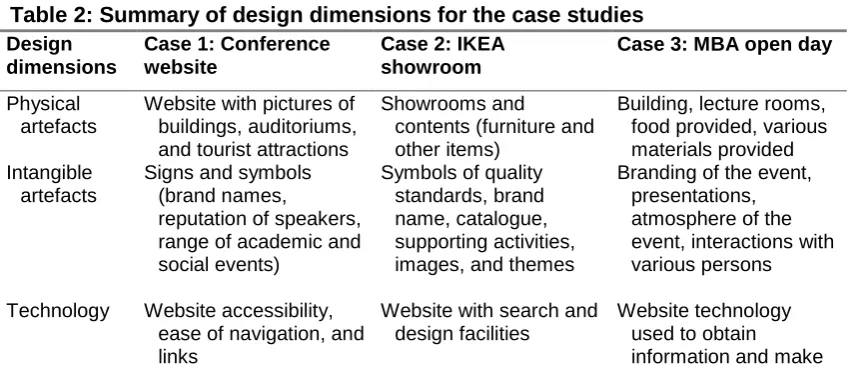
Although it had been planned to utilise the five design dimensions of service „test drives‟ suggested by Edvardsson et al. (2005) to analyse the case studies, it became apparent, especially in Cases 2 and 3, that an additional dimension („interaction with employees‟) also had a strong impact on the prospective customers‟ „test-drive‟ experiences.
It was therefore decided to add this sixth design dimension to the other five dimensions
(„physical artefacts‟; „intangible artefacts‟; „technology‟; „customer placement‟; and „customer involvement‟). Table 2 summarises the three „test drives‟ in terms of these six dimensions.
Table 2: Summary of design dimensions for the case studies
Design dimensions
Case 1: Conference website
Case 2: IKEA showroom
Case 3: MBA open day
Physical artefacts
Website with pictures of buildings, auditoriums, and tourist attractions
Showrooms and
contents (furniture and other items)
Building, lecture rooms, food provided, various materials provided Intangible
artefacts
Signs and symbols (brand names,
reputation of speakers, range of academic and social events)
Symbols of quality standards, brand name, catalogue, supporting activities, images, and themes
Branding of the event, presentations, atmosphere of the event, interactions with various persons Technology Website accessibility,
ease of navigation, and links
Website with search and design facilities
booking; technology used in classroom Customer
placement
Customers artificially placed in the
conference through the website
Customers placed within the showrooms and encouraged to envisage themselves living in it. Interaction with their families and staff members.
Customer placed in real environment with opportunity to interact with facilities, staff, and other students
Customer involvement
Customers involved with navigating and using website
Customers involved in creating the experience through direct physical contact with the room, its contents, and information provided
Customer involved in active discussion with students and staff
Interaction with employees
No interaction with employees
Interaction with staff for more complex „solutions‟. Interaction with administrative and academic staff
6. Discussion
6.1 Analysis in terms of dimensions
The „physical artefacts‟ had an important role to play in all the cases studied here. Even in the case of the most „artificial‟ of the „test drives‟, the conference website, customers were
able to infer a great deal from the numerous evocative pictures of such physical artefacts as
the auditoriums and hotels.
Another critical dimension, especially in the second and third cases, was „interaction with employees‟. These personal interactions were perceived by many customers as key
drivers of the experience and significant factors in their decision-making. Organisations
designing „test drives‟ should therefore enhance opportunities for interaction, even through
websites.
It would seem that consideration of the design dimensions of experience rooms for
service „test drives‟ needs to take account of differing contextual situations. For some service contexts (such as the IKEA showroom and the MBA open day), „interaction with employees‟
was a crucial dimension, whereas for the conference website, it was apparent that
„technology‟ was a more important dimension. Another aspect of the context is the customer‟s familiarity with the service and his or her perception of its complexity. In two of
the cases studied here (the conference website and the IKEA showroom), customers had
visited the sites a number of times. Designers should take note of this and ensure that their
„test drives‟ are renewed and refreshed over time to create new experiences for repeat
customers.
6.2 Value in pre-use
service. According to Vargo and Lusch (2004a), the value of an experiential service can only
be determined by the user in the „consumption‟ of the service; however, the findings of the present study would suggest that, in the case of „test drives‟, some value is derived from the
pre-service experience of the „test drive‟. The customer appears to infer a certain potential
value that might subsequently be obtained from the „real‟ service experience. The present
study suggests that this potential value could be referred to as value in pre-use.
In making a judgment about such „value in pre-use‟, customers appear to make inferences from the „hyper-real‟ service to the „real‟ (but not yet experienced) service. In
doing so, customers interpret symbols (such as brands), physical artefacts (such as layout
and furniture) and atmosphere (such as lighting and décor) and infer that the value
associated with them will also be derived from the real service (if it is subsequently
consumed). By designing service „test drives‟ that are as close as possible to the real
situation, service providers will optimise the „value in pre-use‟ as perceived by a potential
customer who experiences a service „test drive‟.
6.3 Advantages and disadvantages of ‘test drives’
It is apparent from the above findings that the „test drives‟ of service experiences in these
cases offered benefits to both providers and prospective customers; however, it is also
apparent that certain limitations existed. Designers of such service „test drives‟ need to be
aware of both the benefits and the limitations in seeking to enhance the advantages and
mitigating the disadvantages of these novel marketing initiatives.
6.3.1 Advantages
It is apparent that the QMOD website was largely successful in providing potential customers
with information (including pictures and links to other websites) in a manner that gave them a
„feel‟ for the nature of the conference. In the case of the IKEA showroom, the „test drive‟
provided an opportunity for potential customers to explore, in consultation with family and
staff, possible „solutions‟ to real-life problems at home. In the case of the MBA open day,
students were enabled to clarify their expectations by interacting with students and staff and
actually experiencing the learning style and culture of the school.
In summary, the key advantages for customers of the „service test drives‟ examined in
these cases were:
enabling some experience of the service without having to make a purchase;
facilitating more informed choices; and
reducing the risk of purchase and increasing consumers‟ trust in the
organisation.
For the service providers, the advantages of having customers take a „test drive‟
providing a vivid demonstration of the potential value of the service offering;
clarifying customer expectations regarding the service offering;
providing the organisation with useful information that it otherwise might not
have regarding the appropriate management and marketing of its services; and
potentially increasing sales and conversion rates.
6.3.2 Disadvantages
Despite the apparent benefits of the „test drives‟ examined in these cases, it was also
apparent that certain problems existed. In the case of the QMOD website, some consumers
expressed dissatisfaction with the information that was provided and the technical aspects of
the website (regarding navigation, download, and so on). Some respondents also reported
feelings of low involvement with the „experience‟ as a whole. In the case of the IKEA store,
the main disadvantages were experienced by the staff, who felt that many customers had no
intention of buying at the time and were merely visiting the store for a „day out‟. With regard
to the MBA open day, the disadvantages were: (i) that too few prospective students (in
particular, international students) had an opportunity to attend;. (ii) that the shared learning
experience at the open day is an inadequate experience of the real study pressures that
students will experience; (iii) that some of the prospective applicants might not get through
the subsequent selection process, thus lowering the quality of the „test-drive‟ experience for
more able students; and (iv) that some representatives of the school who participated in the
event failed to demonstrate the „friendly, caring, and approachable‟ approach that the school desired to project to prospective students during the „test drive‟.
In summary, the main disadvantage of the „test drives‟ from the customer‟s point of view were related to the fact that the „test drive‟ can never be exactly the same as the real
service. This limitation has the potential to produce the following disadvantages for potential
customers:
the possibility of having misleading, negative, or inappropriate experiences;
time and place constraints that limit access for some customers (especially for
„test drives‟ that are less artificial and simulated); and
the possibility that the „test drive‟ might contain some elements that are not
present in the real service (and excluding some that are in the real service).
From the organisation‟s point of view, the main disadvantages apparent from these
case studies were:
the possibility that the artificiality of the „test drive‟ might project false messages
about the actual service;
the possibility that some customers might be actually discouraged from making
the possibility that time and resources might be wasted on non-purchasers who
simply seek experiences without any intention of purchase.
7. Managerial implications
The findings of this study have implications for marketing managers who wish to design „test drives‟ for potential customers of their services. Seven principles for the design and use of service experience „test drives‟ are suggested from this study.
First, it is apparent that value-in-use can be inferred prior to consumption—which this
study has termed „value in pre-use‟. Using the „test drive‟, potential customers can imagine (or „pre-use‟) a service—such as a conference, home-interior solutions, or an MBA programme—within certain constraints. The results suggest that value-in-use can be assessed (or at least inferred) before purchase and consumption—provided that the experience room is designed in the „right‟ way. The „right‟ way will, of course, differ from case
to case; however, in general terms, the experience should be designed in a manner that
enables the customer to make appropriate inferences about the value-in-use of the real
service. This requires careful attention to all aspects (functional, emotional, and behavioural)
of the „test-drive‟ experience.
The second principle to be noted in designing „test drives‟ is that many customers
choose to involve others in a „test-drive‟ experience. It was apparent from the present study
that many people who used the „test drives‟ chose to involve trusted confidants and/or those who would be involved in the „real‟ service if it were subsequently purchased. From the
perspective of the customer, this enabled them to obtain a second opinion from a trusted
source before making a purchase decision. From the perspective of the service provider, this
also provides an opportunity to create value-in-use among other potential customers (the
customers‟ friends and family). Given the involvement of other people in the co-creation of value during the „test drive‟, managers should take every opportunity to involve their own
experts and employees in the collaborative co-creation of the service experience before
purchase and consumption.
The third principle to be noted in designing service „test drives‟ is that different
customers pay attention to different design dimensions. Managers should therefore be
aware that a variety of activities, interactions, and mental imagery should be utilised in
designing a „test drive‟. Tangible factors (such as buildings and equipment) might be
important for some potential customers, whereas interaction with staff and other customers
might be more important for others. Intangible artefacts (such as image, themes, and brand
name) appeared to be less important in the present study, but they should still be embedded
The fourth principle to be observed in designing „test drives‟ is that building trust is extremely important—especially in „credence services‟ (such as those studied in the present cases). A „test drive‟ can play a key role in enabling customers to assess the risks of a
credence service, and thus build trust. This can be augmented by customer-to-customer
interactions and interactions with helpful service personnel. The utilisation of trusted brand
images (through appropriate intangible artefacts) can also be important in this process. In all
of the cases studied here, the „test drives‟ played a key role in reducing perceptions of risk
and building trust.
The fifth principle to be observed in designing „test drives‟ is to recognise that
customers differ in terms of their prior experiences, knowledge, skills, needs, and wants.
This has implications for the design dimensions of the „test drive‟, which must be flexible
enough to accommodate the different needs, expectations, and behaviours of customers. In
addition, the customer‟s response to the „hyper-real‟ service experience can be noted by the
service provider in learning more about the unspoken latent needs of customers, thus
enabling the development of potentially valuable new services in future.
The sixth principle to be observed is that the dimensions of the „test drive‟ must be
contextualised. Although the six design dimensions identified in this study („physical
artefacts‟; „intangible artefacts‟; „technology‟; „customer placement‟; „customer involvement‟, and „interaction with employees‟) provide a useful framework for designing the key elements of a „test drive‟, the actual construction of a particular experience in a given situation must be
based on: (i) what the customers want to test (and how they prefer to carry out the test); and
(ii) the firm‟s overall business model and service strategy. The provider‟s ambition must be to
enable a realistic service experience within the context of customer preferences and the
firm‟s strategic objectives.
The final principle to be observed in designing a „test drive‟ is recognition that every „test drive‟ involves some degree of artificiality, which might cause some customers to obtain
false impressions. Every attempt should be made to ensure realistic customer expectations,
but resources should not be wasted on „test-drive tourists‟.
8. Conclusions and implications for future research
The objective of this exploratory study was to analyse the relatively new phenomenon of „test drives‟ of service offerings in a variety of service contexts by applying certain design dimensions of „experience rooms‟, as suggested by Edvardsson et al. (2005), in order to develop some principles to guide designers of such „test drives‟.
In terms of its academic contribution, the study has achieved its main objective by
applying the design framework to an analysis of varied services—thus demonstrating how
through „test drives‟ to their customers. In addition, the study has developed the
five-dimensional framework of Edvardsson et al. (2005) by adding a new dimension. The study
thus concludes that six dimensions should be taken into consideration in designing and
analysing such „test drives‟ of service experiences: (i) „physical artefacts‟; (ii) „intangible artefacts‟; (iii) „technology‟; (iv) „customer placement‟; (v) „customer involvement‟; and (vi) „interaction with employees‟.
The study has also made an important contribution to marketing theory by introducing
the notion of value in pre-use to describe the potential value of „real‟ services yet to be
purchased. Such „value in pre-use‟ can be inferred by consumers who experience a „test drive‟ that is well designed to provide a vivid image of a real consumption experience.
The study has also contributed to the literature on service design and new service
development by suggesting that data from „test drives‟ can be used to obtain a better
understanding of customer needs, which can be utilised to stimulate and guide the
development of new services.
In terms of practical managerial implications, the study has suggested seven principles
to guide the design of „test drives‟ of service experiences. It is the contention of this study that the design and implementation of „experience rooms‟ for service „test drives‟ has major implications for marketing in a wide variety of service sectors. The provision of service „test drives‟ has the potential to be a powerful means of understanding customers, designing new
services, and converting possible customers to actual customers.
This study has many acknowledged limitations. First, it is acknowledged that the study
focused on the responses of customers, rather than the provider‟s motives and intentions with regard to the provision of „test drives‟. Secondly, the exploratory and interpretive nature
of the research, and the limited number of cases and respondents, restricts generalisation of
the conclusions to other service contexts; however, the methodology of the study has
enabled the formulation of general principles that might be applicable to other contexts.
In view of these acknowledged limitations, there are therefore opportunities for future
studies to: (i) undertake research in a wider variety of service contexts; (ii) make
comparisons between the provider‟s perspective and the customer‟s perspective; (iii)
undertake in-depth studies of individual design dimensions (and the interdependencies
between them) in a variety of services that entail varying degrees of artificiality in their „test drives‟; (iv) investigate business services (in addition to the business-to-consumer services studied here); (v) identify the main drivers of the ‟test-drive‟ experience
(as defined by various customers); and (vi) determining the influence of these drivers on the
References
Baudrillard, J., (1994) Simulacra and Simulation, The University of Michigan Press, Ann Arbor.
Bendapudi, N., and Leone, R. P., (2003), Psychological Implications of Customer Participation in Co-Production, Journal of Marketing, 67 (1), 14-28.
Berry, L., Carbone, L. and Haeckel, S., (2002) Managing the total customer experience, MIT Sloan Management Review, 43 (3), 85-89.
Bitner, M-J., (1992), “Servicescapes: The Impact of Physical Surroundings on Customers and Employees”, Journal of Marketing, 56 (2l), 57-71.
Brignall, Stan T. J., Lin Fitzgerald, Robert Johnston, and Eleni Markou, (1999), Improving Service Performance: A Study of Step-Change Versus Continuous Improvement, CIMA, London.
Dahlgaard, J (2003), QMOD - The management challenge for the new millennium, European Quality, 10 (3) 10-14
DeSancris, G., and Monge, P., (1990), Communication processes for virtual organizations,
Organization Science, 10 (6), 693-703.
Edvardsson, B., and Enquist, B., (2002), The IKEA SAGA- How Service Culture Drives Service Strategy, The Service Industries Journal, 22 (4), 153-186.
Edvardsson, B., Enquist, B., and Johnston, R., (2005), Co-Creating Customer Value Through Hyperreality in the Pre-purchase Service Experience, Journal of Service Research, 8 (2), 149-161.
Glaser, B.G., (1995), Grounded Theory: 1984-1994, Sociology Press, Mill Vallet, CA.
Grove, S.J., and Fisk, R.P., (1997), “The impact of other customers on service experiences,”
Journal of Retailing, 73 (1), 63-85.
Hirshman, E. C. and Holbrook, M. B., (1982), Hedonic Consumption: Emerging Concepts, Methods and Propositions, Journal of Marketing, 46 (3), 92-101.
Johnston, R. and Mehra S., (2002), Best Practice Complaint Management, The Academy of Management Executive, 16 (4), 145-155.
Johnston, R., and Clark, G., (2008), Service Operations Management, FT Prentice Hall. London
Lusch, R.F., Vargo, S.L. and O´Brien, M.O. (2007), Competing through service: Insights from service-dominant logic. Journal of Retailing 83 (1), 5-18.
Martin, B. A. S., (2004) “Using the Imagination: Consumer Evoking and Thematizing of the Fantastic Imaginary”, Journal of Consumer Research, 31 (1), 136-149.
Mattila, Anna S. and Cathy A. Enz (2002), "The Role of Emotions in Service Encounters,"
Journal of Service Research, 4 (4), 268-277.
Meyer, C. and Schwager A., (2007), “Understanding Customer Experience”, Harvard Business Review, 85 (2), 116-126.
Meyer, D., (2007), Setting the Table, Harper Collins, New York.
Normann, R., (2001), Reframing Business.When the Map Changes the Landscape. John Wiley & Sons, New York.
Prahalad, C.K. and Ramaswamy V., (2004), The Future of Competition – Co-Creating
Unique Value with Customers, Harvard Business School Press, Boston.
Pullman, Madeleine E. and Michael A. Gross (2004), "Ability of experience design elements to elicit emotions and loyalty behaviors," Decision Sciences, 35 (3), 551-578.
Rafaeli, A. and Vilnai-Yavetz, I., (2004), Emotion as a Connection of Physical Artifacts and Organizations, Organization Science, 15 (4), 671-686.
Santos, J., (2003), E-service quality: a model of virtual service quality dimensions, Managing Service Quality, 13 (3), 233-246.
Schembri, S. (2006) “Rationalizing service logic, or understanding services as experience?
Sherry, Jr J. (ed), (1995), Contemporary Marketing and Consumer Behaviour. An Anthropological Sourcebook. Sage Publications, London.
Strauss, A. L., and Corbin, J. M., (1990), Basics of Qualitative Research: Grounded Theory Procedures and Techniques, Newbury, CA: Sage Publications
Swaminathan, V, G M Zinkhan and S K Reddy, (1996), The Evolution and Antecedents of Transformational Advertising: A Conceptual Model, Advances in Consumer Research, 23, 49-55.
Turner, J. W. Thomas, R. J. and Gailiun, M., (2001), Consumer response to virtual service organisations: The case of telemedicine, International Journal of Medical Marketing, 1 (4), 309-318.
Vargo, S. L. and Lusch, R. F., (2004), Evolving to a New Dominant Logic of Marketing,
Journal of Marketing, 68 (1) 1-17.
Vargo, S. L. and Lusch, R. F., (2008), Service-dominant logic: continuing the evolution ,
Journal of the Academy of Marketing Science, 36 (1) 1-10.
Venkatesh, A., (1999), Postmodernism Perspectives for Macromarketing: An Inquiry into the Global Information and Sign Economy, Journal of Macromarketing, 18 (2) 153-169. Voss, Christopher, Aleda V. Roth, and Richard B. Chase (2008), "Experience, Service
Operations Strategy, and Services as Destinations: Foundations and Exploratory Investigation," Production and Operations Management, forthcoming.
Yin, Robert K., (2003), Case Study Research: Design and Methods, 3rd ed., Sage Publications, Thousand Oaks, California.