publisher policies. Please scroll down to view the document itself. Please refer to the repository record for this item and our policy information available from the repository home page for further information.
To see the final version of this paper please visit the publisher’s website. Access to the published version may require a subscription.
Author(s): Eddie Gray, Marcia Pinto, Demetra Pitta and David Tall
Article Title: Knowledge construction and diverging thinking in elementary & advanced mathematics
Year of publication: 1999
Link to published version: http://dx.doi.org/10.1023/A:1003640204118
in Elementary & Advanced Mathematics
Eddie Gray, Marcia Pinto, Demetra Pitta, David Tall
ABSTRACT: This paper begins by considering the cognitive mechanisms available to individuals which enable them to operate successfully in different parts of the mathematics curriculum. We base our theoretical development on fundamental cognitive activities, namely, perception of the world, action upon it and reflection on both perception and action. We see an emphasis on one or more of these activities leading not only to different kinds of mathematics, but also to a spectrum of success and failure depending on the nature of the focus in the individual activity. For instance, geometry builds from the fundamental perception of figures and their shape, supported by action and reflection to move from practical measurement to theoretical deduction and euclidean proof. Arithmetic, on the other hand, initially focuses on the action of counting and later changes focus to the use of symbols for both the process of counting and the concept of number. The evidence that we draw together from a number of studies on children’s arithmetic shows a divergence in performance. The less successful seem to focus more on perceptions of their physical activities than on the flexible use of symbol as process and concept appropriate for a conceptual development in arithmetic and algebra.
Advanced mathematical thinking introduces a new feature in which concept definitions are formulated and formal concepts are constructed by deduction. We show how students cope with the transition to advanced mathematical thinking in different ways leading once more to a diverging spectrum of success.
1. CONSTRUCTING MATHEMATICAL KNOWLEDGE
Mathematical development occurs in a biological brain. To enable a structure with complex simultaneous activity to pursue sequential thought in a coherent way requires a special mechanism. Crick suggests:
The basic idea is that early processing is largely parallel: a lot of different activities proceed simultaneously. Then there appear to be one or more stages where there is a bottleneck in information processing. Only one (or a few) “object(s)” can be dealt with at a time. This is done by temporarily filtering out the information coming from the unattended objects. The attention system then moves fairly rapidly to the next object, and so on, so that attention is largely serial (i.e. attending to one object after another) not highly parallel (as it would be if the system attended to many things at
once). (Crick, 1994, p. 61)
are “small enough” to be considered at one time. It also requires that each of these elements be appropriately linked to other relevant structures in the huge memory store to allow it speedily to become a new focus of attention as required.
One method to cope with the complexity of a sequence of activities is repetition and practice until it becomes routine and can be performed with little conscious thought. This frees the conscious memory to focus on other items (Skemp, 1979). For instance, in using tools, the techniques become part of unconscious activity whilst the individual can focus on more utilitarian or aesthetic issues. Although such repetition and interiorisation of procedures has been seen as an essential part of mathematics learning, for decades it has been known that it has made no improvement in the understanding of relationships (see for example, Thorndike, 1922; Brownell, 1935). More importantly, if used exclusively, it may lead to a form of procedural thinking that lacks the flexi-bility necessary to solve novel problems (see for example, Schoenfeld, 1992).
A more powerful method of dealing with complexity is through the human use of language. Here a single word can stand not only for a highly complex structure of concepts and/or processes but also for various levels in a conceptual hierarchy. Perception of figures is at the foundation of geometry, but it takes the power of language to make hierarchical classifications. Figures are initially perceived as gestalts but then may be described and classified through verbalising their properties, to give the notions of points, lines, planes, triangles, squares, rectangles, circles, spheres, etc. Initially these words may operate at a single generic level, so that a square (with four equal sides and every angle a right angle) is not considered as a rectangle (with only opposite sides equal). Again, through verbal discussion, instruction and construction, the child may begin to see hierarchies with one idea classified within another, so that “a square is a rectangle is a quadrilateral”, or “a square is a rhombus is a parallelogram is a quadrilateral”. The physical and mental pictures supported by linguistic descriptions may become conceived in a more pure, imaginative way. Points have “position but no size”, straight lines are truly straight, with “no thickness and arbitrary length”, a circle is the locus of a point a fixed distance from the centre and so on. Such a development leads to platonic mental constructions of objects and the development of Euclidean geometry and Euclidean proof. Thus, a focus on perceived objects leads naturally through the use of language to platonic mental images and a form of mathematical proof (as in Van Hiele, 1959, 1986).
“there are …three.” It is thus natural to use the word “three” not just as a counting word, but also as a number concept. By this simple device, the counting process “there are one, two, three,” is compressed into the concept “there are three.” (Gray and Tall, 1994).
This compression is powerful in quite a different way from the compression in geometric thinking. In geometry, a word represents a generic concept (say “square”) in a hierarchy of concepts. In arithmetic the number word is also part of a hierarchy (a counting number is a fraction is a rational number is a real number). However, the major biological advantage of numbers arises not from this hierarchy but from the way in which the number words can be used to switch between processes (such as counting or measuring) and concepts (such as numbers). Not only are number symbols “small enough” to be held in the focus of attention as concepts, they also give immediate access to action schemas (such as counting) to carry out appropriate computations. In the biological design of the brain, they act not only as economical units to hold in the focus of attention, they also provide direct links to action schemas.
When numbers have become conceived as mental entities, they may themselves be operated upon. For instance, two numbers may be added to give their sum through a development that again involves a process of compression. The addition of two numbers begins as “count-all”, involving three counting stages: “count one set, count another, put them together and count them all”. This is compressed through various stages including “count-on”, where the first number is taken as the starting value and the second is used to count-on to give the result. Some of these results are committed to memory to give “known facts”. They may then be used in a conceptual way to “derive facts”, for instance, knowing that 5+5 is 10, to deduce that 5+4 is one less, namely, 9.
1.1 Piaget’s three forms of abstraction
Piaget spoke of three forms of abstraction. When acting on objects in the external world, he speaks first of empirical abstraction, where the focus is on the objects themselves and “derives its knowledge from the properties of objects” (Beth & Piaget, 1966, pp. 188-189). On the other hand, a focus on the actions leads to pseudo-empirical abstraction which “teases out properties that the action of the subjects have introduced into objects” (Piaget, 1985, pp. 18-19). Further constructions can then be accomplished by reflective abstraction, using existing structures to construct new ones by observing one’s thoughts and abstracting from them. In this way:
… the whole of mathematics may therefore be thought of in terms of the construction of structures,... mathematical entities move from one level to another; an operation on such ‘entities’ becomes in its turn an object of the theory, and this process is repeated until we reach structures that are alternately structuring or being structured by ‘stronger’ structures. (Piaget, 1972, p. 703)
Note here that reflective abstraction seems to be formulated as a mental version of “pseudo-empirical abstraction”, in which an “operation” on a mental entity becomes in its turn an “object” at the next level. Some authors (for example, Dubinsky, 1991) have taken this to mean that reflective abstraction only occurs by processes becoming conceived as conceptual entities through a process of “encapsulation” or “reification”. Given Piaget’s two notions of abstraction from the physical world, the question naturally arises as to whether there are corresponding forms of reflective abstraction focusing on mental objects and on mental actions. Our analysis would support this position. In the cognitive development of geometry, there is a clear shift from the mental conception of a physical triangle to the mental construction of a perfect platonic triangle. The former is imagined drawn on paper, with lines having thickness joining points having size, the latter has perfectly straight edges with no thickness and vertices with position but no size. We therefore suggest that there are (at least) two forms of reflective abstraction, one focusing on objects, occurring, for instance, in Euclidean geometry, the other focusing on actions on objects (usually represented by symbols), for instance, in arithmetic, algebra and the calculus.
Our focus on perception, action and reflection is therefore consistent with Piaget’s three notions of abstraction, with the additional observation that reflective abstraction has a form which focuses on objects and their properties, as well as one which focuses on actions and their encapsulation as objects.
1.2 Theories of process-object transformation
Dubinsky and his colleagues (e.g. Cottrill et al. 1996) formulate a theory which they give the acronym APOS, in which actions are physical or mental transformations on objects. When these actions become intentional, they are characterised as processes that may be later encapsulated to form a new object. A coherent collection of these actions, processes and objects, is identified as a schema. In more sophisticated contexts, empirical evidence also intimates that a schema may be reflected upon and acted on, resulting in the schema becoming a new object through the encapsulation of cognitive processes (Cottrill et al, 1996, p.l72).
Sfard (1991, p. 10) suggests that “in order to speak about mathematical objects, we must be able to deal with the products of some processes without bothering about the processes themselves”. Thus we begin with “a process performed on familiar objects” (Sfard and Linchevski, 1994, p 64). This is then “condensed” by being seen purely in terms of “input/output without necessarily considering its component steps” and then “reified” by converting “the already condensed process into an object-like entity.” Sfard postulates her notion of “reification” within a wider theory of operational and structural conceptions, the first focusing on processes, the second on objects (Sfard, 1989, 1991, 1994). In several papers she emphasises that the operational approach—constructing new objects through carrying out processes on known objects usually precedes a structural approach to the new objects themselves.
Such theories, which see the construction of new mental objects through actions on familiar objects, have a potential flaw. If objects can only be constructed from cognitive actions on already established objects, where do the initial objects come from?
Piaget’s theory solves this problem by having the child’s preliminary activities involving perception and action of the physical world. Once the child has taken initial steps in empirical or pseudo-empirical abstraction to construct mental entities, then these become available to act upon to give a theoretical hierarchy of mental constructions.
Sfard’s theory concentrates on later developments in older individuals who will already have constructed a variety of cognitive objects. Dubinsky also concentrates on undergraduate mathematicians. However, the APOS theory is formulated to apply to all forms of object formation. Dubinsky, Elterman & Gong (1988, p. 45), suggest that a “permanent object” is constructed through “encapsulating the process of performing transformations in space which do not destroy the physical object”. This theory therefore follows Piaget by starting from initial physical objects that are not part of the child’s cognitive structure and theorises about the construction of a cognitive object in the mind of the child. It formulates empirical abstraction as another form of process-object encapsulation.
therefore designed to formulate a theory of encapsulation covering all possible cases of mental construction of cognitive objects.
Our analysis has different emphases. We see the differences between various types of mathematical concept formation being as least as striking as the similarities. For instance, the construction of number concepts (beginning with pseudo-empirical abstraction) follows a very different cognitive development from that of geometric concepts (beginning with empirical abstraction) (Tall, 1995). In elementary mathematics, we see two different kinds of cognitive development. One is the van Hiele development of geometric objects and their properties from physical perceptions to platonic geometric objects. The other is the development of symbols as process and concept in arithmetic, algebra and symbolic calculus. It begins with actions on objects in the physical world, and requires the focus of attention to shift from the action of counting to the manipulation of number symbols. From here the number symbols take on a life of their own as cognitive concepts, moving on to the extension and generalisations into more sophisticated symbol manipulation in algebra and calculus. Each shift to a new conceptual domain involves its own subtle changes and cognitive reconstructions, however, what characterises these areas of elementary mathematics is the use of symbols as concepts and processes to calculate and to manipulate.
1.3 A new focus in advanced mathematical thinking
When formal proof is introduced in advanced mathematical thinking, a new focus of attention and cognitive activity occurs. Instead of a focus on symbols and computation to give answers, the emphasis changes to selecting certain properties as definitions and axioms and building up the other properties of the defined concepts by logical deduction. The student is often presented with a context where a formal concept (such as a mathematical group) is encountered both by examples and by a definition. Each of the examples satisfies the definition, but each has additional qualities, which may, or may not, be shared between individual examples. The properties of the formal concept are deduced as theorems, thus constructing meaning for an overall umbrella concept from the concept definition. This didactic reversa1—constructing a mental object from “known” properties, instead of constructing properties from “known” objects causes new kinds of cognitive difficulty.
1.4 A theoretical perspective
The preceding discussion leads to a theory of cognitive development in mathematics with two fundamental focuses of attention—object and action—together with the internal process of reflection. In line with Piaget we note the different forms of abstraction which arise from these three: empirical abstraction, pseudo-empirical abstraction and reflective abstraction. However, we note that reflective abstraction itself has aspects that focus on object or on action.
We see abstraction from physical objects as being different from abstraction from actions on objects. In the latter case, action-process-concept development is aided by the use of symbol as a pivot linking the symbol either to process or to concept. Procepts occur throughout arithmetic, algebra and calculus, and continue to appear in advanced mathematical thinking. However, the introduction of axioms and proofs leads to a new kind of cognitive concept—one which is defined by a concept definition and its properties deduced from the definition. We regard the development of formal concepts as being better formulated in terms of the definition-concept construction. This focuses not only on the complexity of the definition, often with multiple quantifiers, but also on the internal conflict between a concept image, which “has” properties, and a formal concept, whose properties must be “proved” from the definitions.
We therefore see elementary mathematics having two distinct methods of development, one focusing on the properties of objects leading to geometry, the other on the properties of processes represented symbolically as procepts. Advanced mathematics takes the notion of property as fundamental, using properties in concept definitions from which a systematic formal theory is constructed.
2. DIVERGING COGNITIVE DEVELOPMENT IN ELEMENTARY MATHEMATICS 2.1 Divergence in performance
The observation that some individuals are more successful than others in mathematics has been evident for generations. Piaget provided a novel method of interpreting empirical evidence by hypothesising that all individuals pass through the same cognitive stages but at different paces. Such a foundation underlies the English National Curriculum with its sequence of levels through which all children pass at an appropriate pace, some progressing further than others during the period of compulsory education.
solutions to focus on essentials, and were able to provide alternative solutions. Average children remembered specific detail, shortened their solutions only after practice involving several of the same type, and generally offered only a single solution to a problem. Incapable children remembered only incidental, often irrelevant detail, had lengthy solutions, often with errors, repetitions and redundancies, and were unable to begin to think of alternatives.
Our research also shows a divergence in performance. We do not use the evidence collected to imply that some children are doomed forever to erroneous procedural methods whilst others are guaranteed to blossom into a rich mathematical conceptualisation. We consider it vital not to place an artificial ceiling on the ultimate performance of any individual, or to predict that some who have greater success today will continue to have greater success tomorrow. However, the evidence we have suggests that the different ways in which individuals process information at a given time can be either beneficial or severely compromising for their current and future development. A child with a fragmented knowledge structure who lacks powerful compressed referents to link to efficient action schemas will be more likely to have greater difficulty in relating ideas. The expert may see distilled concepts which can each be grasped and connected within the focus of attention. The learner may have diffuse knowledge of these conceptual structures which is not sufficiently compressed into a form that can be brought into the focus of attention at a single time for consideration.
Far from not working hard enough, the unsuccessful learner may be working very hard indeed but focusing on less powerful strategies that try to cope with too much uncompressed information. The only strategy that may help them is to rote-learn procedures to perform as sequential action schemas. Such knowledge can be used to solve routine problems requiring that particular technique, but it occurs in time and may not be in a form suitable for thinking about as a whole entity.
2.2 Focus on objects and/or actions in elementary mathematics
The observation that a divergence in performance exists in the success and failure of various students does not of itself explain how that divergence occurs. To gain an initial insight into aspects of this divergence, we return to our initial notions of perception, action and abstraction. We earlier discussed global differences between geometry (based on perception of figures, supported by action and extended through reflection), and arithmetic (based on actions of counting objects that are initially perceived and reflected upon). Now, within arithmetic we consider the effect of different emphases on action, perception and reflection.
as one of the great problems in learning mathematics, particularly if learning and teaching are approached from a representational context. Pitta and Gray (1997) showed that certain observed differences in children’s arithmetic performance could be linked to the learner’s focus either on objects, on actions, or on a combination of both.
To investigate the way in which children may focus on different aspects of a situation, Pitta (1998) placed five red unifix cubes before some seven-year-old children at the extremes of mathematical ability. She asked the children to indicate what they thought about when they saw the cubes and what they thought would be worth remembering about them. The four more able children all had something to say about the cubes using the notion of ‘five’. They all thought that ‘five cubes’ was worth remembering. In contrast, the four lower ability children talked about the pattern, the colour, or the possible rearrangements of the cubes and considered these to be worth remembering.
Different contexts require a focus of attention upon different things. Within an art lesson it may be important to filter out those things that may not immediately be seen to be part of an aesthetic context. Number may be one of these. In the mathematical context it is important to filter out those things that may not be seen to be mathematical. Yet, in the activity just considered, low achievers seemed less able to do this, continuing to focus on their concrete experience. High achievers, on the other hand, were able to separate the inherent mathematical qualities from the actual physical context. They could also, if required, expand their discussions to include other aspects of the activity, revealing cognitive links to a wider array of experience. Such differences may become manifest in the way in the activity is remembered. It is hypothesised that low achievers focus upon the physical aspects of the activity, which are assimilated in an episodic way. High achievers appear to focus upon the semantic mathematical aspects, which are accommodated in a generic way (Pitta & Gray, 1997).
2.3 The Proceptual Divide
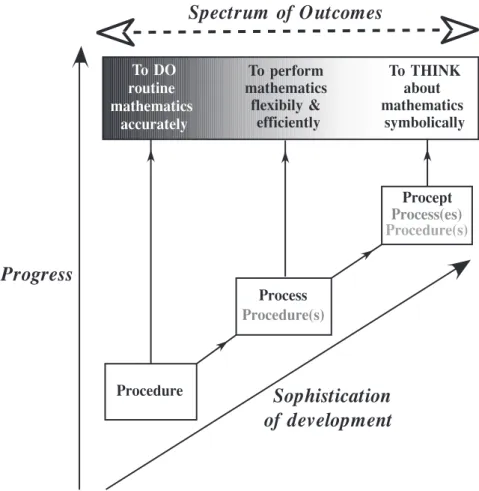
The divergence in success between extremes of success and failure can be usefully be related to the development of the notion of procept. Gray and Tall (1994) suggest that interpretations of mathematical symbolism as process or procepts leads to a proceptual divide between the less successful and the more successful. On the one hand, we see a cognitive style strongly associated with invoking the use of procedures, on the other a style more in tune with the flexible notion of procept. Those using the latter have a cognitive advantage; they derive considerable mathematical flexibility from the cognitive links relating process and concept. In practice, there is a broad spectrum of performance between different individuals in different contexts (figure 1).
develop greater sophistication by being able to use alternative procedures for the same process and to select a more efficient procedure to carry out the given task speedily and accurately. For instance, the procedure of “count-on from largest” is a quicker way of solving 2+7 (counting on 2 after 7 rather than counting-on 7 after 2). Baroody & Ginsburg (1986) suggest that growing sophistication arises from the recognition that a single mathematical process may be associated with several procedures. Woods, Resnick & Groen (1975) note that this element of “choice” can be indicative of increased sophistication. However, it is only when the symbols used to represent the process are seen to represent manipulable concepts that the individual has the proceptual flexibility both to do mathematics and also to mentally manipulate the concepts at a more sophisticated level (Gray & Tall, 1994).
In a particular case, all three levels (procedure, process, procept) might be used to solve a given routine problem. It might therefore be possible for individuals at different levels of sophistication to answer certain questions in a test at a certain level. However, this may be no indication of success at a later level because the procept in its distilled manipulable form is more ready for building into more sophisticated theories than step-by-step procedures. On the other hand, all too frequently, children are seen using procedures even when they are inappropriate, inefficient and unsuccessful (see for example Gray,
Procedure
Procept
Process(es) Procedure(s)
Process
Procedure(s) Progress
Sophistication of development To DO
routine mathematics
accurately
To perform mathematics flexibily &
efficiently
To THINK about mathematics
symbolically
Spectrum of Outcomes
1993). Those who operate successfully at the procedural level are faced with much greater complexity than their proceptual colleagues when the next level of difficulty is encountered.
2.4 Mental representations and elementary mathematics
The notion of a proceptual divide illustrates the extreme outcomes of different cognitive styles. We now turn to asking why such a difference occurs. To gain a partial answer to this question we now consider mental representations, particularly those in imaginistic form.
Pitta & Gray (1997) describe the way in which two groups of children, ‘low achievers’ and ‘high achievers’, report their mental representations when solving elementary number combinations. Differences that emerged showed the tendency of low achievers to concretise numbers and focus on detail. Their mental representations were strongly associated with the procedural aspects of numerical processing—action was the dominant level of operating (see also Steffe, Von Glasersfeld, Richards and Cobb, 1983). In contrast, high achievers appeared to focus on those abstractions that enable them to make choices.
The general impression was that children of different levels of arithmetical achievement were using qualitatively different objects to support their mathematical thinking. Low achievers translated symbols into numerical processes supported by the use of imaginistic objects that possessed shape and in many instances colour. Frequently they reported mental representations strongly associated with the notion of number track although the common object that formed the basis of each ‘unit’ of the track was derived from fingers. In some instances children reported seeing full picture images of fingers, in others it was ‘finger like’. The essential thing is that the object of thought was ‘finger’ and the mental use of finger invoked a double counting procedure. The objects of thought of the low achievers were analogues of perceptual items that seemed to force them to carry out procedures in the mind, almost as if they were carrying out the procedures with perceptual items on the desk in front of them. Pitta and Gray suggest that their mental representations were essential to the action; and they maintained the focus of attention. When items became more difficult, the children reverted to the use of real items.
instance when given 9+7 one eleven year old produced the answer 16 accompanied by the statement. “10 and 6 flashed through my mind”. Here we have vivid evidence of powerful mental connections moving from one focus of attention to another. Such a child evidently has flexible mental links between distilled concepts that allow quick and efficient solutions to arithmetic problems.
This ability to encapsulate arithmetical processes as numerical concepts provides the source of flexibility that becomes available through the proceptual nature of numerical symbolism. Recognising that a considerable amount of information is compressed into a simple representation, the symbol, is a source of mathematical power. This strength derives from two abilities; first an ability to filter out information and operate with the symbol as an object and secondly the ability to connect with an action schema to perform any required computation. We suggest that qualitative differences in the way in which children handle elementary arithmetic may be associated with their relative success. Different cognitive styles seem to indicate that differing perceptions of tasks encountered lead to different consequences, one associated with performing mathematical computations, the other associated with knowing mathematical concepts.
Mental representations associated with the former appear to be products of reflection upon the actions and the objects of the physical environment. One consequence of mathematical activity focusing upon procedural activity is that it would seem to place a tremendous strain on working memory. It does not offer support to the limited space available within short-term memory.
3. THE TRANSITION TO
ADVANCED MATHEMATICAL THINKING
Piaget’s notion of “formal operations” indicates the ability to reason in a logical manner:
Formal thought reaches its fruition during adolescence … from the age of 11–12 years … when the subject becomes capable of reasoning in a hypothetico-deductive manner, i.e., on the basis of simple assumptions which have no necessary relation to reality or to the subject’s beliefs, and … when he relies on the necessary validity of an inference, as opposed to agreement of the conclusions with experience. Piaget, 1950, p. 148. In a similar manner, the SOLO taxonomy identifies the formal mode of thinking where:
“The elements are abstract concepts and propositions, and the operational aspect is concerned with determining the actual and deduced relationships between them; neither the elements nor the operations need a real-world referent” Collis & Romberg, 1991, p. 90. However, often these ideas are applied by Piaget to imagined real-world events and in the SOLO taxonomy to logical arguments in traditional algebra, involv-ingrelationshipsbetweensymbolsthatnolongerneedhave a perceptual referent. The notion of advanced mathematical thinking is more subtle than this. It involves the creation of new mental worlds in the mind of the thinker which may be entirely hypothetical. Mathematicians do this by reflecting on their visual and symbolic intuitions to suggest useful situations to study, then to specify criteria that are necessary for the required situation to hold. This is done by formulating definitions for mathematical concepts as a list of axioms for a given structure, then developing other properties of this structure by deduction from the definitions. A considerable part of research effort is expended in getting these criteria precise so that they give rise to the required deduced properties. What is then produced is more than a verbal/symbolic list of definitions and theorems. Each individual theoretician develops a personal world of concept images and relationships related to the theory. These may include ideas that suggest what ought to be true in the given theory before necessarily being able to formulate a proof of what must follow from the definitions.
In practice, this often proves extremely difficult. Whereas mathematics researchers may have had experience at making new structures by constructing their own definitions, students are more likely to only be initially involved in using definitions which have been provided by others. Through their earlier life experiences they will have developed an image in which objects are “described” in words in terms of collecting together enough information to identify the object in question for another individual. The idea of giving a verbal definition as a list of criteria and constructing the concept from the definition is a reversal of most of the development in elementary mathematics where mathematical objects are thought to have properties which can be discovered by studying the objects and related processes. The move from the object→definition construction to definition→object construction is considered an essential part of the transition from elementary to advanced mathematical thinking.This definition→object construction involves selecting and using criteria for
the definitions of objects. This may reverse previous experiences of relationships. For instance, the child may learn of subtraction as an operation before meeting negative numbers and inverse operations. In formal mathematics the axioms for an additive operation in a group may specify the inverse –a of an element a and define subtraction b–a as the sum of b and –a. In this way the presentation of axiom systems as criteria for theoretical mathematical systems can strike foreign chords in the cognitive structure of the learner. Instead of proving results of which they are unsure by starting from something they know, they find they are trying to prove something they know starting from axioms which make them feel insecure.
Our experience of this learning process in mathematical analysis (Pinto & Gray, 1995; Pinto & Tall, 1996; Pinto, 1998) shows a spectrum of student performances signalling success and failure through following two comple-mentary approaches.
“I think of it graphically ... you got a graph there and the function there, and I think that it’s got the limit there ... and then _, once like that, and you can draw along and then all the ... points after N are inside of those bounds. ... When I first thought of this, it was hard to understand, so I thought of it like that’s the n going across there and that’s an. ... Err, this shouldn’t really be a graph, it should be points.”
(Chris, first interview)
As he drew the picture, he gestured with his hands to show that first he imagined how close he required the values to be (either side of the limit), then how far he would need to go along to get all successive values of the sequence inside the required range. He also explained:
“I don’t memorise that [the definition of limit]. I think of this
[picture] every time I work it out, and then you just get used to it. I can nearly write that straight down.” (Chris, first interview)
However, his building of the concept involved him in a constant state of reconstruction as he refined his notion of convergence, allowing it to be increasing, decreasing, up and down by varying amounts, or constant in whole or part, always linking to the definition which gave a single unifying image to the notion. During his reconstructions, he toyed with the idea of an increase in N causing a resultant reduction in the size of ε, before settling on the preference for specifying ε, then finding an appropriate N.
As an alternative to the “natural” approach, there is a second approach which Pinto (1998) termed “formal”. Here the student concentrates on the definition, using it and repeating it as necessary until it can be written down without effort. Ross, for example explained he learned the definition:
“Just memorising it, well it’s mostly that we have written it down quite a few times in lectures and then whenever I do a question I try to write down the definition and just by writing it down over and over again it gets imprinted and then I remember it.”
(Ross, first interview) He wrote:
(Ross, first interview)
links. However, it is also possible to develop the knowledge in a new compartment, not linked to old knowledge.
Both formal and natural learners can be successful in advanced mathematical thinking. However, they face different sequences of cognitive reconstruction. The natural learner may be in continuous conflict as (s)he reconstructs informal imagery to give rich meaning to the formal theory. The formal learner may have fewer intuitions to guide the way, but follows a course involving more new construction rather than reconstruction. At the end of the formalisation process, if the new knowledge is linked to the old imagery, then reconstruction is likely to be required at this stage.
Less successful students also have difficulties in different ways. Some (such as those in Gray & Pinto, 1995) saw the new ideas only in terms of their old meanings and could not make the transition to the use of definition as criteria for determining the concept. These could be described as natural learners who fail to reconstruct their imagery to build the formalism. Their informal concept image intimates to them that the theorems are “true” and they see no need to support informal imagery with what they regard as alien to both their need and their understanding.
Less successful students attempting the formal route may be unable to grasp the definition as a whole and cope with only parts of it. They may be confused by the complexity of multiple quantifiers, perhaps failing to give them their true formal meaning, perhaps confusing their purpose, perhaps concentrating only on a part of the definition.
It seems that the only way out for unsuccessful students, be they natural or formal learners, is to attempt to rote-learn the definitions.
Maths education at university level, as it stands, is based like many subjects on the system of lectures. The huge quantities of work covered by each course, in such a short space of time, make it extremely difficult to take it in and understand. The pressure of time seems to take away the essence of mathematics and does not create any true understanding of the subject. From personal experience I know that most courses do not have any lasting impression and are usually forgotten directly after the examination. This is surely not an ideal situation, where a maths student can learn and pass and do well, but not have an understanding of his or her subject.
Third Year Mathematics Student, (Tall, 1993a)
4. CONCLUSION
In elementary arithmetic we find that the less successful tend to remain longer focused on the nature of the objects, their layout and the procedures of counting. Our evidence suggests that less successful children focus on the specific and associate it to real and imagined experiences that often do not have generalisable, manipulable aspects. We theorise that this places greater strains on their overloaded short-term memory. A focus on the counting procedure itself can give limited success through procedural methods to solve simple problems. High achievers focus increasingly on flexible proceptual aspects of the symbolism allowing them to concentrate on mentally manipulable concepts that give greater conceptual power. The flexible link between mental concepts to think about and action schemas to do calculations utilise the facilities of the human brain to great advantage.
We see the transition to advanced mathematical thinking involving a transposition of knowledge structure. Elementary mathematical concepts have properties that can be determined by acting upon them. Advanced mathematical concepts are given properties as axiomatic definitions and the nature of the concept itself is built by deducing the properties by logical deduction. Students handle the use of concept definitions in various ways. Some natural learners reconstruct their understanding to lead to the formal theory whilst other, formal, learners build a separate understanding of the formalities by deduction from the concept definitions. However, many more can make little sense of the ideas, either as natural learners whose intuitions make the formalism seem entirely alien, or as formal learners who cannot cope with the complexity of the quantified definitions.
The theory we present here has serious implications in the teaching of elementary and advanced mathematics, in ways which have yet to be widely tested. The obvious question to ask is “how can we help students acquire more beneficial ways of processing information?”, in essence, “how can we help those using less successful methods of processing to become more successful?” Our instincts suggest that we should attempt to teach them more successful ways of thinking about mathematics. However, this strategy needs to be very carefully considered, for it may have the result that we teach procedural children flexible thinking in a procedural way. This scenario would have the effect of burdening the less successful child with even more procedures to cope with. It might tend to make their cognitive structure more complex rather than more flexible and more efficient.
graphic calculator, it was becoming clear in our interactions with her that she was associating a different range of meanings with numbers and numerical symbolism. She was beginning to build new images, symbolic ones that could stand on their own to provide options that gave her greater flexibility. The evidence suggests that if practical activities focus on the process of evaluation and the meaning of the symbolism they may offer a way into arithmetic that helps those children who are experiencing difficulty.
In the teaching of algebra, Tall & Thomas (1991) found that the act of programming could allow students to give more coherent meaning to symbolism as both process and concept. A computer language will evaluate expressions, so that, for instance, the learner may explore the idea that 2+3*x usually gives a different answer from (2+3)*x for numerical values of x. This can provide a context for discussing the ways in which expressions are evaluated by the computer. The fact that 2*(x+3), 2*x+2*3, 2*x+6, always give the same output, can be explored to see how different procedures of evaluation may lead to the same underlying process, giving the notion of equivalent expressions and laying down an experiential basis for manipulating expressions. This leads through a procedure – process – procept sequence in which expressions are first procedures of evaluation, then processes which can have different expressions producing the same effect, then concepts which can themselves be manipulated by replacing one equivalent expression by another.
In advanced mathematical thinking more research is required to test whether different methods of approach may support different personal ways to construct (and reconstruct) formal theory. Just as Skemp (1976) referred to the difficulty faced by a relational learner taught by instrumental methods (or vice versa), we hypothesises that there are analogous difficulties with natural learners being taught by formal methods (or vice versa). This suggests that more than one approach is required to teaching mathematical analysis. Some students may benefit from a study quite different from the traditional formal theory. For example, Tall (1993b) observed that a class of student teachers similar to those who failed to make any sense of the formalism (see Pinto & Gray, 1995) could construct natural insights into highly sophisticated ideas using computer visualisations even though this may not improve their ability to cope with the formal theory.
References
Baroody, A.J. & Ginsburg, H.P.: 1986, ‘The relationship between initial meaningful and mechanical knowledge of arithmetic’. In J. Hiebert (Ed.), Conceptual and Procedural Knowledge: The Case for Mathematics, (pp. 75–112), Hillsdale, N.J., Lawrence Erlbaum Associates.
Beth, E.W. & Piaget, J. :1966, Mathematical Epistemology and Psychology, (W. Mays, trans.), Reidel. Dordrecht (originally published 1965).
Brownell, W. A.: 1935, ‘Psychological considerations in the learning and teaching of
arithmetic’. In W. D. Reeve (Ed.), Teaching of Arithmetic, The Tenth Yearbook of the National Council of Teacher’s of Mathematics, Bureau of Publication, Teachers College, Columbia University.
Cobb, P., Yackel, E. & Wood, T: 1992, ‘A constructivist alternative to the representational view of mind in mathematics education’, Journal for Research in Mathematics Education 23, 2–23.
Collis., K. & Romberg, T.: 1991, ‘Assessment of mathematical performance: An analysis of open-ended test items’ (pp. 82–116). In C. Wittrock & E. Baker (Eds.), Testing and Cognition, New Jersey, Prentice-Hall.
Cottrill, J., Dubinsky, E., Nichols, D., Schwingendorf, K., Thomas, K., & Vidakovic, D.: 1996, ‘Understanding the limit concept: Beginning with a co-ordinated process schema’, Journal of Mathematical Behavior, 15, 167–192.
Crick, F.: 1994, The Astonishing Hypothesis, London: Simon & Schuster.
Davis, R. B.: 1984, Learning mathematics: the cognitive science approach to mathematics education. Norwood, NJ: Ablex.
Dienes, Z. P.: 1960, Building up Mathematics, London: Hutchinson Educational. Dubinsky E.: 1991, ‘Reflective Abstraction’, in D.O.Tall (Ed), Advanced Mathematical
Thinking, (pp. 95–123), Dordrecht: Kluwer Academic Publishers.
Dubinsky, E., Elterman, F. & Gong, C.: 1988, ‘The students construction of quantification’,
For the Learning of Mathematics, 8, 44–51.
Duffin, J. M. & Simpson. A. P.: 1993, ‘Natural, conflicting, and alien’, Journal of Mathematical Behaviour, 12, 313–328.
Gray, E.M.: 1993, ‘Count-on: The parting of the ways in simple arithmetic’. In I.
Hirabayashi, N. Hohda, K Shigematsu and Fou-Lai Lin (Eds.), Proceedings of XVII International Conference for the Psychology of Mathematics Education, Vol. I, 204–211, Tsukuba, Japan.
Gray, E.M.& Tall, D.O.: 1994, ‘Duality, ambiguity and flexibility: A proceptual view of simple arithmetic’, Journal for Research in Mathematics Education, 25, 2, 115–141. Gray, E.M. & Pitta, D.: 1997, ‘Changing Emily’s Images’, Mathematics Teaching, 161,
38–51
Greeno, J. (1983). Conceptual Entities. In D. Genter & A. L. Stevens (Eds.), Mental Models
(pp. 227–252), Hillsdale, NJ: Lawrence Erlbaum.
Harel, G., & Kaput, J.: 1992, ‘Conceptual entitities in advanced mathematical thinking: The role of notations in their formation and use’, in D.O.Tall (Ed), Advanced
Mathematical Thinking, (pp. 82–94), Dordrecht, Kluwer Academic Publishers. Krutetskii, V.A.: 1976, The Psychology of Mathematical Abilities in Schoolchildren, (Trans,
J. Teller; Eds., J. Kilpatrick & I. Wirzup). Chicago: University of Chicago.
Piaget, J.: 1950, The Psychology of Intelligence, (M. Piercy trans.), London, Routledge & Kegan Paul.
Piaget, J.: 1972, The Principles of Genetic Epistemology,(W. Mays trans.), London, Routledge & Kegan Paul.
Piaget, J.: 1985, The Equilibrium of Cognitive Structures, Cambridge Massechusetts: Harvard University Press.
Piaget, J. & Inhelder, B.: 1971, Mental imagery in the child, New York, Basic.
Pinto, M. M. F.: 1998, Students’ Understanding of Real Analysis, Unpublished Doctoral Thesis, Mathematics Education Research Centre, University of Warwick, UK. Pinto, M. M. F. & Gray, E.: 1995, ‘Difficulties teaching mathematical analysis to
Pinto, M. M. F. & Tall, D. O.: 1996, ‘Student teachers’ conceptions of the rational numbers’, in L. Puig and A Guitiérrez (Eds.), Proceedings of XX International Conference for the Psychology of Mathematics Education, Valencia, 4, 139–146.
Pitta, D. & Gray, E.: 1997,. ‘In the Mind. What can imagery tell us about success and failure in arithmetic?’, In G. A. Makrides (Ed.), Proceedings of the First Mediterranean Conference on Mathematics, Nicosia: Cyprus, pp. 29–41.
Pitta, D. & Gray, E.: 1997, ‘Emily and the supercalculator’, in E. Pehkonen (Ed.),
Proceedings of XXI International Conference for the Psychology of Mathematics Education, Lahti: Finland, 4, 17–25.
Pitta, D.: 1998, ‘In the mind. Internal representations and elementary arithmetic’,
Unpublished Doctoral Thesis, Mathematics Education Research Centre, University of Warwick, UK.
Schoenfeld, A.H.: 1992, ‘Learning to think mathematically: Problem solving, metacognition, and sense making in mathematics’, in D. A. Grouws (Ed.), Handbook of research on mathematics teaching and learning: A project of the National Council of Teachers of Mathematics, (pp. 334–370), New York: MacMillan.
Sfard, A.: 1989, ‘Transition from operational to structural conception: The notion of function revisited’, in G. Vergnaud, J. Rogalski, M. Artigue, (Eds.), Proceedings of X111 International Conference for the Psychology of Mathematics Education, Paris, France, Vol. 3, 151–158.
Sfard, A.: 1991, ‘On the dual nature of mathematical conceptions: Reflections on processes and objects as different sides of the same coin’, Educational Studies in Mathematics,
22, 1–36.
Sfard, A. & Linchevski, L.: 1994, ‘The gains and pitfalls of reification–the case of algebra’,
Educational Studies in Mathematics, 26, 191–228.
Skemp, R.R.: 1976, ‘Relational understanding and instrumental understanding’, Mathematics Teaching, 77, 20-26.
Skemp, R.R.:1979, Intelligence, Learning and Action, John Wiley & Sons, Chichester, U.K. Steffe, L., von Glaserfeld, E., Richards, J. & Cobb, P.: 1983, Children’s Counting Types:
Philosophy, Theory and Applications, Preagar, New York.
Tall, D. O.: 1991, Advanced Mathematical Thinking, Dordrecht: Kluwer.
Tall, D.O.: 1993a, ‘Mathematicians Thinking about Students Thinking about Mathematics’,
Newsletter of the London Mathematical Society, 202, 12–13.
Tall, D.O.: 1993b, ‘Real Mathematics, Rational Computers and Complex People’,
Proceedings of the Fifth Annual International Conference on Technology in College Mathematics Teaching, 243–258.
Tall, D. O.: 1995, ‘Cognitive growth in elementary and advanced mathematical thinking’, in D. Carraher and L. Miera (Eds.), Proceedings of X1X International Conference for the Psychology of Mathematics Education, Recife: Brazil. Vol. 1, 61–75.
Tall, D. O. & Vinner, S.: 1981, ‘Concept image and concept definition in mathematics with particular reference to limits and continuity’, Educational Studies in Mathematics, 12, 151-169.
Thorndike, E. L.: 1922, The Psychology of Arithmetic, New York: Macmillan.
Van Hiele, P. & D.: 1959, The child’s thought and geometry. Reprinted (1984) in D. Fuys, D. Geddes & R. Tischler (Eds.), English translation of selected writings of Dina van Hiele-Geldof and Pierre M. van Hiele, (pp.1–214), Brooklyn NY: Brooklyn College. Van Hiele, P.: 1986, Structure and Insight. Orlando: Academic Press.
Woods, S. S., Resnick, L. B. & Groen, G. J.: 1975, ‘An experimental test of five process models for subtraction’, Journal of Educational Psychology, 67, 17-21.