The effect of bystanders and social value
orientation on deception and
power affordances
Hugo Uiterwijk Winkel
Bachelor thesis
June 2017
Supervisors:
Dr. Marco van Bommel Dr. Elze Ufkes
Psychology of Conflict, Risk and Safety Faculty of Behavioural, Management and Social Sciences
2
Abstract
Lying and deceiving in a social interactive setting has broadly been investigated, but little research focused on the factors that motivate people to deceive in a pro-social context while in the presence of others. This study tries to shine light on the motivations why people would lie for the benefit of others, when other people are present. Furthermore it will assess the
influence of deception in the presence of others on perceived power affordances among potential perpetrators.
Participants were given the opportunity to lie either for personal benefit or for charity while in the presence and absence of others during a lab experiment. In total, 119 participants completed a practical task and answered surveys including items that measure social value orientation and power affordances. During this task participants were told they could earn money, either for personal gain or charity. 15 images were presented to the participants. In each image there were one or more errors. The participants could earn points by locating these errors in time. Scoring eight or higher, additional money could be earned. During this task, the researcher left the room. Afterwards he would ask if participants scored high enough to earn additional money, granting them the possibility to cheat. In one condition the game was played in the presence of other participants, in the other without others.
3 it is important to note the limitations of this study and to be careful when interpreting the conclusions regarding the effects of the independent variables on lying.
4
Samenvatting
Misleiding in sociale context is vaak onderzocht, echter is er weinig onderzoek dat zich focust op motiverende factoren om te liegen in een pro-sociale context in de aanwezigheid van anderen. Dit onderzoek probeert duidelijkheid te verschaffen over motiverende factoren om te liegen voor eigen gewin of dat van een ander in de aanwezigheid van anderen. Verder zal de invloed van misleiding in de aanwezigheid van anderen op waargenomen macht van
participanten worden onderzocht.
119 Participanten kregen de gelegenheid om voor eigen gewin of voor een goed doel te liegen in de aanwezigheid van anderen tijdens een lab experiment. Daarnaast hebben ze vragenlijsten met items die sociale waarde orientatie en machts veroorlovingen meten. Tijdens het
experiment werd participanten verteld dat ze geld voor zichzelf of een goed doel konden verdienen. 15 afbeeldingen werden aan participanten gepresenteerd. In elke afbeelding zat minimaal één fout. Door deze fouten op tijd te vinden, konden participanten geld verdienen. Bij een score van acht of hoger kond extra geld verdiend worden. De onderzoeker verliet tijdens de taak de ruimte. Na afloop vroeg hij participanten of ze genoeg hebben gescoord om extra geld te verdienen. Dit gaf ze de mogelijkheid om te liegen. In één conditie werd de taak volbracht in de aanwezigheid van derden, in de andere conditie waren participanten alleen.
6
Introduction
In 2005 the American Cancer Society received 1 million dollars from SmithKline Beecham, a nicotine patch producer, so they could use the ACS logo to promote their products. On the first glance this could be considered a very noble action since the American Cancer Society, not only motivates smokers to quit smoking, but also receives a substantial amount of money to invest in research. By allowing SmithKline Beecham to use ACS’ logo on their products, the American Cancer Society implied that SKB’s nicotine patches are more effective than other brands. This is a problem, since there is no evidence that suggests that this could be the case. By implying that SmithKline Beecham’s nicotine patches are more effective than generic brands, the American Cancer Society deceived the public (organicconsumers.org). Although the motives behind this deception remain unclear, one could even argue that this could be interpreted as pro-social fraud in the name of charity.
Lying and deceitful behavior in a social interactive context has broadly been
investigated. Although people have been known to tell pro-social lies in a social context, (for instance in order to make sure their conversational partner feels good about him-/herself) this type of deception was not researched in a context outside of social interactions. Little research has focused on the willingness to commit fraud for charity. This study aims to shine light on whether and why people might choose to lie for a charitable cause or for personal gain
instead. Furthermore it will be assessed if the presence or absence of bystanders has influence over this choice.
7 Routine activity theory
Routine activity theory (RAT) identifies three factors that might play a role in the likelihood that an offence is committed. For criminal behavior to take place, (1) a motivated offender, (2) a suitable target and (3) the absence of capable guardians are required (Cohen & Felson, 1979). In the case of a fraud situation, for instance a situation where a bank executive commits fraud, the offender (the perpetrator) is often clear, however, the suitable target can take many forms, in this case that of a bank. Coworkers such as bank clerks can be seen as (in-)capable guardians.
Bystanders
The concept of capable guardians has similarities with the concept of bystanders as mentioned in “Bystander intervention in emergencies: Diffusion of responsibility” by Darley and Latané (1968). According to the effect of diffusion of responsibility, bystanders are less likely to intervene when other people are present because they experience fewer feelings of
responsibility. When this concept were to be combined with the concept of capable guardians as mentioned in Routine Activity Theory (which seems to be the opposite), it can be noted that when capable guardians fail to intervene (possible due to diffusion of responsibility) and thus fail to be capable, they can be seen as bystanders (Cohen & Felson, 1979). For instance in the situation as mentioned above, bank clerks might have seen what happened but failed to act because they did not feel it was necessary since no one seemed to think it was.
Deception
In essence, fraud can be seen as a form of deception. Deception can be defined as a
8 Deception occurs on a daily base. According to DePaulo and Kashy (1998), people deceive on average at least once in every two conversations. Deceivers lie most about opinions, attitudes, preferences and emotions (DePaulo et al., 2003). However, the motives for lying are diverse.
Motives
There are several factors that can contribute to performing deceitful behavior. Some people might choose to deceive in order to seek personal gain. For instance, someone might choose to engage in deceitful behavior in order to gain status or financial gain, as is often the case with fraud (Aquino, Freeman, II, Lim & Felps, 2009).
Aside from the positive effect of personal gain, there are also negative consequences of norm-violating behavior such as lying to be taken into account. For example norm violators are more prone to have feelings of guilt and disappointment toward themselves (Costarelli, 2005). If there are negative consequences of norm violating behavior such as lying, then why do people still choose to deceive?
Apart from lying to benefit in status or in a financial way as mentioned earlier, deceivers lie for psychological reasons as well. In Fact, compared to motivations regarding personal gain and status, people are more prone to lie for psychological reasons (DePaulo et. al, 1996). These psychological reasons can be characterized as self-presentation, self-promotion and emotional motivations (Jones & Pittman, 1982; Burris, Rempel, Munteanu & Therrien, 2013). A reason to lie for self-presentation or self-promotion can be that one might wish to be seen as a more powerful and successful individual with positive personal characteristics as opposed to an individual who lacks these characteristics.
Self-oriented lies versus other-oriented lies
9 about him or herself, or to avoid consequences of certain behavior.(DePaulo & Kashy, 1998). For instance, someone might choose to lie to a police officer about the number of alcoholic beverages he/she had before crashing a car in order to stay out of trouble. Besides lies
designed to benefit the deceiver, there are also lies that aim to be beneficial for another party, for instance when I protect a friend after he is caught cheating on an exam, by stating to the teacher that he did not cheat. DePaulo et al. (1996) found that close to one in every four lies is designed to please other people. Therefore the focus of this research will be on factors (such as the absence or presence of bystanders), that might influence the decision to tell self-oriented or other-self-oriented lies.
Power
Powerful people are more likely to engage in norm violating behavior compared to low power individuals (Galinsky, Gruenfeld & Magee, 2003; Keltner, Gruenfeld & Anderson, 2003). This suggests that powerful people also might be more likely to deceive. For instance, research has shown that powerful people are more likely to cheat compared to others (Lammers, Stapel & Galinsky, 2010). Cheating can be interpreted as a form of deception since one actively seeks to mislead another while cheating.
10 Competitive Altruism
As established above, norm violations can have positive outcomes for perpetrators as long as they benefit others and if these norm violations are noticed by others. But how does this function when more than one potential perpetrator is eager to collect these positive outcomes? Hardy and Van Vught (2004), introduced the theory of competitive altruism. According to this theory, individuals attempt to outcompete each other in generosity. Altruism is believed to have a beneficial effect on status and the reputation of the giver, for instance at charity events, where money can be openly donated for a good cause. This idea can also be applied in a context that is more focused on lying, for example cheating in the presence of bystander in a game where one can earn money for charity. When alone, the perpetrator might be less likely to cheat since there is no one to give him credit for contributing to a good cause. There are four conditions that should be met in order for competitive altruism to take place in a deceptive context (Hardy & Van Vught, 2004). First the behavior must be expensive for the perpetrator, for instance, the risk of punishment for lying if the perpetrator were to be caught. Second, others must be able to easily observe the perpetrators behavior. Third, the behavior must be a sign of some underlying trait or characteristic of the perpetrator, for instance, the trait of self-sacrifice. Fourth, the behavior must benefit the perpetrator over time, for example in the form of improved status or power.
Pro-sociality
11 (Steinel, 2015). Competitors and individualists are because of their focus on personal gains often seen as pro-self’s. Cooperators can be interpreted as pro-socials because they are more prone to come up with a solution that works for everyone involved in an interdepend situation (van Lange & Kuhlman, 1994). If the concept of social value orientation were to be applied to lying behavior, it would be logical that pro-socials are more likely to deceive for the benefit of another as opposed to pro-selves.
Hypotheses
If the concepts of self- or other-oriented lying and Routine Activity Theory were to be combined with the concept of competitive altruism we expect an interaction effect of the number of bystanders and the type of lying on the likelihood of lying. Therefore the first hypothesis will be:
H1: When it comes to a personal focused lie, than people are more likely to tell a lie in the absence of bystanders as opposed to when in the presence of bystanders, however when it comes to a pro-social lie, the presence of bystanders increases the likelihood of lying.
Furthermore we expect an interaction effect between the option to either lie for personal gain or charity and the presence or absence of bystanders on perceived power
affordances among potential perpetrators. Based on van Kleef et al. (2012), it can be expected that people feel more power when deceiving for the benefit of others while in the presence of others. Therefore it will be hypothesized that:
H2: People feel more power when given the opportunity to deceive for the benefit of others in the presence of bystanders, compared to people who are given this opportunity in the absence of bystanders. :
12 another. Meaning that lying for the benefit of others is predicted by pro-sociality. For this reason it will be hypothesized that:
H3a: Pro-socials are more likely to lie for charity compared to pro-selves.
In addition to the prediction that pro-socials are more likely to lie for charity compared to pro-selves, it is also likely that this process has a second predictor in the form of presence or absence of bystanders. Because in addition to the concept of social value orientation, it could also be that this process is influenced by the concept of competitive altruism since in a setting as hypothesized in H3a, the four conditions as described in the section about
competitive altruism are met. Therefore it will be hypothesized that .
H3b: Pro-socials are more likely to lie for charity in the presence of bystanders than pro-selves.
Current research
The hypotheses as mentioned above, will be measured by conducting a lab experiment, during this experiment, participants will be provided an opportunity to lie, either for personal
benefits or for charity, in the presence of bystanders or without bystanders. It will be assessed to which extend pro-sociality influences the choice to lie either for personal gain or for charity. Furthermore it will be assessed how this process has influence on perceived power affordances among participants.
Method
Design
13 Approval ethical review board
The ethical review board (EC) of the faculty of Behavioral, Management and Social Sciences (BMS) of the University of Twente approved of this design. Prior to completing any
questionnaires, participants agreed to an informed consent, which can be found in the Appendix. Participants could decide to withdraw their consent at any moment. At the end of the study, participants were fully debriefed and thanked for their participation. Participants were eligible to win €2.50 (roughly $2.70 in American currency) and to earn 1 course credit.
Participants
In total, 120 individuals voluntarily participated in this experiment. However, due to missing data, one participant was excluded from further analysis, leaving a sample of 119 participants. Overall, 68 women (57.1%) and 51 men (42.9%) participated. The average age is 21.50 years (SD = 2.80), ranging from 16 years to 44 years. In total, 61 participants had the Dutch
nationality (51.3%), while 52 participants reported to be German (43.7%). Six participants named another nationality (5%).
Procedure
Students of the behavior, management and social science faculties of the University of Twente are obliged to participate in research in order to pass the first year. The current study was presented on a website where students can apply to take part in research. Via this website we already recruited a substantial part of all participants (21.8%). Other participants were friends and acquaintances of the researchers and have been recruited via social media or face-to-face (78.2%).
14 big table with a number of chairs. On this table was a laptop, in some cases there were three laptops (one for the participant, two for bystanders). Participants were asked to come to the indicated room on the time they signed up for, or were invited to. They were told about the aim of this study and the procedure they would face. They were seated in front of a laptop and asked to follow instructions on the screen. The entire study took place in Qualtrics, an online site where questionnaires can be administered. At the very beginning, an informed consent was presented to participants and they were asked to press the ‘Next’ button if they
understood and agreed to all the listed details. Preceding the visual cue search task, the
respondents were asked to fill in the following surveys: Dark Triad, Self-Efficacy, HEXACO, Social Values Orientation and Locus of Control. When completed, the visual cue search task started. For 30 seconds preceding the task, respondents were requested (as a cover story) to squeeze a stress ball with their hands. Following several images of groups of the same
numbers were presented to participants. In each picture there were between 1 and 3 errors, for instance, there could be a Z among the two’s. Participants were provided three to five seconds to answer each question when presented with five answer options. If answered correct, the participant was provided a positively sounding bell. If false the sound of a buzzer was
provided. For this part of the experiment a number of 15 items were presented to participants. An example of an item can be found in the Appendix.
15 may not work properly yet, and therefore may not save their score. They were therefore asked to keep track of their score. At the end of the task, a self-made ‘error’ was included. It was supposed to make the respondent feel as if the program did not actually save their score in order to further facilitate the respondent to lie.
The researcher left the room after completing the instruction and introduction for the visual cue search task, pretending to collect something from another room. Meanwhile, another member of the research team (who will be called The Snake) entered the room, pretending to be a former participant. He explained that he came to collect a forgotten item, which he “accidentally” left in the room. Furthermore, he stated that the researcher also wasn’t present in his round and that he could have easily lied about his score since the computer failed to save it. After collecting his lost item, The Snake left the room, leaving the participant alone to finish his task. Nearing the end of the experiment, the researcher returned to ask the participant if he scored high enough to receive extra money, giving the respondent the opportunity to commit fraud, by lying about his score. There was another version of this experiment. The procedure was identical were it not the case that there are two bystanders present in the room. As a cover story, the participant was told that they were participants as well and that the aim of the study was to research the effect of disturbing sounds on their performance. These two bystanders did not experience the error and therefore did not report their scores to the researcher. The goal of the presence of these bystanders was to assess if their presence could predict the likelihood for participants to commit fraud either for charity or personal gain. Respondents are not aware of the real aim of the research while taking part in it to prevent a bias in the results.
16 ignorance and diffusion of responsibility. After completing these questionnaires, participants were thoroughly debriefed, paid, and thanked for their participation.
Materials
Social value orientation
In order to assess pro-sociality as a predictor for the likelihood of committing pro-social fraud, the Social Value Orientation scale was used. This questionnaire consists of 9 items that are designed to distinguish three different categories: Pro-Social, Egoist and Competitor. Both Egoist and Competitor will be characterized in this research as Pro-self. As established in the introduction, socials are likely to seek an altruistic outcome for both parties where Pro-selves seek to find personal gain. While completing the survey, the participant has to imagine that they have been randomly paired with another person, that he will never meet, who will be referred to as “Other”. Both the participant and “Other” will be making choices by selecting either the letter A, B, or C. The choices of the participant will generate points for themselves and Other. Likewise, Other’s choice will produce points for him/her and for the participant. Every point has a value: The more points the participant receives for himself, the better for them, and the more points Other receives, the better for him/her.
An example item can be found in Appendix. If the participant chooses A in the example item, they would receive 500 points and Other would receive 100 points; if they chose B, they would receive 500 points and Other 500; and if they chose C, they would receive 550 points and Other 300. This illustrates that their choice influences both the number of points they receive and the number of points the other receives.
Power affordances
17 with each item on a 7-point Likert-type scale from (1) strongly agree to (7) strongly disagree. The items were: “Do you think you have influence on other people?,” ”Do you think you have power over other people?”, “Do you think you have control over things?”, “Do you think you influence the outcome of things?”, “To what extend do you think you have influence on other people?”, “To what extend do you think you have power over other people?”, “To what extend do you think you have control over things?” and “To what extend do you think you influence the outcome of things?”. The items regarding power affordances were found to be reliable, α = .73
Shame and guilt
After the task was completed, the questionnaire on guilt and shame was administered through 10 items (α = .62) on a seven-point Likert-type scale from strongly agree (1) to strongly disagree (7). An example of a guilt item is: “At this moment I have a clean conscience”. An example of a shame item is: “At this moment I feel humiliated”.
Diffusion of responsibility and pluralistic ignorance
In order to assess to which extend participants felt responsible for lying a short questionnaire consisting of 3 items on diffusion of responsibility (α = .50) and 5 items on pluralistic ignorance (α = .79) was administered to the participant, appointed on a seven-point Likert-type scale from (1) strongly agree to (7) strongly disagree. The participant was asked on their opinion of their influence on the university, the supervisor and the researcher; this measures the diffusion of responsibility. An example of an item on pluralistic ignorance was the following: “I think this behavior is acceptable”.
Other questionnaires
18 consisted of items from the scales Dark Triad (α = .79), Hexaco (α = .56) and Locus of
Control (α = .19). Moreover, 10 items measured self-efficacy (α = .87).
Results
In the beginning, 120 people participated in the experiment of this study. However, one participant was removed from the dataset, because his data was not saved in Qualtrics, leaving 119 participants for further analysis.
Regarding the first hypothesis, expected was an interaction of social context and gain focus on lying. A binary logistic regression has been conducted with lying (1) or truth (0) as dependent variable. Social context, thus whether bystanders were present (1) or not (0) and gain focus, thus lying for personal gain (1) or for charity (0), were independent variables. The model with social context and gain focus does not explain a statistical significant proportion of the variance of truth telling (χ²[3, N = 119] = 2.28; p =.516, NK R² = .046). Neither social context (b = 0.04, SEB = 1.04, Wald χ² = 0.00, p = .973) nor gain focus (b = .84, SEB = 0.91,
Wald χ² = 0.86, p = .354) added statistical significance to the model. Therefore, no support was found for hypothesis 1.
19 participants F (1, 115) = 3.06,p = .083. This suggests that social context might be a predictor for perceived power among participants when given the opportunity to lie for personal gain while in the presence of bystanders.
Figure 1. Participants experience more power affordances while lying for personal gain in the presence of bystanders.
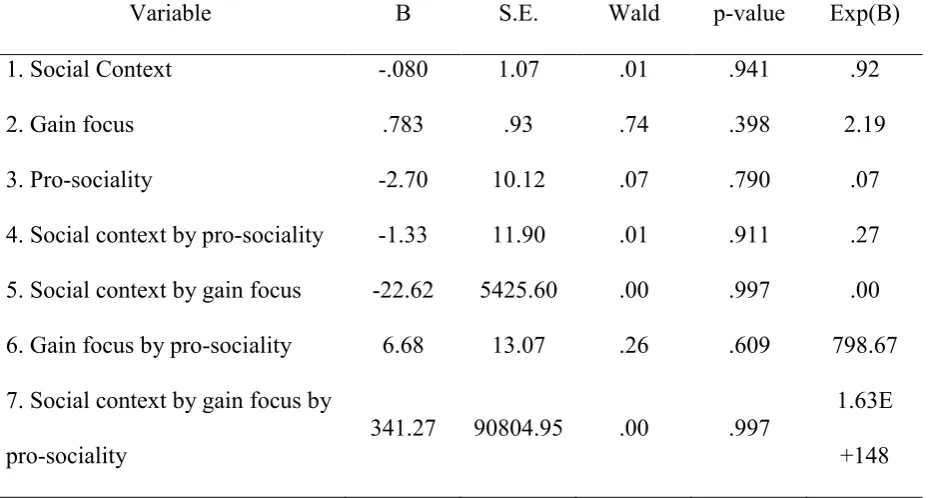
20 gain focus does explain a statistical significant proportion of the variance of truth-telling (χ²[4, N = 119] = 10.404; p = .034, NK R² = .228). However, since this effect could not be found in any of the variables Hosmer and Lemeshow test was conducted. This test suggests the model should not be considered statistical significant due to lack of fit (χ²[5, N=119] = 0.70 ; p = .983). Neither pro-sociality (b =-2.70, SE = 10.12, Wald χ² = 0.07 p = .790) nor gain focus (b = 0.78, SE = 0.93, Wald χ² = 0.74, p = .398) or social context (b = -0.08, SE = 1.07, Wald χ²= 0.01, p = .941) added statistical significance to the model. The interaction between pro-sociality and gain focus also did not add statistical significance to the model (b = 6.68, SE = 13.07, Wald χ² = 0.26, p = .609) (Table 1). No support was found for hypothesis 3a. The interaction between social context, gain focus and pro-sociality did not add statistical significance to the model (b= 341.27, SE = 90804.95, Wald χ² = 0.00, p = .997). No support was found for hypothesis 3b.
Table 1.
Interactions between social context, gain focus and pro-sociality.
Variable B S.E. Wald p-value Exp(B)
1. Social Context -.080 1.07 .01 .941 .92
2. Gain focus .783 .93 .74 .398 2.19
3. Pro-sociality -2.70 10.12 .07 .790 .07
4. Social context by pro-sociality -1.33 11.90 .01 .911 .27 5. Social context by gain focus -22.62 5425.60 .00 .997 .00 6. Gain focus by pro-sociality 6.68 13.07 .26 .609 798.67 7. Social context by gain focus by
pro-sociality 341.27 90804.95 .00 .997
21
Discussion
The aim of this study was to assess to which extent factors, such as social context, gain focus and pro-sociality can have influence on the choice to deceive for personal benefit or charity. The expectations were that deceivers are more likely to lie for personal gain in the absence of bystanders compared to those in the presence of bystanders. The results suggest that there is no link between the presence of bystanders and the choice to lie for personal gain or that of another.
Furthermore, it was expected that people feel more power when they are given the opportunity to deceive for personal benefit in the absence of bystanders compared to people who are given this opportunity in the presence of bystanders. However participants
experienced more power while deceiving for personal gain in the presence of bystanders. It was also expected that pro-socials are more likely to lie for charity and also to do so in the presence of bystanders. No evidence was found for this prediction.
Power, personal gain and bystanders
Results regarding the experience of power affordances among participants showed that people experience more power when given the opportunity to lie for personal gain in the presence of bystanders compared to people who were not given this opportunity. Ridgeway, Berger and Smith (1985) found that since certain behavior can be associated with power, the cues
22 compared to others. In this case the participants had more freedom to act according their own will compared to bystanders can be seen as more powerful. It might also implicate that this also had an effect on participants, since they realized that they had more freedom than others. Therefore they might have associated this with power. The freedom to act as one pleases is normally a capacity that comes with higher power (Galinsky et al., 2003; Keltner, Gruenfeld & Anderson, 2003). Thus participants may experience power affordances when given more freedom to engage in norm violating behavior compared to others who are present. This means that it is not necessary to actually engage in deceitful behavior in order to experience these power affordances. The suggestion that these power affordances are influenced by certain liberties (compared to bystanders who did not have these liberties), also suggests that social value orientation could influence the experience of power affordances when individuals are granted more freedom to break rules than others who are present.
Limitations of this study
One of the biggest limitations of this study was that only 9 participants could be identified as liars. This made it very difficult to investigate factors that could influence deceptive behavior and to make conclusive statements about the influences of the investigated factors on people’s decision to lie For instance, it was impossible to determine the influence of pro-sociality on lying behavior.
23 participants might not have been motivated enough to perform norm violating behavior, indicating that not all conditions of the routine activity theory have been met (Cohen & Felson, 1979)In this case the condition of a motivated offender.
Furthermore some of the participants were acquaintances of researchers which might have inhibited participants to lie. Since participants might act in a more social desirable way in order to please their acquaintance.
Some participants said they saw trough the cover story. Some of them reported not to trust the presence of others in the room, others said not to have believed the story The Snake told them. This suggests that the lab setting of the experiment might have raised
suspiciousness among participants, which could have inhibited them to lie, since they might think that this will increase the odds of getting caught and therefore being confronted with their behavior. The fear of this confrontation might inhibit participants to lie.
Strengths
A strength of the research is that truth tellers were also used in analysis to assess power affordances among participants. This increased the chance to correctly assess the predictive value of independent variables such as social context and gain focus.
Also the method for measuring power affordances had good reliability. This was particularly important in order to assess the interaction effect of social context and gain focus on perceived power affordances among participants.
24 believable acting performance. As mentioned above, this study has limitations, making it important to assess improvements regarding further research.
Further research
Further research is recommended in order to investigate the influence of social value orientation on power affordances while having the opportunity to commit norm violating behavior in the presence of others. In order to improve this study, it is advised to increase the incentive to a more substantial sum of money in order to create motivated offenders.
Furthermore it is recommended to improve the Snake and bystanders’ acting performance in order to decrease suspiciousness among participants. Participants are more likely to engage in norm violating behavior when they perceive the situation as plausible.
General conclusion
25
References
Aquino, K., Freeman, D., II, A. R., Lim, V. K. G., & Felps, W. (2009). Testing a Social-Cognitive Model of Moral Behavior : The Interactive Influence of Situations and Moral Identity Centrality. Journal of Personality and Social Psychology, 97(1), 123– 141. Doi:http://doi.org/10.1037/a0015406
Burris, C. T., Rempel, J. K., Munteanu, A. R., & Therrien, P. A. (2013). More, More, More: The Dark Side of Self-Expansion Motivation. Personality and Social Psychology Bulletin, 39(5), 578–595. Doi: http://doi.org/10.1177/0146167213479134
Cohen, L. E., & Felson, M. (1979). Social Change and Crime Rate Trends: A Routine Activity Approach. American Sociological Review, 44, 588–608.Doi:
http://doi.org/10.2307/2094589
Costarelli, S. (2005). Affective responses to own violations of ingroup norms : The moderating role of norm salience. European Journal of Social Psychology, 35(3), 425–435. Doi: http://doi.org/10.1002/ejsp.257
Darley, J. M., & Latané, B. (1968). Bystander intervention in emergencies: Diffusion of responsibility. Journal of Personality and Social Psychology, 8, 377–383
DePaulo, B. M., Lindsay, J. J., Malone, B. E., Muhlenbruck, L., Charlton, K., & Cooper, H. (2003). Cues to Deception. Psychological Bulletin, 129(1), 74–118. Doi:
http://doi.org/10.1037/0033-2909.129.1.74
DePaulo, B.M. & Kashy, D.A. (1998), Everyday lies in close and casual relationships.
Journal of personality and social psychological association, 74(1), 63- 79. doi:10.1037/0022-3514.74.1.63
DePaulo, B.M., Kashy, D.A., Kirkendol, S.E., Wyer, M.M. & Epstein, J.A., (1996) lying in Everyday Life. Journal of Personality and Social Psychology, 70(5), 979- 995. doi:10.1037/0022-3514.70
Galinsky, A. D., Gruenfeld, D. H., & Magee, J. C. (2003). From Power to Action. Journal of Personality and Social Psychology, 85(3), 453–466. Doi: http://doi.org/10.1037/0022-3514.85.3.453
Hardy, C. L., & Van Vugt, M. (2006). Nice guys finish first: The competitive altruism hy- pothesis. Personality and Social Psychology Bulletin, 32(10), 1402–1413.
26 Keltner, D., Gruenfeld, D. H., & Anderson, C. (2003). Power , Approach , and Inhibition.
Psychological Review, 110(2), 265–284. Doi: http://doi.org/10.1037/0033-295X.110.2.265
Lammers, J., Stapel, D. A., & Galinsky, A. D. (2010). Power Increases Hypocrisy Moralizing in Reasoning, Immorality in Behavior. Psychological Science, 21(5), 737–44. Doi: http://doi.org/doi: 10.1177/0956797610368810
Lange, P. A. M. Van, & Kuhlman, D. M. (1994). Social Value Orientations and Impressions of Partner’s Honesty and Intelligence: A Test of the Might Versus Morality Effect.
Journal of Personality and Social Psychology, 67(1), 126–141. Doi: http://doi.org/DOI: 10.1037//0022-3514.67.1.126
Messick DM, McClintock CG: Motivational bases of choice in experimental games. Journal of Experimental Social Psychol 1968, 4(1), 1-25. Doi: http:// dx.doi.org/10.1016/0022-1031(73)90039-5.
Organic Consumer Association. (n.d.). Retrieved from
https://www.organicconsumers.org/old_articles/politics/cancer091505.php
Overbeck, J. R., Tiedens, L. Z., & Brion, S. (2006). The powerful want to, the powerless have to: Perceived constraint moderates causal attributions. European Journal of Social Psychology, 36, 479–496.
Piff, P. K., Stancato, D. M., Côté, S., Mendoza-Denton, R., & Keltner, D. (2012). unethical behavior Higher social class predicts increased. Proceedings of the National Academy of Sciences of the United States of America, 109(11), 4086–4091. Doi:
http://doi.org/10.1073/pnas.110.
Ridgeway, C. L., Berger, J., and Smith, L. (1985). Nonverbal cues and status: an expectation states approach. American Journal of Sociology, 5, 955–78.
Shalvi, S., Handgraaf, M. J. J., & Dreu, C. K. W. De. (2011). Ethical Manoeuvring: Why People Avoid Both Major and Minor Lies. British Journal of Management, 22(#), 16– 27. Doi: http://doi.org/10.1111/j.1467-8551.2010.00709.x
Steinel, W. (2015). Social value orientation and deception: are proselfs liars? Current Opinion in Psychology, 6(#), 211–215.Doi:
http://doi.org/10.1016/j.copsyc.2015.09.016
27 Van Kleef, G. A., Homan, A. C., Finkenauer, C., Blaker, N., & Heerdink, M. W. (2012).
28
Appendix
Qualtrics survey and experiment
Dear participant, before starting the study, we would like you to read the following form, and if you agree, please continue.
I declare in a manner obvious to me, to be informed about the nature, method, target and [if present] the risks and load of the investigation. I know that the data and results of the study will only be published anonymously and confidentially to third parties. My questions have been answered satisfactorily. I voluntarily agree to take part in this study, while I reserve the right to terminate my participation in this study without giving a reason at any time.
I have read the text above and I agree (1) What is your age?
What is your gender? Male (1)
Female (2)
What is your nationality? Dutch (1)
German (2) Other (3)
In this set of questions, we ask you to imagine that you have been randomly paired with another person, whom we will refer to simply as the “Other”. Other is someone you do not know and that you will not meet in the future. Both you and Other will be making choices by choosing either the letter A, B, or C. Your own choices will produce points for yourself and Other. Likewise, Other’s choice will produce points for him/her and for you. Every point has value: The more points you receive, the better for you, and the more points Other receives, the better for him/her. Here’s an example of how this task works.
In this example, if you chose A you would receive 500 points and Other would receive 100 points; if you chose B, you would receive 500 points and Other 500; and if you chose C, you would receive 550 points and Other 300. So, you see that your choice influences both the number of points you receive and the number of points the other receives.
Before you begin making choices, keep in mind that there are no right or wrong answers - choose the option that you, for whatever reason, prefer most. Also, remember that the points have no value: The more of them you accumulate, the better for you. Likewise, from the Other’s point of view, the more points s/he accumulates the better for him/her.
29 A (4)
B (5) C (6)
A (1) B (2) C (3)
A (1) B (2) C (3)
30 A (1)
B (2) C (3)
A (1) B (2) C (3)
A (1) B (2) C (3)
31 A (1)
32 Below are a few questions we would like you to answer. Select what answer applies to you the most. Remember, there are no right or wrong answers.
Strongly
agree (1) Agree (2) Somewhat agree (3) agree nor Neither disagree (4) Somewhat disagree (5) Disagree
(6) Strongly disagree (7)
I tend to manipulate others to get my way (1) I have used deceit or lied to get
my way (2)
I have use flattery to get my way (3)
I tend to exploit others towards my own end (4)
I tend to lack remorse
(5)
I tend to not be too concerned with morality or the morality of my actions (6)
I tend to be callous
or insensitive
(7)
I tend to be cynical
(8)
33 I tend to
want others to admire me
(9)
I tend to want others to
pay attention to me (10)
I tend to seek prestige or status (11)
I tend to expect special favors
from others (12)
34 Below are a few questions we would like you to answer. Select what answer applies to you the most. Remember, there are no right or wrong answers.
Strongly
agree (1) Agree (2) Somewhat agree (3) agree nor Neither disagree (4) Somewhat disagree (5) Disagree
(6) Strongly disagree (7)
I wouldn't use flattery to get a raise
or promotion
at work, even if I thought it
would succeed.
(1)
If I knew that I could never get caught, I would be willing to steal a million dollars. (2) Having a lot of money is not especially important to me. (3)
I think that I am entitled to more respect than the average person is. (4)
If I want something
from someone,
35 I will laugh at that person's worst jokes. (5) I would never accept a bribe, even if it were very
large. (6)
I would get a lot of
pleasure from owning expensive luxury goods. (7) I want people to know that
I am an important person of high status. (8) I wouldn't pretend to like someone just to get
that person to do favors for me. (9)
36 Below are a few questions we would like you to answer. Select what answer applies to you the most. Remember, there are no right or wrong answers.
Strongly agree (1)
Agree (2) Somewhat agree (3) Neither agree nor disagree (4) Somewhat disagree (5) Disagree (6) Strongly disagree (7)
In the long run people get
the respect they deserve in this world
(1) Unfortunately, an individuals worth often passes unrecognized no matter how
hard he tries (2)
What happens to me is my own doing (3)
Sometimes I feel that I don't have enough control over the direction my life is taking (4)
Most misfortunes are the result
of lack of ability, ignorance, laziness, or all
three (5)
In the long run the bad things that happen to us are balanced by the good
ones (6)
37 Below are a few questions we would like you to answer. Select what answer applies to you the most. Remember, there are no right or wrong answers.
Strongly
agree (1) Agree (2) Somewhat agree (3) disagree (4) Somewhat Disagree (5) Disagree (6) Strongly
I can always manage to solve difficult
problems if I try hard enough
(1)
If someone opposes me, I
can find the means and ways to get what I want (2)
It is easy for me to stick to my
aims and accomplish my
goals (3)
I am confident that I could deal
efficiently with unexpected
events (4)
Thanks to my resourcefulness,
I know how to handle unforeseen situations (5)
I can solve most problems
if I invest the necessary effort
(6)
I can remain calm when
facing difficulties because I can
rely on my coping abilities
(7)
When I am confronted with
a problem, I
38 can usually find
several solutions (8)
If I am in trouble, I can usually think of
a solution (9)
I can usually handle whatever comes
my way (10)
Visual cue search task: find the exception to the rule.
Find the exception to the rule.
39 What was the exception to the rule?
There is a 5 in the second, third and fourths row (1)
There is a 5 in the second and the third row and a 7 in the fifths row (2) There is a 5 in the second, third and the last row (3)
There are two 5 among the 2s (4)
There is a 5 in the second, third and fifths row (5)
Find the exception to the rule.
What was the exception to the rule?
There is a 5 in the first, third and fifth row (1) The 5 occurs four times (2)
There is a 5 in the fifth row (3) The 5 occurs three times (4)
There is a 5 in the third, fifth and sixth row (5)
40 What was the exception to the rule?
There are two 5s in the seventh row and a seven in the first row (1) There is a 5 in the seventh row and a 7 in the second row (2) There is a 5 in the seventh row and a 7 in the fourth row (3) There is a 7 in the third row and a 6 in the first row (4) There is a 7 in the third row and a 5 in the seventh row (5) Find the exception to the rule.
What was the exception to the rule?
There is one 'S' in the third row and another in the seventh row (1) There are three 'S' between the 2's (2)
There is an 'S' in the third row and another in the sixth row (3) There are four 'S' between the 2's (4)
41 What was the exception to the rule?
There are two 5's and one 7 among the 2's (1)
There is a 5 in the second row and a 7 in the seventh row (2) There are two 5s under the 2s (3)
There is a 5 in the second row and a 7 in the eighth row (4) There is a 5 in the second row and a 7 in the ninth row (5) Find the exception to the rule.
What was the exception to the rule?
There is a 7 in the third row row and in the fourth (1) There is a 7 in the fourth row and a 5 in the last row (2) There is no exception (3)
There is a 7 in the fourth row (4)
There is a 7 in the fourth row and a 5 in the seventh row (5) Find the exception to the rule.
What was the exception to the rule?
42 Find the exception to the rule.
What was the exception to the rule?
There is a 7 in the fourth row and a 7 in the ninth row (1) There is a 7 in the fourth row and a 7 in the seventh row (2) There is a 7 in the fourth row and a 7 in the eighth row (3) There is a 7 in the third row and a 7 in the eighth row (4) There are three 7s among the 2s (5)
43 What was the exception to the rule?
There are a 5 and a 7 in the third row, a 7 in the sixth row and a 7 in the eighth row (1) There are a 5 and four 7s among the 2s (2)
There are a 5 and a 7 in the third row, a 7 in the sixth row and a 7 in the ninth row (3) There are one 5 and three 7s among the 2s (4)
There are a 5 and a 7 in the third row, a 7 in the ninth row and a 7 in the last row (5) Find the exceptions to the rule
What was the exception to the rule? There is a Z in the last row (1) There is a Z in the first row (2)
45 What was the exception to the rule?
There is no exception to the rule (1) There are 4 Z's among the 2s (2)
There is a 'Z' in the second row and a 9 in the third row (3) There is one 9 in the third row (4)
There are five Z's among the 2s (5) Find the exception to the rule
What was the exception to the rule? There is a Z in the last row (1)
There are Z's in the fourth and eleventh row (2) There are Z’s in the fourth, sixth and 12th row (3) There are three Z's among the 2s (4)
46 Find the exceptions to the rule
What was the exception to the rule?
There is a z in the 3rd row and in the 12th row (1) There is a z in the 3rd row and in the 4th row (2)
47 What was the exception to the rule?
There is a 'z' in the second row and the sixth row and a 9 in the third row (1) There is a 'z' in the second and the seventh row, a 9 in the third row (2) There is a 'z' in the second and the fifth row, a 9 in the third row (3) There is a 'z' in the third and the seventh row, a 9 in the third row (4) There is a 'z' in the fourth and the seventh row, a 9 in the third row (5) .
48 Below are a few questions we would like you to answer. Select what answer applies to you the most. Remember, there are no right or wrong answers.
Strongly
agree (1) Agree (2) Somewhat agree (3) agree nor Neither disagree (4) Somewhat disagree (5) Disagree
49 power
over other people?
(8) Do you think you
have control
over things? (9)
Do you think you influence
the outcome of things?
(10)
50 You may or may not have lied about your score on the previous task. If you have not lied about it, please imagine that you did while answering the following questions.
Strongly
agree (1) Agree (2) Somewhat agree (3) agree nor Neither disagree (4) Somewhat disagree (5) Disagree
(6) Strongly disagree (7)
51 Do you think your lying has influence on ...
Strongly agree (1)
Agree (2) Somewhat agree (3) Neither agree nor disagree (4) Somewhat disagree (5) Disagree (6) Strongly disagree (8) ...the university (1) ...the supervisor (2) ...the researcher (3)
Besides you and the experimenter, how many people were in the room with you during the experiment?
1 (1) 2 (2) 3 (3) 4 (4) 5 (5) 6 (6) 7 (7) 8 (8) 9 (9) 10 (10)
This scale consists of a number of words that describe different feelings and emotions. Indicate to what extent you feel this way right now.
Not at all (1) A little (2) Moderately (3) Quite a bit (4) Extremely (5)
Distressed (1)
Strong (2)
Scared (3)
Hostile (4)
Proud (5)
Nervous (6)
Determined
(7)
Anxious (8)
Afraid (9)