1
Faculty of Electrical Engineering,
Mathematics & Computer Science
Context Based
Personalized Ranking
in
Academic Search
Alexandru Constantin Serban M.Sc. Thesis
August 2017
Abstract
A criticism of search engines is that queries return the same results for users who send exactly the same query, with distinct information needs. Personalized search is considered a solution as search results are re-evaluated based on user preferences or activity. Instead of relying on the unrealistic assumption that people will precisely specify their intent when searching, the user profile is exploited to re-rank the results. This thesis focuses on two problems related to academic information retrieval systems. The first part is dedicated to data sets for search engine evaluation. Test collections consists of documents, a set of information needs, also called topics, queries that represent the data structure sent to the information retrieval tool and relevance judgements for the top documents retrieved from the collection.
Relevance judgements are difficult to gather because the process involves man-ual work. We propose an automatic method to generate queries from the content of a scientific article and evaluate the relevant results. A test collection is generated, but its power to discriminate between relevant and non relevant results is limited.
In the second part of the thesis Scopus performance is improved through per-sonalization. We focus on the academic background of researchers that interact with Scopus since information about their academic profile is already available. Two methods for personalized search are investigated.
At first, the connections between academic entities, expressed as a graph struc-ture, are used to evaluate how relevant a result is to the user. We use SimRank, a similarity measure for entities based on their relationships with other entities. Sec-ondly, the semantic structure of documents is exploited to evaluate how meaningful a document is for the user. A topic model is trained to reflect the user’s interests in research areas and how relevant the search results are.
In the end both methods are merged with the initial Scopus rank. The results of a user study show a constant performance increase for the first10results.
Contents
Abstract iii
List of Figures vii
List of Tables x
List of acronyms xiii
1 Introduction 1
1.1 Problem identification and motivation . . . 1
1.2 Research methodology and overview . . . 2
1.3 Design science research goals and design problems . . . 3
1.4 Thesis outline . . . 4
1.5 Implementation Considerations . . . 5
2 Background 7 2.1 Introduction . . . 7
2.2 Definitions and notations . . . 7
2.2.1 Graph . . . 8
2.2.2 Context . . . 10
2.2.3 User . . . 10
2.2.4 Entity similarity and relevance . . . 10
2.2.5 Topics . . . 10
2.3 Graph Walk models . . . 11
2.3.1 PageRank . . . 11
2.3.2 Personalized PageRank . . . 13
2.3.3 HITS . . . 13
2.3.4 Graph similarity measures . . . 14
2.4 Bibliographic graphs . . . 15
2.4.1 Entities - graph nodes . . . 15
2.4.2 Relationships between entities - graph edge types . . . 15
2.5 Topic models . . . 18
2.5.1 Probabilistic Latent Semantic Analysis . . . 19
2.5.2 Latent Dirichlet Allocation . . . 21
3 Ranking academic search engines with automatic relevance judgements 25 3.1 Introduction . . . 25
3.2 Related work . . . 26
3.3 Treatment design . . . 28
3.3.1 Characteristics of academic queries . . . 28
3.3.2 Performance measures . . . 30
3.3.3 Treatment proposal . . . 30
3.4 Treatment validation . . . 31
3.4.1 Dataset . . . 32
3.4.2 Results . . . 33
3.4.3 Discussion . . . 37
4 Personalized Ranking in Academic Search 39 4.1 Introduction . . . 39
4.2 Related work . . . 39
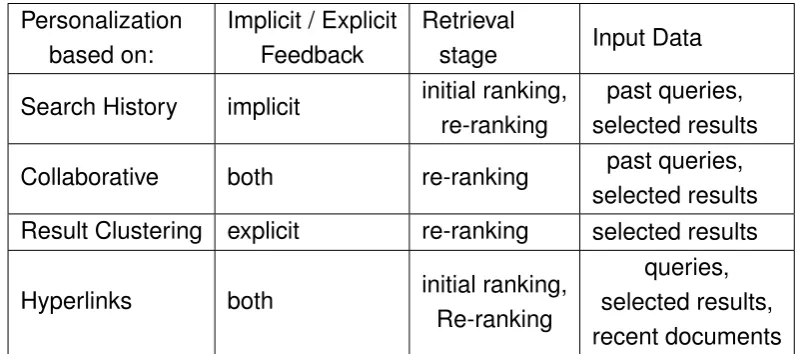
4.2.1 Personalization using search history . . . 41
4.2.2 Collaborative search . . . 42
4.2.3 Result clustering . . . 43
4.2.4 Hiperlink personalization . . . 43
4.2.5 Ranking in academic search . . . 44
4.2.6 Personalized academic search . . . 45
4.3 Treatment Design . . . 46
4.3.1 Graph models . . . 47
4.3.2 Topic models . . . 49
4.3.3 Rank fusion . . . 51
4.3.4 Treatment Proposal . . . 54
4.4 Treatment Validation . . . 55
4.4.1 Experiment Setup . . . 55
4.4.2 Performance measures and relevance judgements . . . 56
4.4.3 Results . . . 57
4.4.4 Discussion . . . 62
5 Conclusions and future work 65 5.1 Conclusions . . . 65
5.2 Threats to validity . . . 66
CONTENTS VII
References 69
Appendices
A Scopus Data 79
A.1 Query examples . . . 79
A.2 Scopus Screenshots . . . 79
A.3 Scopus Subject areas . . . 80
A.3.1 Author subject areas . . . 80
List of Figures
2.1 An example of graph scheme. . . 9
2.2 Simplified relational model for graph entities. . . 16
2.3 Bibliographic coupling. . . 17
2.4 Co-citation. . . 17
2.5 Co-authorship. . . 17
2.6 Co-source. . . 17
2.7 Co-authorship networks as in [1]. . . 18
2.8 Input and Output of a Topic Model. . . 20
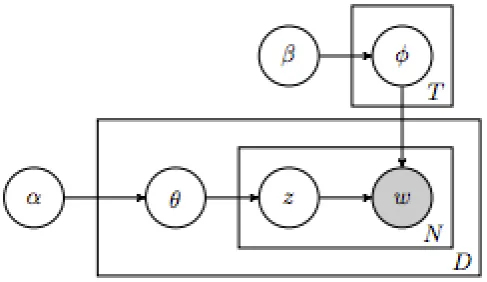
2.9 Graphical model representation of LDA. . . 21
3.1 The number of queries that returned at least one reference (blue) vs. the number of queries that returned no references (red) for test set. . . 33
3.2 The number of queries that returned at least one reference (blue) vs. the number of queries that returned no references (red) for validation set. . . 33
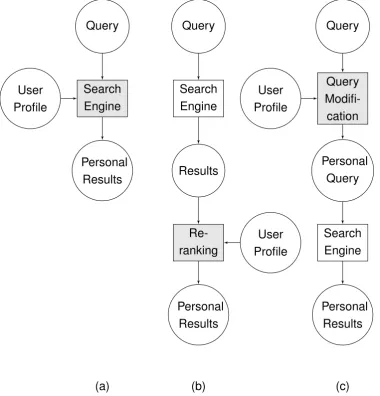
4.1 Personalization process where the user model is used during the re-trieval process (a), in a distinct, re-ranking, step (b) or during query pre-processing(c). . . 40
4.2 Comparative precision for using a graph similarity measure to re-rank the top 100 results retrieved by Scopus. . . 49
4.3 Comparative precision results for using an author-topic model to re-rank the top 100 results retrieved by Scopus (1) and the expanded result set by context at 1 (2). . . 52
4.4 The impact on initial precision for different ranking fusion methods. . . 53
4.5 The impact ofk constant on RRF ranking fusion method. . . 54
4.6 Result sets intersection where red represents the Scopus results, blue the results retrieved through re-ranking, yellow the common results for Scopus and re-ranking and dark blue represents the proportion of results added from the result’s context. . . 58
4.7 Precision at different thresholds for user generated queries and au-tomatic queries formulated through methods (1) and (6) from Section 3.3.3. . . 59 4.8 The impact of personalization on the user provided queries against
the article references. . . 60
List of Tables
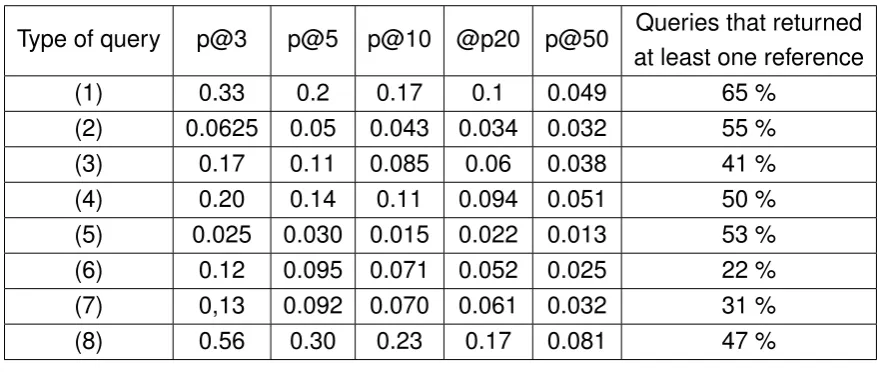
3.1 Precision on test set. . . 34
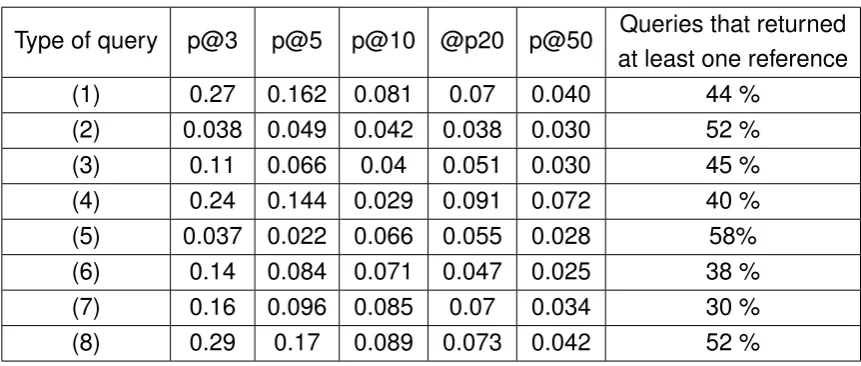
3.2 Precision on validation set. . . 35
3.3 Recall on test set . . . 36
3.4 Recall on validation set . . . 36
4.1 Types of personalized search classified by the type of feedback used to learn the user profile and keep it updated. . . 41
4.2 NDCG results for user study. . . 60
A.1 Examples of queries. . . 79
List of acronyms
RQ Research Question
CS Computer Science
IR Information Retrieval
HITS Hyper linked induced topic search
DL Digital Library
NLP Natural Language Processing
LDA Latent Dirichlet Allocation
pLSA Probabilistic Latent Semantic Analysis
EM Expectation Maximisation
MCMC Markov Chain Monte Carlo Model
TREC Text Retrieval Conference
ODP Open Directory Project
RRF Reciprocal Rank Fusion
DCG Discounted Cumulative Gain
nDCG Normalised Discounted Cumulative Gain
IDCG Ideal Discounted Cumulative Gain
MAD Median Absolute Deviation
TF-IDF Term frequency-Inverse document frequency
Chapter 1
Introduction
1.1
Problem identification and motivation
Search engines have changed the way users find, interact with and access infor-mation. Instead of searching through piles of books and printed media, users can quickly search for and discover relevant information by issuing aquery to asearch engine. Given a query, a typical search engine returns a long list of ranked items displayed over a number of pages.
The increase of searchable information in web environments makes ranking an intrinsic component of search engines and poses a big number of challenges. Briefly, ranking sorts search results according to pre-defined criteria in order to pro-vide the most relevant documents for an information need. It is the quality of such algorithms that can determine preferences for search tools; a weak performance in ranking can force users to scroll through several pages in order to find the desired information, affecting the user’s search experience and overall satisfaction.
Another criticism of search engines is that queries return the same result for each user [2]. Different users can use exactly the same query with distinct infor-mation needs [3], [4]. For example, issuing the query ranking, an information re-trieval researcher can show interest in search engine ranking while an educational researcher can look for ranking models of universities.
Moreover, information needs for a user might change with time: one can use the same query, ranking, to search for page ranking or personalised ranking. Without placing the query in a context, it gets impossible to judge the correct sense. In aca-demic search, time dependency becomes even tighter as a user can show interest in papers that represent the foundation of a field, while another can search only for recent publications. We find the value of information and the relevance of specific sources not intrinsic properties of documents, therefore, they can only be assessed in relation to the embedding task environment [5].
Personalized search is considered a solution to these problems as search
sults are re-evaluated based on user preferences or activity. Instead of relying on the unrealistic assumption that people will precisely specify their intent when search-ing [6], the user’s profile is exploited to re-rank the results. In order to provide per-sonalization services, user preferences are manually collected or automatically ex-tracted through mining techniques. Various personalization techniques for general web search can be found in the literature, however, little to no attention is dedicated to academic search.
The main motivation behind this research is to improve academic search ranking algorithms through personalization. We focus on the academic background of re-searchers that interact with information retrieval tools since information about their academic profile is already available for search engines.
1.2
Research methodology and overview
This research is organised and conducted following the design science methodology explained in [7]. The framework analyses two parts of design science, design and investigation, corresponding to two kinds of research problems: design problems and knowledge problems. Design problems call for a change in the real world and require an analysis of actual or hypothetical stakeholder goals. A solution is a design and there are usually many different solutions. Knowledge questions, however, do not call for a change in the world, but ask for knowledge about the world as it is [7].
In the problem context stakeholders who may affect the project or may be af-fected by it can be included among with the knowledge context which consists of ex-isting theories from science and engineering. Improving the performance of a search engine through personalization calls for a design problem as it requires designing an artifact. In this social context both academic search engine owners (1) (e.g. Sco-pus1, Google Scholar2, Microsoft Academic Search3) and researchers who interact with search tools (2) represent the stakeholders. In the knowledge context, topics from information retrieval, Graph Theory and Natural Language Processing (NLP) will be used.
Another important concept in [7] is the engineering cycle. Defined as a rational problem-solving process, it consists of the following tasks:
• Problem investigation: What phenomena must be improved? Why?
• Treatment design: Design one or more artifacts that could treat the problem.
1.3. DESIGN SCIENCE RESEARCH GOALS AND DESIGN PROBLEMS 3
• Treatment validation: Would these designs treat the problem?
• Treatment implementation: Treat the problem with one of the designed arti-facts.
• Implementation evaluation: How successful has the treatment been?
The current thesis focuses on the design cycle; a subset of the engineering cycle which excludes the treatment implementation and implementation evaluation. These steps are the responsibility of the first class of stakeholders based on the knowledge and design of this research.
1.3
Design science research goals and design
prob-lems
To understand the goals of a design science project, it is useful to distinguish the goals of the researchers from the goals of an external stakeholder. A researcher’s goals invariably include curiosity and fun: curiosity towards what the answer to knowledge questions is and fun in the design and test of new improved artifacts. In this sense, all design science research is curiosity-driven and fun-driven re-search [7]. However, some projects areutility driven and budget constrained while some doexploratory research. In this thesis an exploratory approach to improve the performance of search engines in the academic context is taken i.e. improve the performance of some artifact in a context. As classified in [7], this goal falls into the technical research goals orartifact design goal category.
To better refine our design problem, we take a leap and introduce the two types of personalization mechanisms, namely (1) online and (2) offline personalization. The first method takes advantage of user preferences or activity at query time to assign a probability of relevance score for each document in a collection or to documents retrieved by another algorithm. As it should be called whenever a user sends a query to a search engine, this method is constrained by computational time.
The second method, however, assigns relevance scores offline and has no con-strains. Nevertheless, both methods present quality attributes and come with ad-vantages and disadad-vantages. Yet we find one important discriminant: flexibility. Because the former method is called at query time, it has the potential to be more flexible as users can specify which personalization attributes should be used. Such an approach is impossible for the latter since all the computation is carried offline and is not time dependent.
providing personalization based only on past events might limit the user’s ability to perform research on new frontiers.
As flexibility is a factor that can not be neglected, we seek toimprove the per-formance of academic search engines bydesigninga personalization algorithm that satisfiescomputational query time requirements so that researchers can easily find and access information.
To treat our design problem we further divide it into smaller knowledge areas: (1) performance evaluation and (2) personalization algorithms for search engines. To measure the effectiveness of a retrieval algorithm, atext collection composed of documents, a set of query topics and a set of manual relevance judgements that map topics to relevant documents is used. Given the size of nowadays document collections, relevance judgements are difficult to gather and maintain. Therefore, the first part of the thesis investigates the automatic creation of test collections in aca-demic search. The second part of this thesis is concerned with improving acaaca-demic search engines through personalization.
We formalize the following research questions:
• Research Question (RQ)1: Can the information from scientific articles be used to create test collections with automatic relevance judgements for academic search?
• RQ2: May be Scopus performance improved through personalization using topic models and graph walks?
• RQ3: Will users consider the same documents relevant after a period of time?
1.4
Thesis outline
The rest of the thesis is organised as follows:
• In Chapter 2 we provide the necessary background information from the afore-mentioned knowledge domains.
• In Chapter 3 we provide the problem investigation, treatment design and treat-ment validation model for RQ1.
• In Chapter 4 we provide the problem investigation, treatment design and treat-ment validation for RQ2 and RQ3.
1.5. IMPLEMENTATION CONSIDERATIONS 5
1.5
Implementation Considerations
All treatment validation methods are tested on the Scopus data corpus. The ref-erences for one article can be found in the dataset several times, with different identifiers: at first as a normal article with all details (e.g. abstract, citations) and, secondly, as a reference for an article, where only the title or a description field is available. This means that, in order to get all the details about an article, for some references the title must be parsed from the description field and used to search for the indexed entry with all details.
Since the description field is not consistent in structure, parsing the titles through a regular expression was not always possible. From our estimations, a total of≈20% of the references could not be parsed. A rigorous influence on the re-ranking algo-rithm presented in this study is impossible because the number of relevant refer-ences for re-ranking remains unknown.
Chapter 2
Background
2.1
Introduction
The field of Information Retrieval (IR) tackles a broad range of subjects from Math-ematics and Computer Science in order to develop efficient search algorithms. This study focuses on two aspects of information representation: at first, a non textual ap-proach to represent entities and connections between them expressed as a graph structure and, secondly, a textual approach which analyses words in large text col-lections to discover themes that run through them, how they are connect to each other and how they change over time.
Therefore, this chapter provides an introduction to graph models used both for general and personalized search, graph similarity measures and topic models, a statistical method used to infer themes or categories under which documents can be grouped or which documents can represent. We also provide details about the representation of an academic network as a social graph structure and the relations between entities.
2.2
Definitions and notations
The meaning ofinformation retrievalcan be very broad. Searching the address book for a phone number is a form of information retrieval. However, as an academic field of study, information retrieval might be defined thus: Information retrieval (IR) is finding material (documents) of an unstructured nature (usually text) that satisfies an information need from within large collections (stored on computers) [8].
The term unstructured data reveals data without a clear, semantically overt, structure. In reality, almost no data are truly unstructured. Most text has structure such as headings, paragraph or footnotes and is commonly represented in docu-ments by explicit markup. IR is also used to facilitate ”semistructured” search such
as finding a document where the title contains Java and the body contains thread-ing [8].
The most standard IR task is called ad hoc retrieval: a system aims to provide documents from within the collection, relevant to an arbitrary user information need formulated as a query. An information need represents the topic about which the user wants to have more information and is different from aquery, which is what the user conveys to the computer to communicate the information need. A document becomesrelevant if the user perceives it as valuable with respect to the information need.
The assessment of a document’s relevance by a user is calledrelevance judge-ment. Briefly, the goal of the ad hoc task is to return aranking of the documents in the collection in order of decreasing probability of relevance.
During this study, the terms ranking and re-ranking are used as follows: upon receiving a query from a user, an information retrieval system uses a series of al-gorithms and models to rank and retrieve the top N relevant documents from the collection. A set of M top documents from N is selected for re-ranking, a process which uses a set ofalgorithms andmodels to re-assess the probability of relevance for each document and re-order theM set.
IR has changed considerably in the last years with the expansion of the Web (World Wide Web) and the advent of modern and inexpensive graphical user inter-faces and mass storage devices [9]. Firstly, the web pages are extremely diverse ranging from weather information to journals about information retrieval. Secondly, search engines on the Web must also contend with inexperienced users and pages engineered to manipulate search engines ranking functions [10].
However, unlike flat document collections, the Web is hypertext and provides considerable auxiliary information on top of the text of the web pages, such as link structure and link text. Exploiting the additional information inherent in the hyperlink structure of the web or of documents is called(hyper) link analysis. Such techniques represent the entities asnodes of a graphand the links between them as edgesof the same graph.
The field of academic search deals with inter-connected entities (e.g. academic articles, journals, authors) that can be easily represented as agraphstructure. Since this representation is used throughout the thesis, relevant notations in terms of the underlying graph structures and algorithms are provided.
2.2.1
Graph
repre-2.2. DEFINITIONS AND NOTATIONS 9
sented by letters such as u, v and an edge from u to v as uv. Every node u has a type marked asτ(u)under the assumption that there is a fixed set of possible types and every edge can have a label l denoted as uv(l). Several relations can occur between nodes: for example,uv(l)anduv(l′), wherel ̸=l′. We choose to represent a bidirectional relation between two nodes of a directed graph as two symmetrical directed edges.
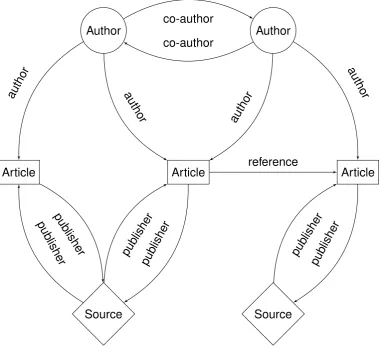
For illustration purposes we present an example in 2.1. In this figure node types are denoted with different shapes. The edges have different types too, denoted by their labels. Suppose that a square represents a node of type article, a circle represents an author and a diamond stands for a source. The different relations between these entities are represented either by direct and inverse relations or by full paths. For example, the author on the left is connected to the source on the left through an author and anpublisher relationship and to the article in the middle through anauthor relationship.
Author Author
Article Article Article
Source Source
co-author
co-author
author
author
author
author
pub lisher pub
lisher
pub lisher
pub lisher
pub lisher
pub lisher
[image:23.595.124.506.366.715.2]reference
2.2.2
Context
Given a graph G =< V, E > with a set of vertices V = {u, v, .., z}, V(G)and a set of edges E = {uv|u, v ∈ V}, E(G) we define two vertices connected by an edge as adjacent. Further on, we note the neighbourhood of a node v in an undirected graph as N(v) = {u|uv ∈ E}. In a directed graph we distinguish between the incoming neighbours of v, B(v) = {u|uv ∈ E} and the outgoing neighbours of v,
N(v) = {u|vu ∈E}.
We define the context of one vertex v, representing one entity in the graph, as the subgraphH withV(H)⊆V(G)andE(H)⊆E(G)formed by all nodesadjacent to v,H ={u, v|uv ∈E(H)} ∪ {v, u|vu ∈E(H)}. To extend the context of one entity to a rank n, we recursively add to the subgraph v the entities adjacent to the last neighbours added. So, for rank 1 we add the entities adjacent tov: u, for rank 2 we add the entities adjacent to u: qand so on.
2.2.3
User
In this thesis the termuser is used to describe an academic author represented by an entity in the graphGsubject to personalized search.
2.2.4
Entity similarity and relevance
Given a graph which represents entities and relations between them, we are in-terested to determine how related (similar) are entities without a direct connection. Since the graph is heterogenous (it contains multiple types of entities and relations), the similarity evaluation method should integrate multiple types of evidence into a similarity score. The similarity score is used to return, given a set of documents relevant to a query, a list of documents ranked by their similarity and relevance to the user’s context described in Section 2.2.2.
2.2.5
Topics
During this study the term topic is used in two ways. In Chapter 3 the term topic is used, as in Text Retrieval Conference (TREC) to describe a natural language statement of information need. In Section 2.5 and Chapter personalised the same term is used to addressthemesor substantively meaningfulcategoriesunder which documents can be grouped or which documents can represent.
2.3. GRAPH WALK MODELS 11
• A word or term represents an unique word type of a fixed length vocabulary indexed by {1, ..., W} . Each word is represented as an unit-bias vector of lengthW that has a single element equal to one and all other elements equal to zero. Thek-th word in the vocabulary is represented by a vectorwsuch that
wk= 1 andwi = 0fori̸=k.
• Adocument ofN words is represented as a sequence by d= (w1, w2, ..., wN), wherewiis thei-th word in the sequence. Note that this is also a bag of words representation since the word sequence does not need to match the original vector of the document.
• Acorpusis a collection ofDdocuments denoted byD={d1, d2, ..., dD}
Let’s consider an example vocabulary,v ={be, not, or, to}with indices{1,2,3,4}. The wordbeis represented asw3 = [1,0,0,0]. The documentd = ”to be or not to be”
will be represented as wd = (w41, w12, w33, w24, w45, w16), using the notation described
above.
We will also use P(t|d) to denote a document’s distribution over topics, P(w|t) the probability distribution over words w given the topic t, P(w|d) the distribution over words within documentDandT for the number of topics. For a corpus with D
documents andW words, a topic model learns a relation between words and topics and a relation between topics and documents as:
• aT xW matrix,Φ, with elementsϕijdenoting the probability P(wj|t =i), and
• aDxT matrix,Θ, with elementsθij denoting the probabilityP(t=j|di).
2.3
Graph Walk models
Beside a textual information representation of documents, IR algorithms use rela-tionships between documents to improve search accuracy. In this section we in-troduce the most important algorithms that make use of hyperlink data in graph structures for general and personalized search. In Section 2.3.4 we also discuss methods to evaluate how close related are two documents (or nodes of a graph) given the relationships between them.
2.3.1
PageRank
The PageRank algorithm [10] was introduced together with the Google web search engine 1. The idea behind it is that if a page u has a link to page v, the author of
u is conferring some importance to page v. Intuitively, Yahoo! 2 is an important
page, reflected by the fact that many pages point to it. Likewise, pages prominently pointed to fromYahoo! are themselves probably important.
How much importance does a page u confer to its out links? Let Nu be the outdegree of page uand letRank(p)represent the importance (i.e. PageRank) of a pagep. Then the link (u, v) confersRank(u)/Nu units of rank tov [11]. This simple idea leads to the following fix point computation that yields the rank vector over all of the pages on the web: ifN is the number of pages, assign all pages the initial value 1/N. Let Bv represent the set of pages pointing to v, in each iteration, the rank is propagated as follows:
∀v, Ranki+1(v) =
∑
u∈Bv
Ranki(u)/Nu (2.1)
The model corresponds to the probability distribution of a random walk on the graph of Web. This can be thought of as modelling the behaviour of a random surfer. The random surfer simply keeps clicking on successive links at random.
However, if a real Web surfer ever gets into a small loop of web pages, it is unlikely that the surfer will continue in the loop forever. Instead, the surfer will jump to some other page [10]. Therandom surfer behaviour can be described as: starting from a nodei, the probability of a user to go to a page (reset) randomly in the network isγ ∈(0,1)and the probability to move to a node j that has an outgoing link fromi
is(1−γ). A random walk process is described as:
Pd+1 =γ[
1
N]1XN + (1−γ)M Pd (2.2)
where N represents the number of pages or nodes in the network and M is the transition matrix. Through M the probability to reach a node in the network is distributed uniformly as:
Mij = {
1
|N(i)| if there is an edge from i to j
0 otherwise (2.3)
whereN(i)represents a set of nodes that have an outgoing link fromi.
γ, the damping factor prevents the chain from getting stuck in small loops [12]. For each node, the PageRank score can be computed by recursively applying:
Rj =γ 1
N + (1−γ)
∑
i∈B(j)
Ri
|N(i)| (2.4)
where B(j) is the set of nodes that link to j. Equation 2.4 is applied until conver-gence.
2.3. GRAPH WALK MODELS 13
2.3.2
Personalized PageRank
The PageRank score reflects a democratic importance that has no preference for particular documents. In reality, a user may have a set P of preferred documents (such as his bookmarks or his referenced articles) which he considers most inter-esting. We can account for preferred documents in the random surfer model by introducing a teleportation probability γ: at each step, a surfer jumps to a random page in P with probability γ, and with probability 1−γ continues forth along a link. The limit distribution of surfers in this model would favour pages inP, pages linked-to byP, pages linked-to in turn, etc [13].
The idea to bias the PageRank score for personalization was introduced in [10]. A similar approach was suggested by Haveliwala [11] in which the PageRank score is biased towards pages classified before as relevant to a given topic.
ThePersonalized PageRank graph walk is defined as:
Rd+1 =γR0+ (1−γ)M Rd (2.5) where R0 represents the distribution of interest over the graph nodes. This
for-mula leads Equation 2.2, ifR0 is uniform.
2.3.3
HITS
Hyper linked induced topic search (HITS) [14] strives to find authoritative documents by analysing the link structure of Web pages. At first, it identifies two kinds of Web pages:
1. authorities- pages representing authoritative sources of information for a given query, and
2. hubs- resource lists containing pointers on the topic.
This relation between Web pages is mutually enforcing: good hubs point to good authorities and vice versa. The HITS algorithm formalises the relation into a two phases iterative computation:
A sampling phase uses the query terms to collect a root set of pages from a text-based search engine. HITS expands the root set into abase set by adding all the pages that are linked to and from pages in the root set. The idea is to ensure that the base set will contain the best pages for the query even though the root set does not.
1. x(p) is the sum of the hub weights for the pages that point top(2.6), and
2. y(p)is the sum of the authority weights for the pages that ppoints to (2.7).
x(p)← ∑
B(p)
y(p) (2.6)
y(p) ← ∑
N(p)
x(p) (2.7)
2.3.4
Graph similarity measures
Given a graph G we would like to assess the similarity of two vertices u, v. One simple measure is the length of the shortest path between the vertices, i.e. the number of edges between the vertices or, if the edges are weighted, the sum of the edge weights for the shortest path. Another way to measure the similarity uses the maximal network flow [15], a measure defined as the number of units that can be simultaneously delivered fromutov given a limited capacity for each edge (propor-tional to its weight).
Faloutsos et al. [16] prove that such measures are not suitable for social network graphs because, at first, a relation between two entities can take several paths and, secondly, the maximum flow does not take into account path lengths.
Other measures of similarity use node neighbourhood (N(u)). The most basic measure is computed as the overlap between node neighbours: |N(u)∩N(v)|. For example, theJaccard coefficient [8] measures the probability that two nodes,uand
v, have a common neighbour, when a node is randomly selected from union|N(u)∪
N(v)| and the Adamic-Adar measure [17] considers the frequency of the common neighbours.
Further on we introduce two similarity measures associated with random graph walks:
1. Hitting time: by initiating a random walk from a node u and moving towards a neighbour of u, v, selected uniformly random, the hitting timeH(u, v) repre-sents the expected number of steps required to reach the nodev.
2. Simrank [18] states that objects are similar if they are related to similar objects (i.e. the nodes uand v are similar if they are connected tox andz andxand
z are themselves similar). The SimRank score can be computed as follows:
Sim(u, v) = γ
B(u)B(v) ∑
a∈B(u)
∑
b∈B(v)
2.4. BIBLIOGRAPHIC GRAPHS 15
where γ ∈ [0,1] and a, b are individual in-neighbours of u and, respectively,
v. The score is propagated iteratively along the direction of the edges until it converges. In this study,γ has, as suggested in [19], a value of 0.6.
2.4
Bibliographic graphs
Social network analysis attracted considerable interest in recent years and plays an important role in many disciplines [20]–[23]. It is based on the premise that the relationships between social actors can be represented as a graph where the graph’s nodes are actors and the graph’s edges connect pairs of nodes, thus representing interactions.
This representation allows the application of graph theory to the analysis of what would otherwise be considered an inherently elusive and poorly understood prob-lem: the tangled web of social interactions [23]. We assume such a graph represen-tation for our field of study: academic networks.
The relations between nodes in a Digital Library (DL) graph are described in the field ofbibliometrics, a term defined by Pritchard as the application of mathematics and statistical methods to books and other media of communication [24]. Specifi-cally, we are interested in the subfield of citation analysis, the representation of a decision made by an author who wants to show the relation between the document he is writing and the work of another [25].
2.4.1
Entities - graph nodes
Actors in academic networks are represented as entities or nodes in a graph struc-ture under the assumption that a researcharticleis written by one or more authors and published in ajournal (source).
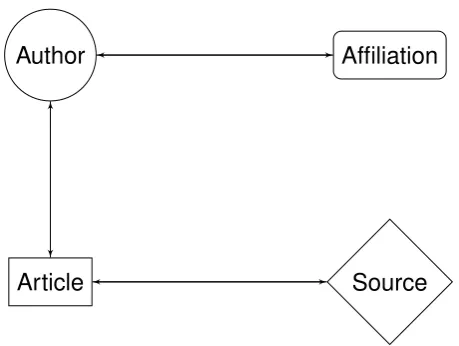
Since later experiments are carried on the Scopus data corpus, we incorporate the affiliation node to represent institutions that authors are affiliated with [26]. A simplistic version of this relational model is represented in Figure 2.2.
2.4.2
Relationships between entities - graph edge types
Author Affiliation
[image:30.595.170.400.82.255.2]Article Source
Figure 2.2: Simplified relational model for graph entities.
First order relationships
In general, a scientific paper does not stand alone, it is embedded in the literature of the subject through references and citations relations [27]. Narin et al. [28] define the terms reference and citation stating that a reference is the confirmation that one documentgives to another.
The acknowledgement that one documentreceivesfrom another is called a cita-tion. For example, when document (a) appears in the list of references of document (b), it means that document (a) has been cited by document (b) as a source of in-formation in support for an idea or a fact. In this case, not only document (a) is a reference of document (b) but also, it has received a citation from document (b). In other words, according to bibliometric terminology, document (b) is a citing docu-ment and docudocu-ment (a) is a cited docudocu-ment [29].
In academic graphs a reference is represented as a direct edge of typelr from node (B) - citing document to node (A) - cited. The number of in lr edges for node (A) will represent the number of citations it receives and the number of outlr edges for node (B), the number of references. Moreover, a direct edge of type la from a node of type author to a node of typearticle represents an authorship relationship and a direct edge of typelsfrom asourcenode to anarticlerepresents thepublisher relation.
Second order relationships
As defined earlier, second order relationships are derived conceptually from first order relationships and identify nodes likely to be closely related. The field of biblio-metrics defines two terms for citations analysis:
2.4. BIBLIOGRAPHIC GRAPHS 17
a b
c
d
e
f
Figure 2.3: Bibliographic cou-pling.
c
d
e
f
[image:31.595.99.521.83.467.2]a b
Figure 2.4: Co-citation.
a1 a2
c
d
e
f
Figure 2.5:Co-authorship.
s1
a
b
c
d
Figure 2.6: Co-source.
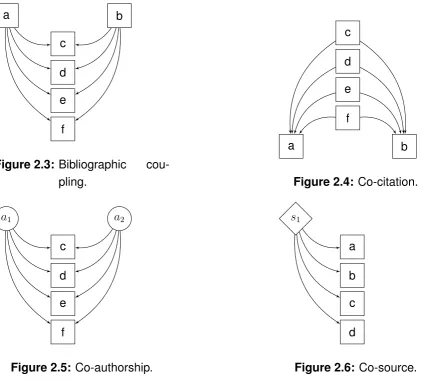
when a reference is used by two papers as a unity of coupling between the two [30]. The strength of bibliographic coupling depends on the number of references the two papers have in common [31]. This relation is illustrated in Figure 2.3 where nodes (a) and (b) are citing documents and nodes (c), (d), (e), (f) are cited ones.
2. co-citation coupling - co-citation indicates the frequency with which two doc-uments are cited together. Small [32] goes one level deeper and describes the similarity measure of co-citation similar to the similarity measures of the co-occurrence of words. This relation is illustrated in Figure 2.4 where nodes (a) and (b) are cited documents and nodes (c), (d), (e), (f) are citing ones.
Beside the relationships introduced by co-citation analysis there are two more relationships that can identify nodes likely to be closely related:
a1 a2
Figure 2.7: Co-authorship networks as in [1]. .
articles the authors have worked on together. Figure 2.5 illustrates this rela-tion as follows: nodes (a1) and (a2) representing authors have written together
documents (c), (d), (e), (f).
2. co-source - this relationship is derived from the publisher relationship and states that two or more articles are likely to be related if they were published in the same journal (source). In Figure 2.6 nodes (a), (b), (c) and (d) representing articles are likely to be similar since they were published in the same journal, (s1).
Alternatively, the co-authorship relationship can be represented as in co-authorship networks [1] by two symmetrical directed edges between two or more author nodes (Figure 2.7).
2.5
Topic models
Topic models are statistical methods that analyse words in large text collections to discover the themes that run through them, how they are connect to each other and how they change over time. Given a document collection, topic models learn a set of latent variables called topics. Topics are probability distributions over a vocabulary of words where frequently co-occurring words in the collection are associated with high probability. In addition, each document is represented as a distribution over topics.
In this thesis the termtopic models is used to refer toprobabilistic topic models [33], [34]. The main assumption of topic models is that documents are generated by a mixture of topics while topics are probability distributions over words. The input of a topic model is a set of documents and its output is a set of topics together with topic assignments to documents.
2.5. TOPIC MODELS 19
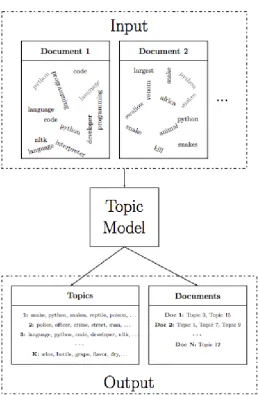
The only information relevant to the model is the number of times a word appears in each document. The input section in Figure 2.8 shows documents represented as bag-of-words. Document 1 contains information about Python programming lan-guage while document 2 contains information about python snakes.
The output of a topic model is a set of topics and a set of topic assignments for each document in the training collection. Each topic is a probability distribution over all the unique words in the collection. Topics are often represented by the words with the highest probability in the topic (output in Figure 2.8). Words assigned high probability in some topics frequently appear together in documents and are likely to represent a coherent subject or theme. A document is represented as a probability distribution over topics with only a few topics assigned with high probability. In the output, the first topic (1) is assigned with high probability to document 2. On the other hand, topic 2 which represents information about programming is assigned to document 1.
Topic models have appealing characteristics for organising document collections. They can be used for clustering documents under themes enhancing browsing and improving information access. In addition, topic models soft cluster terms into topics dealing with polysemy (e.g. topic 1 and 2 represent different senses of the word python and therefore, users can retrieve different sets of documents relevant to a given search germ (e.g. python).
Topic modelling is widely used in NLP and has been applied to a range of tasks including word sense disambiguation [35], multi-document summarisation [36], in-formation retrieval [11], [37] or image labelling [38]. In this thesis a Latent Dirichlet Allocation (LDA) [34] model is used to determine if documents are relevant to au-thors interests. We also provide an introduction to Probabilistic Latent Semantic Analysis (pLSA) to outline it’s disadvantages and the evolution to LDA.
2.5.1
Probabilistic Latent Semantic Analysis
The probabilistic latent semantic analysis models each word in a document as a sample of a mixture model. The mixture model is a set of topics in the form of multinomial random variables.
Given T topics, the aim is to find the probability distribution of words in a topic and the probability distribution of topics in a document. Words are the observed variables while topics are the latent ones. The generative process is the following:
1. For each documentd∈Dwith probabilityP(θd):
(a) select a latent topictwith probabilityP(t|d),
Figure 2.8: Input and Output of a Topic Model.
The process is defined by the following expression as a joint probability between a word and a document:
P(θd, w) =P(θd)P(w|θd), (2.9)
P(w|θd) =
t∈T
P(w|t)P(t|θd) (2.10)
=P(θd)
t∈T
P(w|t)P(t|θd). (2.11)
The pLSA model satisfies the main assumption of topic models, namely that a document consists of multiple topics. The probability P(t|θd) contains the weight of
2.5. TOPIC MODELS 21
main problems [34]: (1) the number of parameters grows linearly with the number of documents in the corpus causing overfitting problems, and (2) it is not possible to assign topic probabilities to any unseen documents (i.e. not in the training corpus).
2.5.2 Latent Dirichlet Allocation
[image:35.595.190.434.317.458.2]LDA [34] is an extension of pLSA which introduces symmetric Dirichlet priors on the distribution over topics for a particular document,θ, and the distribution over words for a particular topic, φ. This addresses the problem with pLSA mentioned above by treating the topic weights in each document as a hidden random variable of size T, where T is the number of topics. A graphical representation of LDA is shown in Figure 2.9.
Figure 2.9: Graphical model representation of LDA.
The generative process for the topics is the following:
1. For each topic
(a) Choose a distribution over wordsφ ∼Dir(β).
2. Choose N number of words
3. Chooseθ ∼Dir(α)
4. For each of theN wordswn:
(a) Choose a topictn ∼M ultinomial(θ)
(b) Choose a word wn from p(wn|tn, β), a multinomial probability conditions
on the topictn.
• N is the number of words in a document.
• tn is thentopic for the wordwn.
• Θis the topic distribution for a document.
• αis the parameter of the Dirichlet prior on the per-document topic distributions.
• β is the parameter of the Dirichlet prior on the per-topic word distribution.
The joint probability of the corpusDgiven the hyperparamentersαandβis given by the following equation:
P(D|α, β) = T ∏ t=1 D ∏ d=1 N ∏ n=1
P(θt|β)P(θd|α)P(tdn|θd)P(wdn|ϕtdn) (2.12)
The main variables that need to be estimated in the model are the per-topic word distribution ϕ and the per-document topic distribution θ. Inferring direct estimates from Equation 2.12 is intractable.
Hofmann [33] used the Expectation Maximisation (EM) algorithm to estimate ϕ
andθ directly. However, the EM algorithm might get stuck in local maxima. Approx-imation methods such as Bayesian variation inference [34] or Gibbs sampling [39] have been used to avoid this problem.
Gibbs sampling is a specific type of Markov Chain Monte Carlo Model (MCMC) for obtaining sample vales from complex multivariate distributions. It starts by as-signing every word w with a random topic t ∈ {1, ..., T}, for every document in the corpus D. Then, for each word, it estimates the probability of assigning the cur-rent word in each topic, given the assignments of all the other words. Griffiths and Steyvers [39] computed this probability as:
P(ti =j|t−i, wi, di,·)α
CW T
wij +βCdijDT +α ∑W
w=1CwjW T +W β ∑T
t=1CditDT +T α
(2.13)
where ti = j represents the topic assignment of word wi in topic j, t−i are the topic assignments of all of the other words, and·represents all the other information from word, documents and hyper-parametersαandβ. In addition, the elementCwjV T
of the matrixCV T,V xT, contains the number of times wordwwas assigned to topic
j. The matrixCDT,Dx T, contains number of time each topic is assigned to words of each document and CdjDT represents the number of times topic j is assigned to words in documentd.
2.5. TOPIC MODELS 23
and the per-document topic distributions can be obtained by:
ϕi,j =
CW T ij +β ∑W
k=1CkjW T +W β
(2.14)
θjd =
CDT dj +α ∑T
k=1cDTdk +T α
(2.15)
whereϕij is the probability of wordwi in topicj andθjd is the probability of topic
Chapter 3
Ranking academic search engines
with automatic relevance judgements
3.1
Introduction
In this chapter we propose several methods to build an IR test collection (similar to TREC collections) with automatic relevance judgements.
A test collection consists of documents, a set of information needs, also called topics, queries that represent the data structure sent to the information retrieval tool andrelevance judgements for the top documents retrieved from the collection. TREC collections are organised by tasks, which represent the reason that caused the user to submit a query. Since relevance judgements are difficult to gather, we investigate an automatic way to assess the value of documents in a collection.
The search task models researchers that use Scopus to find references for their new paper and the work in progress represents the topic. We use all the documents available in Scopus and several methods to automatically generate queries from the content of a document (also called an article). After issuing these queries to Scopus, only the documents referenced in the article (from which the queries were generated) are considered relevant.
The experiment selects articles already indexed in Scopus, generates queries from their content and sends them to Scopus. In order to represent the task, the search is limited to retrieve documents indexed, at most, in the year before the article (from which the queries were generated) was indexed. From the retrieved documents, only the ones referenced in the article are considered relevant. For example, an article is selected and the title is used as a query. After submitting it to Scopus, the number of references retrieved in the result set are counted and the performance of Scopus is evaluated using this measure.
The same terminology introduced in Section 1.2 is used as follows: treatment design (Section 3.3.3) describes the system developed in order to create a test
collection for academic search and treatment validation (Section 3.4) judges the quality of the system and evaluates the resulting collection.
3.2
Related work
The evaluation of information retrieval systems focuses on what is called the pro-cessing level [40]: the performance of specific algorithms and techniques are com-pared in isolation from the larger systems of which they are part of and from the users who employ them. These experiments measure the effectiveness of a re-trieval algorithm using a test collection, composed of a set of documents, a set of query topics and a set of relevance judgements which map topics to the documents relevant to them. Test collections are the basic tools for conducting repeatable ex-periments on retrieval algorithms [41].
Relevance judgements for a test collection are difficult to gather for several rea-sons. At first, for modern collections containing millions of documents it is not fea-sible to assess every document with respect to each topic. One solution is to use pooling: a method through which a fraction of the collection is selected for assess-ment. If the subset examined contains a representative sample of the relevant doc-uments, the pooling method closely approximates the results of assessing the entire collection.
Since retrieval systems attempt to rank documents according to their degree of probability of relevance, the highest ranking documents produced by effective retrieval systems should be a good candidate for inclusion in the assessment pool, even though some relevant documents may be missed [42]. This assumption is the basis of how relevance judgements are created for TREC collections [43].
In TREC, each participating system reports the 1000 top-ranked document for each topic. Of these, the top 100 are collected into a pool for assessment. In his analysis of the TREC results, Zobel concluded that the results obtained given a pool of 100 are reliable even though many relevant documents may be missed. Moreover, the relative performance among systems changed little by limiting the pool depth to 10, although actual precision scores did change for some systems [44].
3.2. RELATED WORK 27
Analysing three independent sets of relevance judgements from TREC-4 and TREC-6, Voorhees found that, despite a low average overlap between assessment sets and a wide variation in the overlap among particular topics, the relative ranking of systems remained largely unchanged across the different sets of relevance judge-ments [47]. Furthermore, hybrid sets of judgements were created for the TREC-4 analysis choosing each possible combination of judgements from the three asses-sors over all 49 topics. On average, the Kendall’sτ 1correlation between the rank-ings of systems obtain with these assessments and the actual TREC ranking was 0.938.
To overcome the difficulty of creating relevance judgements, researchers pro-posed various automatic methods to compare the retrieval effectiveness of IR sys-tems [41], [48]. Chowdhury [48] mined search engine logs to generate query and use documents from the Open Directory Project (ODP) 2 to form query-document
pairs. Afterwards, the queries were issued to several search engines and a rank at which an engine returns the document was computed. The score for a search en-gine was represented as the mean reciprocal rank for all query and document pairs. Moreover, the query-document pairs need to be reasonable and unbiased.
Soboroff asked the following question: how much would system ranking change if relevant documents are chosen randomly from the pool? [41] So, if relevant doc-uments occur in a pool of retrieved docdoc-uments according to some distribution and if human assessors can disagree widely without affecting relative system perfor-mance, can the occurrence of relevant documents be modelled? He concluded that the difference among human judges is not randomly distributed with respect to their impact on precision scores, but instead is concentrated onfringe cases which don’t affect many cases.
Furthermore, disagreement about the number of relevant documents does not seem to have a net impact on system rankings at all, probably because having more relevant documents benefits most systems uniformly. Lastly, with simple sampling models and minimal-effort, the method provides a good first-approximation of the results.
Because academic search was recently included in TREC OpenSearch track, there are not many open collections for evaluating the performance of such sys-tems. One attempt to create an academic test collection can be found in [49] where Harpale et al. gather a set of articles from CiteSeer3 and CiteULike4 together with
manual personalized queries and relevance judgements. In this chapter we assess
1Kendall’s τ correlation is a function of the minimum number of pairwise swaps required to turn
one ranking into another
if automatic methods for query generation and relevance judgement can be used to automatically evaluate academic search engines.
3.3
Treatment design
Treatment design represents the process used to build a test collection with auto-matic relevance judgements, the methods used to generate queries from the content of an article and the evaluation methods. Our search task models researchers that use Scopus to find references for their new article.
The treatment selects articles already indexed in Scopus, generates queries from their content and sends them to Scopus. The search is limited to the year before the selected article was published. Later, all documents retrieved by Scopus that are referenced in the articles (from which the queries were generated) are considered relevant. In order to build the test collection, an understanding of academic search engines and queries is needed.
The following set of objectives is addressed:
1. Explore the characteristics of academic search queries.
2. Find measures to test the dataset’s relevance and the underlying assumptions.
3.3.1
Characteristics of academic queries
In recent years many studies [50]–[52] reveal the information seeking behaviour of researchers through surveys or user studies on a relatively small sample of re-searchers. However, despite the widespread usage of academic search engines, little is known about the actual behaviour of users based on large-scale analysis.
In their recent work, X. Li et al. [53] analyse the user behaviour of ScienceDi-rect 5 to provide a general descriptive analysis of academic queries and highlight
the differences between academic search and web search. A marked difference between the two is the query length, where academic queries are on average 1.4 words longer than general web queries. Academic queries can be categorised as in [53] to:
• Navigational queries: queries that guide the user to a certain publication (iden-tified by special operators such as DOI, ISBN or a title),
• Transactional queries: these are queries that directly aim to retrieve academic information resources (e.g. a PDF file),
3.3. TREATMENT DESIGN 29
• Informational queries: queries that seek, refine or explore research topics,
• Entity queries: queries that contain named entities (e.g. Authors, Journals) and
• Boolean operator queries: queries used by advanced users who like to use the boolean operators for precise matchings.
Our choice is to build a test collection for informational queries, therefore, the search task models researchers that send informational queries to Scopus in order to find references for their new publication.
An important aspect of user behaviour during search sessions that can reveal valuable informations about the way users formulate queries isquery reformulation. Analysing how a user improves past approaches to information retrieval (e.g. by adding new keywords to a past query or completely change it) or how her interests evolve over time (e.g. topic shifts) can help to automatically generate queries. In recent years several studies tried to uncover patterns and models of query reformu-lation [54]–[57] and their applications. Their results show that query reformureformu-lation is an important subject in understanding user behaviour, which benefits retrieval tasks such as query auto completion or improve retrieval performance.
To uncover the reformulation preferences for the academic search, Xinyi Li [58] examined the logs from a popular academic search engine following queries be-haviour for users spanning up to 14 days. Between timespans of 3 days, the ten-dency to submit new informational queries is weak; in this timeline users use past queries or search directly for a publication. In a longer timespan (7 or 14 days) users prefer the use of new informational queries. This suggests that submitting new queries tends to happen not immediately, but within a longer gap.
Other reformulation mechanisms such as terms add, drop or substitution showed a negative correlation with the timespan, meaning that these reformulations are less frequently. Moreover, Li compares the correlation between reformulation behaviour and topic shifts. Since a researcher can be interested in different topics at the same time, their preferences for queries is important. Following the same query reformula-tion methods, the correlareformula-tion study shows that a user’s preference for some methods does not correlate to their topic shift tendency.
3.3.2
Performance measures
The choice for a performance measurement is based on its power to discriminate between results, how meaningful its average values are and how easy to interpret it is. Many of the most frequently used metrics are derived from precision and re-call. Precision is the proportion of retrieved, relevant, documents and recall is the proportion of relevant documents that are retrieved from the total number of relevant documents. In this chapter, precision at maximum 50 documents retrieved (p(50)) and recall at maximum 1000 documents retrieved (r(1000)) are used.
Precision at 50 counts the number of relevant documents in the top 50 results. This measure is extremely easy to interpret. Recall measures the number of relevant documents retrieved over the total number of relevant documents. The choice for these thresholds is given by the nature of re-ranking algorithms. While a user might evaluate the first few pages of a search engine (in Scopus, the first two pages contain 40 results), it will never reach the results in the interval [500; 1000]. However, a re-ranking algorithm, which re-evaluates and re-orders the results retrieved by an initial algorithm, can evaluate and boost any relevant document in the given interval.
3.3.3
Treatment proposal
In this section we introduce the system that models researchers whom use Scopus to find references for a work in progress. Its goal is to generate queries from an arti-cle, submit them to Scopus and evaluate the results. Following this assumption, an article is selected and a series of queries are inferred from its attributes. Afterwards, they are sent to Scopus and the topnresults are checked for references to evaluate the search tool’s performance.
To automatically infer queries from an article, an understanding of its structure is mandatory. Since all the experiments for treatment validation are carried out on the Scopus data corpus, we introduce the attributes an article in Scopus:
• title,
• abstract,
• author keywords - keywords chosen by the authors and
• index keywords - keywords chosen by Scopus indexers.
3.4. TREATMENT VALIDATION 31
Before query formulation, the Scopus search engine was examined using the user interface to determine its search model and adapt the query formulation meth-ods. Whenever a user fills a query in the search box, it is translated to a boolean AND query between all the query words. However, if a sequence of query terms is placed under quotes, Scopus will search for the sequence as it is and not gener-ate a boolean query between the terms. Scopus also provides a syntactic way to issue boolean queries using the capital case AND / OR words and placing the other attributes under quotes.
Following this behaviour and the available attributes of an article, several meth-ods to infer queries are introduced:
1. formulate a query from the paper’s title by removing the stop words and submit it as a boolean query,
2. submit all keywords as a long OR boolean query,
3. generate all possible combinations of two keyword terms and submit them as individual boolean queries,
4. generate all possible combinations of two keyword terms as a big OR query. An important note here is that Scopus limits the character count for a query to 256,
5. apply the same method in (2) for index terms,
6. apply the same method in (3) for index terms,
7. apply the same method in (4) for index terms,
8. use a language model to generate a query from the abstract and title.
To satisfy point 8 we train a pLSA model as presented by Steinberger to generate a summary from the article’s abstract and title [59] (Section 2.5.1). Even though, as discussed in Section 3.3.1, academic users tend to submit new queries instead of reformulation (points 2 and 5), we propose to also combine the power of key and index words as for points 3,4,6 and 7.
Several examples for each query type are provided in Appendix A, Section A.1.
3.4
Treatment validation
Using the afore-mentioned query formulation methods, a dataset is created and evaluated. This section is divided into smaller sub-sections to individually treat all experimental aspects. In the first sub-section (dataset) the methodology for gener-ating a dataset is provided together with valuable insights upon it. Later, the results are showcased and, lastly, a conclusion is given together with the answer for RQ1.
3.4.1
Dataset
In order to make the experiment consistent, the initial dataset must be generated through a deterministic methodology. To validate the scenario from Section 3.3.3 only a set of scientific articles is needed. We use a past experiment in expert finding, where all the results are public, as follows:
1. select the top 10 research areas from Aminer6as in [60],
2. select the top 5 experts for each area according to [61] that exist in Scopus,
3. for each expert, select the most cited paper and the most recent paper with more than 10 citations available in Scopus. If the papers overlap, the next most recent paper is selected. If there is no paper with more than 10 citations, the paper with the number of citations closest to 10 is selected.
Choosing articles from experts in one field can bias the results. In order to avoid the bias we propose to generate another collection of documents in a stochastic manner and use it to validate the result’s on the expert collection. We further address the second set of documents as the validationset. To generate it we use the top 10 research area names as in [60] as queries for Scopus and get the first 5 (most recent) results.
Further on, due to the implementation considerations (Section 1.5) the articles which have at least one reference title with less than 5 characters (after parsing) are removed. The articles with more than 50 references are also removed because they are usually books, cover a broader range of topics and have a high number of references. After this procedure is executed, the first collection (test collection) consists of 63 topics and the validation set (collection 2) of 50.
Considering the textual approach for query generation, it is important to illustrate some statistics about the test dataset:
• the average number of references is 26,
• the average title length is 6 words,