warwick.ac.uk/lib-publications
A Thesis Submitted for the Degree of PhD at the University of Warwick
Permanent WRAP URL:
http://wrap.warwick.ac.uk/110990
Copyright and reuse:
This thesis is made available online and is protected by original copyright.
Please scroll down to view the document itself.
Please refer to the repository record for this item for information to help you to cite it.
Our policy information is available from the repository home page.
T H E B R ITIS H L IB R A R Y
BRITISH TH ESIS SER VICE
COPYRIGHT
Reproduction of this thesis, other than as permitted under
the United Kingdom Copyright Designs and Patents Act
1988, or under specific agreement with the copyright
holder, is prohibited.
This copy has been supplied on the understanding that it
is copyright material and that no quotation from the thesis
may be published without proper acknowledgement.
REPRODUCTION QUALITY NOTICE
The quality of this reproduction is dependent upon the
quality of the original thesis. Whilst every effort has been
made to ensure the highest quality of reproduction, some
pages which contain small or poor printing may not
reproduce well.
Previously copyrighted material (journal articles, published
texts etc.) is not reproduced.
W ARW ICK
Dynamical Behaviour of Digital Filters subject to
2’s Complement Arithmetic Nonlinearity
(Two Volumes)
Volume I
by
Christopher James Vowden
Thesis
Submitted to the University o f Warwick
for the degree o f
Doctor o f Philosophy
Department o f Engineering
Contents
Volume I
Acknowledgements v
Synopsis vi
1 Introduction I
2 A Nonlinear M a p Arising in the Study o f Digital Filters 6
2.1 Introduction to the underlying dynamical system ... 7
2.2 Origins fo r the investigation o f admissible periodic sequences... 29
2.3 A survey o f related investigations... 35
2.4 Elementary inferences from the Chua-Lin in equ alities...46
3 Strings which A p p ear W ithin Adm issible Sequences 53 3.1 The strings + 0 ... 0 + as substrings o f admissible sequences : dependence on the parameter 0 ... 53
3.2 A criterion to identify strings which can appear within admissible s e q u e n c e s ... 57
3.3 A geom etric reformulation o f the c r it e r io n ... 61
3.4 The rhombus configuration for the strings+ 0 . . . 0 + ...
68
3.5 Evolution o f the rhombus configuration as 0 increases...74
3.6 Symmetries o f the rhombus c o n fig u r a t io n ... 82
Contents
3.7 Determining when the rhombi have a common in te r s e c tio n ... 89 3.8 Calculating the sub-intervals o f common in te r s e c tio n ...103 3.9 Application to other strings having regular stru ctu re...114
4 Search Strategies for the Computational Determination o f Admissible
Periodic Sequences 129
4.1 Elimination o f the strings which may not appear in any admissible
sequ ence... 131 4.2 The search for admissible periodic sequences at a fixed parameter value . . 156 4.3 A comprehensive search for admissible periodic sequences with short
generating s tr in g s ...180
5 Some Infinite Families o f Admissible Periodic Sequences 187
5.1 Adm issible periodic sequences generated by the strings +
0
... 0 ... 187 5.2 Adm issible periodic sequences generated by the s t r in g s + - 0 ... 0 ... 206 5.3 Periodic sequences admissible in an interval having ^ as an end-point . . .2 1 2Contents
Volume II
6 Admissible Periodic Sequences Generated by the Strings + 0 0 + 0 ... 0 235
6.1 T h e s tr in g s+ 0 0 + 0 ... 0 as generators fo r p erio dic s e q u e n c e s... 235
6.2 A search for intervals o f a d m is s ib ility ... 237 6.3 Automating the search for intervals o f a d m is s ib ility ...242 6.4 An analytical investigation o f a family o f periodic sequences generated
by strings + 0 0 + 0 ... 0 ... 250 6.5 Description o f the families o f intervals o f a d m is s ib ility ... 267
6.6
An example o f a periodic sequence which has two disjoint intervals o fadm issibility...273
7 Periodic Sequences Admissible in an Interval Having Zero as Left End-point :
Classification o f O d d Length Generating Strings 281
7.1 The specialised form o f the Chua-Lin inequalities at z e r o ... 282 7.2 A transformed version o f the basic inequalities ...285 7.3 Restrictions on the format o f strings generating periodic sequences
admissible adjacent to z e r o ... 288 7.4 Ranges o f x and y for strings generating periodic sequences admissible
adjacent to z e r o ...294 7.5 Construction o f a string for each choice o f jc between 1 and j ( N — 1) . . . . 296 7.6 Characterisation o f the strings generating a periodic sequence
admissible adjacent to z e r o ... 303 7.7 Examples and illustrations o f the t h e o r y ... 308
8 Periodic Sequences Admissible in an Interval Having Zero as Left E n d -p o in t:
Partial Classification o f Even Length Generating Strings 317
8.4 A suggested strategy for completing the argu m en t... 335 8.5 Even length strings for which a precise classification can be g i v e n ...341
9 Periodic Sequences Admissible in an Interval Having Zero as Left E n d -p o in t:
Structure of the Generating Strings and Size o f the Intervals o f Admissibility 347
9.1 Remarks on the structure o f strings generating periodic sequences
admissible adjacent to z e r o ...348 9.2 The functions associated to the Chua-Lin in e q u a litie s ... 354 9.3 Intervals o f a d m is s ib ility ...358 9.4 An application to the orbits in state-space : a measure theoretic bound . . . 365
Postscript 370
B ibliography 374
Tables
Contents *v
Acknowledgements
I thank my supervisor, M ike Chappell, for his advice and encouragement throughout my period as a research student in the Department o f Engineering.
I am grateful also to Stefano Luzzatto who at an early stage took an interest in my re searches, guided me in work on the topological dynamics o f the nonlinear filter map and introduced me to the wider theory o f dynamical systems.
During my period at Warwick University I was a recipient o f an Engineering and Physical Sciences Research Council studentship.
I would like to thank A n yaT om zyk for her help with translation from German, and partic ularly my fe llo w student Orla Dunn for the many discussions, often late into the night, on one or other o f our theses.
Declaration
Synopsis
The thesis investigates a two-dimensional nonlinear map describing a second-order direct form digital filter constrained to operate with 2’s complement arithmetic. A t tention is primarily directed towards the lossless case in which the filter parameters are on the lower boundary o f the linear stability region. An effective tool for studying the dynamics o f the map is the association o f an infinite symbolic sequence with each orbit. Identification o f the admissible periodic sequences is a fundamental theme.
A comprehensive answer is given for when string fragments + 0 ... 0+, and related pat terns, appear within some admissible sequence. Infinite families o f admissible periodic sequences are exhibited as analytic solutions to the trigonometric formulation o f Chua
and Lin ’s admissibility criterion. The role o f the filter parameter a = 2cos 9 in deter
mining admissibility is emphasised. Examples demonstrate that a periodic sequence may be admissible over several disjoint parameter intervals.
Strategies are developed that permit powerful computer searches for admissible peri odic sequences. Tables are included listing the periodic sequences admissible for fixed values o f the parameter, up to period 200. Parameter values for the tabulation progress by steps o f 0.05 across the entire range (0,7t). A complete list, covering all parameter values, o f the admissible periodic sequences up to period 20 is presented; associated with each sequence is its interval o f admissibility.
A classification is undertaken o f all periodic sequences with an interval o f admissibil ity having left end-point 9 = 0. For odd period sequences it is definitive; in the even case a partial classification is achieved, definitive when the period is twice a prime. A n investigation o f comparable scope is presented for admissibility around 9 = f •
The topological dynamics o f a one-dimensional reduction o f the filter map is explored. Orbits are attracted to an invariant set, itself a disjoint union o f intervals, that becomes
increasingly fragmented as the parameter a approaches 1.
Chapter 1
Introduction
T h e purpose o f this introduction is to explain in general terms the subject o f this thesis, to describe where the work began, and to outline the scope o f the original contributions as set forth in the later chapters. T h e style adopted here is non-technical, the formal presentation com m ences in Chapter 2.
Our principal object o f study is a nonlinear map associated with the operation o f a digital filter. T h e map describes the state to state transitions when the filter is realisti c a lly implemented, i.e. constrained to work with some real-world, imperfect, arithmetic system. In this situation the filter operation may depart from the idealised linear model em p lo yed w idely for digital signal processing; nonlinear effects can dominate and the actual behaviour o f the filter may be altogether different. T h e nonlinear map is a direct character isation o f the filter operation and values the map assumes are essentially the output signal fro m the filter; the relation is more intimate than that o f a mathematical model simulating som e physical system. Our concern therefore is with a mathematical study o f the dynamics o f the nonlinear map; questions o f compatability between a mathematical model and the m odelled system do not arise. This accounts for the high proportion o f mathematical the o ry to be found in the thesis, which perhaps at first is surprising given the practical context o f the study; in this respect our work does not d iffer from that o f others in the field. The behaviour o f the nonlinear map in general, and many o f the particular phenomena that one can easily exhibit through computer plotting, are not w ell understood.
Chapter l. Introduction 2
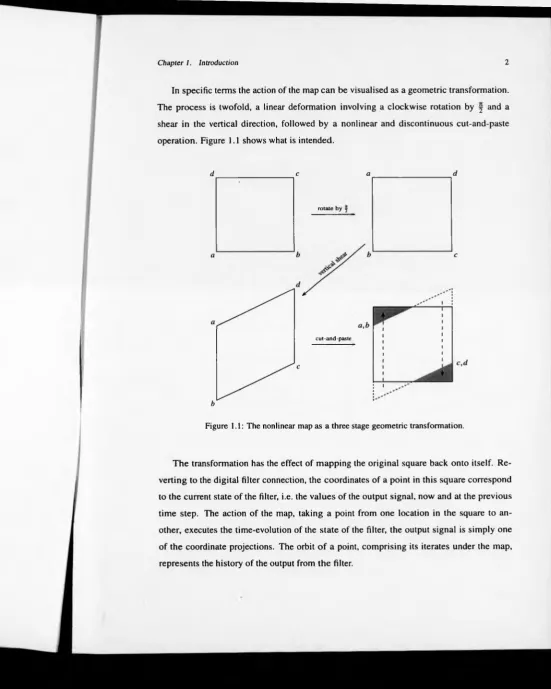
In specific terms the action o f the map can be visualised as a geometric transformation. The process is twofold, a linear deformation involving a clockwise rotation by
5
and a shear in the vertical direction, follow ed by a nonlinear and discontinuous cut-and-paste operation. Figure 1.1 shows what is intended.T h e transformation has the effect o f mapping the original square back onto itself. R e verting to the digital filter connection, the coordinates o f a point in this square correspond to the current state o f the filter, i.e. the values o f the output signal, now and at the previous time step. The action o f the map, taking a point from one location in the square to an other, executes the time-evolution o f the state o f the filter, the output signal is simply one o f the coordinate projections. The orbit o f a point, comprising its iterates under the map, represents the history o f the output from the filter.
d c a d
rotate b y j
c
cut-and-paste
b
[image:11.645.35.587.4.694.2]Chapter 1. Introduction 3
O f prime interest to us are certain sym bolic sequences associated with the dynamical evolution o f the system. One o f the three symbols +,
0
or - is used to record what happens, during the cut-and-paste step, to a point when it is mapped :0
i f it is untouched, - i f it must be translated downwards and + i f it must be translated upwards. To the whole orbit o f a point is assigned an infinite sequence o f these symbols. A classification o f the orbits that arise can be linked to the various types o f sequences. In particular orbits associated with periodic sequences, though not necessarily periodic themselves, form an interesting study, significant for the understanding o f the dynamics o f the map.W e make all o f the foregoing more precise, and justify the assertions, in Chapter 2. That chapter commences with an account o f the basic theory, our main source for this is Chua and Lin (1988), but we have adapted many o f their ideas to fit more smoothly with our subsequent investigations. Otherwise Chapter 2 takes up in more detail the practical origins o f this subject and sets our particular study in the wider context o f the work o f other authors on the nonlinear maps associated with digital filters.
N o t every symbolic sequence arises in association with an orbit, and posed in the liter ature as a significant problem, is the task o f describing those that do. O f particular interest in this connection is the case o f the periodic sequences. The published empirical evidence gathered about these sequences is extremely limited, and a key objective o f the early part o f this thesis is to develop computational strategies permitting a much more extensive search. Chapter 4 describes the computational approach that we have adopted and the results o f our searches are summarised in the tables that form the second half o f Volume II.
Chapter 1. Introduction 4
The ideas underlying the computer algorithms build upon material developed in Chap ter 3. One way o f analysing the nature o f the sym bolic sequences that arise in association with orbits is to decide the question o f whether or not they contain particular types o f sub string. For certain elemental families o f strings, we are able to resolve the issue completely, both unifying all the earlier results in the literature and offering a new and more general means for addressing this kind o f issue.
In Chapters 5 and
6
w e follow up the evidence gleaned from the computer searches to begin a theoretical study o f the apparent structure present amongst the sequences. A feature o f the nonlinear map that we have not yet mentioned is the presence o f a parameter which varies the extent o f the shear and so determines the amount o f the square shifted by the cut-and-paste. The lists o f sequences in Volume II are tabulated according to values o f this parameter, which had not previously been done. A t certain significant parameter values w e observed regular families o f sequences and their analytical investigation is the subject o f Chapter 5. M otivated by the conclusions reached, w e investigate in Chapter6
, an interesting fam ily o f sequences amenable to the methods that proved effective in Chap ter 5. Although simple in form , the sequences o f this fam ily exhibit surprising and subtle properties which makes them difficult objects to study computationally : no member o f the fam ily had been encountered amongst the results o f our computer searches.There is a shift o f emphasis in Chapters 7 and
8
. A fte r the study o f individual fam ilies o f sequences, w e now turn to the much m ore difficult task o f classifying all the periodic sequences associated with the nonlinear map. Our contribution is to achieve a classification near to both ends o f the parameter range, where it is notable that the sequences cluster. O ne feature o f the work is that we are able to give a collective description for all o f these sequences. Chapter 9 develops the consequences o f what is accomplished in Chapters 7 and8
; knowledge o f the sequences gives back information about the dynamics o f the map, and w e give an application o f this kind.Chapter I. Introduction 5
Appended for reference is a short table o f trigonometric formulae which are used inten sively within some sections o f the thesis.
Addition Formulae
sin A + sin B = 2sin j(A + ZJ)cos j(A — B) cosA + cosfl = 2cos j ( A + B )c o s j(A — B)
sin A — sin B = 2cos j(A + B) sin j(A — B) cos A — cos B = — 2sin j(A + B) sin j(A — B)
Product Formulae
2sinAcosB = sin (A + 5 ) + sin (A - B)
2sin A sin B = cos (A - B) — cos (A -I- B)
2cosAcosfl = cos (A + B) -I- cos (A - B)
Shift o f Origin
sin (
0
+ |)sin
(5
—0
)c o s (
0
+ j ) = — sin0
sin (kn +0
) = ( — l ) * s i n0
cos ( f -
0
) = sin0
cos(/tn +0
) = ( —l )* c o s0
= C O S 0
Chapter 2
A Nonlinear Map Arising in the Study of
Digital Filters
This chapter sets the scene for the m aterial in the main body of the thesis, bo th in detailing the required mathematical background and in providing a context for the later work b y relating it to the existing literature.
The content is organised into four sections. Section 2.1 presents an account o f the essential theory, from the mathematical point of view, introducing the nonlinear map whose investigation is at the core o f our study, discussing its associated dynamics, and showing the crucial role played by the admissible periodic sequences in explaining the orbits.
In Section 2.2 a historical perspective is provided, explaining how the m athem atical study arose out o f an observation in the late 1960's o f overflow oscillations in digital filters. Section 2.3 shows how our particular nonlinear map fits naturally into a wider family o f maps, themselves modelling a digital filter under its various operating regimes. We survey the studies reported a n d briefly indicate the conclusions reached and the relevant methods.
The chapter concludes with Section 2.4, in which we bring together some elem entary (but useful) properties of admissible periodic sequences, that otherwise are scattered through the literature and reported in a variety o f inconsistent ways.
Chapter 2. A Nonlinear Map Arising in the Study o f Digital Filters 7
2.1 Introduction to the underlying dynamical system
2.1.1
Definition of the nonlinear map
Our fundamental concern is with the dynamics o f the two-dimensional nonlinear map F, defined by
where A is the matrix ( ^ ) dependent on the real parameter a which is restricted so that
—2
< a <2
,b
is the constant vector ( j ) , and i is a function which is responsible for the nonlinear behaviour o f the map and is specified byW e study F on the square dom ain
/ 2
= [— 1,1) x [—1,1), within R 2, on which F is bijective. T h e action o f the function s is to pull back, by means o f a vertical translation, those pointstransitions o f a second-order digital filter; the relevance o f F to the subject o f digital filters and its role in modelling a specific filter realisation is treated in Section 2.2.
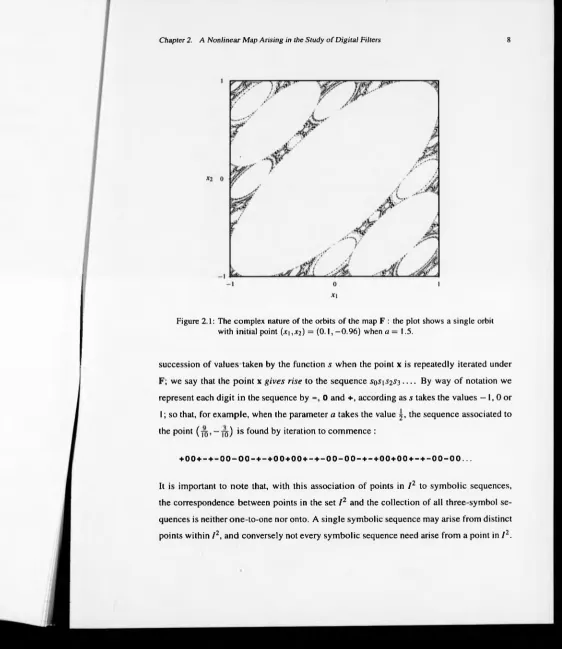
W e wish to study the iterated effect o f F on points within the domain /2. Numerical simulation o f these orbits by computer plotting indicates that the manner in which they fill out the state-space can be extremely complex. Some impression o f the subtle behaviour to expect may be gained from Figure 2.1, which is a representation o f a single orbit in the case when a = 1.5. T o investigate the dynamical system associated with the map F, it is advantageous to decompose the state-space
/ 2
into subsets throughout each o f which the map F exhibits much the same behaviour. The means whereby this is achieved is to associate to each point x in/ 2
an infinite symbolic sequence sqs\s iS3 consisting o f the(2.1)
—
1
i f —X\ + ax2
>1
,s( x ) — '
1
i f —jci 0X2 < —1
,(
2
.
2
)
0
otherwise.Chapter 2. A Nonlinear M ap Arising in the Study o f D igita l Filters 8
Figure 2.1: The complex nature of the orbits o f the map F : the plot shows a single orbit with initial point (x i,X2) = (0.1, —0.96) when a = 1.5.
succession o f values taken by the function
5
when the point x is repeatedly iterated under F; we say that the point x gives rise to the sequence .vo.s1
.S'2
i3
___ By way o f notation we represent each digit in the sequence by0
and +, according as s takes the values —1,0
or1
; so that, for exam ple, when the parameter a takes the value j , the sequence associated to the point (yg, — -¡75
) is found by iteration to com m ence :+
00
+ —+—00
—00
—+ —+00
+00
+ —+—00
—00
—+ —+00+00
+ —+ -0 0
—0 0
...Chapter 2. A Nonlinear M ap Arising in the Study o f Digital Filters 9
Indeed, in relation to the latter circumstance, a key concept for us is the notion o f an admis
sible sequence, which w e define to be a symbolic sequence that does arise in association
with the iteration, under F, o f some point within I 2.
In this thesis our concern is primarily with the points which g iv e rise to periodic sym bolic sequences. These points are important since they comprise a large proportion o f the domain /2; indeed the set o f points in
/ 2
that corresponds to any single admissible periodic sequence has positive measure. Moreover, the points which give rise to periodic sequences form an attractive subject to study, because we are able to describe completely the orbit o f each, and also to specify precisely the region within/ 2
which is the set o f points givin g rise to some particular periodic sequence. W e give an account o f all o f this, and elaborate the theory, in Section 2.1.3.Although the relationship between the admissible periodic sequences and the dynamics o f the map F is well understood, it is applicable only after an admissible periodic sequence has been identified as such, and in fact very little is known about which periodic sequences are admissible. Accounting for the collection o f admissible periodic sequences is a chal lenging and deep problem central to the understanding o f the nature and com plexity o f the dynamics o f the nonlinear map F. In this thesis we present a contribution to the research on this problem, revealing for the first time the rich structure present in the collection o f admis sible periodic sequences. W e are able to uncover many new infinite families o f admissible periodic sequences. Our focus is particularly on the dependence between the admissibility o f the sequences belonging to these families and the parameter o f the nonlinear map.
2.1.2
The identification of strings that generate admissible periodic
sequences
Chapter 2. A Nonlinear Map Arisin g in the Study o f Digital Filters 10
and ideas that w ill be relevant for much o f our later work. A s an instance, we remark that any periodic sym bolic sequence may be specified by a string, o f finite length, each o f whose digits is one o f the symbols +,
0
and the periodic sequence is generated from this string by repeated concatenation o f copies o f it. (In this connection, w e note that we refrain from ever using the phrase “ admissible string” because o f the evident ambiguity. Does it mean a string that can appear as a substring within an admissible sequence, o r is it the generator fo r an admissible periodic sequence? The tw o notions are different and w e will be making use o f them both. W e encountered some confusion in the existing literature.)Proposition 2.1 (cf. Chua & Lin (1988), Theorem 3)
T h e string so^i ...s/v-i generates an admissible periodic sequence o f least period N for the nonlinear map F, with parameter value a such that — 2 < a < 2 but a / 2 cos ^ for * = 1 , 2 ...N — 1, i f and only if the N points xq, Xi, xyv-i in R
2
defined byall lie within the square I 2.
In the course o f the p ro o f o f Proposition 2.1 to follow , and on many occasions through out the thesis, the analysis o f the dynamical behaviour o f the map F is greatly simplified by making a change o f coordinates x = o f the state-space variable x, w here T is the matrix
xo = (I — Aw)
(
so\N
1
+
s\An
2
+ ... +
SA/-iI)b
x i = ( I - A
n ) - 1
( s i A^ - 1
+ S2^n~ 2 -I- . .. + « o I ) b(2.3)
x/v-i = ( I — A ^ ) (sn-iAn
1
4- soAn 2 + . .. + SAr_2
l ) b .T =
c
1
0
cos
0
sin0
(2.4)and 0, a new parameter fo r F, is related to a through a = 2cos 0. T h e parameter 0 assumes values in the range 0 < 0 < n to correspond with the range — 2 < a < 2 for a. Because
Chapter 2. A Nonlinear M ap Arising in the Study o f D igita l Filters II
map is
t 'a t =
(
cos6
sin6
— sin
0
cos0
(2.5)the matrix R e is orthogonal and represents a clockwise rotation through an angle
0
in two dimensions. In this way the rotational action within the linear component A o f the map F is isolated : because o f the nature o f the eigenvalues o f A there has to exist an appropriate coordinate system in which its matrix is a simple rotation. A n immediate consequence is that the m atrix I — \ N is invertible precisely when 0 ^ ^ for A: = 1, 2 , . . . , N — 1.When the x variable is restricted to the state-space I 2 o f the dynamical system, the y variable takes its values in the region T _1 (/2), which is a rhombus as indicated in Figure 2.2. The relationship y = T ~ 'x between a point y e T - 1 (/2) and its corresponding point x e
/ 2
is best expressed by writing T _ l as the productIn the new coordinate system the nonlinear map x i-> F (x ) = A x + s (x )b becomes
where, o f course, s (y ) denotes the application o f the function (2.2) at the value x = Tÿ.
P roof o f Proposition 2.1
Suppose first that all the points xo, x j , . . . . x/v_i lie within I 2. Then for r = 0, 1 , . . . . N — 1,
(
2.
6)
the com bination o f a vertical stretch by an amount ^ and a shear in the vertical direction.
y I ► R 0y + j ( y ) T 'b, (2.7)
F ( x r) = A x r + s (x r)b
= ( I - A * ) - ' (^A^ + ir+iA
^ - 1
+ --- + i r_ ,A )b + i(xf)b
= (I - Aw) ~ '
(sr+, A
n ~ 1
+
sr+
2
A
* " 2
+ • • • + Jrl) b +
(s
(xr) -
sr)
b
Chapter 2. A N onlin ea r Map Arising in the Study o f Digital Filters 12
/2
[image:21.620.9.564.14.662.2]d!
Figure 2.2: Th e correspondence between the domains o f the nonlinear map in the two coordinate systems. Dashed lines indicate the missing boundaries, and the
vertices a', b', c\ d' relate to a, b, c, d v ia a' = T -1 (a) etc.
where w e take x/v = xo, and it follows that s (x r) = sr, because both x r+ i and F (x r) lie within I 2. Hence the point xq, iterated under the map F, gives rise to the periodic sym bolic sequence generated by the string •
For the converse it is advantageous to work in the alternative coordinates introduced above. W e suppose that the point yo in T - 1 (/2) giv e s rise to the periodic sequence gen erated by the string soil and consider its orbit { y o , y i , y
2
>- • • } under the nonlinear map. For the mom ent we restrict our attention to the subset consisting o f every N ,h iterate and, using the periodicity o f the symbolic sequence, these may be listed asyo,
y
n= R/veyo + Uo, y
2
n= R/vey/v +
uq, y-iN = Rvey2iv + uo,
...
etc.,
where
Chapter 2. A Nonlinear Map Arisin g in the Study o f Digital Filters 13
T h e iterates yo, y\, y w, • • • all lie on a circle with centre t|o = ( I — R/ve)
1
uo- This follow s becausey(k+i)N~i\o = (I - R / v e )
1
{ ( I - R w9
)y (* + i)jv _ u o }= ( I - R at
©)- 1
{(I-R / v e )(R / v e y * N + t*o) — uo}= ( i-R /v e
) -1
R/ve {(I-R /v 0 )y * N -u o }
= RAie(yjuv — "Ho) (
2
.10
)fo r each positive integer k. W e use the knowledge that the iterates lie on a circle to show that rio in T _
1
( I 2). There are two cases that need to be considered individually.( i ) NQ is not a rational multiple of 2n
The points yo, y/v, yiN, are dense on the circle, so both the circle and its interior are contained in the closure o f T _ l (/2). Hence the centre Tlo is in T ->(/2).
( i i ) NQ is a rational multiple of 2n
In this case NQ = 2ti^, s o q(NQ) = 2pn and R ^ e = ( Ra
?©)9
= R ?(/ve) is the identity matrix. Now,i(y o + y/H--- i-y(
9
_ i ) A i ) - t i o = ^ [ ( y o - t i o ) + (y A i- t io )H --- i-(y(</-i)/v_ T io )]=
l
[l + R^ve + R^e + — hR^e'j (yo — tlo)
= i ( I - R ^ ) -
1
( I - ^ e ) ( y o - t i o ) =o=
0
,so tlo is interior to the polygon formed by join in g the points yo, yu...y(q-i)N- It follow s by convexity thatT|o is in T - 1 (/2).
A n entirely analogous argument shows that for 1 < r < N — 1, the collection o f it erates y r, yN+r, y2N+rt ••• lie on a circle centred at t|r = ( I — R/ve)-
1
ur where ur =Chapter 2. A Nonlinear M ap Arising in the Study o f D igita l Filters 14
To com plete the proof w e further note that
Tr|r = T (I —R ^ r V = T (
t_1(I — A
^ ) -1t) ‘ ur = ( I - A N)~ 'T \.r
= ( I - A
n ) _1(sr\ N~ 1+
sr+1A
^ -2H--- (- i r_ 1
1) b
= *r, (2.11)
so the condition t l e T _
1
( I 2) corresponds to x r6
I 2. □The p ro o f here corresponds to a more general statement o f the criterion than that ap pearing in (Chua & Lin, 1988); our formulation additionally permits rational multiples o f
7
t for the parameter 0. The values 0 = ^ (equivalently a = 2 c o s ^ ) must be excluded because in these cases the matrices ( I — R/ve) and ( I — \ N) are not invertible : both reduce to the zero matrix, so w e are unable to introduce the points xo, x i , . . . , x\-\ in the manner described above. Periodic sequences that are admissible at these parameter values do exist though, and w e exhibit one in the follow in g example.Example 2.1 : A n admissible sequence of period 6 when 0 = |
Take the string + - 0 0 0 - , o f length N =
6
, at the parameter value 0 = f = ^p. Any point Xo = (jcj , —1
) with0
< x\ <1
gives rise to this sequence, and is itself a period-6
point for F, becausexi = F (x 0) = Axo +
*2 = F (x i) = Ax|
-x3 = F (x2) = Ax2
x4 = F (x3) = Ax3
Xs = F(X4) = AX4
x6 = F (x5) = A x ,
-b = ( - 1 , - x i -I-1)
b = ( x\ + 1, —jcj )
= ( - *
1
, -1
) = ( - l , * i -1
) = (jci - l , * i )Chapter 2. A Nonlinear. Map Arising in the Study o f Digital Filters 15
T o conclude this section we address these particular parameter values and indicate what to expect in the exceptional situation (not treated in the literature). A t a parameter value
0
= Rjve is the identity matrix, so the iterates yo, yn, Yi n, ■ ■ • areyo, y/v = yo + u0, y2
N = yiv + uo,
y
3
/v = y2
N + uo,
•••
and fo r this to be consistent with the fact that all iterates are in T
~ 1
( I 2) w e require uo = 0, i.e.(joR(/V-l
)0
+ slR (W -2)6
H--- b 'i/ V -ll) T1
b =0
.Consideration o f the iterates y i , y ^ + i, y
2
/v+i. • • • similarly leads toCsiR (w - i)e + J
2
R (A t-2
)e + ’ " + so l ) T 'b =0
which can be rewritten as
(soR(Ar-i
)0
+ i iR (tv -2
)e d --- l- s / v - il)R e T 'b =0
.Since the vectors T
1
b and R e T _1b are linearly independent it follow s thatsoR(Ar-i)e + JiR (/ v -
2
)8
'l--- f i / y - i l =0
(2
.12
)with
0
-W e may easily verify that this matrix is indeed zero fo r the string + -
0 0 0
- from the exam ple : R *, — R ^ = I follow s directly from sin ^ = sin and cos ^ — cos = 1. A s a source o f other examples we suggest those obtained by the follow in g method to produce strings which satisfy the necessary condition (2.12). To be definite we take N = \2 and0
= |; then R6
e +1
=0
and R 8e + R 4e+ 1
=0
, so that•soRne + ‘S iR ioe H--- H J i i l =
0
Chapter 2. A Nonlinear Map Arising in the Study o f D igita l Filters 16
Satisfying the condition (2.12) does not guarantee that a string sosi o f length
N generates an admissible periodic for 0 = and nor does it provide a direct means to locate points in state-space which give rise to the sequence, in contrast to the situation fo r all other values o f 0 where the point xo arose naturally out o f the method. H o w ever w e can at least learn where to look for such points, for one consequence o f the conditions R/ve = I and ioR (/v-
1
)e + 5i R (n-2)8
H--- I- SN -1
1 = 0 is that any point which gives rise to a sequence commencing • • -s/v-i is a periodic point o f period N. This follow s because the N ,h iterate o f such a point under the nonlinear map is R/vey + uq = y, and permits a search for these points using the techniques w e describe in Chapter 3.2.1.3
Orbits o f points associated with admissible periodic sequences
A feature o f the proof o f Proposition 2.1 was a full description o f the orbit o f any point which gives rise to some prescribed admissible periodic sequence. M ore specifically, w ork ing in the y-coordinate plane, we proved the fo llo w in g about the orbit o f a point yo defining the periodic sequence generated by the string io^i • • .sjy-l :
( i ) The iterates o f yo lie on N congruent circles o f radius r = ||yo — T|o|| whose centres are at the points Tlo, T|i, . .., Tbv-i- The locations o f the centres depend only on the string sqs i .. .s/v-i and the value o f the parameter, and are determined by
= (I — R/ve)_l ur
where
Ur = (srR(JV-l)8 + sr+lR(/V-2)0 H--- b i r- l l ) T ' b.
( i i ) The points y r, yN+r, yiN+r, ■■■ lie on the r** circle (centred at q r), each is obtained from its predecessor here by a rotation around the circle through an angle NQ. When 0 is not a rational multiple o f
7
i we obtain a dense set, otherwise a finite number o f equally spaced points.Chapter 2. A Nonlinear Map Arising in the Study o f D igital Filters 17
A corresponding description o f the orbits in the original state-space coordinates may be obtained by applying the transformation x = Ty, and is o f course the same but for this change in geometry. The contracting and shearing effect o f T on the vertical coordinate sends each circle to an ellipse inclined at J to the horizontal as we now demonstrate.
T o describe the ellipses obtained, w e note that in the standard coordinate geometry o f the xy-plane the equation o f an ellipse having the x-axis as its major axis and the y-axis as its minor axis is
where a and b are the lengths o f the semi-major and semi-minor axes. Thus when this ellipse is rotated anticlockwise by f , so that the line y — x is now the major axis, its equation is instead
The circle in the y-coordinate plane with centre T\r = (rv,i ,T|r,2) ar|d radius
8
isCvi - IV,i ) 2 + (y2 - tv,2)2 = 82,
i.e. Ily — T|r||2 = 82.
The curve in state-space coordinates that corresponds to this via the transformation T is
2 (2.13)
.e. | | T - '( x - x f )||2 = 82 where T rv = x r, i.e. (x — xr) T (T - 1 )tT ~ 1 (x — xr) = 82
.e. (* 2 ~ * r ,2
)2
=8
2, (2.14)so from (2.13) it is an ellipse, centre at x r with
semi-major axis =
8
\/1
+ cos0
=8
w l + |, (2.15a)Chapter 2. A Nonlinear Map A risin g in the Study o f Digital Filters 18
x\
[image:27.627.4.574.15.652.2](a) 0 = 0.5
Figure 2.3: The point ( —0.4, —0.95) gives rise to the periodic sequence generated by + “ 00 for both parameter values. The plots o f the orbits have a different char
acter, the distinction depending on whether 0 is a rational multiple o f n.
Figures 2.3(a) and 2.3(b) are plots o f sample orbits in the state-space originating at a point giving rise to a periodic sequence; for both plots the periodic sequence is + -
0 0
. Figure 2.3(a) shows the typical situation where 0 is not a rational multiple o f n (0 = 0.5,a = 2cos0.5), in this example the orbit lies dense on four ellipses. The alternative situation, where 0 is a rational multiple o f
7
t, is illustrated in Figure 2.3(b) (0 = g, a = \/3), and here the iterates periodically visit12
isolated points.Chapter 2. A Nonlinear Map Arising in the Study o f Digital Filters 19
sides o f the square whose centre is x r, whose sides are parallel to the coordinate axes and whose side length is 28. Hence i f p is the minimum distance o f any o f the points xo, X|, . . . , x/v_i from a boundary o f 7
2
then the corresponding solid ellipses 7s(xr , p ) are contained in the closure o f/ 2
and are collectively maximal subject to this property.Proposition 2.2 (cf. Chua and Lin 1988, Theorem 5)
For a parameter value a = 2 cos 9 such that 0 is not a rational multiple o f n, the region o f points in state-space which give rise to the admissible periodic sequence generated by a given string ,?o.si .. .s/v-i consists o f the interior o f the solid ellipse E ( xo, p ) together with some points o f the boundary. T w o possibilities arise : either the entire boundary is included, or some dense countable subset o f the boundary must be excluded.
P roof
W e have already shown that if x gives rise to the periodic sequence generated by the string sosi • • -¿tv
- 1
then x belongs to the solid ellipse £ (x o ,p ). The rest o f the proof splits into tw o parts : the first (a) is to show that i f x belongs to the interior o f E ( xo, p) then x gives rise to the periodic sequence generated by soil •. .s/v-i, and the second (b ) treats the case o f the boundary points. W e work in the transformed coordinates introduced in Section 2.1.2.(a ) Suppose y is the point i n T _ l (72) corresponding to our x within the interior o f 7s(xo,p); then ||y—rio|| < p. Under the nonlinear map T)o is sent to T) i . Consider the isometry t n R ez + s o T ~
1
b; under this isometry t i0
maps to T| i (because for the point the isometry has the same effect as the nonlinear map). Suppose y t-y y ' under the isometry, then y ' is interior to the circle centre T|i and radius p, in particular y '6
T ( 7 2). Consequently the nonlinear map applied to y gives y', because there is only one choice for s so that R ey + s T ^ 'b belongs to T - 1 (/2). Hence the first digit o f the sym bolic sequence corresponding to y is so- Subsequent digits are confirmed in the same fashion.(b ) From the definition o f p, at least one o f the circles ||y — t|r|| = p meets the boundary o f
T “ 1 (72). It could happen that all these circles nevertheless are within T _ l (72) in which
Chapter 2. A Nonlinear M ap Arising in the Study o f D igita l Filters 20
the periodic sequence generated by the string .9o.?i. ..s/v-i- This means that the entire boundary o f £ (x o ,p ) consists o f points which give rise to this sequence.
Otherwise at least one o f the circles has points (either 1 or 2 in number) which do not belong to the set T _ l (/2). Should the circle centred at T)o have such points then, certainly, these are excluded because they do not belong to the domain o f the nonlinear map. I f next the circle centred at T|i has such points, then the points on the circle centred at % that are the inverse images o f these under the affine map considered in (a) do not produce the digit sq when the nonlinear map is applied, and therefore do not give rise to the periodic sequence generated by the string .soJ'i.. .s/v'-i • Continue in this way : look at all the inverse images (b y the affine map that uses si in place o f
so), on the circle centred at n i , which derive from the points on the circle centred at Tl
2
not belonging to T '(/ 2). Th eir inverse images in turn by the first affine map are points on the circle centred at T|o which under two iterations o f the nonlinear map do not produce the digit pair sqsi . Extend this scheme so that all the circles are visited and by this stage we have excluded all the points on the circle centred at t|o which do not give rise to the string o f initial digits .voii... .v^r_ | under the nonlinear map. N ext we must exclude those points which do not give rise to soil ■ • .sn-isq, and fo r this w e need to work back from the circle centred at T|o itself, through all the other circles until we arrive again at the circle centred at T\o- I f we continue indefinitely the process o f taking these inverse images, then we obtain a countable subset o f points on the circle centred at t|o, precisely those which do not give rise under iteration o f the nonlinear map to the periodic sequence generated by the string sqs i ... sn- \.Chapter 2. A N onlin ea r Map Arising in the Study o f Digital Filters 21
In the case where 0 is a rational multiple o f
7
t, the region o f points which give rise to an admissible periodic sequence is entirely different in character and the corresponding result is included in our next proposition.Proposition 2.3
For a parameter value a = 2 cos 0 where 0 = 2tc^ (and excluding the exceptional values treated in Section 2.1.2), the region o f points in state-space which give rise to the admissible periodic sequence generated by a given string s o ii • • • i/v
- 1
is a convex polygonal set containing xo. T h e set is determined by at most / linear inequalities, some o f which may be strict, and the value / = lcm(<7
,/V).Proof
W e know from Proposition 2.1 that xo is a periodic point which gives rise to the periodic sequence generated by the string so-si . . .s n-\- In the reasoning that follow s it w ill be convenient to extend notation and define sr = srmodN when r > N. I f w e apply F to xo / times then because o f periodicity
xo = A 'x o + (joA / _i + j iA , - 2 H--- | -i/ -il)b
but A* = I and therefore
( s o A ' - ' + i i A ' - 2 + ■•• + * ,_ ,
1
)1
» =0
. (2.16)Let x be any point in I 2 which under iteration by F gives rise to the periodic sequence generated by the string io^i • • • -s/v
-1
■ ThenF '( x ) = A ,x + ( s o A ,- | + i i A
' - 2
+ - - - + s , _1
l ) band in particular x is periodic. Note also that x satisfies the linear inequalities implied by the statements
x e I 2 ,
A x + Job e I 2 ,
A 2x + (joA + J il)b € I 2 ,
i (2.18)
A ( *x+ (joA^ * + i ] A ^ 2 + • • • + s/—i l ) b G I 2,
(each such coordinate inequality w ill be o f the form
—1
< Xjci+/JX2 + v <1
).Conversely if we look at the iterates under F o f a point x satisfying (2.18), the first / digits o f its symbolic sequence are .voJi... j/_i,
F '(x) = A ;x + (j0A , _i + j iA ,_ 2H--- h J / -il)b = x,
and so the symbolic sequence continues periodically. □
Chapter 2. A Nonlinear M ap Arising in the Study o f Digital Filters 22
Propositions 2.2 and 2.3 allow us to describe the regions for the examples we studied earlier in this section involving the period-4 sequence generated by + - 0 0 . When 0 = 0.5 (a = 2cos0.5), we obtain the ellipse £ (x o ,p ) centred on xo = ( ¿ v i a ’ a*+ 2a ) an<^ w hose size is determined from p = ■ The solid ellipse appears as the shaded region in Figure 2.4(a). In the other case, when 0 = g , / = lcm (12,4) = 12 and the inequalities are :
1
. —1
< Jti <1
7.- 1
< -x\ +2
(2
- V ^ ) <1
2
.- 1
< JC2
<1
8
. -1 < - X 2 + 2 ( V % - 2 ) < 1Chapter 2. A Nonlinear M ap Arising in the Study o f Digital Filters 23
x \ x\
[image:32.627.42.570.15.679.2](a) 0 = 0.5 (b )9 = J
Figure 2.4: The regions in state-space consisting o f the points that give rise to the se quence + —00. The typical case (0 is not a rational multiple o f tt) is a solid ellipse, as in (a); the alternative is a convex polygonal set, as in (b).
Only
6
o f these are instrumental in delimiting the region, namely the left inequalities o f 2,6
, 10 and the right inequalities o f 3, 7, 11. The polygonal region enclosed is shown in Figure 2.4(b).2.1.4
The trigonometric inequalities of Chua and Lin : a criterion for
admissibility
Chapter 2. A Nonlinear Map Arising in the Study o f Digital Filters 24
o f this condition, due also to Chua and Lin, as a set o f N trigonometric inequalities, turns out to be very effective.
F or the deduction o f these inequalities we start with the formula (2.3) for xo,
xo = (I —
An)
1
(soA*-1
---hJAf-iI)b
and rew rite it in terms o f the parameter 0, where a = 2 cos 0. First w e calculate the matrix
(I — \ N ) 1 + * i A ^ -2 H--- l-i/v_il), conjugated by T, i.e.
T -1 ( I — \ N ) ~ l (soA ^-1 + s\ A n ~ 2 H--- hs/v-,1) T
= ( I — R/ve) 1 (io R (A f-i)e + siR (w -2)eH --- (2.19)
■ (
Now,
I — Ryve
and its inverse is
( I — R/ve)-1 =
1 — cosNQ — sin(V0
s in M ) 1 — cosNQ
\ N n ( S i l t y © — C O S y 0 \
) = 2 s in £ 0 2 2 (2.20)
) 2 \^cos j 0 sin j 0 J
2 sin
( S i n y O C O S y 0 \ 1 / 0 1\
f 0 ( - c o s f O s i n f o j “ 2sin j Q R -t®
( - 1
oj
'( ‘
! )Resuming now with xq, and using
T
= ( ^ g si5Je ),T 'b
=(
j , we can express xqxo = T 2sin^0 ( i<)R($ -i)e + ^ R( ¥ -
2
)e + ' " + ^ - i R- ? e ) (_ ° , ¿ ) ( J J= (c o s0 s i ) sitTy^sin 0 ( ioR(?-,)e + ^ R( if -
2
)e + - + ^ - i R -? e ) QIn particular its first coordinate is given by the formula
1
Chapter 2. A Nonlinear Map Arising in the Study o f D igita l Filters 25
The same rearrangement may be effected fo r the expressions for the other (JV — 1) points x i, X
2
, . . . . \Nr-1
. and the resulting form ula for the first coordinate o f a general x r is obtained from (2.22) simply by cycling so —> s\ —► S2
—i►--- ► s/v- 1
—* so. and is. N X ~ - (src o s (f - l ) 0 + sr+i c o s ( ^ - 2 ) 0 + --- + sr_ i c o s ( - f ) 0 ) . (2.23)
sin ytfsin W
It follow s directly from the definition o f the nonlinear map (i.e. from F (x ) = A x + s (x )b where A = (_?, ¿ ) and
b
= ( ° ) ) that the first coordinate o f the point xr + i is the same as the second coordinate o f xr. Hence the condition from Proposition 2.1, namely that x r 6 /2 for r = 0, 1...N — 1, is equivalent to the inequalities< sr
cos(%
- 1) 9 +sr+i
C O S(%
- 2)8
+ • • • +sr_i
c o s( -% 0 )
< Jsin j0 s in 9
for r — 0, 1 ,.... N — 1, and consequently a string s o s i. . .sn-i generates an admissible pe riodic sequence, for the parameter a = 2cos 0, i f and only if it satisfies these N inequalities.
Despite their relatively simple appearance, it should be remembered that implicit in these inequalities is the complex partitioning o f that portion o f the state-space o f the o rig inal dynamical system that is attributable to the orbits o f the points which give rise to pe riodic sequences. (See for example Figure 2.1 in which each elliptical island shown there consists o f the points associated with some individual periodic sequence.) Apart from their original appearance in the literature (Chua & L in , 1990b), these inequalities seem subse quently not to have been follow ed up. Certainly they are subtle and do not easily reveal their content; however we shall see that they form the starting point for several lines o f investigation, each o f which has resulted in an enhanced understanding o f some aspect o f admissible periodic sequences.
Chapter 2. A Nonlinear M ap Arising in the Study o f Digital Filters 26
only by relating the structure o f the periodic sequences to the ranges o f parameter values for which they are admissible does one begin to get some insight into the character o f the collection o f admissible periodic sequences.
A first consequence o f the inequalities (2.24) is that w e can g iv e a qualitative description o f the set o f values o f 0 with which we are concerned (i.e. where a string ■••■sat-i
generates an admissible periodic sequence). T o sim plify the ensuing discussion, and for our later work, we introduce some notation fo r combinations o f the trigonometric terms appearing in the inequalities. W e define
/o(0) = socos j 0 + s i c o s ( y - 1) 0 H--- h^AT-i cos ( j — l) 0
(2.25)
and more generally
N- 1
/ r(6 ) = 2 > r + , c os ^ 2 * 0 , (2.26)
1=0
for r = 0, 1, 1, where as previously s, = i imodn when i > N. Likew ise let
g (0 ) = s i n j 0 s i n 0 . (2.27)
In these terms the inequalities (2.24) may be written
- 1 < < * fo r r = 0, 1, N — 1. (2.28)
g ( 6 )
(N o te that an inconsequential feature o f our notation is that som e cycling has occurred and the inequality which originally came first is now the final one.)
T h e trigonometric identity cos mA = 2 cos (m — 1)A cosA — cos (m — 2)A implies that cos mA is a polynom ial in cos A o f degree m, so that
/o(0) = s o c o s A / jO A - c o s ()V — 2 )j0 H ---cos(N — 2 )| 0
is a polynom ial o f degree N in cos j0 , as are all the // s, and
Chapter 2. A Nonlinear M ap Arising in the Study o f Digital Filters 27
is a polynomial o f degree (N + 2) in c o s j0 . Thus each left-hand inequality — 1 < is equality for a finite collection o f 0 values only, and the set o f 0 values where all the inequalities hold strictly is a finite union o f open intervals. W e w ill be concerned with these open intervals o f 0 values within which all the inequalities hold strictly. A n y value o f 0 where all the inequalities hold, but some left-hand ones with equality, will either be an end-point o f one o f these open intervals or, exceptionally, an isolated point (i.e. to either side some inequality fails). For a given string so*i • • .s/v-t and one o f these latter 0 values, the point set in state-space associated with the admissible periodic sequence generated by the string degenerates to a line segment o f periodic points, or a single such point, on the left- hand or lower boundary o f l 2. These points account only minimally for the entire collection o f orbits present in the state-space, whereas for a 0 value from one o f the open intervals the point set is a non-degenerate ellipse or polygon, characteristic o f what is typically observed in computer plots for this dynamical system. Since our aim is to relate strings to intervals o f admissibility for the sequences they generate, we can clearly restrict attention solely to open intervals.
It is relevant to comment here that our point o f view parallels those adopted by other authors; Kocarev et al. (1996) take care to exclude, in the statements o f their theorems, all orbits that do not remain within the interior o f I 2; Ashwin (1997) excises from the state- space all pre- and post-images o f boundary points. To clarify the discussion we g iv e an example o f the type o f situation that is excluded.
Example 2.2 : A periodic sequence admissible for an isolated value o f 0
For the string - 0 , g (0 ) = sin2 0, /o(0) = — cos 0 and /i (0 ) = — 1. Then
— 1 < < 1 is satisfied for 5 < 0 < x
g(Q) 4 4
— 1 < < 1 is satisfied for 0 = 5 alone.
« ( 6 ) 2
bound-Chapter 2. A Nonlinear M ap Arising in the Study o f Digital Filters 28
ary points xo = ( — \,xi) with — 1 < x 2 < 1, because o f Proposition 2.3 and
xi = F(x0) = Ax0 - b = (x2, - l ) ,
x2 = F(xi) = Ax,
= ( - l , - x 2),
x3 = F(
x2) = A
x2 — b = ( - x 2, - l ) ,
x4 = F(
x3) = A
x3
= (- 1 ,
jc2)
= x 0.
For our subsequent work we summarise in a convenient form below the trigonometric inequalities developed in this section. Because o f the reasons given above we have opted
for strict inequalities, so that the phrase “ admissible periodic sequence” now applies in
a slightly more restricted manner than previously but, as we have explained, we are never concerned with parameter values where there can be any difference between the two usages. For ease o f reference we w ill call these remarkable inequalities the “ Chua-Lin inequalities” .
The string .voi, •
- -s n-igenerates an admissible periodic sequence at
parameter value 0 if and only if
- | s (6 )l < fr(Q ) < |g(6)| f o r r = 0, 1...N - 1
where /o(0) = socosyO + i, cos ( y - 1 ) 0 H--- M
at-
icos
( j- 1 ) 0,
/ r(9 ) = X s'+ ‘cos tLT i Q ^
1=0
g(0) = siny0 sin 0
Chapter 2. A Nonlinear M ap Arising in the Study o f Digital Filters 29
2 .2
Origins for the investigation of admissible periodic
sequences
2.2.1 Nonlinear dynamics arising out o f overflow oscillations in digital
filters
The subject o f our study originated in the late 1960’ s, from the observation o f unexpected oscillatory behaviour in the output signals o f certain digital filters. When the input signal is removed, the output does not always decay to zero, as is predicted by the linear theory used quite generally to model digital filter operation. Instead the output o f the filter sometimes enters a regime o f self-sustained large amplitude oscillations. The systems concerned were second order digital filters, realised in direct form. These are essentially the simplest possi ble filters to be o f use in signal processing, but are nevertheless important since they form a building block for many more complex filter designs. Figure 2.5 shows, diagrammatically, the composition o f a second order direct form filter, synthesized from delay units, signal multipliers and an addition unit. In accordance with the linear theory, the output (y „) o f the filter relates to the present input (x „), and also the inputs and outputs for the two previous time steps, via the relation
yn = ¡oxn + iiX „ -i + i 2x„ - 2 + ay„-i + b y „ -2, (2.29)
where i'o, ij, »
2
, « , h are the multiplier values. Since our interest is in the behaviour o f the output after an input signal has been removed, the input section o f the filter plays no role, and consequently we can reformulate the relation more simply asyn = a y „ _ i + f c y „ _
2
. (2.30)Chapter 2. A Nonlinear Map Arising in the Study o f Digital Filters 30
input
*n
output
yn
Figure 2.5: Schematic representation o f a direct form second order digital filter.
The oscillations are an artifact o f the physical realisation o f the digital filter (this reali sation may be via dedicated hardware components, or as a computer program), and occur because o f nonlinearity introduced through loss o f arithmetic precision when working with some, necessarily limited, scheme o f machine represented numbers. In practice the opera tion o f a digital filter departs from an idealised linear model in the follow in g respects :
(a) Overflow : There is a greatest magnitude M for the numbers that can be repre sented. Values generated in the multipliers, or in the addition unit, that exceed M
must be handled by some overflow convention. Frequently the arithmetic system would be 2’ s-complement arithmetic, and within this scheme the represented num bers are integers ranging from —M to M — 1. O verflow handling is based on the rule that 1 added to the largest positive value M — 1 yields —M.
(b ) Rounding : Arithmetic operations may not performed exactly, with a potential loss o f precision at each multiplication or addition step. Typically, this is commonplace with a fixed point or a floating point arithmetic system.
Chapter 2. A Nonlinear Map Arisin g in the Study o f Digital Filters 31
arithmetic, it may not be possible to em ploy the precise multiplier values derived from the filter performance specification. (The operation o f the filter may be sensi tively dependent on these values.)
In the presence o f any o f these, the digital filter can no longer be m odelled as a linear system.
The concern in this thesis is with the effect o f the overflow nonlinearity introduced by 2’ s complement arithmetic; it is this that is responsible for the oscillations which were originally observed when the phenomenon was uncovered. A convenient way to isolate
and analyse this particular cause o f nonlinearity is to model the underlying number system
through the vehicle o f real numbers between -1 and 1 with arithmetic performed modulo 2 : in effect the greatest magnitude for a number M is normalised to 1. In this idealisation the quantities y„ are real-valued and restricted so that — 1 < y„ < 1. In place o f the original linear relation (2.30), the operation o f a second order direct-form filter is now described by
yn = f (ayn- i + by„-2) , (2.31)
where, implementing the effect o f the 2’ s complement overflow, / is the function
f ( x ) = ((jc -f-1) mod 2) — 1. (2.32)
The graph o f / has sawtooth form, as shown in Figure 2.6. One o f the first investigations into the behaviour o f this system, bringing to light the differences from the associated linear model, is Ebert et al. (1969), in which some simple overflow oscillations are exhibited.
The major preoccupation o f the early studies was the elimination o f overflow oscilla tions, which are regarded as highly undesirable in digital filter applications. Ebert et al.
Chapter 2. A Nonlinear Map Arising in the Study o f Digital Filters 32
Figure 2.6: The function f ( x ) = ( ( * + 1) mod 2) — 1, used to model the effect of 2’s com plement arithmetic overflow.
A further proposal was to adopt a different scheme for handling arithmetic overflow ; a simple alternative to the 2’s complement overflow scheme is saturation arithmetic. In effect, in the model formulated above the function / is redefined so that / (x) = x for — 1 < x < 1 as before, but f ( x ) = —1 when x < — 1 and / (x ) = 1 for x > I. With this system, Ebert
et id. (1969) show that overflow oscillations cannot occur, and demonstrate that an initial
nonzero state tends to zero at least as fast as for the equivalent linear system. Results o f a similar kind for a generalised fam ily o f saturation arithmetic schemes appear in Ebert et id.
(1969) and Willson (1972). However, saturation arithmetic does not provide the complete solution : Mitra (1977) demonstrates that overflow oscillations may nevertheless occur in any direct-form filter o f third (or higher) order.
Chapter 2. A Nonlinear Map Arising in the Study o f Digital Filters 33
standard books on digital filtering, including Rabiner & G old (1975) and Roberts & Mullis (1987).
The topic was revisited in 1988, by Chua and Lin, who approached it from a quite d if ferent point o f view, regarding the nonlinear behaviour not as troublesome and something to be suppressed, but as interesting in its own right. They set x\(n) = y„-\, x2(n ) = y„, so that the second order recurrence (2.31) describing the operation o f the digital filter with a 2’ s complement overflow rule is rewritten as the coupled first order system
x\ (n ) = x2( n - 1)
X i(n ) = f(bx\ (n - 1) + ox2(n - 1 )), (2.33)
and the evolution o f the output o f the digital filter may be viewed as a sequence o f iterates
\ (n ) = j under the nonlinear map x i-> x' defined by
A = x2
■*2
= /(fet|-l-axa). (2.34)(In the literature this map is frequently referred to as the state transition map, since it relates the current state o f the filter, that is, the values stored in the two delay units, to the state at the previous time step.) Through this reformulation the focus is shifted from the practical design o f digital filters to an investigation o f the dynamics o f a nonlinear system. It is thus no longer necessary for the multiplier values a and h to lie within the triangular region
h > —l, b < a + \, b < —a + 1 essential for stable operation in conventional digital filtering
Chapter 2. A N onlinear Map Arising in the Study o f Digital Filters 34
2.2.2
Literature pertaining to admissible periodic sequences
We summarise in this section the state o f knowledge regarding admissible periodic se quences as it was when we began the work encompassed within this thesis. The presen tation here is b rie f because most o f the results will be mentioned again when we set them in the context o f our investigations. We refer back to Section 2.1 for a discussion o f the theory presented in Chua & Lin (1988), in which they link the dynamical behaviour o f the nonlinear map to the notion o f a symbolic sequence, and draw attention to the importance o f admissibility fo r periodic sequences in describing the orbit structure o f the state-space. Some further w ork, concerned with elucidating the nature o f the orbits, is to be found in Chua & Lin (1 9 8 8 ) and Davies & Sriranjan (1989), each includes computer plots o f orbits for various initial points under the nonlinear map.
Several authors report the results o f computer searches for short-period admissible se quences : Chua & Lin (1988, 1990b) and Wu & Chua (1993) both adopt a direct method o f exhaustively testing strings via the criterion implicit in Proposition 2.1, and thereby obtain a list o f the strings that generate admissible periodic sequences o f lengths up to 25, but only when the parameter value is a = 0.5. Galias & Ogorzalek (1992) develop a different approach based on the exclusion o f certain substrings, and are able to extend their search results up to strings o f length 56 (again, only for a = 0.5).
Very few theoretical results concerning the admissibility o f periodic sequences appear in the literature. Chua & Lin (1990b) em ploy their inequalities to show that certain families o f sequences, generated by strings having a simple and regular pattern, do not generate admissible periodic sequences. Their results apply for a fixed parameter value a = 2cos 0, and they show that the follow ing strings o f length N do not generate admissible periodic sequences :
+ 0 ... 0, ;-0 ... 0 : excluded for all even Nand for sufficiently large odd N,
+ + 0 ... 0 , - - 0 . .. 0 : excluded for all odd Nand for sufficiently large even N,
+ - 0 . .. 0 , - + 0 . .. 0 : excluded for sufficiently large N,