C
2014-2015
[COPING WITH STRATEGY
IMPLEMENTATION: A
CHALLENGE?]
Keywords: strategic management, strategy, strategy implementation, strategy execution, strategy realization, implementation approaches
Student
Name: E.M. Tiemersma Student number: s1207385
Study: Master of Business Administration Track: Innovation & Entrepreneurship Email: [email protected]
Supervisory committee
First supervisor: Dr. ir J. Kraaijenbrink Email: [email protected]
Second supervisor: Dr. R.P.A Loohuis MBA Email: [email protected]
University of Twente
i
Preface
This Master’s thesis graduation assignment is the final phase of my study programme Business Administration, with the track Innovation & Entrepreneurship. This paper allowed me to bring the knowledge that I have gained during the courses of the Bachelor’s Programme and Master’s Programme in practice.
The research has been conducted under the supervision of Dr. ir. J. Kraaijenbrink, as the first supervisor of the University of Twente and Dr. R.P.A. Loohuis MBA, as second supervisor of University of Twente. Hereby, I would like to thank both supervisors for their support and supervision, especially to Dr. ir. J. Kraaijenbrink as my first supervisor, during the thesis.
Further, I wish to thank the 25 interviewees who participated in my research. Special thanks to the managing directors of these five organisations who gave me the opportunity to conduct the interviews within the organisations.
Enschede, July 2015 E.M. Tiemersma
X
ii
Management summary
Several researches show that organisations are not successful in implementing their formulated strategies, therefore it can be suggested that strategy implementation is a challenge for organisations. Academic literature describes several frameworks and models for strategy implementation. However, academic literature provides limited information about which strategy implementation approaches are actually used by (manufacturing) organisations in practice. For this reason, the goal of this research has been to map the approaches that manufacturing organisations actually use for strategy implementation and the challenges which organisations face when doing so. Finally, an overall aim has been to develop a roadmap for strategy implementation.
For this research, five established medium-sized, i.e. 50 – 249 employees, manufacturing organisations have been investigated. In total, 25 semi-structured interviews with lower/non-management, middle management and upper management employees have been conducted. A coding technique has been used to analyse the gathered interview data.
The results show that two organisations declared that they use a specific approach for strategy implementation. One organisation uses an operational plan as implementation approach, and another organisation uses information sessions to implement their strategy. However, both approaches do not match with strategy implementation approaches which have been described in the academic literature. Moreover, two organisations use the Balanced Scorecard approach of Kaplan & Norton (1996). The organisations have determined KPIs, divided into four disciplines, to support the strategy implementation and therefore match with the Balanced Scorecard approach. The other three organisations do not use a specific approach for strategy implementation, i.e. there is no established procedure or the organisations do not take specific steps for implementing their strategy.
This paper discusses possible reasons that no approaches, except the BSC approach, from the literature have been used by manufacturing organisations to implement their strategy. The paper suggests two possible reasons for this: the amateurism within (manufacturing) organisations regarding strategy implementation and the bustle within organisations.
iii
iv
List of abbreviations
et al. et alii – and others etc. et cetera – and the others e.g. exempli gratia – for example cf. confer – compared with i.e. id est – that is
BSC Balanced Scorecard
CSR Corporate Social Responsibility
HR Human Resources
v
List of tables
Table 1: Citation report “strategy implementation” and “strategy execution” (Source: Web of Knowledge)
Table 2: Citation report “strategy implementation” and “strategy execution” (Source: Publish of Perish; Google Scholar)
Table 3: Brief description key articles
Table 4: Definition of strategy implementation (Yang et al., 2008 – revised) Table 5: Key factors for strategy implementation
Table 6: Definitions of the key strategy implementation factors (Okumus, 2003) Table 7: Key obstacles/challenges/problems of strategy implementation Table 8: Implementation approaches categorized per category
Table 9: Practical information about the organisations and interviewees who participated Table 10: Comparing element strategy formulation per organisation
Table 11: Comparing element strategy implementation per organisation Table 12: Comparing element communication per organisation
Table 13: Comparing element budgets per organisation Table 14: Comparing element monitoring per organisation Table 15: Comparing element incentives per organisation
Table 16: Comparing element strategy assimilation per organisation Table 17: Alignment approaches
Table 18: Process approaches
Table 19: Combination group, without implementation factors, approaches Table 20: Combination group, with implementation factors, approaches Table 21: Performance measurement system approaches
vi
List of figures
Figure 1: Published items “strategy implementation” in each year; 1971 – 2015 (Source: Web of Knowledge)
Figure 2: Published items “strategy execution” in each year; 1971 – 2015 (Source: Web of Knowledge)
Figure 3: Published items “strategy implementation” in each year; 1971 – 2015 (Source: Publish of Perish; Google Scholar)
vii
Statement of original authorship
I, Ewout M. Tiemersma, hereby declare that this submission is my own work and to the best of my knowledge it contains no materials previously published or written by another person, or substantial proportions of material which have been accepted for the award of any other degree or diploma at University of Twente or any other educational institution, except where due acknowledgements is made in the thesis.
E.M. Tiemersma July, 2015
X
viii
Table of contents
Preface ... i
Management summary ... ii
List of abbreviations ... iv
List of tables ... v
List of figures ... vi
Statement of original authorship ... vii
1. Introduction ... 1
1.1 Situation and complication in the Strategic Management field ... 1
1.2 Research Goal ... 2
1.3 Research Questions ... 2
1.4 Outline of the paper ... 3
2. Theoretical framework ... 4
2.1 Evolution in strategy implementation literature ... 4
2.2 Defining strategy implementation ... 8
2.3 Key factors for strategy implementation ... 11
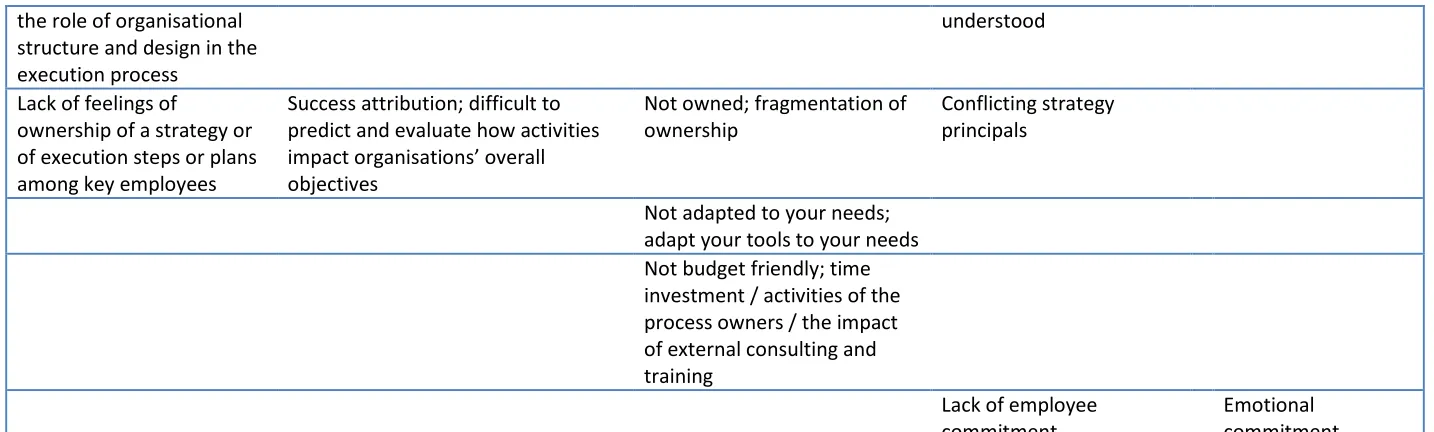
2.4 Key obstacles, challenges and problems of strategy implementation ... 14
2.5 Approaches to strategy implementation ... 19
3. Methodology ... 22
3.1 Research design ... 22
3.1.1 Selection ... 22
3.1.2 Measurement instrument(s) ... 23
3.1.3 Data collection ... 24
3.1.4 Data analyses ... 24
3.2 Trustworthiness and conformability assessment ... 24
4. Results ... 26
4.1 Within case analysis ... 26
4.2 Cross case analysis ... 41
ix
6. Discussion ... 51
Scientific implications ... 51
Recommendations ... 51
Limitations ... 51
Future research ... 52
7. References ... 53
8. Appendix ... 58
Appendix 1: Strategy implementation approaches ... 58
Appendix 2: Graphically representation strategy implementation approaches ... 63
1
1. Introduction
1.1 Situation and complication in the Strategic Management field
2
an implementation framework is the process oriented closed loop management system of Kaplan and Norton (2008), which exists of five stages for successful strategy implementation. In other words, these previous mentioned points have all been widely acknowledged in the literature. However, in the literature is limited information available about which approaches, which are suggested by several books and articles in the literature, are actually used in practice by organisations for implementing their strategy. In other words, there is limited systemic knowledge about how organisations go about implementing their strategy, which consists of several aspects. There is limited systemic knowledge about: firstly, the approaches organisations actually use for strategy implementation, secondly, the advantages and disadvantages of these approaches according to the organisations, and thirdly the challenges organisations face when implementing strategy. Altogether, any practical insight about how the organisation actually implement their strategy has not been acknowledged in the literature – which possibly explain the above mentioned high fail rates. This is peculiar, because both practical and academic experience indicate that decisions made in implementing strategy have substantial impact on organisational performance (Hrebiniak & Joyce, 1984).
1.2 Research Goal
The goal of this research is to map the approaches that manufacturing organisations use for strategy implementation process and the challenges which organisations face when doing so, with as overall aim to develop a roadmap for strategy implementation.
1.3 Research Questions
Research question:
Which approach can established manufacturing organisations use to effectively implement strategy?
Explanation of the core variables (see section ‘theoretical framework’ for a detailed explanation): 1. The definition of strategy is “a unique way of sustainable value creation” (Kraaijenbrink, 2015, p.
18).
2. Strategy implementation refers to “a dynamic, iterative and complex process, which is comprised of a series of decisions and activities by managers and employees – affected by a number of interrelated and external factors – to turn strategic plans into reality in order to achieve strategic objectives” (Yang et al., 2008, p. 6).
3
4. The definition of a manufacturing organisation is: “Any business that uses components, parts or raw materials to make a finished good” (Oxford Dictionaries).
5. The definition of an established organisation is: “Set up a firm permanently, cause to be accepted or recognized” (Oxford Dictionaries). In other words, an established organisation is an organisation which is already on the market for some time.
6. Effectively refers to “prepared for use or action; in operation or in force” (Oxford Dictionaries). In other words, effective refers to what organisations actually use in practice and what are the advantages and disadvantages of these approaches.
There should be researched multiple aspects to answer the research question. Firstly, the paper should map the several approaches described in the academic literature to provide an overview of the strategy implementation approaches which already have been developed by academic researchers. Secondly, the paper should provide insight about which approaches organisations actually use for strategy implementation to be able to check if these approaches match with approaches described in the academic literature. Thirdly, the term effectively should be researched, by determining the advantages and the disadvantages of the used approaches and the challenges which organisations face when implementing the strategy, to develop an effective strategy implementation roadmap. Therefore, the next sub research questions can be formulated:
1. Which strategy implementation approaches are already developed in the literature? 2. Which approaches are actually used by established manufacturing organisations? 3. What are the advantages and disadvantages of these approaches?
4. What are the challenges organisations face when implementing their (business) strategy?
1.4 Outline of the paper
The paper starts with the theoretical framework, which discusses the evolution in strategy implementation literature, definitions of strategy implementation, key factors of strategy implementation, key obstacles, challenges and problems of strategy implementation, and approaches to strategy implementation. After the theoretical framework section, the methodology of this research has been discussed. The methodology section has been followed by the analysis, which exists of two parts; a within case analysis and a cross case analysis. The paper ends with a conclusion and discussion.
4
2. Theoretical framework
2.1 Evolution in strategy implementation literature
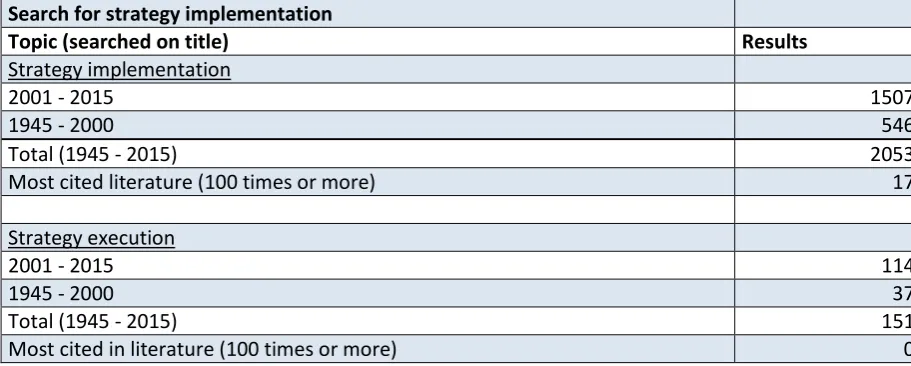
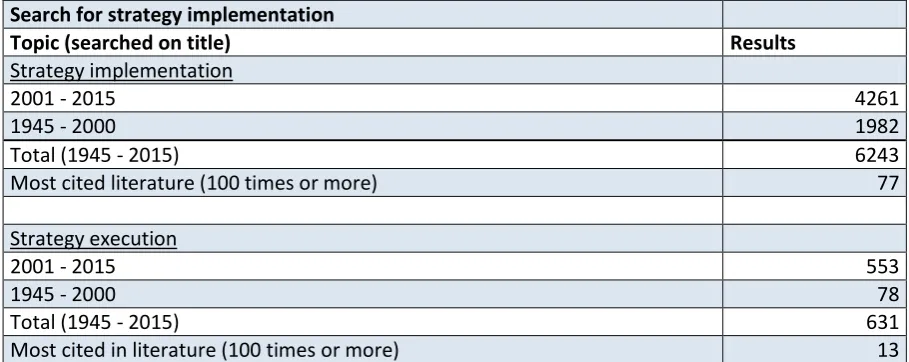
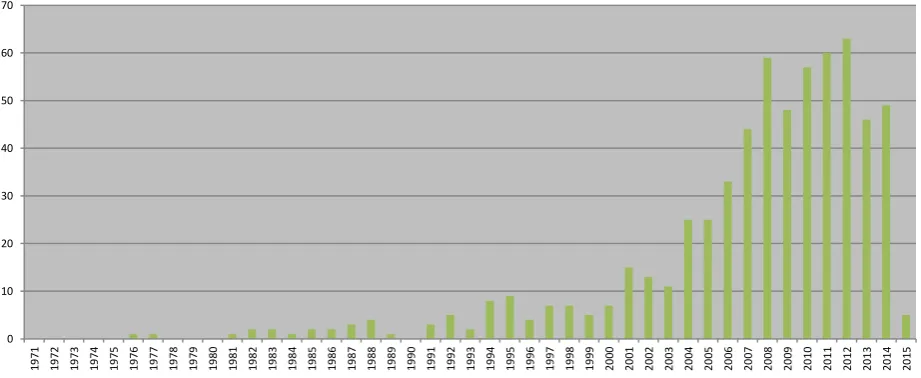
[image:14.595.68.524.374.557.2]As stated in the introduction, there is no shortage of (scientific) literature within the field of strategy implementation and strategy in general. To get an overview of the strategic management literature, a citation report analysis has been conducted, see table 1 and table 2. The analysis has been conducted on the website www.webofknowledge.com and by use of Publish of Perish – which uses Google Scholar – with two search terms, namely strategy implementation and strategy execution, because both terms have been used in the literature for the same topic, namely strategy implementation. There have been searched on title from the years 1945 till 2000 and from 2001 till 2015. It could be suggested, with use of both search terms, that the amount of published papers - using Web of Knowledge – have been increased after the year 2000, see figure 1 and 2, and same applies for the amount of published papers and books – using Google Scholar, see figure 3 and 4. It can be suggested that the field of strategy implementation/execution is a trending topic – because of the increasing amount of articles and books – and has received more attention from in the academic research last years.
Table 1: Citation report “strategy implementation” and “strategy execution”. Source: www.webofknowledge.com.
Search for strategy implementation
Topic (searched on title) Results
Strategy implementation
2001 - 2015 1507
1945 - 2000 546
Total (1945 - 2015) 2053
Most cited literature (100 times or more) 17
Strategy execution
2001 - 2015 114
1945 - 2000 37
Total (1945 - 2015) 151
5
[image:15.595.71.523.298.486.2]Figure 1: Published items “strategy implementation” in each year (1971 – 2015). Source: www.webofknowledge.com.
Figure 2: Published items “strategy execution” in each year (1975 – 2015). Source: www.webofknowledge.com.
Table 2: Citation report “strategy implementation” and “strategy execution”. Source: Harzing’s Publish of Perish: Google Scholar.
Search for strategy implementation
Topic (searched on title) Results
Strategy implementation
2001 - 2015 4261
1945 - 2000 1982
Total (1945 - 2015) 6243
Most cited literature (100 times or more) 77
Strategy execution
2001 - 2015 553
1945 - 2000 78
Total (1945 - 2015) 631
[image:15.595.67.522.511.692.2]6
Figure 3: Published items “strategy implementation” in each year (1971 – 2015). Source: Harzing’s Publish of Perish, Google Scholar.
Figure 4: Published items “strategy execution” in each year (1971 – 2015). Source: Harzing’s Publish of Perish, Google Scholar.
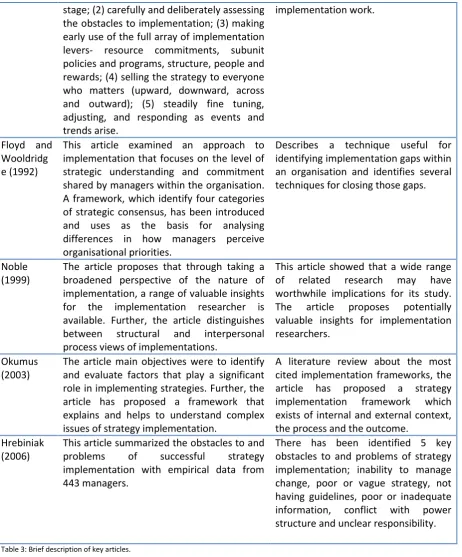
There are several well-known researchers in the field of strategy implementation. According to the citation report analysis, the most important articles, i.e. researchers who have the most citation on their published work, in the field of strategy implementation are: Waterman et al. (1983), Nutt (1983/1989), Bourgeois and Brodwin (1984), Gupta and Govindarajan (1984), Hambrick and Cannella (1989), Floyd and Wooldridge (1992), Noble (1999), Okumus (2003), and Hrebiniak (1985/2006). These authors wrote several papers about the topic strategy implementation. The most trending subjects within the topic strategy implementation are: key factors, i.e. levers, for strategy implementation, challenges, i.e. obstacles, of strategy implementation, roles of executors in the strategy implementation process, potential strategy implementation problems and approaches to strategy implementation. Table 3 provides a brief description of these most cited articles to obtain an overview of the key topics within the topic strategy implementation.
[image:16.595.78.539.287.476.2]7
Furthermore, Yuang et al. (2008) wrote a review paper about the factors influencing strategy implementation. In this paper the researchers review the factors “that enable or impede effective strategy implementation and survey the state-of-art in this domain” (p. 2).
Article Overview Contribution
Waterman et al. (1980)
The article proposes a framework for organisational though and has claimed that the relationship between structure, systems, subordinate goals, style, staff, skills and strategy affects effective organisational change.
A framework for implementing strategy, the 7S framework.
Nutt (1983)
The article has taken the position that implementation prospects improve when the strategy planning process is linked to implementation and when an implementation approach is tailored to fit the internal environment of an organisation.
Considers a range of implementation techniques and power approaches for a variety of planning situations
Bourgeois and Brodwin (1984)
The authors consider 5 process models of implementation – commander, change, collaborative, cultural and crescive. Two fundamental variables appear to characterize these different views, shifting continuously from the commander to the crescive model. The variables are, first, a shift from centralized to decentralized decision-making for both strategy development and implementation and, second, an increasing blurring of the distinction between ‘thinkers’ and ‘doers’.
Draws attention to an area that has traditionally been treated as merely an activity following formulation. This article serves to synthesize advances in the study of implementation, structured around these five models.
Gupta and Govindaraj an (1984)
The authors researched the strategy formulation and implementation at level of divisions or Strategic Business Units (SBUs). The article has taken the position that general managers with greater marketing/sales experience, greater willingness to take risk and greater tolerance for ambiguity will make a greater contribution to effectiveness of strategy implementation.
The article reveals that, at the level instead of organisation as a whole, greater marketing/sales experience, greater willingness to take risk and greater tolerance for ambiguity on the part of SBU general manager contribute to the effectiveness of the SBUs.
Nutt (1986)
This study examined implementation tactics used by managers in making planned changes by profiling 91 case studies. Therefore, the article examined, with help of the transactional planned change process framework, how responsible agents regulate and control a process of planned change.
Identified four types of tactics; intervention, persuasion, participation and edicts.
Hambrick and Cannella (1989)
The authors found the following patterns of behaviour in cases of successful implementation: (1) obtaining broad-based inputs and participation at the formulation
8
stage; (2) carefully and deliberately assessing the obstacles to implementation; (3) making early use of the full array of implementation levers- resource commitments, subunit policies and programs, structure, people and rewards; (4) selling the strategy to everyone who matters (upward, downward, across and outward); (5) steadily fine tuning, adjusting, and responding as events and trends arise.
implementation work.
Floyd and Wooldridg e (1992)
This article examined an approach to implementation that focuses on the level of strategic understanding and commitment shared by managers within the organisation. A framework, which identify four categories of strategic consensus, has been introduced and uses as the basis for analysing differences in how managers perceive organisational priorities.
Describes a technique useful for identifying implementation gaps within an organisation and identifies several techniques for closing those gaps.
Noble (1999)
The article proposes that through taking a broadened perspective of the nature of implementation, a range of valuable insights for the implementation researcher is available. Further, the article distinguishes between structural and interpersonal process views of implementations.
This article showed that a wide range of related research may have worthwhile implications for its study. The article proposes potentially valuable insights for implementation researchers.
Okumus (2003)
The article main objectives were to identify and evaluate factors that play a significant role in implementing strategies. Further, the article has proposed a framework that explains and helps to understand complex issues of strategy implementation.
A literature review about the most cited implementation frameworks, the article has proposed a strategy implementation framework which exists of internal and external context, the process and the outcome.
Hrebiniak (2006)
This article summarized the obstacles to and problems of successful strategy implementation with empirical data from 443 managers.
[image:18.595.71.534.70.628.2]There has been identified 5 key obstacles to and problems of strategy implementation; inability to manage change, poor or vague strategy, not having guidelines, poor or inadequate information, conflict with power structure and unclear responsibility.
Table 3: Brief description of key articles.
2.2 Defining strategy implementation
9
way. Firstly, ‘value creation’ refers to “the value an organisation creates through its products and services” (p. 18). Secondly, ‘sustainable’ refers to four different aspects, namely; “strategy should be hard to copy or circumvent by others”, “organisation receives something in return for the value it creates”, “a strategy should not rely too much on resources that are easily depleted” and “a strategy should take into account the interests of important stakeholders” (Kraaijenbrink, 2015, p. 18-19). Thirdly, the aspect ‘unique’ refers to “a good strategy aims at doing something different from others” (Kraaijenbrink, 2015, p. 19). And fourthly, the aspect ‘way’ refers to “the strategy is an on-going and active process that is lived by the organisation on a daily basis” (Kraaijenbrink, 2015, p. 20). The researcher Porter (1980) developed a more comprehensive definition of strategy, the researcher defined strategy in terms of “taking offensive or defensive actions to create or maintain a defendable position in an industry, cope successfully with the five competitive forces or an yield a superior return of the firm” (p. 29). Further, Marucheck et al. (1990) provide a definition with a focus on the manufacturing organisation: “manufacturing strategy is a collective pattern of coordinated decisions that act upon the formulation, reformulation, and deployment of manufacturing resources and provide a competitive advantage in support of the overall strategic initiative of the firm” (p. 104).
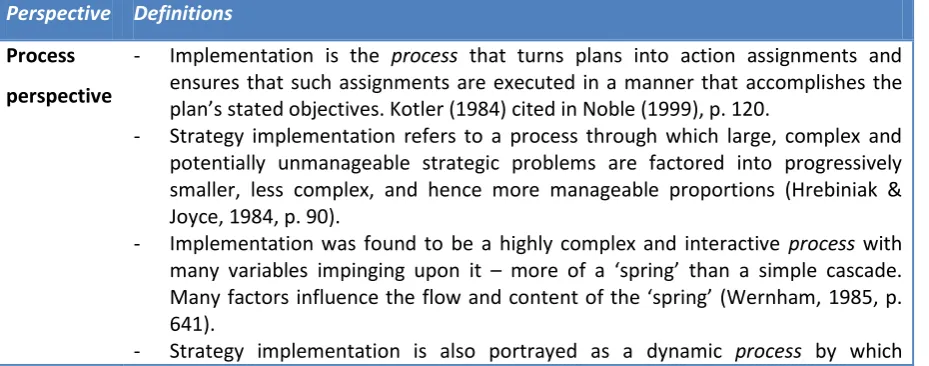
[image:19.595.69.534.577.760.2]There is no universally accepted definition of strategy implementation, or execution, in the literature. The researchers Yang et al. (2008) reviewed sixty articles and collected the definitions in a table. This table, see table 4, has shown below. Yang et al. (2008) divided the collected definitions into three perspectives; process, behavioural and hybrid, i.e. mix between process and behavioural, perspective. This paper has updated the table of Yang et al. (2008) by adding definitions from articles and books to the table from the last recent years. Next to this, Yang et al. (2008) found that “there are no articles differentiating strategy implementation from strategy execution in the sixty articles that we have reviewed” (p. 4). In other words, there is no need to distinguish strategy implementation from execution. Therefore, strategy implementation has used as term in this paper. Perspective Definitions
Process
perspective
- Implementation is the process that turns plans into action assignments and ensures that such assignments are executed in a manner that accomplishes the plan’s stated objectives. Kotler (1984) cited in Noble (1999), p. 120.
- Strategy implementation refers to a process through which large, complex and potentially unmanageable strategic problems are factored into progressively smaller, less complex, and hence more manageable proportions (Hrebiniak & Joyce, 1984, p. 90).
- Implementation was found to be a highly complex and interactive process with many variables impinging upon it – more of a ‘spring’ than a simple cascade. Many factors influence the flow and content of the ‘spring’ (Wernham, 1985, p. 641).
10
companies identify future opportunities (Reid, 1989, p. 554).
- Strategy implementation may be viewed as a process inducing various forms of organisational learning, because both environmental threats and strategic responses are a prime trigger for organisational learning processes (Lehner, 2004, p. 475).
- Implementation is a process, which is the result of a series of integrated decisions and actions over time (Hrebiniak, 2006, p. 14).
- Strategy implementation is an iterative process of implementing strategies, policies, programs and action plans that allows a firm to utilize its resources to take advantage of opportunities in the competitive environment (Harrington, 2006, p. 374).
- Strategy implementation links strategy to operations with a third set of tools and processes, including quality and process management, reengineering, process management, reengineering, process dashboards, rolling forecasts, activity-based costing, resource capacity planning, and dynamic budgeting (Kaplan & Norton, 2008, p. 2).
- The main task of implementation of the strategy is to bring the strategy into the life as a part of everyday decision making process of the company (Misankova & Kacisova, 2014, p. 861).
Behavior
perspective
- It is a series of decisions and resultant actions which commit resources to achieving intended outcomes. Grinyer & Spender (1979) cited in Wernham (1985) p. 634.
- Implementation is a series of interventions concerning organisational structures, key personnel actions, and control systems designed to control performance with respect to desired ends (Hrebiniak & Joyce, 1984, p. 17).
- Implementation designates the managerial interventions that align organisational action with strategic intention (Floyd & Wooldridge, 1992, p. 38).
- Implementation is the actions initiated within the organisation and its relationships with external constituencies to realize the strategy. Varadarajan (1999) cited in Homburg et al. (2004), p. 1331.
- Implementation is operationally defined as those senior-level leadership behaviors and activities that will transform a working plan into a concrete reality (Schaap, 2006, p. 14).
- Strategy execution revolves around aligning key organisational factors with strategy (Higgins, 2005, p. 3)
- The action that moves the organisation along its choice of route towards its goal – the fulfilment of its mission, the achievement of its vision – strategy implementation is the realization of intentions (MacLennan, 2011, p.11).
- Strategy implementation is all the actions necessary to turn your strategy into success (de Flander, 2012, p. 15).
- Implementation is a hands-on operation and action-oriented human behavioral activity that calls for executive leadership and key managerial skills (Apistola & Gottschalk, 2012, p. 93).
Hybrid
perspective
- Implementation is defined as “…the sum total of the activities and choices required for the execution of a strategic plan…the process by which strategies and policies are put into action” (Hunger & Wheelen, 2003, p. 192).
- In the instances where plans, strategies, technologies, or programs are markedly new to the firm, implementation appears to involve organisational design reconfiguration - i.e., a redesign of structure, systems, process, people, and rewards (Galbraith & Kazanjian, 1988, p. 30).
11
activities that make up a formulated decision-making strategy. Strategy execution also can be treated as a cognitive process (Dyer & Singh, 1998, p. 662).
- Strategy implementation is defined as an iterative process of implementing strategies, policies, programs and action plans that allow a firm to utilize its resources to take advantage of opportunities in the competitive environment (Harrington, 2006, p. 374-375).
- Implementation involves running the business, including prioritizing information, making resource allocations, and specifying tasks (Miller et al., 2008, p. 201). - Strategy execution is a process in which strategy is actually realized through
people’s actions and by doing something with ‘stuff’ – technology, materials, buildings, etc. (Kraaijenbrink, 2015, p. 26).
Table 4: Definitions of strategy implementation. Source: derived from Yang et al. (2008) – revised.
All these definitions can be taken together to one comprehensive definition of strategy implementation. This comprehensive definition, used in this paper, is “a dynamic, iterative and complex approach, which is comprised of a series of decisions and activities by managers and employees – affected by a number of internal and external factors – to turn strategic plans into reality in order to achieve strategic objectives” (Yang et al., 2008, p. 6). The next section describes the key factors for strategy implementation.
2.3 Key factors for strategy implementation
12
Waterman et al. (1980)
Hrebiniak (1992) Heide et al. (2000) Aaltonen & Ikavalko (2002); Dobni (2003); Freedman (2003); Linton (2002)
Okumus (2003)
Strategy formulation
Strategy development (Organisational)
Structure
Having a matrix structure
Formal organisational structure including control systems
An organisational structure and culture that is receptive to change
Organisational structure
Systems Information systems for communication Developing the management systems Control
Style Leadership The backing of senior executives Leadership
Staff Developing global
managers
Personnel management People
Skills Facilitating global learning
Learning; employees must have the necessary knowledge and skills for implementing strategy
Developing skills for change
Subordinate goals
Communication activities Communication
Working with external companies
Political factors Environmental
uncertainty Organisational culture The commitment of employees to the
company’s vision
Outcome
Allocation of resources Resource allocation
13
Yang et al. (2008) Crittenden et al. (2008) MacLennan (2010) Alamsjah (2011)
Strategy formulation process Policies; establishing strategy supportive policies
Task definition Clarity of strategy
Organisational structure Organisation structure Organisational structure
Administrative system in place Systems; installing strategic support systems Budgeting systems Strategy executors Interacting; the exercising of strategic
leadership
Managing change
Staff involvement CEO and top management involvement
Programs; instilling organisational learning and continuous improvement practices
Top team functioning People’s competencies Knowledge management
The communication activities Communication
Information sharing
Communication Cross functional
co-ordination and conflict
Degree of uncertainty in environment
The level of commitment for the strategy
Organizing; the strategic shaping of corporate culture
Corporate culture
People’s commitment Monitoring; tying rewards to achievement Performance measurement
and feedback
Performance management Actions; who, what, and when of
cross-functional integration and company collaboration
Strategy execution frameworks
Relationships among different units
and different strategy levels
Allocating; understanding when and where to allocate resources
Resource management The employed implementation
tactics
Clarity of accountability
Execution plan
[image:23.842.61.776.72.513.2]Consensus regarding strategy Time pressure
14
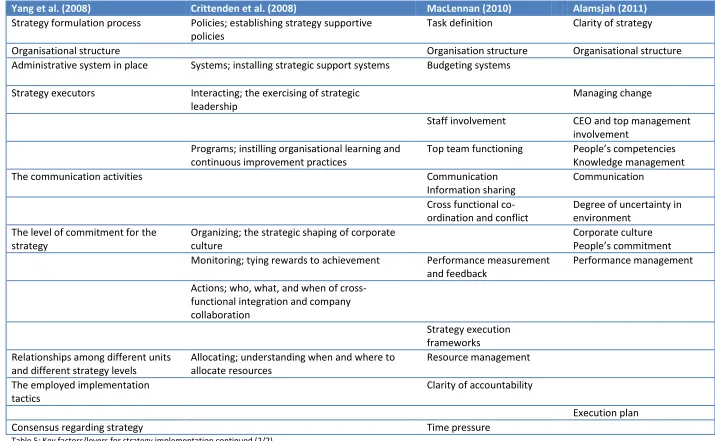
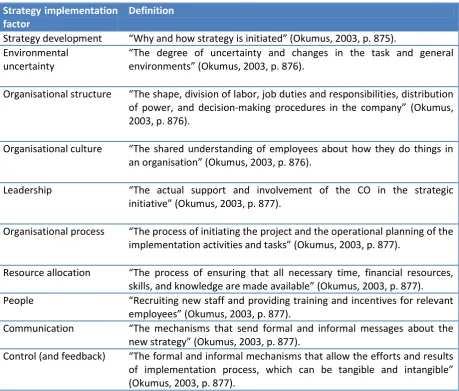
Comparing the factors from these two tables, the most mentioned key factors for strategy implementation are; communication, control, culture, environment, leadership or style, people, (resource) planning, outcome, strategy development and (organisational) structure. To clarify the key strategy implementation factors, the definitions have described in table 6.
Strategy implementation factor
Definition
Strategy development “Why and how strategy is initiated” (Okumus, 2003, p. 875). Environmental
uncertainty
“The degree of uncertainty and changes in the task and general environments” (Okumus, 2003, p. 876).
Organisational structure “The shape, division of labor, job duties and responsibilities, distribution of power, and decision-making procedures in the company” (Okumus, 2003, p. 876).
Organisational culture “The shared understanding of employees about how they do things in an organisation” (Okumus, 2003, p. 876).
Leadership “The actual support and involvement of the CO in the strategic initiative” (Okumus, 2003, p. 877).
Organisational process “The process of initiating the project and the operational planning of the implementation activities and tasks” (Okumus, 2003, p. 877).
Resource allocation “The process of ensuring that all necessary time, financial resources, skills, and knowledge are made available” (Okumus, 2003, p. 877). People “Recruiting new staff and providing training and incentives for relevant
employees” (Okumus, 2003, p. 877).
Communication “The mechanisms that send formal and informal messages about the new strategy” (Okumus, 2003, p. 877).
[image:24.595.69.529.150.541.2]Control (and feedback) “The formal and informal mechanisms that allow the efforts and results of implementation process, which can be tangible and intangible” (Okumus, 2003, p. 877).
Table 6: Definitions of the key strategy implementation factors. Source: Derived from Okumus, 2003.
2.4 Key obstacles, challenges and problems of strategy implementation
15
Alexander (1985) Lorange (1998) Corboy & O’Corrbui (1999) Beer & Eisenstat (2000) Okumus (2003)
Implementation took more time than originally allocated
Implementation taking more time than planned
Major problems surfaced during implementation that had not been identified beforehand
Too much organisational complexity
The ‘brick walls’ are not recognised
Coordination of implementation activities was not effective enough
Individual responsibilities for implementing the change are not clear
Poor coordination across functions, businesses or borders
Lack of coordination
Competing activities and crisis distracted attention from implementing this decision
Lack of speed and urgency
Forgetting to ‘mind the shop’
Capabilities of employees involved were not sufficient
Inadequate down-the-line leadership skills and development Training and instruction given to lower
level employees were not adequate Uncontrollable factors in the external environment had an adverse impact on implementation
Leadership and direction provided by departmental managers were not adequate enough
Lack of a true growth culture in the
organisation, from top to bottom
Chief executives and senior managers step out of the picture one implementation begins
An ineffective senior management team
Support from other levels of management
Key implementation tasks and activities were not defined in enough detail
A lack of understanding of how the strategy should be implemented
Poor vertical communication
Poor communication
Information system used to monitor implementation were not adequate
Strong organisational kingdoms
16
breaking implementing
Lack of cost competitiveness
Customers and staff not fully understand the strategy
[image:26.842.60.780.164.519.2]Unclear strategy and conflicting priorities Table 7: Key obstacles/challenges/problems of strategy implementation (1/2):
Hrebiniak (2006) MacLennan (2011) Flander, de (2012) Ivancic (2013) Mellon & Carter (2014)
Took more time than originally allocated
Inability to manage change
effectively and overcome resistance to change
Many senior leaders mistakenly believe that the organisational realignments required to execute new planned strategies will be initiated by middle managers without their active input and oversight
Not understood by managers; managers should understand the process
- Improper coordination - Too few people involved in implementation
Leaders are reluctant to spend time and effort on strategy execution seeing it as a messy business that more junior employees should deal with
Not easy; companies started off with a straight forward and simple process; doesn’t work.
17 Relatively few managers seem to
possess the learning and thinking styles required for strategy execution – to link conceptual ideas with concrete actions
Top and middle
management conflicting goals and priorities
Unclear communication of responsibility or
accountability for executions decisions or actions
Not balanced; organisations invest in those strategy execution process steps that are already quite developed, but then neglect the weaker ones
- Improper
communication between hierarchical levels and functions and poor information transfer - Inconsistencies in translating long range plans into short term objectives
Poor or inadequate information sharing between individuals or business units responsible for strategy execution
Not measured; strategy execution is a black box in measuring
Improper monitoring and incentive system
Trying to execute a strategy that conflicts with the existing power structure
Inadequate leadership style; top down or laissez fair senior management
Not to be changed; people don’t look change
Inability to overcome resistance to change
A poor or vague strategy Not on the radar; lack of
visibility
Vague strategy formulation
Lack of clarity
Not having guidelines or a model to guide strategy-execution efforts
18 the role of organisational
structure and design in the execution process
understood
Lack of feelings of
ownership of a strategy or of execution steps or plans among key employees
Success attribution; difficult to predict and evaluate how activities impact organisations’ overall objectives
Not owned; fragmentation of ownership
Conflicting strategy principals
Not adapted to your needs; adapt your tools to your needs
Not budget friendly; time
investment / activities of the process owners / the impact of external consulting and training
Lack of employee commitment
[image:28.842.64.781.70.286.2]19
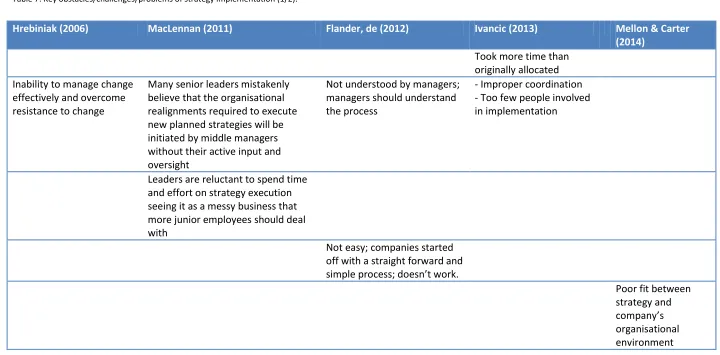
Taking these obstacles, challenges and problems of the tables together, the next are mentioned most frequently: unclear strategy, improper methods, lack of communication, improper motivation, insufficient resources, lack of control system, and ignoring the environment. The numeration below gives a description of the mentioned obstacles, challenges and problems (Pindelski & Mrowka, 2011, p. 41):
1. Unclear strategy – “the strategy is formulated in a general manner, goals are unclear and ambivalent”.
2. Improper methods – “the methods of translating visions into substantial targets and tasks are selected improperly, while the guidelines on the methods of their fulfilment are unclear as well”. 3. Lack of communication – “insufficient or improper communication, the lack of verification of the
level of understanding the message”.
4. Improper motivation – “effective motivation systems, unfit for the strategy and non–supportive to the strategic target performance”.
5. Insufficient resources – “wrong selection of the appropriate resources, improper allocation, inappropriate combination thereof”.
6. Lack of control system – “the lack of control and monitoring of strategy performance progress, the lack of consistency in monitoring and supporting the employees in the performance thereof”.
7. Ignoring the environment – “the varying elements of environment and the lack of space for the possible strategy changes in the course of its performance. Improper adaptation of the strategy to the varying enterprise environment”.
2.5 Approaches to strategy implementation
20
process and outcome into account when implementing the strategy. According to Okumus (2003), following such a holistic approach is “essential in evaluating the best implementation options, challenges and enables, and considering these areas can help executives and middle managers to understand the wider implications of the processes of change in their organisations” (p. 878). This paper suggests that there should be added two additional categories to this categorisation. The fourth category emphasizes the importance of context and process variables as well, but also includes the earlier mentioned implementation factors in the approach – which the paper describes as the combination, context as well as process variables, category with implementation factors. This category describes that it is essential to understand how strategies can be implemented with having a proper coherence between the strategy implementation factors, while the third category describes that it is “essential to understand how strategies can be implemented without having a proper coherence between the implementation factors” (Okumus, 2003, p. 879). The fifth category has as primarily purpose to measure and control performance by setting Key Performance Indicators (KPIs) – the performance measurement system category. In addition, the underlying idea of the performance measurement system category is that the KPIs should be aligned for successful strategy implementation.
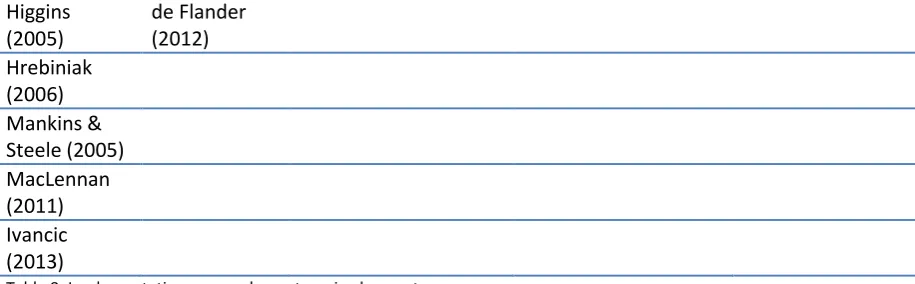
The most cited strategy implementation approaches have been described in essence in appendix 1 (p. 57). The graphically representations of these approaches have been listed in appendix 2 (p. 62). The approaches for strategy implementation have been gathered and categorised into these five categories, which has shown in table 8. This categorisation has been based on the description of the five categories. This table shows that most approaches can be categorised into the alignment category, i.e. these approaches simply list and describe the implementation factors.
Alignment approaches Process approaches Combination category without implementation factors approaches Combination category with implementation factors approaches Performance measurement system approaches Galbraith & Kazanjian (1978) Vasconcellos e Sá (1988)
Pettigrew & Whipp (1991)
Schmelzer & Olsen (1994)
Reed & Buckley (1988)
Waterman et al. (1980)
Galpin (1996) Roth et al. (1991) Okumus (2003) Kaplan & Norton (1996)
Stonich (1984)
Noble (1999) Dawson (1994) Pryor et al. (2007) Hambrick &
Cannella (1989)
de Feo & Janssen (2001)
Allio (2005) Yang et al. (2008)
Miller (1997) Kaplan & Norton (2008)
21 Higgins
(2005)
de Flander (2012) Hrebiniak
[image:31.595.69.527.74.216.2](2006) Mankins & Steele (2005) MacLennan (2011) Ivancic (2013)
Table 8: Implementation approaches categorized per category.
Altogether, as visible in table 8 and appendix 1 and 2, researchers have developed multiple strategy implementation approaches and all of these approaches describe different ways for implementing strategy. As stated, the strategy implementation approaches can be divided into five different categories.
22
3. Methodology
3.1 Research design
3.1.1 Selection
A qualitative research has been conducted in this paper. An important advantage of a qualitative research, cf. a quantitative research, is the possibility to gather more in-depth information and therefore conduct more detailed information (Babbie, 2010). Moreover, another advantage of qualitative research is that it gives the possibility to get face-to-face contact with people and to compare theory with practice and therewith gain deep insight (Babbie, 2010). Furthermore, the research is an embedded multiple case study consisting of 5 organisations. The reason for choosing a multiple case study is the ability to gather information from several organisations, and because of the relatively small sample, collecting in-depth information about the organisation is still possible. The selected interviewees are employees of the organisations. There have been selected 4-6 persons per organisation and these employees have responsibilities on lower/non-management level, middle-management level and the top-management level, i.e. the executives. The reason for choosing different levels of employees is that a strategy-as-practice study indicates, next to the top management, that middle- and lower/non-level management are also important strategic actors and that these employees work on different ways with strategy, from strategic-, tactical-, to operational level (Jarzabkowski et al., 2007). This results in a more representative picture about how different actors in organisations cope with strategy implementation. Table 9 shows the five organisations and the relevant organisations’ characteristics for this research.
The units of analysis are manufacturing organisations with the size of 50 - 249 employees, i.e. the medium-sized organisations following the European Union’s policy (Wiklund & Shepherd, 2003). These organisations have already been established, i.e. it is not a start-up organisation which does not have sufficient experience in strategy implementation, in order to get a representative picture of the strategy implementation processes (Krippendorff, 2012). The reason for choosing for a medium-sized organisation is that that kind of organisations can be analysed on a way that is not possible with large-, and small-sized organisations. The reasons for this is that the large-sized organisations, where the number of employees are >250, their processes are complex to study and the small-sized organisations have often not developed any methodology for implementing strategy (Krippendorff, 2012).
Organisation Number of employees
Number of interviewees
Job position interviewees
1 (Buckets) 120 4 Managing director – Sales manager –
Technological manager – Production and Labelling manager
23
production – Team leader production – Head planning department – Financial administrative assistant
3 (Valves) 180 5 Managing director – Assembly and Paint shop
manager – Order processing manager – Head sales – Senior sales manager
4 (Explosion safety)
248 6 Managing director – Controller – Sales engineer + Planner – Manager system solutions – Sales manager system solutions – Adjunct director
5 (Glass) 150 4 Manager director – Operations manager – Head
planning department – Team leader production
[image:33.595.68.527.73.233.2]Total 25
Table 9: Practical information about the organisations and interviewees who participated.
3.1.2 Measurement instrument(s)
For this research, qualitative research has been conducted with use of semi-structured interviews as the data collection technique. A semi-structured interview contains a set of predefined questions about several areas in the topic, but, next to the predefined questions, there is freedom to discuss specific topics more in-depth (Babbie, 2010). In other words, the semi-structured interview contains predefined questions and questions based on the answers from the interviewees. This gives the possibility to diverge and discuss particular topics within strategy implementation in more detail. Above on previous mentioned advantages, the reason for choosing a semi-structured interview for this research is to make the interviews comparable with other (manufacturing) organisations, but also to get more detailed information about specific issues within the topic strategy implementation. For clarification, the specific issues within strategy implementation are, for example, strategy implementation approaches, challenges and problems with strategy implementation, and involvement of employees in the process. The interview protocol, developed for this research, can be found in appendix 3 (p. 75). As visible in the interview protocol, the main subject of the questions is to gather information about the actual approaches an organisation use for strategy implementation and the advantages and disadvantages of this approach. For clarification, the covered subjects in the interviews, i.e. the structure of the interview, are:
1. Organisation structure 2. Strategy formulation 3. Strategic objectives
4. Strategy implementation approach 5. Communication
24 9. Strategy assimilation in job position
10. Difficulties
These ten subjects cover the mentioned key factors and key challenges, obstacles and problems from the theory section. For instance, the key factor ‘strategy development’ and the key challenge ‘unclear strategy’ have been combined into the subjects strategy formulation and strategic objectives. During the interviews, several sub-questions, depending on the given answer, have been asked to make the answer of the interviewee on the predefined questions more comprehensive and understandable for this research.
3.1.3 Data collection
The first step in the procedure of collecting the data has been to gather information about manufacturing organisations to search organisations which meet the earlier mentioned selection criteria – the amount of employees; should be 50-249 employees, and the type of organisation; should be a manufacturing organisation. The next step of data collection has been to conduct the interviews with the interviewees from the organisations, which are guided through the interview protocol. All the interviews were recorded and notes were taken during the interviews. The interviews were individually conducted in the office of the interviewed employees.
3.1.4 Data analyses
The interviews have been recorded, have been written down and have been coded afterwards. Coding refers to “the process whereby raw data [the records] are transformed into standardized form suitable for machine processing and analysis” (Babbie, 2010, p. 338). To be more precise, coding is “relating particular passages in the text of an interview to one category, in the version that best fits the textual passages” (Flick et al., 2004, p. 255). Both types of coding have been used, the open coding – create and categorize the data into labels – and axial coding – whereby relationships have been identified (Babbie, 2010). Eventually, to code and categorize the data of this research, the next labels have been used: organisation structure, strategy objectives, time frame strategy, strategy implementation approaches, communication, budgets, monitoring, incentives, strategy assimilation in job position, and difficulties.
3.2 Trustworthiness and conformability assessment
25
“no clear dividing between qualitative and quantitative content analysis and similar terms and criteria for reliability and validity are often used” (Schreier, 2012, p. 2). For clarification, the next concepts are equal to each other: creditability and confirmability are equal to internal validity, transferability is equal to external validity and dependability is equal to reliability. In other words, to determine the trustworthiness and conformability of this research, the concepts validity and reliability can be used (Schreier, 2012). Firstly, the approximate internal validity of this research is positive. A first reason for this is that the analysis includes several literal statement and quotations of interviewees, which enhance the design validity. Further, to increase the internal validity, there have been reported negative cases in the analysis, i.e. quotations which are contrarian compared with the other quotations of interviewees, to show exceptions on patterns. Moreover, to assure conformability of this research an interview protocol has been established – and discussed with an expert in the strategic management field – which has been used for every interviewee. In other words, the data have been collected on the same way and checked by an expert and therefore the construct validity can be seen as positive. Further, the findings of this research should be generalizable over the manufacturing organisations, because the findings show how the surveyed medium-sized established manufacturing organisations cope with strategy implementation and other manufacturing organisations can use this information. Therefore, it could be suggested that the results of this paper have a positive external validity over the manufacturing organisations. For clarification, the generalizability over the manufacturing organisations is not the focus of this research, because the goal is to acquire in-depth insights and accuracy about five organisations. Moreover, it could be suggested that the research is reliable, because the answers of the interview questions are primarily facts, so if you repeat the question at another time, the same answer should be given.
26
4. Results
4.1 Within case analysis
This section describes the outcomes of the interviews per organisation, i.e. the within case analysis. The structure of the within case analysis follows the structure of the interview: organisation structure, strategy formulation, strategic objectives, strategy implementation approaches, communication regarding strategy, budgets, monitoring, incentives, strategy assimilation in job position, and difficulties. These subjects, as stated earlier, have been derived from the key factors and key challenges, problems and obstacles from the theory section.
Organisation 1 - Buckets:
The organisation of case 1 is an established manufacturing organisation with a workforce of 120 fixed employees. The organisation has rapidly grown the last years, but the structure has not grown with this growth. Therefore, interviewees stated that the organisation is not used with working in structures, but the interviewees are aware of that the organisation should change in this – ‘we are not used to think in structure …, we are aware that we need to give more flesh and blood to this’ (Sales manager). Bringing more structure in the organisation is in development according to the interviewees.
Strategy formulation
The interviewees stated that the strategy of the organisation has not been established yet, but the organisation is in the process to develop a strategy. Further, the interviewees explained that the organisation makes choices regards strategy based on feelings and intuition – ‘I think that we should grow as company’ (Managing director) – and that these ideas and choices have not been recorded in documents. However, one of interviewees declared that the ideas have been recorded on paper by the managing director (Production and labelling manager).
Strategic objectives
27
objective of the organisation. The last interviewee – Production and labelling manager – stated that the organisation would like to improve the processes in the organisation, which includes; an optimum machine utilization, faultless production process and cost reduction by less personnel and more automation. The interviewees declared that the mentioned objectives are not recorded in documents. Moreover, there has not determined a timeframe for the strategic objectives, which indicates that there has not been a kick-off or endpoint for these objectives. There is a timeframe for the strategic objective of expanding the business to Germany. The kick-off was in the year 2012, but there is not determined an endpoint.
Strategy implementation approach
Next to the strategic objectives, all the interviewees stated that the organisation does not have a specific approach for implementing the strategic objectives, i.e. there is no procedure or the organisation does not take specific steps for implementing the strategy. One of the interviewee – Managing director – stated that the organisation uses a pragmatic approach, which indicates that the employees are doing their daily duties and do not have a plan to implement the strategy – ‘we just go to work and we will so how we get there’ (Managing director). The interviewees explained that the implementation of strategic objectives is based on feelings and intuition instead of on procedures or a plan.
Communication
The communication in the organisation proceeds primarily on an informal way – oral and by e-mail. One of the interviewees stated that conversations about objectives cannot be seen as the culture within the organisation – ‘the culture here is more work, less pay’ (Technological manager). However, there are meetings, not on a regular basis but around once a month, where the conversation is about the strategic objectives and about the problems in de organisation. During these meetings, the same persons of top- and middle management are present. The meetings are controlled and directed by the managing director. Further, there are work meetings on a yearly basis which have as subject to communicate about important decisions.
Budgets
28 Monitoring
Monitoring the outcomes of strategic objectives is on monthly basis. The organisation numerically monitors the results of the produced and sold items and the financial margins of these items. This is purely numerical and no other instruments are used for monitoring this. These monitoring documents are shared with the purchasing department and with the top management.
Incentives
There is no clarity about the incentives in the organisation, because the explanation of the interviewees varies. Two interviewees explained that there is no bonus system in the organisation, while the other two interviewees explained that there is a bonus system. One interviewee stated that the bonus system is connected to turnover objectives, while the other interviewee stated that the bonus system is connected to personal targets, e.g. days of absence – ‘if you are not ill, you will get some extra money’ (Technological manager). Further, one interviewee – Managing director – stated that there is a profit sharing for all the employees, but it is not clear what the minimum profit is for a profit sharing.
Strategy assimilation in job position
Three of the interviewees stated that strategy has been assimilated in the job position, i.e. time is reserved for strategy in their job tasks – ‘the frame has been given, we try to give substance to it’ (Managing director). One interviewee explained that strategy is not included in the tasks, i.e. strategy comes on top of the tasks.
Difficulties
29
think about (strategic) objectives – ‘boys, do not think, we [the small group who is concerned with the strategy formulation] do that for you; this results in that people will not spontaneously think about it’ (Technological manager).
Organisation 2 – Foil:
First of all, the organisation of case 2 is an established manufacturing organisation with a workforce of 100 fixed employees.
Strategy formulation
The strategy has been captured a business plan. The business plan precisely describes the short term objectives per year and also the longer term objectives for the upcoming 3 years. The business plan has been developed by the commercial director and managing director, with input from the management team. Three of the interviewees have knowledge of the business plan, but three other interviewees have no knowledge about this business plan. For these three interviewees, there is no clarity about the strategy, i.e. the interviewees cannot explain the organisation’s objectives for the upcoming years – ‘I cannot explain where the organisation will be in 5 years’ (Head planning department). Further, these interviewees have not been acknowledged about the growth objectives of the organisation.
Strategic objectives
30
or endpoint for these objectives. The completion of the business plan applies for the kick-off point. The organisation has determined the business plan for 5 years.
Strategy implementation approach
Next to the strategic objectives, all the interviewees stated that the organisation does not have a specific approach for implementing the strategic objectives or it is unclear if the organisation uses an approach. In other words, there is no procedure or the organisation does not take specific steps for implementing the strategy. Moreover, the interviewees stated that the ways how to implement the strategy are in the minds of the employees, i.e. based on feelings – ‘we just use logically thinking’ (Managing director).
Communication
The organisation has captured several meetings to discuss the objectives. There is a monthly meeting with all the employees where the managing director discusses the situation of last month and what are the expectations of upcoming month, i.e. discussing the general issues. Next to the monthly meeting, there is a weekly meeting, directed by the commercial director, where the management team discusses operational issues within the organisation. Another meeting is the meeting for R&D, which discusses the product developments and improvements. All these meetings have been recorded and shared within the organisation by mail. The business plan has shared with the employees by issuing a summary of the business plan, i.e. the broad outlines of the business plan. For the management team, the whole business plan is visible. Further, one interviewee stated that the organisation constantly pushes all the departments to achieve the expectations, both weekly and monthly – ‘we are pushing the organisations; these are the expectations on weekly, monthly and yearly level, did you achieve it and if no, why not and how can you solve this’ (Commercial director).
Budgets
According to four interviewees, the organisation has not determined budgets. Two other interviewees have no knowledge about budgets – ‘it is unclear to me if the organisation has determined budgets’ (Team leader production).
Monitoring
31
provides feedback on these results. However, one interviewee – Team leader production - stated that the organisation does not monitor the processes on the production floor.
Incentives
Further, four interviewees stated that the organisation does not make use of an individual bonus system, while one interviewee – Head production – stated that there is a bonus system for the sales and management team. This interviewee explained that there are personal targets, e.g. situational leadership and qualifying yourself, and general targets, e.g. decreasing failure costs. Further, when there is a significant profit – it is unclear how much this profit sharing should be – there is a profit sharing present for all the employees.
Strategy assimilation in job position
Time has been reserved for strategy in their job tasks for the management team and managing director. Further, the interviewees stated that the task separation within the organisation is clear, everyone in the organisation is aware of his/her tasks and there is no overlay with other job positions.
Difficulties
The interviewees mentioned several difficulties where the organisation has to cope with. One of the difficulties is the competitors in the market, i.e. same number of competitors but a less spending market, and no knowledge about these competitors. Therefore one of the objectives is to search for other markets with fewer competitors. The knowledge difficulty can be solved by desk research to gather information about the competitors. Another difficulty is the focus within the organisation. The organisation does not pay attention to the competitors, i.e. the organisation has an internal focus. Further, efficiency within the processes is also a difficulty. According to one interviewee – Head production –, this difficulty of efficiency can be solved by training and by starting with an order as short as possible after the order. A next difficulty is the uncertainty that appears under the employees. One interviewee stated that the reason for this is the unclear strategy – ‘the business strategy is not clear, this results in unclearness, why we do this and why we do not do that, and this results in uncertainties under the employees’ (Head planning department).
Organisation 3 – Valves: