Translating Strategy into
Implementation via
Capability-based planning
Shu Cheng
Master thesis
Business Information Technology
August 2015
Supervisors: Dr. Maria-Eugenia Iacob Dr. Maya Daneva MSc (PhD Candidate) Adina Aldea
Faculty of Electrical Engineering, Mathematics and Computer Science University of Twente
P.O. Box 217 7500 AE Enschede
MASTER THESIS
TRANSLATING STRATEGY INTO
IMPLEMENTATION VIA CAPABILITY-BASED
PLANNING
Shu Cheng
Student number: S1466259
Master of Science in Business Information Technology
University of Twente (UT), Enschede, TheNetherlands
Email: [email protected]
[email protected]
Graduation Committee:
Dr. Maria-Eugenia Iacob, University of Twente (UT)
Dr. Maya Daneva, University of Twente (UT)
Acknowledgements
This thesis concludes the end of my master study ‗Business Information Technology‘ at the University of Twente. These last two years were really special experience for me, since I have lived and studied in a totally different environment. I learnt new knowledge and experience every day, not just from the university, but also from the culture and people from the Netherlands.
This research presented in this thesis was conducted as a graduate intern at BIZZdeisgn. This graduate intern was a great experience for me to learn and work with the experts in the field of Enterprise Architecture. I was appreciated that BIZZdeisgn gave me this opportunity to do this research and provided the resource that I needed.
There are a number of people I would like to take this opportunity to thank for their helps and supports to my master thesis. First, I would like to express my sincere thanks to my university supervisors Maria Iacob and Maya Daneva. I am grateful for all the feedback and guideline they gave to me. Because of their valuable advices and critical questions, I could achieve my goal and accomplish my thesis.
Second, I would like to show my
gratitude
to Adina Aldea, my supervisor from BIZZdesign. Her great supervision and the weekly meetings really helped me through these months. These discussions were always giving me new ideas and helping me to improve the quality of my thesis.Third, a special thank to my friends Anastasia Maria Krisnawati and Zaharah Allah Bukhsh for their feedback and accompany. We did the research together in the last eight months and they made the days at the office more cheerful.
Last but not the least, I would like to thank my parents, who provide the unconditional love to me. Without their endless support and encouragement, I cannot get through my master study.
I
Index
List of Figures ... III
List of Tables ... V
1. Introduction ... 1
1.1 Problem Statement ... 3
1.2 Research Goal ... 3
1.3 Research Questions ... 4
1.4 Research Methodology ... 5
1.5 Research Approach ... 6
2. Literature review ... 8
2.1 Strategy implementation ... 8
2.1.1 Strategy ... 8
2.1.2 Strategic planning ... 9
2.1.3 Strategy models ... 10
2.2 Relationship between capability and strategy ... 15
2.2.1 Capability ... 15
2.2.2 Strategic fit with capability ... 16
2.3 Using CBP for strategy implementation ... 17
2.3.1 Original CBP method ... 17
2.3.2 The CBP tools ... 19
2.3 Enterprise architecture framework and ArchiMate language ... 22
2.3.1 CBP in Enterprise Architecture framework ... 23
2.3.2 ArchiMate language and metamodel ... 24
2.3.3 Using ArchiMate language for CBP ... 27
Summary ... 30
3. Capability-based planning Method Design ... 31
3.1 Capability-based Planning Method ... 31
3.2 Phase A: Map ... 33
3.2.1 Step A1: Identify the current Capability Inventory: ... 35
3.2.2 Step A2: Identify the strategic objectives ... 37
3.2.3 Step A3: Linking the capabilities to the strategic objectives. ... 38
3.2.4 Step A4: Building the Target capability map ... 40
3.3 Phase B: Assess ... 41
3.3.1 Step B1: Develop a set of measures for assessing these strategic
objectives ... 43
3.3.2 Step B2: Define Capability goals ... 45
3.3.3 Step B3: Define the sequence to assess the level 3 capabilities ... 46
3.3.4 Step B4: Assessing the capabilities ... 48
3.4 Phase C: Plan ... 70
3.4.1 Step C1: Addressing the capability gaps ... 72
3.4.2 Step C2: Selecting the urgent underperform capabilities... 73
3.4.3 Step C3: Creating the capability development projects ... 75
3.4.4 Step C4: Balance of Investment ... 77
3.4.5 Step C5: Documenting the Capability development plan ... 78
Summary ... 78
4. ArchiPharma case study ... 79
4.1 Introduction to the ArchiPharma ... 79
II
4.3 Map ... 83
4.4 Assess ... 88
4.4.1 Define capability goals: ... 88
4.4.2 Make sequence to assess the capabilities: ... 90
4.4.3 Assessing the desired performance level of the capabilities ... 91
4.4.2 Assessing the current performance level of the capabilities ... 98
4.5 Plan ... 102
Summary ... 111
5. Evaluation ... 113
5.1 Assessment criteria... 113
5.2 Interview setting... 114
5.3 Interview result and analysis ... 115
5.3.1 Interview result ... 115
5.3.2 Interview analysis ... 117
Summary ... 119
6. Conclusion ... 120
6.1 Answers to the research questions ... 120
6.2 Research contributions ... 122
6.3 Research limitations ... 123
6.4 Future work ... 123
Reference ... 125
Appendix ... 130
Appendix A: ArchiMate Motivation Extension ... 130
Appendix B: ArchiMate Implementation and Migration ... 131
Appendix C: EAM KPI Catalog ... 132
Appendix D: The State of Victoria KPI Catalog ... 133
Appendix E: IT Architecture Capability Maturity Model ... 134
Appendix F: Capability Maturity Model ... 138
Appendix G: IT Organization Strategy Maps ... 141
III
List of Figures
Figure 1: DSRM Process Model (Peffers et al., 2007) ... 6
Figure 2: Strategic planning process (Adina et al., 2014) ... 10
Figure 3 : The method of strategic planning (Aldea et al, 2013) ... 11
Figure 4 : Basic templates for a Strategy Map (Kaplan&Norton, 2004) ... 12
Figure 5 : Translating Vision and Strategy: Four Perspectives (Kaplan & Norton, 1996)... 14
Figure 6 : Simplyfied model of the links between resources, capabilities, and competitive advantage (Grant, 2010) ... 15
Figure 7 : Strategic alignment conceptual framework (Rashidirad, Soltani&Syed, 2013) ... 16
Figure 8 : Generic Process Chart of Capability-Based Planning (TTCP, 2004) ... 18
Figure 9 : A Process Model for Capabilities-Based Planning (Davis, 2002) ... 19
Figure 10 : Capability-based Planning Method (Aldea et al., 2014) ... 19
Figure 11 : Three-level capability decomposition (Ulrich & Rosen, 2011)... 20
Figure 12 : Level 1 Capability Map (Ulrich & Rosen, 2011) ... 21
Figure 13 : The Capability Systems Life Cycle (Capability Development Group Australia, 2014) ... 22
Figure 14 : Capability increments and dimensions (The Open Group, 2011) ... 23
Figure 15 : Capability increment ―Radar‖ (The Open Group, 2011) ... 24
Figure 16 : ArchiMate core metamodel (Iacob et al., 2012) ... 25
Figure 17 : Motivation extension metamodel (Iacob et al., 2012) ... 26
Figure 18 : Implementation and migration extension metamodel (Iacob et al., 2012) ... 27
Figure 19 : Abstract syntax (metamodel fragment) for strategy and value-related concepts (Iacob et al., 2012) ... 28
Figure 20 : Capability-based planning extension metamodel (Aldea et al., 2014) ... 29
Figure 21 : Possible relations between the resource and capability extension ... 29
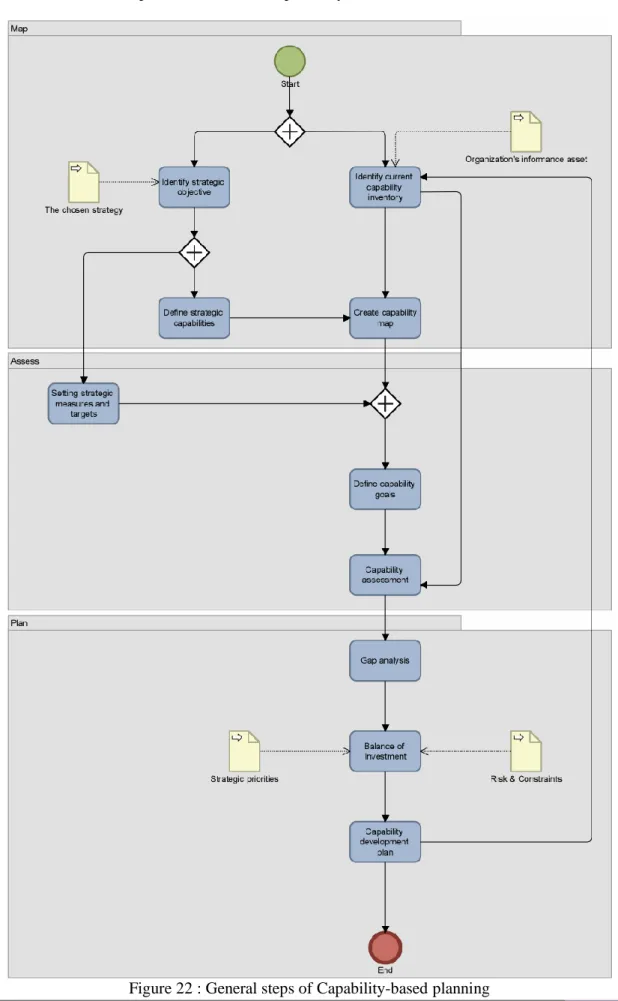
Figure 22 : General steps of Capability-based planning ... 32
Figure 23 : Excerpt from Strategic planning processes (Aldea et al., 2014) ... 34
Figure 24 : Mapping activities ... 34
Figure 25 : Steps of creating the baseline Capability map ... 36
Figure 26 : Example three-Level capability decomposition... 36
Figure 27 : Sub-process of identifying the strategic objectives ... 37
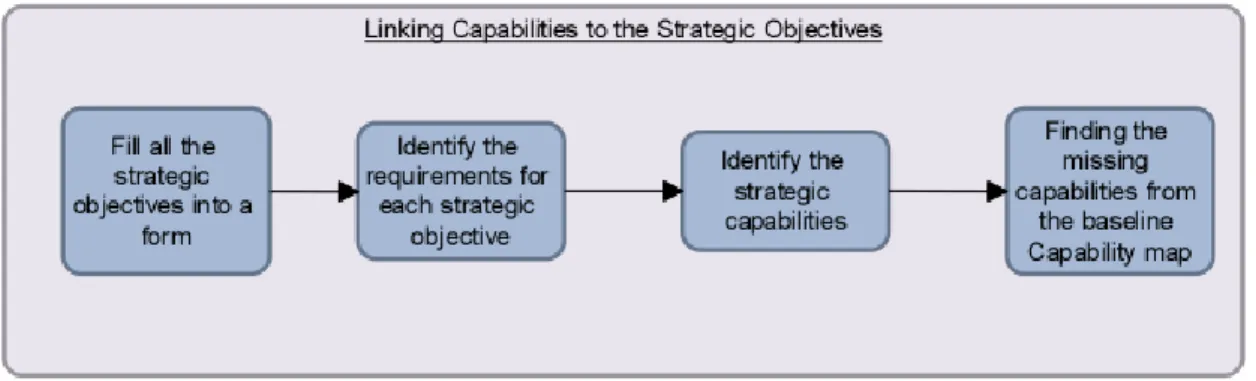
Figure 28 : Sub-process of linking capabilities to the strategic objectives ... 38
Figure 29: Meta-model for linking capabilities with strategic goals and measures (Kudryavtsev, Grigoriev, & Bobrikov,2014)... 39
Figure 30 : Example Target capability map ... 41
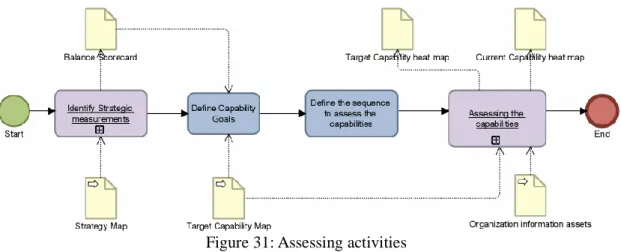
Figure 31: Assessing activities ... 42
Figure 32: Sub-process of Assess: create the BSC ... 43
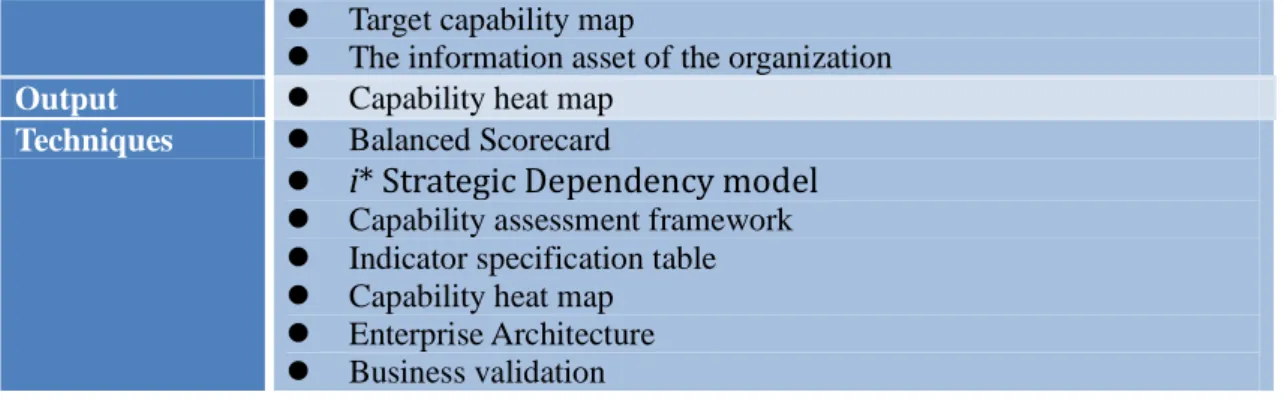
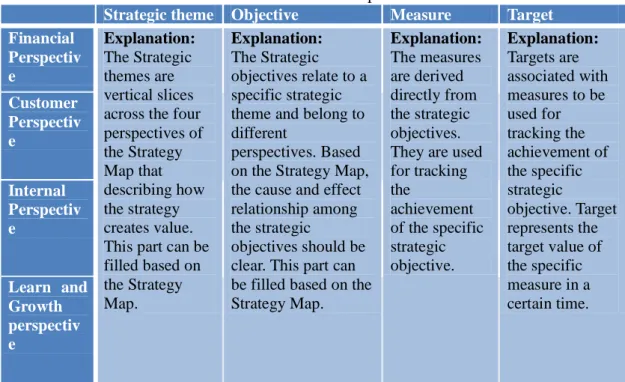
Figure 33: Balanced Scorecard (Kaplan & Norton, 2007) ... 44
Figure 34 : Strategic Dependency Model - The Product Management Capability (Danesh & Yu, 2014) ... 47
Figure 35: Example capability dependency relationships ... 47
Figure 36: Sub-process of assessing the capabilities ... 48
Figure 37 : Example target architecture of the recruitment management ... 50
Figure 38 : Decomposition of the behavioral elements (Papazoglou, 2014) ... 51
Figure 39 : The links among resources, capabilities, and competitive advantage (Grant, 2010) ... 52
Figure 40 : Capability dimensions ... 53
Figure 41 : Classifying Benefits by Their Degree of Explicitness (Ward et al., 2008) ... 55
Figure 42 : Example target capability spider chart... 61
IV
Figure 44 : The Three Critical Dimensions (The CMMI product team, 2006) ... 65
Figure 45 : Example Level 3 target capability heat map ... 67
Figure 46: Example Baseline architecture of recruitment management ... 68
Figure 47: Example current capability spider chart ... 69
Figure 48: Planning activities ... 71
Figure 49 : Combined capability heat map ... 72
Figure 50: Example combined capability spider chart ... 73
Figure 51: Example capabilities related to strategic objectives ... 74
Figure 52: Example architecture elements that realize a capability increment ... 76
Figure 53: Example work packages and/or projects for the capability increments ... 76
Figure 54: Example roadmap with projects linked to the capability they improve ... 77
Figure 55: Vision, Mission and Strategy of ArchiPharma ... 79
Figure 56: Strategy analysis: Operational excellence ... 81
Figure 57: Strategy Map for operational excellence ... 82
Figure 58: ArchiPharma Level 2 Capability Map ... 84
Figure 59: Part of the Level 3 Strategic Capability Map for ArchiPharma ... 85
Figure 60: Operational excellence Target Capability Map ... 87
Figure 61: Relationships among the strategic capabilities ... 90
Figure 62: Target architecture of Customer billing process management ... 92
Figure 63: Target Capability Spider chart for Customer billing process management ... 94
Figure 64: ArchiPharma Target Capability heat map ... 98
Figure 65: Customer billing process management Current architecture ... 99
Figure 66: Current Capability Spider chart for Customer billing process management ... 100
Figure 67 : ArchiPharma Current capability heat map ... 102
Figure 68: Combined capability heat map for ArchiPharma ... 103
Figure 69: Combined spider chart of Customer billing process management ... 104
Figure 70: Part of the ArchiPharma Strategy map ... 105
Figure 71: Part of the relationship among the strategic capabilities for ArchiPharma ... 105
Figure 72: The relationship between the work packages and the strategy ... 106
Figure 73: Combined spider chart of Application portfolio management ... 107
Figure 74: Work packages for capability increment of APM ... 107
Figure 75: Application portfolio management development work package ... 109
Figure 76: APM development roadmap ... 109
Figure 77: Project development timeline ... 110
Figure 78: Visualized Capability Development Plan ... 111
Figure 79 : Motivation Extension Metamodel (The Open Group, 2013) ... 130
Figure 80: Relationships between Motivation Extension and the ArchiMate Core Concepts (The Open Group, 2013) ... 130
Figure 81: Implementation and Migration Extension Metamodel (The Open Group, 2013) 131 Figure 82: Relationship between Implementation and Migration Extension and the ArchiMate Core Concepts (The Open Group, 2013) ... 131
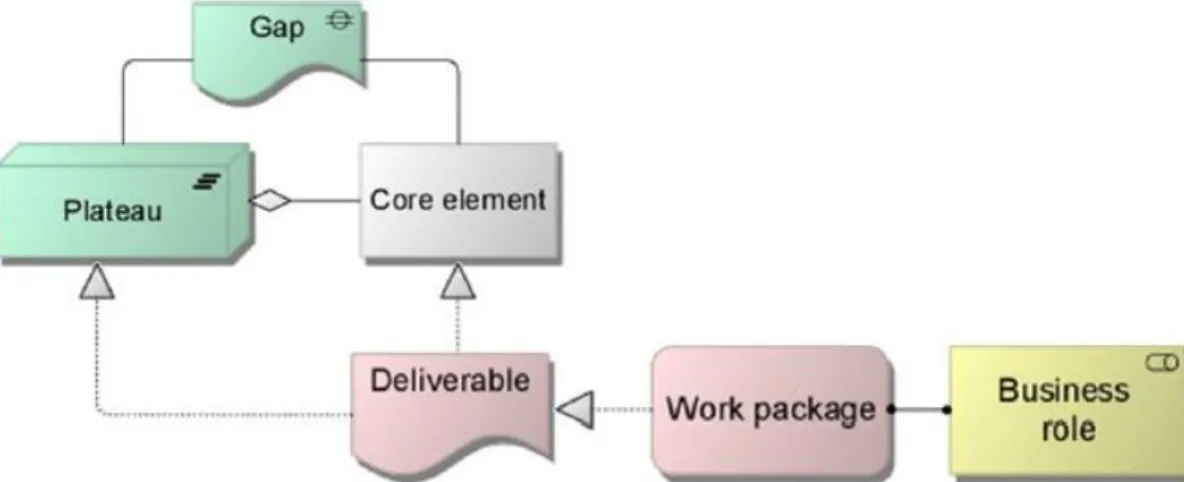
Figure 83: Relationships between Plateau, Deliverable, and Motivation Concepts (The Open Group, 2013) ... 131
V
List of Tables
Table 1: Research Approach ... 7
Table 2 : Possible relations in the resource and capability extension (The Open Group, 2013) ... 29
Table 3 :The Characteristics of Phase Map ... 35
Table 4 : Linking capabilities with strategy ... 40
Table 5 : Example linking capabilities to specific strategic objective ... 40
Table 6 : The Charaterics of Phase Assess ... 42
Table 7 :BSC template ... 45
Table 8 : Example BSC ... 45
Table 9 : Example capability goal... 46
Table 10: Sample Indicator Specification Table... 54
Table 11 : Capability performance assessment framework ... 58
Table 12 : Sample Capability Assessment Framework ... 63
Table 13 : Framework of Capability performance level ... 66
Table 14 : The Charaterics of Phase Plan ... 72
Table 15: Example of basic component of Capability development plan ... 78
Table 16: Balanced Scorecard for Operational excellence ... 83
Table 17: Linking capabilities with strategy for ArchiPharma ... 85
Table 18: Level 3 capabilities goals for ArchiPharma ... 88
Table 19: Indicators of Customer billing process management ... 93
Table 20: Indicator specification table for Process dimension ... 94
Table 21: Simplified Capability performance level model... 95
Table 22: Desired performance of Customer billing process management ... 96
Table 23 : Summary of target capability performance level ... 97
Table 24: Current performance of Customer billing process management ... 100
Table 25: Summary of current capability performance level ... 101
Table 26: ArchiPharma Capability gap analysis ... 103
Table 27: Project portfolio scorecard ... 108
Table 28: Application portfolio management development plan ... 109
Table 29: Evaluation dimensions ... 113
Table 30: Interview setting ... 114
Table 31: Interview question script ... 114
Table 32: Summary of interview results ... 115
Table 33 : KPI Property section (Matthes et al., 2012) ... 132
Table 34: Example KPIs & Categories (The State of Victoria, 2010) ... 133
Table 35: IT Architecture Capability Maturity Model (DoC, 2003) ... 134
Table 36: Maturity Level (CMMI Product Team, 2006) ... 138
Translating Strategy into Implementation via Capability-based planning 1
1. Introduction
In today's fast moving environment, many organizations experience increasing problems in designing their strategy. In an ideal world, managers could design a long-term strategy totally based on what the organization needs and implement this strategy step by step. However, due to the uncertainties of the environment (e.g. rapid technical change, highly dynamic industries, and global volatility), organizations encounter difficulties when making strategic decisions.
Strategy development is depending on the capabilities of the organization and their position in the market. Michael E. Porter said, ―The broadest level formulating competitive strategy involves the consideration of four key factors that determine the limits of what a company can successfully accomplish.‖ (Porter, 1980) The limiting factors include both external and internal ones. The internal factors ―company strengths and weakness‖ and ―personal value of the key implements‖ relate to the organization‘s capabilities. Therefore, Porter stated, ―The value of resources and capabilities is inextricably bound with strategy.‖ (Porter, 1980) For developing a successful strategy, it is necessary to identify resources and capabilities.
After the strategy has been defined, the next challenge is to implement it. Translating strategy into action may be even harder. The Economist Intelligence Unit conducted a global survey of 587 senior executives in March 2013, which shows that around 88% survey respondents believe delivering a strategic plan is important. However, 61% of them admitted that their organizations were struggling with bridging the gap between strategy formulation and strategy implementation (The Economist Intelligence Unit, 2013). Therefore, it is essential for an organization to find a way to translate high-level strategy into the implementable activities.
As a response to the dynamic environment, capability-based theories can be used to complement the strategic management. Scott stated that capabilities could link strategy to action because according to capability analysis, organizations can define what they must be able to do to successfully execute their strategy. Furthermore, capabilities can provide a foundation for assessing and prioritizing the strategic mission, and linking executive intent with operational activities (Scott, 2014). Capabilities can be used as the business-oriented starting point for any discussion around strategic planning and can help determine the impacts of those plans from an enterprise perspective (Ulrich & Rosen, 2011). Thus, knowing what kinds of capabilities are fit for the organization‘s strategy is crucial for executing the strategy.
Capability-based planning (CBP) is originally proposed by the Department of Defence (DoD) in United State and it is used in military agencies. However, from Enterprise Architecture and IT perspective, CBP could be a powerful mechanism to ensure that the strategic business plan drives the enterprise from a top-down approach (The Open Group, 2011). It is centered on realizing strategic goals by focusing on what an organization can do, rather than how it can do it (Aldea, 2014). Thus, CBP can also be used in commercial organizations for business planning based on the strategic needs.
Chapter 1: Introduction
Translating Strategy into Implementation via Capability-based planning 2
methods for performing CBP are not easy to adopt for organizations. Thus, the research of this study will focus on developing a method for CBP and identifying the required inputs and possible outputs for each phase of this method. This could help an organization to have a better understanding of the gap between their current capabilities and target capabilities, so as to give the direction to an organization for developing their capabilities based on their strategic needs.
In order to develop a practical method for performing CBP, the assessment tools that are used for assessing the capability will be designed in this study. Consequently, the main goal of this study is the design of a practical method for aligning strategy development with implementation by using capability-based planning. This method should help organizations with translating their strategy into implementation.
Translating Strategy into Implementation via Capability-based planning 3
1.1 Problem Statement
Both literature and practical studies show that CBP can be used for aligning capabilities with strategy (TTCP, 2004). However, there are not so many researches that can be used in practice so far.
Papazoglou proposed a methodology for implementing CBP in TOGAF framework. It divided the process into three phases, which includes Strategy validation, Capability analysis and Capability development and delivery (Papazoglou, 2014). The steps of the delivering process are clearly identified, but no specific input and result are defined, which could make it difficult to be used directly by organizations. The capability heat map and capability maturity level analysis are not adequate for quantifying capabilities.
TTCP has developed a guide for performing CBP and built a model that included generic steps of CBP. TTCP stated, CBP was a systematic approach to force development that helped the defence department to choose the most appropriate force options to meet government priorities. The generic process of CBP starts from the government guidance and the defense priorities, and comes up with the plan of the capability improvement. In this guideline, TTCP defined the input, the assessment tool and the desired outcomes of CBP (TTCP, 2004). However, the method is too general and more related to defence need, it is not specific for the commercial organizations. Similar to this CBP method, Davis proposed a model for assessing capabilities in a Mission-System Framework. It is rather a depiction of when the capability does well, marginally, or poorly in different scenarios (Davis, 2002). Since it is also for the military use, the model is more focused on risk management and scenario analysis. Thus, to implement CBP in practice, a new method for analyzing is requisite.
For assessing capabilities, there are a few preconditions that must be fulfilled. The artifact of this research will be formulated based on the CBP activities proposed by Aldea et al.: Map, Access and Plan (Aldea et al., 2014). For mapping, CBP starts in the later phase of strategic planning. The related capabilities of the organization need to be identified in the mapping phase. Then, in the assessing phase, relevant metrics/indicators derived from strategy will be used for scoring the capabilities. This step is important for gap analysis, because it helps with identifying the current state and the desired state of the required capabilities. After that, an organization can make the plan to improve its required capabilities to their desired level, which is a useful input for implementing its strategy.
Since the purpose of this research is to help organizations to translate their strategy into action, the input of the CBP method should be derived from strategy, and the output should contribute to strategic implementation. Thus, the proposed CBP method in this research should be linked to the strategy model closely.
1.2 Research Goal
Grant stated that the capabilities and resources of an organization form the foundation for building competitive advantage. And establishing the competitive advantage of the organization requires formulating and implementing a strategy, which exploits the specific resources and capabilities of an organization (Grant, 2010). Therefore, specific resources and capabilities are required for implementing a strategy of an organization.
Chapter 1: Introduction
Translating Strategy into Implementation via Capability-based planning 4
required capabilities for executing a specific strategy. And it provides the suggestion for an organization on the most appropriate options to meet their strategic priorities. Therefore, to facilitate the strategy implementation, the research goal of this thesis is to design a CBP method to translate strategy into implementation. The method should be practical and easy to be adopted by commercial organizations. It includes three phases:
A. Mapping capabilities to strategy: This phase helps organizations to find out what are the capabilities they need for realizing their strategies. In this phase, the required capabilities and the missing capabilities will be identified.
B. Assessing related capabilities: The assessment will be based on the KPIs/metrics derived from strategy and the performance of the capabilities will be identified. This phase helps organizations to understand their current state of these required capabilities and how well their capabilities should be in order to fit their strategies.
C. Capability planning: Developing a roadmap for capability increments. After the gap analysis of capabilities, organizations should make plan to improve their capabilities to fit their strategic needs.
By using this method, organizations can gain a clear view of their current situation and the target situation that they should achieve. The CBP method can help an organization to have a better performance of their strategy implementation by giving them a direction for developing the required capabilities.
1.3 Research Questions
Based on the problem statement and research goal that described in the previous sections, the following research question is formulated:
How to develop a capability-based planning method to support strategic
alignment?
Strategic alignment can be also considered as ―fit‖, which is the process or a notion of linking the business strategy with the functional operations of an organization (Reich & Benbasat, 1996). Rondinelli et al stated that the alignment could facilitate the acquisition and deployment of resources that are required for the organization‘s competitive needs.(Rondinelli, Rosen, & Drori, 2001) Furthermore, Fuchs et al. noticed that the problem always occurred in strategy implementation when an organization did not align the execution capabilities with the organization‘s direction (Fuchs, Mifflin, Miller & Whitney, 2000). The research goal of this thesis is using CBP to translate strategy into implementation. Therefore, the method for performing CBP should support organizations to align capability development with strategy implementation, which means this method should support the strategic alignment.
In order to answer the main research question, a number of sub-questions are formulated:
RQ1: What is the relationship between strategy implementation and capability?
RQ2: How to design a method to link strategy and capabilities?
RQ3: How to define indicators based on strategy to assess capabilities?
RQ4: How can an organization develop and arrange a set of capability development projects based on the strategic needs?
RQ5: How can the method be applied in practice?
Translating Strategy into Implementation via Capability-based planning 5
answered in RQ1.
RQ2, RQ3 and RQ4 are following the activities of CBP defined by Aldea: Map, Assess and Plan. (Adina et al., 2014)
To answer RQ2, a method for aligning capability to strategy will be developed. This method helps organizations to identify the capabilities that are related to their chosen strategy. This step is called Map. After the required capabilities have been found, the organization can continue to assess their capabilities.
To answer RQ3, the indicators that based on the strategy will be designed to assess the quality of the required capabilities. The relevant metric/KPIs are derived from strategic requirements for the capabilities. This step is called Assess. The current and desired performance of the required capabilities can be identified after the capability assessment.
The RQ4 is about planning. After analyzing the gap between the current statement and the target statement of the capabilities, the organization can realize the direction to plan the increments of the required capabilities. Therefore, the organization can achieve a better implementation roadmap of its strategy.
In order to make sure that the method works, this research should answer the RQ5. In this study, we would like to use a case study to validate the method that is defined in the previous sections to see if the method works for the real business case or not. Furthermore, we could evaluate the method through asking the opinions from the external experts who have the experience in related area to see if the method is useful for facilitating the strategy implementation.
1.4 Research Methodology
Chapter 1: Introduction
Translating Strategy into Implementation via Capability-based planning 6
Figure 1: DSRM Process Model (Peffers et al., 2007)
The research steps and the research questions of this research match to the activities of DSRM Process Model. The match of the chapters/sections with the steps will be described below, to show the overview of the research approach of this thesis:
Problem Identification and Motivation
:
In this phase, the research problems will beidentified and the proposed solutions will be justified. We formulate the research questions of this thesis and related them to the problem statement and the motivation of this research and the problem identification will be described in chapter 1.
Define the objectives for a solution: Following the previous step, the next step is to define
the objectives of the solution. It is based on the defined problem and the studies of previous literatures. The solution should be quantitative and qualitative. Thus, this part will be described in chapter 1.5.
Design and development: Depending on the literature review, the solution will be designed
and developed in the following chapters. The method for linking strategy to capability will be designed in chapter 3. And based on the result of chapter 3, the indicators that is used for quantifying the strategic related capabilities will also be defined in chapter 3.
Demonstration
:
After the method has been designed and developed, the usability of it shouldbe demonstrated by solving one or more problems. This could be done by the experimentation, simulation, cased study, proof, or other appropriate activity. The method will be used in this thesis and be described in chapter 4.
Evaluation: To observe and measure how well the method supports the solution of the
defined problems. This step aims at comparing the objectives of the solution to the result from the use of the method, which will include the interview of the experts in this area. This part will be described in chapter 5.
Communication: The communication step will be done in the end after the thesis is
published and the thesis defence is finished.
1.5 Research Approach
Translating Strategy into Implementation via Capability-based planning 7
general, the research approach of this thesis can be divided into three phases: Literature review, design and evaluation.
In the first phase, this research starts from the literature review to gather the existing knowledge of practices and theories related to the research topic. And the second step is to categorize the knowledge that is gained from the previous step, to provide a systematic view of the information on the aspects related to this thesis topic. After that, in the third steps, the defined problem and the solution of this thesis will be refined based on the literature study.
The next phase is design. In the fourth step, the knowledge will be used to support the development of the new method, which includes the process model and the capability assessment metrics. And then comes the fifth step, the demonstration. A case will be chosen to demonstrate the method.
In the evaluation phase, in order to prove that this method can be the solution of the defined problem, the result of the case study and the method itself will be evaluated, which is the sixth step. Finally, the seventh step is the conclusion.
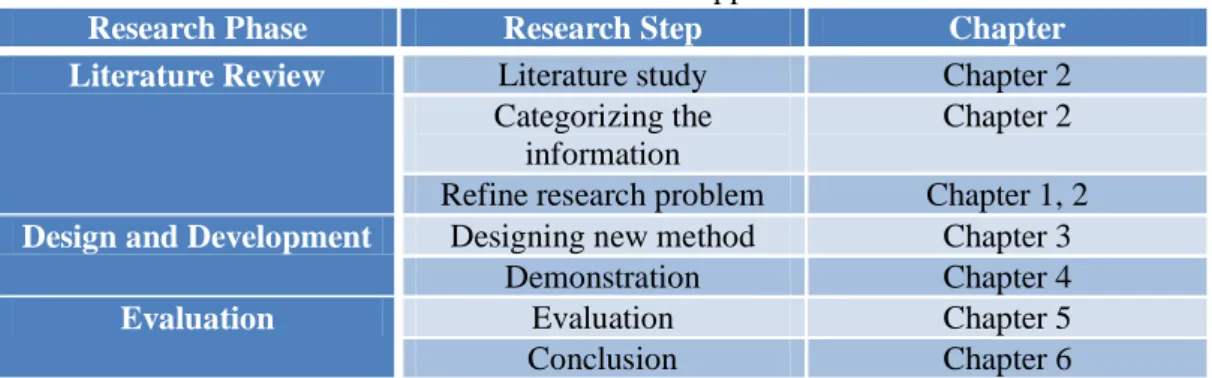
Table 1 shows the overview of the research approach and how these individual steps relate to the chapter/section of this thesis.
Table 1: Research Approach
Research Phase Research Step Chapter
Literature Review Literature study Chapter 2 Categorizing the
information
Chapter 2
Refine research problem Chapter 1, 2
Design and Development Designing new method Chapter 3 Demonstration Chapter 4
Evaluation Evaluation Chapter 5
Chapter 2: Literature review
Translating Strategy into Implementation via Capability-based planning 8
2. Literature review
The aims of the literature review are to provide the further insight on the context and search for the theoretical and empirical methodologies from the domains of both strategy and Capability-based Planning sides.
This chapter gives an overview of the previous studies in this field. This information can be used for providing the background knowledge and the theoretical basis for the further research. According to the requirements of the research, the structure of the literature review is determined by the key concepts, which includes: Strategy implementation, Capability-based Planning (CBP), the relationship between strategy and CBP, Enterprise Architecture (EA).
The purpose of this research is to help organizations translating their strategies into implementation via CBP. Therefore, strategy implementation would be an important concept of this research. Section 2.1 starts with the discussion of the concept strategy and strategic planning. The background knowledge of strategic planning could provide the insight for us about strategy implementation. The strategy models that are discussed in this section could provide the possible strategy inputs for the proposed method. Section 2.2 discusses how capabilities can be related to strategy. The Strategic fit model, which is defined in the previous studies, can prove that the capability of an organization can influence the performance of their strategy implementation. This fit model provides the theoretical foundation for us to design the CBP method to facilitate the strategy implementation. In section 2.3, we discuss the former CBP method and the related capability tools. Our design of the CBP method will be built based on this knowledge. The last section of this chapter describes how to relate EA with CBP and how to use ArchiMate language to model capability and formulate the proposed CBP method. The EA framework and the ArchiMate language help the organization use CBP in practice.
2.1 Strategy implementation
Hill and Jones defined strategy implementation as a task of putting strategies into action, which required the organization taking actions consistent with the chosen strategies in different operating level. (Hill&Jones, 2012) Many organizations find that strategies are easy to make but hard to implement. In today‘s fast changing environment, many organizations fail in the implementation of strategies. Therefore, this research would like to investigate and find a way to help organizations to implement their strategies. Thus, this literature review would start with answering the question ‗What is strategy‘.
2.1.1 Strategy
The word ‗Strategy‘ is derived from the Greek military vocabulary, which can be defined as ‗a plan, method, or series of maneuvers or stratagems for obtaining a specific goal or result‘. (Dictionary, 2012b)
Translating Strategy into Implementation via Capability-based planning 9
he also stated, ―A well-formulated strategy helps to marshal and allocate an organization's resources into a unique and viable posture based on its relative internal competencies and shortcomings, anticipated changes in the environment, and contingent moves by intelligent opponents.‖(Quinn & Henry, 1992)
In Porter‘s five-force model, a strategy helps an organization to understand the underlying forces of their industry in order to determine their competitive advantage. According to his theory, the generic strategy for organizations can be either low-cost, product differentiation or focus. However, there are two kinds of risks in the implementation of these generic strategies: first, fail to reach or maintain the strategy; second, the value of the generic strategy will be decreased because of the industry change. Porter stated, decision making in a strategy should be based on the firm‘s capabilities. It means to successfully execute each generic strategy, resources, strengths and organizational arrangements should be discussed.(Porter, 1980) However, Porter‘s theory more focuses on identifying the opportunities and threats from external environment, while the other studies show the internal factors of an organization can also make differences in the performance. Stalk et al. stated, capabilities of a company were often unique and not easy to change, to choose the right capability was essential for executing a strategy. Thus, a capability approach for formulating and implementing strategy has been proposed. (Stalk, Evans & Shulman, 1992)
2.1.2 Strategic planning
Strategic planning is a process of defining a strategy or a direction, and making decisions on allocating resources to pursue the defined strategy. (Quinn & Henry, 1992) The topic of strategic planning process has been studied for years. But in general, Aldea proposed that there was still a common understanding of the main steps, which involved: strategy analysis, strategy formulation and strategy implementation. (Aldea et al., 2014)
Hill and Jones claimed that after an organization had determined their strategic leadership and the competitive advantages they wanted to achieve, the managers of the organization could select and implement a set of strategies to enable their organization to realize their objectives. (Hill&Jones, 2012) According to the previous studies, Hill and Jones observed a typical formal process of strategic planning. This process starts with the mission statement, which shows the fundamental desires of an organization. The process of strategic planning provides a basic framework for the organization.
Strategic planning process includes five steps:
Select the corporate mission and major corporate goals.
Analyze the organization‘s external competitive environment
Analyze the organization‘s internal operating environment
Select strategies, which are consistent with the mission and major goals of the organization.
Implement the strategies.
The fast-changing industrial environment requires an organization to have an efficient and responsive system to maintain and implement their strategies. Thus, Hill and Jones connected strategy implementation and strategy formulation with a feedback loop.
Chapter 2: Literature review
Translating Strategy into Implementation via Capability-based planning 10
seen as the feedback system which controls the organization‘s activities. It ensures the result of the implementation to meet the objectives of the strategies. (Hunger &Wheelen, 2003)
To summarize, Aldea described a strategic planning process could be regarded as five steps: visioning process, strategy analysis, strategy formulation, strategy implementation and strategy evaluation.(Adina et al., 2014) She emphasized the importance of the three main concepts: strategy analysis, strategy formulation and strategy implementation. These concepts are associated with different steps of the strategic planning process. (Adina et al., 2014) The strategic planning process can be modeled as Figure 2:
Figure 2: Strategic planning process (Adina et al., 2014)
In regard to the topic of this study, the most relevant part of the strategic planning process is the strategy implementation. Once the strategy analysis is done, the organization can create and select the strategies according to the analysis which is conducted in the previous step. To translate the selected strategies into implementation, the organization needs to categorize these strategies into specific, measurable objectives. (Kaplan&Norton, 1992) Therefore, the selected strategies should be measurable and precise, which helps an organization to realize their desired future.
Accompany with the measured targets, these objectives state the specific outcomes that the organization wants to achieve. The metrics of the specific objectives provide the indicators for the organization to measure the performance of the strategy. (Kaplan&Norton, 1996) Therefore, in order to translate strategy into implementation via Capability-based planning, the objectives and the measurements for a specific strategy should be identified first. The techniques and models that can be used for identifying the strategic objectives and measurements will be discussed in the following section.
2.1.3 Strategy models
The purpose of this section is to review the strategy models that can be used for identifying the strategic objective and metrics of a chosen strategy.
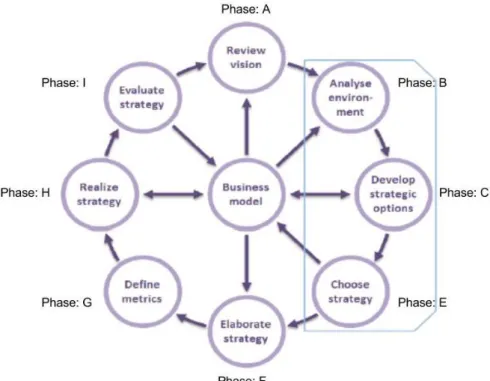
Based on the previous study of Aldea, the strategic planning process can be defined as five steps (visioning process, strategy analysis, strategy formulation, strategy implementation and strategy evaluation). To link strategic planning process to Enterprise Architecture via strategy models, she refined the five-step strategic planning process into nine phases (Figure 3). Each phase could include at least one strategy model (Adina et al., 2013).
Strategy analysis
Visioning process Environment analysis
Strategy formulation
Strategy implementation
Strategic options Strategic choices Strategic objectives
Translating Strategy into Implementation via Capability-based planning 11
Figure 3 : The method of strategic planning (Aldea et al, 2013)
Figure 3 shows the nine phases of the method. After choosing a strategy (Phase E), the organization needs to identify the strategic objectives and the measurements of these objectives for the chosen strategy. To fulfill this task, Aldeasuggested to use Strategy Map to specify the chosen strategy into achievable objectives. And the Balanced Scorecard (BSC) could be used for translating these objectives into executable actions. To find the strategic objectives and their measurements & metrics can be achieved in phase F and G. Moreover, since this study focuses on translating the selected strategy into action, and the phase F, G and H of this method can be seen as the strategy implementation steps of the strategic planning process. Therefore, the following study elaborates these three phase in more details.
First, in strategy elaboration phase, the chosen strategy will be specified into several strategic objectives. To complete this task, Aldea proposed to use Strategy Map and Balance Scorecard (BSC) to help organizations determine the objectives of their strategies. For the next phase, measurements & metrics, the task of this step is to decide how to measure the performance of the objectives that are determined in the previous step. It provides the benchmark for an organization to assess their strategy related capabilities. Finally, the chosen strategies should be implemented. Aldea introduced Enterprise Architecture (EA) with ArchiMate modeling language to model the targets, constraints and objectives that were determined in the previous steps. In this phase, with the Capability-based planning (CBP), EA supports the organization to realize the gaps between their current situation and their desired situation that based on its strategy objectives (Aldea et al., 2013). And the tools that Aldea mentioned in these three phases could be also used as the supporting techniques in our proposed CBP method. This part will be discussed in chapter 3. In the following sections, we would like to introduce these strategy models.
2.1.3.1 Strategy Map
Chapter 2: Literature review
Translating Strategy into Implementation via Capability-based planning 12
creates value by connecting strategic objectives in the cause and effect relationship with each other among the four Balance Scorecard (BSC) perspectives (Financial, Customer, Internal, Learning and growing). (Kaplan & Norton, 2004) Strategy Map provides a consistent way to help the organization to establish and manage its strategy at the operational level, like:
Describing how value is created internally and from the learning and growth perspectives.
Describing the critical few processes that have greatest impact to the strategy.
Describing how to measure the intangible assets of an organization, it includes human, information and organization capital.
Strategy Map is part of the BSC. It links strategy to the high level goal of an organization and provides a visual framework to help people to understand their strategies better. With the BSC approach, Strategy Map provides a robust structure for organizations to express their strategic objectives. It also shows how an organization creates value from these four key perspectives. An organization can use these strategy models to ensure their objectives in each perspective are consistent and internally aligned to each other.
Figure 4 shows the basic structure of Strategy Map, which includes four different layers that derive from BSC. They are Financial perspective, Customer perspective, Internal perspective and Learning and Growth perspective.
Figure 4 : Basic templates for a Strategy Map (Kaplan&Norton, 2004)
Comparing with the BSC, Strategy Map emphasizes the cause-and-effect relationship among the objectives from different perspectives.
Intangible assets:
Translating Strategy into Implementation via Capability-based planning 13
Kaplan and Norton stated that the intangible assets were valued only when they were aligned to the chosen strategy. The Learning & Growth strategic objectives define the intangible assets are needed to enable organizational activities and customer relationships to be performed at the higher levels of performance. (Kaplan & Norton, 2001) Thus, in Learning & Growth perspective, Strategy Map measures these capitals by their contributions to the achievement of the strategic objectives. Furthermore, organizations should figure out what they should learn and improve in order to achieve their vision. Therefore, Learning & Growth perspective is the foundation of any long-term and sustainable change, which relates to the intangible assets of an organization.(Kaplan &Norton, 2001)
Value-creating process:
The second perspective of Strategy Map is Internal perspective. A Strategy Map helps an organization to ensure their internal process for the value creation is well executed and aligned with the intangible assets and the customer value proposition. (Kaplan & Norton, 2004) Kaplan and Norton defined the key internal processes that the organization created value are:
Operations management processes
Customer management processes
Innovation processes
Regulatory and social processes
Strategy Map links these key business processes of the organization to the organizational outcomes in internal perspective, which provides the foundation for the strategic objectives from customer perspective by figuring out the process of how to satisfy their customer and helps the organization to improve the right things. Therefore, for each process, it is necessary to have the value creation objectives and the measurement tool for measuring their performance.
Customized Strategy Map
Internal perspective is the foundation of customer perspective. Value is created through the internal processes and delivered to the customer. In customer perspective, an organization needs to look for the customer value proposition. It is the foundation of financial perspective to ask how an organization must look to their customers to achieve a long-term objective.
To achieve the strategic objectives is following the bottom-to-up sequence. However, to determine these objectives is from up-to-bottom. Kaplan and Norton claimed that the overall strategic objective of a commercial organization can be presented in financial perspective. Financial perspective supports the overall business strategy by identifying the long-term shareholder value. Therefore, the financial objectives should be set up in the beginning, to determine how much short-term increased productivity and cost reduction should be achieved and how much long-term revenue growth the organization wants.
Chapter 2: Literature review
Translating Strategy into Implementation via Capability-based planning 14
Strategy map describes the process for transforming intangible assets into tangible customer and financial outcomes. (Kaplan&Norton, 2000) An organization uses Strategy Map for elaborating the objectives that the organization should try to accomplish in order to improve and grow, within the chosen strategy (Aldea, 2013). Only after identifying the objectives, the organizations can select metrics for each objective and use BSC to measure these objectives.
Through designing a Strategy map, an organization could understand their strategic goal better and the structure of their strategic objectives could be also clear. Therefore, the required capabilities for the specific strategy implementation could be aligned in detail level.
2.1.3.2 Balanced Scorecard
Kaplan and Norton defined, ―Balanced Scorecard translates an organization‘s mission and strategy into a comprehensive set of performance measures that provides the framework for a strategic measurement and management system‖. (Kaplan & Norton, 1996)
BSC emphasizes the linkage of measurement to strategy (Kaplan&Norton, 1993). Figure 5 presents the original structure of BSC. Kaplan and Norton defined the financial metrics as the ultimate outcome measures for company success. But as the complement of the financial objectives, the other three perspectives have been proposed as the drivers for creating long-term shareholder value.
Figure 5 : Translating Vision and Strategy: Four Perspectives (Kaplan & Norton, 1996)
For each perspectives, measure can be established, which are often called key performance indicators (KPIs), and assigned against each objective. These measures lead to the information are needed to measure performance (Ward &Peppard, 2002). These components of BSC are sitting behind the strategic objectives and enable an organization to execute the following strategic management process (Kaplan &Noton, 1996), which are:
Clarify and translate vision strategy
Communicate and link strategic objectives and measures
Plan, set targets, and align strategic initiatives
Enhance strategic feedback and learning
Translating Strategy into Implementation via Capability-based planning 15
1996).Therefore, if Strategy Map is used for identifying the strategic objectives, the role of BSC is to help an organization to determine the measures that will be used to evaluate the chosen objectives.
Measures on BSC are used for communicating the strategy to business and aligning the individual, organizational, and cross-departmental initiatives to achieve the common goal of an organization. And the four perspectives of BSC permit the balance between short and long-term objectives, between outcomes desired and the performance drivers of those outcomes, and between multiple measurements for the strategic objectives. (Kaplan & Norton, 1996) Thus, BSC provides the target and performance evaluation criteria for strategic objectives.
For strategy implementation, capabilities are needed to enable the delivery of a given strategy. Strategy actions are carried out by an organization‘s capabilities (Business Architecture Guide, 2014). Therefore, Strategy Map and BSC could be used by an organization to translate their strategy into implementation, and provides the input data for CBP tools.
2.2 Relationship between capability and strategy
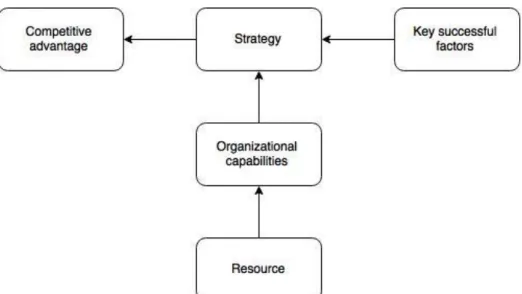
As mentioned in the previous section, Porter stated that a strategy helped an organization to understand the underlying forces of their industry in order to determine their competitive advantage. (Porter, 1980) Furthermore, competitive advantages could be possibly generated by an organization‘s resources and capabilities. According to the figure that defined by Grant, capabilities are the fundamental of an organization‘s strategy, which are needed to enable the delivery of the chosen strategy. Therefore, this section would like to discuss the relationship between strategy and capability according to the literature review.
Figure 6 : Simplyfied model of the links between resources, capabilities, and competitive advantage (Grant, 2010)
2.2.1 Capability
Chapter 2: Literature review
Translating Strategy into Implementation via Capability-based planning 16
Therefore, this research would like to use the definition that defined by Iacob et al.
Capability as the ability (of a static structure element, e.g., actor, application component, etc.) to employ resources to achieve some goals (Iacob, Quartel, & Jonkers, 2012).
To link capabilities with an organization‘s strategy, Teece and Pisano stated that the term ―capabilities‖ emphasized the key role of strategic management in appropriately skills, resources, and functional competences toward changing environment. Furthermore, to be strategic, capabilities have to be boned to a user need, unique and difficult to be replaced (Teece & Pisano, 1994) According to this description, the user‘s need could be the requirement of a strategy for applying capabilities to strategy implementation. Therefore, this study needs to discuss how to align capabilities to the strategy of an organization.
2.2.2 Strategic fit with capability
Strategic alignment is first introduced as a model for aligning IT with business. It includes strategic fit (the interrelationships between external and internal domains) and the functional integration (integration between business and functional domains). The key factor in alignment is the close linkage of the functional operations and business strategy. (Henderson & Venkatraman, 1993) Therefore, Rondinelli claimed that an organization‘s direction, market focus and the capabilities must ‗fit together‘.
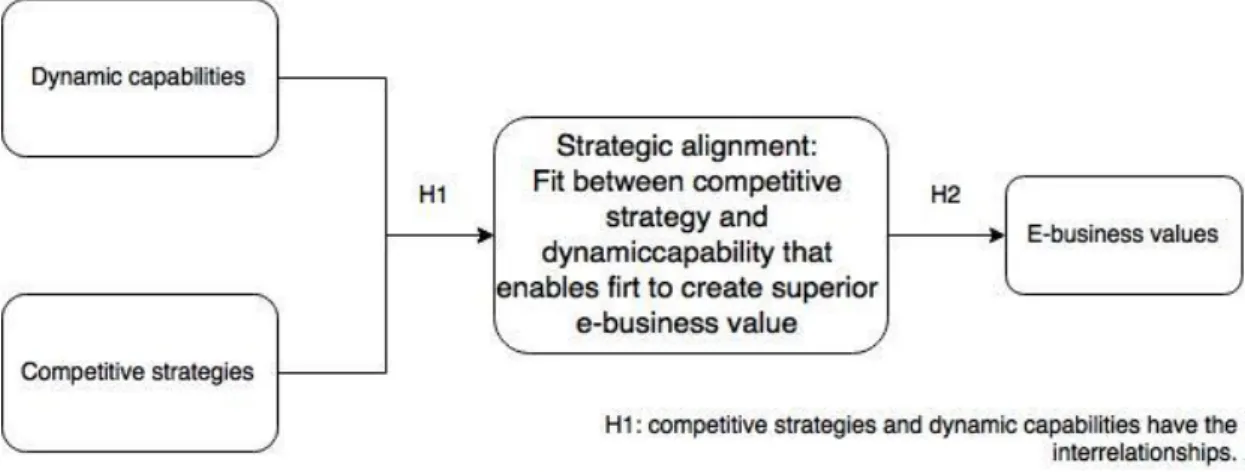
Rashidirad et al. created the strategic alignment conceptual framework to demonstrate the successful development and implementation of strategies depend on a proper deployment of dynamic capabilities. (Rashidirad, Soltani & Syed, 2013) Strategic alignment is significantly contributing to performance (Kearns & Lederer, 2003). Rashidirad et al. defined this framework for evaluating the e-business and they thought the main objective of e-business was the value creation. Therefore, they changed the performance to E-business value.
Figure 7 : Strategic alignment conceptual framework (Rashidirad, Soltani&Syed, 2013)
Translating Strategy into Implementation via Capability-based planning 17
This conceptual framework shows strategies and capabilities can be fitted together. Therefore, the performance of strategy implementation could have the positive association with capabilities.
2.3 Using CBP for strategy implementation
The Department of Defence proposed Capability-based planning (CBP) as ―planning, under uncertainty, to provide capabilities suitable for a wide range of modern-day challenges and circumstances while working within an economic framework that necessitates choice.‖ It is originally used for enabling military agencies to develop forces and allocate resources based on program needs and a specific threat (Davis, 2002).
However, CBP can be also used for commercial organizations to structure their strategies. According to the definitions of the capability that mentioned in the previous section, the capabilities are crucial for an organization to gain the sustainable competitive advantage and successfully to implement their strategy in today‘s market.
The Open Group proposed, ―CBP focuses on the planning, engineering, and delivery of strategic business capabilities to the enterprise. It is business-driven and business-led and combines the requisite efforts of all lines of business to achieve the desired capability. ‖ From an Enterprise Architecture and IT perspective, CBP is a powerful mechanism to ensure that the strategic business plan drives the enterprise from a top-down approach.(The Open Group, 2011)Thus, CBP can serve as the method for translating strategy into action.
2.3.1 Original CBP method
Capability-based Planning is first introduced in the Defence sector. The Technical Cooperation Program (TTCP) published the guideline in 2004, in order to help the defence department to use Capability-Based Planning system for long-term force structure planning(TTCP, 2004).This guide points out that CBP is developed as an alternative to threat-based planning, which is a systematic approach to force development for the defence department. It aims to advise the most appropriate force options that should meet the strategic objectives and minimize the cost and risk and comply with the constraint.
Figure 8 is the generic process of the CBP method that defined by TTCP. The first part of this process is finding the objective and the goal capabilities of the defense department. It starts from the government guidance and the defence priorities. These defence policy and priorities help the defence department to determine multiple scenarios for dealing with uncertainty circumstances. After that, the department can decide the capability goal in order to meet the requirements of these scenarios.
The second part of this process is to identify the gap between current and planning capability and the capability goals. The operational concept, which describes how a force plans to operate in the future, will combine with the capability goals to determine how to assess these capabilities. The outcome of this part is to find the mismatched capabilities and give the direction to the defence department to design the capability development plan.
Chapter 2: Literature review
Translating Strategy into Implementation via Capability-based planning 18
Figure 8 : Generic Process Chart of Capability-Based Planning (TTCP, 2004)
In order to accomplish the whole CBP process and get the desired investment plan. TTCP claimed that the CBP requires a large amount of information. The generic inputs to CBP normally include:
Objectives: The objectives of different scenarios that associated with the defence strategy. And the understanding of the future strategic environment.
Context: Information about the allied capabilities and the competitors‘ capabilities. The scenarios that defined by the objectives and the operational concepts.
Constraints: Resource and the process constraints.
Framework: Accurate inputs to the capability of the required information and divide the capability partition.
Force Characteristics: The characteristics of the force elements and the experience from the previous activities.
However, the inputs that defined by TTCP for the CBP were highly relevant to the defence use. For the commercial usage, the force characteristics should change to the other related business characteristics. Furthermore, the importance of the uncertainty environment will also be decreased.
Translating Strategy into Implementation via Capability-based planning 19
move the defense department from where it is now (as is) to a desired end state (to be) through acquiring the capabilities that needed to achieve the defense strategy. The Secretary of Defense (SecDef) from the U.S. Department of Defense (DoD) proposed the process to get the end state capabilities and achieve the strategic objectives can follow the steps that shows in Figure 9:
Figure 9 : A Process Model for Capabilities-Based Planning (Davis, 2002)
This diagram shows how to use the Capabilities-Based Approach to achieve the strategic objectives of a defense department. It supports the top-down capabilities planning, which includes four elements: Strategy, Planning, Resourcing, and Execution & Accountability. By following these steps to achieve the desired capabilities will also answer the question ―what to do‖, ―how to do it‖ and ―how well did we do‖.
2.3.2 The CBP tools
Figure 10 illustrates the generic activities of the CBP, which includes the Map, Assess and Plan. (Alder et al., 2014) To implement the CBP, there are some models or techniques that an organization could follow. And these tools could relate to these three generic activities.
Figure 10 : Capability-based Planning Method (Aldea et al., 2014)
Map
Chapter 2: Literature review
Translating Strategy into Implementation via Capability-based planning 20
2.3.2.1 Capability map
Ulrich and Rosen stated the Capability Map as the blueprint of capabilities for a given business.(Ulrich & Rosen, 2011) According to Forrester research, Capability Map is a model of a firm associating the business capabilities, processes, and functions required for business success with the IT resource that enables them (Scott, 2010). Thus, the Capability Map is a common way for the organization to document and visualize its capabilities.
Scott said that the Capability Map was the center of a strategic dialogue. The Capability map is the foundation for strategic discussions and it provides the connection between strategy, processes and resources.(Scott, 2009) Besides, Scott stated that mapping capabilities should focus on the specific problems. Therefore, Capability Map can have different level in order to meet the requirement of the business.
The starter of building a Capability Map is to define and understand capabilities. Capabilities of an organization can be decomposed. To realize the high level capabilities, the low level capabilities have to be completed. Figure 11 shows the common three-level capability decomposition. The reason for using the decomposition approach is to help the organization to align the capabilities to business in an appropriate level.
Figure 11 : Three-level capability decomposition (Ulrich & Rosen, 2011)
Translating Strategy into Implementation via Capability-based planning 21
Figure 12 : Level 1 Capability Map (Ulrich & Rosen, 2011)
Therefore, the Capabilities Map can play an important role in strategic planning. It can be used for grouping the capabilities of an organization that are relevant to a specific strategy. Furthermore, it helps the organization to find the missing capabilities. The Capability Map can be the technique that is used for finding the capabilities in both ―as is‖ and ―to be‖ state in the Capability-Based Planning.
2.3.2.2 Capability assessment
To successful implement a strategy and its tasks, a certain set of capabilities are needed. However, the performance level of the required capabilities could be also essential for an organization to achieve their goals. Therefore, an organization needs to answer the question, ―What level of capability is needed to perform a critical task?‖ To solve this problem, an organization can use a set of capability assessment tools to find or set the capability goals and assess the current state of the existing capabilities.
U.S Department of Homeland Security stated that a capability could provide a means to achieve a measurable outcome resulting from performance of one or more critical task(s), under specified conditions and performance standards (Homeland Security, 2009). The conditions and performance standards are defined by the setting objectives of the tasks. In the opposite way, the capabilities of an organization are also needed to meet these performance standards and conditions to help the organization to achieve the objectives of these tasks. Therefore, an organization needs to use capability assessment tool to reveal the capability gaps to implement their strategy.
Chapter 2: Literature review
Translating Strategy into Implementation via Capability-based planning 22
2.3.2.3 Capability development plan
Capability map helps an organization to find the strategic capabilities and identify the missing capabilities. And the capability assessment helps an organization to estimate the degree of the performance of these capabilities. In order to support strategy implementation, capabilities of an organization that is related to the chosen strategy, should exist and meet the expected performances.
However, in many cases, capabilities are needed to be improved and transformed to enable the delivery of the chosen strategy (Business Architecture Guide, 2014). Therefore, to make the capability development plan is important.
The Open Group stated that a capability would take time to deliver and normally involved many projects delivering numerous increments (The Open Group, 2011). At any certain point, the performance of a capability can be represented as a capability increment. Therefore, the capability development plan is about making several projects to improve the capability from one capability increment to another capability increment.
In order to create different projects to improve the capability performance, an organization could use the Capability Systems Life Cycle (CSLC) as a reference, which was defined by the capability development group in Australia. This group believed the CSLC is the basis for defence‘s strategy-led Capability Development process (Capability Development Group Australia, 2014). The CSLC involves five steps, which is shown on Figure 13:
Figure 13 : The Capability Systems Life Cycle (Capability Development Group Australia, 2014)
This figure presents that each capability development plan should start with the needs analysis. The needs phase is referred to the identification of the missing and the underperform capabilities of the organization. After the developing goals are found, the organization should allocate the required resources and create the developing projects then put them into execution.
But these projects probably cannot be executed at the same time. Therefore, Papazolgou proposed a capability roadmap that can be used to sequence these developing projects in order to achieve the desired capability increment.
Eventually, the CBP could help an organization to plan and improve the strategic capabilities. To have all the required capabilities to support, an organization could have a higher chance to implement the chosen strategy better.
2.3 Enterprise architecture framework and ArchiMate
language
Translating Strategy into Implementation via Capability-based planning 23
background of how to use EA to support the execution of Capability-based planning (CBP). There are some papers and researches already described the usage of CBP to facilitate the organizational changing. The purpose of this section is to find out the framework and language that can be used for modeling the CBP.
2.3.1 CBP in Enterprise Architecture framework
EA framework like TOGAF already provides an overview of using CBP as a business planning technique that focuses on business outcomes. It introduces the concept of CBP from EA and IT perspective and claims it could be a powerful mechanism to ensure the strategic business planning. (The Open Group, 2011)
Enterprise Architecture (EA) is the complete, consistent and coherent set of methods, rules, models and tools which guides the (re) design, migration, implementation and governance of business processes, organizational structures, information systems and the technical infrastructure of an organization according to a version(Iacob et al., 2012). To apply CBP in EA framework, The Open Group proposed two notions that could help an organization manages their capabilities, which are capability dimension and capability increments.
Capability dimensions are the sub-set of capability and capability can be managed by its capability dimensions. TOGAF describes the capability dimensions could help an organization to well explain and understand its capability. And the relationship between capability dimensions, capability increments and capability is shown on figure 14.
Figure 14 : Capability increments and dimensions (The Open Group, 2011)
Different studies have different categories for these capability dimensions. Typically, a capability could include Process, People and Assets (Greski, 2009) according to the definition of capability. Some of researches divide the capability dimensions in more details. For example, Grant defined the Assets could involve tangible asset (financial, physical) and intangible asset (technology, culture and reputation)(Grant, 2010). However, no matter which categories that an organization follows, capability is generated by the value that is contributed by its capability dimensions.