http://wrap.warwick.ac.uk
Original citation:
Bryson, K., Luck, M., Joy, Mike and Jones, D. T. (2000) Applying agents to
bioinformatics in GeneWeaver. In: Klusch, M. and Kerschberg, L., (eds.) Cooperative
Information Agents IV - The Future of Information Agents in Cyberspace. Lecture Notes
in Computer Science (Volume 1860). Springer Berlin Heidelberg, pp. 60-71. ISBN
9783540677031
Permanent WRAP url:
http://wrap.warwick.ac.uk/61105
Copyright and reuse:
The Warwick Research Archive Portal (WRAP) makes this work by researchers of the
University of Warwick available open access under the following conditions. Copyright ©
and all moral rights to the version of the paper presented here belong to the individual
author(s) and/or other copyright owners. To the extent reasonable and practicable the
material made available in WRAP has been checked for eligibility before being made
available.
Copies of full items can be used for personal research or study, educational, or not-for
profit purposes without prior permission or charge. Provided that the authors, title and
full bibliographic details are credited, a hyperlink and/or URL is given for the original
metadata page and the content is not changed in any way.
Publisher’s statement:
"The final publication is available at Springer via
http://dx.doi.org/10.1007/978-3-540-45012-2_7”
A note on versions:
The version presented here may differ from the published version or, version of record, if
you wish to cite this item you are advised to consult the publisher’s version. Please see
the ‘permanent WRAP url’ above for details on accessing the published version and note
that access may require a subscription.
To appear in Proceedings of the Fourth International Workshop on Cooperative Information Agents, Lecture Notes in AI, Springer-Verlag, 2000.
Applying Agents to Bioinformatics in GeneWeaver
K. Bryson1
, M. Luck1
, M. Joy1
, and D.T. Jones2
1
Department of Computer Science, University of Warwick, Coventry, CV4 7AL, UK
fbryson, mikeluck, [email protected]
http://www.dcs.warwick.ac.uk/geneweaver/
2
Department of Biological Sciences, Brunel University, Uxbridge, UB8 3PH, UK
Abstract. Recent years have seen dramatic and sustained growth in the amount
of genomic data being generated, including in late 1999 the first complete se-quence of a human chromosome. The challenge now faced by biological scien-tists is to make sense of this vast amount of accumulated and accumulating data. Fortunately, numerous databases are provided as resources containing relevant data, and there are similarly many available programs that analyse this data and attempt to understand it. However, the key problem in analysing this genomic data is how to integrate the software and primary databases in a flexible and ro-bust way. The wide range of available programs conform to very different input, output and processing requirements, typically with little consideration given to issues of integration, and in many cases with only token efforts made in the di-rection of usability. In this paper, we introduce the problem domain and describe GeneWeaver, a multi-agent system for genome analysis. We explain the suitabil-ity of the information agent paradigm to the problem domain, focus on the prob-lem of incorporating different existing analysis tools, and describe progress to date.
1
Introduction
One of the most important and pressing challenges faced by present-day biological sci-entists is to move beyond the task of genomic data collection in the sequencing of DNA, and to make sense of that data so that it may be used, for example, in the development of therapies to address critical genetic disorders. The raw data has been accumulating at an unprecedented pace, and a range of computational tools and techniques have been developed by bioinformaticians, targetted at the problems of storing and analysing that data. In this sense much has already been achieved, but these tools usually require expert manual direction and control, imposing huge restrictions on the rate of progress. Essen-tially, however, the problems involved are familiar from other domains — vast amounts of data and information, existing programs and databases, complex interactions, dis-tributed control — pointing strongly to the adoption of a multi-agent approach.
agent-based approach. We begin with an introduction to the problem domain, outlining some basic biology, and explaining how it leads to the current situation in which systems such as the one we describe here are vital. Then we introduce the GeneWeaver agent community, a multi-agent systems for just this task, describing the agents involved, and the agent architecture. In all this, we aim to provide a view of the overall problem and outline all aspects of the system, rather than addressing any particular aspect, such as the databases providing the data, for example.
2
Genome Analysis and Protein Structure Prediction
The complete sequencing of the first human chromosome represents a significant mile-stone in the Human Genome Project, a 15-year effort to sequence the 3-billion DNA basepairs present in the human genome and to locate the estimated 100,000 or more hu-man genes. A “rough draft” of the complete huhu-man genome will be available by spring 2000 [7], a year ahead of schedule. This draft will provide details of about 90% of the human genome with remaining gaps being filled in over the subsequent three years.
One of the key problems that such a vast amount of data presents is that of recog-nising the position, function and regulation of different genes. By performing various analysis techniques, such as locating similar (or homologous) genes in other species, these problems may be solved. Basic methods are now well developed including those for database searching to reveal similar sequences (similarity searching), comparing se-quences (sequence alignment) and detection of patterns in sese-quences (motif searching). The key problem in the analysis of genome data is to integrate this software and pri-mary sequence databases in a flexible and robust way. It has been stated in the biological community that there is a critical need for a “widely accepted, robust and continuously updated suite of sequence analysis methods integrated into a coherent and efficient pre-diction system” [6].
2.1 Function and Structure Determination
As indicated above, the rate at which this primary genetic data is being produced at present, is extremely rapid, and increasing. There is consequently a huge amount of information that is freely available across the Internet, typically stored in flat file databases. The problem of working out what each gene does, especially in light of the potential benefits of doing so, is therefore correspondingly pressing, and one which is meriting much attention from various scientific communities.
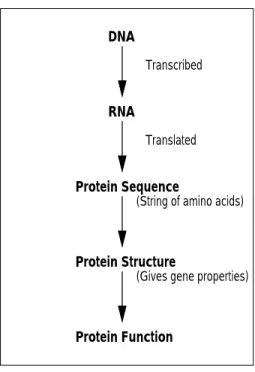
RNA DNA
Transcribed
Translated
Protein Sequence
Protein Structure
(Gives gene properties) (String of amino acids)
Protein Function
Fig. 1. From DNA to protein function
and some form of resolution needs to occur. The stages in getting to protein function from DNA are shown in Figure 1.
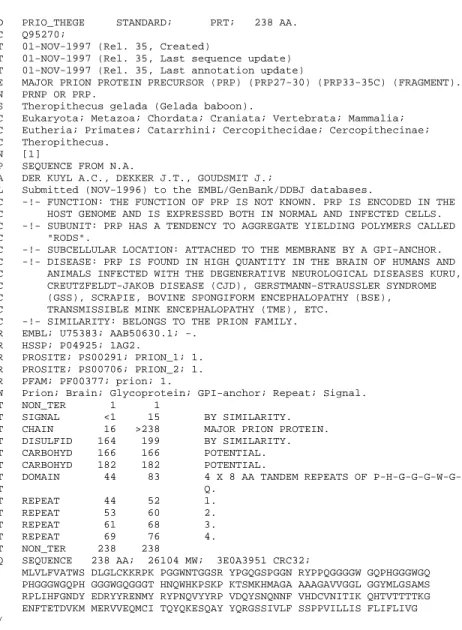
Now, like the primary data, some of the programs are accessible only over the Inter-net — either by electronic mail or the WWW (and increasingly the latter). This requires the different sources of information and the different programs to be managed effec-tively. Many tools are available to perform these tasks, but they are typically standalone programs that are not integrated with each other and require expert users to perform each stage manually and combine them in appropriate ways. For example, the process of trying to find a matching sequence might result in turning up an annotated gene, but the annotations include a lot of spurious information as well as the important functional information. The problem here is distilling this relevant information, which is not at all difficult for an expert, but which might prove problematic for a less experienced user. With the amount of data that is being generated, this kind of expertise is critical. For example, a very small entry in the SWISSPROTdatabase is shown in Figure 2, in which the various lines are of greater or lesser significance. This entry is for the baboon equivalent of the protein which causes mad cow disease and other neurodegenerative disorders.
2.2 Sequence Databases
pri-mary data source (the pripri-mary sequence data banks and the structure data banks, for example) encode their information in different ways, not only in terms of the basic for-matting, but also in the terminology used. For example, different keyword sets are used for each data bank so that understanding and interpreting the data (both of primary data sources and the results from analysis programs) is not a trivial task.
Primary databases are provided externally, under the control of a third-party who may change them at any time. In many cases, the data is largely unstructured, and is often available in the form of flat files. The methods of delivery vary, but have in-cluded email transfer of data, FTP downloads and, more recently, retrieval through the WWW. Each primary database consists of a number of sequence files, which are text files formatted in a particular sequence format. A sequence file usually contains data for a number of protein sequence entries, with each such sequence entry providing a description of the protein and its amino acid sequence.
For example, the Protein Data Bank (PDB) [5], which was established in 1971, is an international repository for the processing and distribution of experimentally-determined structure data that is growing dramatically. Similarly, SWISSPROTis a cu-rated protein sequence databases with a high level of annotation of protein function [3]. Many other such sequence databases are also available (eg. the Protein Information Resource (PIR) [4]), but we will not provide an exhaustive list here.
2.3 Analysis Tools
The tools used to make sense of this partially structured and globally distributed ge-nomic data apply particular techniques to try to identify the structure or function of spe-cific sequences. A variety of such techniques are used in a range of available programs, including similarity searches of greater or lesser sensitivity (eg. BLAST[1]), sequence alignment (eg. CLUSTALW [18]), motif searching (eg. PROSITE[10]), secondary struc-ture prediction (eg. PSIPRED[12]), fold recognition (eg. GENTHREADER [13]), and so on. For example, BLAST(Basic Local Alignment Search Tool) is a set of rapid simi-larity search programs that explore all available sequence databases [1]. The search can be performed by a remote server through a web interface resulting in graphical output, or alternatively can be carried out locally through a command line interface resulting in text output.
Now, some of the methods take longer to run than others, while some provide more accurate or confident results than others. In consequence, it is often necessary to use more than one of these tools depending on the results at any particular stage. While a high confidence is desirable, time-consuming methods should be avoided if their results are not needed.
ID PRIO_THEGE STANDARD; PRT; 238 AA. AC Q95270;
DT 01-NOV-1997 (Rel. 35, Created)
DT 01-NOV-1997 (Rel. 35, Last sequence update) DT 01-NOV-1997 (Rel. 35, Last annotation update)
DE MAJOR PRION PROTEIN PRECURSOR (PRP) (PRP27-30) (PRP33-35C) (FRAGMENT). GN PRNP OR PRP.
OS Theropithecus gelada (Gelada baboon).
OC Eukaryota; Metazoa; Chordata; Craniata; Vertebrata; Mammalia; OC Eutheria; Primates; Catarrhini; Cercopithecidae; Cercopithecinae; OC Theropithecus.
RN [1]
RP SEQUENCE FROM N.A.
RA DER KUYL A.C., DEKKER J.T., GOUDSMIT J.;
RL Submitted (NOV-1996) to the EMBL/GenBank/DDBJ databases.
CC -!- FUNCTION: THE FUNCTION OF PRP IS NOT KNOWN. PRP IS ENCODED IN THE CC HOST GENOME AND IS EXPRESSED BOTH IN NORMAL AND INFECTED CELLS. CC -!- SUBUNIT: PRP HAS A TENDENCY TO AGGREGATE YIELDING POLYMERS CALLED CC "RODS".
CC -!- SUBCELLULAR LOCATION: ATTACHED TO THE MEMBRANE BY A GPI-ANCHOR. CC -!- DISEASE: PRP IS FOUND IN HIGH QUANTITY IN THE BRAIN OF HUMANS AND CC ANIMALS INFECTED WITH THE DEGENERATIVE NEUROLOGICAL DISEASES KURU, CC CREUTZFELDT-JAKOB DISEASE (CJD), GERSTMANN-STRAUSSLER SYNDROME CC (GSS), SCRAPIE, BOVINE SPONGIFORM ENCEPHALOPATHY (BSE), CC TRANSMISSIBLE MINK ENCEPHALOPATHY (TME), ETC.
CC -!- SIMILARITY: BELONGS TO THE PRION FAMILY. DR EMBL; U75383; AAB50630.1; -.
DR HSSP; P04925; 1AG2.
DR PROSITE; PS00291; PRION_1; 1. DR PROSITE; PS00706; PRION_2; 1. DR PFAM; PF00377; prion; 1.
KW Prion; Brain; Glycoprotein; GPI-anchor; Repeat; Signal. FT NON_TER 1 1
FT SIGNAL <1 15 BY SIMILARITY. FT CHAIN 16 >238 MAJOR PRION PROTEIN. FT DISULFID 164 199 BY SIMILARITY. FT CARBOHYD 166 166 POTENTIAL. FT CARBOHYD 182 182 POTENTIAL.
FT DOMAIN 44 83 4 X 8 AA TANDEM REPEATS OF
P-H-G-G-G-W-G-FT Q.
FT REPEAT 44 52 1. FT REPEAT 53 60 2. FT REPEAT 61 68 3. FT REPEAT 69 76 4. FT NON_TER 238 238
SQ SEQUENCE 238 AA; 26104 MW; 3E0A3951 CRC32;
MLVLFVATWS DLGLCKKRPK PGGWNTGGSR YPGQGSPGGN RYPPQGGGGW GQPHGGGWGQ PHGGGWGQPH GGGWGQGGGT HNQWHKPSKP KTSMKHMAGA AAAGAVVGGL GGYMLGSAMS RPLIHFGNDY EDRYYRENMY RYPNQVYYRP VDQYSNQNNF VHDCVNITIK QHTVTTTTKG ENFTETDVKM MERVVEQMCI TQYQKESQAY YQRGSSIVLF SSPPVILLIS FLIFLIVG //
3
The GeneWeaver Agent Community
GeneWeaver is a multi-agent system aimed at addressing many of the problems in the domain of genome analysis and protein structure prediction, as discussed above. It com-prises a community of agents that interact with each other, each performing some dis-tinct task, in an effort to automate the processes involved in, for example, determining gene function. Agents in the system can be concerned with management of the pri-mary databases, performing sequence analyses using existing tools, or with storing and presenting resulting information. The important point to note is that the system does not offer new methods for performing these tasks, but organises existing ones for the most effective and flexible operation. This section provides an overview of the system through the agents within it.
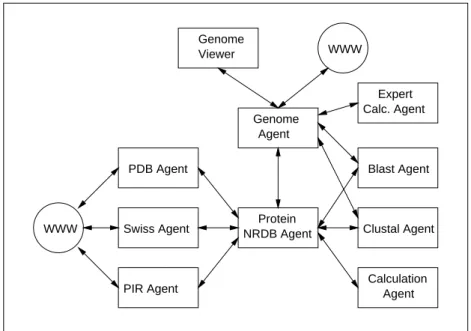
Figure 3 illustrates the overall perspective of GeneWeaver in that it contains the dif-ferent classes of agents and shows how they inter-relate. At the left side, PDB Agent, Swiss Agent and PIR Agent all manage the primary sequence databases indicated by their names, and interact with the Protein NRDB (non-redundant database) Agent, which combines their data. At the right edge of the figure, the calculation agents (in-cluding the Blast Agent and the Clustal Agent that perform specific analysis tasks) attempt to annotate sequences in the database using relevant programs, again indicated by their names. At the top right, an expert calculation agent can combine the skills of the other calculation agents using expert knowledge encoded in plans. In this case it can use the Blast Agent to find similar proteins and then use the Clustal Agent to ac-curately compare the proteins obtained. (For clarity, these interactions are not shown in the diagram). Finally, at the top, the results generated by the system must be externally accessible, and this functionality is achieved by the Genome Agent. At each point of external interaction, agents typically receive and provide information via the WWW.
There are five types of agent present in the GeneWeaver community.
– Broker agents, which are not shown in Figure 3 since they are facilitators rather
than points of functionality, are needed to register information about other agents in the community. They are similar in spirit to the notions discussed, for example, by Foss [9] and Wiederhold [20], but are very limited in functionality because of the constrained domain. (With a more sophisticated domain, however, this functionality might be correspondingly enhanced, to include more complex matchmaking, for example [14].)
– Primary database agents are needed to manage remote primary sequence databases,
and keep the data contained in them up-to-date and in a format that allows other agents to query that data.
– Non-redundant database agents construct and maintain non-redundant databases
from the data managed by other primary database agents in the community.
– Calculation agents encapsulate some pre-existing methods or tools for analysis of
sequence data. They attempt to determine the structure or function of a protein se-quence. Some calculation agents have domain-specific expert knowledge encoded as plans that enable them to carry out expert tasks using the other calculation agents.
– Genome agents are responsible for managing the genomic information for a
WWW
WWW
PDB Agent
Swiss Agent
PIR Agent
Blast Agent
Clustal Agent Genome
Agent
NRDB Agent Protein
Calculation Agent Viewer
Genome
Expert Calc. Agent
Fig. 3. GeneWeaver agent community
4
Architecture
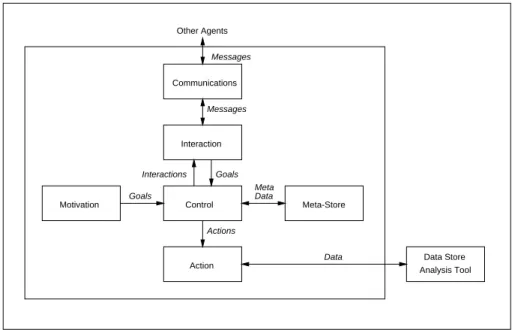
Each agent in the GeneWeaver community shares a common architecture that is in-spired by, and draws on, a number of existing agent architectures, such as [11], but in a far more limited and simplified way. An agent contains a number of internal modules together with either an external persistent data store that is used for the storage of data it manipulates, or the analysis program used to predict function. In this section, we de-scribe the generic modules that comprise the architecture illustrated by Figure 4, which forms the basis of each agent. In essence, everything revolves around the central control
module, which is given direction by the motivation module through particular goals, and
then decides how best to achieve those goals. It can either take action itself through its
action module, or request assistance from another agent through its interaction module
which, in turn, uses the communications module for the mechanics of the interaction. The meta-store simply provides a repository for local information such as the skills of other agents. Each of the modules making up the architecture is considered in detail below.
Messages
Messages
Data Actions
Data
Communications
Motivation Control Meta-Store
Action Data Store
Analysis Tool Interaction
Meta
Other Agents
Goals
Goals Interactions
Fig. 4. GeneWeaver agent architecture
what follows, we focus on analysis rather than data management, which is considered in more detail elsewhere.
4.1 Motivation Module
Since each agent in the GeneWeaver community has different responsibilities and is required to perform different tasks, distinct high-level direction must be provided in each case to cause essentially the same architecture to function in different ways. The conceptual organisation of GeneWeaver agents thus involves the use of some high-level motivations that cause the goals and actions specific to the agent’s tasks and responsi-bilities to be generated and performed [15, 16].
An agent is therefore initialised with the motivations required to carry out its respon-sibilities effectively. For example, all agents (except brokers) are motivated to register themselves with a broker agent, and will generate goals and actions to do so until they have succeeded. Similarly, a primary database agent has a motivation to cause the gen-eration of specific goals and actions to update the primary database on a regular basis in order to ensure that it is up-to-date.
motiva-tions to be ordered in terms of priorities, it also allows intensities to be modified during execution.
4.2 Control Module
Perhaps the most important of the components of the agent architecture is the control
module, which organises how actions should be carried out, once provided with a goal
to pursue. The control module is initiated with a number of plans which can satisfy different goals and which consist of a number of steps specifying types of actions or interactions to be performed. It uses the meta-store for information on how particular actions should be carried out by determing whether suitable skills are available locally or whether the skills of a remote agent are required. The meta-store also provides infor-mation about types of interactions supported by other agents.
For example, a simple goal might be to find a match for a particular protein se-quence. One way to satisfy this may consist of the single step of using a suitable
simi-larity search method. Information contained in the meta-store is then used to locate just
such a similarity search method, which may be one of the skills local to the agent or may require interaction with another agent. A more complicated way of accomplishing this goal may consist of two steps: a similarity search method may be used to find a similar sequence, which can then be used in a sequence alignment against the original sequence to provide more confidence in the result. Now plans can have a quality as-signed to them, with the latter plan in the example above having a higher quality than the simpler one. They can also have an efficiency value associated with them, with the latter plan having a lower efficiency due to the use of more resources. Note that some plans may only be applicable in certain circumstances; for instance the latter plan re-quires the meta-store to identify a suitable sequence alignment method to use. Thus the plans have pre-conditions which need to be satisfied before they can be used. So, a suit-able plan to meet a particular goal can be selected based on its quality, efficiency and any pre-conditions it requires.
4.3 Action Module
The action module is responsible for managing and performing data actions that mod-ify the underlying data being manipulated by the agent. Such actions typically involve performing operations on some input data and may (optionally) result in some output. In this respect, they are likely to use and modify data in the agent’s data store. The action module is thus critically important in terms of the agent functionality in this do-main, since it is the only module that can interface to the underlying wrapped analysis program, and thus provides the only way to invoke the tool for performing an analysis. Each agent’s action module is instantiated with a number of skills (or types of action) that the agent can perform.
4.4 Interaction Module
An interaction takes place between two agents: a requester and a provider. When assistance is needed by an agent, a requester interaction is generated by its
interac-tion module and a message sent to the provider via the communicainterac-tions module. At the
provider’s end of the interaction, the receipt of a request for assistance (via its commu-nications module) causes a provider interaction suitable for the type of interaction to be invoked in the interaction module. The two agents then communicate using a fixed protocol, with the respective agents adopting suitable goals required on their own side of the interaction.
The interaction module is initialised with the types of interaction it can service (or the types of provider interactions it can initiate). For example, the broker is the only agent that initiates its interaction module with a register interaction to service requests to register with it from other agents. The particular interactions an agent is able to provide to others are recorded in its meta store so that it has an accurate picture of its capabilities.
4.5 Communications Module
The mechanics of the interaction of agents in the community is achieved through message-passing communication, which is handled by the communications module. An agent communication protocol specifies both the transport protocol to be used (which can be one of several, including RMI and CORBA [19, 8], for example) and the commu-nication language (which is currently limited to a small prototype KQML-based [17] language). In principle, each agent may have available to it multiple protocols to use in interacting with others. This is achieved by instantiating the communications module at initiation with all those protocols known to the agent (which are also recorded in the meta store so it has an accurate representation of its own abilities).
Now, the communications module for one agent interacts with communications modules of other agents, using particular transport protocols. It also passes messages on to the agent itself for interpretation and processing, as well as accepting outgoing messages to be sent out to others. In this way, one agent interacts with another through their respective communications modules.
4.6 Meta Store
The meta-store simply provides a repository for the information that is required by an individual agent for correct and efficient functioning. For example, the meta-data contained in this repository will enumerate the properties and capabilities of the agent, including aspects such as the protocols the agent can use, the skills that can be executed, and the agent’s motivations. As other modules are instantiated on initialisation, this information is added to the meta-store. Thus, as the action module is initialised, the skills that can be performed by it are added to the repository.
included. The only significant interaction is with the control module which records in-formation in the meta-store as appropriate, and also uses it in decision-making.
5
Conclusions
The problems faced by biological scientists in relation to the increasing amounts of ge-nomic data being generated are becoming critical. Autonomous genome analysis that avoids the need for extensive input by domain experts, but succeeds in annotating the data with structure and function information is a key goal. Through the use of a multi-agent system in which existing databases and tools are encapsulated as independent agents, we aim to relieve the expert of this burden, and increase the throughput of ge-nomic data analysis. In this way, we can actually use the data that has been recorded.
A similar effort on the GeneQuiz system, which generates preliminary functional annotation of protein sequences, has been applied to the analysis of sets of sequences from complete genomes, both to refine overall performance and to make new discov-eries comparable to those made by human experts [2]. Though GeneQuiz has a similar motivation, and makes use of various external databases and analysis tools, its structure suggests that significant modifications may be necessary with the introduction of new databases or tools. In contrast, the agent approach taken in GeneWeaver, in which each agent is autonomous and distinct from the rest of the system, means that the commu-nity of agents can grow in line with the development of new databases and tools without adversely affecting the existing organisation.
In the GeneWeaver project to date, we have developed a prototype system reflecting the structure of the community and the individual agent architecture described above. Database agents for several external databases have been constructed, and a sample cal-culation agent to perform BLASTsearches has been incorporated into the community. Current work aims to extend the range of calculation agents and then to assess the entire system in relation to activity of human domain experts, to identify refinements both to the architecture and the individual agent control mechanisms.
Acknowledgements
The work described in this paper is supported by funding from the Bioinformatics pro-gramme of the UK’s EPSRC and BBSRC.
References
1. S.F. Altschul, W. Gish, W. Miller, E.W. Myers, and D.J. Lippman. Basic local alignment search tool. Journal of Molecular Biology, 215:403–410, 1990.
2. M.A. Andrade, N.P. Brown, C. Leroy, S. Hoersch, A. de Daruvar, C. Reich, A. Franchini, J. Tamames, A. Valencia, C. Ouzounis, and C. Sander. Automated genome sequence analysis and annotation. Bioinformatics, 15(5):391–412, 1999.
4. W.C. Barker, J.S. Garavelliand P.B. McGarvey, C.R. Marzec, B.C. Orcutt, G.Y. Srinivasarao, L.-S.L. Yeh, R.S. Ledley, H.-W. Mewes, F. Pfeiffer, A. Tsugita, and C. Wu. The PIR-international protein sequence database. Nucleic Acids Research, 27(1):39–43, 1999. 5. F.C. Bernstein, T.F. Koetzle, G.J. Williams, E.E. Meyer Jr, M.D. Brice, J.R. Rodgers, O.
Ken-nard, T. Shimanouchi, and M. Tasumi. The protein data bank: a computer-based archival file for macromolecular structures. Journal of Molecular Biology, 112, 1977.
6. P. Bork and E.V. Koonin. Predicting functions from protein sequences: where are the bottle-necks? Nature Genetics, 18:313–318, 1998.
7. F.S. Collins, A. Patrinos, E. Jordan, A. Chakravarti, R. Gesteland, L. Walters, and the mem-bers of the DOE and NIH planning groups. New goals for the U.S. human genome project: 1998-2003. Science, 282:682–689, 1998.
8. J. Farley. Java Distributed Computing. O’Reilly, 1998.
9. J.D. Foss. Brokering the info-underworld. In N.R. Jennings and M. J. Wooldridge, edi-tors, Agent Technology: Foundations, Applications, and Markets, pages 105–123. Springer-Verlag, 1998.
10. K. Hofmann, P. Bucher, L. Falquet, and A. Bairoch. The PROSITE database, its status in 1999. Nucleic Acids Research, 27(1):215–219, 1999.
11. N.R. Jennings and T. Wittig. ARCHON: Theory and practice. In Distributed Artificial
Intelligence: Theory and Praxis, pages 179–195. ECSC, EEC, EAEC, 1992.
12. D. T. Jones. Protein secondary structure prediction based on position-specific scoring matri-ces. Journal of Molecular Biology, 292:195–202, 1999.
13. D.T. Jones. GenTHREADER: an efficient and reliable protein fold recognition method for genomic sequences. Journal of Molecular Biology, 287:797–815, 1999.
14. D. Kuokka and L. Harada. Matchmaking for information agents. In Proceedings of the
Fourteenth International Joint Conference on Artificial Intelligence, pages 672–679, 1995.
15. M. Luck and M. d’Inverno. Engagement and cooperation in motivated agent modelling. In C. Zhang and D. Lukose, editors, Distributed Artificial Intelligence Architecture and
Mod-elling: Proceedings of the First Australian Workshop on Distributed Artificial Intelligence, Lecture Notes in Artificial Intelligence, 1087, pages 70–84. Springer Verlag, 1996.
16. M. Luck and M. d’Inverno. Motivated behaviour for goal adoption. In Multi-Agent Systems
Theories Languages and Applications: Proceedings of the Fourth Australian Workshop on Distributed Artificial Intelligence, Lecture Notes in Artificial Intelligence, 1544, pages 58–
73. Springer Verlag, 1998.
17. J. Mayfield, Y. Labrou, and T. Finin. Evaluating KQML as an agent communication lan-guage. In M. Wooldridge, J. P. M¨uller, and M. Tambe, editors, Intelligent Agents II (LNAI
1037), pages 347–360. Springer, 1996.
18. J.D. Thompson, D.G. Higgins, and T.J. Gibson. CLUSTAL W: improving the sensitivity of progressive multiple sequence alignment through sequence weighting, positions-specific gap penalties and weight matrix choice. Nucleic Acids Research, 22:4673–4680, 1994. 19. G. Vossen. The CORBA specification for cooperation in heterogeneous information
sys-tems. In P. Kandzia and M. Klusch, editors, Cooperative Information Agents, pages 101–115. Springer-Verlag, 1997.