1
MASTER THESIS
Learning paths of teachers, studying: intention,
activities and outcomes to understand teacher learning
at the workplace
Name: Saskia Eline Charlotte Dannenberg Student number: s1252070
Faculty: Behavioral Science
Master Educational Science and Technology University: University of Twente
Supervisors: Dr. M.D. Endedijk & Dr. R. van Veelen Organization: CSG Het Noordik
2
Summary
It is widely assumed that when teachers develop their knowledge, beliefs and attitudes, their daily practice will improve and student performance will increase. Workplace learning is considered to be a powerful way of learning for teachers. Currently, many initiatives exist to enhance workplace learning of teachers. However most of them lack scientific foundation and many focus on single elements of learning rather than considering learning as an integrated set of elements, a learning path. To meet the full potential of the benefits of workplace learning of teachers it is crucial to explore this concept in further detail.To do so this study focusses on learning paths of teachers in secondary schools. This study aimed to explore learning paths consisting of longer chains of learning activities, their interrelatedness and the connection between intention, activities and learning outcomes. These insights can help human resource departments in education to create an effective learning environment for teachers. In order to guide this study a main research question was defined: What is the nature of secondary school teachers’ learning paths? This exploratory study took place at secondary school CSG het Noordik and collected data through logbooks. A mixed method approach was used, consisting of qualitative (open questions) and quantitative (multiple choice questions) methods. A group of 181 respondents delivered 601 logbooks. Results show a number of dominant learning paths. A frequently occurring path with a single learning activity is ‘unplanned – social learning – collaboration’. Frequently occurring path with two learning activities is ‘unplanned – social learning – social learning – personaldevelopment’. Other findings are; the
intention to learn is mostly unplanned, learning paths consist primarily of one learning activity, social learning appears to be a highly frequent activity and learning often occurs in cooperation with colleagues outside the ‘native’ team the teacher is part of. To integrate workplace learning in education systematically, further study could be useful to explore the cyclic character of learning paths.
3
Acknowledgement
This master thesis is the result of my final project carried out to complete my master study Educational Science and Technology at the University of Twente. Completing this degree has not always been easy, foremost because of the combination with work and water polo. I am proud that I managed to allocate the time, focus and energy that was necessary to get to the stage of graduating. In addition I consider all investments as worthwhile as I have developed myself further in the field of human resource development.
This achievement was not possible without support from others. First of all, I want to express my gratitude to my supervisors at the University of Twente. I want to thank Maaike Endedijk for her ongoing confidence and support during the last period of my study. Next, I would to thank Ruth van Veelen for her supervision and clear feedback on this thesis. I have great respect for the way you both work.
Secondly, I want to thank my employer and colleagues. Without the support of my employer and the conditions that were provided, obtaining this degree would not be possible. I am very grateful for the fact that my employer enables me to develop myself as a person and professional. A special thanks goes to my colleagues from the HR-department for their help and understanding. This has been essential in combining my daily job and study activities.
To conclude, I want to thank my family and friends. My parents who always encouraged me to get the best out of myself. And of course my partner Sander, who always believed in me, supported me and encouraged me in the choices I make.
4
Table of contents
1. Introduction ... 5
2. Theoretical framework ... 7
3. Research Questions ... 13
4. Method ... 14
5. Results ... 18
6. Conclussion and discussion………..24
Reference list ... 27
5
1. Introduction
Over the last decade, the debate on school quality in the Netherlands focused increasingly on teachers’ professional development (Ministry of Education, 2007). It is widely assumed that when teachers develop their knowledge, beliefs and attitudes regarding for example new instructional methods, their practice will improve and student performance will increase (Ministry of Education, 2007; Zwart, Wubbels, Bolhuis, & Bergen, 2008). An example of a new instructional method is the change from the traditional role of teachers, in which they transmit knowledge through instruction, to a role where teachers create a stimulating learning environment and act as facilitators in student learning (Kwakman, 2003).
Currently, many initiatives are in place to enhance teacher learning. In recent educational science, a debate is ongoing about the effectivity of different learning types. In literature, a distinction between two types of teacher learning is often made, namely traditional learning and workplace learning. Traditional learning can be described as a top-down approach to disseminating knowledge, whereby teachers are provided with information and resources that they are expected to translate into action (Butler, Lauscher, Jarvis-Selinger, & Beckingham, 2004). Examples are
workshops, conferences and courses (van Veen, Zwart, Meirink, & Verloop, 2010; Zwart et al., 2008). On the other hand, workplace learning can be defined as; the learning process that occurs in
everyday practice (Billett, 1995). Workplace learning is mainly based on experienced based learning (S. Billett, 2002). Examples are self-reflection on performance and obtaining insight from discussions with colleagues.
While a large number of studies have been done on traditional learning of teachers, research on characteristics of workplace learning is scarce (Borko, 2004; Hoekstra, Brekelmans, Beijaard, & Korthagen, 2009). A research area with great potential is thus understudied, as workplace learning can be considered as a very powerful and effective way of learning (Billett, 1995; Onstenk, 2011; Smith, 2003; Tynjälä, 2008). The necessity of exploring this area was also recognized by Kyndt, Gijbels, Grosemans, and Donche (2015). They provided, based on an extensive literature review, five main reasons why workplace learning of teachers is important to investigate. First, workplace learning of teachers is important within the context of school reform or the implementation of an innovation or new teaching method. Second, workplace learning is crucial for the quality of student/pupil learning. Third, workplace learning plays an important role in the future retention of teachers. Fourth, it is important because work pressure on teachers is increasing. And last, it is important because there is a growing awareness of the fact that workplace learning increases professional development initiatives.
Limited research on workplace learning of teachers is mainly descriptive and focusses on a single learning activity and the corresponding learning outcomes. For example, Little (1990) investigated how collegial interaction can contribute to teachers’ professional development. However, researchers agree that workplace learning should be considered as an integrated set of learning activities and learning outcomes (Bakkenes, Vermunt, & Wubbels, 2010; Livingstone, 2006). In general, activities do not begin automatically but originate from a learning intention (Eraut, 2004). In line with this argumentation this study aspires an integral approach to workplace learning.
Therefore the concept of ‘learning paths’ is applied. In this study this concept is described as: the integrated processes of the intention, the learning activity or a combination of activities and the learning outcome.
Following this concept and exploring longer chains of learning activities and the
6 of teachers. These insights can help human resource departments in education to create an effective learning environment for teachers.
Therefore the aim of this study is to explore learning paths of secondary school teachers. In order to reach the aim of this research, this research starts with a theoretical framework, providing a theoretic overview of research on teacher workplace learning and learning paths (chapter 2). Then the research questions are formulated (chapter 3). Chapter 4 elaborates on the method and
7
2. Theoretical framework
Introduction
This study focuses on workplace learning of teachers. This section will address the context of teacher learning in the workplace and discusses recent developments. After this, literature on learning paths will be described. A definition of the different elements of learning paths will be followed by an explanation of the concept of learning paths as a whole.
Teacher learning in the workplace
Workplace learning can be defined as; the learning process that occurs in everyday practice (Billett, 1995). Some authors consider the workplace as the physical location where the job is performed daily, while other authors have a broader view on this context and include for example communities of practice and network meetings (Sparks & Hirsh, 2000). This study looks at the workplace from this second broader view. So, all learning experiences teachers report as workplace learning are included. Workplace learning is mainly based on experience based learning. However, there can be targeted exercise or knowledge processing (S. Billett, 2002). Characteristic for the majority of cases is the simultaneous occurrence of working and learning. Workplace learning is in a sense a by-product (Onstenk, 1997). Concepts of workplace learning provide fruitful opportunities for learners to acquire knowledge effectively in authentic situations that relate to theory and practice (Smith, 2003). This enables quick and flexible response to changes in tasks and processes. Theories of learning through work explain how employees learn through engagement in everyday practice and social interactions at work (S. Billett, 2002; Eraut, 2004). Teachers indicate in several studies that they learn through teaching itself (Kwakman, 2003; Lohman & Woolf, 2001).
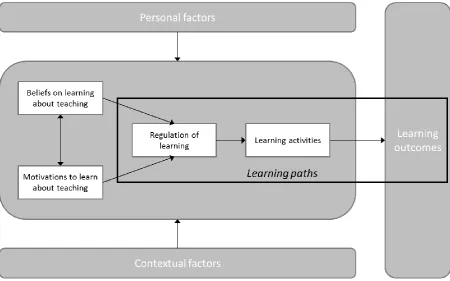
Teacher learning can be defined as an active process in which teachers engage in activities that lead to a change in knowledge and beliefs (cognition) and/or teaching practices (behavior) (Bakkenes et al., 2010; Zwart et al., 2008). A model (figure 1) that describes teacher learning was developed by Vermunt and Endedijk (2011). Central point of this model are the activities a teacher undertakes to learn. These activities are initiated by regulation processes, which are influenced by teachers’ beliefs on their own learning (metacognitive knowledge and belief, learning conceptions, etc.) and their motivation to learn about teaching. These components constitute the learning process and the learning activities teachers employ, which in turn could result in learning outcomes. Personal factors and contextual factors are of influence to this learning process.
The focus of this study thus lies on learning paths in the workplace. The black frame in figure 1 shows this studies’ definition of a learning path, beginning with regulation of learning followed by learning activities and resulting in learning outcomes. Regulation processes are supposed to give direction the learning activities teachers use to learn (Randi, 2004). These processes can entail several actions such as; goal setting, planning, monitoring and control (Pintrich, 2000).
8 Figure 1. Model on teacher learning by Vermunt & Endedijk (2011)
Intention of learning
In the context of this study the intention of the learner provides the starting point of a learning path. Eraut (2004) summarized planning and goal-setting as intention to learn. This intention can vary (Eraut, 2004) and three levels of intentions are distinguished; implicit learning, reactive learning and deliberative learning. Implicit learning occurs outside the conscious awareness of the learner and without a pre-set goal (Eraut, 2004). This means that the learner unconsciously undertakes activities whereby something is learned without a learning goal. Reactive learning is conscious, but happens unplanned. This means learning occurs through activities consciously undertaken by the learner, without a goal of learning. Deliberative learning is conscious, planned and directed towards a
‘definite learning goal’ or a ‘work-based goal’. When learning activities direct towards a learning goal, time is allocated for learning. Work-based goals direct towards activities that a teacher undertakes within the work context aimed at improving their practice (Hoekstra, 2007). This difference is important because most psychological theories of learning only include learning goals.
9
Learning activities
When professional activities of teachers lead to a change in cognition and/or behavior, these activities are called learning activities (Hoekstra et al., 2009). Several types of activities exist, varying from unconscious learning integrated in the job, spontaneous learning activities, to focused and organized training in the workplace (Onstenk, 1997).
In reviews on workplace learning several categorizations of learning activities exist. For example, Eraut (2004) reviewed workplace learning in several settings and identified the main types of work processes that regularly trigger learning. The main processes are; participation in group activities, working alongside others, tackling challenging tasks and working with clients. Tynjälä (2008) presented a comprehensive literature review on workplace learning based on the most recent studies. She categorized the way people learn at work in: (1) doing the job itself, (2) co-operating and interacting with colleagues, (3) working with clients, (4) tackling challenging and new tasks, (5) reflecting and evaluating work experiences, (6) formal education and extra-work contexts.
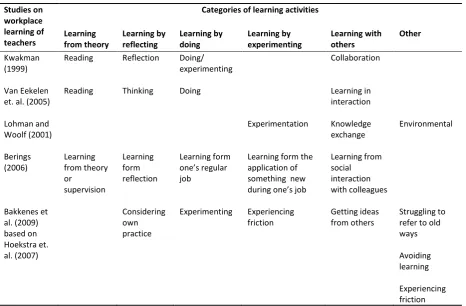
[image:9.595.67.534.405.711.2]Looking into research that focused on learning activities of teachers, a limited number of studies can be found. An overview of these studies is displayed in table 1. Most of the included studies provide inventories of activities which have been obtained by logs or reports of teachers (Kwakman, 2003; Lohman & Woolf, 2001). Looking at these classifications five major categories can be defined: learning from theory, learning by reflecting, learning by doing, learning by experimenting and learning with others.
Table 1. Overview on categories of learning activities of teachers Studies on
workplace learning of teachers
Categories of learning activities
Learning from theory Learning by reflecting Learning by doing Learning by experimenting Learning with others Other Kwakman (1999)
Reading Reflection Doing/ experimenting
Collaboration
Van Eekelen et. al. (2005)
Reading Thinking Doing Learning in interaction
Lohman and Woolf (2001)
Experimentation Knowledge exchange Environmental Berings (2006) Learning from theory or supervision Learning form reflection Learning form one’s regular job
Learning form the application of something new during one’s job
Learning from social interaction with colleagues Bakkenes et al. (2009) based on Hoekstra et. al. (2007) Considering own practice
Experimenting Experiencing friction
Getting ideas from others
Struggling to refer to old ways
Avoiding learning
Experiencing friction
10 & Kyndt, 2015). In countries with high performances in education, such as Finland, teachers
collaborate intensively, leading to excellent results (Vangrieken et al., 2015). Vangrieken et al. (2015) found, based on an extensive literature review, multiple benefits on learning through social
interaction. They distinguish three levels where benefits occur; student level, teacher level and school level. Examples of benefits on student levels are; improved student understanding (Wigglesworth, 2011), student success (Egodawatte, McDougall, & Stoilescu, 2011) and student learning (Main & Bryer, 2005). Examples on teacher levels are; veterans and beginning teachers learn from each other (Carroll & Foster, 2008), innovation and dealing with the complexity of teacher work (Brouwer, 2011), enhanced goal achievement (Egodawatte et al., 2011), increased teacher
effectiveness (if certain conditions are met) (Graham, 2007). And examples on school level are; adaption and innovation (Euwema & Van der Waals, 2007) and cultural shift to more equity (Slavit, Kennedy, Lean, Nelson, & Deuel, 2011). Most benefits that Vangrieken et al. (2015) found are on teacher level. However, research also indicates possible negative consequences of teacher
collaboration. It is important to note that teacher collaboration is not always positively appreciated and therefore success is not guaranteed (Kelchtermans, 2006). Examples of possible negative consequences are; teachers may experience tensions which can escalate into conflicts, competitiveness, increased workloads (Vangrieken et al., 2015). The above findings show the importance of the social aspects of teacher learning. Therefore this perspective will be explored to find out which actors teachers include in their learning activities.
Learning outcomes
Learning outcomes can be defined as sustainable changes in knowledge, skills or attitude resulting from engagement in learning processes (Shuell, 1986). Research on informal learning outcomes is scarce (Hoekstra et al., 2009; Kock & Ellström, 2011). In addition, learning outcomes can be viewed from different perspectives. For example, Kock and Ellström (2011) studied learning outcomes on different levels in organizations; individual, group and organizational. They tried to understand what the outcomes of the learning processes deliver to these different levels within the organization. In contrast, Onstenk (1997) provided a more elaborate classification of learning outcomes and categorized; social, communicative, strategic, methodological, technological-occupational and cultural-normative outcomes. These two examples show that the focus regarding learning outcomes differs and depend on context and research goals.
11 The second model is from Shulman and Shulman (2004). They developed a model whereby the foundation was described as: a competent teacher is part of a professional community and ready, willing and able to teach and to learn from his or her teaching experiences. Thus the elements of this theory are; (a) vision: a teacher must have a vision on teaching and student learning; (b) motivation: a teacher must have the willingness and the motivation to invest in teaching methods; (c) understanding: a teacher must understand concepts and principles of pedagogical models; (d)
practice: a teacher must be able to realize educational practice in a certain way; (e) reflection: a teacher must be able to reflect on experiences in order to learn from them; (f) community: a teacher must be able to function as a member of a school community and participate in learning with
colleagues.
Both models show that teaching can be seen as a multifaceted profession, wherein all components are associated. The model of the Dutch Educational Cooperation provides a more detailed review on explicit behavior, whereby the model of Schulman and Schulman (2004) focuses on a general attitude towards these different elements. Both models make a visible distinction between the primary process of teaching, as pedagogy and didactics, and secondary roles in the school, like cooperation with the environment.
Looking into research focused on concrete learning outcomes of teachers in the workplace, a few studies can be found that have a focus on learning outcomes of a specific learning activity. For example, Little (1990) investigated how collegial interaction can contribute to teachers professional development. Bakkenes et al. (2010) investigated multiple learning activities and outcomes of experienced teachers in the context of educational innovation. They collected data of 100 teachers through digital logs in 30 different schools. The reported learning outcomes were categorized into; change in knowledge, intention for practice, changes in practice and change in emotions. Each of these categories were divided into different types. Results showed that changes in knowledge and beliefs are reported most frequently, changes in teaching practices are being reported rarely. Another research field, comparable to learning of teachers, is learning of student teachers, these are teachers in training. The study of Endedijk and Bronkhorst (2014) categorizes student teachers reflections of their learning experiences in terms of: (1) a rule of thumb; (2) factual knowledge, (3) procedural knowledge, (4) their own learning process or identity, (5) a specific teaching practice, (6) theory of practice and 7) implicit learning.
Concluding, the field of research on learning outcomes is context specific. However, in general a distinction can be made between types and domains of learning outcomes. Types of learning outcomes involves changes in knowledge, skills or behavior. Domain specific learning outcomes are content based on a certain function.
Learning paths
After exploring the elements of learning paths separately, this section will discuss literature that approach the concept as a whole. Learning paths are defined as one or multiple activities that the learner undertakes subsequently to learning questions or problems encountered at work (Endedijk, Hoekman, & Sleegers, 2014). These paths can differ in sequence, context and an activity can also vary in duration. The extent can vary from reading a book, taking a course, to following an entire
professional development program. In terms of context, a learning path can exist of a combination of workplace learning and learning in a formal context. Research even indicates that there is synergy between a mixture of contexts that could enrich the learning process (Bell, 1977).
12 intention of the learner and the learning outcomes. As described above, adding these two elements are relevant in describing the nature of learning paths. For this reason learning paths in this study are defined as the integrated processes of the intention of the learner, the learning activity or a
combination of learning activities that a person undertakes in reaction to a learning question or problem one encounters at work, and can lead to a certain learning outcome. An example of a learning path is; a teacher planned (intention) to improve his teaching method on the Pythagorean. First he looked at a colleague in the classroom, then he searched literature about the subject followed by a lesson he has reflected on. After this, he made a change in his teaching method (learning outcome).
There is limited research explicitly focusing on the way in which learning paths are construed by professionals (Kessels & Poell, 2011). A few exploratory studies on learning paths can be found. Lisman, Natte, and Poell (2007) explored the learning paths of hundred nurses in a cross-sectional qualitative study. In this research the learning theme, the learning activities, the learning context and the learning facilities where included. They defined four different types of learning paths; the self-directed learning path (25%), the formal-external learning path (34%), the social-emotional learning path (25%) and the information-leading learning path (17%). All these learning paths had a high average score on social learning and learning in the work-context. This study did not include the learning outcome of the learning paths.
Methodological constraints limited researchers to investigate the connection between sequences and their learning paths. Nevertheless, two exceptions can be found that did study this connection. The first study focused on engineers and explored their natural learning path and the way this relates to the intentionality of the learning experience and the subsequent learning outcomes (Endedijk et al., 2014). The results of this log study showed that in 51% of the cases engineers use multiple learning activities in order to learn. A typical sequence in these activities was identified. Prime activities consisted particularly of experimenting or trying out. Succeeding activities mainly involved searching for information. In the last position of the sequences, social learning occurs significantly more (Endedijk et al., 2014). The second exception can be found in a study that focuses on teachers, but is limited to only two kinds of learning activities and their learning outcomes and focused on activities during a reciprocal peer coaching trajectory (Zwart et al., 2008). In this study learning processes were mapped by providing a detailed description of reported learning activities, reported learning outcomes, and the relationship between the two. Analyses of periodic coaching conferences, post-coaching interviews and digital diaries submitted by teachers, produces a total of 90 sequences of learning activities associated with particular learning outcomes and 551 distinct learning activities (Zwart et al., 2008).
13
3. Research Questions
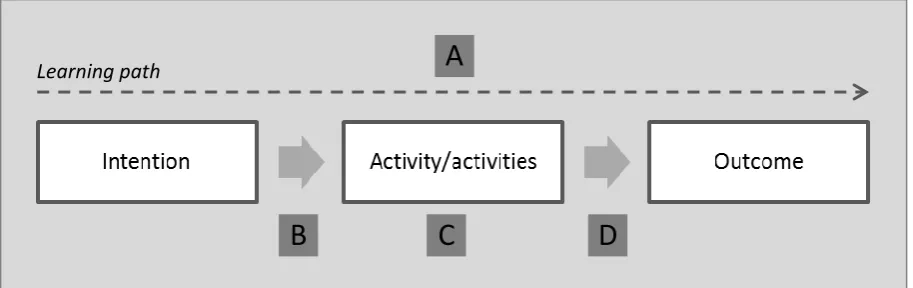
The aim of this research is to explore learning paths of secondary school teachers. Learning paths in this study are described as the integrated processes of the intention of the learner, the learning activity or a combination of learning activities and the learning outcome. This process is illustrated in figure 2. In order to guide this research a main research question is defined;
A. What is the nature of secondary school teachers’ learning paths?
To help answering this main research question, three sub questions are defined;
B. What is the relation between the learning intention and the subsequent learning activities? C. What are typical sequences of learning activities?
D. What is the relation between learning activities and learning outcomes?
These research questions can be classified as empirical research questions because they aim to provide more insight in the way workplace learning of secondary school teachers takes place. Within the classification of empirical research questions several types of questions can be separated. Research question ‘A’can be classified as a descriptive research question, as it aims to describe the different elements of learning paths and the learning path as a whole. The other three questions aim to examine the relationships between the elements of the learning paths; intention, learning
[image:13.595.71.528.462.606.2]activities and learning outcomes. Therefore these questions can be classified as relational questions. Exploring these relations are intended to study learning paths in more depth in terms of structure and sequence. All the above elements are visualized in figure 2, which is a more detailed view of the research framework already presented in figure 1.
Figure 2. Research model
A
B
C
D
14
4. Method
Context
This research is conducted within a secondary educational organization, CSG het Noordik. In the national sector covenant for secondary schools, agreements are made on the way schools should develop to become a professional learning organization. In a professional learning organization there is a work environment that provides challenges and facilities to deal with the dynamics within the educational context. In the sector agreement (2014-2017) it is indicated that the focus of teacher learning should be on teacher motivation and what teachers need to develop themselves. This is supported by the Ministery of Education (2013) which strives to support teachers to learn in their own work context.
CSG het Noordik consist of four locations, Noordikslaan, Catharina van Renneslaan,
Vriezenveen en Vroomshoop, in the area of Almelo. All regular secondary school levels are provided by the organization. To support the locations there is an administration office. In 2015, the school had 3300 students and 370 employees, of which 261 were teachers and 109 were supporting staff. Like any other secondary school, CSG het Noordik has to deal with the vision and the agreements of the sector agreements and the Ministry of Education. To do so, the school formulated a vision on school development. The organization strives “to be a learning organization, in which employees take responsibility for their own learning process”. A rich learning environment is an essential condition in achieving this objective.
In 2010 the structure of the school has been changed. Since that process the school works with self-managing teaching teams, with the aim of increasing educational quality and social
learning. Responsibilities for the educational quality are delegated to the teams. Teams are organized around learning years and school subjects. These structures are intertwined, meaning that a teacher is part of multiple teams. To make meaningful decisions within these teams, there is a need for ongoing professionalization. To achieve this, the organization focused on the development of a more comprehensive HR-policy to increase the development of the talents of teachers. In order to
become a learning organization, a variety of initiatives are provided through which teachers can develop themselves. A lot of these initiatives are organized externally and are not directly linked to the work context.
Respondents
The respondents of this research are teachers of CSG het Noordik. Employees that are not employed as teachers by CSG het Noordik were excluded from the study. This school can be seen as a
representative secondary school, because all levels of secondary education are provided. This study aims at gathering data on an teacher level. Teachers were subjected to a daily digital log which was distributed to them by email. All 261 teachers of CSG het Noordik were asked to participate in the study. Out of this population 181 different teachers were included in the research. These
respondents provided 601 logs. The maximum number of logs over 5 days is therefore 1305.
15 Table 2. Proportion of teachers per location of CSG het Noordik and proportion respondents per location
Proportion of teachers at 1-9-2014 (%)
Respondents (%)
Location
Noordikslaan 43.0% 28.8%
Vriezenveen 19.9% 23.7%
Vroomshoop 15.9% 20.6%
Caterina van Renneslaan 21.0% 26.9%
total 100.0% 100.0%
Function
LB-function 49.7% 41.3%
LC-function 40.8% 44.8%
LD-function 9.5% 13.9%
total 100.0% 100.0%
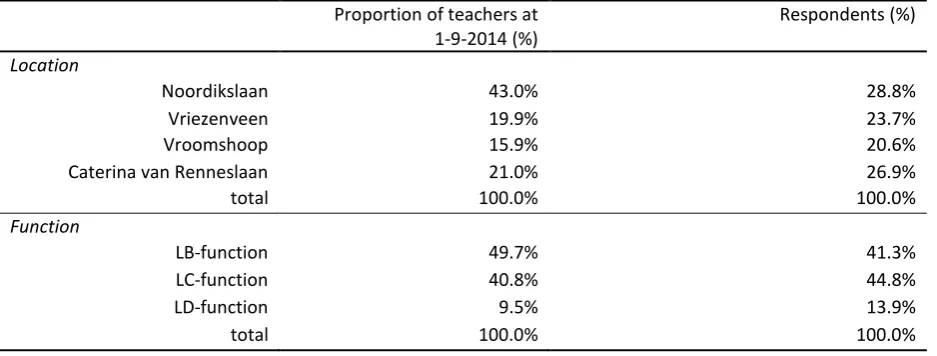
Table 2 shows that the distribution of respondents across the four locations was representative for the distribution of teachers in school. The largest group of respondents comes from location Noordikslaan (28.8%), and the smallest group respondents comes from location Vroomshoop (20.6%). Most teachers (42.9%) that filled in the log had an LC-function, 39.2% had an LB function and 13.3 % had an LD function. This did not completely respond with the distribution of the school whereby 49.7 % has an LB function, 40.8% has an LC function and 9.5% has a LD-function.
Research design
This study was an exploratory dairy study, in which teachers repeatedly fill out daily questionnaires (logbooks) during a predefined period of time. This means that repeated measurements were used to provide multiple measurements per respondent over time. This design enables a detailed insight into the daily workplace learning of secondary school teachers, because data is collected on a daily basis. Furthermore, diary studies are useful because it entails describing characteristics of a large population (Babbie, 2010), and makes it possible to make generalizations from the sample studies to broader groups beyond the sample (Swanson & Holton, 2005). This study used a mixed method approach, consisting of qualitative (open questions) and quantitative (multiple choice questions) methods.
Instrumentation
This study used digital log questionnaires to measure teachers’ daily learning activities. The log was based on the instrument of Endedijk et al. (2010), which was developed in the context of student teachers with the aim to follow their learning activities and realization of these activities.
16 An invitation to fill out the digital log was send to all teachers by email daily. Teachers had to fill in what they learned during a particular working day and by means of what kind of activities they learned it. The log started with an introduction, in which specific information was provided on the purpose of the log and information about workplace learning. Information about workplace learning was provided to help the teacher recognize learning activities and learning outcomes. The log
consisted of one open question and several multiple choice questions. It depended on the answers to the questions how many questions were exposed to the respondent. The time to fill in the log varied therefore. Appendix A shows the survey items used in this research. To following sections describe the way the different variables were measured.
Demographic characteristics
In this research three demographic variables were asked; school location and function. The school location was asked to see if there was an equal distribution among the schools and also to see if there were significant differences between schools. The function was also asked to see if there was an equal distribution and also to see the difference between different functions of teachers. Gender, age, seniority and education were not considered. Also part time and full time teachers were
approached the same. Learning intention
To measure the intention of the learning each log contained a question to determine whether the learning experience was planned, unplanned, or if there was a wish to learn but the experience was unplanned. In case the answer was planned or there was a learning wish, a follow up question was presented about the learning goal setting. There were six answer possibilities in for this closed question, respectively; 1) Out of curiosity 2) It was necessary for my part in the team 3) I was encouraged by others to develop myself 4) I wanted to develop myself 5) I wanted to improve my lessons 6) Other.
Learning activities
Learning activities were measured with multiple choice questions; “Your learning experience can exist of multiple activities, please provide the first learning activity in which you have learned.” There were eight answer possibilities. When the answer was related to social learning, a follow-up question was presented; “Who was involved in the learning activity?” For this closed question nine answers were possible. After each question about learning activities a follow-up question was asked whether more activities were part of the learning experience. If there were more learning activities, the following learning activity was asked. If this was not the case, the next question was provided, regarding the learning intention. Based on the research of Endedijk et al. (2014) there was a maximum sequence of four possible learning activities.
Learning outcomes
Learning outcomes were measured with an open question; “Could you describe a learning experience in the past twenty-four hours in the context of your work? Describe what you have learned”. Several suggestions of learning experiences were provided. The different categories on the types of learning outcomes were; pedagogical/interpersonal, pedagogical content, cooperation, personal development and other. Pedagogical/ interpersonal are learning outcomes which focusses/comprise on supporting students and learning environment. Pedagogical content outcomes, focusses on subject matter and learning methods. Cooperating learning outcomes
17 form another school. This category did not include cooperation between teacher and students. Personal development focusses on reflection of teachers on their own behavior. And other contains all learning outcomes which were not peaceable in the mentioned categories. The categorization of learning outcomes was performed by the researcher. A second coder was used to ensure the reliability of the coding of the learning outcomes. Coding of all the learning outcomes resulted in a good interreliability (Kappa =.96). The codebook is based on content, and is presented in Appendix B.
Procedures
Ethics
This research was approved by the Ethic Commission of University of Twente. Informed consent was obtained from all participating teachers. The data was gathered in a non-anonymous way, because this information is needed to connect the repeated data of one person. After this was done, the data was processed anonymous.
Data collection
To recruit participants, information about the study was provided in advance by e-mail and newsletter to all teachers of CSG het Noordik. In this announcement, attention was paid to the communication of the outcomes of the study to the participants. School leaders were also asked to inform their team about the study. Teachers received a daily email to remind them to fill in the digital-log.
Data Analysis
The data was analyzed using SPSS version 20. First the descriptive statistics were displayed, in order to get a picture of each variable in the learning path. For analyzing the sequences of the learning activities and the relationship between the learning activities and the intention and learning outcomes Chi-square analyses were used. These Chi-square analyses, including post-hoc analyses studied the relationships more in depth.
However, these technique only provide insight in relations between two variables at the same time. To provide insight in the total learning paths of teachers there will be used a visualization technique called a Sankey diagram. This diagram is a flow map. In this study, this diagram will be used to visualize the paths of the different categories of the intentionality of the learning experience to the subsequent learning activities and outcomes.
18
5. Results
In this section the results of the research will be presented. First, in line with the sequence of the research questions, a descriptive analyses will be given. Second, the relational analysis are presented. Subsequently, both of these results are described with reference to the Sankey diagrams, to provide a view on the complete learning paths.
Descriptive results
In total 601 logs were obtained by 181 respondents. This gives an average of 3.3 logs a person. A learning experience was reported 413 times, 188 times teachers could not come up with an learning experience that day.
Intention to learn; planning
[image:18.595.63.528.331.398.2]Table 3 shows the planning of the learning experiences. This shows that almost two third (57.9%) of the learning experiences was unplanned, 33.2% of the experiences was planned and 8.7 % involved a non-planned learning wish.
Table 3. Frequencies of planning to learn
Intention to learn Frequency Percentage
Planned learning 137 33.2
Unplanned learning 239 57.9
Learning wish 36 8.7
Total 412 100
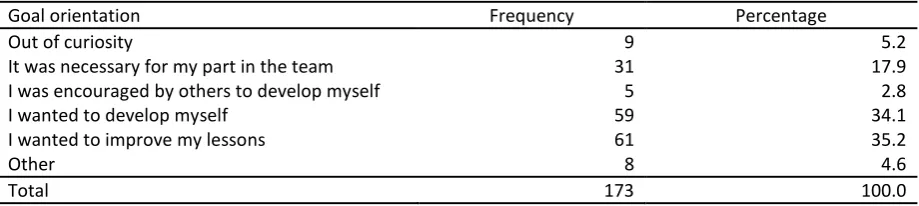
Intention to learn; goal orientation
[image:18.595.67.527.525.628.2]If the learning was planned or a learning wish existed, the goal orientation was asked. In table 4 the reported goals for the learning experiences are presented. The high frequency of the answers ‘I wanted to develop myself’ and ‘I wanted to improve my lessons’ can be considered remarkable. These answers refer to intrinsic motivation of the learner. This corresponds to the low frequency of the category ‘I was encouraged to develop myself’, which refers more to extrinsic motivation. Table 4. Goal orientation of the learner
Goal orientation Frequency Percentage
Out of curiosity 9 5.2
It was necessary for my part in the team 31 17.9
I was encouraged by others to develop myself 5 2.8
I wanted to develop myself 59 34.1
I wanted to improve my lessons 61 35.2
Other 8 4.6
Total 173 100.0
Number of learning activities
19 Learning activities
In table 5 an overview of the frequency of the learning activities is given. For every learning
[image:19.595.66.528.204.305.2]experience multiple learning activities could be reported. So, the total number of learning activities is higher than the amount of learning outcomes. The table shows that social learning is mostly reported (35%) and this is followed by analyzing/ thinking (23%). Least reported activities are information seeking (6.7%) and experimenting/ trying out (12.5%).
Table 5. Frequencies type of learning activities
Involved in social learning
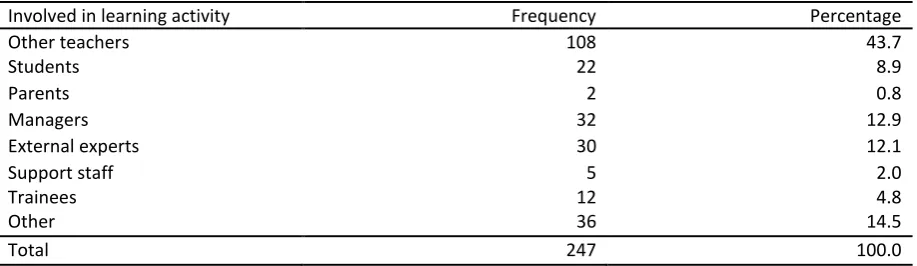
Activities that where most reported where social learning activities. This category means there is interaction during the learning activity with others. Table 6 displays a categorization by position for persons that where involved in the reported learning activities. For each learning activity multiple answers were possible, this resulted in 247 involved persons. External expertise was not an official category in the log, but was mentioned a lot in the open answers and therefore added to the table. For the same reason the category trainees is added to the table. In the open answer possibility, the function of (adjunct) director was also mentioned several times, these answers are added to the category managers in the table. Based on these results it can be concluded that social learning activities frequently involve other teachers (43,7%). Other categories that are regularly reported in learning activities are managers and external experts.
Table 6. Frequencies involved in social learning
Involved in learning activity Frequency Percentage
Other teachers 108 43.7
Students 22 8.9
Parents 2 0.8
Managers 32 12.9
External experts 30 12.1
Support staff Trainees
5 12
2.0 4.8
Other 36 14.5
Total 247 100.0
Teachers involved in learning activity
The largest category of table 8 is ‘other teachers’. This category can be divided into four subdivisions. Table 7 shows the kind of relation of the teacher that was involved in the learning activity. Again, multiple answers were possible. As mentioned earlier, teachers participate in multiple teams in the school. Two teams were separated in the questionnaire; sections and teams. Sections are content teams, teacher that teach the same course. And with teams is referred to the (new) structure whereby a group of teachers (15-20) is responsible for example the lower years. The largest
Type of learning activities Frequency Percentage
Experimenting/ trying out 65 12.2
Analyzing/ thinking 123 23.0
Doing/ Experiencing 107 20.0
Information searching 36 6.7
Social learning 187 35.0
Other 16 3.0
[image:19.595.67.526.517.650.2]20 group of teachers that is mentioned most often are teachers that are in not in their team or section. Logically, this category is represented most frequently in school. Between the other groups, section or teams or both, are no outstanding differences.
Table 7. Frequencies of teachers involved in learning activities
Teachers involved in learning activity Frequency Percentage
Teachers in their section 25 23.1
Teachers in their teams 17 15.7
Teachers in both, section and teams 21 19.4
Teachers neither in their section or team 45 41.6
Total 108 100.0
Learning outcomes
The learning outcomes were coded in line with the teacher competences as described earlier. Table 8 shows the frequencies of learning outcomes. The category ‘pedagogic/ interpersonal’ is reported most frequently (26.4%) and ‘didactic’ least frequently (17.2%).
Table 8. Frequencies of learning outcomes
Learning outcome Frequency Percentage
Pedagogic/ interpersonal 109 26.4
Didactic 82 19.9
Collaborate 71 17.2
Person centered/ professional identity Other
102 49
24.7 11.9
[image:20.595.67.528.332.422.2]21
Relational analyses
Results on the research questions that cover the relational aspects of elements in learning paths will be presented in this section. First, the relation between intention, consisting out of planning and goal orientation, and the kind of activity that follows will be covered. Second, the relation of learning activities and its position in the sequence will be described. Last, learning activities and subsequent learning outcomes will be covered. All tables resulting from the post hoc Chi-square analyses are enclosed in appendix C.
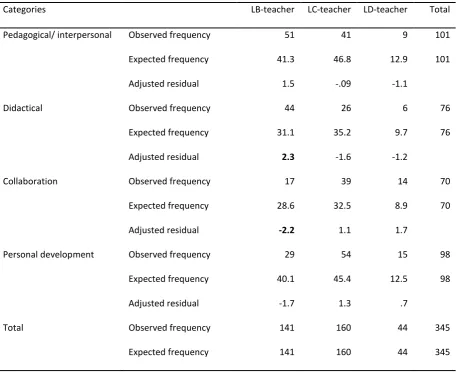
In addition, the results have also been examined on the basis of demographic variables (function and location) that were asked. No significant relational difference between locations were found. However, a significant relation was found between the function and the learning outcomes (X2(6)= 27.48 p = .00). Teachers with a LB-function reported significantly more often didactical learning outcomes (AR=2.2) . Table 9 shows the details of these results.
Planning of learning related to the kind of activity that follows
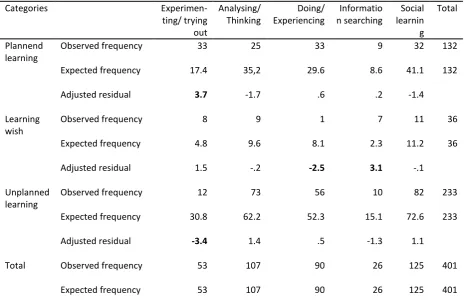
A chi-square analysis showed a significant relation between the intention of learning and the kind of activity that follows (X2(8)= 53.61, p = .00). Table 10 shows the post-hoc analyses. This shows that planned learning significantly more often results in ‘experimenting/trying out’ activities as first activity (AR = 3.7). The opposite can be seen by unplanned learning, hereby ‘experimenting/ trying out’ is less mentioned as first activity (AR = -3.4). And in the category ‘learning wish’ the activity ‘information searching’ is significantly more used as first activity (AR = 3.1) and the activity ‘doing/ experiencing’ is less used as first activity (AR = -2.5). In the table can be seen that two expected counts are below five (13.3%). According to Field (2013) this is acceptable because it is less than 20%. The goal orientation related to first learning activity
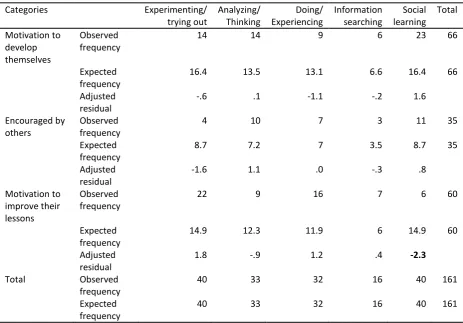
The goal orientation was only asked when the learning experience was planned or if there was a learning wish, this resulted in 161 learning experiences. Looking into the relation between the goal orientation and the first learning activity, there can be found a significant result (X2(8) =19.84, p = 0.01). For this analysis the categorization on goal orientation is reduced and combined to three categories; 1) ‘motivation to develop themselves’, 2) ‘stimulated by others’ and 3) ‘motivation to improve my lessons’. Category 1 entails ‘I was curious’ and ‘I wanted to develop myself’. Category 2 entails ‘it was necessary for the role in my team’ and stimulated by others’. The last category, ‘I wanted to improve my lessons’ is unchanged. Table 11 shows post-hoc analyses. Category 1, social learning was significantly more used as first learning activity. In category 2 there is significantly less learning by doing as first learning activity. Category 3 indicates that learning by doing is significantly more used as first learning activity. Also, social learning is significantly used more as first learning activity in this situation.
Relation between the nature of the learning activity and the position in the sequence
22 Relation between the nature of learning activities and learning outcomes
A chi-square analyses showed a significant relation between de nature of the learning activity and the learning outcomes (X2 (9) =73.54, p= .00). For this analysis the dataset is restructured on learning activity level. Each learning activity is linked to the learning outcome. Because of low frequency ‘information searching’ (N=36) is added to the category ‘analyzing/thinking’. Both categories refer to a cognitive learning process. The learning outcome category ‘other’ is left out of the analysis because of the low frequency.
A post-hoc analyses showed (table 13) that learning outcomes related to didactical outcomes ‘experimenting/trying out’ (AR= 4.9) is deployed significantly more and ‘social learning’ (AR= -2.8) is deployed significantly less. For learning outcomes that are related to improving cooperation, ‘social learning’ (AR= 3.9) is significantly more used and the activities ‘experimenting/trying out’ (AR= -2.2) and ‘analyzing/thinking’ (AR= -2.5) are significantly less deployed. Personal development outcomes are significant less related to the activity ‘experimenting/ trying out’ (AR=-2.0). For learning
23
Results from Sankey diagrams
The results above provide insights into the relationships between two elements of learning paths. Nevertheless, the aim of the research was also to view these paths as a whole, this will be done by using Sankey diagrams. This method provides a way to view the learning paths in a clear visual picture, instead of only the relationship between two variables of the sequence. Two diagrams are presented in the appendices, learning paths with one and two learning activities. Appendix D provides an overview of learning paths with the intention, one learning activity and the learning outcome (N=321). Appendix E shows the intention, two learning activities and the learning outcome (N= 67). Diagrams of three (N=21) and four (N= 4) activities are not presented because of the low frequencies. In the diagrams the nodes as well as the flows are frequency based. How bigger the node, the more often this category was chosen, the thicker the flow, the more often the path was used. The two diagrams, from left to right the intentionality of learning, the subsequent learning activities (1-2) , learning outcomes are displayed. Every variable had a category ‘other’, these are not included in the diagrams. The position of the nodes is random and not meaningful other than that the position is chosen that gives the least complex visualization. Hereinafter, the most frequent learning paths will be discussed.
Most learning paths exist of one learning activity (N=321), Appendix D shows the Sankey diagram of these learning paths. In line with the descriptive results, these learning experiences were mostly unplanned and there were only a few experiences with a learning wish. Unplanned learning experiences mainly lead to activities with interaction, however this is not significantly found. Also the activities ‘analyzing/thinking’ and ‘doing/ experiencing’ are frequently used. In case of planned learning there is less difference between the types of activities undertaken. Learning with a learning wish does not lead to the learning activity ‘doing/ experiencing’. Overall, the most used learning activities are ‘learning in interaction’ and ‘analyzing thinking’. The category ‘analyzing/ thinking ‘ and doing/ experiencing’ lead mainly to the category learning outcomes ‘pedagogic/ interpersonal’. ‘Learning in interaction’ leads mainly to cooperation and ‘experimenting/ trying out’ lead mostly to didactical learning outcomes. Information searching leads only to ‘didactical’ and ‘personal
development’ outcomes.
24
6. Conclusion and discussion
The aim of this study was to explore learning paths of secondary school teachers. Insights have been obtained by examining the relationships between different elements of learning paths. Data was collected through self-reported logs. This section will elaborate the most important findings in relation to the research questions. Then, limitations of the research and suggestions for further research will be given. Furthermore, theoretical and practical implications will be discussed. Looking at the intention teachers have and the activities that follow only a small amount of
significant relations were found. Within the area of planning, the activity ‘experimenting/ trying out’ is significantly more planned beforehand than other activities. This could be explained by the assumption that trying something out in class requires preparation. These results are in line with existing theories and previous studies; experimenting is a deliberate activity, and it is not surprising that these activities are more often planned (Eraut, 2004).
Within the area of goal setting, the goal ‘motivation to improve their lesson’ and the activity ‘social learning’ have no relation, which can be considered as a remarkable result since collaboration and discussion by teachers could benefit the quality of teaching (Vangrieken et al., 2015). On the other hand, teaching itself is an individual task, without direct contact with other teachers within the classroom.
Looking at the position of learning activities within the learning path one significant relation was found. Social learning is often positioned in later stages of the sequence of activities. This finding is in line with the research of Endedijk et al. (2014). Interaction on previous learning activities amongst collegues could be a necessary lead in for social learning.
Learning activities and the resulting learning outcomes for teachers give some significant relations. In line with other studies (e.g.Bakkenes et al., 2010), a significant relation was found between the nature of activities and learning outcomes. Didactical learning outcomes involve the activity ‘experimenting/ trying out’ significantly more often than social activities. This is in itself logical as teaching is mainly performed individually. However didactics is directly related to the quality of lessons. Therefore this finding outlines the potential of social learning as an activity to stimulate didactical learning and the quality of lessons. The influence of social learning on the performance of education was also found by Vangrieken et al. (2015). Another significant relation was found between the learning outcome collaboration and the activity social learning, which is intuitive because collaboration requires social interaction.
25 relatively ad hoc profession, with lots of different work activities during one day. In contrast,
engineers work on bigger projects in a more structural way.
Looking at learning activities, social learning occurs most often, information searching was reported least frequently. With regard to cooperation during social learning activities, it can be concluded that teachers cooperate with other teachers rather than other stakeholders in the work environment. Next, the results show that teachers often cooperate with teachers outside their own team or section. This is remarkable as the school in this study is organized with team structures to stimulate cooperation and learning within teams and sections. The goal of the school thus does not seem to be met.
The clear visualization of learning paths with Sankey diagrams help to distinguish paths by length and frequency of occurrence. Didactical learning outcomes involve longer learning paths than the ones with pedagogical/interpersonal outcomes. Furthermore two clear dominant paths can be identified from the results. Looking at paths with a single learning activity first, ‘unplanned – social learning – collaboration’ and second, ‘unplanned – analyzing/thinking - pedagogical/interpersonal’ frequently occur. Looking at paths with two learning activities first, ‘unplanned – social learning – social learning – personaldevelopment’ and second, ‘unplanned – doing/experiencing – social learning – collaboration’ occur frequently. In addition to these most outstanding paths, a number of elements summarize the nature of secondary school teachers’ learning paths. These are; the intention is mostly unplanned, paths consist primarily out of one learning activity, social learning appears to be a highly frequent activity and learning often occurs in cooperation with colleagues outside the ‘native’ team the teacher is part of.
Limitations and further research
In addition to the conclusion, this research has limitations. First, using an instrument with closed questions might exclude relevant information about learning paths. Second, self-reports require some introspective ability of respondents. Consequently, the reliability of the results can vary and be questioned. Further research that includes methods with a focus on this ability, for example
interviews and observations, can eliminate this limitations. Third, this research approaches learning as an experience with a start and an end. However, it might be likely to approach it as a continuous process. What do teachers undertake when a learning outcome is achieved? Do they reflect on that outcome? Are subsequent learning objectives formulated? These aspects were not included in the scope of this research, but could contribute to teachers’ insights in learning processes. Fourth, research indicates that workplace learning often occurs unconscious. Therefore, teachers might not be aware of their own learning path. Unconscious learning paths might be left out but could be interesting to study. Methods that focus on awareness and reflection on learning can fill this gap. Also more extensive briefing beforehand can take away this limitation. Fifth, opportunities to generalize the results might be limited as the outcomes are very specific for the educational domain. This can be explained by the fact that the used instrument is developed specifically for teachers and their work context. Also, the work context of teachers is relatively unique.
26 of activities. Based on the existing data the three different aspects, knowledge skills and attitude, could be used to another categorization of learning outcomes.
Practical implications
The first practical implication concerns learning through social interaction. The results show that didactical learning outcomes were not significantly related to social interaction. This can be explained by the fact that these learning experiences are often acquired while teaching. Next to this teachers only have a few colleagues that would understand the didactical part of their profession, while every teacher is a pedagogical professional. Looking at the benefits of social learning, the quality of lessons could possibly be increased when teachers use social interaction to enhance their teaching practice. This could be stimulated within the organization by creating a learning climate where it is common for teachers to look or talk about their lessons. This could be done through organizing intervision on didactical skills within school sections or by putting an emphasis on teacher collaboration with regard to didactics.
Another practical implication is related to the career development policy of the organization. The results show that LB-teachers mostly report learning experiences that were related with
didactical and pedagogical learning outcomes and LC-teacher reported outcomes that were more frequently related to team tasks. It might be interesting to differentiate the focus of HRD-policy on career stage. The development of the LB-teacher should be focused on pedagogical and didactical skills and the development of LC- and LD- teachers can be focused more on other tasks within the organization. This last point presumes that LC- and LD-teachers already possess sufficient
pedagogical and didactical skills.
The next practical implication has to do with trainees. The open answer possibility on the question ‘Who was involved in the social learning activity’, was frequently answered with ‘trainees’. The organization is working on policy that has to do with educating trainees within the organization. The organization at this point has the approach that trainees only learn from teachers. However, teachers can also learn from trainees. This can be elaborated by a structure that facilitates mutual learning. For example a buddy system with a double learning intention. So experienced teachers benefit from recent expertise on teaching theories that trainees just learned at university. And vice versa, trainees benefit from the vast experience of teachers.
The last practical implication is based on the opportunity to deliver feedback on the
27
Reference list
Bakkenes, I., Vermunt, J. D., & Wubbels, T. H. (2010). Teacher learning in the context of educational innovation: Learning activities and learning outcomes of experienced teachers. Learning and Instruction, 20(6), 533-548. doi: http://dx.doi.org/10.1016/j.learninstruc.2009.09.001 Bell, C. R. (1977). Informal Learning in Organizations. Personnel Journal, 56(6), 280-283,313. Billett. (1995). Workplace learning: its potential and limitations. Education+ Training, 37(5), 20-27. Billett, S. (2002). Critiquing workplace learning discourses: participation and continuity at work.
Studies in the Education of Adults, 34(1), 56-67.
Borko, H. (2004). Professional development and teacher learning: Mapping the terrain. Educational researcher, 33(8), 3-15.
Brouwer, P. (2011). Collaboration in teacher teams.
Butler, D. L., Lauscher, H. N., Jarvis-Selinger, S., & Beckingham, B. (2004). Collaboration and self-regulation in teachers’ professional development. Teaching and Teacher Education, 20(5), 435-455.
Carroll, T., & Foster, E. (2008). Learning teams: Creating what’s next. Washington, DC: National Commission on Teaching and America’s Future. Retrieved August, 14, 2009.
Dutch Educational Cooperation (2004). Retrieved from https://www.onderwijscooperatie.nl/wp-content/uploads/VOBVE20mei.pdf
Egodawatte, G., McDougall, D., & Stoilescu, D. (2011). The effects of teacher collaboration in Grade 9 applied mathematics. Educational Research for Policy and Practice, 10(3), 189-209.
Endedijk, M. D., & Bronkhorst, L. H. (2014). Students’ Learning Activities Within and Between the Contexts of Education and Work. Vocations and Learning, 7(3), 289-311. doi:
10.1007/s12186-014-9116-x
Endedijk, M. D., Hoekman, M., & Sleegers, P. J. C. (2014). Learning paths of engineers: studying sequences of learning activities to understand knowledge workers’ professional
development. . Paper presented at the The 7th EARLI SIG 14 Conference, Oslo, Norway. Eraut, M. (2004). Informal learning in the workplace. Studies in continuing education, 26(2), 247-273. Euwema, M., & Van der Waals, J. (2007). Teams in scholen: Samen werkt het beter. status: published. Field, A. (2013). Discovering statistics using IBM SPSS statistics: Sage.
Fullan, M. (2014). Teacher development and educational change: Routledge.
Graham, P. (2007). Improving Teacher Effectiveness through Structured Collaboration: A Case Study of a Professional Learning Community. RMLE Online: Research in Middle Level Education, 31(1), 1-17.
Hargreaves, A. (1997). Rethinking educational change.
Hoekstra, A. (2007). Experienced teachers' informal learning in the workplace: IVLOS, Universiteit Utrecht.
Hoekstra, A., Brekelmans, M., Beijaard, D., & Korthagen, F. (2009). Experienced teachers' informal learning: Learning activities and changes in behavior and cognition. Teaching and Teacher Education, 25(5), 663-673. doi: http://dx.doi.org/10.1016/j.tate.2008.12.007
Kelchtermans, G. (2006). Teacher collaboration and collegiality as workplace conditions. A review. Zeitschrift für Pädagogik, 52(2), 220-237.
Kessels, J., & Poell, R. (2011). Handboek human resource development. Organiseren van het leren.[Handbook Human Resource Development. The organization of learning]. Houten: Samsom.
Kock, H., & Ellström, P. (2011). Formal and integrated strategies for competence development in SMEs. Journal of European Industrial Training, 35(1), 71-88.
28 Kyndt, E., Gijbels, D., Grosemans, I., & Donche, V. (2015). Teachers’ everyday professional
development: Mapping informal learning activities, antecedents, and learning outcomes. Review of educational research.
Lisman, A., Natte, M., & Poell, R. (2007). Op zoek naar leerwegtypen van verpleegkundigen. Develop, 3(2), 22-31.
Little, J. (1990). The persistence of privacy: Autonomy and initiative in teachers' professional relations. The Teachers College Record, 91(4), 509-536.
Livingstone, D. (2006). Informal learning. Learning in places: The informal education reader, 203-227. Lohman, M. C., & Woolf, N. H. (2001). Self-initiated learning activities of experienced public school
teachers: methods, sources, and relevant organizational influences. Teachers and Teaching: theory and practice, 7(1), 59-74.
Main, K., & Bryer, F. (2005). What does a ‘good’teaching team look like in a middle school classroom. Paper presented at the 3rd international conference on cognition, language, and special education, Gold Coast, CA.
Ministry of Education, C. a. S. (2007). Note working in education. Den Haag, Nederland: Ministry of OCW.
Onstenk, J. (1997). Lerend leren werken: Eburon Delft.
Onstenk, J. (2011). Ontwikkelen van bekwaamheden tijdens het werk Handboek human resource development (pp. 248-263): Springer.
Pintrich, P. R. (2000). The role of goal orientation in self-regulated learning.
Shuell, T. J. (1986). Cognitive conceptions of learning. Review of educational research, 56(4), 411-436. Shulman, L. S., & Shulman, J. H. (2004). How and what teachers learn: A shifting perspective. Journal
of curriculum studies, 36(2), 257-271.
Slavit, D., Kennedy, A., Lean, Z., Nelson, T. H., & Deuel, A. (2011). Support for professional
collaboration in middle school mathematics: A complex web. Teacher education quarterly, 113-131.
Smith, P. J. (2003). Workplace learning and flexible delivery. Review of educational research, 73(1), 53-88.
Sparks, D., & Hirsh, S. (2000). A National Plan for Improving Professional Development. Swanson, R. A., & Holton, E. F. (2005). Research in Organizations: Foundations and Methods in
Inquiry: Berrett-Koehler Publishers.
Tynjälä, P. (2008). Perspectives into learning at the workplace. Educational Research Review, 3(2), 130-154.
Van Eekelen, I. M., Boshuizen, H. P. A., & Vermunt, J. D. (2005). Self-regulation in higher education teacher learning. Higher Education, 50(3), 447-471.
Van Veen, K., Zwart, R., Meirink, J., & Verloop, N. (2010). Professionele ontwikkeling van leraren. Een reviewstudie naar effectieve kenmerken van professionaliseringsinterventies van leraren. Teacher professional development. A review of studies on effective characteristics of teacher professionalization interventions. Leiden: ICLON/Expertisecentrum Leren van Docenten. Vangrieken, K., Dochy, F., Raes, E., & Kyndt, E. (2015). Teacher collaboration: a systematic review.
Educational Research Review.
Vermunt, J., & Endedijk, M. (2011). Patterns in teacher learning in different phases of the professional career. Learning and Individual Differences, 21(3), 294-302. doi: http://dx.doi.org/10.1016/j.lindif.2010.11.019
Wigglesworth, M. (2011). The effects of teacher collaboration on students' understanding of high school earth science concepts.
29
Appendices
Appendix A: Example digital log
Logboek leerervaringen docenten CSG het Noordik Vraag 1: Wat is je medewerker afkorting?
Deze wordt gevraagd om je data van meerdere dagen en je achtergrondgegevens te kunnen
koppelen; niet voor verdere analyse. Zodra de data zijn verzameld wordt dit verwijderd: de gegevens worden anoniem verwerkt.
Vraag 2: Op welke (hoofd)vestiging ben je werkzaam?
NL
VV
VH
CR
Vraag 3: Welke functie heb je op CSG het Noordik?
LB-docent
LC-docent
LD-docent
Leraar in opleiding
Stagiair
Vraag 4: Kun je een concrete leerervaring beschrijven die afgelopen 24 uur in de context van je werk heeft plaatsgevonden. Dit kan zowel thuis, op je werk of elders zijn geweest.
30
Ja, ik heb nu een leerervaring in gedachten. Beschrijf hieronder je leerervaring. Wat heb je geleerd? ____________________
Nee, ik kan voor vandaag geen concrete leerervaring bedenken (einde vragenlijst).
Indien nee -> laatste scherm
Vraag 5: Kruis hieronder de activiteit aan waardoor je hebt geleerd.
Je leerervaring kan uit meerdere activiteiten bestaan: vul in dat geval hier de eerste activiteit in. In de vragen hierna kun je de andere activiteiten invullen.
Ik heb...
geëxperimenteerd of uitgeprobeerd
een ervaring geanalyseerd of hierop gereflecteerd
iets uitgevoerd, gedaan of ervaren
informatie opgezocht in een boek, tijdschrift of op internet
geobserveerd hoe ander(en) iets aanpakken
met ander(en) over iets nagedacht of geanalyseerd
informatie of feedback gekregen van ander(en)
anders, namelijk… ____________________
Indien antwoord 1 t/m 4 -> naar vraag 16
Vraag 6: Je geeft aan dat één of meerdere mensen betrokken waren bij deze activiteit. Specificeer hieronder wie je bedoelde bij de vorige vraag.
Een docent die zowel in mijn team als sectie zit.
Een docent uit mijn team, die niet in mijn sectie zit
Een docent uit mijn sectie, die niet in mijn team zit
Een leerling
Een ouder
Een teamleider
Ondersteunend personeel
Anders, namelijk.... ____________________
Vraag 7: Waren er nog meer leeractiviteiten onderdeel van jouw leerervaring?
Ja
Nee
31 Vraag 8: Voor mijn leerervaring heb ik eerst (activiteit 1), daarna heb ik ...
geëxperimenteerd of uitgeprobeerd
een ervaring geanalyseerd of hierop gereflecteerd
iets uitgevoerd, gedaan of ervaren
informatie opgezocht in een boek, tijdschrift of op internet
geobserveerd hoe ander(en) iets aanpakken
met ander(en) over iets nagedacht of geanalyseerd
informatie of feedback gekregen van ander(en)
anders, namelijk… ____________________
Indien antwoord 1 t/m 4 -> naar vraag 16
Vraag 9: Je geeft aan dat één of meerdere mensen betrokken waren bij je leeractiviteit. Specificeer hieronder wie je bedoelde bij de vorige vraag.
Meerdere antwoorden zijn mogelijk.
Een docent die zowel in mijn team als sectie zit
Een docent uit mijn team, die niet in mijn sectie zit
Een docent uit mijn sectie, die niet in mijn team zit
Een docent die niet in mijn team of sectie zit
Een leerling
Een ouder
Een teamleider
Anders namelijk... ____________________
Vraag 10: Waren er nog meer activiteiten onderdeel van jouw leerervaring?
Ja
Nee