doi:10.4236/iim.2010.21005 Published Online January 2010 (http://www.scirp.org/journal/iim)
New Variants of Newton’s Method for
Nonlinear
Unconstrained Optimization Problems
V. KANWAR1, Kapil K. SHARMA2, Ramandeep BEHL2
1University Institute of Engineering and Technology, Panjab University, Chandigarh160 014, India 2Department of Mathematics, Panjab University, Chandigarh160 014, India
Email: [email protected], [email protected], ramanbehl87@yahoo.in
Abstract
In this paper, we propose new variants of Newton’s method based on quadrature formula and power mean for solving nonlinear unconstrained optimization problems. It is proved that the order of convergence of the proposed family is three. Numerical comparisons are made to show the performance of the presented meth-ods. Furthermore, numerical experiments demonstrate that the logarithmic mean Newton’s method outper-form the classical Newton’s and other variants of Newton’s method. MSC: 65H05.
Keywords: Unconstrained Optimization, Newton’s Method, Order of Convergence, Power Means, Initial Guess
1. Introduction
The celebrated Newton’s method
1
n
n n
n
f x
x x
f x
(1) used to approximate the optimum of a function is one of the most fundamental tools in computational mathemat-ics, operation research, optimization and control theory. It has many applications in management science, indus-trial and financial research, chaos and fractals, dynamical systems, stability analysis, variational inequalities and even to equilibrium type problems. Its role in optimiza-tion theory can not be overestimated as the method is the basis for the most effective procedures in linear and nonlinear programming. For a more detailed survey, one can refer [1–4] and the references cited therein. The idea behind the Newton’s method is to approximate the objec-tive function locally by a quadratic function which agr- ees with the function at a point. The process can be re-peated at the point that optimizes the approximate func-tion. Recently, many new modified Newton-type meth-ods and their variants are reported in the literature [5–8]. One of the reasons for discussing one dimensional opti-mization is that some of the iterative methods for higher dimensional problems involve steps of searching extrema along certain directions in n [8]. Finding the step size,
n
, along the direction vector involves solving the sub problem to minimize
n d
n 1
n n n
f x f x d
n
, which is a one dimensional search problem in [9]. Hence
the one dimensional methods are most indispensable and the efficiency of any method partly depends on them [10].
The purpose of this work is to provide some alterna-tive derivations through power mean and to revisit some well-known methods for solving nonlinear unconstrained optimization problems.
2. Review of Definition of Various Means
For a given finite real number , the th power mean m of positive scalars and b, is defined as follows [11]
a
1
2
a b
m
(2)
It is easy to see that
For 1, m1 (Harmonic mean)
2a b a b
, (3)
For 1
2 , 1
2
m
2
2
a b
, (4)
For 1, m1 (Arithmetic mean) 2 a b
. (5)
For 0, we have
0
limm a
b, (6)
which is the so-called geometric mean of , and may be denoted by
a b
g
For given positive scalars and , some other well-known means are defined as
a b
N (Heronian mean)
3 a a b b
, (7)
C (Contra-harmonic mean) a2 b2 a b
, (8)
(Centroidal mean)
2 2
2 3
a ab b a b
, (9) T
and
(Logarithmic mean)
log log
a b
a b
. (10)
L
3. Variants of Newton’s Method for
Nonlinear Equations
Recently, some modified Newton’s method with cubic convergence have been developed by considering differ-ent quadrature formula for computing integral, arising in the Newton’s theorem [12]
n x n
x
f x f x
f t d t (11)Weerakoon and Fernando [13] re-derived the classical Newton’s method by approximating the indefinite inte-gral in (11) by rectangular rule. Suppose that x x n1 is
the root of the equation , we then put the left side in the identity (11) and approximate the integral by the rectangular rule according to which
0 f x
n 1
0f x
1
1
n
n x
n n n
x
f t dt x x f x
(12)Therefore, from (11) and (12), they obtain the well- known Newton’s method. Weerakoon and Fernando [13] further used trapezoidal approximation to the definite integral according to which
1
1 1
1 2 n
n x
n n n n
x
f t dt x x f x f x
(13)to obtain modified Newton’s method given by
1
1
2 n
n n
n n
f x
x x
f x f x
(14) where
1
n
n n
n f x
x x
f x
(15)
is the Newton’s iterate. In contrast to classical Newton’s method, this method uses the arithmetic mean of f x
nand
*
1n
f x , instead of f x
n . Therefore, it is called arithmetic mean Newton’s method [13]. By using differ-ent approximations to the indefinite integral in the New-ton’s theorem (11), different iterative formulas can be obtained for solving nonlinear equations [14].4. Variants of Newton’s Method for
Unconstrained Optimization Problems
Now we shall extend this idea for the case of uncon-strained optimization problems. Suppose that the func-tion f x
is a sufficiently differentiable function. Let is an extremum point of f x
, then x is a root of
0f x (16)
Extending Newton’s theorem (11), we have
n x n
x f x f x
f t d1
n n
t (17)
Approximating the indefinite integral in (17) by the rectangular rule according to which
n1
n
n x
x
f t dt x x f x
(18)and using f x
n1
0, we get
1 1
n N
n n n
n f x x
x x
f x
, f
xn 0. (19) This is a well-known quadratically convergent New-ton’s method for unconstrained optimization problems.Approximating the integral in (17) by the trapezoidal approximation
1
1
1
2 n n n n
t x x f x f x
1
n
n x
x
f t d
(20)
in combination with the approximation
1
n n
f x f n
n f x x
f x
1
N n
f x
and f x
n1 0,we get the following arithmetic mean Newton’s method given by
1
1
2 n
n n N
n n
f x
x x
f x f x
(21)
for unconstrained optimization problems. This formula is also derived independently by Kahya [5].
mula (23) as follows:
1 1 2 nn n N
n n f x x x x x f
(22) 1) For 1 (arithmetic mean), Formula (23) corre-sponds to cubically convergent arithmetic mean New-ton’s method
This formula may be called the midpoint Newton’s formula for unconstrained optimization problems. Now for generalization, approximating the functions in cor-
1
1
2 n
n n N
n n
f x
x x
f x f x
(24) rection factor in (21) with a power means of a f
xnand
N 1 , we have nb f x
2) For 1 (harmonic mean), Formula (23) cor-responds to a cubically convergent harmonic mean Newton’s method
1 1 1 0 2 n n n N n n f x x xf x f x
sign f x
1 1 1 1 2 nn n N
n n
f x
x x
f x f x
(25)
3) For 0 (geometric mean), Formula (23) cor-responds to a new cubically convergent geometric mean Newton’s method (23)
1 0 1 n n n N n n f x x xsign f x f x f x
(26)
This family may be called the th power mean it-erative family of Newton’s method for unconstrained op- timization problems.
4) For 1
2
, Formula (23) corresponds to a new cubically convergent method
Special cases:
It is interesting to note that for different specific values of , various new methods can be deduced from For-
1 1 0 4 2 n n n N Nn n n n
f x
x x
f x f x sign f x f x f x
1
(27)
5) For 2 (root mean square), Formula (23) cor-responds to a new cubically convergent root mean square Newton’s method
1 2 2 1 0 2 n n n N n n f x x xf x f x
sign f x
(28)
Some other new third-order iterative methods based on heronian mean, contra-harmonic mean, centrodial mean, logarithmic mean etc. can also be obtained from Formula (21) respectively.
6) New cubically convergent iteration method based on heronian mean is
1 1 0 3 n n n N Nn n n n
f x
x x
f x f x sign f x f x f x
1
(29)
7) New cubically convergent iteration method based on contra-harmonic mean is
11 2 2
1
3 N
n n n
n n N
n n
f x f x f x
x x
f x f x
(30)
9) New cubically convergent iteration method based on logarithmic mean is
1 1
1
log log N
n n n
n n N
n n
f x f x f x
x x
f x f x
(32)
8) New cubically convergent iteration method based
on centroidal mean is
5. Convergence Analysis
1
1 2 2
1
3
2
N
n n n
n n N
n n n
f x f x f x
x x
f x f x f x f x
N 1 n
(31)
suffi-ciently close to , then for , the family of meth-ods defined by (23) has cubic convergence with the fol-lowing error equation
n n
3 4
3
9
2 1
2c e O en
1 4
e c
n n
(33)
wherex e and
1 !
k
f k f
, 3, 4,....
k
c k .
Proof: Let be an extremum of the function f x
(i.e. f
0 and f
0 ). Since f x
is sufficiently differentiable function, expanding f x
n ,
nf x and f
xn
about x by means of Tay-lor’s expansion, we have
2
3
42! n n
1 1
3!
n n
f x f f f e O e
4
n
n
]e
f
f
(34)
2 3
3 4
3 4
n n n n
f x e c e c e O e
(35)
2
33 4
1 6 12
n n n
f x c e c e O e
(36) Using (35) and (36) in (19), we get
2 2
1 3
2 3 4
3 4 3
[1 18
6 8 18
N
n n
n n
f x f c e
c c c e O e
(37)
Case 1) For \ 0
, Formula (23) may be written as
1 1
1
1
2 N
n
n n
n n
n
f x
f x
f x
x x
f x
(38)
Using binomial theorem and the Formulae (35), (36) and (37) in (38), we finally obtain
3
1 3 4
9
1 2
2
n n
e c c e O e
4
n (39)
Case 2) For 0, Formula (23) can be written as
1
0
n
n n
N
n n
f x
x x
sign f x f x f x
1
(40)
Upon using (35), (36) and (37), we obtain
0 1
2 3 4
3 4
9 2
2
n
N
n n
n n
f x
sign f x f x f x
e c c e O e
n
(41)
From (40) and (41), we obtain
2
3
1 4.5 3 2 4
n n
e c c e O 4
n
e (42)
Therefore, it can be concluded that for all , the
th power
mean iterative family (23) for unconstra- ined optimization problems converges cubically. On sim- ilar lines, we can prove the convergence of the remaining Formulae (29)-(32) respectively.
6. Further Modifications of the Family (23)
The two main practical deficiencies of Newton’s method, the need for analytic derivatives and the possible failure to converge to the solutions from poor starting points are the key issues in unconstrained optimization problems. Family (23) and other methods (29)-(32) are also vari-ants of Newton’s method and will fail miserably if at any stage of computation, the second order derivative of the function is either zero or very close to zero. The defect of Newton’s method can easily be eliminated by the simple modification of iteration process. Applying the Newton’s method (19) to a modified function:
p x x n
f x e f x (43)
wherep. This function has better behavior as well as the same optimum point as f x
; we shall get the modified Newton’s method given by
1
n
n n
n n
f x
x x
f x p f x
(44)
This is a one parameter family of Newton’s iteration method for unconstrained optimization problems and do not fail if f
xn 0 like Newton’s method. In order to obtain the quadratic convergence, the sign of en-tity should be chosen so that denominator is largest in magnitude. On similar lines, we can also modify some of the above-mentioned cubically convergent variants of Newton’s methods for unconstrained optimization prob-lems. Kahya [5] has also derived similar formula by us-ing the different approach based on the ideas of Mamta et al. [16]. Similar approaches for finding the simple root of a nonlinear equation or system of equations have been used by Ben-Israel [17] and, Kanwar and Tomar [18].p
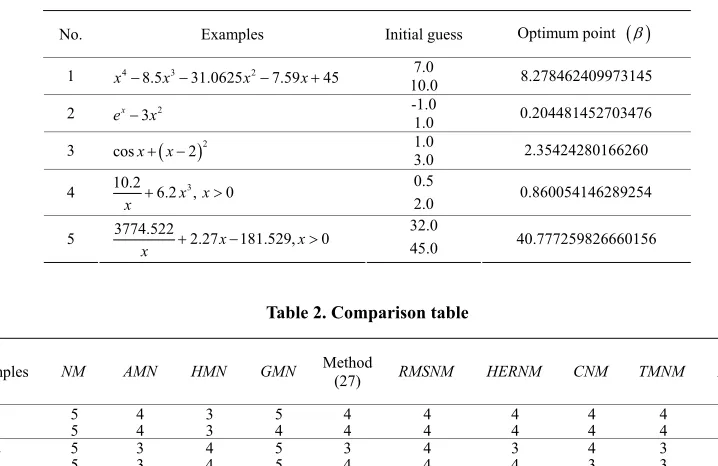
7. Numerical Results
Table 1. Test problems
No. Examples Initial guess Optimum point
7.0 1 x48.5x331.0625x27.59x45
10.0 8.278462409973145
-1.0 2 ex3x2
1.0 0.204481452703476
1.0
3 cosxx22 3.0 2.35424280166260
0.5
4 10.2 6.2 ,x x3 0
x 2.0 0.860054146289254
32.0
5 3774.522 2.27x 181.529,x 0
x 45.0 40.777259826660156
Table 2. Comparison table
Examples NM AMN HMN GMN Method(27) RMSNM HERNM CNM TMNM LMNM
1 5 4 3 5 4 4 4 4 4 3
5 4 3 4 4 4 4 4 4 3
2 5 3 4 5 3 4 3 4 3 3
5 3 4 5 4 4 4 3 3 2
3 5 4 4 5 4 4 4 4 4 2
4 3 3 4 3 3 3 3 3 2
4 6 4 4 6 4 4 4 5 4 3
5 4 4 5 4 4 4 4 4 3
5 5 4 4 5 4 4 4 4 4 3
5 4 3 5 4 4 4 4 4 3
obtained by employing the iterative methods namely Newton’s method ( ), arithmetic mean Newton’s method (
NM
AMN ), harmonic mean Newton’s method (HMN
RMSNM
), geometric mean Newton’s method ( ), method (27), root mean square Newton’s method ( ), heronian mean Newton’s method (
GMN
HENM N
C
), contra-harmonic mean Newton’s method ( ), cen-troidal mean Newton’s method ( ), logarithmic mean Newton’s method (LMNM) respectively to com-pute the extrememum of the function given in Table 1. We use the same functions as Kahya [6, 7]. The results are summarized in Table 2. We use as toler-ance. Computations have been performed using
CM
15
10 TMN
in
double precision arithmetic. The following stopping cri-teria are used for computer programs:
1) xn1xn , 2) f x
n1
.8. Conclusions
It is well-known that the quadrature formulas play an important and significant role in the evaluations of defi-nite integrals. We have shown that these quadrature for-mulas can also be used to develop some iterative meth-ods for solving unconstrained optimization problems. Further, this work proposes a family of Newton-type
methods based on nonlinear means and can be used to solve efficiently the unconstrained optimization prob-lems. Proposed family (23) unifies some of the most known third-order methods for unconstrained optimiza-tion problems. It also provides many more unknown processes. All of the proposed third-order methods re-quire three function evaluations per iterations so that their efficiency index is , which is better than the one of Newton’s method 1.41. Finally experimental results showed that the harmonic mean and logarithmic mean Newton’s method are the best among the proposed iteration methods.
1.44
9. Acknowledgement
We would like to thank the anonymous referee for his or her valuable comments on improving the original manu-script. We are also thankful to Professor S.K. Tomar, Department of Mathematics, Panjab University, Chandi-garh for several useful suggestions. Ramandeep Behl further acknowledges the financial support of CSIR, New Delhi.
10. References
optimiza-tion,” European Journal of Operation Research, Vol. 181, pp. 1086–1096, 2007.
[2] Y. P. Laptin, “An approach to the solution of nonlinear unconstrained optimization problems (brief communica-tions),” Cybernetics and System Analysis, Vol. 45, No. 3, pp. 497–502, 2009.
[3] G. Gundersen & T. Steihaug, “On large-scale uncon-strained optimization problems and higher order meth-ods,” Optimization methods & Software, DOI: 10.1080/ 10556780903239071, No. 1–22, 2009.
[4] H. B. Zhang, “On the Halley class of methods for uncon-strained optimization problems,” Optimization Methods & Software, DOI: 10.1080/10556780902951643, No. 1–10, 2009.
[5] E. Kahya, “Modified secant-type methods for uncon-strained optimization,” Applied Mathematics and Com-putation, Vol. 181, No. 2, pp. 1349–1356, 2007.
[6] E. Kahya & J. Chen, “A modified Secant method for unconstrained optimization,” Applied Mathematics and Computation, Vol. 186, No. 2, pp. 1000–1004, 2007. [7] E. Kahya, “A class of exponential quadratically
conver-gent iterative formulae for unconstrained optimization,” Applied Mathematics and Computation, Vol. 186, pp. 1010–1017, 2007.
[8] C. L. Tseng, “A newton-type univariate optimization algorithm for locating nearest extremum,” European Jour-nal of Operation Research, Vol. 105, pp. 236–246, 1998. [9] E. Kahya, “A new unidimensional search method for
optimization: Linear interpolation method,” Applied Mathematics and Computation, Vol. 171, No. 2, pp. 912–
926, 2005.
[10] M. V. C. Rao & N. D. Bhat, “A new unidimensional search scheme for optimization,” Computer & Chemical Engineering, Vol. 15, No. 9, pp. 671–674, 1991.
[11] P. S. Bulle, “The power means, hand book of means and their inequalities,” Kluwer Dordrecht, Netherlands. 2003. [12] J. E. Dennis & R. B. Schnable, “Numerical methods for
unconstrained optimization and nonlinear equations,” Prentice-Hall, New York, 1983.
[13] S. Weerakoon & T. G. I. Fernando, “A variant of New-ton’s method with accelerated third-order convergence,” Applied Mathematics Letter, Vol. 13, pp. 87–93, 2000. [14] M. Frontini & E. Sormani,” Some variants of Newton’s
method with third-order convergence,” Applied Mathe-matics and Computation, Vol. 140, pp. 419–426, 2003. [15] W. Gautschi, “Numerical analysis: an introduction,”
Birk-häuser, Boston, Inc., Boston, 1997.
[16] Mamta, V. Kanwar, V. K. Kukreja & S. Singh, “On a class of quadratically convergent iteration formulae,” Ap-plied Mathematics Computation, Vol. 166, pp. 633–637, 2005.
[17] B. I. Adi, “Newton’s method with modified functions,” Contemporary Mathematics, Vol. 204, pp. 39–50, 1997. [18] V. Kanwar & S. K. Tomar, “Exponentially fitted variants