P E R S P E C T I V E A R T I C L E
Why do adaptive immune responses cross-react?
Karen J. Fairlie-Clarke, David M. Shuker and Andrea L. GrahamInstitutes of Evolution, Immunology & Infection Research, School of Biological Sciences, University of Edinburgh, Ashworth Laboratories, King’s Buildings, Edinburgh, UK
Introduction
One of the most startling and impressive features of the vertebrate adaptive immune system is its ability to recog-nize and bind diverse parasite antigens. As part of this process, the immune system is able to generate extraordi-nary specificity of antibodies to particular antigens. This specificity is an axiomatic feature of the adaptive immune system, but it is also an incomplete picture. Cross-reactiv-ity of lymphocyte receptors and antibodies to parasite antigens is common, with important consequences for both host and parasite, in terms of host health (e.g., Fesel et al. 2005; Urbani et al. 2005), antigenic variation (Lips-itch and O’Hagan 2007), parasite strain structure (e.g., Recker and Gupta 2005; Koelle et al. 2006a), and epide-miological dynamics (e.g., Adams et al. 2006; Koelle et al. 2006b; Wearing and Rohani 2006). However, the extent to which we shouldexpectto see cross-reactivity of adap-tive immune responses has not been fully explored, espe-cially for antibodies.
In this perspective, we consider whether cross-reactivity is an evolved trait of the immune system, driven by
conflicting costs and benefits of antigen specificity, or whether it is an inescapable side-effect of the problem of recognizing and binding to an enormous range of puta-tive antigens. Throughout, we will use ‘parasite’ in a gen-eral sense, to include all infectious disease agents, and we define ‘specificity’ as the ability of the immune system to discriminate among antigens and ‘cross-reactivity’ as the absence of discrimination, in accordance with general (Janeway et al. 2001) as well as evolutionary (Frank 2002) immunological usage. Cross-reactivity is also known as ‘heterologous immunity’ (Page et al. 2006) or, in some contexts, by the more colorful term ‘original antigenic sin’ (e.g., Liu et al. 2006). Here we use ‘cross-reactivity’ to cover all cases. We would also stress that specificity and cross-reactivity should be considered endpoints of a spectrum rather than strict alternatives, and we would hope that our approach encourages thinking about quan-titative predictions for the level of cross-reactivity we might expect lymphocytes or antibodies to exhibit.
To address whether cross-reactivity of adaptive immune responses is an evolved trait or a side-effect of biological or chemical constraints, we explore the
Keywords
heterologous immunity, information processing, optimal discrimination, optimal immunology.
Correspondence
Andrea L. Graham, Institutes of Evolution, Immunology & Infection Research, School of Biological Sciences, University of Edinburgh, King’s Buildings, Ashworth Laboratories, Edinburgh EH9 3JT, UK.
Tel.: +44 (0) 131 650 8655; fax: +44 (0) 131 650 6564; e-mail: [email protected] Received: 3 October 2008 Accepted: 6 November 2008
First published online: 8 December 2008 doi:10.1111/j.1752-4571.2008.00052.x
Abstract
problem facing the immune system in terms of the infor-mation it needs in order to function correctly. First, the immune system must obtain information about the para-sites attacking it as efficiently as possible, in order to rap-idly combat infection. Thus we expect T- and B-cell repertoires, in terms of their overall size and the binding specificities of component cell lineages, to have been influenced by natural selection in their ability to search ‘antigenic space’ with a certain degree of cross-reactivity. However, the immune system then faces a second prob-lem: how specific should antibodies be, to achieve a major ultimate aim of the immune system, the destruc-tion of parasites? For both of these problems, we consider the theoretical work to date on cross-reactivity, and we then review empirical data on the costs and benefits of specific versus cross-reactive antibodies. We start by introducing parasite detection as an information problem.
The immune system as an information gatherer and processor
Precise phenotypic adaptation to environmental condi-tions requires that organisms process information about their surroundings in order to make appropriate context-dependent decisions (Dall et al. 2005). Optimal foraging decisions, for example, depend upon the ability of a for-ager correctly to perceive the relative resource value of different patches of food, in light of associated costs of foraging such as threats of predation (Stephens et al. 2007). Optimal offspring sex ratios for a given intensity of local mate competition require that female parasitoid wasps accurately perceive the number of other females laying eggs on a patch (Shuker and West 2004; Burton-Chellew et al. 2008). The mammalian immune system must similarly tailor action to context by processing information about the world of antigens: in the face of unpredictable exposure to diverse parasites, a host must perceive infections, identify parasites, and then mobilize the appropriate mechanisms to kill those parasites. In each of these examples of phenotypic adaptation, understanding the mechanisms by which information is gathered and translated to action – i.e., information pro-cessing – can help to explain why organisms may fail to be perfectly adapted to their environments (West and Sheldon 2002; Shuker and West 2004; Dall et al. 2005). For the immune system, is the apparent imperfection in discrimination of parasite antigens (manifested as cross-reactivity) a deliberate strategy to fight parasites across antigenic space with cross-reactive antibodies, or merely an information constraint imposed by the task faced by the immune system?
The antigen recognition task of the adaptive immune system is not easy: it must distinguish self from nonself,
and one parasite from the next, in a sea of molecules. The innate immune system drives the process of sifting through this antigenic information (Janeway and Medzhi-tov 2002), but it is the adaptive immune system, via T and B cells, that possesses the remarkable machinery nec-essary for posing ‘search terms’ over antigenic space, and for recognizing matches to those terms (Fig. 1). We thus consider that the immune system gathers information by binding to parasite antigens, with a failure to obtain that information (a failure to recognize and bind to a parasite antigen) posing a serious risk to the organism’s health (and we also note that avoiding being observed by immune systems is a legitimate and not uncommon strat-egy of parasites (Maizels et al. 2004; Tortorella et al. 2000)). The capacity of lymphocyte receptors to recognize antigen is in theory infinite (Pancer and Cooper 2006). However, this initial searching of antigenic space is only the first step taken by the immune system (Fig. 1). Via somatic hypermutation, B cells generate more specific receptors for a given antigen, which can be construed as a form of ‘local searching’ of antigenic space, or gaining very specific information about the antigen to inform fur-ther action, which in this case is the generation of anti-bodies by plasma cells (Fig. 1). B cells may provide a more focused information-gathering capacity, as they pro-vide very fine-grained information about a certain part of antigenic space.
Despite this sophistication, antibodies often do cross-react with, and take action against, antigens displayed by parasite strains or species other than the one that induced the initial response. Is this cross-reactivity a deliberate feature of the overall strategy of the immune system, or an unselected constraint posed by the realities of antigenic variation? To address this, we first turn our attention to the initial searching problem faced by T and B cells.
How should the immune system search antigenic space?
Given the huge range of possible antigens that an immune system might have to recognize, how best should the immune system cover, or search, antigenic space? In particular, in terms of the adaptive immune system, how specific should the T and B cell repertoire be?
protein antigens on its surface (Sun et al. 2005), and par-asites of mammals span a huge range of biological (and probably antigenic) diversity – from archaea (Lepp et al. 2004) to metazoa (Maizels et al. 2004). Given these con-straints, attempts have been made to predict the informa-tion-gathering potential of lymphocytes. Empirically grounded theoretical work suggests that, prior to expo-sure to antigen, a certain degree of cross-reactivity in the lymphocyte search algorithm is essential (Langman and Cohn 1999). Indeed, hosts may ensure recognition of a large parasite set, or a rapidly evolving parasite set of any size, by coarse-graining antigen recognition (Oprea and Forrest 1998), enabling production of antibody libraries that are strategically placed to generalize over antigenic
space (Oprea and Forrest 1999). Moreover, the optimal level of cross-reactivity increases with decreases in reper-toire size – i.e., fewer lymphocyte receptors must cross-react more, to cover antigenic space – but that strategy risks autoimmunity (Borghans et al. 1999). To balance these factors for the size range of the human repertoire, a low degree of cross-reactivity is optimal for both T (van den Berg et al. 2001; Borghans and De Boer 2002) and B cells (Louzoun et al. 2003).
Theory further suggests that a receptor’s cross-reactivity should be adapted to the portion of antigenic space in which it binds (Fig. 2). By this logic, receptors very unlikely to bind self antigens should have wide circles of reactivity. In studies comparing fixed low cross-reactivity
T
B
PlasmaAntigen independent generation of “search terms”
(i.e., T and B cell receptors) via gene segment swapping
Matching of search terms by antigen triggers cell division.
The better the match, and the stronger the accompanying signals of non-self or danger, the faster the cells divide. Thymus and
bone marrow check basic
soundness of search
terms, eliminating T cells that
cannot interact with
MHC as well as T or B cells that bind too avidly to self
peptides
Only in B cells: antigen dependent gene segment swapping followed by somatic hypermutation by B cells.
The result is a receptor that binds more avidly to the antigen.
B
B
T
Plasma cells produce antibodies of the same specificity as the B cell receptor
A B C
No enhancement of specificity
[image:3.595.150.457.67.405.2](3-5 days) (days to weeks)
with plastic cross-reactivity set by proximity to self antigens, both strategies eliminated self-reactivity but the latter achieved greater coverage of antigenic space, includ-ing the space near self peptides (van den Berg and Rand 2004; Scherer et al. 2004). If cross-reactivity is good for the information gathering phase of an immune response, what about the next phase?
Fine-grained information: the problem of discrimination
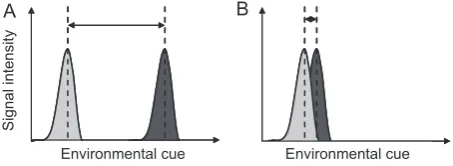
If lymphocytes search antigenic space efficiently by being initially cross-reactive, then discriminating between closely related antigens is not a problem for them. However, the task assigned to antibodies in the immune response is one that may require discrimination, if antigen-specificity is advantageous. Discrimination is a key component of information processing theory (reviewed by Stephens 2007); also see Fig. 3). From this theory, we should expect the binding specificity of a given antibody to be a function of the difference between two antigens (i.e., the target and any nontarget antigens) and the relative costs and benefits of specificity versus cross-reactivity. First we will consider how easy or difficult it might be to discrimi-nate between antigens using the concept of antigenic distance.
If we are going to predict when cross-reactivity will occur, when it will help or hinder the host, or to identify the optimal degree of cross-reactivity for a given context, we need to understand the antigenic distance between parasites: how different do different parasites appear from
the perspective of the immune system? The analogy from behavioral ecology is working out what an animal can perceive, in order to make sense of behavioral responses to environmental change (Boomsma et al. 2003; Shuker and West 2004). The problem of antigenic distance is a difficult one, and not just for the immune system. In this era of whole-genome sequencing of parasites, it has become clear that antigenic distance can bear a decidedly nonlinear relationship to phylogenetic distance (Gog and Grenfell 2002), partly because the recognition of antigen can be as much about physical conformation as about amino acid sequence (e.g., Donermeyer et al. 2006), and partly because antigens can be conserved across taxa. For example, cross-reactivity can occur between antibodies induced by parasites with rather distant phylogenetic B
[image:4.595.138.444.73.222.2]A
Figure 2Contrasting degrees of cross-reactivity over two-dimensional antigenic space. Seven parasite antigens (P1–7) and five self antigens (S)
are represented on a grid. The size of the filled circle represents the range of cross-reactivity of a given lymphocyte receptor or antibody. The host in (A) plays a more cross-reactive strategy than the host in (B). Both avoid self-reactivity and respond to all parasite antigens, but (A) covers more antigenic space with fewer lymphocyte lineages. Is that a good thing? The answer probably depends upon context. For example, imagine both hosts are sequentially exposed first to P3and then P4. If P3and P4were different strains or species of malaria, the host using strategy (A) would
likely benefit from cross-protection (e.g., Mota et al. 2001). If P3and P4were different serotypes of dengue virus, however, the strategy depicted
in (A) could be lethal (e.g., Goncalvez et al. 2007). Figures are modified from Scherer et al. (2004), based on shape-space tools for immunological reactivity developed by Perelson and colleagues (e.g., Smith et al. 1997).
[image:4.595.299.526.334.417.2]relationships, such as helminths and malaria (Mwatha et al. 2003; Naus et al. 2003). Within parasite species, phylogenies may largely parallel antigenic distances over long genetic distances (Frank 2002), but a stepwise and nonlinear relationship between genetic and antigenic change may become evident when examined at higher resolution. In influenza, for example, silent mutations may move a parasite to new regions of antigenic space that are realized with the occurrence of one last mutation; such a mechanism can account for the way in which a single amino acid change can release a strain from immune pressure while the preceding 19 changes led to little antigenic change (Koelle et al. 2006a). The func-tional form of the relationship between genetic and anti-genic change is likely to shape parasite strain structure (Adams and Sasaki 2007) and epidemiology (Gog and Grenfell 2002; Adams et al. 2006; Koelle et al. 2006b) as well as the efficacy of vaccines (Gupta et al. 2006) and memory responses (Deem and Lee 2003).
Various methods can be used to quantify antigenic dis-tance. Much of the work in this area has been on influ-enza, because annual attempts are made to match vaccine antigens with antigens of the strain that caused the pre-ceding year’s outbreak. Hemagglutination inhibition assays, for example, measure the ability of ferret antibod-ies induced by one strain of influenza A to block aggluti-nation of red blood cells by another strain; if strong cross-reactivity is evident, a small antigenic distance is inferred (Smith et al. 2004; Koelle et al. 2006a). Such measurements sometimes successfully predict the efficacy of vaccines, but predictions can be improved by knowl-edge of the antigenic distance between the dominant anti-body binding sites rather than whole viruses (Gupta et al. 2006). Another way of assessing antigenic distance is to measure the dilution of serum at which cross-reactivity disappears (K. J. Fairlie-Clarke, T. J. Lamb, J. Langhorne, A. L. Graham, and J. E. Allen, unpublished data). If cross-reactivity persists at million-fold dilutions (and it can), then the antigenic distance is small.
Such methods can be used to compare antigens from different parasite lineages, as well as antigen samples from a single lineage over time, and are necessary if we are to understand whether cross-reactivity is something that cannot be escaped by antibodies – two antigens are just too alike to be separated, even if they are from very dif-ferent strains (or kingdoms) of parasites – or whether cross-reactivity is a deliberate, selectively advantageous strategy. If antigenic distances were measured among a wide array of parasite taxa, the data would enable assess-ment of how fully or evenly occupied parasite antigenic space may be. The data might also clarify how many cases of apparent cross-reactivity are due to specific molecular recognition of antigens that are conserved across parasite
taxa. Mapping antigenic space (sensu Smith et al. (2004), but applied across a much wider set of parasites) would therefore be extremely useful for understanding the causes of antibody cross-reactivity and host–parasite interactions more generally.
Differences among antigens might not be the only con-straint on antibodies, however, because the mechanics of the immune system may also be important. For example, the persistence of cross-reactivity once antigenic informa-tion is available (i.e., after filter A of Fig. 1) may be explained by lymphocyte limitation in some contexts. The clonal lymphocyte lineage whose receptor best binds a given antigen replicates more rapidly than other clones (Janeway et al. 2001), such that the best-matched lym-phocyte lineage wins by competitive exclusion (Scherer et al. 2006). This process tends to favor specificity, but when lymphocytes are limiting, cross-reactivity may result. For example, if B cells undergo fewer rounds of cell division and somatic hypermutation when a host is resource-limited, the antibodies produced may fall short of the maximal possible specificity. Furthermore, lympho-cyte dynamics during memory responses may constrain the development of specific responses to new antigens. For example, cross-reactive antibodies are produced in preference to specific antibodies during secondary expo-sure to dengue because memory B cells are so rapidly activated and thus outcompete cells that are more specific to the new virus (Rothman 2004), a phenomenon observed in memory responses to various other viruses (e.g., Brehm et al. 2002; Liu et al. 2006). The mechanisms whereby the immune system permits recognition of all possible antigens with limited lymphocyte numbers may therefore constrain its ability to match antibody perfectly to antigen. Given these possible constraints, what are the possible costs and benefits of cross-reactive antibodies?
Is cross-reactivity of antibodies a deliberate strategy?
chorio-meningitis virus (Recher et al. 2004). Furthermore, specific antibodies are produced more rapidly when memory B cells encounter the exact same antigen in a subsequent infection – a major benefit of immunological memory (Ahmed and Gray 1996), provided the parasites are identical to those previously encountered.
When subsequently infected with antigenically different parasites, however, those same antibodies can actually pro-mote parasite replication. These apparent failures of speci-ficity can have health consequences. A classic case is the enhancement of dengue virus replication by cross-reactive antibodies, alluded to above. Antigen-specific antibodies provide long-lasting protection against reinfection with the same serotype (Sabin 1952, cited by Goncalvez et al. 2007), but cross-reactive antibodies are associated with dengue hemorrhagic fever during subsequent infection with a different serotype, and the severity of disease varies with the combination and order of appearance of sero-types (Endy et al. 2004; Rothman 2004). Unable to neu-tralize the virus, the cross-reactive antibodies instead facilitate viral uptake to cells (Goncalvez et al. 2007). The antibodies are specific enough to bind but not to kill para-sites. Costs of cross-reactive responses are also observed across parasite species. For instance, cross-reactive responses induced by influenza A exacerbate liver disease due to hepatitis C virus (Urbani et al. 2005).
Balanced against these benefits of specificity and costs of cross-reactivity, it is apparent that cross-reactive immune responses can, in some contexts, simultaneously protect hosts against a wide array of parasites, a possibil-ity that has not been lost on vaccinologists (Nagy et al. 2008). Indeed, cross-reactive antibodies induced by infec-tion or immunizainfec-tion can protect hosts against other infections. For example, mice experimentally infected with a single malaria clone make cross-reactive antibodies that can bind to antigens of other parasite clones (displayed on the surface of infected red blood cells) and lead to their phagocytosis by macrophages in vitro (Mota et al. 2001). Similarly, cross-reactive antibodies from a person infected withPlasmodium vivax can inhibit the growth of
Plasmodium falciparum in vitro(Nagao et al. 2008). More importantly, cross-reactive antibodies benefit human hosts living in areas of multi-strain or multi-species malaria transmission in nature (Fesel et al. 2005; Haghdoost and Alexander 2007). Benefits of cross-reactive antibodies are also observed amongst flaviviruses: St. Louis encephalitis virus and Japanese encephalitis (JE) vaccine both induce cross-reactive antibodies to West Nile virus that ameliorate the disease in hamsters (Tesh et al. 2002). The induction of cross-reactive antibodies to West Nile by JE vaccine was corroborated in humans (Yamsh-chikov et al. 2005), though whether the antibodies are protective remains to be seen. In the case of influenza,
cross-reactive responses induced by immunization with one virus can protect hosts against other viral genotypes (Sandbulte et al. 2007; Levie et al. 2008; Quan et al. 2008). Cross-reactive antibodies have also been implicated in protection against fungal infection (Casadevall and Pirofski 2007).
Imprecision of antibody responses can therefore benefit the host in some contexts. Ideally, the degree of cross-reactivity would match the infections at hand (see Fig. 2; Scherer et al. 2004; van den Berg and Rand 2007). Varia-tion in the activaVaria-tion thresholds of individual cells (van den Berg and Rand 2007) or tuning mechanisms such as the immunomodulatory molecules employed by regula-tory T cells (Carneiro et al. 2005) should allow precise targeting when needed and cross-reactivity when needed. Recognizing need, however, would require lymphocytes to gather information on the relatedness of parasite antigens – e.g., during co-infections, or comparing remembered to current antigens – to generate the optimal imprecision for a given context. The likelihood of such additional information processing ability is unclear, but even if the immune system could not manage by itself, biomedicine could potentially promote cross-reactive responses (i.e., help the immune system to see two parasites as related), if the context were right. Predicting when imprecisely tar-geted immune responses will occur, and when they will be to the detriment or benefit of hosts, is therefore of clear biomedical relevance, for vaccination programs and other medical interventions.
Outlook
evolutionary change is present in the immune system (Frank 2002). For example, thresholds for B-cell activation or the number of rounds of somatic hypermutation, and thus the timing of plasma cell differentiation, may be polymorphic (Fig. 1). Hosts are known to be hetero-geneous in the specificity of the antibodies that they make to a given antigen (e.g., Lyashchenko et al. 1998; Sato et al. 2004). What remains to be done is to measure the selective consequences of variation in cross-reactivity in the different components of the immune system.
One intriguing possibility, given the antigenic diversity of parasites as well as the uncertainty of exposure to those parasites, is that imprecision in antigen recognition might ultimately be to the benefit of hosts. Might cross-reactive antibodies represent an adaptation to an unpredictable wide world of antigenic exposures? It has been suggested that imprecision in the waggle dance of honeybees is an adaptation that spreads foragers over an optimal patch size: natural selection is proposed to have tuned the amount of error in the waggle dance, to balance the bene-fits of known nectar sources against benebene-fits of wider searching (Weidenmuller and Seeley 1999; Gardner et al. 2007); but see Tanner and Visscher (2006). An alternative analogy from evolutionary ecology is that of ‘bet-hedging,’ whereby life history decisions (such as how much energy to invest in offspring, or where to lay eggs) are deliberately variable, to try to cater for uncertainty in the future environment (Seger and Brockman 1987). Bet-hedging has had its conceptual problems over the years (e.g., Grafen 1999, 2006), but it can be favored under a range of circumstances (e.g., King and Masel 2007), and it would be interesting to explore further the evolution of imprecise antibodies in this context.
We envision several further potential contributions that evolutionary ecologists could make towards understand-ing and controllunderstand-ing the antigen-specificity of immune responses. For example, evolutionary ecological analyses could aid identification of contexts in which hosts would do well to hedge their bets and make cross-reactive anti-bodies, or clinics would do well to administer gamma globulin shots. As epidemiologists are often able to char-acterize exposure risks on local geographical scales, we could combine such information with data on antigenic distances and the relative efficacy of antigen-specific responses to allow evolutionary optimization models to advise which specificity strategy best suits a given setting. Thus quantitative evolutionary ecology could enhance the potential for biomedicine to tailor treatments to epidemi-ological settings.
Another important issue for the attention of evolution-ary ecologists is that biomedical success in generating cross-reactive immune responses with vaccines (Nagy et al. 2008) is likely to feed back on the structure of
parasite populations (Restif and Grenfell 2007). Calcula-tion of the co-evoluCalcula-tionary risks of altered antigen-speci-ficity of immune responses is therefore essential; might cross-reactive vaccines impose strong selection for escape mutants to make larger antigenic, and perhaps more viru-lent, leaps than they do naturally? It will also be critical to identify the role of parasite strategies in promoting cross-reactivity of immune responses. The theory reviewed here (e.g., van den Berg and Rand 2004; Scherer et al. 2004) suggests that the closer the antigenic distance between self and parasite antigens, the less likely that infection will promote cross-reactive antibodies. Do para-sites that mimic host molecules select for antigen-specific immunity? These questions are amenable to both theoret-ical and, more importantly, experimental study.
Finally, we suggest that evolutionary ecology might also gain tremendous insights from the immunological data itself. In particular, interactions between the mammalian immune system and parasites present a rare and useful combination of traits for studies of information process-ing and adaptation. For a start, the molecular details of the antigens and antibodies or receptors are either known or knowable (Boudinot et al. 2008). Thus the informa-tion-gathering system is likely to be better characterized than is usually possible in behavioral ecology systems. Such data might be powerfully combined with quantita-tive tools such as statistical decision theory, an increas-ingly important component of studies of information processing (Dall et al. 2005). Statistical decision theory is based on Bayesian approaches, and the parallels between an organism making decisions based on updated knowl-edge of the environment (formalized as ‘prior’ and ‘pos-terior’ distributions, before and after information acquisition) and the workings of the adaptive immune system, with its updatable immunological memory, are striking. Further, the functional consequences of changes in specificity of immunological recognition can often be measured in exquisite detail. Thus in the immune system, as perhaps in few others, one might be able to discover whether there are limits to the benefits of perfect knowl-edge of the environment.
Acknowledgements
Literature cited
Adams, B., and A. Sasaki. 2007. Cross-immunity, invasion and coexistence of pathogen strains in epidemiological models with one-dimensional antigenic space. Mathematical Biosciences210:680–699.
Adams, B., E. C. Holmes, C. Zhang, M. P. Mammen Jr, S. Nimmannitya, S. Kalayanarooj, and M. Boots. 2006. Cross-protective immunity can account for the alternating epi-demic pattern of dengue virus serotypes circulating in Bang-kok. Proceedings of the National Academy of Sciences of the United States of America103:14234–14239.
Ahmed, R., and D. Gray. 1996. Immunological memory and protective immunity: Understanding their relation. Science
272:54–60.
van den Berg, H. A., and D. A. Rand. 2004. Dynamics of T cell activation threshold tuning. Journal of Theoretical Biology
228:397–416.
van den Berg, H. A., and D. A. Rand. 2007. Quantitative theo-ries of T-cell responsiveness. Immunology Reviews216:81– 92.
van den Berg, H. A., D. A. Rand, and N. J. Burroughs. 2001. A reliable and safe T cell repertoire based on low-affinity T cell receptors. Journal of Theoretical Biology209:465– 486.
Boomsma, J. J., J. Nielsen, L. Sundstrom, N. J. Oldham, J. Tentschert, H. C. Petersen, and E. D. Morgan. 2003. Infor-mational constraints on optimal sex allocation in ants. Proceedings of the National Academy of Sciences of the United States of America100:8799–8804.
Borghans, J. A. M., and R. J. De Boer. 2002. Memorizing innate instructions requires a sufficiently specific adaptive immune system. International Immunology14:525–532. Borghans, J. A. M., A. J. Noest, and R. J. De Boer. 1999. How
specific should immunological memory be? The Journal of Immunology163:569–575.
Boudinot, P., M. E. Marriotti-Ferrandiz, L. D. Pasquier, A. Benmansour, P. A. Cazenave, and A. Six. 2008. New per-spectives for large-scale repertoire analysis of immune receptors. Molecular Immunology45:2437–2445.
Brehm, M. A., A. K. Pinto, K. A. Daniels, J. P. Schneck, R. M. Welsh, and L. K. Selin. 2002. T cell immunodominance and maintenance of memory regulated by unexpectedly cross-reactive pathogens. Nature Immunology3:627–634.
Burton-Chellew, M. N., T. Koevoets, B. K. Grillenberger, E. M. Sykes, S. L. Underwood, K. Bijlsma, J. Gadauet al.2008. Facultative sex ratio adjustment in natural populations of wasps: cues of local mate competition and the precision of adaptation. The American Naturalist172:393–404. Carneiro, J., T. Paixao, D. Milutinovic, J. Sousa, K. Leon, R.
Gardner, and J. Faro. 2005. Immunological self-tolerance: lessons from mathematical modeling. Journal of Computa-tional and Applied Mathematics184:77–100.
Casadevall, A., and L. A. Pirofski. 2007. Antibody-mediated protection through cross-reactivity introduces a fungal
her-esy into immunological dogma. Infection and Immunity
75:5074–5078.
Dall, S. R., L. A. Giraldeau, O. Olsson, J. M. McNamara, and D. W. Stephens. 2005. Information and its use by animals in evolutionary ecology. Trends in Ecology and Evolution
20:187–193.
Deem, M. W., and H. Y. Lee. 2003. Sequence space localiza-tion in the immune system response to vaccinalocaliza-tion and disease. Physical Review Letters91:068101.
Donermeyer, D. L., K. S. Weber, D. M. Kranz, and P. M. Allen. 2006. The study of high-affinity TCRs reveals duality in T cell recognition of antigen: specificity and degeneracy. The Journal of Immunology177:6911–6919.
Endy, T. P., A. Nisalak, S. Chunsuttitwat, D. W. Vaughn, S. Green, F. A. Ennis, A. L. Rothmanet al.2004. Relationship of preexisting dengue virus (DV) neutralizing antibody levels to viremia and severity of disease in a prospective cohort study of DV infection in Thailand. The Journal of Infectious Diseases189:990–1000.
Fesel, C., L. F. Goulart, A. Silva Neto, A. Coelho, C. J. Fontes, E. M. Braga, and N. M. Vaz. 2005. Increased polyclonal immunoglobulin reactivity toward human and bacterial proteins is associated with clinical protection in human Plasmodiuminfection. Malaria Journal4:5.
Frank, S. A. 2002. Immunology and Evolution of Infectious Disease. Princeton, NJ, Princeton University Press. Gardner, K. E., T. D. Seeley, and N. W. Calderone. 2007.
Hypotheses on the adaptiveness or non-adaptiveness of the directional imprecision in the honey bee’s waggle dance (Hymenoptera : Apidae : Apis mellifera). Entomologia Generalis29:285–298.
Gog, J. R., and B. T. Grenfell. 2002. Dynamics and selection of many-strain pathogens. Proceedings of the National Acad-emy of Sciences of the United States of America99:17209– 17214.
Goncalvez, A. P., R. E. Engle, M. St Claire, R. H. Purcell, and C. J. Lai. 2007. Monoclonal antibody-mediated enhancement of dengue virus infection in vitro and in vivo and strategies for prevention. Proceedings of the National Academy of Sciences of the United States of America104:9422–9427. Grafen, A. 1999. Formal Darwinism, the
individual-as-maxi-mizing-agent analogy and bet-hedging. Proceedings of the Royal Society of London Series B-Biological Sciences
266:799–803.
Grafen, A. 2006. Optimization of inclusive fitness. Journal of Theoretical Biology238:541–563.
Gupta, V., D. J. Earl, and M. W. Deem. 2006. Quantifying influenza vaccine efficacy and antigenic distance. Vaccine
24:3881–3888.
Haghdoost, A. A., and N. Alexander. 2007. Systematic review and meta-analysis of the interaction betweenPlasmodium falciparumandPlasmodium vivaxin humans. The Journal of Vector Borne Diseases44:33–43.
Janeway, C. A., P. Travers, M. Walport, and M. J. Shlomchik. 2001. Immunobiology: The Immune System in Health and Disease. Garland Publishing, New York.
King, O. D., and J. Masel. 2007. The evolution of bet-hedging adaptations to rare scenarios. Theoretical Population Biology
72:560–575.
Koelle, K., S. Cobey, B. Grenfell, and M. Pascual. 2006a. Epochal evolution shapes the phylodynamics of inter-pandemic influenza A (H3N2) in humans. Science
314:1898–1903.
Koelle, K., M. Pascual, and M. Yunus. 2006b. Serotype cycles in cholera dynamics. Proceedings of the Royal Society Series B273:2879–2886.
Langman, R. E., and M. Cohn. 1999. Away with words: com-mentary on the Atlan-Cohen essay ‘Immune information, self-organization and meaning’. International Immunology
11:865–870.
Lepp, P. W., M. M. Brinig, C. C. Ouverney, K. Palm, G. C. Armitage, and D. A. Relman. 2004. Methanogenic Archaea and human periodontal disease. Proceedings of the National Academy of Sciences of the United States of America
101:6176–6181.
Levie, K., I. Leroux-Roels, K. Hoppenbrouwers, A. D. Kervyn, C. Vandermeulen, S. Forgus, G. Leroux-Roelset al.2008. An adjuvanted, low-dose, pandemic influenza A (H5N1) vaccine candidate is safe, immunogenic, and induces cross-reactive immune responses in healthy adults. The Journal of Infec-tious Diseases198:642–649.
Lipsitch, M., and J. J. O’Hagan. 2007. Patterns of antigenic diversity and the mechanisms that maintain them. Journal of the Royal Society Interface4:787–802.
Liu, X. S., J. Dyer, G. R. Leggatt, G. J. Fernando, J. Zhong, R. Thomas, and I. H. Frazer. 2006. Overcoming original antigenic sin to generate new CD8 T cell IFN-gamma responses in an antigen-experienced host. The Journal of Immunology177:2873–2879.
Louzoun, Y., M. Weigert, and G. Bhanot. 2003. Dynamical analysis of a degenerate primary and secondary humoral immune response. Bulletin of Mathematical Biology
65:535–545.
Lyashchenko, K., R. Colangeli, M. Houde, H. Al Jahdali, D. Menzies, and M. L. Gennaro. 1998. Heterogeneous antibody responses in tuberculosis. Infection and Immunity66:3936– 3940.
Maizels, R. M., A. Balic, N. Gomez-Escobar, M. Nair, M. D. Taylor, and J. E. Allen. 2004. Helminth parasites – masters of regulation. Immunological Reviews201:89–116. Martin, L. B., Z. M. Weil, and R. J. Nelson. 2007. Immune
defense and reproductive pace of life inPeromyscusmice. Ecology88:2516–2528.
Mota, M. M., K. N. Brown, V. E. Do Rosario, A. A. Holder, and W. Jarra. 2001. Antibody recognition of rodent malaria parasite antigens exposed at the infected erythrocyte surface: specificity of immunity generated in hyperimmune mice. Infection and Immunity69:2535–2541.
Mwatha, J. K., F. M. Jones, G. Mohamed, C. W. A. Naus, E. Riley, A. E. Butterworth, G. Kimaniet al.2003. Associations between anti-Schistosoma mansoniand anti-Plasmodium falciparumantibody responses and hepatosplenomegaly, in Kenyan schoolchildren. The Journal of Infectious Diseases
187:1337–1341.
Nagao, Y., M. Kimura-Sato, P. Chavalitshewinkoon-Petmitr, S. Thongrungkiat, P. Wilairatana, T. Ishida, P. Tan-Ariya et al.2008. Suppression ofPlasmodium falciparumby serum collected from a case ofPlasmodium vivaxinfection. Malaria Journal7:113.
Nagy, G., L. Emody, and T. Pal. 2008. Strategies for the devel-opment of vaccines conferring broad-spectrum protection. International Journal of Medical Microbiology298:379–395. Naus, C. W. A., F. M. Jones, M. Z. Satti, S. Joseph, E. Riley,
G. Kimani, J. K. Mwathaet al.2003. Serological responses among individuals in areas where both schistosomiasis and malaria are endemic: cross-reactivity betweenSchistosoma mansoniandPlasmodium falciparum. The Journal of Infec-tious Diseases187:1272–1282.
Oprea, M., and S. Forrest. 1998. Simulated evolution of anti-body gene libraries under pathogen selection. IEEE Transac-tions on Systems, Man, and Cybernetics4:3793–3798. Oprea, M., and S. Forrest. 1999. How the Immune System
Generates Diversity: Pathogen Space Coverage with Random and Evolved Antibody Libraries, Genetic and Evolutionary Computation Conference. Morgan Kauffman, Orlando, Flor-ida.
Page, K. R., A. L. Scott, and Y. C. Manabe. 2006. The expand-ing realm of heterologous immunity: friend or foe? Cellular Microbiology8:185–196.
Pancer, Z., and M. D. Cooper. 2006. The evolution of adaptive immunity. Annual Review of Immunology24:497–518. Quan, F. S., R. W. Compans, H. H. Nguyen, and S. M. Kang.
2008. Induction of heterosubtypic immunity to influenza virus by intranasal immunization. Journal of Virology
82:1350–1359.
Recher, M., K. S. Lang, L. Hunziker, S. Freigang, B. Eschli, N. L. Harris, A. Navariniet al.2004. Deliberate removal of T cell help improves virus-neutralizing antibody production. Nature Immunology5:934–942.
Recker, M., and S. Gupta. 2005. A model for pathogen popula-tion structure with cross-protecpopula-tion depending on the extent of overlap in antigenic variant repertoires. Journal of Theoretical Biology232:363–373.
Restif, O., and B. T. Grenfell. 2007. Vaccination and the dynamics of immune evasion. Journal of the Royal Society Interface4:143–153.
Rothman, A. L. 2004. Dengue: defining protective versus path-ologic immunity. The Journal of Clinical Investigation
113:946–951.
Sandbulte, M. R., G. S. Jimenez, A. C. Boon, L. R. Smith, J. J. Treanor, and R. J. Webby. 2007. Cross-reactive neuramini-dase antibodies afford partial protection against H5N1 in mice and are present in unexposed humans. PLoS Medicine
4:e59.
Sato, K., T. Morishita, E. Nobusawa, K. Tonegawa, K. Sakae, S. Nakajima, and K. Nakajima. 2004. Amino-acid change on the antigenic region B1 of H3 haemagglutinin may be a trigger for the emergence of drift strain of influenza A virus. Epidemiology and Infection132:399–406.
Scherer, A., A. Noest, and R. J. de Boer. 2004. Activation-threshold tuning in an affinity model for the T-cell repertoire. Proceedings of the Royal Society Series B
271:609–616.
Scherer, A., M. Salathe, and S. Bonhoeffer. 2006. High epitope expression levels increase competition between T cells. PLoS Computational Biology2:e109.
Seger, J., and H. J. Brockman. 1987. What is bet-hedging?. In P. H. Harvey, and L. Partridge, eds. Oxford Surveys in Evolutionary Biology, pp. 182–211. Oxford, Oxford Univer-sity Press.
Shuker, D. M., and S. A West. 2004. Information constraints and the precision of adaptation: sex ratio manipulation in wasps. Proceedings of the National Acad-emy of Sciences of the United States of America101:10363– 10367.
Smith, D. J., S. Forrest, R. R. Hightower, and A. S. Perelson. 1997. Deriving shape space parameters from
immunological data. Journal of Theoretical Biology
189:141–150.
Smith, D. J., A. S. Lapedes, J. C. de Jong, T. M. Bestebroer, G. F. Rimmelzwaan, A. D. Osterhaus, and R. A. Fouchier. 2004. Mapping the antigenic and genetic evolution of influenza virus. Science305:371–376.
Stephens, D. W.. 2007. Models of information use. In D. W. Stephens, J. S. Brown, and R. C. Ydenberg, eds. Foraging: Behavior and Ecology, pp. 31–58. Chicago, University of Chicago Press.
Stephens, D. W., J. S. Brown, and R. C. Ydenberg. 2007. Foraging: Behavior and Ecology. Chicago, University of Chicago Press.
Sun, J., D. J. Earl, and M. W. Deem. 2005. Glassy dynamics in the adaptive immune response prevents autoimmune disease. Physical Review Letters95:148104.
Tanner, D. A., and K. Visscher. 2006. Do honey bees tune error in their dances in nectar-foraging and house-hunting? Behavioral Ecology and Sociobiology59:571–576.
Tesh, R. B., A. P. Travassos da Rosa, H. Guzman, T. P. Araujo, and S. Y. Xiao. 2002. Immunization with heterologous flaviviruses protective against fatal West Nile encephalitis. Emerging Infectious Diseases8:245–251.
Tortorella, D., B. E. Gewurz, M. H. Furman, D. J. Schust, and H. L. Ploegh. 2000. Viral subversion of the immune system. Annual Review of Immunology18:861–926.
Urbani, S., B. Amadei, P. Fisicaro, M. Pilli, G. Missale, A. Bertoletti, and C. Ferrari. 2005. Heterologous T cell immunity in severe hepatitis C virus infection. The Journal of Experimental Medicine201:675–680.
Viney, M. E., E. M. Riley, and K. L. Buchanan. 2005. Optimal immune responses: immunocompetence revisited. Trends in Ecology and Evolution20:665–669.
Wearing, H. J., and P. Rohani. 2006. Ecological and immuno-logical determinants of dengue epidemics. Proceedings of the National Academy of Sciences of the United States of America103:11802–11807.
Weidenmuller, A., and T. D. Seeley. 1999. Imprecision in waggle dances of the honeybee (Apis mellifera) for nearby food sources: error or adaptation? Behavioral Ecology and Sociobiology46:190–199.
West, S. A., and B. C. Sheldon. 2002. Constraints in the evolution of sex ratio adjustment. Science295:1685–1688. Yamshchikov, G., V. Borisevich, C. W. Kwok, R. Nistler,