Wireless Sensor Network, 2010, 2, 199-205
doi:10.4236/wsn.2010.23026 Published Online March 2010 (http://www.scirp.org/journal/wsn)
A General Algorithm for Biorthogonal Functions and
Performance Analysis of Biorthogonal Scramble
Modulation System
Yueyun Chen1,2, Zhenhui Tan1
1State Key Laboratory of Rail Traffic Control and Safety, Beijing Jiaotong University, Beijing, China 2Beijing Science and Technology University, Beijing, China
E-mail: chenyy2@sina.com
Received August 26, 2009; revised September 7, 2009; accepted November 6, 2009
Abstract
Applying the theorems of Mobius inverse and Dirichlet inverse, a general algorithm to obtain biorthogonal functions based on generalized Fourier series analysis is introduced. In the algorithm, the orthogonal func-tion can be not only Fourier or Legendre series, but also can be any one of all orthogonal funcfunc-tion systems. These kinds of biorthogonal function sets are used as scramble signals to construct biorthogonal scramble modulation (BOSM) wireless transmission systems. In a BOSM system, the transmitted signal has signifi-cant security performance. Several different BOSM and orthogonal systems are compared on aspects of BER performance and spectrum efficiency, simulation results show that the BOSM systems based on Chebyshev polynomial and Legendre polynomial are better than BOSM system based on Fourier series, also better than orthogonal MCM and OFDM systems.
Keywords:Biorthogonal Functions, Biorthogonal Scramble Modulation, Generalized, Fourier Series, Mobius Inverse, Wireless Transmission
1. Introduction
In wireless transmission systems, orthogonal signals are often used for transmission information. In order to re-duce the complexity of receivers in orthogonal transmis-sion system and improve the bandwidth efficiency, a kind of special biorthogonal modulation was adopted. The biorthogonal signals are consisted of two groups of orthogonal signals [1,2]. In group one, the M/2 functions are directly obtained from orthogonal function system; the M/2 functions in the other group are the inverse func-tions of group one’s. Therefore, only half of the band-width and half correlators were required compared with M orthogonal functions modulation system. Biorthogo-nal CDMA is also helpful to improve spectrum effi-ciency, reduce multiple-access interference and com-plexity in receiver [3,4]. However, these systems also belong to orthogonal systems because all the biorthogo-nal sigbiorthogo-nals are also orthogobiorthogo-nal.
In fact, security is difficult to be guaranteed in or-thogonal systems, because the signals used in modulation and de-modulation are same in transmitter and receiver (sometimes except the symbol “+” or “–”). Recently, a
kind of biorthogonal functions which are no-orthogonal was discussed. In paper [5,6], Wei Yuchuan and Chen Nianxian analyzed several periodic waves based on Fou-rier series expansions with the theorem of Möbius in-verse and the extended Möbius inin-verse theorem proposed by Chen Nanxian [7], pointed out that a periodic signal is able to be represented as the a superposition of some easily generated periodic functions (such as sawtooth wave and triangular wave) with different frequencies, and gave an algorithm to obtain the biorthogonal func-tions based on Fourier series analysis. The kind of bior-thogonal functions is not orbior-thogonal. However, the con-dition above is that the Fourier coefficients of the period functions are completely multiplicative. Subsequently, Su Wuxun in paper [8] gave similarly the inverse trans-form of some often-used symmetrical periodic wave-forms based on Fourier series analysis, and suggested a digital communication system architecture using bior-thogonal functions as multi-carriers in paper [9]. How-ever, the condition of completely multiplicative Fourier coefficients limited the space of biorthogonal functions.
analysis, and proposed a wireless transmission system of biorthogonal scramble modulation (BOSM) based on such kind of biorthogonal function sets. It was pointed out that in flat fading channel, the BOSM systems based on Fourier series analysis have the close BER perform-ance, and spectrum efficiency is similar to MCM system; but the system based on Fourier-Legendre series analysis has higher spectrum efficiency better BER performance than other systems.
In this paper, we introduce a universal algorithm to obtain biorthogonal functions based on General Fourier series analysis. The algorithm doesn’t need the condition that the series coefficients are completely multiplicative. In the meantime, the orthogonal function can be not only Fourier or Legendre series, but also can be any one of all orthogonal function systems. Then we propose a BOSM (biorthogonal scramble modulation) system using some of these new biorthogonal functions. On the condition of flat fading channel, we analyze and compare the BER performance and spectrum efficiency of different BOSM and orthogonal systems. The simulating results show that the BOSM based on General Fourier series analysis not only has better BER performance, but also has higher spectrum efficiency than the BOSM system based on Fourier series analysis.
2. The Fundamental Theorems of Möbius
Inverse Transform and Dirichlet Inverse
Möbius inverse transform and Dirichlet inversion are helpful theorems. The related theorems are briefly intro-duced in this section.
A basic Möbius inverse formula is described as fol-lows. If f n( ) is a number-theoretic function and
|
( ) ( )
d n
F n
f d (1)then, for all positive integers n, there exists
|
( ) ( ) ( )
d n
n
f n d F
d
(2)Inversely, if Equation (2) exists, then Equation (1) can be yielded. In above equation, ( )n is a Mobius func-tion defined as
1, 1
( ) ( 1) if all the primes of are different
0, has a squared factor
r
n n
if n
n
If f(n) and g n( ) are number-theoretic functions, then their Dirichlet multiplication is also a number- theoretic functions [11]
( ) h n
|
( ) ( ) 1, 2,3,
d n
n
h n f n g n
d
and it can be written as
( ) ( ) ( )
h n f n g n (4)
If f(1) 0 , there exists a unique number-theoretic function f1( )n satisfying
1 1
1
( ) ( ) ( ) ( ) n
f n f n f n f n
where n1 is Kroneche’s delta symbol and f1( )n is
called Dirichlet inverse of f n f( ). 1( )n can be
calcu-lated by recurrence formula as following
1( ) 1
(1)
f n f
(n = 1) (5)
1 1
| <
1
( ) ( ) > 1
(1)d n d n
n
f n f f d n
f d
(6)Specially, if f x( ) is complete multiplicative, then
1
f n n f n (7)
Following is a useful Mobius inverse formula. It is expressed as follows [8,12]
1
1 1
n n
G x r n g nx g x r n G nx (8)
where G x
and g x
are two functions defined in
- ,
and r1
d is Dirichlet inverse of r d
.3. Fourier Series Analysis
Function f x( ) belongs to function space L2
- ,
with period 2. It has a unique Fourier series expressed as
1
0 cos sin
n
f t a a n nt b n nt (9)
where, a
0 ,a n
and are the Fourier series coefficients of
b n
f t .
Supposing that u t
and v t
are respectively an even and odd functions with period of 2, their Fourier series is expressed respectively as
1
cos
nu t A n n t
1
sin
nv t B n n t
By the theorem of Möbius inverse [12], Equation(9) can be rewritten as the following form
Y. Y. Chen ET AL. 201
1 1
1 1 1 1
1 1
1 | 1 |
1 1 0 0 0
n m n m
k d k k d k
k k
f t a a n A m u mnt b n B m v mnt
k k
a a d A u kt b d B v kt
d d
a c k u kt d k v kt
(10) where
1 | 1 | 1 cos( ) d k d k k kc k a d A
d
k f t dt dt A
d
f t g t dt
(11)
1 | 1 | 1 sin( ) d k d k k kd k b d B
d
k f t dt dt B
d
f t h t dt
(12)Equation (10) shows that a quadratically integrabel function can be decomposed as the superposition of even function u t
and v t
and odd function v t
with different frequencies. In Equation (11) and Equation (12),
kg t and hk
t is given respectively by
1| 1 cos
k d k kg t A
d dt (13)
1| 1 sin
k d k kh t B dt
d (14) It can be proved that
u mt g t dtn nm (15)
v mt h t dtn nm (16)namely, g tk
and arebiorthogonal functions, the same are
1 cos
nu mt A n mnt
k h t
nt and. In Equation (10),
sinv mt
m1
n
B n u t
andare called the basic function of biorthogonal func-tions. In fact, the proof of Equation (15) and Equation (16) do not need the condition that Fourier coefficients
v t
A n or
of or are completely multiplicative. When
B n u t
v t
A n or B n
are not com-pletely multiplicative, i.e., A1 n n A n
or
1
B n n B n , the conclusion of Equation (15) and Equation (16) can also be obtained.
4. General Fourier Series Analysis
Supposing P xn
is an infinite orthogonal series with weight function h x
in the orthogonal interval
a b, , namely
bah x P x
0, 1 m n m n P x dx
m n (17)
where weight function h x
is nonnegative and inte-grable in the interval
a b, [13]. If f x
is a function defined in interval
a b, and satisfies
2 <
bah x f x dx ,
then it can be decomposed to generalized Fourier series as
0
nn
f x a n P x (18)
The coefficient of generalized Fourier series a n
is defined by
a n
b
nah x f x P x dx (19)
Then, a more universal algorithm to obtain biorthogo-nal functions is introduced by following proposition. Proposition 1. Supposing is orthogonal series with weighted function in orthogonal interval
n P x
h x
a b, . If f x
is a function defined in interval
a b, and satisfies the relation of
2 <
bah x f x dx (i.e.
f x belongs to a b h, ;
x ). Then, the two group functions
1 ,
m nm nF x a n P x nm K (20)
and
1
|
n
d k n
F x a h x Pd x
d (21)
is a biorthogonal function set, namely
m F x dxn
ba F x mn (22)
where a n
is the coefficient of generalized Fourier series of f x
,
is its Dirichlet inverse, aK is the order of biorthogonal function set
1
a n nd
1 1 | 1 , 1 | 1 | | 1 | | / /
b bm n im
a a
i d n
im d i d n
d n m n mn d n m n n
F x F x dx a i P x a h x Pd x dx
d n
a i a d
d n
a a
m d
d n m
a a
m d m
The proof is completed.
In Proposition 1, represents any a kind of or-thogonal series expanded in oror-thogonal function system
. With the difference of , can be different orthogonal polynomials series, such as Legen-dre polynomials, Chabyshev polynomials, Hermite polynomials, Laguarre polynomials, etc. The particular case is Fourier series when and
nP x
P xn
h x
1h x
n P x
P xn is trigonometric function. Therefore, the algorithm given by Equation (20) and Equation (21) is a general algo-rithm to obtain biorthogonal functions. In fact, the proc-ess of biorthogonalizing corresponds to rotate the or-thogonal polynomials coordinate axis, thus one function in bi-orthogonal function set has projection on one or more axis.There is a fast algorithm for biorthogonal functions. Functions (20) and (21) can be rewritten as matrix forms as
1 2 3 4
1 2 3 4
1 2 3 4 5 6
0 1 0 2 0 3
0 0 1 0 0 2
0 0 0 1 0 0
0 0 0 0 0 1
T K K
F F x F x F x F x F x
a a a a a a a K P x
a a a P
a a
a P
a P x
A P x
x P x x 1 (23)
1 2 3 4
1
1 1
1
1 1
2
1 1 1
3 1
4
1 1 1
1
1 0 0 0 0
2 1 0 0 0
3 0 1 0 0
4 2 0 1 0
5 0 0 0 0
6 3 2 0 0
0 1 T K K
F F x F x F x F x F x
a P x a a P x a a P x
a a a
h x
P x a
a a a
P x
a K a
h x B P x
(24) where K is called the order of biorthogonal function set. If matrix A and is normalized individually by B
1a and a1
1 , Equation (23) and Equation (24) arerewritten as
F AP x (25)
F h x BP x (26)
where A A a /
1 , B B a / 1
1 . Then, matrix A and are sparse triangular matrixes and they are transposes each other (regardless the upper-mark “-1”). Therefore, the calculation speed of the algorithm method is improved rapidly.B
Following takes Chabyshev polynomials as an exam-ple. Chabyshev polynomials is defined in orthogonal interval [-1,1] with weight function h x
1/ 1x2 .The series can be expressed as
arccos
0,1, 2,
n cos n x n
T x
(27)
If
1
1
1n 1 1n2 2
n n nf x x T x
n , then
1
2 1 , 1 ,
n
n n
a n and can be
calcu-lated by Equation (6) and Equation (7). Let
1a n
6
K , then the biorthogonal functions can be directly obtained as follows
1 2 3 4 5 6 1 2 3 4 5 61 1 2 1 3 1 4 1 5 1 6
0 1 0 1 2 0 1 4
0 0 1 0 0 1 2
0 0 0 1 0 0
0 0 0 0 1 0
0 0 0 0 0 1
F x P x
F x P x
F x P x
F x P x
F x P x
F x P x
(28)
1 1 2 3 4 5 6 2 3 2 4 5 61 0 0 0 0 0
1 2 1 0 0 0 0
1 3 0 1 0 0 0
1
1 2 1 2 0 1 0 0
1
1 5 0 0 0 1 0
1 6 1 3 1 2 0 0 1
P x P x P x P x x P x P x F x F x F x F x F x F x (29) It can be proved that functions
F xm
and
m
F x are biorthogonal, and the functions in one group are not orthogonal. So, this is a kind of more gen-eral biorthogonal functions.
5. Transmission System of BOSM
Y. Y. Chen ET AL. 203
not orthogonal in time and frequency region. If the func-tions of one group are mixed up, it is very difficult to apart each one of them from the mixture if without the other group of biorthogonal functions. Profiting from this feature, a wireless security transmission system based this kind of comprehensive biorthogonal function can be constructed. Using the biorthogonal function sets as scramble modulation signal, the systems have out-standing security performance. We call the system as Bi-Orthogonal Scrambling Modulation (BOSM) transmis-sion system. The principle diagram is shown in Figure 2.
The input sequence is converted to parallel sub-sequences
i
d K
1
pi
d i K which is individually scra- mbled by the biorthogonal signal
F x F1 , 2 x ,,F xK
called BOSS (biorthogonal scramble signal) and the variable x is treated as time . The transmitted sym-bolt
s t is performed by mixing all the outputs of K parallel branches. It is expressed as
1
K pi i is t d t F t (30)
Supposing that the mixed signal s t
is transmitted over flat fading channel and the transmitted signal is compensated effectively in receiver. Then, the received signal r t
is expressed as
1
K pi i i
r t s t n t d t F t n t (31)
where n t
is AWGN with mean0, variance 2 0 . Further, supposing that the scramble signal in receiver has been already synchronized with transmitter’s. The received signal r t
is correlated individually by
, L
,
,
F t F t1 2 F t
, and the output of thecorrelator is
-th j
0 1 0 0
T K
T
Tpi j pi i j j
i i pi
d r t F t dt d t F t F t dt n t F t dt
d t i j
n t i j
(32) where i is a constant. When the correlating process is
finished, the de-scramble process is completed also.
6. Simulation Analysis for Transmission
Performance of BOSM System
In this section, we discuss BER performance, spectrum efficiency and the impact of synchronization precision in BOSM system. The simulation system is established according to Figure 1. Considering the scene of flat
fad-ing channel in narrow band condition, let K 6 and symbol rate Rs 4800 baud s. In receiver, the decision criterion is ML (maximum likelihood). Because parallel transmission depresses ISI (inter-symbol interference) remarkably, the BER performance is mainly affected by channel and ICI (inter-channel interference).
We compare different BOSM and orthogonal systems on the performance of BER and spectrum efficiency. They are based on different BOSS which are obtained respectively by Chebyshev polynomial, Legendre poly-nomial (general Fourier series) and Fourier series analysis. The basic function for Chebyshev polynomial analysis is the example given in Section 4. For Legendre polyno-mial analysis, the basic function is as following
1, 0< 11, 1 <0
x f x
x (33) An even symmetrical trapezoid is used as the basic function for Fourier series analysis, expressed as
2
2 2
2
2
t t
Tra t t
t t
(34)
Correspondingly, the obtained biorthogonal functions sets are marked as BOSS-C, BOSS-L, and BOSS-F, in-dividually. Figure 2 shows the transmitted signal wave-form of the example of BOSS-C. It seems like noise.
n t F x1
1
F x
r t
s t
2
F x
2
F x
K
F x
K
F x
i
F x
i
[image:5.595.311.535.420.515.2]F x
Figure 1. Block diagram of baseband BOSM system.
[image:5.595.321.529.536.704.2]6.1. Spectrum Efficiency
In BOSS-F, the bandwidth of mixed signal is B14kHz
(see Figure 3), the spectrum efficiency is 0.34 baud/Hz approximately, and equal to orthogonal MCM (Multiple Carriers Modulation) system regardless the guard band.
[image:6.595.71.271.214.368.2]In BOSS-C and BOSS-L, the PSD (power spectrum density) of mixed signal is shown respectively in Figures 4(a) and 4(b). The energy of mixed signal is mainly con-centrated in interval of 0~3.2kHz and 0~4.8kHz, and the
Figure 3. Spectrum of mixed signal for BOSS-F.
(a)
[image:6.595.82.259.399.698.2](b)
Figure 4. Single-side PSD of mixed signal. (a) BOSS-C; (b) BOSS-L.
spectrum efficiency approximately is 1 baud/Hz and 1.5 baud/Hz respectively. In fact, the PSD of mixed signals are changed a bit with the change of basic function f t
.In OFDM system, the spectrum efficiency is improved approaching 1 times than orthogonal MCM system. Compared with OFDM system, the BOSM system based on 10 Legendre polynomial analyses has similar per-formance of spectrum efficiency. Therefore, the BOSM systems based on general Fourier series analysis, includ-ing Chebyshev series and Legendre series analysis, have higher spectrum efficiency.
6.2. BER Performance
In paper [10], we had given a conclusion that the BOSM systems based on Fourier series with different basic functions have close BER performance. Supposing syn-chronization is exactly established. The BER perform-ance of different systems is shown in Figure 5. It reveals that, in flat fading channel, the BER performance of BOSS-L and BOSS-C systems are the best, and BOSS-F and orthogonal-M systems (or OFDM system) have the close BER performance. Therefore, the BER perform-ance of the BOSM systems based on general Fourier series analysis is satisfying.
6.3. Synchronization Property
Synchronization error of biorthogonal signals between transmitter and receiver leads to ICI. Supposing the error is
, then, the output of j-th correlator is (n t
is omitted)
0 1
0
1 1 1
0 1 1 1
K T
pi pi i j
i
K T K K
pi ik i jl j
i k l
K K K T
pi ik jl i j
i k l
d d t F t F t dt
d t A P B P t dt
d t A B P t P t dt
(35)
[image:6.595.325.536.449.707.2]Y. Y. Chen ET AL. 205
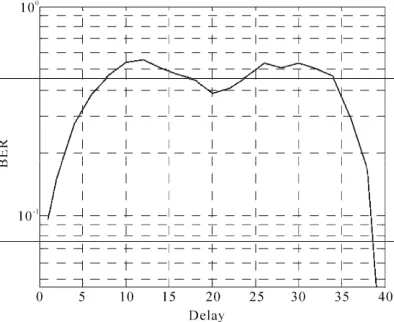
In above expression, the output is impacted by all other K-1 channels, because the biorthogonal feature is damaged in different degree with different. When using the example of BOSS-C, Figure 6 shows the im-pact of synchronization error to BER performance. The BER curve is changed periodically with the synchroniza-tion error, and the period is the length of interval [a,b] (sample number 40 represents the interval length). Therefore, synchronization precision needed to be guar-antied in BOSM system, just same as OFDM systems.
error probability will be deteriorate when the energy in a symbol interval is significantly weaker than the considered noise level. Therefore, the order K should be not too big.
To properly choose the basic function can change the PDF and PAPR of transmitted signal. In order to make BOSM systems with better performance, how to con-struct a proper basic function in an orthogonal function system to obtain the biorthogonal functions, it is still a challenge.
8. References
7. Conclusions
[1] R. B. Blizard, “Comparison of biorthogonal and bisim-plex codes,” IEEE Transactions on Communications Technology, Vol. 15, No. 4, pp. 657–658, August 1967.
The biorthogonal functions were introduced into ordi-nary orthogonal function systems, and pointed out that the condition of complete multiplication is not needed. In the meantime, a more general algorithm for biorthogonal functions called general Fourier series analysis was pro-posed. Because the obtained biorthogonal functions are not orthogonal each other, the BOSS that the obtained biorthogonal functions were used as scramble signal to be modulated by transmitted symbols has outstanding security performance, especially when the order is enough big. This is very different from orthogonal sys-tem and traditional biorthogonal modulation syssys-tem. By simulation analysis, in flat fading channel, the BOSM systems based on general Fourier series analysis, such as Chebyshev polynomial and Legendre polynomial analy-sis, have better BER performance and spectrum effi-ciency than the BOSM system based on Fourier series analysis, orthogonal MCM system or OFDM system.
[2] M. Kim and S. Tretter, “Performance of sequential de-coding with biorthogonal modulation and Q-level quan-tization,” IEEE Transactions on Communications, Vol. 19, pp. 88–92, February 1971.
[3] S.-H. Hong and J.-S. No, “Performance analysis of CDMA systems by using biorthogonal codes,” IEEE 45th Conference on Vehicular Technology, Vol. 2, pp. 694– 698, July 1995.
[4] S.-J. Kang, D.-K. Hong, et al., “Constant-amplitude mul-ticode-biorthogonal modulation,” IEEE Transactions on Communications, Vol. 55, No. 1, pp. 69–75, January 2007.
[5] Y. Wei and N. Chen, “Square wave analysis,” Journal of Mathematical Physics, Vol. 39, No. 8, pp. 4226–4245, August 1998.
[6] Y. Wei, “Dirichlet multiplication and easily-generated function analysis,” Computers & Mathematical with Ap-plications, Vol. 39, pp. 173–199, 2000.
However, the demand of high synchronization preci-sion and having high PAPR (peak average power rate) in BOSM systems are two primary problems, just as OFDM or multi-carriers systems, and the degree of PAPR rises with increasing of the order of BOSS. Because smaller amplitude of polynomial coefficients in biorthogonal functions appears with the increasing of the order of biorthogonal function set, the performance of demodulation
[7] N. Chen, “Modified Möbius inverse formula and its ap-plications in physics,” Physics Review Letters, Vol. 64, No. 11, pp. 1193–l195, 1990.
[8] W. Su, W. Zhang, and J. Wang, “The evaluations of the inverse transform of eight often-used waveforms by Möbius transform—The inverse transform of their Fou-rier series,” Chinese of Journal Electronics, Vol. 14, No. 3, pp. 513–518, July 2005.
[9] C. Ling, F. Chen, and W. Su, “The Chen-mobius multi-carriers digital communication system and its simulation,” IEEE International Workshop on Anti-Coun-terfeiting, Security and Identification, pp. 16–18, April 2007.
[10] Y. Chen, J. Zhang, and Z. Tan, “A kind of biorthogonal functions based on Fourier-Legendre series and its appli-cation in wireless transmission system,” IEEE 9th Inter-national Conference on Signal Processing, 2008. [11] K. H. Rosen, “Elementary number theory and its
applica-tion,” 5th edition, Pearson Education Inc. Press, 2005. [12] M. R. Schroeder, “Number theory in science and
com-munication,” 4th edition, Springer-Verlag Press, New York, 2006.
[image:7.595.73.270.543.704.2][13] Z. Liu, “Orthogonal function and its application,” Na-tional Defense Industry Publisher, Beijing, 1982.