FOREWORD
The attached paper is now an interesting historical curiosity, but little more than that. It
repre-sents an experiment in carrying out realtime programming in a high-level language (Algol68), in
user space, using the ‘conceptual multiplexer’ facility in the GEORGE 3/4 operating systems. In
this era realtime programming would often have been done in assembler so we felt a great sense
of liberation in having all the expressive power of Algol68 available to us. However, we knew
that our application would not be portable, not so much because Algol68 could not be ported (it
could, and it was) but because the underlying GEORGE operating system was solidly locked to
ICL 1900 series hardware.
Very shortly after this paper was presented a tidal wave called “UNIX” spread over the academic
computer science community. It was immediately obvious that the C language (though lacking
some of Algol 68’s expressiveness) would be a powerful system implementation language. The
fact that the UNIX kernel was small, and programmed in C, and that the UNIX system calls were
designed to allow processes in user mode to provide ‘system’ functionality (via close
communi-cation with the kernel) all came together to make multi-threading and multi-tasking relatively
straightforward to implement. Moreover, provided UNIX itself survived as an operating system
and proved capable of being ported to various hardware platforms (and over the past 30 years this
has certainly occurred !) then real-time processes communicating with a UNIX kernel could also,
themselves, become portable.
The program attached as Appendix 1 could be transliterated to C with little difficulty and could
be used to drive multiple VDUs on a multiplexer (not that there are many ‘dumb’ VDUs or
multi-plexers around any more). The program text itself is interesting in several respects: the ‘triple ref’
technique is used to allow a single pointer to traverse a list and to effect insertions and deletions
from that list. This technique can be transliterated to any language such as C, or C++, which
dis-tinguishes between different levels of reference and which allows access to intermediate levels of
referencing via casts. Sadly, languages such as Basic, Pascal and Java do not qualify …
More-over, it is startling to see, in a non-functional language, the ability to provide functional
argu-ments to procedures as written-out denotations of the required function (with no need to give a
name to the function if this is not needed). Connoisseurs of program languages may well find
other interesting snippets.
The attached paper was presented at a conference on “Applications of Algol 68” held at the
Uni-versity of Liverpool in 1975. This was in an era well before PDF, Word and Desktop Publishing,
so only typewritten abstracts of papers were circulated at the time. Lack of resources for
typeset-ting the various accepted papers meant that a formal Proceedings was never published.
COLOPHON
Development of a Real Time System in Algol 68.
K. C. Mander and D. F. Brailsford
Department of Mathematics
University of Nottingham
Nottingham NG7 2RD
For various reasons, many Algol 68 compilers do not directly
implement the parallel processing operations defined in the Revised
Algol 68 Report. It is still possible however, to perform parallel
processing, multitasking and simulation provided that the
implemen-tation permits the creation of a master routine for the coordination
and initiation of processes under its control. The package described
here is intended for real time applications and runs in conjunction
with the Algol 68R system; it extends and develops the original
Algol 68RT package, which was designed for use with multiplexers at
the Royal Radar Establishment, Malvern. The facilities provided, in
addition to the synchronising operations, include an interface to an
ICL Communications Processor enabling the abstract processes to be
realised as the interaction of several teletypes or visual display
units with a real time program providing a useful service.
Introduction
The real time system to be described was conceived as a
conve-nient interface between the Algol 68R system developed at the Royal
Radar Establishment, Malvern and the ICL 7900 Series Communications
processors [l]. We would like to acknowledge the assistance of RRE
in the provision of certain basic software which, by way of
intro-duction, will now be briefly described. The software consists of a
special loader to load program segments in a specific order together
with a small segment which enables Algol 68R procedures to be
exe-cuted in parallel, each with its own separate run-time stack area
and which also allows control to transfer between procedures at
user-specified points; this transfer is called coordination.
The
software is designed on the multi-tasking primitives proposed by
Briefly,
{ SIGNAL s; }
up(s) Adds 1 to s and coordinates.
down(s)
If s=O, the coordinator suspends the
procedure, with the result that some
other procedure must run instead. The
suspension is cancelled as
soon as up(s) is obeyed anywhere.
If s>0, the procedure remains unsuspended
and 1 is subtracted from s the moment
it continues. A coordination takes place,
however, and may cause continuation to be
postponed.
The procedures up and down are an extension of the Dijkstra V
and P operations and the procedure ’launch next call’, for example
launch next call; process1
establishes the next procedure call (i.e. process1) as an
indepen-dent procedure to be run in parallel with others so launched. These
procedures are referred to as processes and form the basic
program-ming unit of the RRE software.
The ICL 7900 Series Communications Processors provide a
multi-access service to ICL computers and the main concern in the
develop-ment of a real time system in Algol 68 was the provision of a
ser-vice for ICL 7071 teletypes and 7181 visual display units (vdus)
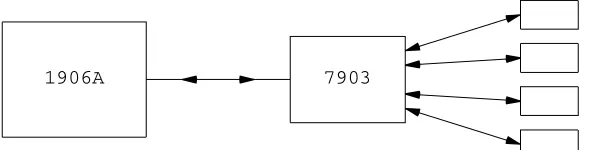
other than that provided by ICL’s Driver system. On a 1900 Series
machine a typical configuration might be …
1906A
7903
[image:3.594.132.430.534.609.2]teletypes / vdus
… with the whole of the 7900 processor available for the real time
program to use. In practice this will provide far more devices than
the average user would require and would also prevent the unwanted
devices being used to provide any standard online service that the
operating system may support. In the George 3/4 system, however,
there is a facility for enabling a subset of the devices to be
con-nected up to an in-core program providing some kind of specialist
online service. The remaining devices on the communications
proces-sor continue to give the standard George 3 online service (MOP). It
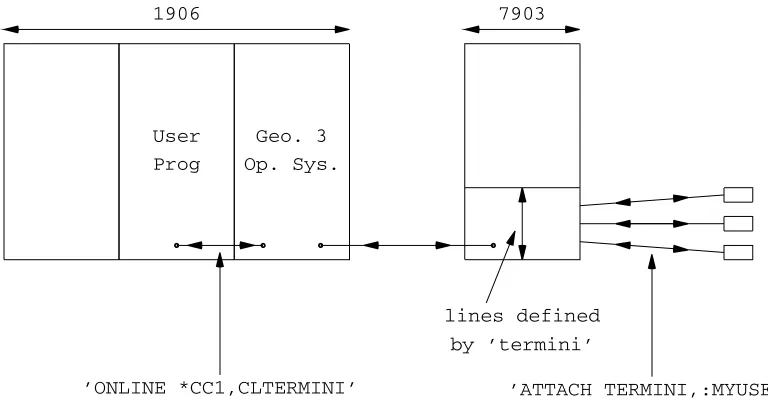
is the ‘CONCEPTUAL’ command which is used to associate a given name,
for example, ‘TERMINI’ with a particular subset of the devices. The
user can then make use of this subset without interfering with the
rest of the service. Each device is associated with the conceptual
by the ‘ATTACH’ command and the program is associated with the
con-ceptual by the ‘ONLINE’ command within its job control. Thus
schematically we have
User
Prog
Geo. 3
Op. Sys.
1906
7903
’ONLINE *CC1,CLTERMINI’
’ATTACH TERMINI,:MYUSER’
lines defined
[image:4.594.88.472.313.522.2]by ’termini’
Figure 2
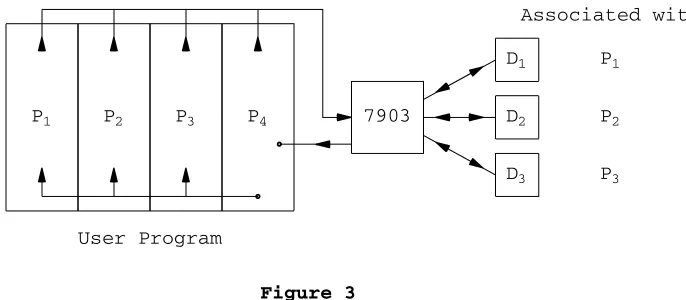
To each device attached there corresponds a distinct process
within the user program which controls the transput to the device.
Output to the devices is handled directly by the process concerned
but input has to be handled by a separate process since the 7900
guarantee of the order in which the messages arrive from it.
P
1P
2P
3P
4User Program
7903
D
2D
1D
3P
1P
2P
3 [image:5.594.123.466.113.263.2]Associated with
Figure 3
Having described the constraints introduced by the operating
system we can describe the interface between the 7900 processor and
the Algol 68R system.
There are few visible differences between the transput to
file-store files and the transput to interactive devices. This is because
most of the interface is hidden from the user; for example
outf(channel, $tl$, "hello")
would output the message "hello" on some device ( ’channel’ is an
appropriate CHARPUT variable). The actual transput is achieved by
trapping the event of taking a newline and instead of making a
transfer to a filestore file the transput is directed to the 7900
processor. Input is analogous to output, the program extract
INT i,j; inf(channel,$l3d,2d$,(i,j))
would serve to input i and j from a device. The call of newline is
usually placed at the end of output formats and the beginning of
input formats.
Unfortunately under the Algol 68R system formats are not
re-entrant, that is to say that no two processes are allowed to execute
the same format simultaneously. It is necessary, therefore, that
each process expecting to use a format at the same time as some
other process, should take its own copy. This can be done by having
for example,
FORMAT global = $la, 2(2d), l 4(4a) $
and taking a copy within each process, for example,
FORMAT copy; copyformat(global,copy)
We are now able to construct device independent procedures for
par-allel execution. Such procedures will depend critically on transput
being directed to the correct device and by declaring each procedure
to have two REF CHARPUT parameters we can ensure that the correct
transput is achieved. For example,
PROC myproc = (REF CHARPUT input,output)VOID: BEGIN ... END
Within these procedures transput proceeds in the normal way. The
following routine, for example, outputs the squares of input
num-bers.
PROC square = (REF CHARPUT input,output)VOID: BEGIN
FORMAT fin,foutl,fout2; copyformat($ l3v.3d $,fin); copyformat($ tl $,foutl);
copyformat($ "the square of " 3v.3d, " is " 6sv.6d l $,fout2);
WHILE REAL r;
outf(output,foutl,
"type a number in the form xxx.xxx"); inf(input,fin,r);
outf(output,fout2,(r,r*r)); r < 999.0
DO SKIP END
We are now able to associate procedures with devices. Each
device has a unique identifier number, assigned to it by the
operat-ing system and denotoperat-ing one of the lines of the conceptual
multi-plexer; devices are referred to by this number and it is supplied as
the first parameter to the call of a procedure ’start iden’, tbe
second parameter being the procedure which is to be run on the
device. As many devices can be started as have been previously
defined and they are scanned for input by a procedure corresponding
If the attached device is a vdu there is an extensive range of
routines which can be used to provide lineprinter and backing store
copies of the screen as well as facilities for clearing and racking
up the screen.
It is also possible to output strings of protected
characters, that is, characters which cannot be overwritten by input
from the vdu keyboard.
Much use can be made of this facility for
data collection purposes as will be seen later.
Throughout the testing of a program it could be inconvenient to
attach devices and run in real time when, especially in the early
stages of development, the program may contain some errors. It is
possible, therefore, by setting the appropriate switch, to take
mes-sages from a filestore file instead of the communications processor,
thereby obviating the need for real time. Similarly output for the
processor is sent to a file. Records within the input file have to
be in a format acceptable to the program i.e. as if they came from
the processor and a small segment is provided to add the appropriate
red-tape to messages. A typical record might be
0002@005HELLO
Identifier
Record contains data
Number of chars
in the data
Data
With the exception of this internal transput, the program
behaves in exactly the same way as it would if run in real time,
without incurring the overheads and inconvenience which real time
testing introduces. This approach has been used to develop a small
illustrative application for this conference.
The application is a simple hotel reservation system. We have a
small hotel with assorted double and single rooms most of which have
bathrooms.
We have two receptionists, one at the hotel and the
sec-ond at some (possibly remote) other site. Each receptionist has a
vdu into which the following commands may be input
ENQ
LISTALL
CANCEL
LISTFREE
DAY
LISTTAKEN
STOP
Depending on the command typed, different frames can be
DAY 15
sets the current day to 15. This also causes
the removal of all old bookings i.e. those
ookings which were only up to day 14 or
efore
ENQ
Causes the following frame to be output to
the vdu
NUMBER OF SINGLE ROOMS
(
)
NUMBER OF DOUBLE ROOMS
(
)
BATHROOMSWITH EACH ROOM?
(
)
Y = YES
FROM DAY (
) TO DAY (
)
Items of data can then be input by either
receptionist on behalf of
a client in the
spaces provided
NUMBER OF SINGLE ROOMS
(00)
NUMBER OF DOUBLE ROOMS
(01
)
BATHROOMSWITH EACH ROOM?
(N)
Y = YES
FROM DAY (21) TO DAY (24)
LISTALL
lists the bookings for each room, for example
ROOM
S/D
BATH
BEDS
OCCUPANCY FROM DAY 2
1
DOUBLE
WITH
0
1
V FROM DAY 2 TO 30
2
SINGLE
WITHOUT
1
0
V FROM DAY 4 TO 8
T FROM DAY 9 TO 11
The program is written as one might write any other program with
the addition of special transput procedure calls and the following
calls which set up the individual processes.
define configuration(2,1); vdu ( (1, 2) ) ;
start configuration;
The last three calls are of greatest interest, the two calls of
’start iden’ create two processes each obeying the procedure
’recep-tionist’ i.e.
two separate areas of the run-time stack are set
apart as work space for the procedures and certain information (for
example the contents of registers, stack pointers etc.) is kept to
enable the process to be restarted should control pass from it. The
task of the procedure ’scan configuration’ is to read messages from
the communications processor; the messages read are of two types
(i) those of a supervisory nature i.e.
containing information
about the physical state of the system (for example, a
device being inoperable) and
(ii) those containing data for the various processes within the
program. Most messages are of the latter type and are passed
to the appropriate process. ’Scan configuration’ continues
reading until both calls of the procedure receptionist have
terminated (by both receptionists typing STOP).
A copy of the complete program follows at the end of this paper
together with part of the hard copy output produced by the program.
The great advantage of the system is the ability to program real
time applications in a high-level language; Algol 68 permits a
free-dom of expression which is impossible in an assembly language. This
is, however, coupled with the penalty of a larger program and a
slightly slower speed of execution. On a smaller computer (for
exam-ple, one with less than 128K of core store) the program size may be
of great importance and possible future developments include the
provision of a system of overlays and the option of making one
pro-cess control more than one device, hopefully reducing the overall
size of the program.
We estimate that if the application presented were rewritten
using ICL Driver with overlays it would occupy about 17K of core
store (that being the size of the largest overlay) and would have
taken 50 days to write; this compares with 30K and only 10
References
1. ICL Data Communications and Interrogation Manual.
ICL number
4328.
E. W. DIJKSTRA : Cooperating Sequential Processes In ’Programming
Languages’ edited by F. Genuys.
Acknowledgements
The authors would like to acknowledge the assistance of the
Cripps Computing Centre at the University of Nottingham and Dr. D.P.
Jenkins and Dr. A.J. Fox of the Roya1 Radar Establishment Malvern in
the preparation of this paper. Support from the Science Research
APPENDIX 1 — PROGRAM LISTING
HOTEL ’WITH’ RTMATHSEG, VDUBASICSEG, ’FROM’ RTLIB ’BEGIN’’MODE’ ’DATE’ = ’STRUCT’ (’INT’ FROM, TO),
’ENTRY’ = ’STRUCT’ (’INT’ NUMBER, FROM, TO),
’ROOM’ = ’STRUCT’ (’BOOL’ SINGLE, BATH, ’INT’ SBEDS, DBEDS, ’REF’ ’BOOKING’ B),
’BOOKING’ = ’STRUCT’ (’BOOL’ PENDING, TAKEN, ’DATES’ DATE, ’REF’ ’BOOKING’ NEXT);
’REF’ ’BOOKING’ NOTBOOKED = ’NIL’; ’INT’ NROOMS;
INF (STANDIN, $2D$, NROOMS); [1:NROOMS] ’ROOM’ ROOMS;
FORMAT(STANDIN,$1B,B,D,D$); ’FOR’ I ’TO’ NROOMS ’DO’ ’BEGIN’
’REF’ ’ROOM’ R = ROOMS[I]; IN (STANDIN,
(SINGLE, ’OF’ R, BATH ’OF’ R, SBEDS ’OF’ R, DBEDS ’OF’ R)); B ’OF’ R := NOTBOOKED
’END’
’MODE’ ’ENQUIRY’ = ’STRUCT’ (’INT’SING, DOUB, ’BOOL’ BATH); ’INT’ DAY := 1, LASTDAY := 30;
’FORMAT’ COMMANDLIST = $LC("ENQ", "LISTFREE", "LISTALL", "LISTTAKEN", "CANCEL", "DAY", "STOP", ""$, ROOMLIST = $1K 3V,2X B("SINGLE", "DOUBLE"), 2X B("WITH", "WITHOUT"), 22K 2(2X 2V)$,
BOOKINGLIST = $ 35K A, 2X "FROM" 2X 3V, " TO " 3VL $, F1 = $2L10KT50K $,
F2 = $ 3X T 2L $,
F3 = $ L2D,2D,A,2D,2D $,
F4 = $ 2L 10K "ROOM NUMBER " 3SV, " IS AVAILABLE FROM " 3SV, " TO "3SV2L10K "SATISFACTORY ? "$,
F5 = $2L 10K T 3X$, F6 = $ LA $,
F7 = $2(2D)$, F8 = $ 2L T 2L $,
F9 = $L "ROOM"2X"S/D"4X"BATH"25K"BEDS"35K "OCCUPANCY FROM DAY "3SVL$,
F10 = $L3SV " OUT OF ", 3SV " ROOMS AVAILABLE"L$, F11 = $ 10K T X $,
’PROC’ LISTROOMS = (’PROC’(’REF’ ’BOOKING’) ’BOOL’ PB, ’REF’ ’CHARPUT’ OUTC):
’BEGIN’
’C’ LISTS THE ROOMS WITH PROPERTIES SPECIFIED BY PB
’C’
’FORMAT’ RL, BL, HL, G1;
COPYFORMAT(ROOMLIST,RL); COPYFORMAT(BOOKINGLIST,BL); COPYFORMAT(F9,HL); COPYFORMAT(F13,G1);
STARTSCREEN(OUTC); OUTF(OUTC,HL,DAY); ’FOR’ I ’TO’ NROOMS ’DO’
’BEGIN’
’REF’’ROOM’ R = ROOMS[I]; ’REF’ ’BOOKING’ RB := B ’OF’ R; OUTF(OUTC,
CLEARFORMAT(RL),
(I,SINGLE’OF’R,BATH’OF’R SBEDS’OF’R,DBEDS’OF’R)); ’IF’ RB ’IS’ NOTBOOKED
’THEN’ OUTF(OUTC, CLEARFORMAT(BL), ("V",DAY,LASTDAY))
’ELSE’
’WHILE’ RB ’ISNT’ NOTBOOKED ’DO’ ’BEGIN’
’IF’PB(RB)
’THEN’ OUTF(OUTC,CLEARFORMAT(BL), (’IF’ PENDING’OF’RB
’THEN’ "P"
’ELSF’ TAKEN’OF’RB ’THEN’ "T"
’ELSE’ "V" ’FI’,
FROM’OF’DATE’OF’RB,TO’OF’DATE ’OF’ RB)) ’ELSE’ OUTF(OUTC,G1," ")
’FI’
RB := NEXT ’OF’ RB ’END’
’FI’;
( I=NROOMS’/’2
| ’C’ PRINT THE SCREEN ON LINEPRINTER AND CLEAR SCREEN
’C’
STARTSCREEN(OUTC); OUTF(OUTC,HL,DAY) )
’END’;
PRINTSCREEN(CURRENTVDU(OUTC)) ’END’;
’PROC’ INTTOCHARS = (’REF’’VDU’ ME,’INT’ I, LINE, COL, NUMBER): ’BEGIN’ ’INT’ COPY := I;
’FOR’ J ’FROM’ COL ’BY’ -1 ’TO’ COL-NUMBER+1 ’DO’ (SCREEN ’OF’ ME)[LINE,J] := ’REPR’ (COPY’/:=’10) ’END’;
’PROC’ FRAME1 = (’REF’ ’CHARPUT’ INC, OUTC, ’REF’ ’ENQUIRY’ ENQ, ’REF’ ’ENTRY’ ENT):
’BEGIN’
’C’ DISPLAYS THE FIRST "ENQUIRY" FRAME ’C’
’REF’ ’VDU’ ME = CURRENTVDU(OUTC); ’CHAR’ C; ’FORMAT’ G1, G2, G3, G4, G5; COPYFORMAT(F1,G1);
COPYFORMAT(F2,G2); COPYFORMAT(F3,G3); COPYFORMAT(F11,G4); COPYFORMAT(F12,G5); STARTSCREEN(OUTC);
OUTF(OUTC,G1,"NUMBER OF SINGLE ROOMS"); ’C’ SPECIFY A PLACE ON THE SCREEN FOR INPUT ’C’
INPUT FIELD(OUTC, PB, 2, ’FALSE); OUTF(OUTC,G1,"NUMBER OF DOUBLE ROOMS"); INPUT FIELD(OUTC, PB, 2, ’FALSE);
OUTF(OUTC,G1,"BATHROOMS WITH EACH ROOM?"); INPUT FIELD(OUTC, PB, 1, ’FALSE);
OUTF(OUTC, G2, "Y = YES"); OUTF(OUTC, G4, "FROM DAY"); INPUT FIELD(OUTC, PB, 2, ’FALSE); OUTF(OUTC, G5, "TO");
INPUT FIELD(OUTC, PB, 2, ’FALSE); ’C’ POSITION CURSOR TO START OF SCREEN ’C’
SETCURSOR(OUTC,0, 0); INF(INC, G3,
INTTOCHARS(ME, SING ’OF’ ENQ,3,53,2); INTTOCHARS(ME, DOUB ’OF’ ENQ,4,53,2); INTTOCHARS(ME, FROM ’OF’ ENT,6,22,2); INTTOCHARS(ME, TO ’OF’ ENT,6,34,2);
BATH ’OF’ ENQ := C=Y; (SCREEN ’OF’ ME)[3,52]:=C; PRINTSCREEN(ME)
’END’
’PROC’ FRAME2 = (’REF’’CHARPUT’ INC, OUTC, ’REF’ ’DATES’ D, ’REF’ ’ENTRY’ E) ’BOOL’:
’BEGIN’
’C’ DISPLAYS THE SECOND "ENQUIRY" FRAME ’C’
’CHAR’ C; ’FORMAT’ G1, G2, G3, G4; ’BOOL’ B; ’REF’ ’VDU’ ME = CURRENTVDU(OUTC);
COPYFORMAT(F4,G1); COPYFORMAT(F5,G2); COPYFORMAT(F8,G3); COPYFORMAT(F6,G4); STARTSCREEN(OUTC); OUTF(OUTC,G1,E);
INPUT FIELD(OUTC, PB, 1, "FALSE"); OUTF(OUTC,G2,"IF ""Y"" INSERT DATES"); INPUT FIELD(OUTC, PB, 2, "FALSE"); SETCURSOR(OUTC,0,0);
INF(INC,G3,C); (SCREEN ’OF’ ME)[4,28]:=C; (B := C = "Y"
! INF(INC,G4, D)
INTTOCHARS(ME,FROM’OF’D, 5,35,2); INTTOCHARS(ME, TO ’OF’D, 5,45,2);
FROM ’OF’ E := FROM ’OF’ D; TO ’OF’ E := TO ’OF’ D; PRINTSCREEN(ME)
’PROC’ GARBAGE COLLECT = ’VOID’: ’BEGIN’
’C’ DELETE ALL OLD BOOKINGS ’C’
’FOR’ I ’TO’ NROOMS ’DO’
’BEGIN’ ’REF’ ’REF’ ’BOOKING’ RB = B ’OF’ ROOMS[I]; ’IF’ (RB ’ISNT’ NOTBOOKED
! DAY > TO ’OF’ DATE ’OF’ RB ! ’FALSE’
)
’THEN’ RB := NEXT ’OF’ RB ’FI’
’END’ ’END’;
’PROC’ BOOKROOM = (’REF’ ’ENTRY’ ENT, ’BOOL’ BOOK, ’REF’ ’CHARPUT’ OUTC): ’BEGIN’
’C’ CONFIRMS BOOKING
TRACER USES "TRIPLE REF" TECHNIQUE AND IS USED TO LOCATE THE CORRECT BOOKING IN THE CHAIN
’C’
’FORMAT’ ERROR; COPYFORMAT(F8,ERROR); ’BOOL’ NOTMATCHED := ’TRUE’;
’REF’ ’REF’ ’BOOKING’ TRACER := B ’OF’ ROOMS[NUMBER ’OF’ ENT]; ’WHILE’
( TRACER ’ISNT’ NOTBOOKED
! NOTMATCHED := FROM ’OF’ DATE ’OF’ TRACER # FROM ’OF’ ENT ! ’FALSE’
)
’DO’ TRACER := NEXT ’OF’ TRACER; ’IF’ (TRACER ’IS’ NOTBOOKED)
’OR’ NOTMATCHED
’THEN’ OUTF(OUTC,ERROR,"BOOKING NOT FOUND") ’ELSF’ BOOK
’THEN’ TAKEN ’OF’ TRACER := ’TRUE’;
PENDING ’OF’ TRACER := ’FALSE’
DATE ’OF’ TRACER := (FROM ’OF’ ENT, TO ’OF’ ENT)
’ELSE’ ’REF’ ’REF’ ’BOOKING’ ’VAL’ TRACER := NEXT ’OF’ TRACER
’PROC’ CANCEL ROOM = (’REF’ ’CHARPUT’ INC, OUTC): ’BEGIN’
’ENTRY’ ENT; ’FORMAT’ G1, G2, G3; COPYFORMAT(F11,G1);
COPYFORMAT(F12,G2); COPYFORMAT(F6,G3);
OUTF(OUTC, G1, "ROOM NUMBER 2); INPUT FIELD(OUTC, PB, 2, ’FALSE’); OUTF(OUTC, G3, " FROM "); INPUT FIELD(OUTC, PB, 2, ’FALSE’); SET CURSOR(OUTC, 0, 0);
NEWLINE(INC); INF(INC,G3,(NUMBER ’OF’ ENT, FROM ’OF’ENT)); BOOKROOM(ENT, ’FALSE’, OUTC)
’END’;
’PROC’ SEEKROOM = (’PROC’ (’REF’ ROOM) ’BOOL’ PB) ’INT’: ’BEGIN’
’C’ SEARCHES FOR A ROOM WITH PROPERTIES
SPECIFIED BY PB ’C’
’BOOL’ STOP := ’FALSE’; ’INT’ RESULT := 0; ’FOR’ I ’TO’ NROOMS ’WHILE’ ’NOT’ STOP ’DO’ ’BEGIN’
’IF’ STOP := PB(ROOMS[I]) ’THEN’ RESULT := I
’FI’ ’END’; RESULT
’PROC’ ROOMFREE = (’REF’ ’ROOM’ R, ’REF’ ’ENTRY’ ENT) ’BOOL’: ’BEGIN’
’C’ SEARCHES FOR A VACANCY IN A PARTICULAR ROOMS BOOKINGS ’C’
’REF’ ’REF’ ’BOOKING’ TRACER := B ’OF’ R;
’BOOL’ OK := TRACER ’IS’ NOTBOOKED; ’BOOL’ B:= OK; ’WHILE’
’IF’ ’NOT’ OK
’THEN’ TRACER ’ISNT’ NOTBOOKED
’ELSE’ (’REF’ ’REF’ ’BOOKING’ ’VAL’ TRACER) := ’BOOKING’ :=
(’TRUE’, ’FALSE’, (FROM ’OF’ ENT,
( B ’OF’ R ’IS’ NOTBOOKED ! LASTDAY | TO ’OF’ ENT)), TRACER);
ENT := (0, FROM ’OF’ ENT,
(B ! LASTDAY ! FROM ’OF’ DATE ’OF’ TRACER)); ’FALSE’
’FI’
’DO’ ’BEGIN’
OK := TO ’OF’ DATE ’OF’ TRACER < FROM ’OF’ ENT ’AND’ ’IF’ B := NEXT ’OF’ TRACER ’IS’ NOTBOOKED ’THEN’ ’TRUE’
’ELSE’ FROM ’OF’ DATE ’OF’ NEXT ’OF’ TRACER > TO ’OF’ ENT ’FI’;
TRACER := NEXT ’OF’ TRACER ’END’;
OK ’END’;
’PROC’ FINDROOM = (’REF’ ’ENTRY’ ENT, ’BOOL’ BATH, SINGLE) ’INT’: ’BEGIN’
’C’ SEARCHES FOR A ROOM OF A PARTICULAR TYPE IF ONE IS NOT FOUND THE CONDITIONS BECOME PROGESSIVELY LESS STRINGENT
’C’
’INT’ RESULT := 0;
’IF’ ( RESULT := SEEKROOM ( (’REF’ ’ROOM’ R) ’BOOL’: ’BEGIN’
(SINGLE ’OF’ R = SINGLE) ’AND’ (BATH ’OF’ R = BATH) ’AND’ ROOMFREE(R,ENT)
’IF’ ( RESULT := SEEKROOM((’REF’ ’ROOM’ R) ’BOOL’: ’BEGIN’
(SINGLE ’OF’ R = SINGLE) ’AND’ ROOMFREE(R, ENT)
’END’ )) = 0
’THEN’ RESULT := SEEKROOM (’REF’ ’ROOM’ R) ’BOOL’: ’BEGIN’
ROOMFREE(R, ENT) ’END’)
’FI’ ’FI’ RESULT ’END’
’PROC’ PROCESSENQ = (’ENQUIRY’ ENQ, ’REF’ ’BOOL’ OK, ’REF’ ’ENTRY’ ENT,
’REF’ ’CHARPUT’ INC. OUTC): ’BEGIN’
’INT’ U = SING ’OF’ ENQ + DOUB ’OF’ ENQ; ’INT’ VALID ENTRIES := 0; [1:U] ’ENTRY’ ENTRIES;
’FORMAT’ G1; COPYFORMAT(F10, G1); ’TO’ SING ’OF’ ENQ ’DO’
’BEGIN’
’INT’ I = FINDROOM(ENT, BATH ’OF’ ENQ, ’TRUE’); (I>0
! ENTRIES[VALIDENTRIES ’PLUS’ 1] := (I, FROM ’OF’ ENT, TO ’OF’ ENT) )
’END’
OUTF(OUTC, G1, (VALIDENTRIES, U)); ’FOR’ I ’TO’ VALIDENTRIES ’DO’ ’BEGIN’
’REF’ ’ENTRY’ E = ENTRIES[I];
’DATES’ DA := (FROM ’OF’ E, TO ’OF’ E); BOOKROOM(E, FRAME2(INC,OUTC,DA,E), OUTC) ’END’
’PROC’ RECEPTIONIST = (’REF’ ’CHARPUT’ INC, OUTC): ’BEGIN’ ’FORMAT’ ROOM, ERROR;
’C’ THIS IS THE PROCEDURE TO BE LAUNCHED AS A SEPARATE PROCESS
’C’
COPYFORMAT(F8,ERROR); COPYFORMAT(COMMANDLIST, COMM); ’INT’ DUMMY; ’ENQUIRY’ ENQ; ’BOOL’ OK;
’ENTRY’ ENT; ’DATES’ DA; ’WHILE’
STRATSCREEN(OUTC); INF(INC, COMM, DUMMY); ’CASE’ DUMMY
’IN’
FRAME1(INC, OUTC, ENQ, ENT);
PROCESSENQ(ENQ, OK, ENT, INC, OUTC),
LISTROOMS((’REF’ ’BOOKING’ B) ’BOOL’:
(’NOT’ (PENDING ’OF’ B ’OR’ TAKEN ’OF’ B)), OUTC),
LISTROOMS((’REF’ ’BOOKING’ B) ’BOOL’: (’TRUE’),OUTC),
LISTROOMS((’REF’ ’BOOKING’ B) ’BOOL’: (TAKEN ’OF’ B), OUTC),
CANCEL ROOM(INC, OUTC),
INF(INC, $2D$, DAY); GARBAGE COLLECT,
’SKIP’
’OUT’
OUTF(OUTC, ERROR, "REQUEST NOT RECOGNISED")
’ESAC’; DUMMY # 7 ’DO’ ’SKIP’ ’END’
’C’ DEFINE 2 DEVICES ON CHANNEL 0 ... ’C’ DEFINE CONFIGURATION(2,0);
’C’ ... BOTH ARE VDUS ’C’ VDU((1,2));
’C’ START THE WHOLE SYSTEM ... ’C’ STARTCONFIGURATION;
’C’ ... AND EACH DEVICE. ’C’
STARTIDEN(1, RECEPTIONIST); STARTIDEN(2, RECEPTIONIST);
’C’ SCAN FOR INPUT FROM THE DEVICES ’C’
SCAN CONFIGURATION ’END’
APPENDIX 2 — SAMPLE OUTPUT
TERMINAL NUMBER 1 DATE: 02/04/75 TIME: 15.56.37
NUMBER OF SINGLE ROOMS (00)
NUMBER OF DOUBLE ROOMS (01)
BATHROOMS WITH EACH ROOM? (N) Y = YES
TERMINAL NUMBER 1 DATE: 02/04/75 TIME: 15.56.37
ROOM NUMBER 2 IS AVAILABLE FROM 21 TO 30
SATISFACTORY ? (Y)
TERMINAL NUMBER 1 DATE: 02/04/75 TIME: 15.57.26
ROOM S/D BATH BEDS OCCUPANCY FROM DAY 10
1 DOUBLE WITH 0 1 T FROM 12 TO 15
2 DOUBLE WITHOUT 0 1 T FROM 21 TO 24
P FROM 25 TO 28
3 SINGLE WITH 1 0 T FROM 3 TO 10
4 SINGLE WITH 1 0 T FROM 3 TO 12
TERMINAL NUMBER 1 DATE: 02/04/75 TIME: 15.57.27
ROOM S/D BATH BEDS OCCUPANCY FROM DAY 10
6 SINGLE WITH 1 0 V FROM 10 TO 30
7 SINGLE WITH 1 0 V FROM 10 TO 30
8 SINGLE WITH 1 0 V FROM 10 TO 30
9 SINGLE WITH 1 0 V FROM 10 TO 30