Chapter 1 Introduction
1.1 Introduction
Environmental pollution and corruption have been inseparable twin evils in current China. The
immediate motivation for this book is to link the environment and corruption with China’s large
inflows of foreign direct investment (FDI). It investigates the effects of economic development
and foreign investment on the pollution in China; the effects of corruption and governance
quality on FDI location choice in China; and the relationship between environmental regulation
stringency and FDI, as well as the role of corruption played in this relationship.
Since 1978 the Chinese government has been reforming its economy from a centrally planned to
a market-oriented economy, known as “socialism with Chinese characteristics”. The results of
this dramatic transformation have been the generation of wealth on a previous unimagined scale
and the removal of millions from absolute poverty, bringing the poverty rate down from 84 per
cent in 1981 to 13 per cent in 2008 (World Bank).1 China is the fastest growing country with a
consistent annual gross domestic product (GDP) growth rate above 8 per cent. By the end of
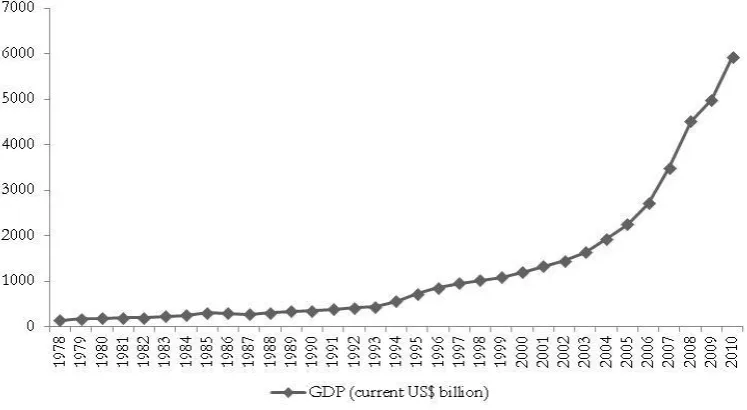
2010, China has overtaken Japan as the second largest economy in the world when measured by
nominal GDP (RMB 40.12 trillion, or $5.93 trillion, see Figure 1.1 for the nominal GDP growth
of China from 1979 to 2010).2 Removing the impact of inflation, China’s real GDP in 2010 was
20 times as many as that in 1978. The nominal per capita GDP has also increased from RMB
381 to RMB 29,992 (about $4,430), which means a growth of 14.7 times in real term. The rapid
growth has been drawing worldwide attention to China, including academics in a number of
research areas.
1 Data source: http://data.worldbank.org/country/china. Poverty is defined as the number of people living at <
$1.25/day measured by purchasing power parity.
2 United States and Japan’s GDP in 2010 was respectively $14.42 trillion and $5.49 trillion, according to the World
Figure 1.1 China’s Nominal GDP 1978-2010
Source: World Development Indicators database, The World Bank.
Much of China’s success has been driven by a tremendous growth in exports coupled with
equally impressive increases in FDI. According to the statistics from China’s National Bureau of
Statistics (NBS), the value of China’s exports grew by an average of 14.7 per cent a year between
1980 and 2000 and by 27.3 per cent a year between the entry to the World Trade Organization
(WTO) in 2001 and the world financial crisis in 2008. At the end of 2010 China’s global trade
exceeded $2.97 trillion with exports of $1.58 trillion. From then on China surpassed Germany to
be the world’s largest exporting nation and the second largest importer behind the United States
(US). In addition, China’s trade surplus has been stable at around $30 billion between 1999 and
2004 but surged rapidly afterwards (varied between $102 billion and $298 billion). In terms of
$30.10 billion between 1990 and 2000. The stock of FDI has increased similarly, rising from
$20.69 billion in 1990 to $1048.38 billion in 2010.
The Chinese government launched a range of policies to encourage FDI inflows. In 1979, the
government introduced legislation and regulations designed to encourage foreigners to invest in
high-priority sectors and regions. The government eliminated restrictions and implemented
permissive policies in the early 1980s. It established Special Economic Zones in 1980 and then
opened up coastal cities and development regions in coastal provinces in the mid-1980s. More
favourable regulations and treatments have been used to encourage FDI inflows in these regions.
In 1990s, the policies began to promote the high-tech and capital intensive FDI projects in
accordance with domestic industrial objectives. More preferential tax treatments were granted for
the investment in selected economic zones or in projects encouraged by the government, such as
energy, communications and transport. Such preferential policies have resulted in an
overwhelming concentration of FDI and rapid economic development in the east. The spillover
effects from coastal to the inland provinces are limited, and therefore, the regional development
gap has widened.
Rapid export driven economic growth enhanced by large investment inflows from abroad has
come at a cost. A harmful by-product of globalization has been increased pollution. The State
Environmental Protection Administration (the predecessor of Ministry of Environmental
Protection) reported that two thirds of Chinese cities are considered polluted according to the air
quality data. Respiratory and heart diseases related to air pollution are the leading causes of death
in China. Almost all of the nation’s rivers are polluted to some degree and half of the population
lacks access to clean water. Water scarcity occurs most in northern China and acid rain falls on
of China’s GDP each year. Environmental degradation and the increase in poor health are all
signs that China’s current growth path is unsustainable.3
There have been numerous theoretical and empirical studies that examine the relationship
between economic growth and various indicators of environmental degradation. The aim of the
research is to examine the existence of the “Environmental Kuznets Curve” (EKC), which is
found firstly in Grossman and Krueger (1991). The hypothesis of EKC indicates that the total
amount of environmental impact of economic growth initially increases, reaches a peak and then
falls, illustrated in Figure 1.2. In addition, some researchers have started to use empirical
methods to examine the effects of FDI on environmental quality, especially in developing
countries. However, the majority of studies on both the environmental effects of economic
growth and FDI, are cross-country analyzes and the results are often inconsistent.
Figure 1.2 Environmental Kuznets Curve
Therefore, in the case of China, the following questions are worthy of consideration. Does the
environmental Kuznets curve hold for some pollutants? If it does, where is the threshold income
3 Sustainable development refers to development that “meets the needs of the present without compromising the
ability of future generations to meet their own needs”, which is defined in the UN Report of the World Commission on Environment and Development, 1987 (http://www.un.org /documents/ga/res/42/ares42-187.htm).
Environmental impact
level and how many regions have passed it? As an important driving force of economic growth
in China, does FDI benefit/harm environmental quality? These questions have attracted
relatively few research using different datasets and methodologies, with mixed results.
The huge amount of FDI inflows and unbalanced geographical distribution of FDI have
attracted several studies to investigate the determinants of FDI location choice in China (see for
example Wei et al., 1999; Coughlin and Segev, 2000; Cheng and Kwan, 2000; and Amiti and
Javorcik, 2008). In addition to the preferential policies, many factors may have affected where
foreign investors locate their production facilities within China, such as labour costs, potential
market size, market access, supplier access, infrastructure, productivity, education level, location,
and spatial dependence. However, these studies all omitted certain structural determinants of
FDI, including environmental regulation stringency and government quality.
Some environmental economists and environmentalists claim that firms in developed countries
may relocate their “dirty” industries to developing countries to take the advantages of the less
stringent environmental regulations (see for example Pearson, 1987; Dean, 1992; and Copeland
and Taylor, 1994). Such a point of view is known as “the pollution haven hypothesis” (PHH).
In China, the legal system has lagged far behind the overall economic development. Although
China has established a comprehensive environmental regulatory framework with a range of laws,
regulations and standards, the strength and the enforcement of the regulations are much weaker
than those in developed countries. An important issue in the enforcement of environmental
regulations is of the government itself violating the law. Some local governments would protect
polluting enterprises in the name of local interest. Land appropriation, excessive mining and the
failure to carry out environmental impact assessments: such situations continue due to the lack
of the environmental awareness among local government officials. Environmental enforcement
citizens (Ma, 2007). The differences in the performance of local government and the
characteristics of the public have led environmental stringency to vary among regions.
Multinational corporations (MNCs) could be attracted by the weak environmental regulations in
China. Ma Jun, director of the nongovernmental Institute of Public and Environmental Affairs
(IPE), announced in August 2007 that over 100 multinational corporations were punished by the
government for their violation of the environmental laws and regulations in terms of water
pollution from 2004. And in January 2008 this figure increased to 260 corporations for water
pollution and more than 50 corporations for air pollution. The exposed companies include
subsidiaries of world-renowned corporations such as American Standard, Panasonic, Pepsi,
Nestle, 3M, Whirlpool, Bosch, Carlsberg, Samsung, Nissin and Kao. These corporations are
mostly from Japan, US and Europe. One third of their polluting subsidiaries are located in
Shanghai, and others scattered over the country. Liu (2006) reported that according to Lo Sze
Ping, campaign director of Greenpeace China, the “words” of multinationals are often better
than their deeds. Multinationals are more willing to invest in public relations than in actually
cleaning up the manufacturing process. Local governments seek to attract more FDI and hence
do not take strict measures to address pollution by multinational corporations. Lo also observes
that since multinational corporations typically perform better than the domestic enterprises
environmentally, their activities do not attract the attention of the environmental authorities, and
hence avoid the supervision.
Therefore, the regional differences in environmental stringency may have a significant impact on
the FDI location choice in China, that is to say, an intra-country pollution haven effect may exist.
Previous empirical studies have adopted different approaches to investigate the PHH (see for
example Levinson, 1996a & 1996b; List and Co, 2000; Keller and Kevinson, 2002; Xing and
Kolstad, 2002; Eskeland and Harrison, 2003; Fredriksson et al., 2003; Dean et al., 2005; and
to support the existence of PHH. However, these studies have several methodological
weaknesses and are mostly centred on the US data, a few studies look at developing countries
and only Dean et al. (2005) look at China. Therefore, this book, addressing weaknesses of
previous studies, makes some contribution to the literature on PHH.
Rapid economic growth with the lagged development of the legal system has resulted in a serious
social problem in China – corruption. The transition to a market-based economy has resulted in
considerable changes to how firms operate within the new commercial business environment.
The huge increase in opportunities in the private sector combined with the traditional power of
local and national officials led to a proliferation of corruption at all levels of the Chinese
economy. Corruption has been recognised as an emerging challenge to China’s economy and
social reforms.
Corruption is widely recognised as a deterrent of foreign investment but is only considered in a
few empirical studies on a cross-country basis (see for example Wheeler and Mody, 1992; Hines,
1995; Wei, 2000; and Smarzynska and Wei, 2000). Although China has received a high volume of
foreign capital, corruption has deterred FDI inflows, especially those from Europe and the US.
Wei (1997) notes that FDI from the ten largest source countries in the world, all of them
members of Organization of Economic Co-operation and Development (OECD), accounts for
a relatively small portion of total FDI going to China, because investors from the major source
countries prefer to go to less corrupt countries. Similarly, the corruptibility of local government
in China may affect the location of FDI. Moreover, corruption should not be considered in
isolation and is strongly correlated with the quality of government (see Globerman and Shapiro,
2002 & 2003; Globerman et al., 2006; and Fan et al., 2007). Thus, government quality is another
important determinant of FDI inflows. Therefore, this book is the first to examine the effects of
inter-regional differences in corruption and government quality on FDI location choice within a
Corruption is also associated with environmental regulations. A common limitation in pollution
haven studies is that they only consider the impact of environmental regulations on FDI but few
have considered the endogeneity of environmental regulations. This book firstly considers that
environmental stringency may be influenced by both corruption and the level of FDI.
1.2 Structure of the Book
Combining various aspects within the broad area of FDI, governance and the environment, this
book is structured as follows. Chapter one is the introduction, which outlines related background
in China, research questions and brief analytical framework in this book. The first part of the
book includes four substantial chapters looking at effects of economic development and FDI on
the environment in China. Chapter two examines China’s economic growth and the nature and
development of inward FDI from its opening up in 1978. Chapter three examines China’s
natural environment and its environmental pollutions. Particular attention is paid to its water
pollution, air pollution, solid waste pollution and the cost of pollution. Chapter four reviews the
theoretical and empirical research on EKC and the impact of FDI on the environment,
particularly those using Chinese data. Chapter five examines the relationship between economic
growth and a range of industrial pollution emissions in China using data for 112 major cities
between 2001 and 2004. After separating foreign investment from Hong Kong, Macao and
Taiwan from the investment of other foreign economies, we also observe the environmental
effects of different ownership groups of investment. The results provide some evidence that
economic growth induces more pollution at current income levels in China. And the
environmental effects vary across investment groups.
The second part of this book contains three chapters that consider environmental regulatory
protection legal framework and its implementations. It shows the regional differences in terms of
investment in environmental protection and analyzes the reasons of general weak enforcement
of environmental regulations in China. Chapter seven reviews the theories and empirical studies
on pollution haven hypothesis. Chapter eight tests whether pollution havens exist in China using
socioeconomic and environmental data for 30 Chinese regions over the period from 1999 to
2003. We address the methodological weaknesses in the previous literature and employ a feasible
generalized least square method that controls for both autocorrelation and heteroskedasticity.
The findings provide some evidence to support the existence of a pollution haven effect within
China.
The third part of this book consists of four chapters that examine the impact of regional
government corruption and governance quality on FDI inflows, as well as the impact of FDI and
corruption on environmental regulation stringency. Chapter nine defines corruption and the
measures of corruption. It also reviews relevant studies on corruption and governance quality,
particularly the evidence that explores their impact on FDI location choice. Chapter ten
introduces the problem of corruption in China, its extend and types, as well as China’s
anti-corruption effort. The lack of a perceptive index of regional government anti-corruption leads us to
develop two objective indices, measuring the effort of local government in fighting against
corruption and local government efficiency, respectively. The methodology and results of these
indices are also reported in Chapter ten. Chapter eleven is the empirical evidence showing that
government anti-corruption effort and efficiency are both significant determinants of FDI.
When considering government characteristics affect the environmental stringency, an
intra-country pollution haven effect still exists in China. The empirical study in Chapter twelve
confirms that an increase in FDI inflows reduces the stringency of environmental regulations but
Chapter thirteen concludes with a review of the results, a discussion of the limitations and
improvements in data and methodology, the contributions to the literature, challenges and policy