Evidence for the contribution of a threshold retrieval process to semantic memory
Journal: Quarterly Journal of Experimental Psychology
Manuscript ID QJE-STD 15-229.R1
Manuscript Type: Standard Article
Date Submitted by the Author: n/a
Complete List of Authors: Kempnich, Maria; University of St Andrews, School of Psychology & Neuroscience
Urquhart, Josephine; University of St Andrews, School of Psychology & Neuroscience
O'Connor, Akira; University of St Andrews, School of Psychology & Neuroscience
Moulin, Chris; University of Bourgogne, , France, Laboratoire d'Etude de l'Apprentissage et du Développement
Keywords: recollection, memory, semantic memory, word recognition
Title
Evidence for the contribution of a threshold retrieval process to semantic memory
Authors
Maria Kempnich*, School of Psychology & Neuroscience, University of St. Andrews, Scotland
Josephine A. Urquhart*, School of Psychology & Neuroscience, University of St. Andrews, Scotland
Akira R. O’Connor, School of Psychology & Neuroscience, University of St. Andrews, Scotland
Chris J.A. Moulin, LPNC CNRS 5105, Université Grenoble Alpes, France
* Maria Kempnich and Josephine Urquhart made equally important contributions to this article and should be recognised as joint first authors.
Corresponding Author
Akira O’Connor, School of Psychology, University of St Andrews, St Mary's College, South Street, St Andrews, Fife, KY16 9JP, Scotland, UK. Email [email protected]
Acknowledgement
Maria Kempnich was supported by the University of St Andrews University Research Internship Placement Scheme and a Walker Trust Travel Scholarship.
Josephine Urquhart was supported by the Economic and Social Research Council 1+3 Scheme.
Disclosure Statement
All authors declare that we have no financial interest and will receive no financial benefit from the direct applications of the research presented in this manuscript.
ABSTRACT
It is widely held that episodic retrieval can recruit two processes, a threshold context retrieval process (recollection) and a continuous signal strength process (familiarity). Conversely, and in spite of its importance for everyday memory, the processes recruited during semantic retrieval are less well specified. We developed a semantic task analogous to single-item episodic recognition to interrogate semantic recognition receiver operating characteristics (ROCs) for a marker of a threshold retrieval process. We then fit observed ROC points to three signal detection models: two models typically used in episodic recognition (unequal variance and dual process signal detection models) and a novel dual process recollect-to-reject (DP-RR) signal detection model that allows a threshold recollection process to aid both target identification and lure rejection. Given the nature of most semantic questions used here, we anticipated the DP-RR model would best fit the data obtained from our semantic task. In Experiment 1 (506 participants), we found evidence for a threshold retrieval process in semantic memory, with overall best fits to the DP-RR model. In Experiment 2 (316 participants), we found within-subjects estimates of episodic and semantic threshold retrieval to be uncorrelated, suggesting the relationship between the analogous memory processes is not straightforward. Our findings add weight to the proposal that semantic and episodic memory are served by similar dual process retrieval systems, though the relationship between the two threshold processes needs to be more fully elucidated.
Keywords: recollection, memory, semantic memory, word recognition
Cognitive and neuroscientific evidence indicates that two distinct retrieval processes play a role in episodic recognition: familiarity and recollection (for reviews, see Vilberg & Rugg, 2008, and Yonelinas, 2002). Familiarity involves an interrogation of memory strength, a continuum along which old and new items (targets and lures respectively) elicit a simple memorial response. An episode recognised on the basis of familiarity alone will not yield any contextual evidence that it is old, merely the awareness that it relates to an experience from the past. Recollection on the other hand, provides context in the form of evidence retrieved to support the recognition judgement e.g. “I am certain that this is the road I travelled with my parents when we were on holiday as I remember stopping at that picnic area.”
Recollection is typically conceptualised as a ‘threshold’ process, not on a graded continuum like familiarity, but with contextual information either being successfully retrieved or not.
Recollection that occurs during recognition of a presented item typically indicates
unambiguously that the item is a target (Yonelinas, 2001; though there are exceptions, e.g. Payne, Elie, Blackwell & Neuschatz, 1996). This is because such target-driven recollection brings to mind associative details encoded during study – details which it would not be possible to recollect were the item a lure. The absence of recollection during such trials however, does not necessarily signify that the currently judged item is a lure - just because one fails to retrieve supporting context, that does not rule out the possibility that an item is a target for which context was not encoded or is currently unavailable. Because episodic recognition tests tend to use cues that do not lead to identification of a single item, it is generally not possible to use recollection to aid rejection of a lure. For example, just because one recollects details associated with ‘bush’, that does not indicate that one can therefore not have encountered the currently presented ‘lens’. Hence, in typical episodic recognition tasks, the threshold process of recollection aids only the identification of targets, and in so doing lends accompanying recognition judgements a high degree of subjective confidence. The continuous process of familiarity on the other hand, can aid the identification of both
lures and targets, and does so across the full range of subjective confidence.
There remains some debate about the contribution of recollection to episodic retrieval (see Dunn, 2004). For example Shiffrin and Steyvers’ (1997) REM computational model
advances a number of previous models to predict ROC shapes without requiring this process. Meanwhile, Mickes, Wixted & Wais (2009) posit that recollection is not an ‘all-or-none’ high-threshold process, but that it is graded in much the way that we have described familiarity. Nevertheless, the dual process nature of episodic retrieval has been largely supported by results from a range of cognitive paradigms, including the ‘remember-know’ (RK) procedure, process dissociation (PD), and receiver-operating characteristics (ROCs; for a review see Yonelinas, 2002). Whilst the RK procedure has its origins in Tulving’s (1985) fractionation of declarative memory into episodic content which can be
“(R)emembered”, and semantic content which is “(K)nown”, it is now widely used to differentiate remembered recollective content from known familiar content (e.g. Gardiner, 1988; Koen & Yonelinas, 2016). It requires participants to introspect on the subjective quality of their episodic memory and approaches this from the position that the dual process
account is correct (participants are required to understand the qualitative distinction between R and K responses before they can make them). PD does not require participants to
introspect on their retrieval processes, but asks them to make judgements in which they either include all items they recognise or exclude some, which it is assumed can only be done using the context brought to mind via recollection (Jacoby, 1991). Similarly, ROC analyses make even fewer theoretical assumptions at the data collection stage and so are less predisposed to favour dual process accounts when adjudicating between competing accounts of episodic recognition memory. As outlined in detail below, ROC analyses fit theoretically-specified curves to observed data on the assumption that the most accurate account of the memory processes will provide the best fits overall (see Arndt & Reder, 2002, for a lucid account of this method; also Yonelinas, 1994).
Semantic memory recognition processes underpin a variety of real world tasks and
behaviours: e.g. Does the word ‘tortuous’ mean twisty? Is this calf pain a result of plantar fasciitis? Is the brown wire in my plug live? Yet given the vast range of episodic recognition measures which could be repurposed for its investigation, it is surprising how little
methodological crossover there is from episodic to semantic memory research. Interestingly, a number of noteworthy studies drawing on methodological crossover from episodic to semantic domains have used famous names as stimuli.
Bowles, Harlow, Meeking and Köhler (2012) conducted two experiments in which they used ROC fits to investigate the retrieval processes characterising the identification of famous compared to fictional names. In comparing models with different combinations of
parameters, they found that ROC differences across their experiments could be best accounted for by model that varied two parameters, the displacement of the target
distribution and either the standard deviation of the target distribution or the displacement of an additional lure distributing representing a higher baseline familiarity for famous names (target distribution displacement and standard deviation are explained in greater depth below). Bowles and colleagues found no benefit, beyond what would be expected from including an additional parameter, of including a parameter modelling recollection.
Waidergoren, Segalowicz and Gilboa (2012) used a different methodology, a semantic PD procedure, whereby participants classified people as famous or nonfamous and dead or alive. Contrary to Bowles and colleagues’ (2012) ROC findings, Waidergoren et al found that their PD data could be best accounted for through the contribution of two processes: a signal strength-based process and a more effortful, contextually rich process—analogous to
episodic familiarity and recollection respectively. Data from this PD procedure suggests that dual processes may contribute to systems at play in semantic retrieval, and indeed, this is implicit in later work by Bowles and Köhler (2014). In a semantic task assessing recognition of famous names, Bowles and Köhler identified names which participants termed ‘familiar-only’—names for which participants could not retrieve any additional context. The authors found that, although the ‘familiar-only’ status suggests no additional stimulus information
should be recovered, participants were able to perform above chance when given a forced-choice semantic task (identifying the occupation associated with the name). Importantly to their approach, in using terms aligned to episodic recognition research, Bowles and Köhler suggest that a more complete semantic retrieval would involve a process episodic memory researchers would deem analogous to recollection.
If a dual process account generalised to all semantic memory retrieval, convergent evidence for it could also be evident using ROC analyses. To test memory models against ROC data, theoretically-determined ROC curves are fit to points plotted from old/new and confidence responses to recognition tests, representing the cumulative proportion of targets (y-axis) and lures (x-axis) given judgements from “high confidence old” (bottom-left of the ROC) through to “high confidence new” (top-right). Episodic ROCs based on single-item recognition tasks typically suggest a y-axis intercept above zero and an asymmetry about the diagonal joining points [0,1] and [1,0] (y = 1 – x; see Figure 1B). Episodic dual process theories
accommodate this ROC shape by incorporating the selective advantage to target identification that threshold recollection offers. This takes the form of the parameter, R,
specifying the degree to which the y-axis intercept falls above 0 i.e. the proportion of targets which recollectionunambiguously identifies as “old”, at no cost to the misidentification of lures. As would be expected of parameter estimates from this method, convergence with RK and PD methods is established (e.g. Koen & Yonelinas, 2016; Yonelinas, Dobbins,
Szymanski, Dhaliwal & King, 1996; Yonelinas, Kroll, Dobbins, Lazzara & Knight, 1998). Extrapolating from these episodic memory findings to the current subject of investigation, and based on Waidergoren and colleagues’ (2012) PD-derived evidence for a semantic recollection-like process, it should be possible to find a corresponding marker of a threshold retrieval process using ROCs constructed from on semantic data.
Two established models to which we fit ROCs obtained from semantic recognition are standard models within the episodic recognition memory literature: the unequal variance
(UEV) signal detection model; and the previously described dual process (DP) signal detection model. The UEV model is a single process model (i.e. does not assume the existence of a recollection process) which accommodates typical episodic recognition ROCs by allowing the target distribution dispersion to vary relative to the lure distribution dispersion (Heathcote, 2003; Ratcliff, Sheu & Gronlund, 1992). Thus, it formalises the displacement of the target distribution (d'), and its standard deviation (σ; see Figure 1A). When σ exceeds the lure distribution standard deviation, the proportion of hits generally increases relative to the proportion of false alarms. Under these circumstances, the ROC will extend from [0,0] to [1,1], but display an asymmetry about the diagonal (y = 1 - x; i.e.the dotted line that extends from [0,1] to [1,0] in Figure 1A). When represented in z-space, the UEV model yields lines of varying intercept and gradient. When fitting an UEV model ROC to data based on 6 degrees of confidence, 7 parameters can vary: 5 criterion parameters (one for each confidence boundary), d' and σ.
The DP model accommodates typical episodic recognition ROCs by supplementing a target distribution with the same dispersion as the lure distribution, with the recollection process described previously (Yonelinas, 1994). It therefore formalises a d' parameter and a recollection parameter (R), with R representing the proportion of targets which are not subject to the signal detection process, but are identified as high confidence hits via a second, independent, threshold process (see Figure 1B). In a DP model ROC, the curve will extend from [0,R], usually in the lower left quadrant, to [1,1] in the upper right quadrant, displaying asymmetry about y = 1 - x. When represented in z-space, the DP model yields lines with a curve in the lower aspect that corresponds to the magnitude of the R parameter. Under the same conditions as the UEV model, the DP model also has 7 free parameters: 5 criterion parameters, d' and R.
The above models have different ways of accommodating ROCs asymmetry associated with a higher proportion of high confidence target identifications than lure rejections.
Nonetheless, they could not accommodate situation where ROC asymmetry was negated by the additional contribution of recollection to the rejection of lures. Such a situation would be unlikely to occur in standard episodic recognition tests (which is undoubtedly why an ROC model that allows for this possibility has not gained traction) but is well described in
alternative tasks in which recollecting the target indicated by the cue can aid the rejection of the lure with which the cue is presented (known as a recall-to-reject strategy; e.g. Rotello, Macmillan & Van Tassel, 2000). For example, in episodic recognition, recollecting
information associated with studying ‘glass’ has no bearing on whether ‘cadence’ is a target or a lure. This is because the question used to interrogate memory (implicitly, “This word appeared on the previous list, true or false?”) refers to as many probes as were studied. A question with only one answer, on the other hand, affords the recollection aiding lure
rejection. Whilst this could be enacted in an episodic task, the most straightforward example of this sort of question that is encountered on a day-to-day basis is in the domain of
semantic memory. The cue, “Who was the first person to run a mile in under 4 minutes?”, could be used to reject the lure “Eric Liddell” with high confidence, if the respondent recalled the target answer Roger Bannister and recollected details consistent with this alternative response. Thus, assuming that recollection can aid semantic memory retrieval, semantic recognition tests of the form described would warrant a modified instantiation of the dual process model for resulting ROC shapes.
The novel third model to which we fit ROCs obtained from semantic recognition was
therefore a dual process model modified to incorporate recollection-aided lure rejection. The dual process recollect-to-reject (DP-RR) signal detection model, uses the same parameters as the classic DP model but the R parameter is operationalised slightly differently (see Formulae 1, adapted from Koen, Barrett, Harlow & Yonelinas, 2014). DP-RR ROCs show an
x-axis intercept of 1-R at y = 1 (see Figure 1C). Thus, we propose that semantic retrieval ROCs will, under the demands of this particular task, display evidence of a recollection-like process that both parallels and deviates from that typically observed during episodic
recognition. In model parameter terms, R represents both the proportion of targets identified with high confidence at no cost to the misidentification of lures and the proportion of lures rejected with high confidence and at no cost to the misidentification of targets. It is important to note that this yoking of the two identification advantages to one parameter ensures that lure rejection must benefit from R as much as target identification does. The benefit of accommodating lure rejection simultaneously constrains the model, only allowing it to fit symmetric ROCs. Thus, in the DP-RR model ROC, the curve will extend from [0,R] to [1-R,1] with symmetry about y = 1 - x. When represented in z-space, the DP-RR model yields lines with curves in both the lower and upper aspects, which correspond to the magnitude of the R parameter. The number of free parameters, 7, remains identical to the classic DP model.
(ܤ݅|target) = ܴ + (1 − ܴ)Ф(ܿ݇−
d'
,1) (ܤ݅|lure) = (1−ܴ)Ф(ܿ݇,1)Note: ܤ݅ is the ݅th rating bin, (ܤ݅|target) is the proportion of responses in each bin for
targets, (ܤ݅|lure) is the proportion of responses in each bin for lures, R is the
recollection parameter, Ф is the Gaussian cumulative distribution function, ck is the
kthcriterion placement parameter (where the maximum value of k is equal to ݅ – 1),
and d' is the familiarity parameter representing the distance between target and lure
distributions.
[Formulae 1]
All three models can fully accommodate equal variance single process signal detection ROCs, which are symmetrical about y = 1 - x and extend from the origin to [1,1], by setting σ
= 1 or R = 0.
(Figure 1 about here)
The possibility of analogous threshold contributions to semantic and episodic retrieval raises the question of how these processes relate to one another. A core quality of some definitions of episodic recollection is its capacity to stimulate mental time-travel – the re-living of past experiences (Suddendorf & Corballis, 1997, Tulving, 1985). In contrast, the process of transferring episodic content to semantic memory has been characterised as the stripping away of this episodic specificity (e.g. going from remembering your teacher telling you that the English were defeated by the Scots at the Battle of Bannockburn, to knowing that this is the case without being able to bring to mind how you know; Conway, Gardiner, Perfect, Anderson & Cohen, 1997; also Klein, 2013). Thus, there are inconsistencies in at least the subjective qualities of recollection and the putative semantic recollection-like process which indicate a range of possible points of divergence. It may be that the threshold retrieval process is unitary, acting on different memory stores, which recover qualitatively different retrieval content. Or it may be that these two processes are entirely dissociable – supported by different neural structures and comparable only in their eventual effects on subjective confidence ratings (c.f. Waidergoren et al, 2012). An obvious exploratory step is to use a within-subjects approach which matches the methods used to estimate the two retrieval processes as closely as possible, to establish whether there is any correspondence in the degree to which semantic and episodic memories are supported by them.
Thus, two questions motivated our research. First, we were interested in whether the
semantic recollection-like process reported by Waidergoren et al (2012) would be evident as a threshold process in ROC curves fit to semantic memory retrieval. Second, we wanted to establish whether any semantic threshold process would show a clear relationship with episodic recollection parameters, recovered in an analogous manner. Our starting point was to collect confidence judgements obtained during a single-item semantic recognition task and use these to construct ROCs. To this end, in Experiment 1 we developed and employed a recognition task to assess the semantic retrieval processes recruited to answer general knowledge questions. Our hypothesis was that a recollection-like threshold process would
be evident in semantic ROCs. In Experiment 2, we capitalised on the identification of a semantic threshold retrieval process by running within-subjects comparisons of semantic and episodic recognition memory.
EXPERIMENT 1 METHODS Stimuli
With the aim of constructing ROCs from semantic retrieval data, we developed a test of recognition memory for semantic materials which has the same constraints and procedures as a classic episodic memory recognition task. In episodic tasks there is usually a binary decision, old or new, based on 6 degrees of confidence, ranging from certain old to certain new. Although one tends not to explicitly probe a question in episodic memory tasks, a stimulus word is shown and each trial is essentially of the form: “This word appeared on the previous list, true or false?” (e.g. Donaldson, 1996; c.f. Mill & O’Connor, 2014). Thus, to parallel this design, our semantic questions were a true/false format with the same 6 confidence points: sure true to sure false. Standard procedure is to probe participants’ memories with equal numbers of targets and lures, so we generated a set of questions and provided a true answer for half of the trials and a false answer for the other half.
Stimuli were 500 general knowledge questions generated by the experimenters, covering a wide subject range (see Supplementary Materials A for a complete list). In generating stimuli, we prioritised open-ended questions which allowed the use of a recall strategy as a viable way in which the assessed knowledge could be retrieved e.g. “Which country is associated with haggis?” For each question, we generated one incorrect answer (lure; “Wales”) as well as the correct answer (target; “Scotland”). During each memory test, a random sample of 60 questions was selected for each participant. Questions were presented alongside either a target answer (30 trials) or a lure answer (30 trials). The
experiment was programmed using JavaScript and presented to participants via their internet browsers.
Participants
506 participants (259 men, 239 women, 8 did not disclose sex) completed the online experiment. Participants were recruited via links to the experiment posted on the laboratory website and social networking sites (e.g. Facebook and Twitter). Informed consent was obtained in accordance with the University Teaching and Research Ethics Committee at the University of St Andrews. Of the 500 who disclosed their age, mean reported age was 26.9 years (SD = 10.1). We found no differences in sensitivity (equal variance [EV] d') between the 414 participants who reported that English was their first language (M = 1.06, 95% CIs = [1.02, 1.09]) and the 83 participants who reported that it was not (M = 1.03 [0.95, 1.10])1. Similarly we found no differences in bias (EV c)over the two groups (M = -.097 [-.120, -.075] and M = -.104 [-.154, -.054] respectively). We therefore included all participants in
subsequent analyses, collapsing across reported first language.
Design and Procedure
Onscreen instructions were followed by a single test block. A 0.5 s fixation cross preceded each self-paced test trial. During each test trial, the fixation was replaced by a question presented in 250% font size at the top of the screen, above an answer (either a target or a lure) presented in 200% font size (relative font sizes were used to allow for scalable text sizes according to display size/resolution). Below the answer were six response buttons,
1
All preliminary signal detection parameter analyses were conducted on sensitivity (d') and bias (c) parameters derived from the assumptions of an equal variance signal detection model (Green & Swets, 1966; Macmillan & Creelman, 2005). In calculating these
parameters, we applied a correction for errorless responding as detailed in Snodgrass and Corwin (1988).
from left to right: false sure 1, false probably 2, false guess 3, true guess 4, true probably 5, true sure 6. If using a keyboard, participants responded by pressing the corresponding number key. If using a touchscreen device, participants responded by pressing the appropriate button on the screen. After a response had been rendered, the fixation period before the next trial was initiated. Across the entire test, 30 target trials and 30 lure trials were presented with the allocation of question target/lure status being randomised (e.g. the question “The Roman numeral D represents what number?” was equally likely to be presented alongside the target “500” as the lure “50”). This ensured that the format of the test would not lend itself to the adoption of a bias towards either ‘true’ or ‘false’ responding. Once the 60th trial had been responded to, participants were taken to a debrief page, which also provided feedback on their accuracy and confidence.
RESULTS Item Selection
To acknowledge that participants could look up question answers in a separate tab/window, we excluded responses with response times exceeding 10 s from all subsequent analyses. We excluded 5.26 [4.70, 5.82] responses per participants, which reduced mean response times from 5.76 s [5.57 s, 5.94 s] to 4.91 s [4.82, 5.00].
Model Fits
To fit each participant to each model, we used standard maximum likelihood estimation (MLE) procedures operationalised in the ROC Toolbox for Matlab (Koen et al, 2014; https://github.com/jdkoen/roc_toolbox/releases; we also compared model fits between the DP-RR model and the equal variance signal detection model in Supplementary Materials B). This yielded successful fits to all models in 502 participants (99.2%) of the sample. In the additional question-selective analyses detailed below, successful fits were obtained to all models in 500 participants (98.8%).
Figure 2A plots the mean observed data against predicted ROCs derived from the mean parameters output by the MLE fitting procedures. The data points are approximately symmetrical about y = 1 – x and the proximity to the boundaries in the lower left and upper right of the plot are not consistent with an ROC that tends to [0,0] and [1,1].
For a number of items, participants did not use as much of the response scale as for others. Specifically, these items appeared to be very easy (answered with high confidence as both targets and lures), with the potential that they were biasing the shape of the ROC towards showing markers of a recollection-like process. We therefore conducted an additional ROC-fitting procedure on responses to a subsample of questions which encouraged more complete use of the response scale. We eliminated 89 items in which 4 or more of the 12 possible response bins were unused (sure false to sure true [6] across the item’s use as a target and a lure [2]). This question exclusion had the effect of decreasing overall EV d' from 1.08 [1.05, 1.12] to 0.79 [0.76, 0.84] but had no effect on EV c, which was .123 [.145, -.101] before the exclusion and -.125 [-.149, -.100] after. The excluded items were thus confirmed disproportionate contributors of high sensitivity responses. Figure 2B plots the question-selective data against predicted ROCs derived from the mean parameters output by the MLE fitting procedures. These data still show symmetry about y = 1 – x, and although the reduced sensitivity is evident as a decreased area under the curve, the first and last ROC points remain inconsistent with a curve that tends to [0,0] and [1,1].
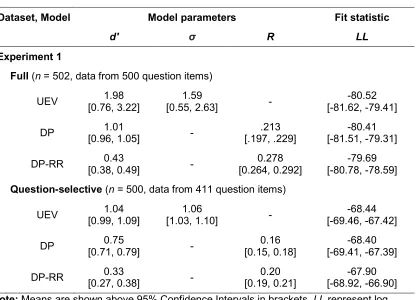
Across both the full dataset and the question-selective subset, the DP-RR model curve shows the most consistent overlap with all of the observed ROC points. The UEV and DP models both show an overshoot of points in the middle range, with this particularly prominent for the UEV model fit to the full dataset (Figure 2A). The UEV and DP models also show an undershoot in the upper right as they both tend to [1, 1]. (The descriptives summarising the parameters used to generate each ROC curve are shown in Table 1.) The zROCs for both datasets are also best accommodated by the DP-RR model. The curves at both upper and
lower aspects of the line are accommodated by the DP-RR model, but cannot be accommodated by the linear UEV model or the single curve of the DP model.
Given the close correspondence between the full dataset and the question-selective subset, and the risk of biasing our results towards best fitting the DP-RR model, we use only
question-selective data in future analyses.
(Figure 2 about here) (Table 1 about here)
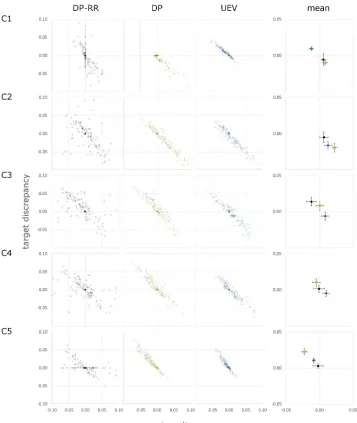
ROC curves and zROC lines based on averaged model parameters do not necessarily best represent the fit/misfit of the models on a per participant basis. We therefore illustrate each participant’s model misfit (estimated ROC point position relative to the observed position) for each ROC criterion point in Figure 3. Examination of the scatterplots reveals that the DP-RR model is noisier in its fits than the UEV and DP models, though the overall mean misfit, reflecting the averaged model fits, shows less systematic bias (mean misfit point closer to the origin). To formally asses the absolute misfit at each point, we calculated Euclidean misfit distances (shown in Figure 4) and entered these values into a 3 (model: UEV; DP; DP-RR) x 5 (ROC point) ANOVA. As suggested by the scatterplots, there was a main effect of model, F(2, 1010) = 52.57, p < .001, ηp2 = .094, with the DP-RR model showing greatest absolute misfit (M = .044, [.042, .047]) relative to the DP (M = .037, [.036, .039]) and UEV (M
= .035, [.033, .036]) models. (There was also a significant main effect of ROC point, F(4, 2020) = 107.01, p < .001, ηp
2
= .175, and a significant interaction, F(8, 4040) = 117.22, p < .001, ηp2 = .188.) These two illustrations suggest that, whilst the DP-RR model’s shape appears to best accommodate group data from the semantic memory task, misfit on the participant level may be higher for the novel model compared to the two established models. We now turn to analysis of the fit statistics to assess whether misfit is indeed greater for the DP-RR model than the others.
(Figure 3 about here) (Figure 4 about here)
Log likelihood (LL) parameters represent the probability of the data given the parameter estimates. They are always negative, with more positive (closer to 0) values indicating better model fits. We calculated LL for each participant (see Table 1 for descriptives) and entered the parameters for the question-selective dataset into a three-way (model: UEV, DP, DP-RR) repeated measures ANOVA (identical analysis of the full dataset yielded revealed the same effects). There was a significant difference in LL according to model, F(2,998) = 69.82,
p < .001, ηp 2
= .123, with the DP-RR model yielding better (more positive) fits than the other two models. This advantage in the fit statistics was borne out in the proportion of participants for whom the DP-RR model was best fitting, compared to the UEV and DP models: .538, .318 and .144 respectively, χ2(2) = 116.96, p < .001. It should be noted that the UEV and DP models both typically account for ~99.9% of variance in standard episodic ROCs (e.g. O’Connor, Guhl, Cox & Dobbins, 2011), meaning that these DP-RR advantages are noteworthy.
The majority of analyses support the DP-RR model as best characterising semantic memory retrieval within these recognition tests. The proximity of points to the upper and left bounds in the ROC, alternatively represented by the curve at upper and lower aspects of the zROC are not well accommodated by either the UEV or DP models (Figure 2). Conversely, the DP-RR model, which affords recollection-like benefit to both the high confidence identification of targets and the high confidence rejection of lures, best estimates the parameters
characterising retrieval here. Although fits to the DP-RR model are noisier than to competing models, they result in less systematic deviation from the observed data (Figures 3 and 4) and as a result yield significantly better fit parameters than the UEV and DP models. In sum, Experiment 1 demonstrates that semantic retrieval does indeed display an ROC marker of a
recollection-like threshold process (albeit operationalized slightly differently to episodic recollection), and we proceed to Experiment 2 with the aim of using the DP-RR model to best recover semantic retrieval threshold parameters to for within-subjects comparison with episodic retrieval threshold parameters.
EXPERIMENT 2
We next looked for indication of whether semantic and episodic threshold retrieval share the same underlying process – whether the semantic threshold retrieval process is comparable to recollection from to episodic memory. To this end, we administered the semantic
recognition test from Experiment 1 alongside an analogous episodic recognition task. A correlation between the recovered semantic and episodic threshold parameters could indicate some association which could be explored with further analyses. Experiment 2 also allowed us to attempt to replicate the findings from Experiment 1 using an independent sample. Thus, we first compared recognition fits to the three models, before using the model parameters recovered from these fits to search for an association in threshold parameters across tasks.
METHODS Stimuli
As in Experiment 1, Experiment 2 was programmed using JavaScript and presented to participants via their internet browsers.
Semantic Test. The 411 general knowledge questions used in the question-selective subset of Experiment 1 were used in the semantic test. For each participant, a random sample of 50 semantic questions (25 targets, 25 lures) was drawn from this question pool.
Episodic Test. A word pool comprising 2200 singular, common nouns from the English Lexicon Project (Balota et al., 2007) was used in the episodic test. A Hyperspace Analogue
to Language (HAL) frequency high-pass cut-off of 7.70 served to exclude highly distinctive items (final word list characteristics: mean HAL frequency = 8.98, mean word length = 7.24, mean number of syllables = 2.43). For each participant, a random sample of 100 episodic memory questions was administered in a single study-test block. Fifty words presented at both study and test (targets) and 50 words were presented only at test (lures).
Participants
316 participants (115 men, 187 women, 14 did not disclose sex) completed the online experiment. Recruitment and ethics procedures were identical to those in Experiment 1. Of the 301 who disclosed their age, mean reported age was 27.7 years (SD = 11.8). Once again, we found no differences in EV d' between the 240 participants who reported that English was their first language and the 62 participants who reported that it was not (semantic: first language M = .684 [.624, .744], second language M = .692 [.581, .803]; episodic: first language M = 2.00 [1.87, 2.13], second language M = 2.10 [1.92, 2.27]). Similarly we found no differences in EV c over the two memory tests (semantic: first language M = -.146 [-.183, -.108], second language M = -.178 [-.256, -.100]; episodic: first language M = .061 [.018, .103], second language M = .125 [.022, .228]). We included all participants in subsequent analyses.
Design and Procedure
Onscreen instructions were followed by the episodic study-test block, and then the semantic test block. In the episodic study phase, a 0.5 s fixation cross preceded each self-paced study trial (RT M = 2.30 s). During each study trial, the fixation was replaced by a word presented in 850% font size in the middle of the screen. Below the word was a task cue “syllables?” (220% font), and six response buttons, 1 to 6+. Participants could use a
keyboard or touchscreen (where available) to respond. After a response had been rendered, the fixation period before the next trial was initiated. After 50 study trials, the episodic test phase was initiated. A 0.5 s fixation again preceded each self-paced test trial. Test words
(850% font) were presented in the middle of the screen, above the task cue “recognition?” (220% font). The six responses buttons were, from left to right: new sure 1, new probably 2, new guess 3, old guess 4, old probably 5, old sure 6. Once the 100th trial had been
responded to, participants were taken to the self-paced semantic test, which was a slightly shorter version of that described for Experiment 1 (50 rather than 60 trials). The semantic test was followed by a debrief, which provided feedback on participant accuracy and confidence across the two tests.
RESULTS Item Selection
We excluded responses with response times exceeding 10s. In the semantic test, we excluded 4.97 [4.33, 5.60] responses per participants, which reduced mean response times from 6.16 s [5.91 s, 6.41 s] to 5.18 s [5.06 s, 5.30 s]. For the episodic test, although
participants would not have been able to look up the answers online, for consistency we applied the same response exclusion criteria, excluding 0.67 [0.50, 0.85] responses per participant, which reduced overall response times from 2.10 s [2.01 s, 2.18 s] to 2.00 s [1.94 s, 2.07 s].
The overall semantic test EV d' of .688 [.630, .745] was lower than in the question selective subset of Experiment 1, suggesting the 411 semantic items used did not result in
excessively high sensitivity responses. (Mean EV c was -.176 [-.212, -.140]). We therefore proceeded with the analyses without excluding any additional semantic items.
Receiver Operating Characteristics and Model Fits
We first addressed how the competing models from Experiment 1 would fit the data obtained in each memory test. We anticipated that the DP-RR model would best fit semantic retrieval responses, whereas one of the established models for episodic recognition would best fit episodic retrieval responses.
We used an analytic procedure identical to that used in Experiment 1. Successful fits were obtained in 309 participants (98.1%) for the semantic task and in 280 participants (88.9%) for the episodic task. The difference here is likely driven by the difference in d' over the two tasks. Mean EV d' for the semantic task, 0.70 [0.64, 0.76] was far lower than for the episodic task, 1.99 [1.88, 2.10]. Although this sensitivity disparity is potentially problematic when adjudicating model fits, we restrict the bulk of our analyses below to sensitivity-matched subsamples.
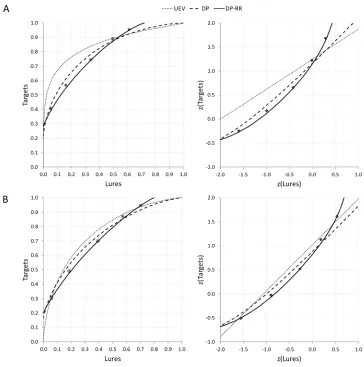
Figure 5A uses the whole sample to plot the average observed ROC points against average predicted ROC curves for semantic and episodic tasks. Once again, for the semantic task, the points are approximately symmetrical about y = 1 - x and inconsistent with an ROC that tends to [1, 1]. In contrast, the episodic task ROC shows points that could be from an ROC that tends to [1, 1]. To best ensure that subsequent findings were attributable to the tasks themselves and not differences in sensitivity associated with each task outlined above, for the remainder of this section, we report analyses applied to subsamples whose sensitivity were comparable (though descriptive for the full sample are shown in Table 2 and all patterns of significance were almost identical across full and sensitivity-matched
subsamples). For the semantic task, we used a high-pass filter of 0.875, applied to EV d', yielding 109 participants with mean EV d' of 1.24 [1.18, 1.30]. For the episodic task, we used a low-pass filter of 1.925, applied to the EV d' estimate, yielding 108 participants with mean EV d' of 1.26 [1.07, 1.44]. Figure 5B plots the average observed ROC points and average predicted ROCs from fits to these subsamples. Once again, the proximity of semantic ROC points to the top boundary, suggests a better fit for the DP-RR model to the semantic data, though the best-fitting model for the episodic data is less obvious.
(Figure 5 about here)
We first examine analyses of data from the semantic recognition task. Whilst the DP-RR model appears to best fit the data on a group-averaged level, the misfit scatterplot in Figure 6 once again shows that the DP-RR fits are noisier than those for the competing models, though with less systematic deviation (as demonstrated by reduced deviation from [0, 0] in the mean plots). Absolute misfit distances (Figure 8 Panel A) in a 3 (model) x 5 (ROC point) ANOVA demonstrated a main effect of model, F(2, 216) = 19.79, p < .001, ηp2 = .155, with DP-RR showing greatest absolute misfit (M = .039, [.035, .043]) relative to the DP (M = .034, [.031, .037]) and UEV (M = .028, [.025, .030]) models. (There was also a significant main effect of ROC point, F(4, 432) = 17.65, p < .001, ηp2 = .140, and a significant interaction, F(8, 864 = 13.29, p < .001, ηp
2
= .110.)
(Figure 6 about here)
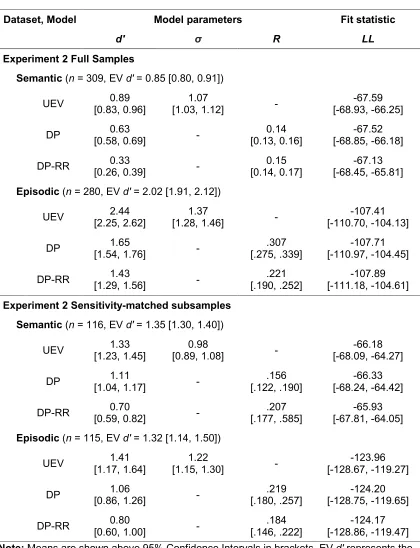
In spite of the misfit distances, LL fitstatistics (Table 2) again showed that the semantic data within the sensitivity-matched sample are best accommodated by the DP-RR model.
Entered into a repeated measures ANOVA, a significant effect of model on LL was found,
F(2,216) = 10.24, p < .001, ηp2 = .087, with the DP-RR model yielding better fits than the other two models. This advantage in the fit statistics was borne out in the proportion of participants for whom the DP-RR model was best fitting, compared to the UEV and DP models: .495, .385 and .119 respectively, χ2(2) = 24.46, p < .001. Thus, these data from the semantic task in Experiment 2 replicated those of Experiment 1 in ROC shape, misfit distance and model fit.
(Table 2 about here)
Moving to the episodic recognition task, group-averaged ROC fits appear more ambiguous as to the best-fitting model, but the misfit scatterplot in Figure 7 shows that the DP-RR fits are again noisier than those for the competing models. This time, and in contrast to the means plots in Figure 6, Figure 7 shows that the DP-RR model yields more systematic misfit (greater mean deviation from [0, 0]) than the competing models. Absolute misfit distances (Figure 8 Panel B) in a 3 (model) x 5 (ROC point) ANOVA yielded a main effect of model,
F(2, 214) = 19.48, p < .001, ηp2 = .154, with DP-RR showing greatest absolute misfit (M = .024, [.020, .027]) relative to the DP (M = .017, [.016, .019]) and UEV models (M = .016, [.014, .018]). (There was also a significant main effect of ROC point, F(4, 428) = 35.10, p < .001, ηp2 = .247, and a significant interaction, F(8, 856) = 18.89, p < .001, ηp2 = .150.)
(Figure 7 about here)
(Figure 8 about here)
Consistent with the more ambiguous ROC fits, LL fitstatistics were less clear-cut for the episodic data. There was no significant effect of model on LL in a repeated-measures ANOVA, F(2,214) = 1.03, p = .360, ηp
2
= .009, and although the UEV model yielded
numerically better fits than its competitors, the LL values are all very close. Overall, the DP-RR model’s advantage in fitting semantic data is lost when applied to episodic data, with the UEV model fitting a greater proportion of participants best, compared to the DP-RR and DP models: .491, .287 and .222 respectively, χ2(2) = 12.72, p = .002. These new data from the episodic task in Experiment 2 demonstrate that the DP-RR model is not a generally better-fitting model for all recognition tasks, but is specific in its advantage for certain tasks – in this case to data obtained from the semantic recognition tasks of Experiments 1 and 2.
Having established that DP-RR-recovered threshold process parameters are reliable and specific in quantifying responses to semantic recognition memory responding, we now
proceed to test the association between within-subjects semantic and episodic threshold process estimates using the two models that provide such an estimate: the novel DP-RR model within semantic data, and the established DP models within episodic data.
Association between Semantic and Episodic Threshold Process Estimates
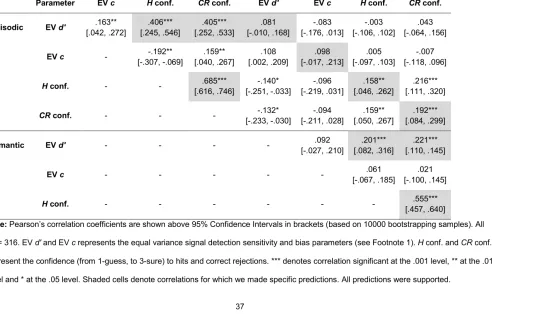
As a preliminary check, we first examined the full sample correlations between EV d' and c
parameters and mean confidence responses to hits and correct rejections. Within episodic and semantic tasks, we anticipated that: i) d' would be positively correlated with both hit and correct rejection confidence; and ii) the two confidence means would be positively
correlated. We also anticipated that: iii) each of the four parameters would be positively correlated with its cross-domain equivalent. Table 3 (shaded cells) shows that these
predictions were largely supported by the data, but there was no correlation across domains between the EV d' or the c parameters.
(Table 3 about here)
We then proceeded to the main correlation analysis testing the association between the threshold parameters (R) estimated for semantic and episodic tasks. To do this we identified all participants for whom both the DP-RR model had recovered a fit for their semantic task responses and the DP model had recovered a fit for their episodic task responses. This left 278 participants (88.3% of the original full sample). In this subsample, mean semantic EV d'
was 0.69 [0.63, 0.76] and mean episodic EV d' was 1.99 [1.88, 2.10].
As a preliminary check, we found no correlation between the equal variance d' parameters across the two tasks, r(276) = .031, 95% CIs based on 10000 bootstrapping samples = [-.066, .121], p = .609. As in the full sample, in the subsample there was no significant relationship between participants’ abilities to discriminate true from false general knowledge questions in the semantic test and their abilities to recognise old from new words in the
episodic test. We proceeded to test the correlation between semantic DP-RR and episodic DP R parameters, as an association between the two (such as one driven by a reliance on the same retrieval process) could be hidden by a divergence in other processes contributing to overall sensitivity. No association whatsoever was observed between semantic and episodic R parameters, r(276) = -.001 [-.122, .120], p = .987, (see Figure 9; there was also no correlation between respective DP-RR and DP d' parameters recovered using the same fitting procedures r[276] = .085 [ -.048, .215], p = .156). In case a true association between threshold parameters was masked by R parameters estimated to be 0, we removed all participants with DP-RR or DP R parameters less than 0.01 and ran a second correlation, also showing no relationship, r(153) = .065 [ -.099, .225], p = .421. Thus, we found no association between the two threshold processes we propose contribute to semantic and episodic retrieval.
(Figure 9 about here)
DISCUSSION
We used a novel single-item semantic recognition task to find evidence for a recollection-like threshold retrieval process within semantic memory. In Experiment 1 we found that the DP-RR model, a variation of the dual process model that allows recollection to contribute to both the identification of targets and the rejection of lures, provides better fits to the observed data than the unequal variance single process model and the standard dual process model. In Experiment 2 found the DP-RR model fitting advantage was specific to our semantic test, and does not persist in the standard single-item episodic recognition test. Finally, we used the threshold parameters recovered using these fitting procedures and found there to be no association between the relative magnitudes of the threshold parameters recovered in semantic and episodic recognition.
Our experimental task recovered ROCs indicating the presence of a process analogous to episodic recollection in semantic memory. This finding is consistent with that of Waidergoren and colleagues’ (2012) study using a semantic process dissociation task, but used an independent experimental paradigm to recover this convergent result. Specific to our procedure, the ROC model that best fit semantic recognition responding incorporated a recollection parameter necessary for dual process accounts of episodic memory (Yonelinas, Aly, Wang & Koen, 2010). Using the same terms as are used to justify similar patterns in episodic tasks, our results show that semantic memory retrieval includes a process by which we are able to identify answers to questions assessing knowledge as unambiguously true. This process likely draws on the recovery of contextualising information e.g. “I know with high certainty that Canberra is the capital of Australia because i) the capital isn’t Sydney, ii) Canberra is in a territory called the Australian Capital Territory, and iii) I remember seeing the Aboriginal Tent Embassy outside Parliament House when I visited Canberra.” This third contextual point is an example where episodic recollection can provide context for semantic knowledge, but we argue that the semantic threshold process is not necessarily dependent upon episodic content: we can imagine that a number of different sources of information can bring to bear on recognition decisions. Nonetheless, this raises a potentially important consideration for those looking to extend this finding further. Whereas the mappings of responses to components of dual process episodic memory models are considered fuzzy because of the lack of process purity (high confidence target recognition can be justified by
both recollection and familiarity; Wixted, 2007), there is in this case a lack of ‘system purity’ in the putative dual process semantic memory system. Episodic and semantic content may well be used to justify semantic recollection-like retrieval.
This proposed system impurity revisits a similar crossover in the origins of the episodic dual process account. Tulving (1985) originally intended the RK procedure to differentiate episodic material (R responses) from semantic material (K responses). Indeed, such a taxonomy without consideration of more recent work, would have led us to hypothesise that
semantic retrieval should recruit only a single process, familiarity. Importantly though, Tulving’s system distinction became a process distinction as episodic recognition
researchers began to consider these responses qualitatively different, but both within the episodic memory system (e.g. Gardiner, 1988). Taken together, these system and process impurities point to flexible memory arrangements within which content consistent with response justification, regardless of domain, can be amalgamated. As regards our
examination of semantic memory processes, a RK procedure requiring participants to give justifications could provide a better indication of the breakdown of episodic and semantic justifications. We can also envisage scenarios in which non-memorial reasoning and problem-solving processes might contribute to responses, and could therefore be
considered influential of a memory decision-making system drawing on a range of cognitive processes. In the first instance though, it is clear that Tulving’s taxonomy continues to require revision, with mounting evidence that content and processes which would previously have been considered exclusively episodic, weighing in on semantic retrieval too.
A consistent finding across our two experiments is the overall advantage the DP-RR model showed in accommodating the semantic ROC data. Although both dual process models incorporate the threshold process aiding target detection, the key advantage for the DP-RR model is its ability to model the upper intercept as [1-R, 1]. This intercept replaces the [1, 1] intercept observed in episodic recognition, and is indicative of a high-certainty lure rejection process unique to these particular semantic materials. We propose that this results from the mutual exclusivity of our semantic questions, which afford the following reasoning: “If the answer to the question is Ahab then it cannot also be Ishmael”. Such recall-to-reject strategies can apply in episodic memory too, as discussed earlier (e.g. Rotello et al. 2000). These apply especially where one has to differentiate between two familiar stimuli. But, in typical item-by-item tests of episodic recognition memory, the reasoning “‘table’ was not a studied word, because ‘apple’ was” does not hold. Thus, recollection-like retrieval
contributes to semantic recognition responses but, given the mutual exclusivity of target and
lure options for each semantic question, its utility here is two-fold, to confirm targets and to reject lures.
We suggest that this deviation from what would be expected based on standard episodic ROCs is driven by the nature of the semantic task used. If we had used a semantic task for which correct answers were not mutually exclusive, we would likely have observed an asymmetric benefit to targets, and not lures, akin to that observed in episodic recognition. More generally, in considering how to refine the present findings, we believe it is important to disentangle the question format from the memory store interrogated. If it is taken that
recollection operates within both semantic and episodic systems, the mutual exclusivity of the cue-probe combination should be what determines whether the DP or the DP-RR best fits data obtained from either system. We contend that responses to general knowledge questions which have more than one answer (e.g. “The following word was invented by Shakespeare:” where any number of words could be correct) would be more likely to be best fit by the DP rather than the DP-RR model (though this also depends on the recollective affordance of the lure probe). Alternatively, an episodic paired-associate recognition task in which retrieval of the target would rule out the lure, would be best fit by the DP-RR task. Such tasks would go some way towards demonstrating the format-dependent utility of a threshold retrieval process in all forms of memory decision-making.
Having found that the overall pattern of results points towards the DP-RR model best fitting the semantic data, it is curious that the same model produces greater absolute misfit distances than its competitors. An insight into why this might be can be found from examination of the correlations between absolute misfit distances across criterion points. There are 10 correlations (C1-C2, C1-C3 ] C4-C5), over which the Experiment 1 grand average correlation r is .532 [.452, .612] for the DP-RR model, .173 [.075, .271] for DP and .288 [136, 441] for UEV. That the DP-RR model shows greatest coherence in its misfit could
result from it providing fair fits across all points, rather than good fits for most, compared to an excellent/bad fit for the remaining one or two points.
Relatedly, a modification of the DP-RR model which would have improved the absolute misfit as well as the overall fits, would be to remove the yoking of target identification- and lure rejection-aiding recollective processes. Whilst the questions/cues remain identical across target/lure trials, the probes themselves have the potential to elicit differing
recollective response—in addition to recall and recollection cued by the question, a target probe may in itself trigger recollection of context that confirms its status, whilst a lure probe may trigger context that disconfirms it as the correct response. Operationalising this in a signal detection model straightforward (indeed, it is provided as a model within Koen et al.’s 2014 ROC toolbox), but it would necessitate an additional parameter relative to the two established models. We wanted to avoid this in the first instance—there are issues with using fit statistics that penalise for additional parameters, see Supplementary Material B— and the LL fits suggest that in spite of this constraint, the DP-RR model is largely superior to its competitors in its fits. Both issues remain to be fully elucidated, but should not detract from the overall superiority of the DP-RR model, even in its current form, when it comes to fitting the semantic data.
A criticism of the presented data, which led to knock-on effects for our analyses, concerns the sensitivity discrepancy between the episodic and semantic tests of Experiment 2. Episodic task performance was far higher than semantic performance, meaning that any differences in fits across task could have been attributed to the models’ capacities to fit at differing sensitivities, rather than their capacities to fit based on the tasks themselves. Our solution here was to restrict our sample to subsamples with matched sensitivities, and while this overcame the problem of differential sensitivity, it removed the within-subjects strength of the Experiment 2 design. It would have been preferable to have been able to use the same samples for both sets of fits, and this is a design consideration to be borne in mind
both for future studies and the interpretation of the correlations between R parameters derived from these two tests.
We found no association between the contributions of semantic and episodic threshold parameters to recognition performance in each domain. Significant R-parameter correlations estimated using three different recognition tasks (albeit within the same episodic memory system), have previously been found within subjects (e.g. Koen & Yonelinas, 2016), suggesting that this approach yields correlations when performance depends on the same underlying process. Thus, it would be tempting to argue that the absence of a relationship across our tasks indicates that the two threshold processes identified are not unitary. The opposite case would have been far easier to make if a significant correlation had been found (though with the caveat that third variables can underpin shared variance in cognition), but it is not possible to argue convincingly that the absence of a correlation indicates the absence of a relationship.
A number of factors, not least the previously discussed sensitivity discrepancy across tests, may have contributed to the present results. The varied nature of the semantic task,
compared to the episodic task, may have played a role in masking any association between
R parameters. There are vast individual differences in the near limitless domains of semantic knowledge. While the within-subjects tendency to retrieve context to support semantic judgements could be static, if Participant A is only able to draw on very little contextual material to support rejection of a pop music lure, but Participant B’s interest in the subject furnishes them with far contextual material, it follows that Participant B will show greater evidence of recollection than Participant A, regardless of their individual tendencies. We can also return to discussion of the system purity of semantic and episodic retrieval to explain any lack of an association. Some semantic questions may have been easier if the
participant had reasoned the target as true or the lure as false. For the episodic task, some participants may have been better able to sustain attention to the study list than others,
thereby enhancing encoding. Thus, reasoning and attention abilities may contaminate the estimates of R, further diluting the chances of finding an association. Greater experimental control could go some way towards eliminating these confounds. For example, there is the intriguing possibility of having participants study artificial semantic material under controlled conditions, which is then tested both episodically and semantically. However, such a procedure lay outwith the realms of the current set of online experiments, and the question of whether the absence of an association indicates the true absence of a mechanistic relationship remains to be answered.
As a starting point for theoretical discussions, our results suggest that semantic and episodic memory systems recruit multiple retrieval processes which show parallels in function. More intriguingly, they open the door to the possibilities of both convergence and divergence within the same threshold process, applied to retrieval from different memory stores. In applying established episodic memory analysis techniques to the study of semantic memory, we have produced further evidence to suggest we should rethink widely held assumptions of how we bring knowledge to mind.
REFERENCES
Arndt, J., & Reder, L.M. (2002). Word frequency and receiver operating characteristic curves in recognition memory: evidence for a dual-process interpretation. Journal of
Experimental Psychology: Learning, Memory, and Cognition, 28(5), 830-842. http://dx.doi.org/10.1037/0278-7393.28.5.830
Balota, D.A., Yap, M.J., Cortese, M.J., Hutchison, K.A., Kessler,B., Loftis, B., et al (2007). The English lexicon project. Behavior Research Methods, 39, 445–459.
http://dx.doi.org/10.3758/BF03193014
Bowles, B., Harlow, I.M., Meeking, M.M. & Köhler, S. (2012). Discriminating famous from fictional names based on lifetime experience: evidence in support of a signal-detection
model based on finite mixture distributions. Journal of Experimental Psychology: Learning, Memory, and Cognition, 38, 78-91. http://dx.doi.org/10.1037/a0025198 Bowles, B. & Köhler, S. (2014). Availability of semantic knowledge in familiar-only
experiences for names. Journal of Experimental Psychology: Learning, Memory, and Cognition, 40, 724-737. http://dx.doi.org/10.1037/a0035584
Conway, M.A., Gardiner, J.M., Perfect, T.J., Anderson, S.J. & Cohen, G.M. (1997). Changes in Memory Awareness During Learning: The Acquisition of Knowledge by Psychology Undergraduates. Journal of Experimental Psychology: General, 4, 393-413.
http://dx.doi.org/10.1037/0096-3445.126.4.393
Donaldson, W. (1996). The role of decision processes in remembering and knowing.
Memory & Cognition, 24(4), 523-533. http://dx.doi.org/10.3758/BF03200940 Dunn J.C. (2004) Remember–know: A matter of confidence. Psychological Review, 111,
524–542. http://dx.doi.org/10.1037/0033-295X.111.2.524
Gardiner, J.M. (1988). Functional aspects of recollective experience. Memory & Cognition, 16, 309-313. http://dx.doi.org/10.3758/BF03197041
Green, D.M., & Swets, J.A. (1966). Signal detection theory and psychophysics. New York: Wiley.
Heathcote, A. (2003). Item recognition memory and the receiver operating characteristic.
Journal of Experimental Psychology: Learning, Memory, and Cognition, 29, 1210– 1230. http://dx.doi.org/10.1037/0278-7393.29.6.1210
Jacoby, L.L. (1991). A Process dissociation framework: Separating automatic from intentional uses of memory. Journal of Memory and Language, 30, 513-541. http://dx.doi.org/10.1016/0749-596X(91)90025-F
Klein, S.B. (2013). Making the case that episodic recollection is attributable to operations occurring at retrieval rather than to content stored in a dedicated subsystem of long-term memory. Frontiers in Behavioral Neuroscience, 7:3.
http://dx.doi.org/10.3389/fnbeh.2013.00003
Koen, J.D., Barrett, F.S., Harlow, I.M. & Yonelinas, A.P. (2014). ROC Toolbox Manual.
Davis: The Regents of the University of California.
Koen, J.D. & Yonelinas, A.P. (2016). Recollection, not familiarity, decreases in healthy ageing: Converging evidence from four estimation methods. Memory, 24, 75-88. http://dx.doi.org/10.1080/09658211.2014.985590
Macmillan, N.A., & Creelman, C.D. (2005). Detection theory: A user’s guide (2nd ed.). New York: Lawrence Erlbaum.
Mickes, L., Wais, P.E. & Wixted, J.T. (2009) Recollection is a continuous process.
Psychological Science, 20, 509-515. http://dx.doi.org/10.1111/j.1467-9280.2009.02324.x
Mill, R.D., & O’Connor, A.R. (2014). Question format shifts bias away from the emphasised response in tests of recognition memory. Consciousness and Cognition, 30, 91-104. http://dx.doi.org/10.1016/j.concog.2014.09.006
O’Connor, A.R., Guhl, E.N., Cox, J.C. & Dobbins, I.G. (2011). Some memories are odder than others: Judgments of episodic oddity violate known decision rules. Journal of Memory and Language, 64, 299-315. http://dx.doi.org/10.1016/j.jml.2011.02.001 Payne, D.G., Elie, C.J., Blackwell, J.M. & Neuschatz, J.S. (1996). Memory illusions:
Recalling, recognizing, and recollecting events that never occurred. Journal of Memory & Language, 35, 261–285. http://dx.doi.org/10.1006/jmla.1996.0015
Ratcliff, R., Sheu, C.-F., & Gronlund, S.D. (1992). Testing global memory models using ROC curves. Psychological Review, 99, 518–535.
http://dx.doi.org/10.1037/0033-295X.99.3.518
Rotello, C.M., Macmillan, N.A., & Van Tassel, G. (2000). Recall-to-reject in recognition: Evidence from ROC curves. Journal of Memory and Language, 43(1), 67-88. http://dx.doi.org/10.1006/jmla.1999.2701
Shiffrin, R.M. & Steyvers, M. (1997). A model for recognition memory: REM—retrieving effectively from memory. Psychonomic Bulletin & Review, 4, 145-166.
http:dx.doi.org/10.3758/BF03209391
Snodgrass, J.G., & Corwin, J. (1988). Pragmatics of measuring recognition memory: Applications to dementia and amnesia. Journal of Experimental Psychology: General, 117(1), 34–50. http://dx.doi.org/10.1037/0096-3445.117.1.34
Suddendorf, T., & Corballis, M.C. (1997). Mental time travel and the evolution of the human mind. Genetic, social, and general psychology monographs, 123(2), 133-167.
Tulving, E. (1985). Memory and consciousness. Canadian Psychology/Psychologie Canadienne, 26(1), 1-12. http://dx.doi.org/10.1037/h0080017
Vilberg, K.L. & Rugg, M.D. (2008). Memory retrieval and the parietal cortex: a review of evidence from a dual-process perspective. Neuropsychologia, 46, 1787-99. http://dx.doi.org/10.1016/j.neuropsychologia.2008.01.004
Waidergoren, S., Segalowicz, J. & Gilboa, A. (2012). Semantic memory recognition is supported by intrinsic recollection-like processes: “The butcher on the bus” revisited.
Neuropsychologia, 50, 3573-3587.
http://dx.doi.org/10.1016/j.neuropsychologia.2012.09.040
Wixted, J.T. (2007). Dual-process theory and signal-detection theory of recognition memory.
Psychological Review, 114, 152-176. http://dx.doi.org/10.1037/0033-295X.114.1.152 Yonelinas, A.P. (1994). Receiver-operating characteristics in recognition memory: evidence
for a dual-process model. Journal of Experimental Psychology: Learning, Memory, and Cognition, 20(6), 1341-1354. http://dx.doi.org/10.1037/0278-7393.20.6.1341
Yonelinas, A.P. (2001). Components of episodic memory: The contribution of recollection and familiarity. The Philosophical Transactions of the Royal Society of London Series B, 356(1413), 1363-1374. http://dx.doi.org/10.1098/rstb.2001.0939
Yonelinas, A.P. (2002). The nature of recollection and familiarity: A review of 30 years of research. Journal of memory and language, 46(3), 441-517.
http://dx.doi.org/10.1006/jmla.2002.2864
Yonelinas, A.P., Aly, M., Wang, W., & Koen, J.D. (2010). Recollection and familiarity: examining controversial assumptions and new directions. Hippocampus, 20(11), 1178-1194. http://dx.doi.org/10.1002/hipo.20864
Yonelinas, A.P., Dobbins, I., Szymanski, M.D., Dhaliwal, H.S., & King, L. (1996). Signal-detection, threshold, and dual-process models of recognition memory: ROCs and conscious recollection. Consciousness and cognition, 5(4), 418-441.
http://dx.doi.org/10.1006/ccog.1996.0026
Yonelinas, A.P., Kroll, N.E., Dobbins, I., Lazzara, M., & Knight, R.T. (1998). Recollection and familiarity deficits in amnesia: convergence of remember-know, process dissociation, and receiver operating characteristic data. Neuropsychology, 12(3), 323-339.
http://dx.doi.org/10.1037/0894-4105.12.3.323
TABLES WITH CAPTIONS
Table 1: Experiment 1 model parameters and fit statistics for the competing signal detection models
Dataset, Model Model parameters Fit statistic
d' σ R LL
Experiment 1
Full (n = 502, data from 500 question items)
UEV 1.98
[0.76, 3.22]
1.59
[0.55, 2.63] -
-80.52 [-81.62, -79.41]
DP 1.01
[0.96, 1.05] -
.213 [.197, .229]
-80.41 [-81.51, -79.31]
DP-RR 0.43
[0.38, 0.49] -
0.278 [0.264, 0.292]
-79.69 [-80.78, -78.59] Question-selective (n = 500, data from 411 question items)
UEV 1.04
[0.99, 1.09]
1.06
[1.03, 1.10] -
-68.44 [-69.46, -67.42]
DP 0.75
[0.71, 0.79] -
0.16 [0.15, 0.18]
-68.40 [-69.41, -67.39]
DP-RR 0.33
[0.27, 0.38] -
0.20 [0.19, 0.21]
-67.90 [-68.92, -66.90] Note: Means are shown above 95% Confidence Intervals in brackets. LL represent log likelihood parameters summarising each model’s goodness of fit. A higher LL value indicates a better model fit.