http://wrap.warwick.ac.uk
Original citation:
Pogrebna, Ganna (2015) Servitization through human-data interaction : a behavioural approach. Working Paper. Coventry: Warwick Manufacturing Group. WMG Service Systems Research Group Working Paper Series (Number 05/15).
Permanent WRAP url:
http://wrap.warwick.ac.uk/67283
Copyright and reuse:
The Warwick Research Archive Portal (WRAP) makes this work by researchers of the University of Warwick available open access under the following conditions. Copyright © and all moral rights to the version of the paper presented here belong to the individual author(s) and/or other copyright owners. To the extent reasonable and practicable the material made available in WRAP has been checked for eligibility before being made available.
Copies of full items can be used for personal research or study, educational, or not-for-profit purposes without prior permission or charge. Provided that the authors, title and full bibliographic details are credited, a hyperlink and/or URL is given for the original metadata page and the content is not changed in any way.
A note on versions:
The version presented here is a working paper or pre-print that may be later published elsewhere. If a published version is known of, the above WRAP url will contain details on finding it.
WMG Service Systems Research Group
Working Paper Series
Servitization Through Human-Data
Interaction: A Behavioural Approach
_____________________________________________________________________
Ganna Pogrebna
About WMG Service Systems Group
The Service Systems research group at WMG works in collaboration with large organisations such as GlaxoSmithKline, Rolls-Royce, BAE Systems, IBM, Ministry of Defence as well as with SMEs researching into value constellations, new business models and value-creating service systems of people, product, service and technology.
The group conducts research that is capable of solving real problems in practice (ie. how and what do do), while also understanding theoretical abstractions from research (ie. why) so that the knowledge results in high-level publications necessary for its transfer across sector and industry. This approach ensures that the knowledge we create is relevant, impactful and grounded in research.
In particular, we pursue the knowledge of service systems for value co-creation that is replicable, scalable and transferable so that we can address some of the most difficult challenges faced by businesses, markets and society.
Research Streams
The WMG Service Systems research group conducts research that is capable of solving real problems in practice, and also to create theoretical abstractions from or research that is relevant and applicable across sector and industry, so that the impact of our research is substantial.
The group currently conducts research under six broad themes:
• Contextualisation
• Dematerialisation
• Service Design
• Value and Business Models
• Visualisation
• Viable Service Systems and Transformation
WMG Service Systems Research Group Working Paper Series
Issue number: 05/15
3
Servitization Through Human-Data Interaction: A Behavioural
Approach
Pogrebna, Ganna
Service Systems Group, Warwick Manufacturing Group University of Warwick, Gibbet Hill Road, Coventry CV4 7AL, UK
E-mail: [email protected]
Acknowledgement: Ganna Pogrebna acknowledges financial support via the EPSRC grant “Smart Me versus Smart Things: The Development of a Personal Resource Planning (PRP) System through Human Interactions with Data Enabled by the IoT”.
If you wish to cite this paper, please use the following reference:
WMG Service Systems Research Group Working Paper Series – 05/15 4
Abstract
This paper proposes a new approach to servitization and business models
Purpose:
by understanding behavioural aspects of human interactions with technology, specifically, with “smart” devices, connected devices, autonomous systems, and internet of things (IoT) through understanding and interacting with data which these devices and systems generate.
Proposed approach, Behavioural Human Data
Design/methodology/approach:
Interaction Hypothesis (Behavioural HDI Hypothesis), which differs from existing literature, leverages on research in behavioural science, data-driven business models, multi-sided markets, and Human-Data Interaction (HDI).
Behavioural HDI Hypothesis can offer a new approach to future markets for
Findings:
data because it helps to (a) predict consumer choice of product and services; (b) suggest new and improved interaction mechanisms between consumers and their self-generated data; and (c) propose a new approach for building and evaluating business models.
To date, very little has been known about whether and how
Originality/value:
consumers and households accumulate, review and use self-generated data about consumption decisions and how this affects market relationships between consumers and providers of goods and services. This paper shows how Behavioural HDI Hypothesis can make markets for data more efficient through better personalisation and servitization. It also has implications for data collection visibility, data ownership and structure, platform trade-off, security and other ICT-related challenges which negatively affect current business models in the digital economy.
servitization, data as a service, Human-Data Interaction (HDI), new
Key words:
WMG Service Systems Research Group Working Paper Series – 05/15 5
1. Introduction
The development of information and communication technology (ICT) in the modern economy has created opportunities for businesses to provide customised products, services and experiences to their customers. This customisation became possible due to large volumes of (personal) data which customers generate on a day-to-day basis and which businesses collect, store and analyse. For many businesses, the future relies on their ability to process the data in order to accurately predict consumer preferences and create personalised products, services and experiences in the most cost-effective way.
Yet, at the moment, data-driven business models through personalisation are still in their infancy as even companies with access to large amounts of data struggle to create reliable forecasts of future customer wants and needs to quickly react to changes in market trends. One of the most notable examples of forecasting inefficiency are so-called recommendation systems (available via major retailers) which are supposed to make suggestions about what a customer might like to purchase in the future, but which are in fact rarely used. Furthermore, we also do not see a development of effective markets for data where consumers of goods and services (henceforth, users) would trade their self-generated data with producers of goods and services (henceforth, providers) which inhibits an effective use of data as a service.
This paper first considers reasons for the current data market inefficiencies and then develops a model of market for data where users and providers interact to develop new business models utilising different types of data as well as different ways in which this data is perceived by the users. The proposed model – Behavioural Human-Data Interaction Hypothesis – is based on Data-Driven Business Models approach which explains how business models can be developed using data (e.g., Hartmann et al. 2014); an open multi-sided markets approach which offers an account of how new markets with multiple players can be created in the digital economy (Ng 2014); as well as research in Human-Data Interactions (HDI) research which explains how users interact with data (Mortier et al. 2014). This new Behavioural HDI Hypothesis is also rooted in behavioural science literature and has significant implications for new business models in the digital economy as well as offering important solutions for the currently existing ICT-related servitization problems such as data collection visibility, data ownership and structure, platform trade-offs, and security.
2. Markets for Data: Present And Future
2.1 Current Market for Data: Value and Worth
WMG Service Systems Research Group Working Paper Series – 05/15 6
price is relatively high as it allows providers to offer better (more personalised) goods and services to users and increase providers’ profitability via better understanding user demand for goods and services as well as via increasing user value. We define providers broadly – this could be companies which trade data, data analysts, app developers and providers of goods/services.
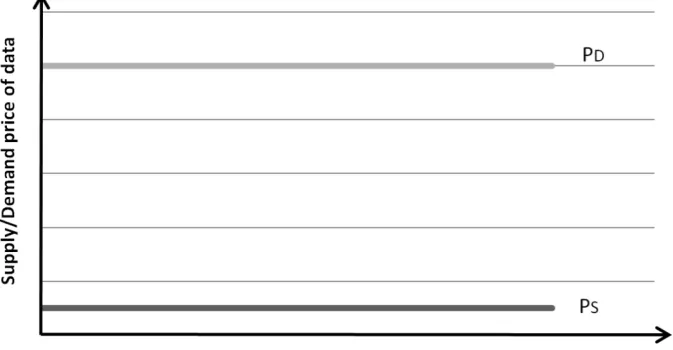
Users are willing to offer data at a supply price PS which is perceived by them as very low. On Figure 1 we choose a price level close to 0 in order to describe the level of PS (this is how much the data is worth to users). In practice, this price is not expressed in monetary terms, i.e., users do not directly receive any money from the providers. Instead, it reflects the “cost” of data to users in terms of, e.g., loss of privacy, etc.
Abstracting from different types of data as well as from different ways in which the data is perceived by users and providers, the level of PD and PS (shown using the vertical axis) remains stable irrespective of the quality of the data as a service
[image:7.595.132.469.370.545.2](shown using the horizontal axis). The data as a service variable depicts how effectively available data can be converted into meaningful business models (provision mechanisms). In other words, it reflects the value of the data for providers and users on the market.
Figure 1 Current Model of Market for Data
WMG Service Systems Research Group Working Paper Series – 05/15 7
Figure 1 shows that the current market is inefficient: since the disparity between the supply and demand price for data is very large, the data is not traded. In principle, providers are willing to pay PD to obtain the data, but users are offering the data at a very low price PS which means that providers can either (a) obtain the data themselves at a very low (or even zero) price in which case they receive a profit margin of PD –PS > 0 (e.g., Google, Facebook, etc.); or (b) purchase the data from other providers (intermediaries) at PD in which case intermediaries receive a profit margin PD –PS > 0. Note that the obtained/purchased data can be of low or high quality as captured by the data as a service variable and the demand/supply price does not depend on it.
2.2 Future Markets for Data Ignoring Behavioural HDI
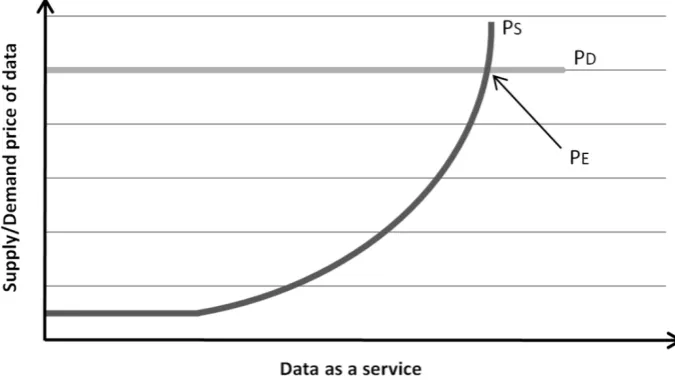
[image:8.595.127.465.387.578.2]In recent years, various issues were raised with regard to supply price for data. Specifically, the development of new technologies (e.g., Eckl and MacWilliams 2009) resulting in concerns about data ownership (e.g., Evans 2011), data privacy (Itani et al. 2009), as well as the inequality between users and providers in terms of profit distribution from data usage. Under these circumstances, user perceptions of data markets have changed giving rise to scepticism about the potential of trading data with providers. This sceptical view which ignores the fact that people interact with different types of data in a different way is depicted on Figure 2.
Figure 2 Future Model of Market for Data without Behavioural HDI
WMG Service Systems Research Group Working Paper Series – 05/15 8
would not be correct because it does not capture the complex human-data interactions within the digital economy.
3. Behavioural HDI Hypothesis and Its Impact on Business Models
3.1 Behavioural HDI Hypothesis
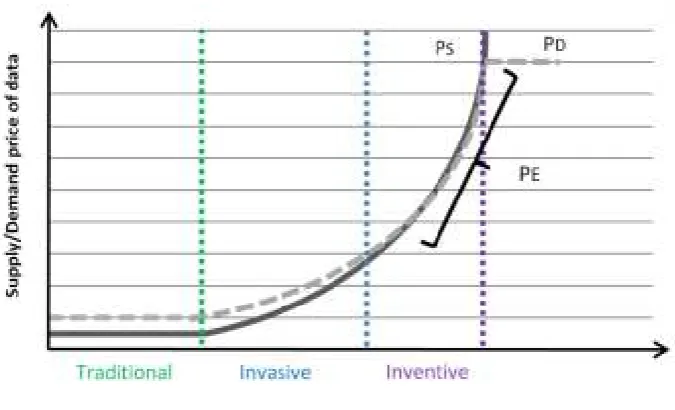
[image:9.595.144.479.287.380.2]The market structures presented in sections 2.1 and 2.2 do not take into account that different types of data which may be perceived by users differently. Yet, by applying Behavioural HDI Hypothesis we can show how different types of data (with different value to users and providers) can be successfully traded on the market for data. Behavioural HDI Hypothesis distinguishes between traditional data, invasive data, and inventive data (see Figure 3).
Figure 3 Data Types according to Behavioural HDI Hypothesis
The data types presented on Figure 3 differ by the amount of effort which a user needs to exert in order to engage with each type from low effort (traditional data) to high effort (inventive data). Due to the fact that users need to exert a different amount of effort to engage with each type of data, they will perceive the 3 types of data differently.
Traditional data involves minimum/low user effort because it is accumulated by technology which exists in the households of the majority of users. The data generated by this technology is reviewed by users on a regular basis and all users can easily assess this data (e.g., data from electricity meters, water meters and other “traditional” devices).
Invasive data involves medium user effort because it is accumulated by technology which is accessible and yet non-“standard”. For example, data from mobile applications (apps), smart home sensors, etc. requires for the user to install the apps or devises and learn how to read and understand self-generated data obtained through this technology. This type of data is called “invasive” because this data often influences human behaviour (e.g., fitness apps may make an individual exercise more).
Inventive data involves maximum/high user effort because it requires for the user to add relevant content to existing data accumulated through Internet-of-Things (IoT). Particularly, inventive data may require for the user to add context to the data
WMG Service Systems Research Group Working Paper Series – 05/15 9
collected through other devices. In other words, inventive data does not only tell an individual that electricity was used but also stores important information about who used it, when and which device was turned on. This type of data is called “inventive” because it requires the user to innovate or co-create together with providers in order to receive the best-quality informative data.
While traditional and invasive data is used, aggregated and analysed by providers as Content Data (data which provides information about action events but gives no context about these events such as, e.g., Big Data or Connected Data), inventive data is accumulated as Metadata (data which provides information about events in conjunction with their contexts).
3.2 Perceived Market for Data with Behavioural HDI Hypothesis
Since different types of data under Behavioural HDI Hypothesis are not perceived by users in the same way, we can modify Figure 2 to introduce different types of data and show how future markets for data may be affected by these different perceptions.
WMG Service Systems Research Group Working Paper Series – 05/15 10 Figure 4 Future Model of Market for Data with Behavioural HDI
Overall, under Behavioural HDI, different user perceptions of traditional, invasive, and inventive data will result in large portions of data being traded on the data market which will be beneficial for both users and providers. After reaching its maximum, PD will be flat due to the fact that providers have budget constraints and beyond a certain point even extremely valuable inventive data will become too costly for providers.
Behavioural HDI provides a system of market relationships through which providers can better fulfil users’ wants and needs by better understanding their preferences and offering better (more personalised) services. It also suggests new and improved interaction mechanisms between users and providers as they have an opportunity to directly trade data on the market. It also may offer new approaches for building and evaluating business models. Specifically, business models can be evaluated based on the user effort level necessary to engage with providers, the actual price at which the data is traded (top of bottom of the PE interval), etc.
4. Implications of Behavioural HDI
The proposed approach has several important implications not only for new business models but also for research and practice of data collection visibility, data ownership structure, platform trade-offs and security of data.
WMG Service Systems Research Group Working Paper Series – 05/15 11
whether users are more concerned about the visibility of data collection or about the possibility that a device maybe collecting information which is unknown to the user. Behavioural HDI allows us to study these issues systematically by eliciting user preferences over different types of data.
Since the supply of data is dependent on the technology, the ownership of the data often remains with the technology owner. For example, Internet search data trends are owned by large corporations (e.g., Google) or supermarket data owned by large supermarkets (e.g., Tesco) and it is often difficult or even impossible for individual users to obtain their self-generated data. Furthermore, the data collection mechanism, structure, representation, storage and, therefore, the potential applicability of the data is dependent on the technology, i.e., the nature of how the data is collected affects how it could be used. Since such data often has a vertical structure, it is primarily beneficial to companies and not to individual users. However, it is not clear whether users would be interested in having access to their own data (should they be able to view their data in a different way through novel visualisation mechanisms) or prefer to outsource data management and analysis to a third party which would then present it in a meaningful way and communicate it to each user as a set summary statistics or recommendations. Understanding these individual preferences is very important and Behavioural HDI can provide novel data ownership solutions through increased user participation in data markets.
All providers have platforms for their IoT devices such as “smart” sensors within the home, apps, and wearable devices. Increasingly, platforms emerge which offer reporting services across many of the same provider’s products. This causes “vendor lock-ins”. Consider an individual who owns a technology produced by a certain provider (provider A). When a user is next presented with a choice between two new technologies, of which one is made by provider A and another by a new provider (provider B), the “convenient” decision for the user is to opt for technology from provider A because it allows this user to stay with the current platform instead of using two different platforms or switching to a new platform. As a result, users may not always choose the best or cheapest technology or device weighing their decision more on their existing products and on how an additional technology benefits the overall platform than how it performs on its own. Behavioural HDI allows users to differentiate between data types and provider propositions on the market which can give users more information about how to make most effective decisions.
WMG Service Systems Research Group Working Paper Series – 05/15 12
data by identifying data types and market relationships with high risk of privacy infringement.
Behavioural HDI is useful for business practice. The understanding of the types of data as well as different ways in which these data are perceived by consumers can allow businesses to (a) decrease uncertainty about the value of the consumer-generated data; (b) simplify consumer-business interactions; and (c) motivate consumers to collect and supply high-quality data to businesses. By incorporating Behavioural HDI into their business models, companies can create systems which would allow them to quickly aggregate and use data to accurately anticipate consumer demand and produce customised products and services. Behavioural HDI can change recommendation systems (available via major retailers) to co-creation systems where instead of making recommendations to consumers, companies can collect data on features of products which consumers may need or want in the future and cater to consumer needs making full use of data as a service.
References
Eckl, Roland, and Asa MacWilliams. "Smart home challenges and approaches to solve them: A practical industrial perspective." In Intelligent Interactive Assistance and Mobile Multimedia Computing, pp. 119-130. Springer Berlin Heidelberg, 2009. Evans, B. J. (2011). Much ado about data ownership. Harv. JL & Tech., 25, 69.
Hartmann, Philipp Max, Mohamed Zaki, Niels Feldmann, and Andy Neely. "Big Data for Big Business? A Taxonomy of Data-driven Business Models used by Start-up Firms." A Taxonomy of Data-Driven Business Models Used by Start-Up Firms (March 27, 2014) (2014).
Itani, Wassim, Ayman Kayssi, and Ali Chehab. "Privacy as a service: Privacy-aware data storage and processing in cloud computing architectures." InDependable, Autonomic and Secure Computing, 2009. DASC'09. Eighth IEEE International Conference on, pp. 711-716. IEEE (2009).
Mortier, Richard, Hamed Haddadi, Tristan Henderson, Derek McAuley, and Jon Crowcroft. "Human-Data Interaction: The Human Face of the Data-Driven Society." Available at SSRN 2508051 (2014).
Ng, Irene CL. Creating New Markets in the Digital Economy. Cambridge University Press (2014).
Ng, Irene CL, Kimberley A. Scharf, Ganna Progrebna, and Roger Maull. "Contextual variety, internet-of-things and the choice of tailoring over platform: mass customisation strategy in supply chain management." (2014).