Identifying Types of Self-Kindness and Exploring their Potential to Increase
Mental Well-being
A qualitative diary study
Master thesis by
Mariesa Sophie Huxoll s1522965
Supervised by
Marijke Schotanus-Dijkstra Gert-Jan Prosman
Abstract
Background. High mental well-being encompasses psychological and social function-ing, life satisfaction and the absence of psychopathology. Acts of kindness interventions have been found to increase well-being. However, research on the effectiveness of practising self-kindness in order to increase well-being is barely existent. The present study therefore invest-igated the potential of performing different self-kindness activities to promote mental well-being, by identifying different types of self-kindness behaviours and associate these beha-viours with well-being.
Methods. In total 85 participants took part in a 6-week self-kindness intervention,
wherein they performed five acts of self-kindness on one day per week. Participants were drawn from a nationwide sample in the Netherlands, predominantly higher educated, female and on the average M = 47.91 years (SD = 9.54) old. They additionally filled in online diaries about the acts of self-kindness they had performed, which were qualitatively analysed using content analysis. The identified categories were correlated with mental well-being.
Results. Eleven different types of behaviours were identified: Self-indulgence, Pursuit
of meaningful goals, Indulging with foods/drinks, Idleness, Material Goods, Wellness,
Mind-fulness, Positive relationships, Active leisure,Physical activity, Flow activities and Organize duties. Performing self-kindness activities led to significantly higher mental well-being within this condition over time. Specifically ‘flow activities’ were significantly correlated with in-creases in mental well-being.
Conclusion. In general, self-kindness seems to bear the potential to increase mental
the present study is the first to qualitatively analyse self-kindness, the results should be inter-preted with caution. Confirmatory research regarding the present results will be needed.
Introduction
Nowadays, Western societies are on the ‘pursuit of happiness’. Happiness has evolved as an ideal that people strive for (Diener & Suh, 2003). As part of this development, self-care and self-management advice in the form of books, blogs, podcasts or counseling circulate within the public, containing advice on how to treat oneself with kindness and care in order to lead a fulfilled life. In this light, it is remarkable that self-kindness has not received much attention within psychological research yet.
The present study will consequently dedicate itself towards the topic of self-kindness and explore its’ potential to promote personal well-being.
Self-kindness
There are very few studies that investigate the concept of self-kindness in general or the ef-fects of performing acts of self-kindness on well-being. Present insights concerning the effect-iveness of self-kindness to enhance well-being do predominantly stem from experimental studies on prosocial behaviour, wherein self-kindness serves as an active control group. Prosocial behaviour has in contrast been investigated extensively and has been found not only to increase well-being for the recipient of the good deed, but also to result in higher well-be-ing levels of the do-er (Dunn, Aknin & Norton, 2008; Buchanan & Bardi, 2010; Weinstein & Ryan, 2010; Schueller & Parks, 2014; Curry et al., 2018). Some of these studies on prosocial behaviour have even concluded that being kind towards others is more effective than being kind towards oneself (Dunn et al., 2008; Nelson, Layous, Cole & Lyubomirsky, 2016).
promot-ing well-bepromot-ing (Nelson-Coffey et al., in progress). This indicates that self-kindness does bear the potential to increase well-being.
In order to conduct research on the effectiveness of kindness, in a first step self-kindness needs to be defined. With research on self-self-kindness being sparse, one must mainly rely on research on distinct, but similar concepts, such as self-compassion in order to provide a definition of self-kindness. Self-compassion describes a warm, kind, understanding and ac-cepting way of treating and relating to oneself (Neff, 2003). It entails three facets: self-kind-ness, common humanity and mindfulness. In this context, self-kindness is understood as the treatment of oneself with kindness, even (and especially) in the face of suffering, failure and one’s flaws and imperfections, by taking on a warm and understanding attitude towards one self. (Neff, 2003). ’People are often much harsher and unkind toward themselves than they ever would be to others they cared about, or even to strangers’ (Neff, 2003; p. 87) which can be problematic, since self-criticism and shame present transdiagnostic factors that underlie numerous mental health problems (Gilbert, 2009). A compassionate attitude towards one self and treating oneself with kindness on the contrary has been found to be associated with higher mental well-being (Neff, Kirkpatrick & Rude, 2007; Leary, Tate, Adams, Batts Allen & Han-cock, 2007; Gilbert, 2009). So, from research on self-compassion we might consider defining self-kindness as an attitude or a way of relating towards oneself, rather than a specific action.
the same line of argumentation as Neff and Germer (2013), who pose that being compassion-ate to one self is the same as being compassioncompassion-ate towards others, only in the other direction. In that way, any act of kindness such as spending money for somebody, cooking for some-body or caring for somesome-body (Ouweneel, Le Blanc, & Schaufeli, 2014) qualifies as an act of self-kindness, if only it is directed at the self instead. So - in the manner of Nelson et al. (2016) and Neff and Germer (2013) - if prosocial behaviour is defined as behaviour that is aimed at protecting or increasing the welfare of others, including any type of kind action dir-ected towards another person (Weinstein & Ryan, 2010; Ouweneel et al., 2014), self-kindness may be defined as any kind ofbehaviour that is aimed at protecting or increasing the welfare of oneself. Taken together, self-kindness most likely encompasses a great range of kind beha-viours, that are directed towards oneself (Nelson et al., 2016) and are carried out with a well-meaning attitude towards oneself (Neff, 2003).
Mental Well-Being and Flourishing
positive relations, taking part in community-life and experiencing a sense of belonging (Sin & Lyubomirsky, 2009; Ryan & Deci, 2001; Ryff, 1989). Optimal functioning in individual and social life, which the latter two target, is referred to as eudaimonic well-being. Eudaimonic well-being is mainly characterised by the pursuit of meaningful goals and relationships (Delle Fave et al., 2011). While emotional or hedonic well-being involves immediate pleasurable experiences, social and especially psychological well-being (i.e. eudaimonic well-being) often rather result in pleasure retrospectively, establishing well-being on the longer term (Delle Fave et al., 2011).
Individuals that experience high levels of both hedonic and eudaimonic well-being, thus feel and function well, are called flourishers (Keyes, 2007; Seligman, 2012; Huppert, Timothy, 2013). Recent research has proven that flourishing (i.e. experiencing high levels of mental well-being) is associated with better mental and physical health outcomes, as well as heightened creativity and cognitive abilities (Gable & Haidt, 2005; Huppert, 2005; Keyes & Simoes, 2012; Schotanus-Dijkstra et al., 2016). Furthermore it has been found, that these be-nefits also extend onto the community level. Namely, flourishing is associated with increased productivity, lowered health care costs and lower numbers of sick-days at work (Gable & Haidt, 2005; Hamar, Coberley, Pope & Rula, 2015; Keyes, 2007). Hence, in order to foster these beneficial outcomes, ways to promote flourishing (i.e. ways to increase well-being) need to be studied.
into everyday life, they are a suitable means to promote well-being and optimal functioning not only in clinical settings, but also amongst the general public (Seligmann, et al., 2005; Mongrain & Anselmo-Matthews, 2012). Considering the present focus on self-care within the general public (Nelson et al., 2016), one shall ask whether this approach can be successful from a scientific point of view. Can one increase one’s personal welfare by treating oneself kindly?
The current study
The aim of the current study is to examine the potential of self-kindness to promote mental well-being, reveal what types of self-kindness behaviours people do perform and to investig-ate whether certain types of self-kindness prove to be more effective than others in increasing mental well-being. Specifically, the research questions are: Firstly, ’Which types of self-kind-ness behaviours do people perform?’, secondly, ’Do acts of self-kindness bear the potential to increase mental well-being?’ and thirdly, ’Which types of self-kindness behaviours are linked to higher levels of well-being?’.
With regard towards the question whether certain types of self-kindness lead to better outco-mes, it is hypothesized that hedonic pleasures produce immediate, but rather short-termed po-sitive experiences (Delle Fave et al., 2011) and therefore fail to initiate long-lasting behaviou-ral changes, which is why mere hedonic activities are expected to prove less effective than activities targeting eudaimonic well-being.
Methods Design
This study builds upon a large randomized controlled trial in the Netherlands on the effective-ness of different happieffective-ness exercises, conducted by researchers of the University of Twente (Nelson-Coffey et al., in progress).
The current study focused on one arm of the larger trial, namely the self-kindness condition. A qualitative content analysis of the online diaries of the participants was conduc-ted in order to distinguish different types of self-kindness behaviour. Furthermore, the rela-tionship of these different types of self-kindness behaviours with changes in mental-well be-ing scores was quantitatively analysed. Well-bebe-ing was measure usbe-ing the Mental Health Con-tinuum-Short Form (MHC-SF) (Keyes et al., 2008). Changes in well-being were calculated using the change score from baseline to 6-week post-test. All participants provided informed consent to take part in the study.
Participants and procedure
e-mail address; sufficient Dutch language skills and a completed baseline questionnaire. Fur-thermore participants had to show low or moderate levels of well-being and no symptoms of severe depression (i.e. scores >34 on the Center for Epidemiological Studies Depression Scale (CES-D) (Radloff, 1977) and/or anxiety (i.e. >15 on the Generalized Anxiety Disorder 7-item Scale (GAD-7) (Spitzer, Kroenke, Williams & Löwe, 2016).
Of the 653 recruited participants, 423 met the inclusion criteria. 85 participants were randomly assigned to the acts of kindness condition, which was the focus of the current study. The average age in the current sample was M = 47.91 years (SD = 9.54), ranging between 18 and 67 years. Participants scored moderately (M = 2,77; SD = .69) on the MHC-SF (Keyes et al., 2008), were mainly female (89.4%), of Dutch nationality (90.6%), higher educated (80.0%) and in paid employment (89.4%). About half of the participants were married (47.1%) and lived together with their partner (58.8%).
Participants received instructions via e-mail to perform five acts of self-kindness on one day per week, over a period of six weeks in total. The day after they had performed the five acts of self-kindness, they were instructed to fill in an online diary (see Appendix A (in Dutch). wherein they should report on these acts of self-kindness, hence how many actions they had performed and what these actions consisted of. Participants could perform any kind of action they would consider as an act of self-kindness, however, they were encouraged to focus on small acts that take little money or effort. In order to strengthen adherence, parti-cipants received a weekly reminder e-mail containing the instructions (see Appendix B (in Dutch)).
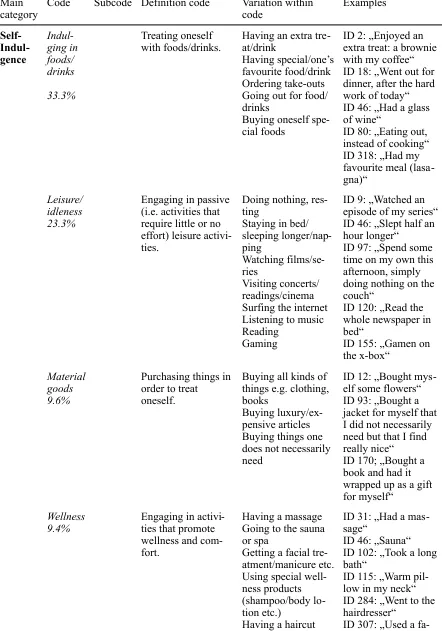
In order to analyse the contents of the diary data, a code scheme was created using content analysis (Mayring, 2000; Kuckartz, 2014). All qualitative analysis were conducted with the software atlas.ti (version 8.3.1). The first step of this analysis was the creation of a code scheme (see Table 1). For the creation of the scheme, the diaries were read once by the re-searcher and a tentative code scheme was derived directly from the data by categorising the statements of the participants according to their content and labelling them. This method fea-tures the inductive approach (Mayring, 2000). The resulting tentative draft was then discussed with a second researcher and applied by the first researcher and a second researcher to about 10% of the data (= the data of 8 participants) to check for its’ validity and comprehensiveness. Based on the results of this process, the code scheme was adjusted again resulting in a first draft of the coding scheme (see Appendix B), which was then applied to all data by both re-searchers.
Table 1 Coding scheme of the different types of self-kindness behaviours including definition, va-riation within the code and examples
Main
category Code Subcode Definition code Variation within code Examples Self- Indul-gence Indul-ging in foods/ drinks 33.3% Treating oneself
with foods/drinks. Having an extra tre-at/drink Having special/one’s favourite food/drink Ordering take-outs Going out for food/ drinks
Buying oneself spe-cial foods
ID 2: „Enjoyed an extra treat: a brownie with my coffee“ ID 18: „Went out for dinner, after the hard work of today“ ID 46: „Had a glass of wine“
ID 80: „Eating out, instead of cooking“ ID 318: „Had my favourite meal (lasa-gna)“
Leisure/ idleness 23.3%
Engaging in passive (i.e. activities that require little or no effort) leisure activi-ties.
Doing nothing, res-ting
Staying in bed/ sleeping longer/nap-ping Watching films/se-ries Visiting concerts/ readings/cinema Surfing the internet Listening to music Reading
Gaming
ID 9: „Watched an episode of my series“ ID 46: „Slept half an hour longer“
ID 97: „Spend some time on my own this afternoon, simply doing nothing on the couch“
ID 120: „Read the whole newspaper in bed“
ID 155: „Gamen on the x-box“
Material goods 9.6%
Purchasing things in order to treat oneself.
Buying all kinds of things e.g. clothing, books
Buying luxury/ex-pensive articles Buying things one does not necessarily need
ID 12: „Bought mys-elf some flowers“ ID 93: „Bought a jacket for myself that I did not necessarily need but that I find really nice“ ID 170; „Bought a book and had it wrapped up as a gift for myself“
Wellness
9.4% Engaging in activi-ties that promote wellness and com-fort.
Having a massage Going to the sauna or spa
Getting a facial tre-atment/manicure etc. Using special well-ness products (shampoo/body lo-tion etc.)
Having a haircut
ID 31: „Had a mas-sage“
ID 46: „Sauna“ ID 102: „Took a long bath“
ID 115: „Warm pil-low in my neck“ ID 284: „Went to the hairdresser“
Pursuit of mea-ningful goals Mind-fulness, reflec-tion and self-care 23.3% Consciously atten-ding to the present moment, reflecting onto one’s current state and acting ac-cordingly.
Meditating Practicing yoga Reflection (also via journaling)
Gratitude for one’s blessings
Guarding one’s own boundaries (e.g. say-ing no, taksay-ing time-out when needed) Self-appreciation/ self-care
ID 2: „Consciously made time in the morning for some yoga, mediation and enjoyed the shower“ ID 30: „Reflected on what I have contribu-ted today“
ID 222: „Evening meditation“ ID 232: „Stayed in bed due to sickness“ ID 273: „Did some Yoga“ Active leisure 13.8% Physical activity 9.1% Being physically
active. Exercising Perform moderate exercise Physical activities like going for walks, bike tours etc.
ID 6: „Went run-ning“
ID 78: „Went for a walk, after a day of sitting“
[image:14.595.79.526.106.619.2]ID 139: „Exercising, even though I mostly do no like going the-re, I know that I will feel great when I go back home. It makes me happy.“
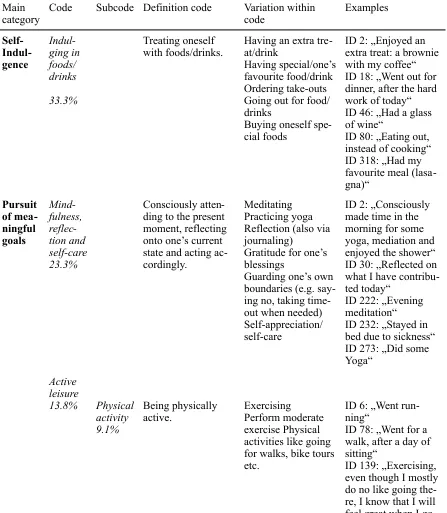
Table 1 Coding scheme of the different types of self-kindness behaviours including definition, va-riation within the code and examples
Main
category Code Subcode Definition code Variation within code Examples Self- Indul-gence Indul-ging in foods/ drinks 33.3% Treating oneself
with foods/drinks. Having an extra tre-at/drink Having special/one’s favourite food/drink Ordering take-outs Going out for food/ drinks
Buying oneself spe-cial foods
ID 2: „Enjoyed an extra treat: a brownie with my coffee“ ID 18: „Went out for dinner, after the hard work of today“ ID 46: „Had a glass of wine“
Therefore, the scheme was edited profoundly until it was found to be the best possible re-flection of the diary content and comprehensive of all data (Mayring, 2000).
Flow activi-ties 4.7%
Engaging in active leisure activities that promote flow (i.e. activities that are intrinsically rewar-ding and meaningful to the individual).
Creating art Crafting Playing/writing mu-sic Gardening Cooking
Trying new things, challenging oneself Spending time out-doors/w. pets
ID 34: „Knitted for an hour“
ID 116: „Begun to create a website for a hobby.“
ID 127: „Did some yard work, being outside“
ID 166: „ Played with my dog“ ID 223: „Played some music“ ID 265: „Made a cake (new recipe)
Organi-ze duties Organising one’s everyday duties. Doing/delegating chores Study
To carry out or dele-gate one’s duties
ID 2: „Business mee-ting outside on a walk“
ID 108: „Delegated a task“
ID 166: „Time for studying“
[image:15.595.82.525.104.642.2]ID 191: „Declutte-ring = sorted out old stuff and prepared it for the second hand shop.“
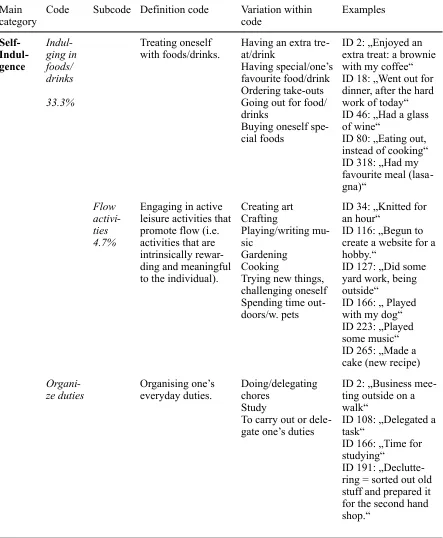
Table 1 Coding scheme of the different types of self-kindness behaviours including definition, va-riation within the code and examples
Main
category Code Subcode Definition code Variation within code Examples Self- Indul-gence Indul-ging in foods/ drinks 33.3% Treating oneself
with foods/drinks. Having an extra tre-at/drink Having special/one’s favourite food/drink Ordering take-outs Going out for food/ drinks
Buying oneself spe-cial foods
ID 2: „Enjoyed an extra treat: a brownie with my coffee“ ID 18: „Went out for dinner, after the hard work of today“ ID 46: „Had a glass of wine“
Using the final scheme (Table 1), the data was analysed by the first researcher, accord-ing to the codaccord-ing rules specified within the scheme. However it was not possible to have a second researcher code the data again, therefore interrater-reliability could not be calculated. Each description of a self-kindness activity presents a fragment. There were 1302 of such fragments in total from 78 participants who had completed the online diary at least once. The average number of fragments (i.e. acts of kindness described) per participant was M = 12 (SD = 5.58). The total number of fragments per participant varied between 6 and 28 fragments. A maximum of 30 fragments per participant was possible. Because the fragments could describe more than one activity or more than one type of activity, each text fragment could have been assigned multiple codes.
Quantitative Data Analysis
Measures. Well-being was measured with the Mental Health Continuum Short Form (MHC-SF) (Keyes et al., 2008; Lamers et al., 2011). The MHC-SC (14 items) has 3 sub-sca-les: emotional-well being (3 items), social well-being (5 items) and psychological
well-being (6 items). Participants had to report on the frequency of experiencing different emotional states during the last four weeks, using a 6-point Likert scale (0 = never; 5 = almost always). Higher scores indicate a higher level of well-being, while lower scores indicate low levels of well-being. In general the MHC-SF has good psychometric properties (Lamers et al., 2012). In this study the MSC-SF shows an excellent internal consistency (α = .91) at pre-test and at post-test (α = .95).
Quantitative analyses. The quantitative statistical data analysis was conducted with
fre-quencies by which each code was mentioned were calculated, as well as the difference score for mental well-being by subtracting the mean score at baseline from the score at post-test. Positive difference scores indicate an increase in well-being, while negative difference scores indicate a decrease in well-being.
In order to answer whether and how self-kindness behaviours influence well-being, a correlational analysis of the types of self-kindness (as found in the qualitative analysis) and the outcomes on mental well-being was conducted. The difference scores were correlated with the mean frequencies of the self-kindness behaviours using Spearmans’ rho (rs). In order to assess wether well-being has increased during the intervention the Wilcoxon-Signed-Ranks-Test was used to compare the mean scores on mental well-being between baseline and post-test.
Results
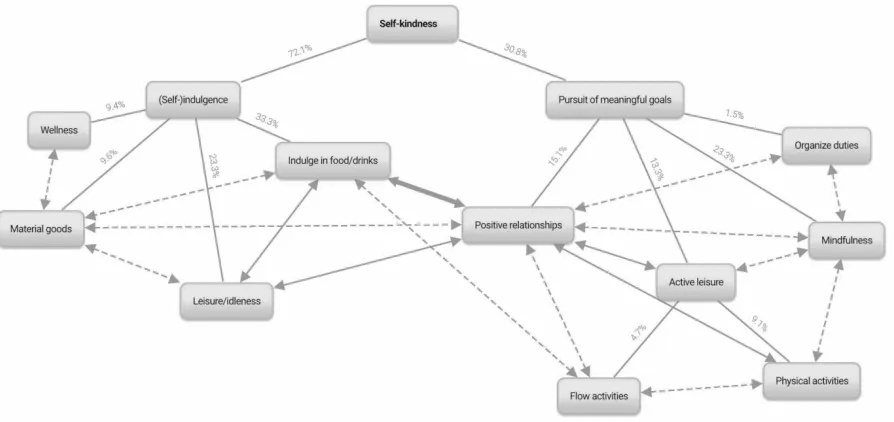
In total, thirteen categories of self-kindness behaviours were found that summarise the 1302 acts of self-kindness that were performed by the participants. The content analysis revealed two overarching categories, namely Self-indulgence and Pursuit of meaningful goals. Each of these main categories comprises four categories. Self-indulgence consists of the categories Indulging with foods/drinks; Idleness; Material Goods and Wellness, while the main category Pursuit of meaningful goals includesthe categories Mindfulness (including self-reflection and -care); Positive Relationships, Active leisure and Organize duties. The category Active leisure was further divided, to include two subcategories: Physical activity and Flow activities.
Figure 1. Code structure and relationships between the codes
Self-indulgence
The main category 'Self-indulgence’ summarises types of self-kindness behaviours which are aimed at increasing pleasure, require little effort to initiate and result in immediate reward. Behaviours, which hence can be identified as hedonic actions. In total 939 (72.1%) of all ac-tions mentioned were self-indulgent in nature, while four different types of self-indulgent be-haviour were identified.
One third (144 times, 33.3%) of all activities reported by the participants involved: Indulging in food/drinks. The code was assigned to all kinds of behaviours, that include either the consumption, purchase or preparation of (special) foods and drinks in order to treat oneself. Examples of this code are little treats throughout the day, e.g. ‘Enjoyed an extra treat: a brownie with my coffee’ (ID 2), a special drink, for example ‘[..] a glass of wine’ (ID 46), [..] eating out (ID 146) or enjoying one’s ’[…] favourite meal‘ (ID 318).
idleness ‘Spend some time on my own this afternoon, simply doing nothing on the couch’ (ID 97), sleep (‘Took a nap’, ID 46) and also all kinds of media consumption, like ‘[…]
reading’ (ID 62), ‘listening to music’ (ID 9), watching TV-series (‘Watched a nice series’, ID 115), surfing the internet or ‘Gaming […]’ (ID 155). The category furthermore includes activ-ities like visiting the cinema (‘Visited the cinema, ID 91), concerts etc., since the performer of these actions still remains passive and consuming in these settings.
Behaviours that involve purchasing of material goods and/or luxury articles in order to treat oneself and make oneself a gift, have been assigned the code: Material goods. This code was mentioned 125 (9.6%) times. Examples of this code are ‘Bought a book and had it
wrapped up as a gift for myself’ (ID 170) or ‘Bought luxury eyeliner at the airport’ (ID 116). Wellness. Wellness activities were named 123 (9.4%) times. This category includes visits to the ‘Sauna’ (ID 46) or spa, getting a massage or haircut, as well as a ‘Long
shower’ (ID 277) at home or the use of ‘Luxury body lotion’ (ID 96) or other (luxury) cosmet-ic products in order to feel well.
Pursuit of meaningful goals
While the first main category Self-indulgence summarises self-indulgent behaviours that are characterised by a search for pleasure, the second main category Pursuit of meaningful goals includes meaningful actions that promote personal growth or positive relationships. These types of actions in contrast might not seem pleasurable per se at first glance, since they often rely on active effort to initiate and pursue. The content analysis revealed four categories that describe behaviours linked to the Pursuit of meaningful goals.
Idleness. Mindfulness involves consciously attending to the present moment, gratitude, re-flecting on one’s situation, strengths and weaknesses and acting accordingly by caring for one-self, respecting and appreciating oneself, e.g. ‘Consciously made time in the morning for some yoga, mediation and enjoyed the shower’ (ID 2), ‘Smiled at myself in the mirror’ (ID 170); ‘Reflected on what I have contributed today’ (ID 30) or ‘Wrote down, what I am grate-ful for’, ID 284.
Furthermore, even though participants were encouraged to perform acts of self-kind-ness, this often (197, 15.1%) involved cherishing Positive relationships. This category com-prises behaviours like relying on, building and strengthening meaningful relationships with others. Examples for such behaviours are inviting (‘Invited a friend’, ID 154), calling, visiting or texting others, as well as seeking help, advice or comfort from others (e.g. ‘Asked
someone for a lift (I can’t drive at the moment)’, ID 93; ‘Had a hug from my husband’, (ID 314)).
In contrast to Idleness, participants also mentioned: Active Leisure. This code was assigned 173 (13.3%) times. Active leisure was further divided into two sub-categories (i.e.
activities like gardening, playing with pets etc. (‘Did some yard work, being outside’, ID 127; ‘Quality time with dog’, ID 166).
The last category is: Organize duties. This code was assigned the least often with 20 (1.5%) times. Organize duties included all activities that are about the performance, organisa-tion and/or‘Delegaorganisa-tion of a task’ (ID 108) in order. Other examples of productive acorganisa-tions are work or study related duties, chores, ‘Decluttering […]’(ID 191).
Additional Impressions
In general the complexity and individuality of the behaviours differed notably between those activities that fell under the category Self-indulgence versus those that fell under the category Pursuit of meaningful goals. The activities that fell under Self-indulgence were largely relat-ively simple and common activities which were mentioned by many participants (e.g. ‘having a special coffee […]’, (ID 53), ‘having a sweet […]’, (ID 314) or ‘[…] buying something’, (ID 2)). Those activities usually were easy to perform and required little own initiative, while the activities that fell under the category Pursuit of meaningful goals required effort and were much more individualistic, more complex and often also more active and time-consuming (e.g. ‘[…] painting’, (ID 147 ), ‘gardening […]’, (ID 127) or ‘training [a] dog (ID 166)), when compared with activities from the category Self-indulgence (eg. ‘[…] painting’, (ID 147 ) vs. ‘having a special coffee […]’, (ID 53)).
Effects on Well-being
The Wilcoxon-Signed-Ranks-Test demonstrated that participants level of well-being signifi-cantly increased between baseline (M = 2.84, SD = .68) and post-test (M = 3.06, SD = .80), t(1146) = 14.21, p < .001. In addition, the correlational analysis yielded a significant positive relationship between Flow activities and the change score for well-being (rs = .08, p = .007, see Table 2), indicating that the purposeful performance of activities that are intrinsically re-warding and meaningful to the individual is associated with increases in well-being. A margi-nal positive correlation was found for the relation between increased well-being and Active leisure (rs = .05, p = .084). No significant correlations were found between Self-indulgence (rs = - .03, p = .256), Pursuit of meaningful goals (rs = .02, p = .477), Indulging with foods/
drinks (rs = - .05, p = .109), Idleness (rs = .05, p = .118), Material Goods (rs = - .05, p = .117),
Wellness (rs = .01, p = .868),Mindfulness (rs = - .05, p = .107),Positive relationships (rs = .02,
p = .524),Physical activity (rs = - .00, p = .956)or Organize duties (rs = .02, p = .593) and well-being (Table 2).
Discussion
Main Findings
Different types of self-kindness. The present study identified and differentiated
thir-teen different categories of self-kindness behaviours. The actions that were performed by the participants, included behaviours ranging from simply indulging and initiating hedonic pleas-ures, towards more effortful activities that help maintaining and building social relationships and/or the pursuit of meaningful, strengthening eudaimonic well-being. Hence, the outcomes revealed two overarching categories of self-kindness that comprised the remaining eleven types of self-kindness.
24
Table 2 Correlation matrix of change scores in well-being and self-kindness categories
Note: *p < 0.05, **p < 0.01, + p < 0.10
1 2 3 4 5 6 7 8 9 10 11 12 13
1.
Well-being 1
2.
Self-in-dulgence - .03 1
3. Indulge in food/ drinks
- .
05 44 .** 1
4. Idleness .05 . 36**
- . 32**
1
5. Material
goods - .05 20 .** 22 - .** 17 - .** 1
6. Wellness .01
18** 22 - .** 18 - .** 10 - .** 1
7. Pursuit of mea-ningful goals
.02 - .
80** - .25 31 - .** 21 - .** 19 - .** 1
8.
Mindful-ness - .05 39 - .**
- . 17** - . 13** - 08** - . 08** . 35** 1 9. Positive relations-hips
.02 - .
26** 01 . ** 14 - .** 11 - .** 09 - .** 62 .** - .08** 1
10. Active
leisure .
05 + .
44** 24 - .** 22 - .** 13 - .** 13 - .** 25 - .** - .
05 + - .
01 1
11.
Physi-cal activitiy - .00 50 - .**
- . 20** - . 18** - . 10** - . 10** . 48**
- .03 - .01 . 80**
1
12. Flow
activities 08 .** 33 - .** 13 - .** 12 - .** 07 - .** 07 - .** 32 .** - .
05 + - .
60** .01 .01 1
13. Organize
duties .02 19 - .**
- . 09**
- .
05 +
- .04 - .04 . 18**
- .00 - .
05 + - .
05 +
nature. This finding is remarkable, since in the first place the instructions rather encouraged simple and hedonistic actions, while additionally previous research by Parker Schiffer and Roberts (2018) found that people usually tend to perform simple, passive and hedonistic ac-tions over more complex and active eudaimonic ones. People seem to perceive simple ‘pass-ive activities as being significantly more enjoyable, requiring less effort, and being less daunt-ing to get started [when compardaunt-ing them to more meandaunt-ingful active leisure activities]’ and - when given the choice – most would opt for the performance of simple and passive acts, even though these activities are found to be less effective in increasing well-being (Parker Schiffer & Roberts, 2018).
A possible explanation why participants in the present study also performed more complex, effort-requiring actions might be, that while the study by Parker Schiffer and
Roberts (2018) simply assessed which activities participants would perform in a typical week, the present study instructed participants to conciously perform actions that do them good once per week (i.e. acts of self-kindness). Indeed, participants in the study by Parker Schiffer and Roberts (2018), did report being aware of the fact, that the performance of active and complex activities would do them good, however typically they would perceive these activities as be-ing more exhaustbe-ing and less enjoyable and therefore still opt for simpler activities. It may be that the explicit instruction to perform five acts of self-kindness, made participants choose their activities with more consideration and/or increased the motivation of the participants to undergo some effort, which caused the participants in the present study to not only perform hedonic actions, but also eudaimonic actions.
oneself might lead to self-indulgence […] in many instances, giving the self pleasure actually harms well-being […] while promoting one’s health often involves a certain amount of dis-pleasure […]’ (Neff, 2011, p. ). Thus, even though dis-pleasure and feeling well are part of mental well-being and can to some extent promote well-being (Fredrickson, 2000; Fredrickson & Joiner, 2002; Keyes, 2007), it is important to balance these kind of activities with activities that support the pursuit of meaning and optimal functioning (i.e. psychological well-being) and that foster positive relationships (i.e. social well-being). Respectively, it seems that it is especially this balance that is crucial. Following Keyes and Annas (2009) only people who experience high levels of both hedonic and eudaimonic well-being in a balanced way are can experiences high overall well-being (Keyes & Annas, 2009). Balancing hedonic and eudai-monic acts may keep one from over-indulging (Neff, 2011; Nelson et al., 2016). The results of the present study imply that extensive self-indulgence in turn, might lead towards feelings of guilt, which may eventually overarch the pleasure one gains from it. Indeed Veenhoven (2003) implies, that the absence of feelings of guilt is crucial for hedonic actions to not back-fire.
Self-kindness and well-being. In general, participants reported a significant higher
So why is it, that Dunn et al. (2008) and Nelson et al. (2016) found the opposite? Looking more closely at their studies, there are some differences in how self-kindness was operationalized. Dunn et al. (2008) did operationalize self- and other-kindness as spending money for oneself vs. for others. Considering the outcomes of the present study, it becomes clear, that spending money on oneself, is only one way of being kind-towards oneself (and the study of Dunn et al. (2008) might prove it to be not an effective one), but this finding may be not generalizable . Nelson et al. (2016) in contrast, did include a larger variety of self-kind-ness behaviours. Still they specifically ‘sought to hold constant the types of behaviours people performed (e.g. buying a cup of coffee), while altering only the target of those actions’ (Nel-son et al., 2016, p.851). Self-kindness was hence operationalized merely as the exact opposite to specific prosocial actions that Dunn et al. (2008) and Nelson et al. (2016) studied and as such, their operationalizations of self-kindness may have failed to capture self-kindness in all its’ different facets. The present research or the RCT by Nelson-Coffey et al. (in progress), allowed for the participants to think of their own actions, capturing more facets of self-kind-ness, which might be the reason for the opposing results.
Flow activities. The results of the present study imply, that in general self-kindness
may be related to increased well-being. However, considering each category on its own, only for flow activities (i.e. activities that are intrinsically rewarding and meaningful to the indi-vidual) it can be concluded with certainty, that this type of self-kindness behaviour signific-antly relates to higher well-being.
meaning-ful goals and actively initiating and performing actions is a prerequisite for well-being (Ryff, 1989; Deci & Ryan, 2008; Schiffer Parker & Roberts, 2016). The experience of mastery ex-periences, which arise from completing an important or difficult task (i.e. flow activities) has been found to positively affect the mood (i.e. increase emotional/hedonic well-being) (Yeung, 1996). Furthermore, since flow activities are activities, more complex, active activities that are meaningful to the individual, they do also promote psychological well-being/eudaimonic. Hence what was defined as ‘Flow activities’ in the present research, seemingly succeeds to target both hedonic and eudaimonic well-being, which might be the reason why ‘Flow activit-ies’ did have a significant effect on well-being.
For the remaining categories no particular conclusions can be drawn, as the correla-tions did not reach statistical significance. However, since many of the correlacorrela-tions at times were close to being marginally significant (i.e. < .100), it may be that significant relationships were to be found when using a larger sample size. Even though previous literature for ex-ample indicates that positive relationships, mindfulness or physical activity relate to higher well-being (e.g. Yeung, 1996; Chiesa & Serretti, 2009; Schueller & Parks, 2014), the present study did not find such effects. Concerning the relationship of different types of self-kindness and well-being, further research therefore is indicated.
Strengths and limitations
inductive approach of the qualitative analysis, it was ensured that the concept was captured as least biased as possible. Lastly, the sample was drawn nationwide and sample size was con-siderably high for a qualitative study (Robinson, 2014) including a large amount of data, which should have ensured as much variety as possible and led to better representativeness.
Directions for future research
In general, the present research should be understood as an invitation to fellow researchers to pay more attention towards the concept of self-kindness and its potential to increase mental well-being. The creation of self-kindness interventions should receive more consideration in the context of mental health promotion. More specifically, research in the form of experi-mental designs will be needed in order to assess the efficiency of single types of self-kindness behaviours with regard towards their potential to increase well-being.
import-ance of addressing different facets of well-being through different types of self-kindness activities and knowledge which types of activities can address which facet of well-being.
To exclude the possibility of biased results due to flaws in the present research design and process, attention should be paid to several aspects. Firstly to exclude that the qualitative analysis contained a subjectivity bias, a replication should be conducted, with at least a second coder, in order to assess inter-rater reliability. Moreover, replication studies with dif-ferent samples may be a valuable addition to see if the effectiveness of self-kindness and the found types of self-kindness, may be generalised to a more representative sample. For ex-ample by using stratified sampling (Robinson, 2014 in order to address underrepresented population groups within this research (such as men or lower-educated) directly. Also adher-ence must be strengthened, for example, by tailoring interventions more to personal needs or include more interactive features (Bolier et al., 2013).
Conclusion
All in all, the present study illustrates the potential that self-kindness presumably bears the potential to promote mental well-being. However more research should follow and it remains to be seen how self-kindness can be integrated in mental health interventions in order to be the most effective and whether certain types of self-kindness prove more (like ’Flow activit-ies’) or less effective than others increasing well-being.
en-gaging in a meaningful and challenging task - it is the balance of these activities that matters the most and that will make a difference.
References
Bohlmeijer, E., Bolier, L., Walburg, J.A., Westerhof, G. Handboek positieve psychologie. Amsterdam: Boom; 2013. Bolier, L., Haverman, M., Westerhof, G. J., Riper, H., Smit, F., & Bohlmeijer, E. (2013). Positive psychology interventions: a meta-analysis of randomized controlled studies. BMC public health, 13(1), 119.
Bolier, L., Haverman, M., Westerhof, G. J., Riper, H., Smit, F., & Bohlmeijer, E. (2013). Pos-itive psychology interventions: a meta-analysis of randomized controlled
studies. BMC public health, 13(1), 119.
Buchanan, K. E., & Bardi, A. (2010). Acts of kindness and acts of novelty affect life satisfac-tion. The Journal of social psychology, 150(3), 235-237
Chiesa, A., & Serretti, A. (2009). Mindfulness-based stress reduction for stress management in healthy people: a review and meta-analysis. The journal of alternative and com-plementary medicine, 15(5), 593-600.
Csikszentmihalyi, M., & Seligman, M. E. (2000). Positive psychology: An introduction. Ame-rican Psychologist, 55(1), 5-14.
Curry, O. S., Rowland, L. A., Van Lissa, C. J., Zlotowitz, S., McAlaney, J., & Whitehouse, H. (2018). Happy to help? A systematic review and meta-analysis of the effects of per-forming acts of kindness on the well-being of the actor. Journal of Experimental So-cial Psychology, 76, 320-329
Deci, E. L., & Ryan, R. M. (2008). Self-determination theory: A macrotheory of human moti-vation, development, and health. Canadian psychology/Psychologie
Delle Fave, A., Massimini, F., & Bassi, M. (2011). Hedonism and eudaimonism in positive psychology. In Psychological selection and optimal experience across cultures (pp. 3-18). Springer, Dordrecht.
Diener, E. (1984). Subjective well-being. Psychological bulletin, 95(3), 542.
Diener, E., & Suh, E. M. (Eds.). (2003). Culture and subjective well-being. MIT press. Duckworth, A. L., Steen, T. A., & Seligman, M. E. (2005). Positive psychology in clinical
practice. Annu. Rev. Clin. Psychol., 1, 629-651.
Dunn, E. W., Aknin, L. B., & Norton, M. I. (2008). Spending money on others promotes hap-piness. Science, 319(5870), 1687-1688.
Fredrickson, B. L. (2000). Cultivating positive emotions to optimize health and well-being. Prevention & treatment, 3(1), 1a.
Fredrickson, B. L., & Joiner, T. (2002). Positive emotions trigger upward spirals toward emo-tional well-being. Psychological science, 13(2), 172-175.
Gable, S. L., & Haidt, J. (2005). What (and why) is positive psychology?. Review of general psychology, 9(2), 103-110.
Gilbert, P. (2009). Introducing compassion-focused therapy. Advances in psychiatric treat-ment, 15(3), 199-208.
Grossman, P., Niemann, L., Schmidt, S., & Walach, H. (2004). Mindfulness-based stress re-duction and health benefits: A meta-analysis. Journal of psychosomatic
research, 57(1), 35-43.
Huppert, F. A. (2005). Positive mental health in individuals and populations.
Huppert, F. A., & Timothy, T. C. (2013). Flourishing across Europe: Application of a new conceptual framework for defining well-being. Social indicators research, 110(3), 837-861.
Keyes, C. L. (2007). Promoting and protecting mental health as flourishing: A complementary strategy for improving national mental health. American psychologist, 62(2), 95. Keyes, C. L., Dhingra, S. S., & Simoes, E. J. (2010). Change in level of positive mental health
as a predictor of future risk of mental illness. American journal of public health, 100(12), 2366-2371.
Keyes, C. L., Wissing, M., Potgieter, J. P., Temane, M., Kruger, A., & Van Rooy, S. (2008). Evaluation of the mental health continuum–short form (MHC–SF) in
setswana-speaking South Africans. Clinical Psychology & Psychotherapy, 15(3), 181-192. Kuckartz, U. (2014). Mixed Methods: Methodologie, Forschungsdesigns und
Analyseverfah-ren. Springer-Verlag.
Lamers, S. M., Glas, C. A., Westerhof, G. J., & Bohlmeijer, E. T. (2012). Longitudinal evalua-tion of the mental health continuum-short form (MHC-SF). European journal of psy-chological assessment.
Landis, J. R., & Koch, G. G. (1977). The measurement of observer agreement for categorical data. Biometrics, 159-174.
Leary, M. R., Tate, E. B., Adams, C. E., Batts Allen, A., & Hancock, J. (2007). Self-compas-sion and reactions to unpleasant self-relevant events: the implications of treating oneself kindly. Journal of personality and social psychology, 92(5), 887.
Mongrain, M., & Anselmo-Matthews, T. (2012). Do positive psychology exercises work? A replication of Seligman et al.(). Journal of clinical psychology, 68(4).
Nakamura, J., & Csikszentmihalyi, M. (2014). The concept of flow. In Flow and the foundati-ons of positive psychology (pp. 239-263). Springer, Dordrecht.
Neff, K. (2003). Self-compassion: An alternative conceptualization of a healthy attitude toward oneself. Self and identity, 2(2), 85-101.
Neff, K. D., & Germer, C. K. (2013). A pilot study and randomized controlled trial of the mindful self-compassion program. Journal of clinical psychology, 69(1), 28-44.
Neff, K. D., Kirkpatrick, K. L., & Rude, S. S. (2007). Self-compassion and adaptive psycho-logical functioning. Journal of research in personality, 41(1), 139-154.
Nelson, S. K., Layous, K., Cole, S. W., & Lyubomirsky, S. (2016). Do unto others or treat yourself? The effects of prosocial and self-focused behaviour on psychological flou-rishing. Emotion, 16(6), 850.
O’Connell, B. H., O’Shea, D., & Gallagher, S. (2016). Enhancing social relationships through positive psychology activities: A randomised controlled trial. The Journal of Positive Psychology, 11(2), 149-162.
Ouweneel, E., Le Blanc, P. M., & Schaufeli, W. B. (2014). On being grateful and kind: Re-sults of two randomized controlled trials on study-related emotions and academic engagement. The Journal of Psychology, 148(1), 37-60.
Radloff, L. S. (1977). The CES-D scale: A self-report depression scale for research in the gen-eral population. Applied psychological measurement, 1(3), 385-401.
Rowland, L., & Curry, O. S. (2019). A range of kindness activities boost happiness. The Journal of social psychology, 159(3), 340-343.
Ryan, R. M., & Deci, E. L. (2001). On happiness and human potentials: A review of research on hedonic and eudaimonic well-being. Annual review of psychology, 52(1),
141-166.
Ryff, C. D. (1989). Happiness is everything, or is it? Explorations on the meaning of psycho-logical well-being. Journal of personality and social psychology, 57(6), 1069. Schotanus-Dijkstra, M., Pieterse, M. E., Drossaert, C. H., Westerhof, G. J., De Graaf, R., Ten
Have, M., & Bohlmeijer, E. T. (2016). What factors are associated with flourishing? Results from a large representative national sample. Journal of happiness
studies, 17(4), 1351-1370.
Schueller, S. M., & Parks, A. C. (2014). The science of self-help. European Psychologist. Seligman, M. E. (2012). Flourish: A visionary new understanding of happiness and
well-be-ing. Simon and Schuster.
Seligman, M. E., Steen, T. A., Park, N., & Peterson, C. (2005). Positive psychology progress: empirical validation of interventions. American psychologist, 60(5), 410.
Sin, N. L., & Lyubomirsky, S. (2009). Enhancing well-being and alleviating depressive sym-ptoms with positive psychology interventions: A practice-friendly
meta-analysis. Journal of clinical psychology, 65(5), 467-487.
Spitzer, R. L., Kroenke, K., Williams, J. B., & Löwe, B. (2006). A brief measure for assessing generalized anxiety disorder: the GAD-7. Archives of internal medicine, 166(10), 1092-1097.
Weinstein, N., & Ryan, R. M. (2010). When helping helps: autonomous motivation for proso-cial behaviour and its influence on well-being for the helper and recipient. Journal of personality and social psychology, 98(2), 222.
Appendix A – ‘Geluksdagboekje’ Hoe vaak heb je jezelf getrakteerd gisteren?
Indien je vergeten was dit dagboek de dag na je activiteiten in te vullen, dan gaan de vragen over de dag waarop jij de oefening hebt uitgevoerd in de afgelopen week.
• 5 keer • 4 keer • 3 keer • 2 keer • 1 keer
• Ik heb de afgelopen week mezelf niet getrakteerd.
Geef per activiteit aan wat je hebt gedaan om jezelf te trakteren. Bijvoorbeeld: “Een luxe kof-fie gedronken".
• Activiteit 1 • Activiteit 2 • Activiteit 3 • Activiteit 4 • Activiteit 5
Hieronder volgen drie stellingen. Geef voor elke stelling aan wat op jou van toepassing is. Je doet dit door het balkje te verschuiven.
a. Hoeveel moeite heb je gedaan om de oefening "jezelf trakteren" uit te voeren in de afgelo-pen week?
• 1 = helemaal geen moeite 9 = heel erg veel moeite • 1 --- 9
b. Hoe erg deed jij je best om de oefening "jezelf trakteren" uit te voeren in de afgelopen week?
• 1 = ik deed helemaal niet mijn best 9 = ik deed ontzettend erg mijn best • 1 --- 9
c. Hoeveel extra tijd kostte het jou om de oefening "jezelf trakteren" uit te voeren in de afge-lopen week?
Appendix B – Instructions for participants Beste {FirstName},
Hartstikke leuk dat je mee doet aan ons onderzoek naar de effectiviteit van geluksoefeningen! Ken je iemand die ook aan dit onderzoek mee doet? We verzoeken je geen informatie uit te wisselen met hen over de instructies die jij hebt gekregen omdat dit de resultaten ernstig kan beïnvloeden. En dat zou natuurlijk jammer zijn. Vanaf kerst mag je ervaringen met elkaar uitwisselen.
INSTRUCTIES
De komende zes weken ontvang je elke week onderstaande geluksoefening. De oefening be-staat steeds uit twee delen: Op één dag in de week de geluksoefening ‘jezelf trakteren’ uit-voeren (zie hieronder, punt 1) en de volgende dag deze activiteiten opschrijven in een online geluksdagboekje (zie hieronder, punt 2).
Geluksoefening: Jezelf trakteren
In ons dagelijkse leven doen we allemaal wel eens iets aardigs voor een ander, maar we ver-geten vaak onszelf. Daar gaan we met deze oefening verandering in brengen. Het gaat bij het ‘jezelf trakteren’ vooral om kleine, simpele dingen die relatief weinig extra geld of inspanning kosten. Voorbeelden zijn: jezelf trakteren op een luxe koffie, lekker gebakje, je favoriete tijd-schrift of je lievelingsmaaltijd, een extra lekkere douchegel gebruiken, 5 minuten extra pauze nemen van je werk of studie, jezelf een compliment geven, een wandeling maken. Af en toe mag je jezelf ook op iets groters trakteren, zoals een massage of meer tijd besteden aan je ei-gen hobby. Het gaat dus om activiteiten die je helemaal voor jezelf doet.
1. Het is de bedoeling dat je op één doordeweekse dag van de komende week jezelf vijf keer trakteert. Dus alle vijf activiteiten op één dag. De activiteiten mogen hetzelfde zijn als de voorbeelden die we hierboven noemden, maar je mag ook andere activiteiten bedenken of meer stil staan bij de dingen die je al voor jezelf doet. We willen je vragen om deze oefening uiterlijk a.s. vrijdag uit te voeren. Voer alsjeblieft geen activiteiten uit die jezelf of anderen in gevaar kunnen brengen.
2. De dag nadat je de oefening ‘jezelf trakteren’ hebt uitgevoerd, is het de bedoeling dat je via onderstaande link in je geluksdagboekje opschrijft welke activiteiten je de vorige dag hebt gedaan. Dus als je dinsdag de oefening hebt uitgevoerd, dan vul je op woensdag het dagboek-je in. We willen dagboek-je vragen om het dagboekdagboek-je op zaterdag in te vullen, omdat dagboek-je zondag weer instructies ontvangt voor de oefening van volgende week.
Wil je zaterdag XX.XX via onderstaande link het geluksdagboekje invullen?
Jouw wekelijkse ervaringen met de oefening zijn voor ons zeer waardevol! Alvast hartelijk dank!
{Link: Online geluksdagboekje week X}
Heel veel plezier met de geluksoefening van deze week!
Met vriendelijke groet,
Appendix C – Draft code scheme
Draft code scheme with code, frequencies, definition and example
Code Frequency Definition Code Example
Treat yours-elf
- food/ drink
- shopping/ gift to self
- wellness 584 (44.8%) 341 (26.1%) 127 (9.7%) 116 (8.9%)
to allow oneself a little luxury or a little extra
- have special/favourite food/ drink,
- have a second (or more) drink/ helping of food
- eating out
- order a take away
- make yourself a gift (flowers, book etc.)
- buy something you wanted to have (e.g. book, clothing etc.)
- visit spa/sauna, beauty salon - have a haircut, facial
treat-ment, massage, special sham-poo etc.
ID 1022: 'Genoten van extra tracta-tie: brownie bij de thee'
ID 1027: 'Heerlijke yoghurt van de yoghurt barn met cookie dough. Ben daar rustig voor gaan zitten om van te genieten'
ID 1041: 'Na het zware werk van deze dag lekker uit eten geweest' ID 1465: 'Mijn lievelingsmaaltijd gegeten (lasagne)'
ID 1135: 'Tijdschrift Happinez ge-kocht'
ID 1169: 'Nieuwe jas gekocht die ik niet nodig had maar wel leuk vond'
ID 1240: 'boek gekocht en laten pakken als cadeau voor mezelf'
ID 1059: 'me laten masseren' ID 1100: ''s Morgens mijn lichaam scrubben onder de douche Vervol-gens een lekkere douchegel ge-bruikt'
ID 1101: 'Naar de kapper haar kleuren i.p.v. Zelf doen' social
sup- port/sociali-sing
147
(11.3 %) - accessing ones’ social network for support/help, company, advice , comfort
- activities with others that aim to improve/maintain social relations (activities, lunch/ dinner/coffee, dates/appoint-ments etc., with others)
ID 1030: 'Mijn verhaal van de dag gedeeld met een vriendin'
me-time/
time-out (12.6%)164 - taking a time-out from every-thing and every one/time-alo-ne
- pausing every-day life - take the time to do things
slowly, start the day slowly - going on holiday
- relaxing/chilling out - nap
ID 1101: 'Extra pauze' ID 1122: 'Ochtend alleen' ID 1142: 'middag niksen op de bank, alleen'
ID 1168: 'Rustig ontbeten met krant'
ID 1169: 'Heel spontaan een weekendreisje naar Barcelona ge-boekt'
ID 1305: 'Heerlijk uitgeslapen. Mm mm zonder wekker'
ID 1479: 'Een dutje in de middag'
hobby/plea-sant activi-ties
150
(11.5%) - spending (extra) time on ones hobbies (painting, crafting, photographing…)
- other pleasant activities (net-flixen, listening to music, playing (board) games …)
ID 1091: 'De hele avond heerlijk zitten mazen voor de trui van mijn kleinzoon'
ID 1101: 'Museumbezoek' ID 1175: 'middagje getekend en geschilderd'
ID 1182: 'naar mooie muziek thuis geluisterd en meegezongen' ID 1222: 'bordspel'
ID 1282: 'boek gelezen'
health - moderate exercise - exercise - healthy diet 125 (9.6%) 60 (4.6%) 33 (2.5%) 26 (2.0%)
nurturing ones own body/health
- low intensity exercise: going for a walk, cycling (slowly), stretching
- higher intensity exercising: running, cycling, swimming, gymnastics, dancing, etc.
- healthy diet (fruit, vegetables, organic food..)
- fresh and self cooking
ID 1142: 'Op de fiets naar het werk'
ID 1174: 'via een omweg naar de bakker gefietst'
ID 1027: 'hardlopen' ID 1080: 'Sport'
ID 1142: 'Getraind met personal trainer en afgesloten met een potje boksen'
ID 1190: 'zwemmen' ID 1479: 'Wielrenfietsen' ID 1059: 'meer aandacht besteed aan lunch, rauwkost salade erbij' ID 1089: 'Kokoswater na de work out'
mindful- ness/savou-ring
47
(3.6%) - meditation - mindfulness exercises - living in the present moment - yoga
- generate, prolong and intensi-fy enjoyment through con-sciousness and deliberation
ID 1022: 'echt bewust tijd gemaakt 's morgens voor yoga, meditatie en genoten van de douche'
ID 1034: 'Uurtje yoga gedaan' ID 1137: 'korte buitenwandeling , even op een bankje zitten om te genieten prachtige herfstbomen' ID 1245: 'tijdens het fietsen me één gevoelt met de prachtige lucht en schitterde wolken in de zon' ID 1282: 'Rustig naar werk gefietst en genoten van de geuren en om me heen gekeken naar de mooie gebouwen'
self-accep- tance/com-passion
19
(1.5%) - compassionate attitude towards oneself - self-care
- comforting, accepting and forgiving oneself
- accepting own flaws - cheering oneself up - complementing oneself - self-appreciation
ID 1057: 'Bewust teruggekeken op wat ik vandaag allemaal heb bijge-dragen'
ID 1190: 'nagedacht wat ik moest doen om me na 22.00 uur s'avonds minder eenzaam te voelen. Niets bedacht! Maar was leuk om te doen'
ID 1251: 'Mezelf een compliment gegeven'
saying no/
delegating (1.8%)23 - delegating tasks/chores - saying no to things one does not want (to do)
ID 1022: 'aan mijn man gevraagd of hij naar een ouderavond kon gaan zodat ik mijn yogales kon volgen'
ID 1156: 'Taak gedelegeerd' ID 1156: 'Ondanks verzoek van dochter niet meegedaan aan een spelletje'
productivity 15
(1.1%) - ticking off ones’ to do-list - stop procrastination - getting things done
ID 1062: 'In de zon het tuinbankje geverfd'
ID 1235: 'tijd om te studeren' ID 1287: 'Ontspult = oude rommel uitgezocht en klaargezet voor het goed'
try
some-thing new (1.1%)14 leaving the comfort-zone by: - trying new challenges/things/ activities
- visiting new places - meeting new people
ID 1089: 'Op verzoek yin yoga cooling down'
ID 1100: 'Eerste keer naar zumba-les'