• No results found

3G03_2013_Test_2_ver1.docx    1

N/A
N/A
Protected

Academic year: 2020

Share "3G03_2013_Test_2_ver1.docx    1"

Copied!
6
0
0

Loading.... (view fulltext now)

Full text

(1)

Biochemistry  3G03                            Test  2                            October  7,  2013    

Note:  Please  check  your  examination  booklet  to  ensure  all  pages  are  there.  There  are  27  questions   and  7  pages.  Please  mark  your  answers  clearly  on  the  examination  answer  sheet.  You  can  keep  the   examination  booklet.  There  are  several  different  versions  of  this  test,  therefore  it's  important  that   you  mark  your  version  on  the  CLASSROOM  ANSWER  SHEET  (scantron)  according  to  question  1  &  2.  


Please  also  mark  your  seat  number  on  the  scantron  in  the  space  for  RECORD  (SEAT)  NUMBER   according  to  the  following  table.  


Failure  to  indicate  your  version  number  or  seat  number  may  result  in  5%  penalty.  


Table  for  conversion  of  ROW  number:  

A   01   F   06   K   11   P   16   U   21   Z   26  

B   02   G   07   L   12   Q   17   V   22  

C   03   H   08   M   13   R   18   W   23  

D   04   I   09   N   14   S   19   X   24    

E   05   J   10   O   15   T   20   Y   25  


First  two  numbers  in  RECORD  (SEAT)  NUMBER  are  used  for  letter  (row)  and  the  following  three   numbers  are  for  the  seat  number.    For  example:  w020  is  23020.  


1. Please mark question 1 a 2. Please mark question 2 a

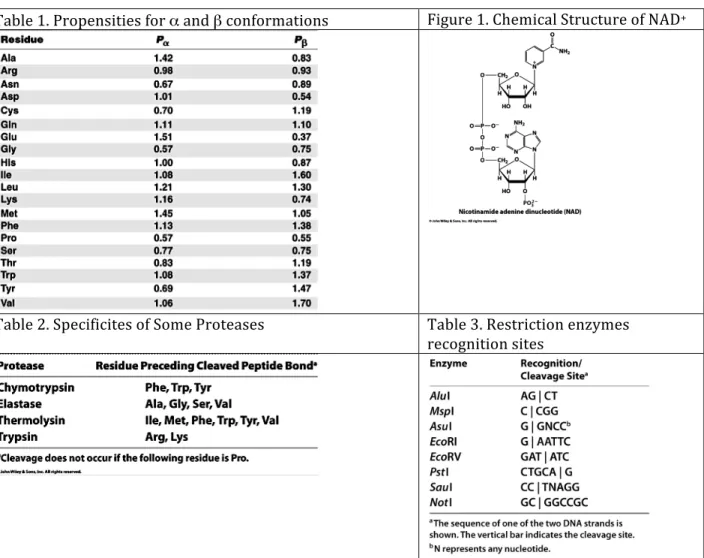
3. What are the products from treatment of the following peptide with chymotrypsin?

Met-Tyr-Ala-Ser-Phe-Val-Lys-Asn-His-Tyr-Gly-Arg-Met-Trp

a) 1 dipeptide, 2 tripeptides, 1 pentapeptide and one free amino acid b) 1 dipeptide, 1 tetrapeptide and 1 octapeptide

c) 1 dipeptide, 1 tripeptide, 1 tetrapeptide and 1 pentapeptide

d) 1 tripeptide, 1 tetrapeptide, 1 pentapeptide, and two free amino acids e) none of the rest

4. Which of the 20 standard amino acids is optically inactive?

a) Arg b) Gly c) Cys d) Pro e) Ile

5. If instead of four different bases in DNA and RNA, there were six, what is the minimum size of a codon to encode the 20 amino acids commonly found in proteins?

a) 4 b) 1

c) cannot be determined d) 2

e) 3

(2)

6. Which of the following correctly describes the B-DNA double helix?

a) right-handed helix b) antiparallel strands

c) one helical rotation has a rise of 3.4 nm

d) base pairs are located in the center of the helix e) all of the rest

7. Which of the following amino acids is generally absent from an alpha-helix?

a) Ile b) Trp c) Ser d) Pro

e) none of the rest

8. According to Table 3, which of the following statements is incorrect.

a) EcoRI and PstI generate sticky ends b) AluI and EcoRV generate blunt ends c) SauI and NotI generate sticky ends

d) AsuI and SauI cleave palindromic DNA sequences e) MspI and AsuI generate sticky ends

9. Figure 4 is an example of ___.

a) parallel alpha-helix b) parallel beta-sheet c) none of the rest

d) antiparallel beta-sheet e) antiparallel alpha-helix

10. At a pH above its pKa, the epsilon-amino group of lysine is ___.

a) covalently bonded via a peptide bond to a previous residue on the polypeptide

b) protonated and neutral

c) deprotonated and negatively charged d) protonated and positively charged e) deprotonated and neutral

11. In humans, approximately _____ % of the genome encodes proteins.

a) 78 b) 11 c) 1.5 d) 45 e) 33

12. Which of the following statements is correct about PCR experiments using DNA polymerase from E. coli instead of from thermophilic bacteria?

a) DNA polymerase is destroyed by the high temperature required for separating the double stranded DNA

b) all of the rest are correct

c) The best temperature for primer extension is between 37 - 47 degree celsius

d) Fresh DNA polymerase has to be added at each reaction cycle

e) After separating the two DNA strands and allowing the primers to anneal

with the template, more DNA polymerase has to be added

(3)

13. Which of the following is a characteristic of Chargaff’s rules?

a) A + T = C + G b) A + G = C + T c) none of the rest

d) all organisms have identical amounts of all four nucleotides e) A + G = C + U

14. What reagents are required for the Sanger sequencing method?

a) template, primer, DNA polymerase, rRNA, dNTPs, ddNTP b) template, primer, DNA polymerase, dNTPs, ddNTP

c) none of the rest

d) template, primer, DNA polymerase, mRNA, dNTPs, ddNTP e) template, primer, DNA polymerase, mRNA, dNTPs

15. Which of the following is a palindromic DNA sequence?

a) GAATTC b) ATCCTA c) GATATG d) CATTAG e) GATTAG

16. EcoRI recognizes the sequence 5'-G|AATTC-3' ("|" indicates the point of cleavage). Treatment of the following oligonucleotide with EcoRI would produce two oligonucleotides with sizes of _____ double-stranded

nucleotides containing _____ ends.

5'-AAGTCGATACAGAATTCGTACCTAG-3' a) 12 and 13; blunt

b) 12 and 9; sticky c) 9 and 13; sticky d) 11 and 8; sticky e) 12 and 8; blunt

17. Given pKa values of 2.1, 9.8 and 3.9 (side chain), what is the pI of aspartic acid?

a) 6.0 b) 5.3

c) none of the rest d) 6.9

e) 3.0

18. At a pH above its pKa, the phenolic group of tyrosine is ___.

a) protonated and positively charged b) protonated and neutral

c) deprotonated and negatively charged d) deprotonated and neutral

e) none of the rest

19. What is the N-terminal residue of the peptide AYSDG?

a) glutamic acid b) alanine

c) aspartic acid

d) arginine

e) glycine

(4)

20. DNA rich in which of the following base pairs has the highest melting temperature (TM)

a) G:C b) A:T c) A:U d) G:T e) G:A

21. If the following mixture of proteins was applied to a size-exclusion chromatography column, what would be the order of elution? Proteins with molecular weights: myoglobin (17.7 kDa) , hemoglobin (64.5 kDa) , lysozyme (14.3 kDa) and triose phosphate isomerase (57.4 kDa)

a) hemoglobin, triose phosphate isomerase, myoglobin, lysozyme b) triose phosphate isomerase, hemoglobin, lysozyme, myoglobin c) lysozyme, myoglobin, triose phosphate isomerase, hemoglobin d) cannot be determined

e) hemoglobin, myoglobin, lysozyme, triose phosphate isomerase

22. What reagents are required to perform PCR?

a) DNA fragment, primers flanking the region of interest, dNTPs, DNA polymerase

b) DNA fragment, one primer, dNTPs, DNA Polymerase, DNA endonuclease c) DNA fragment, primers flanking the region of interest, dNTPs, ddNTPs, DNA polymerase

d) DNA fragment, primers flanking the region of interest, dNTPs, DNA endonuclease

e) DNA fragment, one primer, dNTPs, DNA Polymerase, DNA ligase

23. The coenzymes known as NAD+, FAD and coenzyme A all contain a derivative of _____.

a) cytidine b) thymidine c) adenosine d) guanosine e) uridine

24. The isoelectric point of Ala-Lys-Asp-Arg-Val-Ile-Glu is a) 3.98

b) 7.95 c) 6.97 d) 7.0 e) 10.20

25. Given the Henderson-Hasselbalch equation as pH = pK + log {[A-]

/[HA]}, what is the probability of finding the form of histidine shown in Figure 5 at pH 5 assuming the various pK's of histidine are:

pK amino = 10.0; pK carboxyl = 2.0; pK imidazole = 6.0 a) (1/10001)x(1/1001)x(1/1001)

b) (1/1001)x(1/10001)x(1/10001) c) (1/1000001)x(1/101)x(1/101) d) (1/101)x(1/100001)x(1/100001) e) (1/100001)x(1/1001)x(1/11)

(5)

26. Because of the high temperature _____ step during a PCR reaction, the DNA polymerase from _____ is used.

a) primer extension; E. coli

b) primer extension; bacteriophage ? c) primer annealing; Thermus aquaticus d) strand separation; E. coli

e) strand separation; Thermus aquaticus

27. Given pKa values of 2.3 and 9.7, what is the pI of alanine?

a) 6 b) 7.4 c) 4.2 d) 12

e) none of the rest  

THE  END  of  QUESTIONS  


Table  1.  Propensities  for  α  and  β  conformations   Figure  1.  Chemical  Structure  of  NAD

+


Table  2.  Specificites  of  Some  Proteases   Table  3.  Restriction  enzymes   recognition  sites  


(6)


Figure  2.  Chemical  Structure  of  CoA   Figure  3.    Chemical  Structure  of  FAD  


Figure  4.    A  Secondary  Structure  Element  in  Protein   Figure  5.  Chemical  Structure  of   histidine  


Figure

Table	
  for	
  conversion	
  of	
  ROW	
  number:	
  
Table	
  2.	
  Specificites	
  of	
  Some	
  Proteases	
   Table	
  3.	
  Restriction	
  enzymes	
   recognition	
  sites	
  
Figure	
  2.	
  Chemical	
  Structure	
  of	
  CoA	
   Figure	
  3.	
  	
  Chemical	
  Structure	
  of	
  FAD	
  

References

Related documents