
Faculty of Electrical Engineering,
Mathematics & Computer Science
Enterprise Architecture Mining
Ahmad Mujahid Fajri
Master Thesis
February 2019Study Programmes
MSc Computer Science (CSC) MSc Business Information Technology (BIT)
Supervisors
Prof. dr. Maria-Eugenia Iacob dr. ir. Marten van Sinderen
In order to maintain its competitive advantage, an enterprise needs to be adapted to changes and opportunities. EA is one of the tools that capable to grasp the current condition of the enterprise. Thus it is prevalent to maintain an up-to-date EA model. However, manually maintain the model is cost and time consuming. In order to automated maintenance pro-cess, there is available method called automated EA model documentation. They are tools, mechanisms that enabled an architect to maintain the EA model automatically. However, current tools and methods only limited to certain systems or products. In this research, we propose an alternative to conducting automated EA model documentation that can combine multiple data sources and inter-operable structure between systems.
The research conducted a literature review to study current literature related to log, event log, types of the log, and how an event log produced based on the viewpoint of process min-ing. The literature study also discovers the definition of process mining, its categories, its type of perspective and the algorithms that support the mining process. The study also dis-covers possible data sources that available for automated EA model documentation, related work in the automated EA model documentation and lastly propose the conversion pattern between a process model and an EA model. The research also did an narrative review to select appropriate process mining algorithms that are needed for the validation process.
We also proposed a log structure that can be populated from systems with the help of the log guideline. Moreover, we indicate possible relevant fields that can be added to the structure to gather additional EA elements. After that we propose EA mining that consists of three steps, to discover business process, elements that related to the workflows, and analysis function. Using both log structure and EA mining we were able to generate an EA model. We were also able to implement EA mining and create algorithms and a prototype. In the research, we also conducted validation to test both the structure and the EA mining. The validation is analysed if the user perception comply with the reality that are produced from running systems. The validation also consists of the accuracy of the conversion pattern and the performance of the prototype.
This thesis is a requirement that is needed to get a master degree in Business Infomation Technology at the University of Twente. In the past two years, I gained a lot from this pro-gramme. I received new information and knowledge, experiencing different cultures, working style, and meeting with new people.
Thank you for Allah SWT for this opportunity and experience, for his providence and guidance during my study. I also would like to express my gratitude to the Ministry of Communica-tion and InformaCommunica-tion (MCIT) of the Republic of Indonesia. Without the scholarship that was granted to me in 2017, it will be hard for me to get this opportunity. And it has always been an honor for me to be an MCIT scholarship awardee.
I would like to thank my family that always supports me through my study. My wife Citta, both of my daughters: Kaffa and Alisya. You guys have always helped me in my dire time and also motivate and cheer me up through that time. I would like to dedicate this thesis to my parents: Mama Bibah and Ayah David. Without your support and prayers, I wouldn’t be the person that I am today, and I wouldn’t be to where I am now. My parents-in-law that always support me. Thank you for Bapak Sobrun that always visited and looked after my family in my absence and Mama Ely for supporting me financially.
Thank you for my supervisors: Marten, Maria, and Adina. Without your guidance and sup-port, i will not be able to finish my thesis and my degree here. I would like to thank all my professors and lecturers that share their abundance knowledge with me. I am hoping that we can meet again in the next occasion, and the knowledge that you bestow upon me hopefully can always help me through my journey in the future.
Thank you for my Indonesian friends and families in Enschede and the Netherlands, thank you for your friendship, help, and moments that you guys share with me. And to other people that I cannot mention one by one, thank you for being a part of my journey during my study. I wish you all the best, and I hope we will meet again in the future.
Ahmad Mujahid Fajri Enschede, 26 February 2019
Abstract iii
List of Figures xi
List of Tables xiii
1 Introduction 1
1.1 Motivation . . . 1
1.2 Research Design . . . 2
1.2.1 Research Goal . . . 2
1.2.2 Research Methodology . . . 3
1.2.3 Thesis Structure . . . 5
2 Literature Study 7 2.1 Literature Review Methodology . . . 7
2.1.1 Search process . . . 7
2.1.2 Inclusion and Exclusion Criteria . . . 8
2.1.3 Data collection . . . 8
2.2 Literature Review Result . . . 9
2.2.1 Log . . . 9
2.2.1.1 Log and event log . . . 9
2.2.1.2 XES Standard . . . 10
2.2.1.3 Event log type . . . 12
2.2.1.4 How to produce an event log . . . 13
2.2.2 Is process mining algorithms can be used to produce automated EA model documentation . . . 14
2.2.2.1 Data sources and automation process . . . 14
2.2.2.2 Relevant fields and mapping . . . 15
2.2.2.3 Business Layer . . . 15
2.2.2.4 Application Layer . . . 16
2.2.2.5 Technology Layer . . . 17
2.2.2.6 Relationship . . . 17
2.2.3 Algorithms . . . 18
2.2.3.1 Process models . . . 18
2.2.3.1.1 Petri-Net and workflow-net . . . 18
2.2.3.1.2 Dependency graph . . . 19
2.2.3.2 Algorithms . . . 19
2.2.3.3 Control Flow Perspective Algorithms . . . 20
2.2.3.3.1 Alpha Miner . . . 20
2.2.3.3.2 Heuristic Miner . . . 21
2.2.3.3.3 Fuzzy Miner . . . 21
2.2.3.3.4 Genetic Miner . . . 22
2.2.3.3.5 Inductive Miner . . . 23
2.2.3.4 Organisational Perspective Algorithms . . . 24
2.2.3.4.1 Organisational Miner . . . 24
2.2.3.4.2 Social Network Miner . . . 24
2.2.3.5 Data and Performance Perspective Algorithms . . . 25
2.2.4 Conversion pattern . . . 25
3 Theoretical Background 27
3.1 Enterprise Architecture . . . 27
3.1.1 Enterprise Architecture . . . 27
3.1.2 Archimate . . . 27
3.2 Process Mining . . . 28
3.2.1 Alpha miner . . . 29
3.2.2 Heuristic Miner . . . 31
3.2.3 Default Miner . . . 32
3.2.4 Disco and PromLite . . . 33
4 EA mining 35 4.1 EA mining overview . . . 35
4.1.1 Log Structure . . . 36
4.1.2 Possible relevant fields . . . 36
4.1.3 Basic Log Structure for EA Mining . . . 37
4.1.4 Log Guideline . . . 38
4.1.4.1 Identify Business Model . . . 38
4.1.4.2 Identify Activities, Key, and Workflow . . . 38
4.1.4.3 Identify Traces and Events . . . 38
4.1.4.4 Collecting relevant fields and create a log . . . 38
4.2 EA mining conversion method . . . 39
4.2.1 EA mining definition . . . 40
4.2.1.1 Step 1: Business Process Discovery . . . 40
4.2.1.2 Step 2: Workflow related elements discovery . . . 42
4.2.1.3 Step 3: Analysis Function . . . 43
5 Implementation 45 5.1 Code Implementations . . . 45
5.1.1 Business Process Discovery Algorithm . . . 46
5.1.1.1 Read log file algorithm . . . 46
5.1.1.2 Business Process Discovery Algorithm . . . 46
5.1.2 Workflow Related Elements Discovery Algorithm . . . 48
5.1.3 EA Analysis Functions Algorithm . . . 48
5.2 Archi File Generation . . . 49
5.2.1 Archi Metamodel . . . 49
5.2.2 Generate Relationships and Elements Table . . . 50
5.2.3 Archi File Generation . . . 52
5.3 Prototype . . . 53
6 Validation 55 6.1 EA mining validation . . . 55
6.1.1 Step 1: Log generation . . . 56
6.1.1.1 Step 1a: Identify a business model . . . 56
6.1.1.2 Step 1b: Identify activities, key, and workflow . . . 56
6.1.1.3 Step 1c: Identify traces and events . . . 56
6.1.1.4 Step 1d: Collecting relevant attributes and create a log . . . 57
6.1.2 Step 2: EA model creation . . . 58
6.1.3 Step 3: Model comparison . . . 58
6.2 Conversion pattern validation . . . 59
6.2.1 Validation #1 - Small dataset . . . 59
6.2.2 Validation #2 - Larger dataset . . . 61
6.3 Prototype test . . . 62
7 Discussion and Conclusion 65 7.1 Result summary . . . 65
7.2 Contributions . . . 66
7.3 Validity . . . 67
Bibliography 69
A Automated EA documentation fields mapping 75
B Process discovery algorithms based on literature review 77
1.1 Research questions overview . . . 2
1.2 Research design strategy . . . 4
2.1 Search strategy diagram . . . 7
2.2 Structure event log [36] . . . 11
2.3 Meta-model of the XES standard [20] . . . 12
2.4 Process mining framework [36] . . . 13
2.5 Getting process mining data from heterogeneous data source [36] . . . 14
2.6 Conceptual model of runtime business architecture [42] . . . 16
2.7 Archimate information model elements covered by SAP PI [9] . . . 17
2.8 Workflow net [36, p.37] . . . 18
2.9 Example dependency graph [44] . . . 19
2.10 Alpha Miner result Example [36] . . . 20
2.11 Heuristic Miner Example [30] . . . 21
2.12 Fuzzy Miner Example [8] . . . 22
2.13 Genetic Process Mining Overview [36] . . . 23
2.14 Inductive Miner Sample [36] . . . 23
2.15 Organisational Miner Sample [33] . . . 24
2.16 Social Network Analysis Sample [40] . . . 25
3.1 Simplified EA metamodel . . . 28
3.2 Process mining overview . . . 29
3.3 WF-NET𝐿 [36] . . . 31
3.4 PromLite main user interface . . . 33
3.5 PromLite result example . . . 33
3.6 Disco main user interface . . . 33
4.1 EA mining workflow . . . 35
4.2 Log structure . . . 38
4.3 Event log guideline . . . 38
4.4 EA mining algorithms overview . . . 39
4.5 EA mining development procedure . . . 40
4.6 Example dependency graph [44] . . . 41
4.7 Example of converted dependency graph to Archimate . . . 41
4.8 EA model conversion of𝐿 . . . 42
5.1 Implementation procedures . . . 45
5.2 Simple Archi xml . . . 49
5.3 Archi metamodel . . . 50
5.4 Fragment of relationships and elements table . . . 51
5.5 Main user interface . . . 53
5.6 Result table interface . . . 53
5.7 Relationship table interface . . . 53
5.8 Element table interface . . . 53
5.9 Prototype processes . . . 54
6.1 EA mining validation workflow . . . 55
6.2 Simple e-commerce transactions . . . 56
6.3 Identify activities, key, and workflow . . . 57
6.4 Example of multiple traces and events . . . 57
6.5 Collecting relevant attributes . . . 58
6.6 MyShop EA model . . . 59
6.7 Conversion pattern test #1 workflow . . . 59
6.8 EA miner result . . . 60
6.9 Result table of business process discovery . . . 60
6.10 Fluxicon-Disco Result . . . 60
6.11 PromLite Interactive Heuristic Result . . . 60
6.12 Conversion pattern test #2 workflow . . . 61
6.13 BPI 2012 result . . . 61
6.14 BPI 2012 validation #1 (disco) . . . 62
6.15 BPI 2012 validation #1 (excel) . . . 62
6.16 BPI 2012 validation #2 (disco) . . . 62
6.17 BPI 2012 validation #2 (excel) . . . 62
6.18 BPI 2012 validation #3 (disco) . . . 62
6.19 BPI 2012 validation #3 (excel) . . . 62
6.20 Prototype linear graph . . . 63
1.1 Thesis structure and tracebility matrix . . . 5
2.1 Literature Review Studies . . . 9
3.1 Footprint of𝐿 [36] . . . 30
4.1 Possible log structure . . . 37
4.2 Footprint of𝐿 . . . 42
4.3 Frequency matrix of𝐿 . . . 42
4.4 Dependency matrix of𝐿 . . . 42
4.5 Finalise table𝐿 . . . 42
4.6 Metrics based on joint activities example . . . 43
6.1 MyShop event log . . . 58
6.2 Performance Test . . . 63
1
Introduction
1.1. Motivation
Frequent changes in socio-economic environments are continuously challenging enterprises. These changes can be varied, from rapid transitions in business models, compliance with new regulations, or introduction of new business services and technologies. In order to navigate through those changes, an enterprise needs a guideline, a tool that enables the enterprise to see its own capabilities in business and information technology. Enterprise Architecture (EA) could provide assistance for the enterprise in designing and realising of the enterprise’s organisational structure, business processes, information system, and infrastructure [28]. It could also give a holistic overview of the enterprise and providing necessary information for decision-makers.
Currently, enterprises are struggling to maintain up-to-date EA models. The survey con-ducted by Winter et al. [46] stated that EA models maintenance process still concon-ducted in a highly manual process with little automation. Moreover, the maintenance process can not cope up with the growth of the enterprise, and it leaves the models became (partly) outdated [5]. In addition, the EA delivery function could also suffer from ivory tower syndrome [41], which leads to deliver EA models with wrong level abstraction, that might be too abstract or complex to be used in practice. Combination of manual processes with a high volume of changes that are needed to be maintained, and sometimes the reality is quite differs from what architects perceived leads to maintaining EA models are time consuming and costly.
Some attempts were made by researchers in tackling manual maintenance processes by introducing automated EA documentation. Farwick et al. [14] and Valja et al. [35] conducted research of requirements for maintaining an automated EA model, Hauder et al. [21] stud-ied challenges in the maintenance process. In addition, Holm et al. [22] studstud-ied the usage of a network scanner for automatic data gathering process to create an EA model. Farwick et al. [12] presented semi-automated processes for EA data collection and quality assurance, they also made an extension of EA maintenance processes to meet the requirements for EA automated maintenance. Furthermore, they argued that the requirements could be a basis for future technical implementation. Buschle et al. [9] utilised an Enterprise Service Bus (ESB) to automate an EA documentation. They reverse-engineered the ESB data model and made transformation rules for three layers of an EA framework. They argued that automated processes could reduce cost and data quality improvement. Johnson et al. [25] described the usage of Dynamic Bayesian Networks (DBNs) for automatic EA modelling. They argued that this approach could help in automating the modelling processes. Van Langerak et al. [42] studied the utilisation of process mining in uncovering cooperation of each department of an organisation by analysing execution data. They define a social network analysis of the or-ganisation using a log that is produced by running systems. In this study, they implemented an automation process in data gathering by tapping information on the running systems and create new Archimate viewpoint as an output.
There is also other research that specified in creating an automated EA model through
using a log [42] or other data sources([9], [22]). However, there are limitations in their re-search. Mostly lies in the tools that were used. In [9] they used SAP PI as an ESB. In the tool not all information is available to generate an EA model, as the tool is technology-oriented, hence lacking in providing some business perspective. While [42] limiting their research to certain aspects of viewpoint (Business Process Collaboration), and the technique implies that it still required manual processing as they used Process Mining to generate Process Model and Social Network Analysis before converting them into an EA model. While [22] has simi-lar circumstances as in [9], they dependent on the tools. Since the data might or might not available for conversion, thus, limiting the model that was produced.
1.2. Research Design
Research design consists of a research goal, research methodology, and thesis structure. Re-search goal will discuss the objective of this reRe-search and formulate it into reRe-search questions. While research methodology explains that methods that were used to answer the research questions. Lastly, the thesis structure explains the writing structure of the thesis, what to expect for each chapter of this thesis, and its alignment with research questions and research methodology.
1.2.1
Research Goal
The main objective of this research is to produce artefacts that can convert a daily log activity into an EA model, and the objective of the artefact is to promote an alternative to approaches that are currently available in automating EA model documentation. In addition, processing daily log activity can close the gap between the user’s perception with reality. This research
has a main research question of how to convert a log into an EA model?. The main
re-search question is supported by two sub-questions, the sub-questions talk about two big parts of the research: the input and the process. Each sub-questions is supported by addi-tional supporting questions. The structure of research questions can be seen at Fig.1.1.
Figure 1.1: Research questions overview
RQ1. What log structures that are able to facilitate the EA conversion?
The input is needed for the EA conversion, and what structure that can be accepted into the conversion mechanism? In order to answer this question, there are sub-questions that are needed to be answered first. Detail of the sub-questions can be seen at the following list. The research conducted a systematic literature review with exploratory literature review and synthesis the answer to this question. The result can be seen at Section.4.1.1.
RQ1a. What is a log, event log, what type of event log that available and how to produce the event log?
and how to produce the event log. The answer to this question can be seen in Sec-tion.2.2.1.
RQ1b. What are suitable data sources that can be used in automated EA model documentation?
An event log can be produced by multiple data sources and what are suitable data sources that available as an input for the log. The research conducted a systematic literature review to discover suitable data sources that are available for automated EA model documentation, and the result can be seen at Section.2.2.2.1.
RQ1c. What are the relevant fields and the mappings between fields and Archi-mate constructs?
After knowing the suitable data source, then the next questions is which are the relevant fields that can be used? and what is the mapping between those fields to Archimate constructs. This research conducted a systematic literature review to answer this question, and it can be seen at Section.2.2.2.2
RQ2. What are conversion methods to process logs into EA models?
After knowing the input, the next question of this research will be how to process that input to be the expected result? Next, it is necessary to answer the sub-questions first. The sub-questions can be seen at the following list. After answering the sub-questions, the research conducted a treatment design and created the conversion definition (Sec-tion.4.2.1), implementation (Section.5.1), and prototype (Section.5.3).
RQ2a. What are algorithms that are used in Process Mining to convert a log into a process model?
The conversion methods were derived from process mining, then it is important to know what is process mining, a different perspective of process mining, and algo-rithms for each perspective.Next, the research conducted a systematic literature review and able to produce a list of suitable algorithms and miner that can be used for the purpose of the conversion, the result can be seen at Section.2.2.3.2.
RQ2b. What are the relevant algorithms that can be used in conversion meth-ods?
After knowing the algorithm and the miner that can be used for the conversion methods, the next step of the research is to pick the relevant algorithms that suit-able for the conversion. Next, the research conducted a narrative review, and the result can be seen at Section.3.2.2.
RQ2c. What are the Archimate elements that can be used to represent process models?
This study used relevant algorithms from process mining, the algorithm then are incorporated into EA mining, and the process model that the algorithm produced needs to be converted into Archimate elements. This research used metonymy to associate the elements of the process model to elements of Archimate. The result of this process can be seen at Section.2.2.4.
1.2.2
Research Methodology
This research used the Design Science Methodology (DSM) [45]. The design science is a suit-able framework to investigate and design an information system (IS) artefact. It is also defined interactions between artefact and the problem context in order to make improvements in the context. The DSM introduces the design cycle to iterates over the activities of designing and investigation of a design science research project. The design cycle consists of three tasks: The problem investigation is to examine problems that will be addressed by artefact using context observation. Finding the causes, mechanisms, and reasons behind those problems. The treatment designis to specify requirements for the artefact, correlate the requirements
validation is to examine the satisfaction level between the artefact and the research objec-tives.
Figure 1.2: Research design strategy
This research used various research approaches. Each approach was associated with a step in DSM, and each step of DSM was used to answer a specific research question. The association between approach, DSM step, and research questions can be seen in Figure.1.2. The list of the approaches can be seen at the following list:
Systematic Literature Review
This research used systematic literature review (SLR) [27]. An SLR is a methodologically rigorous review of research results. The objective of an SLR is to support the devel-opment of evidence-based guidelines for the practitioner and to aggregate all existing evidence on a research question. The SLR helped the research to investigate problems
and answering research questionsRQ1(a-c)andRQ2(a-c).
Narrative Review
Narrative review is a study that focused on gathering relevant information that provides both context and substance to the author’s overall argument [47]. This approach com-plements the SLR to investigate the problem and was used to select suitable algorithms
for the conversion methods (RQ2b). Besides, this approach also helps to design the
artefacts (RQ1, RQ2).
Prototype
Prototypes are widely recognised to be a core means of exploring and expressing designs for interactive computer artefacts [23]. Prototypes provide the means for examining design problems and evaluating solutions. This research built the prototype in the
treatment design, it helped the research in validating the research’s constructs (RQ2),
and it provided feedbacks for further improvement of the artefacts.
Single-Case Mechanism Experiment
A single-case mechanism experiment (SCME) [45] is a test to describe and explain cause-effect behaviour of the object of study. The research used SCME in the treatment vali-dation, the objective of this test is to obtain the response of the internal mechanism of a validation model if the model were to be tested by certain stimuli. This test helped to
1.2.3
Thesis Structure
This paper is structured as follows: Chapter two presents a systematic literature review (SLR). The chapter discusses: searching methodology, findings, and discussion. This chapter will
be answering RQ1(a-c),RQ2(a-c). Chapter three presents the theoretical background, this
chapter will answer RQ1 and RQ2. The theoretical background also adds the additional
theory that needed for this research. Chapter four describes the artefact for this research,
it will answer RQ1 andRQ2. Chapter five is the implementation of the EA mining, and it
also produces a prototype. This chapter will answer RQ2. Next, chapter six presents the
validation of this research. The validation methods and results. this chapter will answer
RQ1andRQ2. After that, chapter seven discusses the result of this research, concludes the
report, and provides suggestions for future work. The following table gives an overview of the research structure and the traceability matrix between chapters, DSM phases, and research questions.
Table 1.1: Thesis structure and tracebility matrix
Chapter Applicable DSM phases Research Questions
1. Introduction -
-2. Literature Review Problem Investigation RQ1(a-c), RQ2(a-c) 3. Theoretical Background Problem Investigation RQ1, RQ2
4. EA mining Treatment Design RQ1, RQ2
5. Implementation Treatment Design RQ2
6. Validation Treatment Validation RQ1, RQ2
2
Literature Study
In this chapter we will discuss the literature study that we conducted in the problem inves-tigation phase, in order to extract information regarding event log, available data sources for automated EA model documentation, algorithms that were used in process mining to pro-duce process models, and lastly conversion pattern that we used for associating a process model to an EA model.
2.1. Literature Review Methodology
In this research we conducted a systematic literature review (SLR) using Kitchenham et al. [27] framework, each steps in SLR method are described in detail in the following sub-sections.
2.1.1
Search process
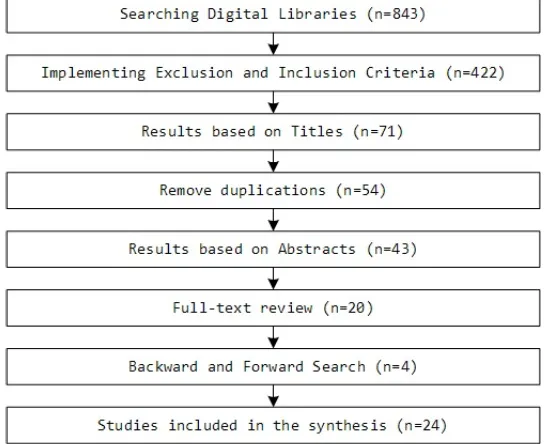
[image:21.595.146.418.499.721.2]In search process we first looked into Scopus and Web of Science for preliminary search for title and abstract. After that, we looked into other digital libraries to get the full text of the literature. We also conducted backward and forward search for literature that we find useful but not yet covered in the initial search. Fig.2.1 depicts the outline of our search strategy.
Figure 2.1: Search strategy diagram
We used following keywords to find relevant studies for our research: (”logging” AND ”log management”), (”logging” AND ”literature review”), (”process mining algorithm” AND ”litera-ture review” ), (”process mining algorithm” AND ”process discovery” ), (”process mining” AND ”control flow perspective”), (”process mining” AND ”organizational perspective”), (”auto*” AND (”enterprise architecture model*” OR ”enterprise architecture documentation” OR ”enterprise architecture”)), (”process mining” AND ”enterprise architect*”) and the following list are the digital libraries that we used in our research.
• Scopus (www.scopus.com).
• Web of Science (www.webofknowledge.com).
• IEEE Explore (www.ieee.org/web/publications/xplore/).
• Research Gate (www.researchgate.net).
• Springer Link (www.springerlink.com).
• Science Direct (www.sciencedirect.com)
• Google Scholar (www.scholar.google.com).
• University of Twente Library (www.utwente.nl/en/lisa/library)
2.1.2
Inclusion and Exclusion Criteria
Inclusion Criteria:
• Studies that related to automated enterprise architecture documentation, process
min-ing and enterprise architecture, process minmin-ing algorithm in the literature review, pro-cess mining in organisational and control flow perspective, propro-cess mining algorithm in process discovery, log management in the literature review, logging and log manage-ment.
• Research areas in Computer Science.
• English peer review studies including Conference papers, Proceeding papers, Articles,
Books and Book Chapters.
• Published between 2000 and 2018.
Exclusion Criteria:
• Studies are not in English.
• Studies are not related to the research questions.
• Duplicate studies (by title or content).
• Short paper.
2.1.3
Data collection
The data extracted from each study were:
• Identity of study: the Unique identity of the study.
• Bibliographic references: Authors, year of publication, title and source of Publication.
• Type of study: Book, journal paper, conference paper, article.
• Type of Logs: Definition and type of logs.
• Process mining algorithms: Description of algorithms with consideration of the classi-fication.
• Automated EA documentation current studies: Contribution of current literature in
automated EA documentation areas.
• Mapping EA Framework: EA framework elements that have already mapped in the
cur-rent literature.
2.2. Literature Review Result
We began with searching literature in Scopus and Web of Science to get 843 studies related to various topics for this research after we implemented exclusion and inclusion criteria we got 422 studies, and we filtered based on title to get 71 studies. After that, we remove duplication for 54 results, and after we read the abstract, we got 43 studies. Next, after thoroughly reading the content we decided to synthesis 20 studies. In addition to backward and forward search, we decided to add four additional studies. Overall, we got 24 studies for this research. The illustration of the process can be seen at Fig.2.1 and the detail search result corresponding to data collection (2.1.3) can be seen at Table.2.1.
Table 2.1: Literature Review Studies
ID Author Date Topic Type Topic Areas Source Type Cited Source S1 Chuvakin et al. [11] 2012 Log Log management Book 7 UT Library S2 Rojas et al. [32] 2016 Process Mining Literature Review Conference Paper 70 ScienceDirect S3 Van Der Aalst W.M.P. [36] 2016 Process Mining Algorithms Book 426 UT Library S4 Akman and Demirörs [6] 2009 Process Mining Process Discovery Algorithms Conference Paper 13 IEEE S5 Weber et al. [43] 2011 Process Mining Process Discovery Algorithms Conference Paper 9 IEEE S6 Van Der Aalst W.M.P. [38] 2013 Process Mining Process Discovery Algorithms Conference Paper 23 IEEE S7 Mans et al. [30] 2008 Process Mining Control Flow Algorithms Conference Paper 132 Springer Link S8 Bozkaya et al. [8] 2009 Process Mining Control Flow Algorithms Conference Paper 41 IEEE S9 Kalenkova et al. [26] 2017 Process Mining Control Flow Algorithms Article 8 Springer Link S10 Van der Aalst et al. [40] 2007 Process Mining Organisational Algorithms Article 436 ScienceDirect S11 Song et al. [33] 2008 Process Mining Organisational Algorithms Conference Paper 302 ScienceDirect S12 Appice et al. [7] 2016 Process Mining Organisational Algorithms Conference Paper 3 Springer Link S13 Lismont et al. [29] 2016 Process Mining Organisational Algorithms Article 6 ScienceDirect S14 Aier et al. [5] 2009 EA management EA maintenance Conference Paper 38 Google Scholar S15 Winter et al. [46] 2010 EA management EA management practice Conference Paper 83 Research Gate S16 Farwick et al. [14] 2011 Automated EA Requirements and Challenges Proceedings Paper 4 Research Gate S17 Hauder et al. [21] 2012 Automated EA Requirements and Challenges Conference Paper 17 Springer Link S18 Välja et al. [35] 2015 Automated EA Requirements and Challenges Conference Paper 3 IEEE S19 Farwick et al. [12] 2011 Automated EA Implementation Conference Paper 26 IEEE S20 Buschle et al. [9] 2012 Automated EA Implementation Conference Paper 28 Research Gate S21 Buschle et al. [10] 2012 Automated EA Implementation Conference Paper 11 Springer Link S22 Holm et al. [22] 2014 Automated EA Implementation Article 15 Springer Link S23 Van Langer[42] 2017 Automated EA Implementation Conference Paper 0 Springer Link S24 Johnson et al. [25] 2016 Automated EA Algorithm Conference Paper 0 IEEE
2.2.1
Log
RQ1a: What is a log, event log, what type of event log that available and how to produce the log?
2.2.1.1 Log and event log
A log is what a computer system, device, software, etc. generates in response to some sort of stimuli [11]. For example, login and logout messages in a Unix system, ACL accept and deny
messages in the firewall. Log could be classified into the some general categories [11]:
Infor-mational, debug, warning, error, andalert. Informational is a log that describes occurrences
of benign activities, debug is a log that aids software developer to troubleshoot and identify
problems of running code. Warning is a log that describes some situations that might be
missing or needed for a system. Error is a log that describes errors that occurs in various
levels in a computer system. Lastly, alert is a log that indicates something interesting has
happened. Log has typical basic contents [11], which are: Timestamp, source, and data.
Timestamp is the time at which the log message was generated,sourcerepresents in IP
ad-dress or hostname, to describe from which the log was generated. Anddata is the content
of the log itself, there is no standard format of how data is represented in a log message. It depends on from which system or application that the log was generated.
table) [37]. Another definition of log are:
Definition 1(Event, attribute [36]). LetE be theevent universe, i.e., the set of all possible event identifiers. Event may be characterised by variousattributes, e.g., an event may have a times-tamp, correspond to an activity, is executed by a particular person, has associated costs, etc. Let
ANbe a set of attribute names. For any event𝑒 ∈E and name𝑛 ∈ 𝐴𝑁,# (𝑒)is value of attribute
nfor evente. if event does not have an attribute namedn, then# (𝑒) = (null value)
Definition 2(Classifier [36]). For any event𝑒 ∈E,𝑒̲is thenameof the event.
Definition 3(Case, trace, event log [36]). LetC be thecase universe, i.e., the set of all possible case identifiers. Cases, like events, have attributes. For any case𝑐 ∈C and name𝑛 ∈ 𝐴𝑁:# (𝑐)
is the value of attribute n for case𝑐(# (𝑐) = if case c has no attribute named n). Each case has a special mandatory attribute, trace# (𝑐) ∈E∗(In assumption# (𝑐) ≠ ⟨ ⟩, i.e., traces in a log contain at least one event). ̂𝑐 = # (𝑐)is a shorthand for referring to the trace of a case.
A trace is a finite sequence of events𝜎 ∈E∗such that each event appears only once, i.e., for
1 ≤ 𝑖 < 𝑗 ≤ |𝜎| ∶ 𝜎(𝑖) ≠ 𝜎(𝑗).
An event log is a set of cases𝐿 ⊆C such that each event appears at most once in the entire log, i.e., for any𝑐 , 𝑐 ∈ 𝐿such that𝑐 ≠ 𝑐 : 𝜕𝑠𝑒𝑡( ̂𝑐 ) ∩ 𝜕𝑠𝑒𝑡( ̂𝑐 ) = ∅
If an event log contains timestamps, then the ordering in a trace should respect these times-tamps, i.e., for any𝑐 ∈ 𝐿, i and j such that1 ≤ 𝑖 < 𝑗 ≤ | ̂𝑐| ∶ # ( ̂𝑐(𝑖)) ≤ # ( ̂𝑐(𝑗)).
Van der Aalst [36] defined an event can be identified with attributes that it has. Example
that was described in the Definition.1, an event can be described in activitythat the event
does, at what time that the event does (timestamp), who/what execute the event (resource) or
what cost that the event takes (cost). In addition, we can also identify the event by its name
(𝑒̲). In summary, event log consists of cases or traces, each case consists of events that each
event relates to one case, the event has its attributes, and the event could also be ordered by its attributes. Illustration for an event log structure can be seen at Fig.2.2.
Definition 4(Simple event log [36]). LetA be a set activity names. A simple trace𝜎is a sequence of activities, i.e.,𝜎 ∈A∗. A simple event log L is multi-set of traces overA, i.e., L∈ 𝔹(A∗). And using assumption that each trace contains at least one element, i.e.,𝜎 ∈L implies𝜎 ≠ ().
A simple event log is a multi-set of traces over some set of activity names (A). For example,
[(𝑎, 𝑏, 𝑐, 𝑑) , (𝑎, 𝑐, 𝑏, 𝑑) , (𝑎, 𝑒, 𝑑)]defines a log containing six cases, and in total there are(3𝑥2) + (2𝑥4) + (1𝑥3) = 23 events. In this context all cases start witha and end with d. Moreover, since there are no other attributes in the simple event log, i.e., timestamps or resources, thus, cases and events are no longer uniquely identifiable [36].
2.2.1.2 XES Standard
The current de facto standard for event log is XES ([20], [36]), the XES format is the successor of MXML and referring to practical experiences with MXML, XES format is less restrictive and
extensible. The format was adopted by theIEEE Task Force on Process Miningin September
2010. The basic structure of XES consists of Log. It contains all event information that
is related to one specific process. A log contains an arbitrary number (may be empty) of
traceobjects, each trace describes the execution of one specific instance, or case, of logged
processes. Every trace contains an arbitrary number (may also be empty) of event objects.
The event represents a single granularity of activity that has been observed in the execution of a process. The log, trace, and event do not contain information, they defined the structure
of the document. All information of an event log is stored and described in attributes. An
Boolean, Id, ListorContainer data type. With string-basedkey. The meta-model of XES can be seen at Fig.2.3. As can be seen, the metamodel (Fig.2.3) is the formalised standard of event log that Van der Aalst [36] defined previously.
Figure 2.3: Meta-model of the XES standard [20]
2.2.1.3 Event log type
In [36] data in event log can be classified into ”pre mortem” and ”post mortem” data. Post
mortemdata refers to information of cases that have completed or historical data. The objec-tive of this data not to influence the current process, but to improve the process and auditing.
Meanwhile,pre mortem data refers to data that is still running or ”alive” (pre mortem). It is
possible to exploit these type of data to ensure correctness or improve the effectiveness of the processes.
Post mortemdata is suitable for offline process mining, for example discovering the control-flow (Section.2.2.3) based on historical process data. However, for online process mining it
is necessary to use a combination of “pre mortem” (current) and “post mortem” (historical)
data. We can produce a predictive model based on historical data and improve running case using the predictive model, for example, to predict the estimation time needed for running the processes. Based on the data type, process mining itself refined into two types of models, “de jure models” and “de facto models”. De jure models refer to the normative model that
accepted or perceived by stakeholders of how things should be done or handled. While de
facto modelsrefer to the descriptive model or how it is currently done or handled based on captured reality. These type of data and models are illustrated in Fig.2.4. As can be seen at the figure, there are two arrows. De facto models are derived from reality (right downward arrow), and that de jure models aim to influence reality (left upward arrow), and in between, there are ten activities that are grouped into three categories: cartography, auditing, and navigation.
that describes the operational processes of organisations. In order to do that abstraction or blueprint (process model) is needed. Thus, activities in these categories mainly targeted to
produce a process model, enhance it or diagnose the model. Auditingrefers to a set of
activi-ties that are used to check if business processes that are executed within certain boundaries
set by managers, governments, and other stakeholders. Lastly,navigationrefers to activities
[image:27.595.132.433.199.524.2]that needed to navigate running and future business process, for example, exploration of business process at runtime, make a prediction model of the business process, and produce recommendation based on the predictive model.
Figure 2.4: Process mining framework [36]
2.2.1.4 How to produce an event log
Figure 2.5: Getting process mining data from heterogeneous data source [36]
2.2.2
Is process mining algorithms can be used to produce automated EA
model documentation
In this section, we found data sources available for the automation process, with its con-version mechanism. We also identify a list of fields that used to conduct the automation processes. Furthermore, we also map the fields into appropriate elements and relationships of Archimate based on literature and our conjuncture.
2.2.2.1 Data sources and automation process
RQ1b: What are suitable data sources that can be used in automated EA model documenta-tion?
RQ1c: What are the automation processes used in automated EA model documentation?
Farwick et al. [13] in their research discovered a list of productive systems that contains relevant EA information. There are at least six information sources that might be available for Is process mining algorithms can be used to produce automated EA model documentation:
Network monitor and scanners, a tool to gather network activities using network scanners
organisation that complies with ITIL.Project portfolio management tools, a tool for managing
project portfolio. Enterprise service bus, central mediating entities for inter-application
com-munication. Change management tools, a tool to optimise implementation of changes in the
IT-landscape. Lastly,license management tools, a tool to manage acquired software licenses.
The research from Farwick et al. [13] align with research of Holm et al. [22] and Buschle et al. [9]. Buschle et al. [9] determine Archimate informational model in business, applica-tion and infrastructure layer, the input for their research is SAP PI, Enterprise Service Bus (ESB) software that hosts on the cloud. They were able to relate SAP PI’s components to Archimate’s elements and relationship. They also devise transformation rules to facilitate those conversions. Although their research focused on SAP PI, it is adaptable to other ESB software. However, there are limitations in their research, as they stated in their research that SAP PI is very technological-oriented, thus limiting the input for business information related. Holm et al. [22] in their research also able to implement process mining algorithms can be used to produce automated EA model documentation using a network scanner. They defined elements and relationship of Archimate that relatable to data that gathered using network scanner and propose a tool to map between Archimate constructs and data source from the scanner. Both research from Buschle et al. [9] and Holm et al. [22] proved the op-tions to used Network monitor and scanners and ESB for data source input in generating automated EA model.
In addition to Farwick et al. [13] research, we also discover other data source available to creating Is process mining algorithms can be used to produce automated EA model doc-umentation. Van Langerak et al. [42] in their research implement mechanism from pro-cess mining to develop Business Propro-cess Cooperation Viewpoint in Archimate. They utilised Process-Aware Information System (PAIS) to record reality in the form of audit trails or event logs and using that logs as input to generate Archimate constructs. However, they did not provide tools for converting the log into an EA model, and it is unclear how they correlate between process models and EA models.
2.2.2.2 Relevant fields and mapping
RQ1d: What are the relevant fields and the mappings between fields and Archimate con-structs?
There is a list of elements and relationship that can be possibly converted into EA models using a PAIS’ log [42], Enterprise Service Bus [9] and network scanner [22]. In this research, we limit our research to only use Archimate as our EA framework. The list is not exhaustive since we based the list on the literature that we searched, and the list can be found at Appendix. A.
2.2.2.3 Business Layer
In the business layer, based on the literature, we could convert data sources intoBusiness
Actor, Business Collaboration, Business Process, andBusiness Service. Van Langerak et al.
[42] in their research argued that Organisation andDepartment are specialisation of
Busi-ness Actor, anOrganisation has a hierarchical structure ofDepartments, and delivers some
Business Service. A Business Service is implemented by one or more Business Processes.
Activitiesin aBusiness ProcessformCooperation (orBusiness Collaboration). ACooperation
is always initiated and concluded by an Activity. Using an event log, Trace can be used to
produce Business Service which implements Business Process. While Event are raised by
executingActivitiesand can be used to reconstructCooperation. AlsoResourcesas one who
executesActivitiescan be used to create Business Actor throughDepartment and
Organisa-tion. The conceptual model of their idea can be seen in Fig.2.6.
While [9] stated that elements ofBusiness Layer are quite difficult to reconstruct, as we
quote from their research ”although SAP PI’s element are meant to implement business
func-tionality a reconstruction of business information is commonly hindered by the strong technol-ogy focus”. Some business elements that can be used to describe commutative goals such
Object are not directly included in SAP PI. Other elements, such asRepresentation can be reconstructed with implicit information, as in SAP’s, it derives from technologies data such as e-mail. Overall, in the research, some element can be implicitly reconstructed while others are not possible because of the absence of the data. Archimate elements that can be covered
by SAP PI can be seen at Figure 2.7. In [22] it is possible to reconstruct aBusiness Actor from
the data, as they described that a scanner collects all user accounts of a computer system, however, if one wants to relate these actors to different actor, i.e. department, it requires additional effort from the modeller to perform the translation.
Figure 2.6: Conceptual model of runtime business architecture [42]
2.2.2.4 Application Layer
In the Application Layer, we can reconstruct Application Component, Application
Collabora-tion, Application Interface, and Data Object. Buschle et al. [9] stated that SAP PI provides
software components and software products to fulfil the information needed for Application Component. Also Application Collaboration is reconstructed by temporary configuration of
two or moreApplication Components. Application Interface is broadly similar to SAP PI’s
en-terprise service interface. In SAP PI there are no elements available to describe behaviour
elements, such asApplication Service. However, they argued that it can be derived indirectly
usinginterfaceand description ofoperations. Lastly,Data Objectsis similar to SAP PI’sdata
types. Their conjuncture regarding elements of SAP PI that can be converted into EA model
can also be seen in Fig.2.7. In [22],Application Component can be reconstructed using data
of various application components that gathered by the scanner, for example, different ERP system modules, application clients such as Adobe Reader. If an application is running on an
end-point (i.e., a port), it can provide information forApplication Interface. In regards to [9],
Figure 2.7: Archimate information model elements covered by SAP PI [9]
2.2.2.5 Technology Layer
In this layer, we can reconstruct Node, Device, System Software, Technology Interface, and
Communication Network. Buschle et al. [9] stated that SAP PI’s computer system can fill in
for aNode. A subset of installed system software registered at System Landscape Directory
of SAP PI can be used to represent System Software. While Communication Network can
be reconstruct using an underlying physical medium of each service invocation by SAP PI. However they did not provide information on how a device can be recreate using SAP PI, yet
they put the information in the picture (Fig.2.7). In [22] aSystem Softwareis represented by
the identification of several types of system software, for example, web servers and operating
systems. Infrastructure Interface can be fill in using the protocol (i.e., SMTP) and port (i.e.,
8080). While Deviceis represented by hardware or IP address of a system. Holm et al. [22]
also argued that IP address could be used to represent aNetwork.
2.2.2.6 Relationship
Based on the literature we can define relationship such as Composition, Aggregation,
As-signment, Realization, Serving, Access, Triggering andAssociation. Buschle et al. [9] in their
Ap-plication Interface and Application Component, while Aggregation used to relate Application Component and Application Collaboration. While Assignment was used in relationship
be-tween System Software and Device. Node can be related to Communication Path through
Association. In addition, [42] implied that they usedComposition, Realization, Serving, and
Triggering in their research. While [22] stated that they used Assignment to define
rela-tionship between Device and System Software, andUsed by (Serving) to define relationship
betweenApplication Component andInfrastructure Interface.
2.2.3
Algorithms
RQ2a: What are algorithms that are used in Process Mining to convert a log into a process model?
2.2.3.1 Process models
2.2.3.1.1 Petri-Net and workflow-net
Definition 5(Petri net[36]). A Petri net is a triplet N = (P, T, F) where P is a finite set of places, T is a finite set of transitions such that𝑃 ∩ 𝑇 = ∅, and𝐹 ⊆ (𝑃 × 𝑇) ∪ (𝑇 × 𝑃)is a set of directed arcs, called the flow relation. A marked Petri net is a pair (N, M), where N = (P, T, F) is a Petri net and where𝑀 ∈ 𝔹(𝑃)is a multi-set over P denoting the marking of the net. The set of all marked Petri nets is denotedN . The Petri net shown Fig. 2.8 can be formalized as follows: P = {start, c1, c2, c3, c4, c5, end}, T = {a, b, c, d, e, f, g, h}, and F = {(start, a), (a, c1), (a, c2), (c1, b), (c1, c), (c2, d), (b, c3), (c, c3), (d, c4), (c3, e), (c4, e), (e, c5), (c5, f), (f, c1), (f, c2), (c5, g), (c5, h), (g, end),(h, end)}
Petri net is a bipartite graph consisting of places and transitions, interconnected by
[image:32.595.137.492.481.708.2]di-rected arcs [36]. Petri net is one of the most basic process model that being used as an output of process mining algorithms, one of the algorithms that produced WF-net (Petri net with start and end place) is alpha miner. Petri net also depends on the token to ensure that the process model replayable / can be simulated for each cases of event log. There also split and join rules that inherent in petri net, this is useful to denotes if some events have concurrent activities or some execution path is exclusive for some events.
Definition 6(Workflow net[36]:). Let N = (P, T, F, A, l) be a (labeled) Petri net and ̄𝑡 a fresh identifier not in 𝑃 ∪ 𝑇. N is a workflow net (WF-net) if and only if (a) P contains an input place i (also called source place) such that•𝑖 = ∅, (b) P contains an output place o (also called sink place) such that𝑜• = ∅, and (c)𝑁̄ = (𝑃, 𝑇 ∪ { ̄𝑡},𝐹 ∪ {(𝑜, ̄𝑡), ( ̄𝑡, 𝑖)}, 𝐴 ∪ {𝜏}, 𝑙 ∪ {( ̄𝑡, 𝜏)}) is strongly connected, i.e., there is a directed path between any pair of nodes in𝑁̄.
A workflow net (WF-Net) is a Petri net with a single start place and a single end place that represent the start and end state of a process.
2.2.3.1.2 Dependency graph
Heuristic miner produces dependency graph (Definition.15) as its process model [44], the dependency graph represents all the dependencies found in the log. Fig.4.6 is an example of dependency graph that resulted from a heuristic miner processing. As can be seen at the figure, it has rectangle to represent an activity with its frequency occurrences, the arc represent dependency path between activities, the arc also has label that represent
depen-dency factor and its frequency. The result ofbusiness process discoveryalgorithm is similar
to dependency graph, and instead of rectangle as an activity, we substitute it withbusiness
process element, and we convert arcs to triggering relationship. Example of the converted graph can be seen at Fig.4.6.
[image:33.595.149.410.386.599.2]Definition 7(Dependency Graph [4]). Given a set of activities V and a log of executions L of the same process, a directed graph𝐺 is a dependency graph if there exists a path from activity u to activity v in𝐺 if and only if v depends on u.
Figure 2.9: Example dependency graph [44]
2.2.3.2 Algorithms
There are three types of Process Mining: discovery [6–8, 26, 29, 30, 32, 36, 38, 40, 43],
conformance [8, 26, 32, 36, 38], and enhancement [8, 32, 36]. Discovery is a technique to
process an Event log without using apriori information, while conformanceis a mechanism
observe, such ascontrol flow[8, 26, 29, 30, 32, 36, 40],organisational [7, 8, 26, 29, 30, 32,
36, 40], performance / time [8, 29, 30, 32, 36], and data / case [26, 36, 40]. The control
flow perspective focuses on the ordering of activities, to find a good characterisation of all possible paths of processes. The organisational perspective discovers the hidden information regarding resources in a log, which actors (i.e. people, system, roles, and departments) are involved and relationship between them. The organisational perspective also has an objective to structure the organisation by classifying people in regards of roles, organisational unit, or social network. The case perspective focuses on the properties of cases. A case can describes a process or originator that working on it, or it can also describe values of corresponding data elements, such as number of products ordered. The time perspective explains the timing and frequency of events, discovering bottleneck, measure service levels, monitor utilisation of resources, and predict the remaining processing time of running cases.
In this study, we found out algorithms that used for each perspective in the process discov-ery (Appendix.B). Also, in the following sub-sections we described in more detail algorithms that we think can be potential algorithms for converting a log into an EA model.
2.2.3.3 Control Flow Perspective Algorithms
Control flow algorithms help to discover the sequence of processes that reside in an event log. The algorithms also able to describe the dependency of processes, correlations between those processes and the frequency of those processes occurs. Related to our study, this information will help us to uncover certain elements of the EA framework, for example in
Archimate elements such asbusiness processes. The algorithms also able to cluster coherent
activities and limiting the processes using the high degree of correlation or frequencies that occurs, this capability will help reducing the number of elements that can be generated in an EA model, thus relieving over-complexity of the EA model.
Figure 2.10: Alpha Miner result Example [36]
2.2.3.3.1 Alpha Miner
The alpha miner is one of the first algorithms that can be used to discover concurrency [36], it discovers dependency pattern between activities and describes process behaviour within the log. The alpha miner scans the event log for particular pattern [36]. It able to discern between dependency, non-dependent, concurrency relationship between events. They also enabled process patterns, to distinct if relationship between events are sequence, XOR/AND-split or XOR/AND-join pattern. Then algorithm also ensure that the process model is re-playable or enable to simulate when its needed for analysis. The algorithm produces a workflow net: a
bipartite graph consisting ofplacesandtransitionsinterconnected by directed arcs and has
a single start and end place. In the Fig.3.3 it can be seen a sample of behavioural activities
based on a given log, for example, the whole process begin with activitya and end inf, with
also represent process pattern, for example from activityatodis connected with dependency
relationship in sequence, while b and e connected to f with XOR-join relationship. The
algorithms is quite simple and easily to implement, however there are certain limitation for this simplicity, it has difficulty to process infrequent or rare behaviour (noise), logs that only contain a little or few events (incompleteness) or log with complex routing constructs.
2.2.3.3.2 Heuristic Miner
Heuristic Miner is an algorithm that able to deal with noise and exceptions. It also have capabilities of alpha miner to discern dependency, non-dependent, concurrency relationship between events. It also focus on frequencies of events and sequences, and it enables users to concentrate on the main process flow instead of on every detail of the behaviour that appears in the process log. Heuristic Miner produces a Causal Net, a graph that represents activities as nodes and dependencies as arcs and also dependency graph, directed graph that represent dependent relationship between activities. For example, in Fig.2.11 sample of a behavioural analysis using Heuristic Miner. It can be seen the algorithm able to discover frequencies of
processes. In the activity of ”ArtificialStartTask”, it has 352 occurrences, and 36 of those
occurrences happens to be followed by ”Yearly checkup OC Obst/Gyn”. The algorithm also
able to extract correlation between processes, as shown the dependency factor between ”
Ar-tificialStartTask” and ”Yearly checkup OC Obst/Gyn” is 0.973 or 97.3% ”ArtificialStartTask”
[image:35.595.61.506.349.592.2]will be directly followed by ”Yearly checkup OC Obst/Gyn”.
Figure 2.11: Heuristic Miner Example [30]
2.2.3.3.3 Fuzzy Miner
Fuzzy Miner able to generate process models from the huge number of activities and highly unstructured behaviour. The Fuzzy Miner combines abstraction and clustering techniques to produce a high-level view and emphasising the most important details. In the Fig.2.12 it can be seen the example of using this algorithm to extract behavioural process of a log. The algorithm able to discover frequency of processes, it can be seen at the thickness of the
arc, for example, ”1” to ”61” is more frequent than ”495” to ”61”. The algorithm also able to
Figure 2.12: Fuzzy Miner Example [8]
2.2.3.3.4 Genetic Miner
Figure 2.13: Genetic Process Mining Overview [36]
Figure 2.14: Inductive Miner Sample [36]
2.2.3.3.5 Inductive Miner
[image:37.595.66.503.460.681.2]algo-rithm is highly extensible, it also able to handle infrequent behaviour and deal with huge model and logs, the algorithm also ensures formal correctness criteria, for example, ability to rediscover the original model. While the alpha miner produces WF-Net, Inductive miner produces equivalent process tree. The Inductive miner is processing an event log in an it-erative manner, splitting the log into sub-logs and create the directly-follows graph for each sub-logs. In Fig.2.14 it can see the sample of the process tree as a process model result when processing an event log using Inductive Miner. Each node is the result of observation of sub-logs that was mentioned earlier.
2.2.3.4 Organisational Perspective Algorithms
Organisational algorithm focus on who perform what activities and express more into the relationship between originators (a person who conduct some activity). There are two algo-rithms that we highlight in this section, organisational and social network analysis miner. In our study, both algorithms can be used in the future research. Elements of Archimate,
such asbusiness actorsandbusiness rolescan be discovered using these algorithms.
2.2.3.4.1 Organisational Miner
[image:38.595.133.495.369.625.2]Organisational miner is the algorithm to derive an organisational model from event logs. It can derive a group of originators that have similar characteristics in process execution and discover the relationship between mined groups and the tasks. In Fig.2.15 it can be seen the sample of using this algorithm to determine the role of each originator that lie in a given log.
Figure 2.15: Organisational Miner Sample [33]
2.2.3.4.2 Social Network Miner
The social network analysis algorithm is the algorithm that able to derive an interpersonal
relationship between originators in a given log. It can describehandover of work: detecting
Figure 2.16: Social Network Analysis Sample [40]
2.2.3.5 Data and Performance Perspective Algorithms
Based on the literature finding, we did not find relevant algorithms that might useful for our research. We found the dotted chart, a technique to describe events and represent data attributes in two-dimensional plane. However, for this research, we seek the algorithms that enable users to extract process models from logs, while mostly algorithms of this perspectives seek attribute information that lies in logs, such as duration of activities, resources that execute the activities. Overall, we think it is irrelevant to use this perspectives’ algorithm for our research unless we want to describe the performance of activities in our EA model.
2.2.4
Conversion pattern
RQ2c: What are Archimate elements that can be used to represent process models?
Hence, using control-flow we can achieve this objective.
We perceive each step in the e-commerce case is an event, and for an event, we can attach various information as attributes, such as the name of the system, a user who execute the events, time its been executed, etc. Thus, identifying the event is the most crucial part in automated EA documentation using process mining. As we discussed before there are multiple algorithms that we can choose, however for this research we chose the simplest one. In the beginning, we chose alpha miner as the algorithm provide a basic algorithm to control-flow perspective, but we also realised that alpha miner has limitations in recognising infrequent/rare, incomplete, or complex routing case. Thus, we chose heuristic miner for this reason. Heuristic miner also simpler than other algorithms that more mature and advance, so we believe it is easier to implement in future works. Moreover, heuristic miner able to address the problems that raised in the alpha miner, so this is a trade-off that we pick. Heuristic miner is able to generate various type of process model, such as Causal net, dependency graph. However, in this study, we pick the dependency graph as a process model for referencing to Archimate. Again, we pick the graph to easier implementation.
The comparison process that we chose is quite simple, we identify the definition of el-ements of the process model, and we pick Archimate elel-ements that closely represent that definition. Based on the definition of the dependency graph (Definition.15), the graph con-sisted of a set of activities and connected to the arc that represents the dependency between
activities. The activityitself is referred to ”a well-defined step in the process.” [37]. And we
interpret it asBusiness Process, ”A sequence of business behaviors that achieves a specific
outcome such as a defined set of products or business services.” [18]. In our opinion ac-tivity is a step of the process, the process in this context is a business-related process, and it closely fit business process that defines a sequence of business behaviour, since the pro-cess discovery also targeted to observe certain behaviour of propro-cesses in the log. Hence, we think the business process can be used to represent activity. In addition, there are multiple
relationship that represent relationship between business processes, such asspecialization,
composition, aggregation, serving, triggering, flow, and association [18, p.125] and since arc
in the dependency graph represent dependency relationship, thus we choseservingto
con-nect betweenbusiness processes. Theserving relationship models that an element provides
3
Theoretical Background
In this chapter we will discuss additional theoretical background that were used in the re-search that had not been explained before in previous chapters. We discuss the definition of EA, Archimate as an EA framework, popular process mining algorithms in more detail, and tools that were commonly used in process mining.
3.1. Enterprise Architecture
3.1.1
Enterprise Architecture
Enterprise architecture is a coherent whole of principles, methods, and models that are used in the design and realisation of an enterprise’s organisational structure, business processes, information systems, and infrastructure [28]. While Gartner [16] defined enterprise architec-ture is a discipline for proactively and holistically leading enterprise responses to disruptive forces by identifying and analysing the execution of change toward desired business vision and outcomes. EA delivers value by presenting business and IT leaders with signature-ready recommendations for adjusting policies and projects to achieve target business outcomes that capitalise on relevant business disruptions. And [19] defined enterprise architecture with two separate definitions. Enterprise is the fundamental organisation of a system, em-bodied in its components, their relationships to each other and the environment, and the principles governing its design and evolution. And architecture are: (1) A formal description of a system or a detailed plan of the system at component level to guide its implementation. (2) The structure of components, their inter-relationships, and the principles and guidelines governing their design and evolution over time.
3.1.2
Archimate
The Archimate Enterprise Architecture Modelling language is a technical standard from The Open Group. It provides a diagram standardisation that used to describe Enterprise Ar-chitectures. It presents a selection of viewpoints to address a variety of stakeholders, an integrated architectural approach that used to describe and visualise multiple architectural domains and their underlying relations and dependencies [18].
![Figure 2.2: Structure event log [36]](https://thumb-us.123doks.com/thumbv2/123dok_us/9593619.462859/25.595.86.483.132.649/figure-structure-event-log.webp)
![Figure 2.3: Meta-model of the XES standard [20]](https://thumb-us.123doks.com/thumbv2/123dok_us/9593619.462859/26.595.158.465.118.435/figure-meta-model-of-the-xes-standard.webp)
![Figure 2.4: Process mining framework [36]](https://thumb-us.123doks.com/thumbv2/123dok_us/9593619.462859/27.595.132.433.199.524/figure-process-mining-framework.webp)
![Figure 2.5: Getting process mining data from heterogeneous data source [36]](https://thumb-us.123doks.com/thumbv2/123dok_us/9593619.462859/28.595.137.491.66.480/figure-getting-process-mining-data-heterogeneous-data-source.webp)
![Figure 2.7: Archimate information model elements covered by SAP PI [9]](https://thumb-us.123doks.com/thumbv2/123dok_us/9593619.462859/31.595.59.505.66.486/figure-archimate-information-model-elements-covered-sap-pi.webp)
![Figure 2.8: Workflow net [36, p.37]](https://thumb-us.123doks.com/thumbv2/123dok_us/9593619.462859/32.595.137.492.481.708/figure-workflow-net-p.webp)
![Figure 2.9: Example dependency graph [44]](https://thumb-us.123doks.com/thumbv2/123dok_us/9593619.462859/33.595.149.410.386.599/figure-example-dependency-graph.webp)
![Figure 2.11: Heuristic Miner Example [30]](https://thumb-us.123doks.com/thumbv2/123dok_us/9593619.462859/35.595.61.506.349.592/figure-heuristic-miner-example.webp)
![Figure 2.14: Inductive Miner Sample [36]](https://thumb-us.123doks.com/thumbv2/123dok_us/9593619.462859/37.595.70.503.79.408/figure-inductive-miner-sample.webp)
