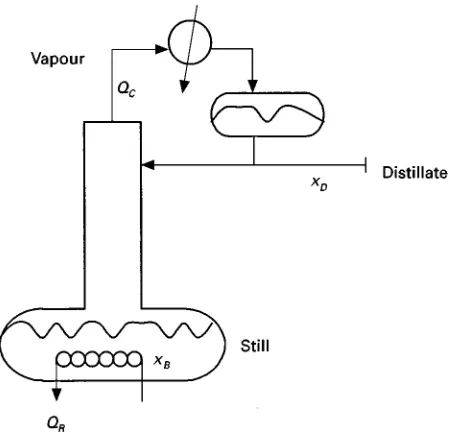
Figure 1 Simple distillation}a still.
Multicomponent Distillation
V. Rico-RamOHrez and U. Diwekar,
Carnegie Mellon University, Pittsburgh, PA, USA
Copyright^ 2000 Academic Press
Introduction
Distillation is the oldest separation process and the most widely used unit operation in industry. It in-volves the separation of a mixture based on the differ-ence in the boiling point (or volatility) of its compo-nents. The reason for the wide acceptance of distilla-tion is that, from both kinetic and thermodynamic points of view, distillation offers advantages over other existing processes for the separation of Suid mixtures:
1. Distillation has the potential for high mass trans-fer rates because, in general, in distillation there are no inert materials or solids present.
2. The thermodynamic efRciency for distillation is higher than the efRciency of most other available processes in the chemical industry.
Designing a distillation column involves: (1) selecting the type of column, mostly based on heuristics; (2) obtaining the vapour}liquid equilibrium data using thermodynamics; and (3)Rnding the design variables such as number of equilibrium stages and operating conditions required to obtain the desired separation based on mass and energy balances.
When the mixture to be separated contains two components, the design of a column can be accomp-lished by using graphical methods. However, for multicomponent systems the design methods are more difRcult and are the focus of this article.
Fundamentals
Simple Distillation
Distillation began as a simple still. In such an opera-tion, a liquid mixture is heated (see Figure 1). As a result, a vapour stream richer in the more volatile components comes off, while the liquid, richer in the less volatile components, remains in the still. The vapour stream is condensed and collected in the con-denser.
The analysis of simple distillation for a binary mixture presented in 1902 by Lord Rayleigh marks the earliest theoretical work on distillation. Consider Figure 1. Let F (moles) be the initial feed to the
still and xF (mole fraction) be the composition of componentAof the mixture. LetBbe the number of moles of material remaining in the still,xB the mole fraction of component A in the still, xD the mole fraction of componentAin the vapour dBproduced during an inRnitesimal time interval dt. The differen-tial material balance for componentAcan be written as:
ln
BF
"xB
xF dxB
xD!xB [1]
Complex mass and heat transfer processes occur in distillation processes and it is generally assumed that the vapour formed is in thermodynamic equilibrium with the liquid. Hence, the vapour composition (xD)
is related to the liquid composition (xB) by an equilib-rium relation of the functional form xD"f(xB). Note that, because of the unsteady nature of simple distillation, the equilibrium relationship between
xD and xB holds only for each inRnitesimal time interval dt.
The exact equilibrium relationship for a particular mixture may be obtained from a thermodynamic analysis and is also dependent upon temperature and pressure.
Thermodynamics and Equilibrium Data
design. For binary mixtures, these data are generally presented in the form of tables containing the liquid and vapour equilibrium compositions over a range of temperatures for aRxed pressure. The same informa-tion can also be plotted in what is called an x}y
diagram. For multicomponent mixtures, however, vapour liquid equilibrium data are difRcult to repres-ent in graphical or tabular form. In such case,
Kvalues are used instead.
K value and relative volatility The K value of a component i is a measure of the tendency of such component to vaporize. AKvalue is deRned by:
Ki"yi
xi [2]
whereyiis the equilibrium composition of the vapour
phase for a composition xi of the liquid phase.
Kvalues are a function of temperature, pressure and composition, and they are widely reported for binary and multicomponent mixtures. An associated concept is the relative volatility,i,j, which is a measure of the
ease of separation of componentsiandj by distilla-tion:
i,j"
Ki
Kj [3]
Ideal and nonideal systems An ideal system is one in which the liquid phase obeys Raoult’s Law and the vapour phase obeys the ideal gas law. For such sys-tems, theKvalue is given by:
Ki"yi xi"
p0
i
P [4]
where p0
i is the vapour pressure of pure component iandPis the pressure of the system. Note thatp0
i is
a function of temperature.
For a nonideal system, theKvalues can also depend upon the composition of the mixture and are ex-pressed in terms of fugacity coefRcients, whereV
i is
the vapour phase fugacity coefRcient and L
i is the
liquid phase activity coefRcient, as given below:
Ki"Li
V
i ) p0i
P [5]
Azeotropic systems represent examples of nonideal mixtures for which eqn [5] has to be used.
Classi\cation of Distillation Processes
There are many criteria under which one can classify distillation: type of accessories, operating mode,
design calculation assumptions, etc. Distillation can either be binary or multicomponent. According to the type of accessories used to increase the mass transfer in the separation process, a distillation col-umn can be packed (use of packing) or staged (use of plates). It can be batch or continuous. Also, according to the assumptions made and accuracy expected in a distillation design calculation, a calculation technique can either be a shortcut method or a rigorous method.
Packed columns and staged columns Although simple distillation in a still historically represents the start of the distillation process, a complete separation of the components of the mixture using this process is not possible. Therefore, the application of these stills is restricted to laboratory-scale distillation, where high purities are not required or when the mixture is easily separable.
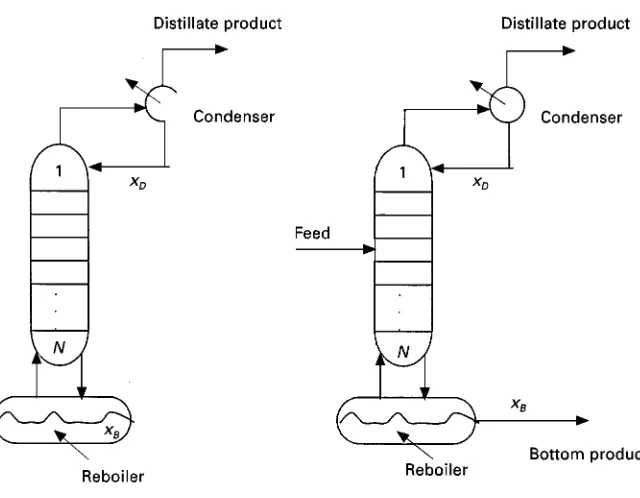
One can look at simple distillation as consisting of one equilibrium stage where a liquid and a vapour are in contact with one another and mass and heat trans-fers take place between the two phases. If N such stages are stacked one above the other, and are al-lowed to have successive vaporization and condensa-tion, that results in a substantially richer vapour and weaker liquid (in terms of the more volatile compon-ent) in the condenser and the reboiler, respectively. This multistage arrangement is representative of a distillation column, where the vapour from the reboiler rises to the top and the liquid from the condenser is reSuxed downwards (seeFigure 2). The contact between the liquid and the vapour phase is established through accessories such as packing or plates. When the accessory is a stack of plates, then the result is a column of trays. Similarly, if the acces-sory is packing, the result is a packed column.
Continuous distillation and batch distillation The basic difference between a batch column and a continuous column is that in continuous distillation the feed is continuously entering the column, while in batch distillation the reboiler is normally fed at the beginning of the operation. Also, while the top prod-ucts are removed continuously in both batch and continuous operations, there is no bottom product in a conventional batch distillation. Since in a continu-ous operation the total product Sow equals that of incoming feed or feeds, the process reaches a steady state. In batch distillation, on the other hand, the reboiler becomes depleted over time, so the process is unsteady. Such differences are illustrated in Figure 3.
Figure 2 Equilibrium processes. (A) Single stage; (B) multi-stage.
Figure 3 Batch distillation versus continuous distillation. (eqn [1]) is applicable. However, in both batch and continuous distillation, multistage mass transfer and thermodynamic equilibrium stage calculations are used for obtaining the steady-state relationship
be-tween the product composition (instantaneous in case of batch) and feed composition.
Multicomponent Multistage
Equilibrium Calculations
This section is divided in two parts. In the Rrst we discuss approximate methods (or shortcut methods); the second part corresponds to rigorous methods. The approaches are different depending upon the tion mode of the column, that is, a continuous opera-tion or a batch operaopera-tion.
In this section, our attention is focused on the approaches to the design of continuous columns. The reader can refer to the book by Diwekar (1995) for batch distillation calculations.
Shortcut Methods
Approximate methods constitute a useful for the syn-thesis, analysis and design of distillation separations. The main advantage of shortcut methods is that they can provide the feasible region of operation. They also provide large saving in computer time, and some-times, they are sufRciently accurate that more expen-sive rigorous methods are not justiRed.
Concept of Nmin and Rmin Minimum number of
Nmin corresponds to the number of trays required for separation in a situation in which the external reSux ratio R (ratio of the liquid reSuxed to the distillate rate) of the column is inRnite. This corres-ponds to total reSux operation.
Rmincorresponds to the minimum value of the ex-ternal reSux ratio required to achieve the speciRed separation in a situation in which the number of trays of the column is inRnite.
Fenske}Underwood}Gilliland method The most popular of these shortcut methods is the Fenske-Underwood-Gilliland method (FUG). The basic as-sumptions of such a method are:
1. The system is ideal.
2. Constant molar overSow (as in the McCabe Thiele method for binary mixtures).
3. The separation is essentially taking place between the light key component and the heavy key com-ponent. The light key (lk) is the lightest compon-ent appearing in the bottom and the heavy key (hk) is the heaviest component appearing in the top.
In the FUG method:
1. Fenske’s equation is used to calculate the min-imum number of trays,Nmin.
2. Underwood’s equation is used to estimate the min-imum reSux,Rmin.
3. Gilliland’s correlation is used to calculate the ac-tual number of trays,N (for anyRgiven), or the reSux ratio, R, (for any N given) in terms of previous limiting valuesNminandRmin.
The Fenske equation is:
Nmin"
log
xDlkxBlk
)
xBhkxDhk
log(lk,hk) [6]
wherelk,hkis the relative volatility between the light key component and the heavy key component. Since it can be expected that the value ofchanges for each tray of the column, the geometric average of this value is generally used:
N"N )
N\121 [7]
The Underwood equation can be written as:
i
i ) xi,D
i!"Rmin#1 [8]
whereis a root of the equation:
i
i ) xi,F
i!"1!q [9]
such that hk44lk. hk and lk are the relative volatilities of the key components (light and heavy) in the calculation. As stated earlier, such components are the ones that the designer uses as the basis for the separation.
Finally, the Gilliland correlation is given by:
N!Nmin
N#1 "1!exp
1#54.4G
11#117.2G
) G!1G0.5
[10]
where
G"R!Rmin
R#1 [11]
The main assumptions of the Underwood equation are the assumption of constant molarSow rates and an ideal system. Such assumptions constitute the main limitation of the algorithm.
Rigorous Methods
Recent developments in computer hardware and soft-ware have made it possible to use rigorous methods for the design of distillation processes. In these methods, the assumption of constant molarSow rates is no longer considered. The implication of removing such an assumption is that rigorous methods not only consider mass balances, but also enthalpy balances for each of the trays of the column. Thus, rigorous methods require simultaneous convergence of mass and energy equations. Depending on the calculation sequence, there are several rigorous methods reported in the literature. The most important of these methods are: (1) Thiele}Geddes; (2) tridiagonal methods; (3) Naphtali}Sandholm; (4) inside-out algo-rithms; (5)convergence methods; and (6) 2N New-ton methods. The method of Naphtali}Sandholm and the inside-out algorithm, which are commonly used nowadays, are discussed in this work to give an idea of the scope and applications of rigorous methods.
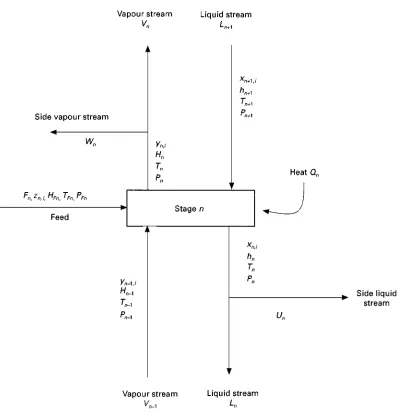
Figure 4 Equilibrium stage. Derivation of MESH equations. are generally given as functions of temperatures, pres-sures and compositions. The generalized form of the MESH equations for the equilibrium stage shown in Figure 4and the expressions forKvalues and enthal-pies are present inTable 1.
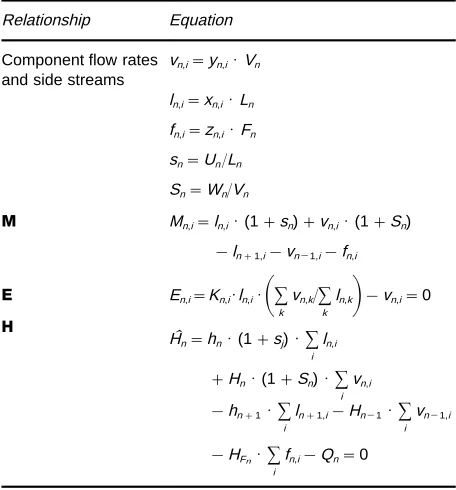
Naphtali}Sandholm method In the Naphtali} Sandholm method, the number of variables of the MESH equations is reduced by the introduction of componentSow rates and side streams. Furthermore, the summation of compositions are eliminated. Those modiRcations result in the equations presented in Table 2.
To solve the system of MESH equations given in Table 2, the vectors of variables and equations are ordered as follows. Variables:
XM "[XM 1,XM 2,2,XMn,2,XM N] [12]
whereNis the number of stages and
XM n"[vn,1,vn,2,2,vn,C,Tn,ln,1,ln,2,2,ln,C]T[13]
Equations:
FM"[FM1,FM2,2,FMn,2,FMN] [14]
where
FMn"[HK n,Mn,1,Mn,2,2,Mn,C,En,1,En,2,2,En,C]T
[15]
Table 1 MESH equations
Relationship Equation
Mass balance Ln#1)xn#1,i#Vn\1)yn\1,i#Fn)zn,i!(Ln#Un))xn,i!(Vn#Wn))yn,i"0
Equilibrium yn,i"Kn,i)xn,i
Summation of compositions i
yn,i!1"0
Henergy balance Ln#1)hn#1#Vn\1)Hn\1#Fn)HFn!(Ln#Un))hn!(Vn#Wn))Hn!Qn"0
Kvalues and enthalpies Kn,i"Kn,i(Tn,Pn,xnyn) Hn,i"Hn,i(Tn,Pn,yn)
[image:6.568.50.278.467.712.2]hn,i"hn,i(Tn,Pn,xn)
Table 2 MEH equations for method of Naphtali and Sandholm Relationship Equation
Component flow rates and side streams
vn,i"yn,i)Vn
ln,i"xn,i)Ln
fn,i"zn,i)Fn
sn"Un/Ln
Sn"Wn/Vn
M Mn,i"ln,i)(1#sn)#vn,i)(1#Sn)
!ln#1,i!vn\1,i!fn,i
E En,i"Kn,i)ln,i)
kvn,k/ k
ln,k
!vn,i"0H
HKn"hn)(1#sj)) i
ln,i
#Hn )(1#Sn)) i
vn,i
!hn#1 ) i
ln#1,i!Hn\1) i
vn\1,i
!HFn)
i
fn,i!Qn"0
(classical Newton}Raphson equations):
FM (k)"!
FMXM
\1
(k)) FM (k) [16]
XM (k#1)"XM (k)#t ) XM (k) [17]
where t is such that 04t41. t is the factor that ensures progress toward the solution of the system at equations of each iteration.
Inside-out algorithm In the Naphtali}Sandholm method, the temperatures and component Sowrates are the primary solution variables (see eqn [13]) and
are used to generate theKvalues and enthalpies from complex correlations. Hence, such a method updates the primary variables in an outer loop, with the
K values and enthalpies updated in an inner loop whenever the primary variables change.
In inside-out algorithms, the previous situation is reversed. These methods use complex Kvalues and enthalpy correlations to generate parameters for simpleK values and enthalpy models. Hence, these parameters become the variables for the outside loop. The inside loop then consists of the MESH equations. In every step through the outside loop, the simple
Kvalues and enthalpy models are updated by using the MESH variables from the inside loop. This sets up the next pass through the inside loop. The book by Kister (1992) provides detailed guidelines for the use of the various inside-out methods.
Special Separations
When the components of a mixture have low relative volatilities, or when the mixture contains a large number of components, separation by distillation be-comes difRcult and expensive because a large number of trays or a large number of columns are required for the separation. Furthermore, some systems may show nonideal behaviour such as the formation of azeo-tropes or a reversal of the relative volatility with the change in pressure from top to bottom in a column. Complex systems which have these characteristics are common in the pharmaceutical and synthetic chem-ical industry.
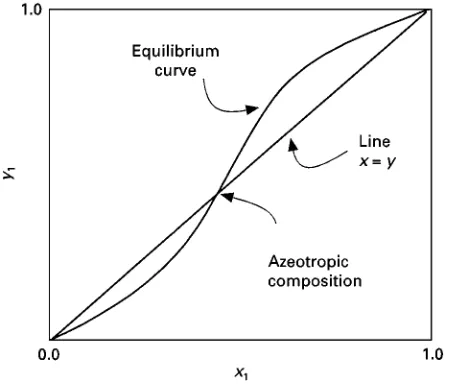
Figure 5 Azeotropic behaviour.
in which the complexity of the mixture (petroleum) requires special considerations for the separation.
Azeotropic Distillation
Highly nonideal systems, with components having close boiling points among them, often produce azeo-tropes. Azeotropes can be identiRed by using anx}y
diagram. When an azeotrope is present, the equilib-rium curve crosses the linex"y(453line), as shown inFigure 5.
Azeotropes limit the separation that can be achieved by conventional distillation. Sometimes it is possible to shift the equilibrium by changing the pres-sure of the system sufRciently to move the azeotrope away from the region where the separation must be made. Other cases, however, require the addition of a new material in order to achieve separation.
In azeotropic distillation, the equilibrium behav-iour of the mixture is modiRed by adding a new material (called the solvent or entrainer). The added entrainer forms a minimum boiling point azeotrope with one or more components and distils overhead. The distillate is generally heterogeneous, that is, it is composed of two immiscible liquids when condensed. Such a heterogeneous nature facilitates the separation of the product from the entrainer.
Extractive Distillation
Extractive distillation also involves the addition of the third component to the mixture (solvent or en-trainer). However, in the case of extractive distilla-tion, the solvent is a relatively high boiling point material, which is present at high concentration on each stage and exits at the bottom. To improve the efRciency of the process, the entrainer has to be added
at the top of the column, so that its concentration on each stage will be enough to produce the desired effect in the equilibrium of the original mixture. Fi-nally, the entrainer is separated from the bottoms product in another distillation column.
Reactive Distillation
The idea of combining reaction and separation in a single apparatus has been extensively investigated. Doherty and Buzad (1992) present a survey of the available design techniques for reactive distillation. Reactive distillation is particularly attractive when-ever a chemical reaction provides the favourable ef-fect of reacting away azeotropic mixtures so that the behaviour of the liquid phase is simpliRed. In addi-tion, it has been shown that reactive distillation has the potential of eliminating recycle costs when a liquid reaction involves a large excess of one reactant.
In general, the current trend in reactive distillation design is using experimental results from bench-scale problems in the initial stages of the design, and then using computer-aided simulation tools for scale-up and operability issues.
Possible proRtable applications of reactive distilla-tion processes are numerous. However, an incom-plete understanding of the interactions of the many nonlinear phenomena such as chemical reaction, phase equilibrium, mass transfer and countercurrent
Sow has prevented the widespread use of such pro-cesses. Considerable research effort in the area is currently being conducted.
Petroleum Distillation
Petroleum distillation is particularly difRcult because of the large number of components of the mixture and large scale of the processes. This type of distilla-tion involves products that are not easily identiRable components. Instead, separation is achieved in terms of pseudo-components, which are generally charac-terized in terms of their true boiling point ranges (TBP), an average relative molecular mass and an API gravity. TBP data are widely available and are gener-ally presented in form of curves.
There are two main approaches to the design of petroleum distillation columns. The Rrst consists of the solution of mass and energy balances based on empirical correlations, and is basically a calculation by hand. This approach was developed by Packie.
terms of the reSux ratio. Several efRcient computer programs following this approach have been de-veloped.
Packed Columns
Several approaches exist for the design of packed columns. These are based on the concepts of number of transfer units (NTU), height of transfer units (HTU) and height equivalent to a theoretical plate (HETP). The last of these concepts is the most widely used.
Since methods for the design of staged distillation columns are well developed, a common approach is to calculate the number of trays N using such ap-proaches and then to Rnd the height of the packed column,h, by the relation:
h"N ) HETP [18]
There exist various correlations for predicting the value of the HETP. One of most commonly used is the Sherwood correlation. It can be expected that HETP will change with respect to the operating con-ditions, physical properties of the liquid, etc., so, it is calculated in terms of correlations containing many factors.
Nonequilibrium Distillation
All the mathematical methods (binary, rigorous, shortcut) presented earlier assume that each stage in the column is an equilibrium stage. In reality, how-ever, this assumption is rarely satisRed.
Stage Ef\ciency
An approach to nonequilibrium calculations is the use of the concept of stage efRciency. The most com-mon approach is to modify the rigorous methods with the introduction of the so-called Murphree efRciency in the calculations. The Murphree efR cien-cy in a stage calculation can be deRned as:
EL Mi"
xout,i!xin,i xi!xin,i
[19]
for the liquid and
EV Mi"
yout,i!xin,i yi!yin,i
[20]
for the vapour.xiare the compositions of the liquid
that would be in equilibrium with the outlet composi-tion of the vapour. yi are the compositions of the
liquid that would be in equilibrium with the outlet composition of the liquid.
Mass Transfer Rates
It has been shown that stage efRciency prediction and scale-up are difRcult and unreliable. For highly nonideal, polar and reactive systems, a transport phe-nomena approach for predicting mass transfer rates is preferred. Such mass transfer rates are calculated continuously along the column similarly to the HETP calculation for packed columns.
Nonequilibrium models for the calculation of mass transfer rates assume that, while the bulk vapour and liquid phase are not in equilibrium with each other, there is an equilibrium at the interface. Hence, the net loss or gain for a component at the interface is expressed in a rate form. For instance, the net gain by the vapour because of the transfer at the interface is:
NV0
ij "Nvij ) daj [21]
whereNV
ijis the vapourSux of the component at some
point through the interface and daj is the interface area through which theSux passes. The mass transfer rates for liquid and vapour,NV
ijandNLij, are dependent
on the mass transfer coefRcients for each phase. There exist several correlations for the heat and mass trans-fer coefRcients and these are dependent on the com-positions in the bulk phase, the temperatures in the bulk phase and interface, and on the packing or tray geometries.
Industrial Applications
Distillation is by far the most widely used separation technique in the petroleum, natural gas and chemical industries so, applications of multicomponent distil-lation are numerous. A couple of industrial applica-tions are described in this section.
Primary Distillation of Crude Oil
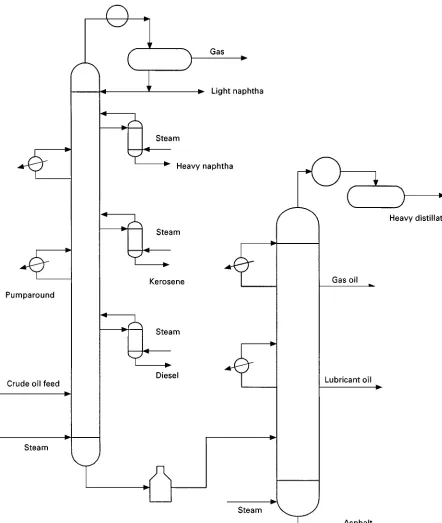
Figure 6 Crude oil distillation unit.
steam is also frequently used in the bottom of the tower.
The bottom product of the atmospheric tower is further separated by rectiRcation in the vacuum tower. The feed-tray pressure of a vacuum tower is usually 6 kPa (45 Torr). Vacuum towers are mainly designed to obtain heavy distillates such as gas oil,
lubricating oils and bunker fuels with asphalt as the bottom product.
Figure 7 Separation of products of the manufacture of ethylene and propylene. Highly developed procedures for the preliminary
design of fractionators that process petroleum are commercially available through computer programs. The program ‘REFINE’ of the ChemShare Corpora-tion and the ‘PROCESS’ (now PRO-II) program of Simulation Sciences Inc. are two examples.
Ethylene and Propylene Production
The manufacture of ethylene and propylene is one of the most important operations of the petrochemical industry. In that process, ethylene and propylene are formed from the thermal cracking of other hydrocar-bons, such as ethane, propane and naphtha. The mixture resulting from the thermal cracking is very complex. Hence, the mixture has to be separated into relatively pure ethylene and propylene, ethane and propane to be used as a recycle, methane and hydro-gen to be used as fuel, and heavier products to be used for gasoline. A typical reRnery gas feed to the separ-ation system of this process contains hydrogen, ethylene, methane, ethane, propane, propylene and lower compositions of other heavy hydro-carbons. The distillation sequence most commonly used for the separation of the mixture is shown in Figure 7.
In a high pressure plant (no refrigeration is needed for condensation of products), the distillation se-quence consists ofRve distillation columns:
1. Demethanizer 2. Deethanizer
3. Ethylene/ethane separator 4. Depropanizer
5. Propylene/propane separator.
Both the propylene/propane and the ethylene/ ethane separator require high towers with large dia-meters because such mixtures contain components with very close relative volatilities. A plant that uses the conRguration described here was built by Pullman Kellogg Inc., Houston, Texas.
In the case of a lower pressure plant, the deethan-izer precedes the demethandeethan-izer because refrigeration is required for the feed of the demethanizer. So, by placing the deethanizerRrst, important utility savings are obtained.
Future Work
Enormous progress has been made on the application and design of distillation technology. However, chal-lenges still exist in some areas, which lead to the following ongoing research:
2. The simulation, synthesis and design of reactive and azeotropic distillation. Such topics still consti-tute a gap in the knowledge of distillation tech-nology.
3. Investigation of complex conRgurations for batch distillation processes.
4. Use of optimization methods for obtaining opti-mal conRguration and design of batch and con-tinuous distillation processes.
5. Online optimization and control of columns.
See also: II/Distillation: Batch Distillation; Theory of Dis-tillation; Vapour-Liquid Equilibrium: Correlation and Pre-diction; Vapour-Liquid Equilibrium: Theory.
Further Reading
Diwekar UM (1995)Batch Distillation:Simulation, Opti-mal Design and Control. Series in Chemical and Mech-anical Engineering. Washington, DC: Taylor&Francis.
Doherty MF and Buzad G (1992) Reactive distillation by design.Transactions of the Institution of Chemical En-gineers70: part A.
Gmehling J and Onken U (1977) Vapor}Liquid Equilib-rium Data Collections, DECHEMA Chemistry Data series, vol. 1. Frankfurt:
Henley EJ and Seader JD (1981)Equilibrium-Stage Separ-ation OperSepar-ations in Chemical Engineering. New York: Wiley.
Holland CD (1981)Fundamentals of Multicomponent Dis-tillation. New York: McGraw-Hill.
King CJ (1980)Separation Processes,2nd edn. New York: McGraw-Hill.
Kister HZ (1992) Distillation Design. New York: McGraw-Hill.
Perry RH, Green DW and Maloney JO (1984) Perry’s Chemical Engineers’ Handbook, 6th edn. New York: McGraw-Hill.
Schweitzer PA (1979)Handbook of Separation Techniques for Chemical Engineers. New York: McGraw-Hill, The Kingsport Press.
Treybal RE (1980) Mass Transfer Operations, 3rd edn. New York: McGraw-Hill.
Packed Columns: Design and Performance
L. Klemas, Bogota, Colombia J. A. Bonilla, Ellicott City, MD, USA
Copyright^ 2000 Academic Press
Use of Packing in Distillation
Use of packing in mass transfer has its origins in the early 1800s for simple applications such as alcohol distillation, and in sulfuric acid plant absorbers. Glass balls, coke or even stones were used as packing ma-terials. Nevertheless packings for distillation were not established until the 1930s with the use of regular shape materials such as ceramic Raschig rings and Berl saddles, as well as the availability of distillation calculations such as the McCabe}Thiele and Pon-chon}Savarit methods. Early in the second half of the century, the use of packing for distillation went through a transformation, producing the second-generation packings (see Table 1). Regular and im-proved shape of packings, such as pall rings, became available with larger open areas that permitted a sub-stantial increase both in capacity and column efR cien-cy. In the 1960s Sulzer introduced the wire-mesh packings with very high efRciency (low height equiva-lent to a theoretical plate, HETP), resulting in a new transformation in the use of packings. In the 1970s
and 1980s all major mass-transfer equipment manu-facturers developed structured packings. Compared to the traditional tray columns spectacular improve-ments in plant capacity were achieved, but also some projects were pitfalls, when the expected beneRts did not materialize. Manufacturers started realizing that liquid distributors had to be improved, but there was no coherent understanding, nor correlations, that could lead to a safe distributor-column system design. Many manufacturers returned to trays, producing new improved designs, using the area under the downcomer for vapourSow: these trays are offered with new names that indicate their increased vapour
Sow capacity (MaxySow, Superfrack, etc.). The need for good distribution and its effect on the column efRciency are now well understood, allowing safe design and efRcient applications for random and structured packings in large industrial columns.