Conformation-Based Computing:
a Rationale and a Recipe
Michael Conrad and Klaus-Peter Zauner
Department of Computer Science, Wayne State University Detroit, MI 48202, U.S.A.
0.1
Objectives
Biological systems possess enviable information processing abilities, which
are rooted in the self-organization of context-sensitive building blocks.
Molec-ular computing can utilize this principle. Our objective in the present
chap-ter is to show that this opens up a realm of information processing that is
inaccessible to programmable machines. Our second objective is to present
a table top prototype that illustrates a methodology for pursuing this
direc-tion.
Algorithmic complexity theory provides a framework for elucidating the
comparative capabilities of programmable and nonprogrammable systems.
Programmable architectures are amenable to a more compressible
descrip-tion, concomitant to the fact that they must conform to a simple user
man-ual. To implement complex input-output behavior it is necessary to
sup-ply a complex program. The programmer therefore must be the source of
complexity. Biomolecular architectures are sharply different: complexity is
inherent. The capabilities are constructed by orchestrating a repertoire of
complex components through an adaptive process. The number of functions
that can be implemented is limited by the time available for adaptation and
may not be larger than that in programmable systems. We will however
argue that the complexity of the actual achievable behavior is greater.
John von Neumann (1951) referred to such noncompressible complexity
in a discussion of the visual cortex:
It is not at all certain that in this domain a real object might not
to describe it by the usual literary or formal-logical method may
lead to something less manageable and more involved.
In our case the real objects are proteins. We will show that it is possible
to utilize the conformational dynamics of proteins to process input signal
patterns, though at this stage not in a manner that transcends formal
de-scription.
0.2
Algorithmic Complexity Rationale
Digital computers are commonly referred to as general purpose machines.
The seeming implication is that with sufficient memory and speed it should
be possible to implement any computable process on such a machine. The
concept of computation universality, originally expressed in terms of the
Turing model of computation, captures this idea. For the present purposes
the Turing formalism can be equated to a digital machine with noa priori
limit on available memory and time. Such an idealized machine would be
capable of computing any computable function. Realizable machines are
of course finite. The memory available may not be sufficient to perform
the desired computation; or the computation might require an unacceptable
span of time. Here we are especially concerned with a further limitation:
the size of the program that can be presented to the machine is also subject
to practical restrictions.
The above distinction, between limits on processing capacity and
pro-gram size, has an important implication. Even if processing speed and
processing tasks would still be inaccessible. The programs, or maps
describ-ing the input-output behavior of the system, can be too large to practically
specify.
Let us take as a computer any system which, starting from a state that
encodes a problem description, will change to a state interpretable as the
solution of the problem. The limited precision and limited dynamic range
of the computer’s components, together with the requirement of a finite
response time, restrict any computer to a finite set of discernible inputs and
a finite repertoire of outputs.
A deterministic computer is a physical realization of a function that takes
an input signal pattern as argument and returns as the value the associated
output signal pattern. To make the computer perform a desired task it
is necessary to specify the appropriate function. The specification may be
provided explicitly by programming or, in case of an adaptable system,
implicitly through training. In either case the specification has to select the
desired system behavior from the set of potential behaviors.
Consider a deterministic computer that is supposed to respond to each
n-bit input pattern with an appropriatem-bit output pattern. The function
that maps the input into output can in principle (and for small values ofn
also in practice) be described by a table. The table would have 2n
rows, one
for every possible input, and each row would contain the pattern that the
computer should output in response to this input. Programming a computer
requires that the table it should implement be communicated to it.
The amount of information necessary to specify the input-output map is
of all possible tables. There are 2n
rows corresponding to the possible inputs
in the table, and any one of the 2m
possible outputs may be assigned to each
row. This gives rise to 2(m2n
) possible tables. Selecting an arbitrary table
from this set requires a specification that is log2
h
2(m2n )i
=m2n
bits long
(Ashby 1968). The important implication is this: even for input patterns
of very moderate size it will almost always be impossible to program a
computer to perform a map arbitrarily selected from the set of possible
maps. For example, consider a pattern of the size of a single character on
a computer screen, say 10 ×10 black and white pixels (n = 100 bits) and
suppose we want to classify such tiny images according to whether or not
they contain a certain feature (meaning thatm= 1 bit). This could require
a program 1020 giga bytes in length.
On the surface it might seem that for any particular job required it should
be possible to devise an appropriate program of practical size. The following
considerations from algorithmic complexity theory reveal that programming
a ‘general’ purpose computer is in fact practical only in very special
situa-tions.
In the example considered above every row of the table that describes
the classification of the 10×10 pixel images has a 1 bit entry indicating the
presence or absence of the feature. The content of the table corresponds to
a binary string of length equal to the number of rows in the table. Chaitin
(1966) asked the question, how long would a program need to be in order
to generate such a sequence? For our purpose we can take the ability to
generate the contents of the table as equivalent to the capacity to implement
programs. If we want each input image to be classified according to whether
it is all black, then all but one row in the table contain the same bit. A
program much shorter than the explicit table will be sufficient to generate
the table. This corresponds to the fact that the table is highly compressible,
the program being a compressed description of the table. The algorithmic
complexity of the table is defined as the length, up to an additive constant,
of the shortest program required to generate it (Li and Vit´anyi 1997). The
additive constant reflects differences in machine architecture that from a
practical point of view can have immense impact as the constant becomes
large (Kampis 1991).
For most tables no significant compression is possible, as can be seen
from a simple counting argument (Chaitin 1974). Under the assumption
that (due to the capacity of the machine or its programmers) the longest
practical program is limited to a length ofbbits, there exist only 2b
distinct
programs. The fractionη of tables describingnbit inputs mapped tombit
outputs which can be compressed to abbit long specification is therefore at
most
η= 2(b−m2n)
Furthermore, this maximum value ofη can only be achieved if the machine
architecture is not degenerate in the sense that two or more distinct
pro-grams yield identical input-output behavior.
The above equation shows that in practice only a very small fraction of
the conceivable information processing tasks can be implemented by
compress-ability of the tables is relative to the machine architecture on which they
are specified. Different architectures can bring different input-output
behav-iors within reach of practical specifications. An extreme example would be
a machine specifically constructed to solve a single large problem instance
(Zauner and Conrad 1996).
Every realizable information processing machine can only implement a
small subset of the possible input-output transforms and is therefore a
spe-cial purpose device (Zauner and Conrad 2000b). The common computers,
often naively assumed to be general purpose, are in fact specialized devices
that have been designed to implement the narrow class of highly
compress-ible input-output maps.
0.3
Tradeoff Principle
The comparative limits of programmable and nonprogrammable
architec-tures can be stated in terms of a tradeoff principle: programmability,
effi-ciency, and evolutionary adaptability are incompatible. A system, to achieve
high programmability, must trade off efficiency and evolvability.
A computing system is programmable if the initial state and a chosen
set of formally defined state transition rules can be explicitly invoked. The
programmer communicates the intended relations among the system states
to the system, which in turn interprets the rules in rigid adherence to a finite
user manual. If the programmability is bound into the material structure
of the system we will refer to it as structural. Material physical systems
incompatible with prescriptive programmability. The computer designer
must quench these self-organizing aspects in order to achieve a physical
realization of a formal system. Information processing systems however do
not need to be programmable; functionality can be molded through adaptive
procedures.
We can phrase the programmability-efficiency tradeoff in terms of
inter-actions. To be as generous as possible, let us make the assumption that
elementary particles can serve as active components in a computing system
and the system contains n such particles. The potential function of the
system can call on as many asn2 interactions. If the system is structurally
programmable the input-output behavior of components should remain the
same as more components are added. This is only possible if the
compo-nents have a fixed number of possible inputs. Thus the number of allowable
interactions scales asCn, whereCis a constant. The fraction of interactions
available for problem solving falls off asC/n as the number of components
increases. If the system is run in a serial mode, therefore in an effectively
programmable mode, the falloff is even faster, i.e., asK/n2, whereK is the
number of components that can be active at any given time. If quantum
features are pertinent to the system’s problem solving, interference effects
among the possible states of the particles must also be considered, further
increasing the disparity between the potential complexity of natural systems
and systems configured to be structurally programmable. The assumption
that single particles could act in accordance with a finite user manual is
of course quite unreasonable. As the number of particles per component
a way that escapes a simple user manual description (Conrad 1995).
The tradeoff principle is intimately connected to the compression issues
considered in the previous section. The salient point is that all structurally
programmable architectures must have a highly compressible description in
order to conform to formal rules specified in a simple user manual.
Con-structing a formal component calls for a large number of particles, since
this requires quenching of self-organizing characteristics that deviate from
the user manual. A large number of such formal and hence low complexity
components is needed to build a system with complex behavior. Efficiency
in terms of necessary number of particles will therefore be low. In short, to
make a heavyweight architecture out of light weight components the system
must be large.
The conflict between structural programmability and evolutionary
adapt-ability can also be understood in terms of compression. In a program that
is a highly compressed description of the system’s behavior a change in any
single bit will in general have radical effects on the behavior of the modified
program. The program ordinarily describes an input-output table that is
much larger than the program. Any bit modification in the program will
in general alter many bits in the input-output table. The uncompressed
input-output table can of course always be changed gradually (bit by bit).
But it is only possible to act on this table through modifications of the
pro-gram, hence the gradualism requirement for evolutionary adaptability
can-not in general be satisfied. If biological systems were amenable to a highly
compressed description they would a fortiori be unsuitable for evolutionary
The tradeoff principle does not assert that structural programmability
absolutely precludes evolutionary adaptability. Biological systems in nature
are clearly highly evolvable. In principle it should be possible to use a
struc-turally programmable machine to simulate the structure-function plasticity
that allows for this evolvability. As long as mutations are restricted to the
virtual level, rather than to the program as encoded in the state of the base
machine, it would be possible to duplicate the requisite evolvability.
How-ever, this comes at a computational cost; the computational work required
to simulate plastic structure-function relations puts a severe practical limit
on the degree of evolvability that can be retained. In effect the simulation
program is a decompression of some highly compressed program that could
do the same job as the simulated system. The decompression, if
appropri-ately introduced, reduces the fragility of the program.
The decompression has an equivalent in the interaction picture.
Redun-dancy in the number of components and interactions among them serves to
buffer the effect of mutation on features of the system critical for function
(Conrad 1979). This is not an entirely general fact; it is restricted to a
sub-class of systems with self-organizing dynamics. Protein folding, in particular,
fits this picture. As the length of the amino acid chain increases or as more
amino acids with similar properties are available for substitutions the chance
that a mutation will be acceptable increases. Without self-organization the
introduction of redundancy would only yield fault tolerance, not the
topo-logical distortability necessary for transformation of function (Conrad 1983).
The structure-function relations that enable high efficiency and high
components’ behavior to their environment is in sharp contrast to the
pre-cisely defined and therefore context free components of structurally
pro-grammable systems. Nevertheless, networks of context free components run
in a parallel mode can also exhibit self-organization, as in the case of artificial
neural networks. The self-organization, however, causes a loss of effective
programmability. With the main advantage of rigidly defined components
lost, there is no reason to restrict the architecture of the network to context
free components. Instead, context sensitive components that open the path
to high efficiency and high evolvability can be employed.
The tradeoff principle suggests that there are two sharply different modes
of computing: the high programmability mode versus the high efficiency,
high adaptability mode. Biological systems, since they are the products
of evolution, must operate in the latter. The remainder of this chapter
will focus on initial concrete steps in the direction of artificial systems that
operate in the biological mode.
0.4
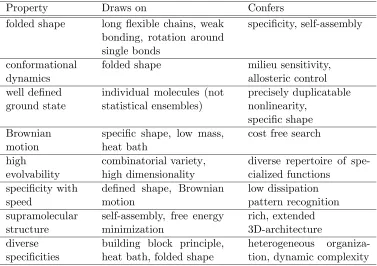
Pertinent molecular properties
The tradeoff principle asserts that systems with nonprogrammable
structure-function relations are capable of implementing transforms that are too
com-plex to embody in general purpose (programmable) architectures. The
phys-ical dynamics of such systems, suitably interpreted, effectuates the
compu-tation. Conceivably many types of physical dynamics could be utilized in
this manner. Macromolecules afford a particularly powerful combination of
The main property is folded shape. This requires long, nonconjugated
polymers (since rotation around single bonds is necessary). Carbon, the
atom of life, supports this requirement. Silicon, the only competitor for
carbon in this respect, is rather inferior (Henderson 1913; Conrad 1994b).
The C–C bond energy is about the same as for bonds with H or O. The
energy required to break the Si–Si bond is only about half as much as the
energy required to break Si–H and Si–O bonds. The number of carbon based
structures that are possible is accordingly much greater than is possible with
silicon (Sidgwick 1950; Edsall and Wyman 1958). The longer chains possible
with carbon allow for a greater variety of folded shapes.
The well known lock-key metaphor (Fischer 1894) for enzyme-substrate
recognition is based on this fact of folded shape. Proteins must be big
enough to have significant shape features (not true for individual atoms)
but small enough to scan each other’s shapes through diffusion (which we
can refer to as Brownian search). The shape fitting is in reality dynamic;
conformational motions are critical to the rate of complex formation and (in
the case of catalysis) complex decomposition. The conformational motions
are sensitive to a variety of milieu features (e.g., temperature, ions, control
molecules). The prototype device that we will shortly turn to utilizes this
context selectivity for signal pattern recognition.
As in all chemical reactions, thermal fluctuation (heat motion) is sine
qua non. The term Brownian search, used above, is intended to suggest its
computational significance. Recall the discussion of complexity: complexity
must either be provided in a program fed to a system from the outside or it
structure-function relations. Protein folding and complex formation are prime
exam-ples. The heat bath is a potent source of complexity. The amino acid
se-quence draws on thermal fluctuations to explore itself in the folding process.
The folded structure draws on thermal fluctuations to explore molecules with
which it interacts in the complex formation process. In general physical
self-organization is based either on energy minimization or entropy
maximiza-tion. The randomness of the heat bath is an essential ingredient in both
cases. If entropy maximization is the controlling feature the fluctuations
allow the system to assume a greater number of structural forms. If energy
minimization dominates thermal energy must be given up to the heat bath
in an irreversible way. From the point of view of algorithmic complexity
theory the complexity of a pattern or process increases as the size of the
shortest program required to generate it increases, i.e., as its description
becomes less compressible. Of all phenomena considered in physics perhaps
the heat bath has the most incompressible description.
The combinatorial variety of carbon compounds is another powerful
virtue. The number of possible amino acid or nucleotide sequences is
hyper-astronomically large. The important point is that the notion of a general
purpose system takes on a new guise. Conventional electronic machines
are constructed from simple standard building blocks, for example, NAND
gates. Biological systems, in contrast, are built from an extremely large
vari-ety of macromolecular species, each capable of performing a specific complex
transform. Cells and organisms with different input-output behaviors arise
through adaptive processes that modify the proteins in the repertoire or that
The high evolvability of proteins is requisite for the efficacy of the
adap-tation process. Folding again is the key feature, since it allows for
structure-function malleability. As noted in the previous section, there is an intimate
connection between evolvability and complexity. If protein folding could
be described by an extremely compressed program, therefore were a simple
process from the algorithmic complexity point of view, then the
structure-function relations would approach programmability and would be fragile.
Most mutations would be cataclysmic. Evolutionary considerations thus
imply that folding and (chemical) complex formation are complex processes
in the algorithmic sense. At the same time the introduction of redundant
amino-acids in the sequence and the utilization of amino acids with high
re-placeability serve to buffer the effect of mutation on conformational features
critical for function (Conrad and Volkenstein 1981).
Sometimes the argument is put forward that biological molecules are
insufficiently reliable for computing. The opposite is actually the case.
Sin-gle molecules have definite ground states, as opposed to the macroscopic
switches from which conventional computers are built. The latter are built
from statistical aggregates of particles and are therefore subject to erosion.
The reliability issue is rather subtle, since it is clear that with solid state
components it is possible to perform many repetitive operations and to do so
rapidly. But if we want to build a reliable information processing system out
of nonlinear base components the capability for reproducing the nonlinearity
in a highly precise manner is absolutely critical. This is infeasible with
con-ventional electronic or other macroscopic components, simply because it is
preserve their nonlinear characteristics on an operational time scale. The
discrete amino acid sequences that determine the function of proteins can be
precisely specified. This is sufficient, at least for a large class of sequences, to
uniquely determine the folded shape and the set of available conformational
states. The shape (or conformation) of course changes when the protein
in-teracts with its environment, but the existence of a ground state and, more
generally, discrete energy levels confer precision that is unobtainable with
macroscopic processing elements.
0.5
Example: protein solubility as a language
As a preliminary step, let us consider a transformation that is easy to
imple-ment with macromolecules but difficult with programmable machines.
Prac-tically speaking any ab initio calculation of the properties of even a small
cluster of particles outpaces programmable computational capabilities. For
the present purposes, however, we would like to consider an example of a
problem that typically arises in computer science, namely the problem of
deciding whether or not a sequence of symbols belongs to a given set of
se-quences. Such sets are considered in formal language theory. The question
is whether it is possible to construct a machine, subject to given constraints,
that can recognize the language. For example, the constraint might be that
the machine is a finite automaton (as are actual computers).
Consider a languageL in which the elements are protein sequences that
satisfy a certain property (Davidson and Sauer 1994; Prijambada et al. 1996;
amino acids, for instance the twenty amino acids that are the predominant
building blocks of natural proteins. We can choose solubilityS in water as
the property that has to be satisfied by a sequencepcomposed of the amino
acids that constitute the alphabet (Σ). The conditionscof the process must
be fixed e.g., temperature, pressure, pH and cosolutes (Laidler and Bunting
1973; Cacace, Landau, and Ramsden 1997). Formally we can write
L={p∈Σ∗ :Sc(p)> x,|p| ≤w}
whereL denotes the language,x is a fixed solubility threshold (massprotein
masssolvent),
and we assume that length (|p|) of the sequence of amino acids does not
exceed some constantw. The important point is thatSc is a physical and
not a formal condition.
In principle a computer of sufficient size and speed should be able to
an-swer the question whether a given sequencep is a member ofL. In practice
however, performing physics calculations to answer the membership
ques-tion for the above language by implementing formal rules is not efficient. To
decide the membership of a sequence in this language, the properties of the
(possibly folded) amino acid sequence need to be known, thus the language
encodes the protein folding problem. Calling on calculational methods of
physics to solve this problem is clearly daunting. However, it is also
pos-sible to decide the membership by actually synthesizing the protein with
the sequence in question and measuring its solubility. The synthesis and
measurement procedure could be automated. The resulting machine can
easily decide for any particular sequence presented to it whether it belongs
capabilities of presently available general purpose machines.
0.6
Macro-Micro Interface
Language recognition problems of the type considered above can be viewed
as pattern recognition problems. The patterns might be computer codes that
have to be compiled. Or they might be objects in the world, say chairs. If
all (and only) chairs were marked with a standard printed ‘C’, then it would
be easy for a digital computer to say ‘yes’ whenever it is presented with a
chair and ‘no’ whenever it is presented with some other object. Without
such preprocessing, however, no existing computer program can do this job.
The morphology of chairs is too ambiguous and variable. The required
program, though it might exist, is too complex to express in a reasonably
compressed way, even assuming that we knew how to write it at all. Yet,
humans perform this transformation with relative ease.
The protein solubility example was intended to show that molecules can
be used to perform transformations that are refractory to programmable
machines. But of course this is far from using this power to address any
problem of interest. To do so, the molecular level needs to be connected to
the external world and the transformation needs to be adapted into a useful
function.
We will return to the adaptation issue in section 0.9. Here it is
per-tinent to consider the general requirements for input and output (Conrad
1984; Conrad 1990). In biological cells the signals that represent the
environment. The former case is pertinent to regulation and the latter to
perception-action activities. Three levels of scale are involved: macro, meso,
and micro. The signals from the environment are generally macroscopic on
some dimension of scale (energy, mass, dissipation, time, space) or represent
features of the world that are macroscopic. The nerve impulse, for example,
is a macroscopic signal. Signals inside the cells, say diffusion of substances,
can be either macroscopic or mesoscopic. The signals constitute the milieu
patterns, or context, to which proteins and other biological macromolecules
respond. Since these molecules must be sufficiently large to have significant
shape features (and shape dynamics) they can be classified as mesoscopic.
But the nuclear coordinates couple with the electronic coordinates, so that
we also have to think in unambiguously microscopic terms (Conrad 1994a).
In short we have downward flow of influence from the macro to the meso to
the micro.
This downward flow is complemented by an upward flow, triggered by
the response of the macromolecule or macromolecular aggregate, say a
cat-alytic response in the case of an enzyme or a mechanical response in the
case of a contractile unit. For the present purposes it is sufficient to think
in terms of enzymes. The chemical changes produced in the milieu link the
activity of different enzymes. The linking chemicals can be thought of as
sig-nals, either because they provide context or because they serve as common
intermediates. The communication between the processing macromolecules
is thus essentially at a mesoscopic level. Macromolecules can also
commu-nicate through direct conformational interactions, in which case the signal
that convert signals representing macro features of the external environment
to internal signals that can be brought into the web of meso and micro level
processing.
The amount of computational work performed at the meso and micro
level should be as great as possible, due to the thermodynamic cost of
pro-ducing macroscopic signals. Enzymes, as catalysts, are thermodynamically
reversible; their pattern recognition work is free, driven only by the heat
bath. The dissipation in a typical biochemical reaction can range from 10
to a 100kT. A nerve impulse might cost 105 to 1010 kT, depending on the
size of the neuron. To the extent that processing is kept as close as possible
to the micro level the amount of information processing obtainable is vastly
enhanced.
Macro-micro communication links are essential for any computational
system that utilizes the activity of individual molecules, as opposed to
sys-tems that employ only statistical aggregates of particles. The signal
pro-cessing activities of the medium can itself have significant nonlinear
dynam-ics • Reference to Rambidi’s Chapter •. The whole medium, not just the
controlling macromolecules can then contribute to the input-output
trans-form. But the controlling macromolecular components are critical, since the
recognition-action events would otherwise be slow and difficult to mold for
different functionalities. The addition of new signal substances and
macro-molecular species to the medium need not and in general does not yield
an additive response. This nonlinear component interaction is where the
0.7
Prototype System
Recall (from section 0.4) that protein molecules are flexible chains of amino
acids. Many sequences will curl up into a compact three-dimensional shape
(cf., e.g. White, Handler, and Smith 1968; Stryer 1988). The folded shape is
stabilized by electrostatic interactions among its atoms, but possesses at the
same time a defined agility that enables it to assume numerous
conforma-tional states. Under given physiological conditions a subset of these states
is favored (Frauenfelder, Park, and Young 1988; Freire 1998). A change in
physiochemical context can induce a switch to a different favored state. This
prevalent protein behavior has two points of significance for novel
informa-tion processing devices. The first is that proteins have substantial freedom
to select the specific stimuli to which they respond and to associate these
with a response in an essentially arbitrary way. The intricate
conforma-tional dynamics constitutes the second point, since this allows the protein
to fuse information in a complex nonlinear fashion that would require large
numbers of conventional components to duplicate.
The nonlinear conformational dynamics harbors the computational
re-source we seek to exploit, but at the same time precludes direct engineering
of a prototype system. An alternating sequence of exploratory and selective
steps can be used instead to sculpt desired functionality. In general there
are three levels open to exploration: the coding of the input signals, the
amino acid sequence and operational conditions that control the protein’s
capacity to fuse input signals, and the choice and interpretation of the
probes attached to the protein. If the protein is an enzyme, however, its
catalytic activity is most often critically dependent on conformational state
and therefore provides a sensitive probe for conformation change. Changes
in physiochemical context that alter the preferred conformational state of
the enzyme will hence modulate the speed of the reaction catalyzed by the
enzyme.
Enzymes that catalyze reactions involving NAD (nicotinamide adenine
dinucleotide) are particularly convenient in this regard, since the oxidized
form and the reduced form of NAD have quite different absorbance in the
ul-tra violet (UV) range. Changes in the concenul-tration of NADH can therefore
be observed with little effort by a spectrophotometer.
We used an easy to tend enzyme, malate dehydrogenase (MDH), which
participates in the citric-acid cycle and is widely available. MDH catalyzes
the oxidation of malate to oxalacetate while reducing NAD+ to NADH.
For our purposes we can view MDH as an implementation of a function
that takes selected features of its physiochemical milieu as arguments and
maps these into absorbance values. Different compositions of the reaction
milieu are thereby grouped by MDH into classes of UV absorbance levels
(Zauner and Conrad 2000a). The aim is to associate input signals with
milieu features in a way that results in a useful classification.
The number of potential milieu factors that could conceivably be used
to encode input signals is virtually boundless and of course not limited to
chemicals of known physiological significance. Only in exceptional cases can
mechanistic kinetic models predict the outcome of a specific signal encoding.
limited interest from a computational point of view, since the possibility
of formulating such models indicates the realm of low complexity behavior.
Instead, empirical models of factor interactions mediated by the protein
are employed to discover signal encodings that yield interesting response
characteristics.
Sampling the protein’s performance under different milieu conditions
allows for the construction of a response surface for a small number of the
potentially operative factors (Box and Draper 1987; Cornell 1990). Fig. 2
shows such a response surface for MDH with respect to changes in the MgCl2
and CaCl2 concentration.
The response surface, once established, can be used to analyze various
signal encodings. Different encoding schemes are evaluated according to a
performance measure. For pattern classification tasks the minimum
differ-ence in the response to signal patterns that should be grouped into separate
classes can serve as the performance measure, to be referred to as signal
strength. Only encodings yielding a positive signal strength allow for the
implementation of the desired function; in general an encoding that
maxi-mizes signal strength is advantageous.
As a concrete example, consider the exclusive-or (XOR) operation (Tab. 2).
This can be viewed as a simple arithmetic operation adding two bits
with-out carry. It is also the simplest pattern classification problem that is not
linearly separable. For this reason it is used as a benchmark for learning in
natural and artificial systems (Griffith et al. 1968; Minsky and Papert 1969;
Ellacott and Bose 1996). The XOR operation groups patterns into one
the signals are different. The signal strength ∆sfor the XOR operation can
therefore be expressed as
∆s= Min (r(01), r(10))−Max (r(00), r(11))
where the function r denotes the response to the signal pattern (e.g, 00,
01,. . . ).
With this performance measure we can ask which signal encoding best
adapts the enzymatic system to the desired input-output behavior, here the
XOR operation. The empirical response surface shown in Fig. 2 is used
as the response function r. The question is how much MgCl2 and CaCl2
should be used for the input signals to maximize the signal strength ∆s.
Several encoding methods are possible. For example, MgCl2 can be used as
the signal carrier on one input line and CaCl2 as carrier for the other input
line. The XOR operation, however, is commutative and hence there is no
need to encode the signals arriving from different input lines by different
carrier substances. It is therefore possible, for example, to encode 1-signals
independent of the input line by a mixture of MgCl2and CaCl2and 0-signals
by a different mixture or the absence of ions. For encodings that use the
same carrier substance for both input lines, only signal encodings up to half
the concentration range covered by the response surface can be evaluated,
since the carrier substances are additive with respect to their contribution
to the reaction milieu. Signal strengths for different encoding methods are
shown in Fig. 3 as functions of the MgCl2 and CaCl2 concentrations used
to represent the signals.
XOR based on MDH is feasible. To realize such a device, and more generally
to explore enzymes as active components for the implementation of pattern
classifiers, we constructed the experimental set-up shown in Fig. 4. Small
piston pumps, each composed of a 3 cm3 syringe and two one-way valves,
deliver input signals from reservoirs to a mixing chamber. The two signal
so-lutions, one representing 0-signals and the other 1-signals, contain the same
amount ofL-malate, a substrate in the reaction catalyzed by MDH. The
so-lution representing the 1-signal in addition contains MgCl2, while 0-signals
are represented by the absence of MgCl2. By injecting a defined amount of
MDH/NAD+ solution into the mixing chamber a reaction is initiated. The
reaction progresses while the mixture is pumped to a spectrophotometer and
the absorbance of the NADH produced during the transit time is recorded
as the output response.
Fig. 5 illustrates the details of an improved version of the prototype in
which the spectrophotometer cuvette (Cv) serves as the mixing chamber,
thus permitting shorter response times and increased reliability. The
injec-tion of the enzyme soluinjec-tion (R1/Sy1) activates microswitches (Ms1, Ms2)
that provide a trigger signal for the timing of the measurement used as the
output response. A syringe (Sy4) takes up the air displaced when the cuvette
(Cv) is filled. Several T-valves (T4–T6), a water reservoir (R4) and a
peri-staltic pump serve to clear the system between consecutive signal processing
cycles.
The XOR was also implemented with the improved set-up (Fig. 5).
The device was required to classify 135 consecutively presented 2-bit
enzyme/NAD solution until the output measurement is taken, was set to
10 s. All 135 input patterns gave rise to response levels that permit correct
classification by a single thresholding operation. The choice of 10 s is due to
the limits of our table top instrumentation, not to the underlying process.
The prototype demonstrates that enzymes can be used to transform pattern
classifications that are not linearly separable into simpler, linearly
separa-ble prosepara-blems. More importantly, it points to the feasibility of developing
novel computational systems that operate on the basis of high complexity
Recipe
Materials
UV-spectrophotometer (λ= 339 nm); analytic scale; adjustable micropipettes
(200µl, 1 ml); pH meter; timer.
Malate dehydrogenase from porcine heart, as ammonium sulfate
sus-pension (store refrigerated); NAD+ (oxidized β-nicotinamide adenine
dinu-cleotide), as free acid (store refrigerated or frozen);l-malic acid, as free acid;
MgCl2 as magnesium chloride hexahydrate (MgCl2·6H2O); MOPS
(3-[N-morpholino]propanesulfonic acid); glycine (aminoacetic acid), as free acid;
10 N HCl and 10 N NaOH (for pH adjustment); pure (distilled) H2O. Below
‘water’ always refers to pure H2O.
Method
1. Basis Solution for signals (120 mM glycine, 7.5 mMl-malic acid, 1 l):
Dissolve 9 g glycine in about 950 ml water. Add 1 gl-malic acid and
allow to dissolve while stirring. Adjust to pH 10.5 with 10 N NaOH.
Fill with water to a final volume of 1000 ml.
2. MgCl2 Solution (4 M MgCl2, 50 ml): Dissolve 40.66 g MgCl2·6H2O in
15 ml hot water. Let the solution cool to room temperature. Fill with
water to 50 ml.
solution (1). The resulting solution is used for 0-signals.
Add 5 ml of the MgCl2 solution (2) to 100 ml of the signal basis
solution (1). The resulting solution is used for 1-signals.
4. Enzyme solution (MDH/NAD+, 10 ml): Dissolve 20.93 g MOPS in
about 300 ml water, then fill up to 475 ml. Adjust pH to 7.4 with 10
N NaOH. Fill up with water to a final volume of 500 ml. This is the
0.2 M MOPS buffer.
Weigh 36 mg of NAD+ into a test tube that can hold 10 ml fluid and
is wide enough to access with the 1 ml micropipette. Add 10 ml of the
0.2 M MOPS buffer and shake to dissolve the NAD+. Add about 20
µl malate dehydrogenase suspension and shake. If the response time
for the signal processing is found to be too slow, more of the enzyme
suspension can be added to the solution.
5. The volume of the signal solutions and the reaction solution may need
to be adjusted for the particular spectrophotometer used. The
mini-mum volume required to cover the beam path can be determined by
marking the beam atλ≈540 nm on a white piece of paper fixed to the
cuvette. If this volume is larger than 2.1 ml, the volume for the signals
and the enzyme solution (6 and 8) should be adjusted proportionally.
6. The input signal pattern is composed of two 0.8 ml portions taken in
any combination from the two signal solutions (3). The signal solutions
are pipetted into a cuvette.
339 nm.
8. To start the processing pipette 0.5 ml of the enzyme solution (4) into
the cuvette containing the signal solutions (6). A timer is started and
the cuvette content mixed (e.g., by inverting the sealed cuvette or by
stirring when the enzyme solution is added.).
9. Record the progress of the reaction for various combinations of the
input signals by repeating steps 6 to 8.
Choose a response time that will separate 00 and 11 input patterns
from 01 and 10 inputs and determine the threshold level from the
corresponding absorbance values.
10. Signals can now be processed using the time and threshold determined
in the calibration step (9).
Note: The above protocol can serve as a starting point to explore other
signaling substances. It is quite robust and could easily be adapted (e.g.,
replacing the micropipettes with disposable syringes) for classroom use.
0.8
Multienzyme Response Surfaces: A Simulated
Example
The XOR demonstration points to the possibility of using networks of
en-zymes to create computationally richer response surfaces. This would only
interact in a nonlinear fashion. Placing multiple enzyme species in a
com-mon milieu can then lead to a response surface that is quite different from
the summation of the surfaces yielded by the enzymes taken in isolation.
We have developed a software simulation tool to investigate the
interac-tion of conformainterac-tional, kinetic (reacinterac-tion-diffusion), structural, and dynamic
(force) interactions of protein networks in three dimensional space that for
the present purposes can be used to illustrate this nonadditivity (Zauner
1996; Zauner and Conrad 1997).
The basic concept of the simulator is as follows. The simulation space, a
three dimensional lattice, contains two classes of components:
macrocompo-nents and microcompomacrocompo-nents. The former represent proteins and the latter
milieu substances, i.e., metabolites on which the proteins act catalytically,
as well as control molecules and ions that trigger conformational changes.
The microcomponents are represented by the integer number present in each
unit cell. Each catalytic or diffusional event is associated with an integer
increment or decrement of this number.
The macrocomponents are represented in the simulation space by
dodec-ahedra, each consisting of up to twelve coupled finite state automata that
model active protein domains. Recognition, binding, control, and catalytic
properties are assigned to the states of these domains. The state transitions
of the domains correspond to conformational changes. Transition
probabil-ities depend on the local milieu, therefore on the microcomponents present
in the location of the dodecohedra and on adjacent macrocomponents. The
local milieu can change through reaction (catalyzed by macrocomponents)
conformation, and action. Milieu molecules and adjacent macrocomponents
provide the context in which enzymes function. This influences
conforma-tion. Conformation controls action, including catalysis and structure
for-mation. Catalysis and structure formation in turn control context, and so
on (Fig. 7).
For illustrative purposes we consider two toy reactions running separately
and then consider the response of the combined reaction. The first reaction,
catalyzed by enzyme e1, is
A+B *) Ce1 +D
We assume that e1 has ten conformational states that differ in the catalytic
activity that they confer. The transition probabilities and activity associated
with the different states are illustrated in Fig. 8. R and S in the figure denote
substances used as milieu signals. The product D is chosen as output signal.
The response surface of e1 with respect to R and S, illustrated in Fig. 9,
shows that even a relatively small number of conformational states can yield
a nontrivial surface.
For the second reaction, catalyzed by enzyme e2, we take
A+E *) Fe2 + 2D
Here we assume that e2 has only four conformational states. As shown in
the state transition diagram (Fig. 10) the enzyme is sensitive to the same
two signaling substances, R and S, as e1. The response surface is shown in
Fig. 11.
Now suppose that both enzymes are introduced into the reactor. As can
substrate A and both will contribute to the output signal D. Furthermore
they affect each other’s conformational transitions via the products C, D,
and F (see Figs. 8 and 10). The resulting response surface is shown in
Fig. 12. The response obtained by combining the enzymes cannot be easily
predicted from knowledge of the response of the individual enzymes. This
nonadditivity precludes the possibility of using a simpler user manual to
anticipate the effect of adding components on the input-output map of the
system. From our point of view this means that it should be possible to
build up molecular signal processing modules that can implement transforms
that cannot be achieved by linking the processing components in a context
independent way. The joint system self-organizes into ade novo transform.
0.9
Architectures and Adaptive Procedures
The tabletop prototype discussed in the previous section can be thought of
as an extreme abstraction of the recognition-action dynamics of a biological
cell. The cell is crudely pictured as a mixing chamber. The syringes roughly
correspond to receptors that serve to introduce signaling substances into the
chamber. The enzyme is the primary processing component, acting on the
medium to trigger an output signal that could potentially control an action.
As noted above, more enzymes and signaling substances could be added.
Alternative designs are possible, for example, designs with enzymes that are
embedded in a matrix in an ordered way. The potential nonadditivity of the
superposed response surface increases, thereby increasing the complexity of
basis functions for implementing input-output transforms that cannot be
accommodated by programmable architectures (as discussed in section 0.2).
Three issues arise: how to migrate the tabletop prototype to a chip, how
to generate a useful repertoire of transformations, and how to use these chips
as molecular co-processors for a conventional architecture or to organize
them into novel architectural designs.
Current advances in lab-on-a-chip technology open up a number of
possi-ble migration pathways. Fig. 13 visualizes one of these (Zauner and Conrad
1997). This comprises two layers, a molecular layer that contains the
macro-molecules and milieu components and an optoelectronic layer that serves as
the input-output interface. The molecular layer could be a sealed fluid film,
gel matrix, or Langmuir-Blodgett film (Blodgett 1935). Proteins could be
embedded in the film and materials moved around using microfluidic
tech-niques (Hadd et al. 1997; Chohen et al. 1999; Unger et al. 2000). Specific
molecular components are selected to couple the molecular layer to the
op-toelectronic layer for input and output. A pattern of light signals introduces
the pattern to be classified. The induced pattern of milieu features is then
fused by the conformational dynamics of the embedded proteins. The
re-sulting conformation change produces spectroscopically identifiable signals,
either directly or indirectly through catalytic change in the concentration
of a light absorbing substance. The optoelectronic layer would include
inte-grated optics (e.g. waveguides, gratings) for coupling to the molecular layer
and could incorporate integrated circuits for interfacing with a conventional
electronic environment. Activities of multiple proteins in the molecular layer
par-allel capabilities in an appropriate wavelength range to come on line. The
choice of parameters for readout of the dynamics constitutes the
interpreta-tion.
The second issue concerns the adaptation of the physical dynamics and
the interpretation. The tuning of our tabletop prototype was done by
vary-ing the substances used for codvary-ing of the inputs and essentially by ad hoc
variation of the substrate concentration. A response surface was then
con-structed that could be used to elicit different functionalities, attention being
focused in the present case on the two-variable logic functions (since only two
input lines were used). The number of signal substances could be increased.
The number of enzyme species included could be increased and their type
varied. New macromolecular species could be evolved with specific
capabil-ities, using for example protein engineering techniques (Beaudry and Joyce
1992; Gao et al. 1997). The combinatorics clearly grows explosively, as
they do in natural biological evolution. Response surface methodology (Box
and Draper 1987) can be used to prune this gigantic search space. The
surfaces would be explored for features that could be used for useful
input-output transformations and the next steps of variation focused on the most
interesting regions of the surface. The whole process can be automated.
The technology is available for this development program, but needless
to say the evolution of suitable transforms must be a long term, continuing
process. As a first step we envisage the development of a limited class of
modules that can serve as molecular co-processors for conventional machines.
These could be used as preprocessors to transform complex input patterns
techniques. The conventional architecture would provide the procedural
capabilities, but these would be complemented and synergized by the
self-organizing dynamics of the molecular co-processors.
As more molecular basis functions become available it should be possible
to build up an architecture with a more neuromolecular character.
Artifi-cial neural networks are essentially built up out of a set of fairly simple
transforms. The situation in the brain is arguably quite different. The
neu-ronal units exhibit a diversity of capabilities that draw on internal molecular
dynamics. Complex interweavings of self-organization and procedural
pro-cesses mediate what, according to our earlier considerations, are the high
complexity programs that cannot be accommodated by conventional
archi-tectures.
Our group has developed a virtual system, referred to as the artificial
neuromolecular (ANM) architecture, along this line (Chen 1993). Briefly,
the system consists of neurons controlled by an internal signal integration
mechanism modeled after the neuronal cytoskeleton. Read-in elements
rep-resent molecules of the input layer in a molecular chip; read-out elements
correspond to molecules that trigger output firing. Neurons fire when a
locus occupied by a read-out element is sufficiently activated. The
input-output transform performed by the neuron is adapted by varying internal
parameters (read-in locations, read-out locations, structure of the signal
in-tegration network), and connections to other neurons. A repertoire of special
purpose transforms is thus created. Memory manipulation mechanisms that
are essentially procedural in nature are then used to orchestrate the different
transforms, again using a variation-selection evolutionary technique.
The ANM architecture has been applied to a variety of 64-bit pattern
recognition problems (the input interface being currently limited in this
way). These include maze navigation (Chen and Conrad 1994), Chinese
character recognition (Chen and Conrad 1997), and most recently hepatitis
diagnosis (Chen 2000). The power of the system lies in its computational
adaptability properties. It is a virtual system run on top of a conventional
base machine. It uses the limited resources of a low complexity machine to
achieve computational adaptability, but this must be at the expense of other
desirable features that programs using the same resources differently might
exhibit. The molecular processing in the neurons, in particular the read-out,
is of course nominal. The read-outs are just threshold elements. It would
be too computationally costly to simulate the conformational dynamics that
allows context sensitive fusion of milieu features. The reasonable supposition
is that implementing the architecture with real molecules would enormously
increase the complexity of the programs that it is capable of embodying,
thereby affording concomitant expansion of the problem domains that it is
capable of managing.
0.10
Transformal Computing
The processing capabilities of the prototype described in this chapter are
of course extremely modest, indeed even minimal, in comparison to the
architectural projections of the previous section. It is to be regarded only
concept and to demonstrate its technological feasibility at the level of what
might be called macroscopic fluidics. The step to lab-on-a-chip integration
can readily be seen.
The important question concerns the basic claim, namely that the
con-formation-driven approach should provide access to computational processes
that cannot practically fit into a conventional architecture. The term
trans-formal computing is apt. How would we even recognize whether a
com-putational system performs an operation that is refractory to digital (i.e.,
formal) machines?
The famous thesis of Church and Turing asserts, in its strong form, that
all processes in nature can be brought into the circle of formal computation
(Hofstadter 1980). This is an open question. Whether the answer is
affirma-tive or negaaffirma-tive is not the issue with which we are concerned here. It is the
practical question that is relevant. Many examples could be cited: human
aesthetic judgments, legal judgments, ethical rules (like the Golden Rule),
or any decision that involves an indefinitely large number of situations.
Ar-guably an unambiguous description of such general decision rules by formal
rules (i.e., by a program in the Turing sense) is infeasible. We here enter
the realm of what was referred to above as transformal computations.
We of course do not expect the conformation-driven technology
pro-posed here to perform such complex human operations either. Constructing
an artificial brain that comes close to the human brain, even under the
rea-sonable assumption that conformational processing plays a key role in the
human mental process, exceeds by far any expectations that we would care
transformations that exceed the practical capabilities of formal machines;
and how could such transformations be identified.
Take as a concrete example the functioning of an assembly line.
Automa-tion is limited by the speed of visual processing and by the fact that quality
control problems are often ambiguous. If conformational processors were
evolved and harvested that could preprocess ambiguous patterns in a
man-ner that made them suitable for processing by vision algorithms this would
constitute what in practice might be called a transformal computation.
By choosing to look at the benchmark XOR operation we have a fortiori
precluded the possibility of finding a transformal transformation. Our
ob-jective was to demonstrate that even a single enzyme species could do more
processing that is standardly attributed to the threshold elements utilized
in many current neural net models. Our working hypothesis that we can
use the conformation-driven approach to escape the practical limitations of
programmable machines is based on three considerations: the complexity
ar-guments indicating that systems with self-organizing dynamics can perform
more complex operations than systems with programmable architectures,
the technological feasibility of fabricating conformation-driven modules that
utilize self-organizing dynamics, and the feasibility of using an
evolutionary-response surface methodology for developing a repertoire of high complexity
basis transforms that can be embedded in or conjoined with higher level
architectures. This is a three point landing on theory, technology, and
ar-chitecture. The pieces are present; bringing them together should yield
computational capabilities complementary to and synergistic with digital
Acknowledgments
This material is based upon work supported by the U.S. National
Sci-ence Foundation under Grant Nos. ECS-9704190 and CCR-9610054, and
Ashby, W. R. (1968). Some consequences of Bremermann’s limit for
information-processing systems. In H. L. Oestreicher and D. R. Moore
(Eds.),Cybernetic Problems in Bionics, pp. 69–76. New York: Gordon
and Breach.
Beaudry, A. A. and G. F. Joyce (1992). Directed evolution of an RNA
enzyme.Science 257, 635–641.
Blodgett, K. B. (1935). Films built by depositing successive
monomolec-ular layers on a solid surface.J. Am. Chem. Soc. 57, 1007–1022.
Box, G. E. P. and N. R. Draper (1987). Empirical Model-Building and
Response Surfaces. New York: John Wiley & Sons.
Cacace, M. G., E. M. Landau, and J. J. Ramsden (1997). The
hofmeis-ter series: salt and solvent effects on inhofmeis-terfacial phenomena. Q. Rev.
Biophys. 30, 241–278.
Chaitin, G. J. (1966). On the length of programs for computing finite
binary sequences.J. Assoc. Comput. Mach. 13, 547–569.
Chaitin, G. J. (1974). Information-theoretic computational complexity.
IEEE Trans. Inf. Theor. 20, 10–15.
Chen, J.-C. (1993). Computer Experiments on Evolutionary Learning in
a Multilevel Neuromolecular Architecture. Ph. D. thesis, Wayne State
University, Detroit, Michigan.
Chen, J.-C. (2000). Data differentiation and parameter analysis of a
chronic heptatitis B database with an artificial neuromolecular
sys-tem.BioSystems, (in press).
Chen, J.-C. and M. Conrad (1994). Learning synergy in a multilevel
neu-ronal architecture.BioSystems 32, 111–142.
Chen, J.-C. and M. Conrad (1997). Evolutionary learning with a
neuro-molecular architecture: A biologically motivated approach to
compu-tational adaptability.Soft Computing 1, 19–34.
Chohen, C. B., E. Chin-Dixon, S. Jeong, and T. T. Nikiforov
(1999). A microchip-based enzyme assay for protein kinase A. Anal.
Biochem. 273, 89–97.
Conrad, M. (1979). Mutation-absorption model of the enzyme. Bull.
Math. Biol. 41, 387–405.
Conrad, M. (1983). Adaptability: The Significance of Variability from
Molecule to Ecosystem. New York: Plenum Press.
Conrad, M. (1984). Microscopic-macroscopic interface in biological
infor-mation processing.BioSystems 16, 345–363.
Conrad, M. (1990). Molecular computing. In M. C. Yovits (Ed.),Advances
Conrad, M. (1994a). Amplification of superpositional effects through
electronic-conformational interactions. Chaos, Solitons, and
Frac-tals 4, 423–438.
Conrad, M. (1994b). The fitness of carbon for computing. In Molecular
and Biomolecular Electronics, pp. 43–62. Washington DC: American
Chemical Society.
Conrad, M. (1995). Scaling of efficiency in programmable and
nonpro-grammable systems.BioSystems 35, 161–166.
Conrad, M. and M. Volkenstein (1981). Replaceability of amino acids and
the self-facilitation of evolution.J. theor. Biol. 92, 293–299.
Cornell, J. A. (1990). Experiments with Mixtures: Designs, Models, and
the Analysis of Mixture Data. New York: John Wiley & Sons.
Davidson, A. R. and R. T. Sauer (1994). Folded proteins occur frequently
in libraries of random amino acid sequences. Proc. Natl. Acad. Sci.
USA 91(6), 2146–2150.
Edsall, J. T. and J. Wyman (1958). Biophysical Chemistry. New York:
Academic Press.
Ellacott, S. and D. Bose (1996).Neural Networks: Deterministic Methods
of Analysis. London: Intern. Thomson Computer Press.
Fischer, E. (1894). Einfluss der Configuration auf die Wirkung der
En-zyme. Berichte der Deutschen Chemischen Gesellschaft (since 1947:
Chemische Berichte) 27-3, 2985–2993.
sub-states in proteins. Ann. Rev. Biophysics and Biophysical Chem. 17,
451–479.
Freire, E. (1998). Statistical thermodynamic linkage between
conforma-tional and binding equilibria.Adv.in Prot. Chem. 51, 255–279.
Gao, C., C.-H. Lin, C.-H. L. Lo, S. Mao, P. Wirsching, R. A. Lerner,
and K. D. Janda (1997). Making chemistry selectable by linking it to
infectivity.Proc. Natl. Acad. Sci. USA 94, 11777–11782.
Griffith, V. V., J. A. Davis, and R. H. Kause (1968). Learning of the
exclusive-or logic function in rats. In H. L. Oestreicher and D. R.
Moore (Eds.),Cybernetic Problems in Bionics, pp. 587–595. New York:
Gordon and Breach.
Hadd, A. G., D. E. Raymond, J. W. Halliwell, S. C. Jacobson, and J. M.
Ramsey (1997). Microchip device for performing enzyme assays.Anal.
Chem. 69, 3407–3412.
Henderson, L. J. (1913). The Fitness of the Environment. New York:
Macmillan.
Hofstadter, D. (1980). G¨odel, Escher, Bach: An Eternal Golden Braid.
New York: Vintage Books.
Kampis, G. (1991).Self-Modifying Systems in Biology and Cognitive
Sci-ence, Chapter 6, pp. 278–343. Oxford: Pergamon Press.
Laidler, K. J. and P. S. Bunting (1973).The Chemical Kinetics of Enzyme
Action (2nd ed.). Oxford: Clarendon Press.
and its Applications (2nd ed.). New York: Springer.
Minsky, M. L. and S. Papert (1969). Perceptrons: An Introduction to
Computational Geometry. Cambridge, MA: MIT Press.
Prijambada, I. D., T. Yomo, F. Tanaka, T. Kawama, K. Yamamoto,
A. Hasegawa, Y. Shima, S. Negoro, and I. Urabe (1996). Solubility
of artificial proteins with random sequences.FEBS Lett. 382, 21–25.
Sidgwick, N. V. (1950). The Chemical Elements and Their Compounds,
Volume 2. New York: Oxford University Press.
Stryer, L. (1988).Biochemistry. New York: W. H. Freeman.
Unger, M. A., H.-P. Chou, T. Thorsen, A. Scherer, and S. R. Quake
(2000). Monolithic microfabricated valves and pumps by multilayer
soft lithography.Science 288, 113–116.
von Neumann, J. (1951). The general and logical theory of automata.
In Cerebral Mechanisms in Behaviour—The Hixon Symposium. New
York: John Wiley. Reprinted in J. von Neumann, Collected Works, A.
H. Taub (ed.), Pergamon Press, New York, 1963, Vol. 5, pp. 288–328.
White, A., P. Handler, and E. L. Smith (1968).Principles of Biochemistry.
New York: McGraw-Hill.
Yamauchi, A., T. Yomo, F. Tanaka, I. D. Prijambada, S. Ohhashi,
K. Yamamoto, Y. Shima, K. Ogasahara, K. Yutani, M. Kataoka, and
I. Urabe (1998). Characterization of soluble artificial proteins with
random sequences.FEBS Lett. 421(2), 147–151.
biochemical interactions. Master’s thesis, Wayne State University.
Zauner, K.-P. and M. Conrad (1996). Parallel computing with DNA:
toward the anti-universal machine. In H.-M. Voigt, W. Ebeling,
I. Rechenberg, and H.-P. Schwefel (Eds.), Parallel Problem Solving
from Nature: PPSN IV, Volume 1141 of Lecture Notes in Computer
Science, Berlin, pp. 696–705. Springer-Verlag, Berlin.
Zauner, K.-P. and M. Conrad (1997). Conformation-driven molecular
computing: The optical connection.Optical Memory and Neural
Net-works 6, 157–173.
Zauner, K.-P. and M. Conrad (2000a). Enzymatic pattern processing.
Naturwissenschaften 87(8), 360–362.
Zauner, K.-P. and M. Conrad (2000?b). Molecular approach to informal
computing.Soft Computing, (to appear).
Table Captions
Table 1: Computationally important properties of macromolecules
Table 2: Exclusive-or logic function
Figure 1: Schematic illustration of signal fusion mediated by conformational
dynamics.
Figure 2: Empirical response surface of MDH with respect to CaCl2 and
MgCl2. The dots are at concentrations where measurements were made. The
surface is obtained by interpolation. • PERMISSION may be required•
Figure 3: Signal strengths for the XOR operation under different signal
en-coding schemes. The contour lines indicate areas of positive signal strengths,
therefore concentrations that make the XOR feasible. Bold contour lines
in-dicate an increase in signal strength of 0.1, the outermost line being 0. (A)
Input line 1 releases MgCl2 when a 1-signal arrives on this line. Input line
2 releases CaCl2 under the same condition. When the input is 0 no ions
are released. Encoding the input lines by different signal substances makes
it possible to utilize the whole concentration range of the response surface.
(B) Here both signal lines are encoded the same way, with MgCl2
repre-senting the 1-signal and CaCl2 representing the 0-signal. (C) Input lines 1
and 2 have the same encoding. The 0- and 1-signals are both encoded with
CaCl2 concentrations that consequently must be different in order to obtain
a positive signal strength. The symmetry of the graph reflects the
symme-try of the XOR operation with respect to negation of the input signals (cf.
Table 2). (D) In this case the 1-signal is encoded by a mixture of MgCl2
and CaCl2 for both signal lines. The 0-signal is encoded by the absence of
Figure 4: Experimental setup for first version of the tabletop XOR module.
Figure 5: Flow diagram for direct injection version of the XOR module.
Fig. 4 shows an earlier version utilizing a mixing chamber separate from the
cuvette. •PERMISSION may be required •
Figure 6: Experimental run illustrating repeated operation of the XOR
mod-ule. The absorbance output separates the the 01/10 inputs from the 00 and
11 inputs.
Figure 7: Schematic of interactions supported by the CKSD simulator (for
simplicity limited to a three enzyme system). The enzymes (labeled by e1,
e2, and e3) have from one to three states (labeled by the qi). States
rep-resent conformations. Arrows connecting states reprep-resent conformational
transitions. These are typically influenced by the milieu components (dashed
arrows) and also may be influenced by direct interactions between two
en-zymes (dashed arrow from e2 to e1). Specific conformational states catalyze
milieu reactions (indicated by bent arrows). Enzymes in complementary
conformational states may self-assemble to form quaternary structures
(in-dicated by the double arrow between e1 and e2). Note that the transitions of
distant enzymes may be coupled through their catalytic effect on the milieu.
Figure 8: Conformational transition used to simulate enzyme e1. The
di-agram is not based on any actual enzyme. The numbers below the state
name indicate the relative catalytic activity of the state. Capital letters
on the transitions refer to metabolites and signal molecules. The transition
Figure 9: Simulated response surface for enzyme e1 with respect to signaling
substances R and S. The product D is used as the output value. The values in
the diagram show the actual number of molecules present in the simulation
space. The latter contained 200 e1 enzymes distributed on a 61 × 61 ×