Finding interaction partners using cognition-based decision strategies
Partha Sarathi Dutta, Luc Moreau, Nicholas R. Jennings
Department of Electronics and Computer Science
University of Southampton
Highfield, Southampton SO 17 1BJ, U.K.
Email:
fpsa01r,L.Moreau,nrj
g@ecs.soton.ac.uk
Abstract
In this paper, we develop decision making heuris-tics for rational agents using artefacts of cognition such as observation, learning and memory. Specif-ically, we extend previous research in this area by incorporating essential aspects of multi-agent inter-actions such as building behavioural models via ob-servation, selectively choosing interaction partners and forming cooperating groups by identifying mu-tual capabilities. In particular, we demonstrate that cognitive capabilities enable agents to successfully identify matching partners and establish coopera-tive groups in a community of selfish agents with varying expertise.
1
Introduction
Agent-based systems are increasingly being used in open en-vironments such as the Semantic Web, the Grid and electronic commerce applications. Typically, agents deployed in such systems have different owners and act as self-interested en-tities to achieve their corresponding goals. In such systems, it is not feasible to predict in advance all possible services that agents would require in order to achieve their individual and collective goals [Jennings, 2001]. Also, it is not possible to enumerate a priori the contexts in which an agent might need to interact with another for its service requirements. Against this background, this paper develops a set of decision heuristics that assist self-interested agents in finding the nec-essary service providers by interacting with a limited num-ber of known acquaintances. In particular, we demonstrate that flexible strategies can be developed using elements of cognition, such as memory and learning, that allow agents to successfully identify matching partner agents and form stable interacting groups in a population of self-interested agents.
Previous research has developed strategies of rational be-haviour for agents interacting in competitive multi-agent domains [Axelrod, 1984; Sandholm and Crites, 1995]. These works have typically focused on developing utility-maximizing decision strategies for agents playing idealized “games” such as the Prisoner’s Dilemma. However, issues such as whom to interact with, what information to reveal to whom and when, whether and how interactions with one
agent can affect relationships with others, and whether co-operation can emerge by identifying mutual service require-ments are left unaddressed. To rectify this shortcoming, in this paper we have designed agent decision making heuristics, based on capabilities of individual cognition, that address these fundamental issues. Specifically, cognitive abilities har-ness a rich set of information about the environment that facil-itate context analysis and allow for flexible behaviour. There-fore, we believe that decision mechanisms supported by cog-nitive abilities are likely to lead to robust and flexible agent models that are suitable for deployment in complex, dynamic domains of practical importance.
To apply and evaluate the decision heuristics, we have sim-ulated a generic setting where agents are required to complete sets of tasks that require both expertise and resource to be fin-ished. Not all agents have all the expertise and resource ca-pabilities to complete any task. Hence, an agent searches for service from those with the required capabilities. This service can be sought from agents with whom interactions exist cur-rently. Alternatively, agents can search for new acquaintances if their current acquaintances cannot provide the required ser-vice. In so doing, the realistic constraint of each agent having a limited number of acquaintances is assessed. This is im-portant because it is impractical for an agent to interact with all the other agents in the domain. Also, we have designed agents that interact only with those that are capable of pro-viding the required service. Without this, a self-interested agent would stop interacting with them. During interactions, the agents observe, analyse, learn and memorize models of other agents. With the above specifications and equipped with cognitive capabilities, our agents exhibit context-dependent behaviour with respect to, whom to request assistance from, whether to acknowledge a request for assistance, whether to seek a new acquaintance, when to reveal information about new acquaintances to other agents and whether it is “useful” to continue interactions with a particular acquaintance. In this work all the decisions are solely targeted towards improving the agent’s own utility: we do not consider inherently social agents that act towards the goal of the community [Panzarasa
et al., 2001]. In this context, we show that the agents
This work advances the state of the art in the following ways: (a) strategies of rational decision making in a multi-agent context are designed using artefacts of cognition and, (b) agent decision strategies are shown to be effective in iden-tifying partners and in forming cooperative groups in a com-munity of selfish agents .
The remainder of the paper is structured in the following way. Section 2 discusses related research to establish the con-text for our work. Section 3 describes the domain in which we evaluate the agent decision strategies. Section 4 details for-mulations of the different decision heuristics. Subsequently, Section 5 outlines a brief summary of the simulation before Section 6 reports the experimental results. Finally, Section 7 concludes and presents proposals for future work.
2
Related Work
A key research issue in the field of multi-agent systems (MAS) is that of designing adaptive decision mechanisms that support agent interactions in open environments. In addition to MAS researchers proposing theoretical and computational models of agents to explain such behaviour, useful results have also been obtained from social and cognitive sciences. Both strands of work are discussed in this section.
Azoulay-Schwartz and Kraus [2001] have developed a game theoretic approach for strategy selection where agent-pairs repetitively interact by asking and responding to queries. However, in their work, agents do not evaluate the consequences of decisions on their relationships with other agents, neither do they take decisions based on their current relationships with others. Multiple self-interested agents in-teracting to form coalitions have been studied in the work of Lerman et. al [2000]. However, in their work, agents do not employ cognitive abilities to recognise behaviours of other agents, nor do they adapt their action selection during inter-actions. Learning another agent’s strategy and analysing past experience to take interaction decisions are employed in [Sen, 2002]. However, assumptions such as any agent can inter-act with any other constrain the scalability of his strategies. Also, agents do not model environment characteristics and do not employ future lookahead to predict the behaviour of another agent. We remove all these restrictions in our work. Castelfranchi and Falcone [1998] advocate trust-based inter-action mechanisms for multi-agent collaboration. Although they use a different mechanism, their work is related to our approach in that it is inspired by the notion of using cogni-tion for autonomous decision making. Yu et. al [2003] simu-late a social network for information access in a multi-agent scenario. They use referrals to search for matching expertise and show that learning improves the network quality which is a measure of how close in the network are agent-pairs with matching expertise. In our work, since agents are solely self-interested, they deliberate on the consequences of such de-cisions in terms of the cost incurred. Each such decision is facilitated by their individual cognition and directed towards improving their own utility. Agents with both individual and societal decision-making components are studied in [Hogg and Jennings, 2001]. Here, learning others’ behaviour and employing a meta-level reasoning to adapt strategies of
in-teractions are shown to yield improvements in utility earn-ings. However, though this work dwells on adaptive agent behaviour, it does not address emergence of group structures as an influence of the task environment and the individual ex-pertise of agents.
Our work also builds upon certain design methodologies from the social network literature (e.g., [Jin et al., 2001; Kautz et al., 1997]). In these works, an entity is set to have a limited number of direct acquaintances at any time. Also, the relationships between acquaintances weaken if interac-tions fail to occur. Entities get referred to prospective collab-orators via acquaintances which facilitates information dis-semination. In our work, we adapt these specifications to shape our simulation dynamics. Specifically, the social net-work literature deals with abstract simulations of the growth of a network from a random graph, and this is not concerned with studying agent decision strategies as mechanisms for the emergence of group structures in a multi-agent system.
The final strand of related work is that of cognitive sci-ence. This is mostly focused on explaining individual cog-nition and rational judgments [Betchel and Graham, 1998; Forgas, 1991]. The first significant attempt to unite the threads of research in cognitive science, sociology and multi-agent systems can be accredited to the work of Sun [2001]. His work emphasises the application of the theories of cog-nitive science in agent-based applications. Understanding well the issues of individual cognition would enable agent re-searchers to model agent behaviour more accurately in open environment settings. In our work, we demonstrate that cog-nitive knowledge empowers an agent with the reasoning capa-bility that helps selecting the appropriate actions to maximize its self-interest.
3
Domain and Agent Roles
the requested service is low or if it believes that serving the particular requester does not affect its relations with other ac-quaintances (see Section 4 for more details).
However, at first glance, it seems that agreeing to serve a request apparently contradicts selfish behaviour because the agent serving incurs cost in terms of time and resource spent for the service. However, a selfish agent can potentially serve if it evaluates a high future prospect of receiving help from the agent requesting service. Also, the fact that serving an agent earns an agent some “goodwill”, helps to get reciprocated by receiving service in future. So, we identify that agents can act in two distinct roles; that of an interaction initiator or
re-quester and that of a service provider. Some practical issues
concerning such multi-agent interactions are described in the following paragraphs.
Due to communication and computational constraints, it is not possible for an agent to keep track of or interact with ev-ery other agent in a large system. We have, therefore, limited the maximum number of acquaintances that an agent can in-teract with at any time to a certain fixed percentage of the total number of agents. For assistance on an assigned task, an agent seeks help from these acquaintances (also described as its “neighbours” hereafter). Alternatively, when searching for a new agent, instead of depending on some ad-hoc pro-tocol (such as, randomly seeking) of finding an agent in the entire population, the seeker can request a referral from one of its neighbours — a referral request. If acknowledged, this referral request would provide the requesting agent with the reference of another which was not present in its neighbour-hood. However, a referral can be an agent that the requester already knows, in which case, the latter denies from accept-ing the referral. Dependaccept-ing on the capability of the referred agent, an agent can get new acquaintances with better service capabilities than the current ones. In this way an agent can, potentially, extend its neighbourhood size beyond the initial set and locate better matching partners.
In addition to seeking assistance or referrals from neigh-bours, an agent can renege interactions with an existing neighbour. As self-interested entities, agents rate their inter-actions with neighbours in proportion to the assistance (and hence, to the amount of benefit earned) they receive from the latter. The “relationship” (based on help requests/responses) is stronger for higher benefit earned from such interactions and vice versa. An agent tends to interact more with a neigh-bour from which it receives greater service assistance than from another in order to maximize the utility earned via in-teractions. This process leads to the cumulative strengthen-ing of the relationships between some agents and weakenstrengthen-ing of others, and finally, reneging on some neighbours. How-ever, an erratic task environment, with frequent changes in capability requirements for agents, can prevent long-standing stable relationships from developing. In this work, we have used a task environment where task requirements are time pe-riodic, with a short period compared to the total time agents interact in the simulation so that they have sufficient time to learn the task arrival pattern and use the information in their decision strategies (see Section 4 for details). Lastly, we note that agents give lesser importance to past interactions (i.e., interaction ratings decay over time).
Against this background, brief descriptions of the two es-sential components of the agent cognitive model are given below.
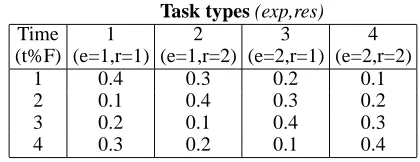
Task environment: We consider an agent’s model of the task environment to consist of estimates of how the ex-pertise and resource requirements of tasks vary with time. In our simulations, each task can have one of two possible required expertise types and one of two possi-ble required resource types; hence, a task can have one of 4 different types (designating the two expertise types as exp1 and exp2, and the two resource types as res1 and res2, the 4 different task types can be (exp1, res1), (exp1, res2), (exp2, res1) and (exp2, res2)). Also, we as-sume a fixed probability distribution over the task types as per Table 1. It shows the probabilities of occurrences of different task types at each time instance (for exam-ple, row 1 shows the probabilities with which task types 1, 2, 3 and 4 can occur at time instantcurrenttime
mod1). The expertise and resource components of each task type are shown within parentheses under the corre-sponding task type box. This probability pattern repeats itself after everyFtime instances, which is the task type periodicity. We assume a task type periodicity of 4 time instances. To keep the simulation simple, we have pro-vided the agents with perfect information about this task distribution1.
Capability models: An agent records the expertise and source requirements of another agent when the latter re-quests assistance for a certain task type. This informa-tion is used to build estimates of the task types in which the requester requires assistance from other agents 2. These estimates are utilised by agents to compute the dependence of its acquaintances on its own capabilities and are important in decisions described in Section 4.5. Additionally, an agent learns the capabilities of a service provider when it receives assistance from the latter. In this work, the agents employ reinforcement learning to build such estimates (see Section 4 for details).
There are four possible capability types that an agent can have — having expertise and resource of either one, two, three or all four task types. Thus, we label an agent as
type i (
i 2 f1;2;3;4g) whereiis the cardinality of its capability set.
Having described the task and agent capability models that agents develop, we show in the next section how these models are utilised by agents in their decision making processes.
4
Cognition-based Decision Strategies
In this section we formalise the agent decision strategies that are designed by incorporating the cognitive models discussed in Section 3. However, we note that our formulations are but one possible way of characterising the behaviour of agents in
1
We believe this is reasonable and does not affect our results and conclusions in a significant way.
2
Table 1: Probability distribution of task types over time
Task types (exp,res)
Time 1 2 3 4
(t%F) (e=1,r=1) (e=1,r=2) (e=2,r=1) (e=2,r=2)
1 0.4 0.3 0.2 0.1
2 0.1 0.4 0.3 0.2
3 0.2 0.1 0.4 0.3
4 0.3 0.2 0.1 0.4
this context. The parameters that agents take into considera-tion for building their decision heuristics and the way they are combined to generate formal behavioural specifications are not claimed to be unique. Moreover, we do not claim they are optimal. Instead, our goal is to lay out a generic behavioural model motivated by cognitive capabilities.
In Section 3, we have identified two behavioural roles that an agent can adapt to — that of a service requester and a provider. As a requester, an agent can either:
request assistance from a neighbour (see Section 4.1), or,
request referral with the motivation of finding a new neighbour from whom it can gain improved quality of assistance on task types in which it lacks expertise (see Section 4.2), or,
accept or deny a referral depending on whether it al-ready knows the acquaintance or it was reneged on ear-lier (Section 4.3).
As a service provider an agent can either decide to,
grant or deny service assistance (Section 4.4), or, grant or deny referral request (Section 4.5).
The decision to renege on an acquaintance, formalised in Section 4.6, can be taken by any agent and is not an ac-tion that corresponds to either the requester or the provider roles. In the following discussion, each of the above actions are elaborated and the influence of the cognitive models on action selection explained.
4.1
Requester Action: Request Assistance
Agentirequests its neighbourjto execute a task on its behalf when its own expertise and resources do not match with the task’s requirements. In more detail,icomputes the “likeli-hood” of receiving help from each of its neighbours and polls a neighbour (j) with a probability in proportion to the com-puted likelihood for that neighbour. To this end, we have in-corporated the following factors in the decision process ofi. First,iassesses how much the requirements of its task match with the capabilities ofj. It believes that ifjhas the match-ing capability for a task, then the likelihood of gettmatch-ing assis-tance increases becausej is more likely to help for a task it has expertise on and hence, incurs less cost (relation between capability match and task cost is explained later). Second, from its previous interactions withj,icomputes the number of times it was helped byjas opposed to it helpedj or was denied assistance byj. From these numbers, it compares the
frequency with which it received benefit in the past fromj with the frequency of incurring cost due toj. The higher the frequency of the first type compared to the latter, the greater is the likelihood of getting help fromj. Lastly, in addition to computing how many times j had assisted in the past, i computes how muchjhad been “useful” in past interactions by helpingi, allowingito save cost (discussions on task cost later). The morej has been useful in the past, the greater is the likelihood that iwould get assistance again fromj. In-tuitively, the last two factors help iuse its past experiences in deriving the chances of receiving help from a neighbour. Now, we present formal definitions of each of these factors and a logical way of putting them together for the agents to compute the likelihood metric.
Match: For a task of type x, requiring expertise and re-source typese
xand r
xrespectively, an agent’s capabil-ities “match” with the task requirements if it has both
e x and
r
x in its capability set. We say the “match” value is “high” in this case and “low”, otherwise. To compute the match (match
i
(x;j)) of the requirements of task typexwith the capabilities ofj,iuses its own estimates (E) ofj’s expertise and resource capabilities, updated using reinforcement learning techniques [Sut-ton and Burto, 1998]:E
x t+1
(1 )E
x t
+R, where trefers to the interaction number,xis the task type, is the learning rate andRis the immediate reward (the value of resource or expertise with which the helping agent executes the task). Whenj assistsifor task type
x, the latter updates its estimates (E x
) ofj’s capabili-ties for that task type. Since a task is composed of both an expertise and a resource type, separate estimates of both aspects are kept to match an acquaintance’s capa-bility with a given task. In our formulation, we say that a match is “high” (=5) if both the estimated expertise and resource values are close to the required values of the task (within a permissible error,Æ(=10) %), and “low” (=1), otherwise. A learning rate of0:5is used.
Interaction frequency: “Beneficial” interaction frequency foriwithjis the ratio of the number of timesireceived assistance (the benefactor) from j to the total number of interactions between the two. Analogously,i’s “non-beneficial” interaction frequency with j is the ratio of the number of times ihelped j and was denied assis-tance by jto the total number of interactions. At time
t,icomputes time-discounted frequencies from its inter-action record withjover a finite past time period (P):
fr cat i
(j;t) P
P T=1
T
jcond(i;j;T)
jinteractionsj P 1
:
The boolean variable cond(i;j;T) is “true” if i and
j interacted at time T. Here, cat can be one of the two frequency types, beneficial or non-beneficial.
T corresponds to absolute time (t T) in the past. jinteractionsj
P 1
denotes the total number of interac-tions betweeniandjin a time ofP units in the past and
frequency, interactions whereieither helped or was de-nied assistance fromj are used. A value ofP =10is used which is sufficient to allowiconsider interactions withj for all task types (since task types repeat every 4 time instances).
Rating: Utility earned and cost incurred fromj are repre-sented ini’s ratings ofj.iups its “beneficial” rating of
jat that time by an amount equal to the cost
3
isaved, if either ireceives help from j or from another agent thatj referred toi. However, ifiservesj’s request, it reduces the “non-beneficial” rating ofjat that time by an amount equal to the cost incurred. Alternatively, if
iis denied assistance byj,ireduces its non-beneficial rating ofjby a fixed positive “penalty” (=0:5). Ratings are maintained for interactions over a finite past time pe-riodP. To compute the likelihood metric,i calculates at timet the cumulative, time-discounted ratings of its neighbourj,
C rating cat i
(j;t) P X
T=1 x
T
T ;
wherex
T denotes a saving at time
T in the past in case of beneficial rating (cat= beneficial), or a cost incurred at time T in the past in case of non-beneficial rating (cat= non-beneficial). We note that all agents initially have zero values for both types of ratings of their neigh-bours. The beneficial ratings (and hence, the cumulative beneficial rating) are, therefore, positive real numbers. Similarly, beneficial ratings (thus, cumulative non-beneficial rating) are negative real numbers.
Forito compute at timet, the likelihood of receiving help fromjon a task of typex, we develop the following method.
likelihood i
(j;t) (match i
(x;j)+C rating + i
(j;t)
fr + i
(j;t))+(C rating i
(j;t)fr i
(j;t)): Here, “+” superscript is used for beneficial frequency and rat-ing categories, “-” for non-beneficial. This measure ensures that the the higher the match of the current task withi’s esti-mates ofj’s capabilities (or, lower the estimated task cost for
j) and the savings earned fromj(note:C rating +
0), and the lower the cost incurred due tojin the past (C rating
0), the greater is the likelihood of receiving help fromj. An agentiuses a standard Boltzmann exploration function to compute the probability of asking neighbourjat timet:
Pr j;t i
(ask)
exp(
lik elihoodi(j;t) K
) P
k 2neighboursi exp(
lik elihood i
(k ;t) K
) ; (1)
where, K is an exploration constant with value 0.8 and
neighbours
i refers to the current set of neighbours of i. Equation 1 guarantees that the probability of asking help from a neighbour increases with increasing value of thelikelihood metric of that neighbour and vice versa.
3
We assume that the cost of doing a task is “high” (=5) if an
agent lacks matching capability for the task. “High” cost is used as an equivalence to the agent’s inability to complete that task; cost is “low” (=1), otherwise.
4.2
Requester Action: Request Referral
An agent seeks a new acquaintance if services on task types for which it lacks expertise are not available from exist-ing acquaintances. In more detail, each agent periodically checks, using its own learned models of neighbour capabili-ties, whether its current neighbours have the matching exper-tise and resource capabilities for all of its task requirements. We say the “state” of an agent is “fit” if it has at least one matching neighbour for each of the task types it requires as-sistance for. This implies that the agent can potentially re-ceive service from its neighbours on all task types in which it lacks the abilities. If there is at least one task type in which it lacks the required capabilities and does not have a neighbour with those capabilities, its “state” is “not fit”. An agent with state “not fit” requests a randomly chosen neighbour to reveal one of the latter’s existing neighbours. The motivation for seeking a new neighbour is to increase the chance of locat-ing an agent with the required capabilities. We observe that precise measurement of an agent’s state is possible by having accurate models of its neighbour capabilities. Such accurate information would help an agent to take decisions that are relevant, rather than random referral requests that incur un-necessary communication costs.
4.3
Requester Action: Accept/Deny Referral
An agentiaccepts a referralaonly if the following conditions hold for bothianda: (a) either did not have the other agent as a neighbour before (and reneged in the past), and (b) the cur-rent neighbourhood of both contains less than the maximum number of neighbours an agent can have at any time.
4.4
Provider Action: Grant/Deny Assistance
An agentiwhile deciding whether or not to acknowledge a service request from agentj considers the following factors. First,ievaluates the cost it will incur to execute the task for whichjrequests assistance. The greater the cost incurred by
i, the less likely it would be to help. Second, similar to the decision process in Section 4.1, the providerialso uses its assessments of previous interactions withj (the “interaction frequency” and “rating”) to evaluate the probability of grant-ing service to the provider. Thus, the greater the frequency of beneficial interactions in the past and the more utility earned fromj, the higher is the chance of helpingj. In addition to the above,ialso looks ahead into its own future task require-ments and computes how likely isjto help on those. Specif-ically, i’s probability of helpingj increases if it evaluatesj as a prospective future helper by comparingj’s capabilities with its own future task requirements. To this end, we note that agents require precise models of both the task environ-ment and of capabilities of other agents. In the following, our formulations of the above factors are described together with the method of combining them into a decision strategy.
Task cost (C x i
Interaction frequency withj. The “beneficial” and “non-beneficial” interaction frequency computations are the same as discussed in Section 4.1.
Rating ofi for j. “Beneficial” and “non-beneficial” rat-ing calculations are similar to what have been defined in Section 4.1.
Future expected usefulness: Sinceihas the knowledge of how the task types vary with time (see Table 1) and it has the estimates ofj’s expertise and resource capabili-ties for different task types (developed via learning dur-ing interactions withj), it can compute the match ofj’s capabilities with its future service requirements. Thus,i computes the future prospect ofjat timetas:
pro i
(j;t) P
F T=1
P M x=1
match i
(x;j)Pr(x;T 0
)
jFj
Here,T countsF time instants (F is the periodicity of the task environment). Pr(x;T
0
), where T 0
= (t+ T)%F, is the probability of task typexoccurring at time
(t+T)in the future (corresponds to (time =T 0
,task type =x) in Table 1). M is the total number of task types. ¿From Table 1, we see that the values ofF andM are both four.
Agentiuses a sigmoidal probability function,
Pr
1
1+exp( V Th
)
; (2)
to determine the probability (Pr) of acceptingj’s service re-quest. This form is inspired from the Fermi function and has been used in settings [Sen, 2002; Jin et al., 2001] where the probability of choosing an action is thresholded around some value Thof a control variableV. The probability takes a value of 0.5 when the control variable is equal to the thresh-old. The transition of the probability function around the pointV = Thcan be made more or less skewed by adjust-ing the shapadjust-ing parameter. We propose a novel method that agentiuses to computeV.
V (C
x i
C rating i
(j;t)fr i
(j;t))
(pro i
(j;t)+C rating + i
(j;t)fr + i
(j;t)): Such a formulation ensures that the probability of providing service tojincreases with:
lower task costs fori,
lower cost incurred from interactions withj in the past (lower non-beneficial rating and frequency values),
higher prospect ofjas future service provider, and,
higher savings earned from interactions withjin the past (higher beneficial rating and frequency values).
We have used avalue of 1 and setTh=0. We note that the terms in the first pair of parentheses are comparable to those in the second pair. Also, the provider agent has a small pos-itive helping probability when it is completely neutral (i.e., when it has no cognitive models of either the environment or other agents’ capabilities and the rating and frequency terms in the control variable all have values of zero).
As more interactions occur agentican improve its cogni-tive models of j’s capabilities and, hence, can compute the above probability function in a more precise manner.
4.5
Provider Action: Grant/Deny Referral
First, we summarize agenti’s deliberations as they relate to deciding to provide a reference of an agent ato requesting agentj. Being self-interested,ireveals a referral only if that action earns it some utility. Therefore, the first condition that
iverifies is whether it has any dependence on the requester j
4. In case it does not, its rational choice is to ignore
j’s request: since it does not foresee any service assistance from
j, it is not inclined to acknowledge the latter’s requests. In case i depends onj, it then considers whetherj has a de-pendence on the prospective referencea. It evaluates this by comparing the requirement estimates ofjwith the capability estimates ofa. The reason being, ifj has a dependence on
a, then it is likely to receive assistance fromaand thus, as-sign the referring agent (i, in this case) a positive beneficial rating (see discussion on rating in Section 4.1). This, in turn, would assistiin obtaining future assistance fromj. Ifi de-tects no dependence ofjona, it does not referabecause in so doing it would not earn any future expected utility (positive rating) fromj. On the contrary, ificonfirms that the above two dependences exist, it subsequently computes if there is a chance of losing utility by getting reneged on by eitheraor
jor both. Agents renege on interactions with those acquain-tances that fail to serve their requests or are less capable of service compared to other acquaintances. The latter situation can arise if an agent gets referred to a new acquaintance hav-ing high match and thus, reneges on some of its previous ac-quaintances. So,ichecks whether the condition arises where eitheraorj, being new acquaintances, might stop interacting with it. The above factors are evaluated sequentially by the deciding agenti, and are enumerated in the following.
idepends onj: As described before,iconsiders refer-ring only if it estimates a dependence of its task require-ments with the capabilities ofj.
j depends ona: iconsiders referring if it estimates that j depends on a’s expertise. The motivation is (stated earlier),iearns positive rating fromjevery time the ref-erenceahelpsj, which allowsito receive help fromj in the future. Thus,iaims to maximize the utility earned (rating fromj) from its action of referringatoj.
i does not losej as neighbour by referringatoj: An agent m reneges on a neighbourn if m does not re-ceive service from it. This can happen under two cir-cumstances: (1)ndoes not have the capabilities to serve
mon tasks in whichmrequires assistance, or, (2)mhas too many other neighbours on whom its dependences are much stronger than onnand hence,mdoes not interact withnoften enough to be able to detect the latter as a beneficiary.
Sinceiconsiders referring only if it depends onj, it en-sures that the referral would not engender the latter of
4
The “dependence” of an agentxon another agentyconsists of
the set of task types in whichx’s own requirements match withy’s
the above two situations wherejgets a more beneficial neighbouraand stops interactions withi. It achieves this by referring only if, (a)j’s dependence onais a proper subset ofj’s dependence onior, (b)j’s dependence on
ais completely uncorrelated withj’s dependence oni. In either situations,jwould not potentially renege oni after being referred agenta.
Ifidetects that j depends onaandj does not renege onias a consequence of referral, then it refersatojif it estimates that it does not depend ona. Otherwise, it considers the following.
Sinceievaluates dependence ona, it can ensure it is not getting reneged on byain the future following similar reasons as applied to the case of not losingj. Therefore,
i refersa toj if, (a)a’s dependence onj is a proper subset ofa’s dependence onior, (b)a’s dependence on
j is completely uncorrelated witha’s dependence oni. The reason being similar to that described in the third criterion above.
4.6
Reneging on Interactions with a Neighbour
Interacting with a neighbour involves computation costs to evaluate and update their behavioural models and commu-nication overhead. Hence, a selfish agent decides to revoke interactions with those acquaintances that fail to provide its required services. The following discussion formally estab-lishes an agent’s decision to renege on a neighbour.
In our formulation, an agenti maintains a record of the number of times it has requested assistance from a neighbour
j for each of the task types in which it lacks expertise. The higher the number of times such requests failed, the higher is the likelihood thatiwould renege on interacting withj. We let our agents use the decay functionexp( x
t
)to update the current “strength” of the relationship betweeniandj(this form of the equation is inspired from the work on evolution of social networks [Jin et al., 2001]). Here,x
tis the number of failed requests made byitoj for tasks of typetand is the decay factor. Wheneverireceives help fromjon typet, it sets the decay function to 1. An agent revokes interactions with its neighbour if the decay function falls below a thresh-old (of 0.3) for all task types that it requires assistance for. Thus, by adjusting the value of, the agents can have dif-ferent punishing tendencies for neighbours who do not assist — in the current formulation, we select = 0:1204which implies that an agentiwould renege onj ifj fails to helpi on 10 successive requests (sinceexp( 100:1204)0:3) on tasks of each type in whichilacks expertise.
In the following section we summarily describe the simula-tion of agent interacsimula-tions where the above decision strategies are used by agents.
5
Simulation and Interaction Dynamics
Our domain simulations can be summarized in the following steps.Agents are assigned their capability sets and the initial random neighbours.
While simulation continues for N time steps, at each time step:
- K tasks assigned to each of a random set of agents. - While all tasks are not completed (each task is
assumed to take one time unit for completion): - All agents who do not have required expertise
and resource for assigned tasks, ask for help. - The provider updates estimates of the
requester’s expertise and resource requirements. - Provider decides to help/not help.
- Requester updates capability model of provider. - Both requester and provider assigns ratings to
the other.
- All agents evaluate ‘‘state’’ and decide to request a referral
- Provider takes referral decision.
- Requester accepts / rejects referral, if any.
- All agents check for possible reneging on neighbours.
6
Experimental Results
Our goal is to study whether and to what extent can agents locate partners with matching capabilities in the specified do-main (Section 3) using the decision heuristics described in Section 4. These observations are compared with those where agents adopt random decision strategies as opposed to using cognition-based strategies. The following metrics are chosen for comparison.
Agent state: In the agent groups that emerge out of the simulations, we measure the proportion of an agent’s expertise and resource requirements that match with its neighbours’ (group members) capabilities. We compute
the “state” of an agenti, P
x2r eq uir ed i
1jcondi(x) required
i
, where
required
iis the set of task types in which
ilacks exper-tise and resource, and the boolean variablecond
i (x)is trueif there is at least one agent ini’s neighbours thati estimates to have the capability for task typex. Thus, the “state” value is 1 for an agent having a neighbour with the matching capabilities for each task type in which it lacks required capabilities. Hence, the closer the value of an agent’s “state” is to1, the more successful (better) it has been in locating complementary partners.
Group size and composition: We measure the agent “con-nectedness” in the emerged groups. The metrics of inter-est are (a) average size of the group (or, number of neigh-bours) of an agent of each capability type, and (b) aver-age number of aver-agents of different capability types (group composition) in groups of each agent type. Group size measurements help analyse how the connectedness of agents depend on the constraint of having a limited num-ber of acquaintances. Also, it correlates group size with “state” values of agents. Group composition analysis shows any relation that exists between the size of part-nerships of different agent types and their capabilities.
0 0.1 0.2 0.3 0.4 0.5 0.6 0.7 0.8
20 30 40 50 60 70 80
Average state
% of type1 agents
Average states of type 1 agents (Total 50 agents)
70 % max neighbours
50 %
60 %
40 % 30 %
20 %
[image:8.612.332.536.61.234.2]10 %
Figure 1: Agent type 1 “states”
with the number of connections for each agent bounded by the maximum allowable neighbour size. For a given random initial configuration, each simulation is repeated for 10 runs. A simulation run spans 1500 time steps (details of one time step is described in Section 5). All results reported are aver-aged over experiments conducted for 10 such random initial configurations, hence, over a total of 100 runs.
6.1
Agent States
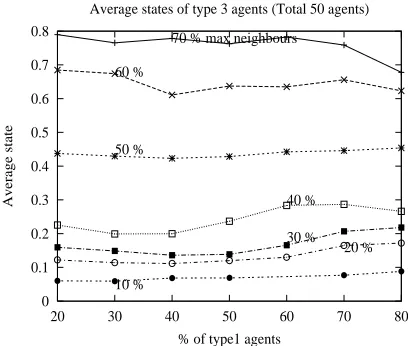
We measured agent states by increasing the maximum num-ber of neighbours an agent can have (allowable neighbour size), from 10% to 70% in steps of 10. A maximum neigh-bour size of x% means that an agent can interact with (or, have as neighbours) at most x% of the total agent popula-tion. For each value of allowable neighbours, the proportions of type1and type3agents were varied from(20%;80%)to
(80%;20%)in steps of 10%. Figures 1 and 2 show the varia-tion of agent states with changing composivaria-tion of type1and type3agents, respectively, for different values of maximum neighbours.
Observation 1: Agent states improve with increase in the
number of allowable neighbours.
In both Figures 1 and 2, we note that, with increase in the maximum neighbour size, the agents attain better state values. With maximum neighbour size =70%, a type3agent gets a state value of almost0:8, which indicates a very close match of its requirements and the capabilities of its neighbours. This indicates that with more available neighbours to interact with, agents using cognition-based decision strategies are able to locate better matching partners. The state values of agents using random decisions are found to be always zero. These agents do not interact with others using strategies similar to the cognitive agents. Hence, they fail to recognise helpful partners. This in turn leads to their having poor (zero) state values.
However, we observed that increasing the neighbour size, the communication cost increases. We recorded the total number of requests (graph not provided) an agent makes for all service requirements over a simulation run. From this, we
0 0.1 0.2 0.3 0.4 0.5 0.6 0.7 0.8
20 30 40 50 60 70 80
Average state
% of type1 agents
Average states of type 3 agents (Total 50 agents)
70 % max neighbours
60 %
50 %
40 %
30 % 20 %
[image:8.612.70.275.61.234.2]10 %
Figure 2: Agent type 3 “states”
found that the average number of requests made in one simu-lation run increased almost linearly from about 2500 to close to 22500 as the neighbour size was increased from 10% to 70% with a total 50 agents and with 50% of each agent type (1and3).
Observation 2: The state of type 1 agents decreases with
increase in their numbers, while that of type 3 agents remains unchanged.
For the same maximum neighbour size, a decrease in the state value is observed for type1agents, as their proportion in the population increases (see Figure 1). The state values of type
3agents, on the contrary, remain almost unaffected by the changing composition (Figure 2). Type1agents require as-sistance for 3 different task types in which they lack expertise and resource. To attain a high state value, they require assis-tance in most of the required task types. But, agents receive cooperation only if they can reciprocate (see decision strategy in Section 4.4). Type1agents have scarce resource and exper-tise to be potential service providers. However, when they are a minority in the population compared to type3agents, they can find a few type3agents that contribute significantly to improve their state values (note graph when type1’s are mi-nority). On the contrary, as type1increases in the population, they are able to form more partnerships with agents of their own type than with type3(result in Section 6.2 shows this). A coalition with its own type is not as beneficial for a type1 agent as is that with type3. In a type1- type1partnership, only 1 of its 3 required capabilities are satisfied compared to all 3 in a type1- type3partnership. Hence, type1agent states decrease with an increase in their numbers. Type 3agents, however, require assistance for only one task type and can be potential cooperators in several task types. These factors en-able them to find cooperating neighbours (mainly of its own type) and thus, maintain a stable state value independent of their number in the population.
6.2
Group Characteristics
are interested to know how many agents and of what type form groups.
Observation 3: Average group size of an agent type
in-creases with increase in the number of agents of that type.
Table 2 shows the average group size of type1and type3 agents. Simulations were run using a moderate value (30%) of the maximum neighbour size and changing the proportion of the agent types in the population. It is observed that with an increase in their numbers, both agent types form larger groups. This implies that the connectedness of an agent is directly related to the number of agents of its type in the pop-ulation. However, we observe a negative correlation between the group size and the state values of type1agents. As a majority in the population, they form larger groups but have lower state values (see Figure 1) than when they are less in number. With an increase in number, type 1 agents form groups with more agents of their own type than type3(see discussion on group composition), which does not help to in-crease the states of these agents (explained previously in state results). Table 2 also reveals that type1agents have slightly larger groups than an equal proportion of type3agents. This is due to the difference in the sizes of capability sets of the two agent types. A type1agentihas capability in only one task type. It can, hence, find several other type1agents that have one matching capability type out of the 3 that it requires and can therefore maintain partnerships through mutual coop-eration. Thus, although a type1- type1partnership does not result in a significant state improvement of the agents forming the partnership, they are more in number than type3- type3 partnerships. We believe that the differences in group sizes would be more pronounced if the capability types in which agents differ increase in number, i.e, with more heterogeneity in agent types.
Observation 4: In a population of agents with
hetero-geneous capability sets, larger partnerships form between agents of the same type.
Table 3 summarizes how many type1and type3agents are present on an average in groups of an average type1and an average type3agent. It shows that an agent forms more coali-tions with agents of its own type than with others. The size of partnerships between similar agents increases with an in-crease in their numbers. This skewness about which agent type to make partnerships with is because partnerships are based on utility-generating interactions: a type3agent (that has a greater set of capabilities than a type1) is more likely to revoke a type1partner (which has exactly 1 capability type) from its neighbourhood when it recognises the poorer coop-eration capability of the latter compared to the agents of its own type5. However, we see type3agents have more type
1partners when the number of the latter type becomes domi-nant in the population (Table 3: row corresponding to(70;30) and column of group composition of agent type3). A type1 agent develops partnerships with other type1agents that have its missing capability type. Such partnerships increase with increase in the number of type1in the population.
We note that this behaviour of agents to preferentially
5
It is unlikely that a type1agent has the exact matching
capabil-ity that a type3requires.
Table 2: Average group size (50 agents, max neighbour 30%)
(type1 %, type3 %) Type 1 groups Type 3 groups
(30,70) 3.38 6.04
(40,60) 5.03 5.68
(50,50) 5.73 5.65
(60,40) 6.85 4.54
(70,30) 7.08 4.31
Table 3: Average group composition (50 agents, max neigh-bour 30%)
Type 1 groups Type 3 groups (type1 %, type3 %) Type 1 Type 3 Type 1 Type 3
(30,70) 1.88 1.95 0.8 5.2
(40,60) 3.34 1.69 1.12 4.6
(50,50) 4.2 1.5 1.5 4.12
(60,40) 5.9 1 1.5 3
(70,30) 6 0.9 2.1 2.2
make partners requires accurate agent models, developed us-ing cognition-supported decision mechanisms. Agents de-signed with random decision strategies quickly renege on all neighbours. Since they do not employ observation-based modelling of agent capabilities, they are unable to detect the benefit of interacting with any agent. Thus, measurement of group characteristics is not realisable for such agents.
6.3
Reneging and Referral Patterns
In addition to computing agent state values and their con-nectedness at the end of the simulations, we are interested in studying their behaviour in course of the simulation. Specif-ically, we note how their decisions to renege on neighbours and ask or provide referrals vary over time.
Observation 5: Frequency of reneging neighbours
de-creases and finally stops during the simulation. Referral re-quests continue while granting references stop over time.
Declining to interact with a neighbour or ask and/or grant re-ferrals are important decisions that determine the final state and group structure of agents. In our experiments, we have observed a decay in the rate at which neighbours are reneged on with time. The reason being, even though agents do not always find partners with all matching capabilities, they are able to locate those with some matching capabilities to con-tinue assisting each other and hence, maintain partnerships. The regularity in the task environment is an important in-fluence in this context. With an erratic task environment, long lasting interactions that would allow agents to recognise the capabilities of each other for different task types simply would not have occurred.
of 1). However, revealing reference information ceases. This is because, since agents have neighbours from whom they ceive assistance in one or more of their task requirements, re-ferral becomes too “costly” — following the decision mech-anism described in Section 4.5. This, in turn, means agents refrain from granting referrals because they evaluate a finite risk of losing neighbours by so doing.
6.4
Other Observations
It is observed that the learned values of neighbour expertise and resource estimates converge to their true values at the end of the simulation. Also, we make a note that in the decision related to asking for help (Section 4.1), a constant value is used for the exploration factorK. In our simulations, agent neighbourhoods are dynamic structures; hence, adjusting the exploration factor to encourage exploitation would lead to a complete lack of exploration of new neighbours obtained through referrals. Without sufficient interactions with new neighbours agents would fail to build accurate estimates of their capabilities which are necessary for effective decision making.
7
Conclusions and Future Work
In this paper, we have presented a set of novel decision mech-anisms for a self-interested cognitive agent that interacts with other cognitive agents having different expertise types in a time-periodic task environment under some practical con-straints. Using simulations, we have demonstrated that ele-ments of cognition such as memory and learning help agents to successfully detect matching partners and form groups un-der such constraints. We also showed that, the utility earned from services of group members depends on capabilities of agents and the maximum allowable number of agents they can interact with. In this context, group size depends on the num-ber of agents in the population. In addition, a given agent type is found to have a higher preference to form partnerships with others of its own type. That agents are able to receive service, and hence, earn utility, from group members of matching ca-pabilities indicates the effectiveness of the decision strategies under the specified conditions.
Some of the interesting areas of future investigation are, (a) adding a random component to the task environment and designing decision strategies that help agents to appropriately adapt to such changes; (b) studying the effects of “multi-hop” referrals, where if a neighbour does not grant a referral re-quest, it can pass it on for further evaluation to other neigh-bours; and, (c) applying and evaluating the decision mech-anisms in problems such as multi-agent coordination using task delegation among self-interested agents.
References
[Axelrod, 1984] R. Axelrod. The evolution of cooperation. Basic Books, New York, 1984.
[Azoulay-Schwartz and Kraus, 2001] R. Azoulay-Schwartz and S. Kraus. Stable strategies for sharing information among agents. In Proceedings of the Seventeenth
Interna-tional Joint Conference on Artificial Intelligence (IJCAI),
pages 1128–1134, 2001.
[Betchel and Graham, 1998] W. Betchel and G. Graham, ed-itors. A companion to congnitive science. Blackwell, Ox-ford, UK, 1998.
[Castelfranchi and Falcone, 1998] C. Castelfranchi and R. Falcone. Principles of trust for mas: Cognitive autonomy, social importance, and quantification. In
Proceedings of the Third International Conference on Multi-Agent Systems (ICMAS), pages 72–79, 1998.
[Forgas, 1991] J. P. Forgas, editor. Emotion and social
judge-ment. Permagon Press, New York, 1991.
[Hogg and Jennings, 2001] L. M. Hogg and N. R. Jennings. Socially intelligent reasoning for autonomous agents.
IEEE Transactions on Systems, Man and Cybernetics -Part A, 31(5):381–399, 2001.
[Jennings, 2001] N. R. Jennings. An agent-based approach for building complex software systems. Communications
of the ACM, 44(4):35–41, 2001.
[Jin et al., 2001] M. Jin, M. Girvan, and M. E. J. Newman. The structure of growing social networks. Phys. Rev. E, 64, 026118:381–399, 2001.
[Kautz et al., 1997] H. Kautz, B. Selman, and M. Shah. Re-ferralweb: Combining social networks and collaborative filtering. Communications of the ACM, 40(3):63–65, 1997. [Lerman and Shehory, 2000] K. Lerman and O. Shehory. Coalition formation for large-scale electronic markets. In
Proceedings of the Fourth International Conference on Multi-Agent Systems (ICMAS), pages 167–174, 2000.
[Panzarasa et al., 2001] P. Panzarasa, N. R. Jennings, and T. J. Norman. Social mental shaping: modelling the impact of sociality on autonomous agents’ mental states.
Compu-tational Intelligence, 17(4):738–782, 2001.
[Sandholm and Crites, 1995] T. Sandholm and R. Crites. Multiagent reinforcement learning in the iterated pris-oner’s dilemma. Biosystems, 37:147–166, 1995. Special issue on the Prisoner’s Dilemma.
[Sen, 2002] S. Sen. Believing others: pros and cons.
Artifi-cial Intelligence, 142:179–203, 2002.
[Sun, 2001] R. Sun. Cognitive science meets multi-agent systems: A prolegomenon. Philosophical Psychology,
14(1):5–28, 2001.
[Sutton and Burto, 1998] R. S. Sutton and A. G. Burto, ed-itors. Reinforcement Learning: An Introduction. MIT Press, Cambridge, MA, 1998.
[Yu et al., 2003] B. Yu, M. Venkatraman, and M. P. Singh. An adaptive social network for information access: archi-tecture and experimental results. Applied Artificial