Title: Breaking from binaries – using a sequential mixed methods design
Correspondence to Patricia Larkin
Patricia Mary Larkin PhD, MSc, RGN, RM is a lecturer in midwifery at the School of Health
and Science, Dundalk Institute of Technology, Republic of Ireland
Cecily Marion Begley RGN, RM, RNT, FFNRCSI, MSc, MA, PhD, FTCD is chair of nursing and
midwifery at the School of Nursing and Midwifery, Trinity College Dublin, Republic of Ireland
Declan Devane RGN, RM, RNT, DipHE, MSc, PgDip(Stats, PhD is chair of midwifery at the
National University of Ireland Galway, Republic of Ireland
Date of submission: January 3 2013
Date of acceptance: June 3 2013
Abstract
Aim To outline the traditional worldviews of healthcare research and discuss the benefits and challenges of using mixed methods approaches in contributing to the development of nursing
and midwifery knowledge.
Background There has been much debate about the contribution of mixed methods research to
nursing and midwifery knowledge in recent years.
Data sources A sequential exploratory design is used as an exemplar of a mixed methods approach. The study discussed used a combination of focus--‐group interviews and a quantitative
Review methods
The mixed methods study example qualitative data were analysed using thematic analysis. Quantitative
data were analysed using regression analysis
Discussion
Polarised debates about the veracity, philosophical integrity and motivation for conducting Mixed
Methods research have largely abated. Mixed Methods Research has the potential to contribute to a
deeper more contextual understanding of a variety of subjects and experiences furthering knowledge
for clinical practice.
Conclusion
The purpose of the research study should be the main instigator when choosing from an array of Mixed
Methods research designs. Mixed Methods Research offers a variety of models that can augment
investigative capabilities and provide richer data than a discrete method alone.
Implications for practice/research
This paper offers an example of an exploratory sequential approach to investigate women’s childbirth
experiences. A clear framework for the conduct and integration of the different phases of the Mixed
Methods Research process is provided. This approach can be can be used by practitioners and policy
makers to improve practice.
Keywords
Mixed methods, discrete choice experiment, sequential design, childbirth experiences
Introduction
Much of nursing and midwifery research aims to bring about changes in practice through
improved knowledge. Until recently, the healthcare research agenda has focused on traditional
positivist or naturalistic approaches or worldviews (Twinn 2003). The positivist approach to
research is objective and scientific. The research is conducted using a structured design, where the
researcher withholds their beliefs in order not to contaminate the data. Analysis is statistical
presenting data in numerical forms. Naturalistic approaches adopt a different set of beliefs about
various aspects of the research process. Unlike the positivist approach the researcher recognises that
they can have a potential effect on the research process. The design is systematic but flexible
recognising that data can be complex and contextual. The analysis is rigorous, with researchers sifting
through information and presenting data in the form of words which offer a theory or a description
of the phenomenon under investigation. Qualitative research aligns itself with naturalistic
approaches, while quantitative research is closely aligned with positivism. In health care,
quantitative research is often favoured, with the randomised controlled trial considered the ‘gold
standard’ for the development of healthcare interventions.
However, holistic care, which is central to nursing and midwifery philosophies, is incompatible
with a purely positivist approach. Using statistical measures alone can ignore or minimise human
experiences, including their psychological and emotional aspects. Conversely, qualitative studies
have been criticised, mainly because of their often small, convenience sample size and a lack of
generalisability, which can lead to a perception that they are less powerful and less influential
than quantitative research.
Sandelowski (2003) contended that the criticisms levelled at both approaches are misplaced. She
asserted that neither qualitative nor quantitative methods are inherently strong or weak,
except in relation to particular perspectives and standards of enquiry (Sandelowski 2003).
Different approaches to research address diverse purposes or intentions. Qualitative approaches
focus on the multiple realities of an information--‐rich sample and challenging assumptions
that are taken for granted, whereas quantitative approaches centre on the measurement
of single, determinate realities, seeking to find statistically significant reductive information that
can then be generalised.
Both perspectives have valuable contributions to make to the body of nursing and
choosing incorrect approaches or executing them in the wrong way (Sandelowski 2003).
Contemporary nursing and midwifery practice covers a broad and complex spectrum of care,
from before conception and birth, to health and illness, to death. Their theoretical and
philosophical aspects encompass concepts such as holism, individualised care, partnership,
empowerment and advocacy. The environment in which practice occurs therefore requires
different, multi--‐level, realistic, contextual perspectives to further develop nursing and midwifery
knowledge (Twinn 2003). The increasing complexity of health care has been part of the drive
towards the development of new approaches, different combinations of approaches, and the
blending of research practices and perspectives.
Experiences from both paradigms
Understanding complex experiences is central to nursing and midwifery care. The experiences of
healthcare users are increasingly being used to assess, plan and implement changes in
service provision and policy development (Lees 2011). Qualitative and quantitative approaches
have been used to enrich contemporary knowledge of healthcare experiences using a variety of
perspectives, methods and designs.
Qualitative data have the potential to identify disparities between the perceptions of users
and providers of care (Lees 2011). They have been invaluable in providing in--‐depth insights into
women’s feelings about childbirth, the consequent effects on their lives, and those of their families
and community. Quantitative designs have traditionally used ‘satisfaction studies’, surveys or
measurements of psychological components such as ‘self--‐efficacy’ to evaluate childbirth
experiences (Larkin et al 2009). Quantitative satisfaction studies are restricted as they rely
on a global satisfaction index, often omitting important details that are significant to the
healthcare user (Lees 2011). Satisfaction studies in relation to childbirth are limited due to
potential participants valuing the status quo and feeling reluctant to criticise their care,
believing it to be as good as it could be (van Teijlingen et al 2003).
Qualitative and quantitative designs have made important contributions to the understanding of
people’s experiences from different perspectives. A recognition of their intricacies results in the
need for innovative approaches that use mixed methods to address complex research
questions, rather than adopting a particular approach (Twinn 2003). A mixed methods
approach has the potential to explore contextual understandings that require multiple
perspectives. Evidence in the nursing literature attests to the contemporary use of mixed
methods to the extent that a textbook of mixed methods has been published (Andrew and
From the perspective of midwifery, there are few published, mixed methods studies that
focus explicitly on women’s experiences of childbirth. Jomeen and Martin (2005) used mixed
methods to explore whether there was a multidimensional measure of anxiety and depression in
early pregnancy. Further examples include Kingdon et al (2009), who explored women’s
choosing of caesarean sections, and Beake et al (2013), who developed a competency
assessment for midwives to use when caring for women with an intellectual disability. Lees (2011)
concludes that mixed methods is the most effective approach in exploring experiences of health
care as it provides a more complete contextual understanding of users’ views.
Advantages of mixed methods
Mixed methods research (MMR) has been described in many different ways. Johnson et al
(2007) have amalgamated 19 separate definitions: ‘MMR is the type of research in which a
researcher or team of researchers combines elements of qualitative and quantitative research
approaches (for example, use of qualitative and quantitative viewpoints, data collection,
analysis, inference techniques) for the purposes of breadth and depth of understanding and
corroboration.’
A broad rationale for adopting MMR in health services research (O’Cathain et al 2007)
includes an increased contextual understanding of health care, improved confidence in findings,
strategic use such as funding, and ensuring different groups in society are heard. Teddlie and
Tashakkori (2009) outlined the three advantages of MMR as:
• Being able to simultaneously address a range of confirmatory and exploratory questions
with qualitative and quantitative approaches.
• Providing better (stronger) inferences.
• Offering the opportunity for a greater assortment of divergent views.
The intention and purpose of MMR, therefore, is to attain a deeper level of understanding and a
commitment to engagement with diverse viewpoints, paradigms and methods. Notwithstanding
its advantages, undertaking a mixed methods study can be challenging in terms of researchers’
abilities and resources, which can be compounded by shifting definitions in relation to design,
Challenges of mixed methods
A major challenge to reading and understanding MMR is the lack of uniformity in the
terminology and description, and absence of clarity as to when and at what level they are
mixed (Sandelowski 2003). Such confusion has led to criticisms of using a ’pick and mix
approach’, presenting triangulation as a mixed methods design (Sandelowski 2003, Twinn
2003), and a perceived lack of ontological and epistemological coherence by some nurse
researchers (Lipscomb 2008). Creswell (2011) identified several enduring controversies about
MMR and revisited previous arguments against mixed methods, such as inconsistent
descriptions and terminology, paradigmatic independence, over--‐emphasis on positivism,
integrating methods and methodologies without clear rationale, and appropriation of research
methodologies already in use. There are therefore unresolved issues about the conception
and process of mixed methods designs.
Despite these controversies, there is an increasing acceptance of mixed methods as a legitimate
and valuable research design (Teddlie and Tashakkori 2009). This paper provides an overview of
MMR, so does not explore these ongoing debates.
Mixed methods research designs
It is impossible to provide an exhaustive list of MMR designs because of their large number
and inherent capacity to transform and adapt (Teddlie and Tashakkori 2006). Greene (2007)
emphasised using the intent or purpose of the research as a focal point when deciding the
most appropriate design, rather than being wedded to specific approaches or methods. The
choice of a mixed method design therefore arises from the study question rather than the
method driving the question. The three main purposes of a mixed methods design are:
development, complementarity and expansion (Greene 2008).
A developmental mixed method strategy, such as the development of an instrument, is
sequential and assesses a number of constructs of phenomena where one method is used to
inform the other (Greene 2007). Complementarity seeks to enhance our understanding of
complex social phenomena by establishing connections between their multidimensional
aspects (Greene 2007). Greene explained ‘expansion’ as a means of extending the scope and
breadth of a study, thus examining multiple phenomena in different ways. Each method can assess
a different phenomenon, which collectively expands the breadth of the study beyond the scope of
a single method (Greene 2007).
To illustrate the steps in the process, a sequential exploratory design is discussed as an example
The sequential exploratory design
MMR designs provide an organisational framework for different research processes, including the
purpose of the study, sampling, analysis, mixing, interpretation and the reporting of the
study. Teddlie and Tashakkori (2006) outlined the four main dimensions of their design
typology as: the number of approaches used; the number of strands or phases of the
design; the type of implementation process (concurrent sequential or conversion); and the
stage at which integration takes place. The sequential exploratory design involves collecting and
analysing qualitative and then quantitative data in two consecutive phases within a single study.
This design is ideal for the exploration of new phenomena (Creswell and Plano Clarke 2007)
where there is little knowledge about the area being researched.
The research’s design was driven by its aims and objectives and incorporated multiple
justifications. The design sought to capture more fully the complexity of human phenomena
and understand women’s experiences (Sandelowski 2003) by gathering and analysing
qualitative and quantitative data. This was also a strategic decision, as the study would
then have appealed to research audiences from qualitative and quantitative traditions. This
design also allowed the participants’ opinions to be heard in relation to their childbirth
experiences.
The study’s objectives were
to:
• Determine women’s expectations of childbirth.
• Identify the components or attributes of childbirth that are important to women.
• Determine the relative value or usefulness that women assign to elements of their
experiences.
• Investigate the associations between women’s preferences regarding childbirth
and variables such as parity, age and model of maternity care.
While the overall aim of the study may appear to lend itself to a qualitative design, the
identification of specific elements of childbirth, such as individualised care and access to pain
relief, combined with the relative value women ascribe to those elements, required a more
complex approach. A qualitative study would have identified the elements but would not have
enabled the researcher to establish quantitatively those considered most important. A
quantitative study would not have identified women’s priorities linked with local
organisations, so the quantitative attributes would have been based on conjecture.
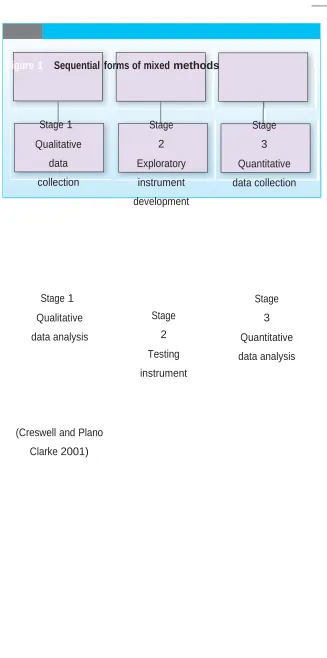
attributes of the childbirth experience that were important to women (stage one). Stage two
involved the development of a discrete choice experiment (DCE) instrument, a quantitative tool
used to establish the relative importance of the attributes identified (stage three) (Figure 1). The
DCE is an economics tool increasingly used in health care to identify service users’ priorities. The
DCE quantitative data analysis allowed the priorities to be ranked in terms of their relative value.
Consequently, the first two objectives were fulfilled by the initial, qualitative phase, while the
remaining objectives were fulfilled by the second, quantitative one. This provided two of the
justifications for a mixed methods approach: developmental (where one method informs the
other) and complementarity (enhanced understanding of a phenomenon). Thus, quantitative
and qualitative approaches were used to address different aspects of childbirth. The use of
mixed methods helped to achieve in the qualitative phase a more complete appreciation of the
important elements of childbirth and, in the quantitative phase, a ranking of those elements,
which contributed to a better understanding of the overall phenomenon.
Stage 1. Qualitative data collection and analysis
The initial qualitative descriptive study used five antenatal and five postnatal FGIs. Qualitative data
analysis generated important characteristics or attributes of childbirth. The use of qualitative
data to inform a quantitative instrument is sometimes referred to as ‘quantitising’ (Sandelowski
2000), with qualitative data transformed into quantitative data using content analysis. The aim
of the study, however, precluded using decontextualised iterative content alone.
Themes and subthemes were identified; overlapping themes were reviewed and subsequently
merged where appropriate. The data transformation, rather than being a linear process, involved
a ‘to and fro’ between the developing instrument and the FGI data.
Stage 2. Exploratory instrument development and testing
Six elements of childbirth experiences were identified, such as individualised care and access to
pain relief. The DCE offered women a ‘menu’ of choices made up of the six elements arranged in
various combinations. In choosing a particular composite or ‘menu of elements’, women
identified the value they attributed to each one. This stage also involved the development and
testing of the DCE, including the conducting of a pilot study and refinement of the final DCE
instrument. A detailed account of DCE conception and development is described elsewhere
(Coast and Horrocks 2007).
DCE data analysis information will be restricted to a few aspects here; Hensher et al (2005)
contains further information. The basis of the DCE analysis is the use of regression models. A
linear additive model, which can identify the direct independent effect of each attribute on the
response choice (Hensher et al 2005), was used. This identified women’s priorities for each
attribute and their importance to childbirth.
Once the analysis was complete, the two types of data were used together to address the four
research objectives. The quantitative research instrument enabled the prioritisation of the
elements of childbirth identified by the FGIs. Statistical significance established from the
regression analysis revealed women’s priorities. For example, although the FGIs established that
decision--‐making was an important element of childbirth, the DCE showed that access to pain
relief was valued more highly by women, thereby providing a more nuanced investigation of
childbirth.
DCE development has been criticised for its lack of clarity and transparency in generating
attributes (Coast and Horrocks 2007). MMR has the potential to help in the development of the
DCE. The sequential exploratory design is a straightforward way to organise and develop DCE
attributes. With this type of design, the ‘mixing’ occurs in the way the two phases are
connected. The connection occurred as data and findings from stage one informed
development of the quantitative instrument in stage two, which led to the collection of data in
stage three addressing the same substantive issue of women’s experiences of childbirth.
Conclusion
Mixed methods are not inherently superior to individual methods. The acid test of the mixed
methods design is the appraisal of whether the information gained from the study contributed to
an overall better understanding of women’s experiences of childbirth. Qualitative and
quantitative phases had different but linked roles in the study that offered complementary
evidence about the subject. The qualitative elements of experiences of childbirth, when
examined quantitatively, enabled important priorities to be identified. The particular values that
women ascribed to each element could not have been identified from a qualitative study alone.
Equally, the elements emerging from the FGIs enabled users’ opinions to be heard while
providing transparency and validity to the development of the DCE instrument. It is useful
therefore for care providers to understand women’s priorities so as to provide optimum care.
This article provides an example of a mixed methods study using a sequential exploratory design.
An example of how quantitative and qualitative components are linked throughout the design
quantitative and qualitative methods, enabling a fuller understanding of women’s childbirth
experiences. The blending of both types of data allowed a more informed, contextual
understanding that provided statistical support to indicate respondents’ priorities on a larger
scale. This information can be used to identify practice and policy changes to improve users’
experiences, thereby enhancing care.
References
Andrew S, Halcomb EJ (Eds) (2009) Mixed Methods Research for Nursing and the Health
Sciences. Wiley--‐Blackwell, Oxford.
Beake S, Clark LL, Turner T et al (2013) A mixed methods study to develop and pilot a
competency assessment tool to support midwifery care of women with intellectual disabilities.
Nurse Education Today. 33, 8, 901--‐906.
Coast J, Horrocks S (2007) Developing attributes and levels for discrete choice experiments
using qualitative methods. Journal of Health Services Research and Policy. 12, 1, 25--‐30.
Creswell DJW, Plano Clark VL (2007) Designing and Conducting Mixed Methods Research.
First edition. Sage Publications, London.
Creswell DJW (2011) Controversies in mixed methods research. In Denzin NK, Lincoln YS (Eds)
The SAGE Handbook of Qualitative Research. Fourth edition. Sage Publications, Thousand
Oaks CA. Greene JC (2007) Mixed Methods in Social Inquiry. Jossey--‐Bass, San Francisco CA.
Greene JC (2008) Is mixed methods social inquiry a distinctive methodology? Journal of Mixed
Methods Research. 2, 1, 7--‐22.
Hensher DA, Rose JM, Greene WH et al (2005) Applied Choice Analysis: A Primer. Cambridge
University Press, Cambridge.
Johnson RB, Onwuegbuzie AJ, Turner LA (2007) Toward a definition of mixed methods research.
Journal of Mixed Methods Research. 1, 2, 112--‐133.
Jomeen J, Martin CR (2005) A mixed--‐methods approach to understanding women's worries
during early pregnancy. Health Psychology Update. 14, 1, 17--‐27.
Kingdon C, Neilson J, Singleton V et al (2009) Choice and birth method: mixed--‐method
study of caesarean delivery for maternal request. BJOG. 116, 7, 886--‐895.
Larkin P, Begley CM, Devane D et al (2009) Women’s experiences of labour and birth:
an evolutionary concept analysis. Midwifery. 25, 2, 49--‐59.
Lipscomb M (2008) Mixed method nursing studies: a critical realist critique. Nursing Philosophy. 9,
1, 32--‐45.
O´Cathain A, Murphy E, Nicholl JP. ( 2007)Why, and how, mixed methods research is undertaken in
health services research: a mixed methods study. BMC Health Services Research 7:85. Accessed
@http://www.biomedcentral.com/1472-6963/7/85. June 17th 2013.
Sandelowski M (2000) Combining qualitative and quantitative sampling, data collection, and
analysis techniques in mixed--‐method studies. Research in Nursing and Health. 23, 3, 246--‐255.
Sandelowski M (2003) Tables or tableaux? The challenges of writing and reading mixed
methods studies. In Tashakkori A, Teddlie C (Eds) Handbook of Mixed Methods in Social &
Behavioral Research. Sage Publications, Thousand Oaks CA.
Teddlie C, Tashakkori A (2006) A general typology of research designs featuring mixed methods.
Research in the Schools. 13, 1, 12--‐28.
Teddlie C, Tashakkori A (2009) Foundations of Mixed Methods Research: Integrating
Quantitative and Qualitative Approaches in the Social and Behavioral Sciences. Sage
Publications, Thousand Oaks CA.
Twinn S (2003) Status of mixed methods in nursing. In Tashakkori A, Teddlie C (Eds) Handbook of
Mixed Methods in Social & Behavioral Research. Sage Publications, Thousand Oaks CA.
van Teijlingen, Hundley V, Rennie AM et al (2003) Maternity satisfaction studies and
Feature
Figure 1 Sequential forms of mixed methods
Stage 1
Qualitative
data
collection
Stage
2
Exploratory
instrument
development
Stage
3
Quantitative
data collection
Stage 1
Qualitative
data analysis
Stage
2
Testing
instrument
Stage
3
Quantitative
data analysis
(Creswell and Plano
© RCN PUBLISHING / NURSE RESEARCHER XXXXXX 2014 | Volume XX | Number XX
08-?? NR MAR 2014.indd 9 31/01/2014