Corporate eLearning:
Human Resource Development Implications for
Large and Small Organisations
Liam Brown1, Eamonn Murphy1, Vincent Wade2 1
Enterprise Research Centre, University of Limerick, Ireland Tel: +353 –61- 213355, Fax: + 353- 61- 213583 email: [email protected], [email protected],
2
Knowledge and Data Engineering Group, Trinity College Dublin, Ireland Tel: +353-1- 6082091, Fax: +353-1-6772204, email: [email protected]
Abstract:
This paper compares and contrasts the current attitudes towards, awareness of and take-up of eLearning in large and small organisations and outlines the implications for Human Resource Development (HRD) Professionals. An in-depth study was conducted in Ireland with a number of large multinational organisations and a number of Small and Medium sized Enterprises (SMEs) in the engineering, electronics, aerospace, pharmaceutical and medical device sectors. The study focused on awareness, perceptions, technology support infrastructure, current and planned involvement, most frequent and most preferred methods of delivery, benefits, barriers, the motivational factors and overall attitudes to eLearning. The comparison describes a number of similarities and a number of differences both within the large organisation sector and within the SME sector and between the two sectors. Finally the implications for HRD professionals are discussed.
1.
Introduction - Lifelong Learning and eLearning
Many European governments are encouraging lifelong learning; for example the UK in particular highlights the changing nature of work, the need for re-skilling as traditional industries decline and new technologies emerge, and the need for everyone to engage in ongoing learning. According to Sambrook & Stewart (2000) one of the key reasons cited for aspiring to become learning organisations is the need to cope with technological change to compete. As noted by Sambrook (2004), a key government initiative in the UK was the launch of the University for Industry (UFI) renamed “learndirect”, where computer-based learning materials are located in learndirect centres – public places such as libraries, local colleges and hospitals. This facilitates access to personal and work-related learning by existing and potential employees, to enhance both their attitudes to learning and their personal knowledge and skills. However, although e-learning could deliver the national lifelong learning agenda, at the European level, researchers have critically evaluated the European policy for eLearning (Attwell, 2002).
According to Sambrook (2004) electronic learning, often abbreviated to eLearning, can be defined as any learning activity supported by information and communication technologies (ICT). According to Blocker (2005) eLearning encompasses training, education information, communication, collaboration, knowledge management and performance management.
It must however also be remembered that learning is inherently complex (Stevens, 2002). One of the principal criticisms of many learning technologies, especially eLearning applications, is that they seem to be predicated on assumptions of learning that are overly simplistic (Brown et al., 2004). We can refer for example to many problematic attempts at using the Web or other forms of ICT to supplant or substitute face-to-face interaction between students and peers and tutors (Brown et al., 2003).
2.
Rationale – The importance of eLearning for Human Resource
Development
As eLearning becomes more mainstream, there are a number of implications for HRD professionals. According to Blocker (2005) eLearning addresses business issues such as reducing costs, providing greater access to information and accountability for learning, and increasing employee competence and competitive agility. According toCrowley (2002) “Cisco maintain that eLearning can be thought of as a critical element of any enterprise workforce optimisation initiative”. However, according to Schetler (2003) HRD professionals who are trying to solve training problems with eLearning focus too much on training metrics, as opposed to accepting that between 50 and 70 percent of what is learned on the job is unstructured and assimilated through informal contact and content. In Cheese’s (2003) Executive Issues survey of 1,000 executives from operations in North America, Europe and Asia, four issues in which eLearning could be effectively applied include:
1. Retention: Research shows a remarkable correlation between training and retention.
Employees who say they have access to the training that they need to be successful are more than two times more likely to expect to be with the company in two years.
2. Employee attitudes and culture: Those same employees with access to the right
training are six times more likely to think that their firm is a "great place to work."
3. Improved work-force performance: Based on the analysis of more than 60,000
professionals, 85 percent believed that training had resulted in at least a moderate increase in their skills or knowledge, and 53 percent attributed a significant increase in productivity to training.
4. Customer service: Research studies at Ford Motor Credit and a number of other recent
Finally there are a number of key differences between the implications in large and small organisations that are discussed in the following sections.
3.
eLearning in large and small organisations
There has been much published on eLearning in the corporate sector (Masie, 2001; Bonk, 2002; Garavan and O’Donnell, 2003; Sambrook, 2004; Skillsoft 2004; Blocker, 2005) Bonk’s 2002 survey received over 200 corporate respondents and was focused on web-based training practices, experiences, tool preferences, instructional approaches, assessment methods, obstacles, and support structures. Some of the key findings included:
• Respondents were primarily interested in Web-based learning as it increased access to learning (86%). Two-thirds of respondents noted that growth in employee skills, ability to track learner progress through a learning management system, and increased job performance were key reasons for their interest.
• Most organisations were using Web-based learning as an alternative to instructor-led courses (66%) or as a supplement to traditional instructor-instructor-led training courses (53%). About one quarter used it as a follow-up to live instruction. One in five used the Web as the sole source for learning.
• Commercial courseware was deemed highly useful by 66% of respondents and was actually used by 57% of their organisations.
• The primary cultural or organisational obstacle to Web-based learning, according to the respondents, was the perception of high cost (44%). Other serious cultural/organisational inhibitors to Web-based teaching and learning included instructor time to prepare courses (36%), resistance to technology (33%), the lack of organisational support (32%), difficulty measuring ROI (27%), and a lack of training on how to use the Web (25%).
• Both lack of time (46%) and lack of incentives (29%) were key reasons cited as to why learners dropped online courses. While poorly designed courses were mentioned by 17% of respondents, only 2% indicated that costs inhibited course completion.
According to Blocker (2005) eLearning assists in keeping employees’ skills current to help bottom line performance eLearning and many organisations are looking to embrace eLearning as a means to ensure regulatory training.
Attitude to, awareness of and take-up of eLearning in SMEs is significantly lower than in large organisations as outlined by Brown et al. (2004). Research by Tansy Webster (2002) on accessibility of training for SMEs in Ireland identified the following barriers to access: Affordability (42%); lack of local availability (25%); too disruptive to release personnel (74%). Sambrook (2004) found similar views in her study of e-learning in Welsh SMEs.
Brock (2000) points out that SMEs tend to use ICT more as tools to support organisational tasks like administration and accounting, rather than for formal, internal communications as in larger organisations. However, the size of the firm does not necessarily determine levels of ICT awareness, as very small firms can be highly IT sophisticated (Gray and Lawless, 2000), cited in Sambrook (2004). There is evidence in Irish SMEs of increasing proficiency in e-commerce in general, with owner-managers the driving force (Barry and Milner, 2002). From a European perspective, Oberski & Palomar (2000) found that online courses for managers in SMEs are only effective if there are collaborative links between educational providers and enterprises.
Having briefly outlined existing knowledge, the next section presents our own research study.
4.
Outline of Study and Results
There were two parts to our particular study. The first part involved an in-depth analysis of eLearning in selected Irish based high-technology large companies that spanned a range of sectors including: electronics, aerospace, pharmaceutical and medical devices. 16 individuals responsible for training in 11 organisations were interviewed. The second part of the study focused on the SME sector.
4.1 The Large Organisation Survey
The survey initially established what each organisation’s current involvement in eLearning was and how long they had been using eLearning for. Figure 1 shows that 67% of organisations have been using eLearning for some time (greater than 5 years).
What is your Organisation's Current Involvement in eLearning
Using eLearning for some time
67%
Beginning implementation
11% Planning or selec tion
stage 11% Exploring the Options
[image:4.595.141.465.395.531.2]11%
Figure 1. Organisations current involvement in eLearning
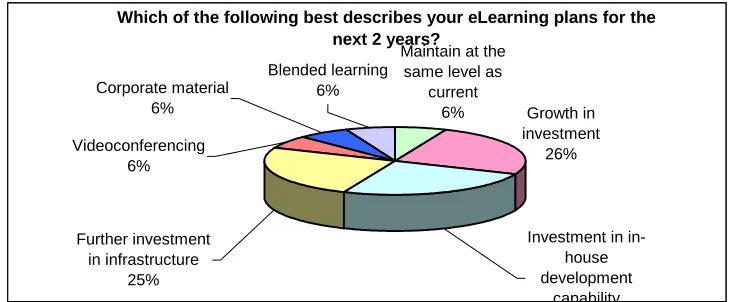
It then established their investment plans for eLearning for the next 2 years, as outlined in figure 2.
Which of the following best describes your eLearning plans for the next 2 years?
Maintain at the same level as
current
6% Growth in investment
26%
Further investment in infrastructure
25%
Investment in in-house development
capability Videoconferencing
6%
Corporate material 6%
Blended learning 6%
[image:4.595.117.484.589.740.2]In excess of 90% of respondents indicated that there would be further investment in eLearning. Twenty-five percent indicated that there would be an investment in in-house development capability and 25% indicated that there would be further investments in infrastructure with 40% of that infrastructural investment in some form of Learning Management System.
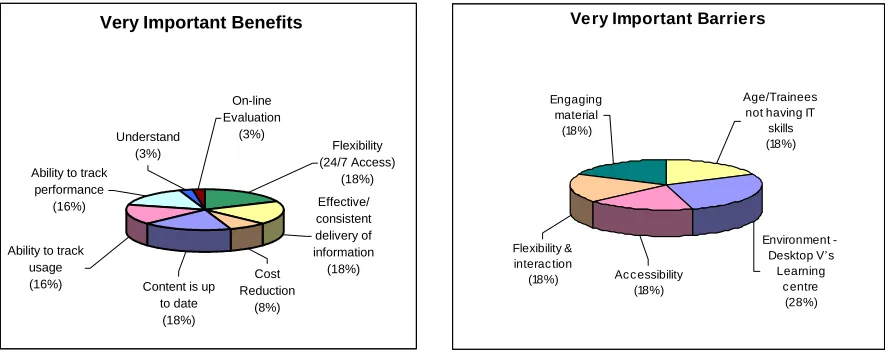
The survey established departmental responsibilities for eLearning. In more than 80% of cases the training and development departments were responsible for the original embedding and the fostering of eLearning within organisations. Again in the majority of cases eLearning was both a corporate and a local initiative. In most organisations Training and Development were responsible for the administrative and data management aspects of eLearning. The Information Technology departments or outside contractors were responsible for technical and technology report – often corporate Information Technology where the infrastructure was their responsibility. It was a mix of the business units/departments and Human Resources that typically determined what eLearning content was available. eLearning content was typically paid for by those business units that required it either directly or by some form of central headcount allocation to Training and Development who then paid for the eLearning content. Most organisations indicated that approximately 20% of training was carried out using eLearning (up to 40% in technical skills and as low as 5% in soft skills) and most felt that there would be up to a 25% increase in the amount of training that was planned to be undertaken using eLearning over the next 2 years. Personal Perceptions on benefits and barriers as per a Skillsoft survey (2004) were then established as outlined in figures 3 and 4.
Very Important Benefits
Ability to track usage (16%)
Effective/ consistent delivery of information (18%) Cost
Reduction (8%) Content is up
to date (18%) Ability to track
performance (16%)
On-line Evaluation
(3%)
Flexibility (24/7 Access)
(18%) Understand
(3%)
Very Important Barriers
Engaging material
(18%)
Age/Trainees not having IT
skills (18%)
Environment - Desktop V’s
Learning c entre
(28%) Ac c essibility
(18%) Flexibility &
interac tion (18%)
Figure 3. Benefits to eLearning Figure 4. Barriers to eLearning
The primary benefits included flexibility (24/7 Access), effective consistent delivery of information and the fact that content is up to date. The primary barrier was the delivery environment; 28% felt that, due to motivational issues and interruptions, courses delivered to the desktop were not as effective as those that were undertaken at a dedicated learning centre. Another very interesting finding here was that cost reduction figured as a very important benefit to only 8% of large organisations.
[image:5.595.83.526.383.562.2]Motivational Factors
Ease of understandin
g & usability (5%) Makes job easier 5% Mandatory, requirement 5% Content drives business case/career 5% Built into performance objectives (26%) Formally accredited (18%) Enhances career opportunities (14%) W ell advertised and championed (22%) Promotional Techniques Advertise course on multiple occasions (14%)
Get managers of learners tell them about course (14%) Informal communication (17%) Formal communication 17% User/Trainee Testimonials (14%) Communications via meetings (5%) Availability of a range of courses
5% Accreditation/
Certification (9%)
Link to business objective/challeng
e & link to best practise
(5%)
[image:6.595.82.562.50.241.2]Figure 5. Most important motivational factors
Figure 6. Most preferred and most frequently used promotional techniques
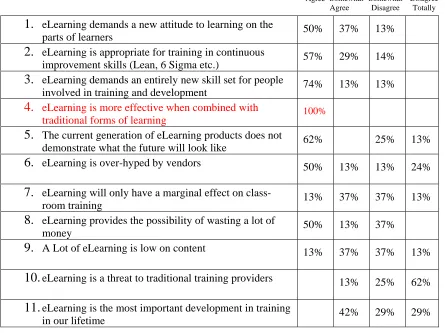
As a follow up to the study by Garavan and O’Donnell (2003) a series of subjective perceptions of eLearning were assessed by asking the interviewees to agree/disagree with the following statements as outlined in table 1:
Somewhat
Agree Somewha Disagree t Disagree Totally Agree
1. eLearning demands a new attitude to learning on the
parts of learners 50% 37% 13%
2. eLearning is appropriate for training in continuous
improvement skills (Lean, 6 Sigma etc.) 57% 29% 14%
3. eLearning demands an entirely new skill set for people
involved in training and development 74% 13% 13%
4. eLearning is more effective when combined with
traditional forms of learning 100%
5. The current generation of eLearning products does not
demonstrate what the future will look like 62% 25% 13%
6. eLearning is over-hyped by vendors 50% 13% 13% 24%
7. eLearning will only have a marginal effect on
class-room training 13% 37% 37% 13%
8. eLearning provides the possibility of wasting a lot of
money 50% 13% 37%
9. A Lot of eLearning is low on content 13% 37% 37% 13%
10. eLearning is a threat to traditional training providers 13% 25% 62%
11. eLearning is the most important development in training
[image:6.595.83.528.364.697.2]in our lifetime 42% 29% 29%
Table 1. Perceptions of eLearning
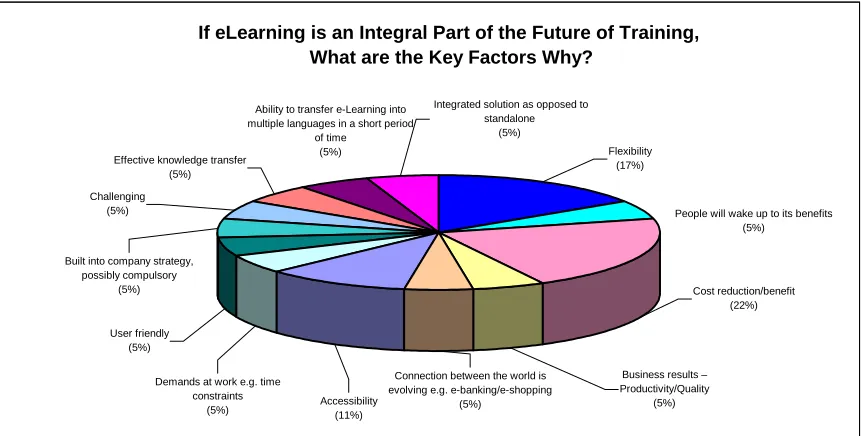
different from the 8% that currently identified cost as a most important benefit. Figure 7 outlines the findings:
If eLearning is an Integral Part of the Future of Training, What are the Key Factors Why?
Business results – Productivity/Quality
(5%)
Cost reduction/benefit (22%)
Connection between the world is evolving e.g. e-banking/e-shopping
(5%) Accessibility
(11%) Demands at work e.g. time
constraints (5%) User friendly
(5%) Built into company strategy,
possibly compulsory (5%) Challenging
(5%)
Integrated solution as opposed to standalone
(5%)
Effective knowledge transfer (5%)
Ability to transfer e-Learning into multiple languages in a short period
of time
(5%) Flexibility
(17%)
[image:7.595.84.515.80.298.2]People will wake up to its benefits (5%)
Figure 7. Key factors why eLearning will be an integral part of the future of training
Finally, the survey established whether the organisations and the interviewees were supporters of eLearning. There was a 100% positive response i.e. in all cases both the interviewee and the organisation were supporters of eLearning.
4.2 The Small and Medium Size Enterprise Survey
For the SME survey, 100 SMEs in 5 countries across Europe were surveyed, namely Ireland, UK, Sweden, Spain and Poland. The focus was on 3 selected sectors: component manufacturers (particularly polymers), the food sector and engineering products/sub-supply companies. These particular sectors are faced with growing and relentless competitiveness challenges from both low cost regions and from over-emphasis on low value-adding activities. Again, the focus of the SME survey was on the optimum ICT technologies to use in the delivery of training, bearing in mind the technical, financial and cultural restrictions within the general SME environment. This included pedagogical considerations, communication technologies, network support services and on-the-job facilitation. The results below pertain only to the 21 companies in Ireland to facilitate comparative analysis with Irish large organisations.
Figures 8 and 9 show that only 20% of respondents (n=21) have previously participated in internet based learning courses but of those 50% found them good and 25% found them very good.
Participation in Courses or Other Educational Activities which are based on
Learning via Internet
20%
80%
Yes No
Overall View of those who answered " Yes"
25%
50% 25%
[image:7.595.85.533.615.764.2]Poor Good Very Good
Figure 8. Participation in Courses which are based on Learning via Internet
Figure 9. Overall View of those who answered " Yes"
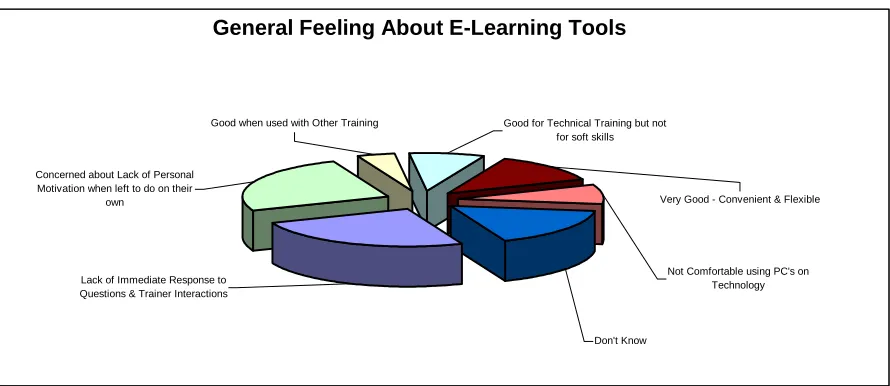
As outlined in figure 10, the main concerns that were highlighted with eLearning courseware were:
1. Lack of immediate response to questions and trainer interactions
2. Concern about lack of personal motivation when left to do on their own
General Feeling About E-Learning Tools
Concerned about Lack of Personal Motivation when left to do on their
own
Good when used with Other Training Good for Technical Training but not
for soft skills
Not Comfortable using PC's on Technology
Don't Know Lack of Immediate Response to
Questions & Trainer Interactions
[image:8.595.85.530.142.335.2]Very Good - Convenient & Flexible
Figure 10. General Feeling About ELearning Tools
5. Comparative
Analysis
6. Conclusions,
Recommendations
and the Implications for Human
Resource Development
Experience and usage of eLearning technologies and content is significantly higher in the large organisations (Usage = 67% > 5Years) than the SMEs (Usage = 20% total). Both groups agree that eLearning courses are more effective when undertaken in a dedicated learning centre as opposed to being delivered to the desktop primarily due to a lack of motivation when left to undertake the course on their own. Cost is always an issue for the SME; Cost is currently not the most important concern for the large organisation but will be vital in the future.
The consensus among both the large organisations and the SMEs is that eLearning is more effective when combined with traditional forms of learning and that the future lay in some form of “blended learning” solution. This has also been borne out in the literature by a number of commentators including Sloman & Reynolds (2003).
It is clear that changes in the modern workplace and in business processes raise expectations that eLearning will meet HRD needs. The primary benefit for embracing eLearning for organisations is that we can now distribute HRD programmes anywhere, anytime and cost-effectively. The implications for HRD professionals is that there is a requirement to accept using technology for the benefit of the learner and the learning experience, as opposed to using the technology for the technology’s sake, or indeed resisting the use of the technology. The most common denotation of eLearning is specifically use a small ‘e’ and large ‘L’ to indicate that the technology is there to support the learning. There is also merit in the argument that the ‘e’ in eLearning is not electronic learning but rather enhanced learning. This again relates back to the need for a blended solution, where there is a requirement for some traditional face-to-face contact. A key implication for a number of HRD professionals is to embrace the technology to enhance the learning experience as opposed to resisting or ignoring the technology.
Roffe (2004) argues that the emerging thinking on the applications of eLearning implies a shift in the importance of the research agenda, away from descriptions and applications of technology-based applications and towards methodologies on learner-centred approaches and critical analysis of eLearning that help the learning processes. Various questions posed by Roffe (2004) include: Are the methods suited to support the learning processes? Does the eLearning approach present a strong motivation to learn? Does the learning lead to the desired results? Is the content authentic for the learner?
The research conducted as part of this study has shown that there were some significant differences but more surprisingly there were also a number of similarities between the large organisations and Small and Medium Sized Enterprises and that there are a number of implications for HRD professionals.
7. References
Attwell, G. (2002), “eEurope and eLearning – is European policy working”, paper presented to ELSEKEK: Hellenic Association of Vocational training Centres, 1st ELSEKEK conference, Athens
Attwell, G. (2003), The challenge of eLearning in small enterprises Issues for policy and practice in Europe, Cedefop Panorama series; 82 Luxembourg: Office for Official Publications of the European Communities,
Barry, H. and Milner, B. (2002), “SMEs and electronic commerce: a departure from the traditional prioritisation of training?”, Journal of European Industrial Training, Vol. 26 No. 7, pp. 316-26.
Blocker, M.J. (2005), “E-Learning: An Organizational Necessity” a White Paper. Retrieved January 31, 2006 from www.rxfrohumanperformance.com
Bonk, C. J. (2002), Online training in an online world. Bloomington, IN. Retrieved April 6, 2005 from www.CourseShare.com
Brandsma, J. (1997), Een leven lang leren: (on)mogelijkheden en perspectieven (Lifelong Learning), University of Twente, Enschede.
Brock, J.K.-U. (2000), “Information and communication technology in the small firm”, in Carter, S. and Jones-Evans, D. (Eds), Enterprise and Small Business, Harlow, Pearson Education, Financial Times, Prentice-Hall, Englewood Cliffs, NJ.
Brown, L., Hall, T.,Bannon,L., Molan,C., Hogan, D., Murphy, E. (2003) “The design and use of a blended learning solution in Irish third-level education” Paper presented at
EDTECH May 2003, Waterford, Ireland.
Brown L., Murphy E., McQuade E., and Pauli M. (2004) “Two sides to the tale - An Irish third-level blended eLearning programme and its suitability for ‘Lean’ competitiveness training in SMEs” Presented at eChallenges Conference, Vienna, October 2004.
Cheese, P. (2003), “Lost in Translation. Helping Learning professionals to speak the language of business benefits”,e-learning, Jan2003, Vol. 4 Issue 1, p17
Crowley, R. (2002) “Blueprint For An Enterprise ELearning Architecture”,Customer Inter@ction Solutions, Oct 2002, Vol. 21 Issue 4, p58-61.
European Union (2001), Memorandum of Lifelong Learning. Retrieved January 31, 2006 from from [email protected]
Figueira, E. (2003), “Evaluating the effectiveness of eLearning strategies for small and medium enterprises”. Retrieved April 7, 2005 from
www.theknownet.com/ICT_SMEs_seminars/papers/Figueira.html
Garavan, T. & O’Donnell, D. (2003) eLearning in Irish Organisations, Survey Report, November 2003, CIPD, Dublin.
Masie, E. (2001), e-Learning: If We Build it, Will they Come? Alexandria, VA., ASTD/The Maisie Center, Retrieved April 7, 2005 from
http://www.masie.com/masie/researchreports/ASTD_Exec_Summ.pdf
Oberski, I., Palomar, A., (2000), “Evaluating online work-based eudcation for managers in SMEs: some initial observations”, Industry and Higher Education, Vol. 14 No. 3, pp. 200-3 OECD (1996), Lifelong Learning For All, OECD, Paris.
Roffe, I. (2004) “ELearning for SMEs Competition and dimensions of perceived value”, Journal of European Industrial Training , Volume 28 Number 5 2004 pp. 440-455
Sambrook, S. & Stewart J. (2000), “Factors influencing learning in European learning oriented organisations: issues for management”, Journal of European Industrial Training , Volume 28 Number 5 2004 pp. 440-455
Sambrook S (2004) ‘ELearning in small organisations’ in Stewart & Beaver (eds) HRD in small organisations: research and practice HRD Research Monograph Series, London: Routledge, pp 185-214
Schetler, J. (2003) “CISCO'S KELLY: IT'S MORE THAN TRAINING”Training, Jan2003, Vol. 40 Issue 1, p16,
Skillsoft Survey (2004) eLearning is popular and effective, International Journal of Productivity and Performance Management, Vol. 53 No.6, Emerald Group Publishing
Slater, D. NEXUS, Ireland, 2002 Practical Evaluation Interventions in Understanding Informal Learning within SMEs presented to a seminar series on Exploring models and partnerships for eLearning in SMEs, held in Stirling, Scotland and Brussels, Belgium, in Nov 2002 and Feb 2003.
Sloman M & Reynolds J (2003) ‘Developing the e-learning community’ Human Resource Development International, 6 (2), 259-272
Stevens, R. (2002) Keeping it complex in an era of Big education. In CSCL2 – Carrying forward the conversation. (Eds. Koschmann, T., Hall, R., and Miyake, N.), Mahwah, New Jersey: Lawrence Erlbaum Associates, pp. 269-273.