Cognitive Processes in Moral Judgment
Shane Timmons
Thesis submitted for the degree of Doctor of Philosophy
University of Dublin, Trinity College
2018
This research was funded by a Postgraduate Research Studentship from Trinity
Declaration
I declare that this thesis has not been submitted as an exercise for a degree at
this or any other university and it is entirely my own work.
I agree to deposit this thesis in the University’s open access institutional
repository or allow the Library to do so on my behalf, subject to Irish
Copyright Legislation and Trinity College Library conditions of use and
acknowledgement.
The results of ten experiments investigating cognitive processes in
moral judgment are presented in this thesis. The experiments examined two
key questions relevant for theoretical issues in moral psychology. The first
question asked: what is the role of effortful cognition in moral reasoning? And
the second question asked: what cognitive processes are required for reasoning
about the good moral actions of others, and are the same processes that underlie
reasoning about moral violations recruited for reasoning about self-sacrificial
actions?
The first series of experiments (Experiments 1 to 4) showed that
completing a cognitively demanding task affects the moral judgments that
people subsequently make. For example, after writing an essay without using
words that contain the letters “a” or “n”, participants judged that causing harm
to one person in order to save a larger group of people was less morally
permissible compared to participants who had written essays with no
constraints. The experiments also showed that this effect of cognitive fatigue
on moral judgments can be eliminated by emphasising the good outcome.
These novel findings corroborate predictions from one psychological theory of
moral judgment, which proposes that people make deontological judgments
against causing harm when they construct a simple mental model of the action
and they make utilitarian judgments that favour the overall consequences when
they use deliberative cognitive processes to construct complex mental models
This series of experiments showed not only that effortful cognition
facilitates the constructions of complex mental models but also that it has a role
in regulating the emotions people experience after making moral judgments. In
two experiments (Experiments 3 and 4), participants felt worse about the
judgments they made after they had completed a cognitively demanding task,
even though their judgments about whether harm was permissible were the
same as those made by participants who had completed a less cognitively
demanding initial task. These results are argued to suggest a nuanced role for
effortful cognition in moral judgment and some extensions to current theories
are proposed in order to account for these findings.
The second issue that was examined was the cognitive processes
involved in reasoning about self-sacrificial actions of others, and this issue was
investigated in two series of experiments. The first of these series
(Experiments 5 to 7) showed an asymmetric moral hindsight effect for good
moral actions: participants judged that good actions should be taken more when
they learned the outcome was good compared to before they learned about the
outcome, but there was no such effect when the outcome was bad. Imagining
how the outcome could have been worse had the action not been taken
amplified judgments that it should have been taken, and imagining how the
outcome could have turned out the same had the action not been taken
diminished judgments that is should have been taken. These novel effects for
good moral actions support predictions derived from theories about moral
violations, for example that causal links between actions and outcomes are
Experiments 8 to 10 extended this moral hindsight effect for good
actions to judgments of how inspiring or “morally elevating” good actions were
judged to be, and further extended the effect to moral behaviour: participants
were more likely to spontaneously engage in helping behaviour and more likely
to donate money to charity after they had thought about times when good
actions turned out well compared to times when good actions failed. The
results suggest that moral elevation depends not only on the moral goodness of
an action but also on its success.
Both series of experiments further contribute to the idea that
domain-general reasoning processes, such as processes that underlie causal inferences
and imagined alternatives, are influential in making judgments about moral
contents as they are for thinking about non-moral contents. The novel effects
of cognitive fatigue on moral judgments and hindsight about good moral
actions have important implications for this debate, and for understanding how
Acknowledgements
Firstly, I would like to express my sincere gratitude to my supervisor,
Ruth Byrne, for her continuous support of my development as a scientist. Her
patience, encouragement and immense knowledge helped to clarify my
thoughts and boost my motivation after each one of our many meetings. I am
especially grateful for the balance of expert guidance and freedom to pursue my
own ideas I received throughout my PhD; I could not have asked for a better
mentor. I would also like to thank my appraisers, Michael Gormley and Shane
O’ Mara, for their insightful comments on my research and the opportunity to
voice any concerns over the past 3 years. Thanks especially to Michael for his
availability and helpful advice for analysing reaction time data at the beginning
of my PhD studies.
I am grateful to all the other staff in the School of Psychology and
Trinity College Institute of Neuroscience for everything I have learned during
my studies. And a special thanks to the administrative and support staff for
always being on hand, especially Lisa Gilroy and Niall Mullins for technical
support and June Switzer for stationary needs and chats about rugby. I also
appreciate the help with data entry and management for Experiments 3 and 4 I
received from Rory Vignoles, and the help with data management and
counterfactual coding for Experiments 8 and 9 I received from Evie Alkin and
Meg Ryan.
I am grateful to Trinity College Dublin for providing the initial support
years. Thanks also to the Graduate Studies Office at Trinity College Dublin for
funding support received to attend my first international conference.
Additional thanks go to the audience members at that conference and many
others for thoughtful questions about my research and for sharing their own
work with me. Thanks to: the attendees at the conference of the European
Society for Cognitive Psychology in Cyprus in September 2015, the first
meeting of the Society for the Advancement of Judgment and Decision-Making
in Spain in July 2016, the International Conference on Thinking in the USA in
August 2016 and the Annual Meeting of the Society for Philosophy and
Psychology in the USA in June 2017 for their comments on the experiments
reported in Chapter 2; the attendees at the London Reasoning Workshop and
the Annual Meeting of the Cognitive Science Society in the UK in July 2017
for their feedback on the experiments in Chapter 3; and also attendees of the
Institutions for Moral Behaviour Workshop in the Netherlands in November
2015, the Small Group Meeting on Counterfactual Thinking in France in June
2016 and the Cooperation and Self-Control Workshop in the UK in June 2016
for their engaging ideas and helpful discussions. Thanks are also due to
reviewers at the Journal of Experimental Psychology: General and reviewers at
Cognition for their comments on articles based on the experiments in Chapter
2.
In addition to the fantastic academic support I have received, I am
grateful for the personal support too. I especially thank my parents, Derek and
Denise, for their unwavering encouragement of all my academic endeavours
and support; I appreciate the safety net that is always there (and that “Five-Star
Nursing Home” awaits!). To my brother, Aaron, thanks for making sure that
there’s always craic to be had at home. Special thanks go also to Nanny and
Grandad Barcoe, and Nanny and Lala Timmons, for making sure I was taking
care of myself in Dublin. And thanks to the rest of my family for their support.
I am grateful also to the friends who made sure that life never got too
serious. Thanks to new ones made along the way, especially Iseult Cremen,
Mary Parkinson, Sabrina Haimovici, Sadhbh Byrne and Tiago Almeida. And
thanks to older ones for always checking in, especially Ciara Burke, Ellen Finn,
Lauren Stewart, Niamh Bergin, Rebecca O’ Connor, Sorcha Ní Chobhthaigh,
Sarah May, Stephen Shannon and Tessa McKenna. And for distracting me
from work with trips away and pints of Guinness, thanks to Aidean Kingston,
Conor Hanniffy, Cormac O’ Laoide, David McCormick, Eunan McBrearty,
(proof-reader extraordinaire) Kev Dowling, Liam Claffey, Rob Ryan and Sean
Table of Contents
Chapter 1: Introduction ... 15
Domain Specific or Domain General Processes? ... 19
Effortful Cognition in Moral Reasoning ... 24
Reasoning about Good Moral Actions ... 35
Aims ... 41
Chapter 2: Cognitive Fatigue and Moral Judgments ... 43
Utilitarian Judgments and Effortful Cognition ... 44
Sequential Task Designs ... 48
Pilot Study ... 50
Experiment 1 ... 61
Experiment 2 ... 73
Experiment 3 ... 81
Experiment 4 ... 89
General Discussion ... 98
Chapter 3: Reasoning about Self-Sacrificial Actions ... 106
Outcome Knowledge ... 107
Imagined Alternatives and Hindsight ... 109
Experiment 5 ... 112
Experiment 6 ... 120
Experiments 7A and 7B ... 125
General Discussion ... 135
Chapter 4: Moral Hindsight about Morally Elevating Memories ... 141
Moral Elevation, Episodic Memories and Helping Behaviour ... 142
Experiment 8 ... 148
Experiment 9 ... 157
Experiment 10 ... 163
General Discussion ... 174
Chapter 5: Discussion ... 179
Effortful Cognition in Moral Reasoning ... 180
Reasoning about Good Moral Actions ... 192
General Implications for Moral Psychology ... 204
Future Directions ... 207
Conclusion ... 209
References ... 211
List of Figures
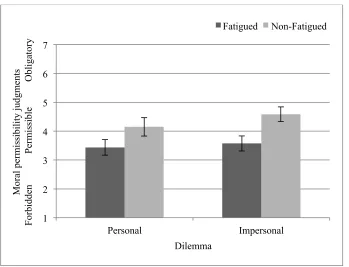
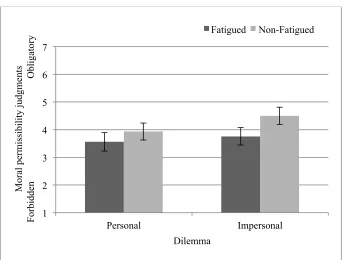
Figure 2.1. Mean permissibility judgments to personal and impersonal dilemmas in the pilot study. Error bars represent the standard error of
the mean. ... 58 Figure 2.2. Average non-transformed latencies in milliseconds to respond to
personal and impersonal dilemma questions. Error bars are the standard
error of the mean. ... 60 Figure 2.3. Mean permissibility judgments to personal and impersonal
dilemmas in Experiment 1. Error bars represent the standard error of
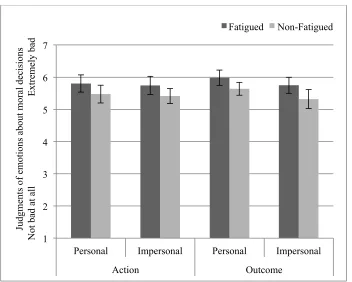
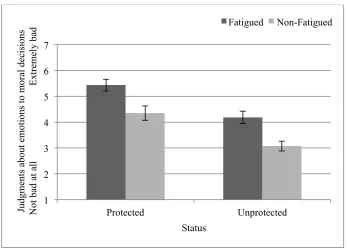
the mean. ... 68 Figure 2.4. Mean emotion judgments to dilemmas in Experiment 1. Error bars are the standard error of the mean. ... 70 Figure 2.5. Mean permissibility judgments to stories in Experiment 2. Error
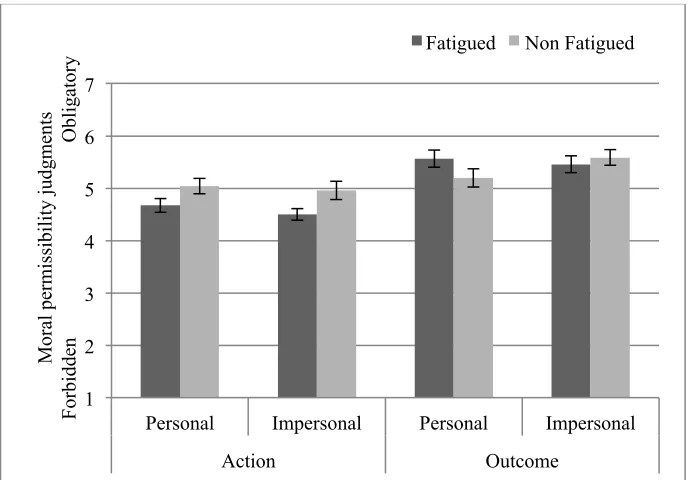
bars are the standard error of the mean. ... 77 Figure 2.6. Mean emotion judgments to stories in Experiment 2. Error bars
are the standard error of the mean. ... 78 Figure 2.7. Mean permissibility judgments to personal and impersonal
dilemmas in Experiment 3. Error bars are the standard error of the
mean. ... 85 Figure 2.8. Mean emotion judgments to personal and impersonal dilemmas in
Experiment 3. Error bars are the standard error of the mean. ... 87
Figure 2.9. Proportion of sacrificial actions endorsed by participants in
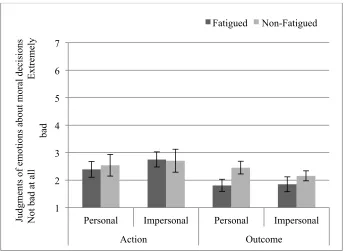
Figure 2.10. Mean emotion judgments to dilemmas in Experiment 4. Error bars are the standard error of the mean. ... 96 Figure 3.1. Mean agreement that the action should be taken in Experiment 5.
Error bars are the standard error of the mean. ... 118 Figure 3.2. Mean agreement that the action is morally good in Experiment 5.
Error bars are the standard error of the mean. ... 119 Figure 3.3. Mean agreement that the action should be taken in Experiment 6.
Error bars are the standard error of the mean. ... 123 Figure 3.4. Mean agreement that the action is morally good in Experiment 6.
Error bars are the standard error of the mean. ... 124 Figure 3.5. Mean agreement that the action should be taken in Experiment 7A. Error bars are the standard error of the mean. ... 128 Figure 3.6. Mean agreement that the action should be taken in Experiment 7B.
Error bars indicate the standard error of the mean. ... 129
Figure 3.7. Mean agreement that the action is morally good in Experiment 7A. Error bars are the standard error of the mean. ... 131 Figure 3.8. Mean agreement that the action is morally good in Experiment 7B. Error bars are the standard error of the mean. ... 132 Figure 4.1. Types of counterfactuals created in Experiment 8. Error bars are
the standard error of the proportion. ... 155 Figure 4.2. Proportion of participants who helped to pick up the pens in
Experiment 8. Error bars are the standard error of the proportion. ... 156
Figure 4.4. Proportion of participants who helped to pick up the pens in
Experiment 9. Error bars are the standard error of the proportion. ... 161
Figure 4.5. Mean elevation ratings in Experiment 10. Error bars are the standard error of the mean. ... 167 Figure 4.6. Types of counterfactuals generated in Experiment 10. Error bars
are the standard error of the proportion. ... 169 Figure 4.7. Proportion of participants who were willing to donate some of their payment to charity in Experiment 10. Error bars are the standard error
of the proportion. ... 171 Figure 4.8. Amount donated by participants who chose to donate some of their payment to charity in Experiment 10. Error bars are the standard error
List of Tables
Table 2.1. Means and Standard Deviations for Emotion Judgments to Actions
Judged Permissible in Experiment 1. ... 71
Table 2.2. Means and Standard Deviations for Emotion Judgments to Actions
Judged Permissible in Experiment 2. ... 79
Table 2.3. Means and Standard Deviations for Emotion Judgments to Actions
Judged Permissible in Experiment 3. ... 87
Table 2.4. Means and Standard Deviations for Emotion Judgments to Actions
Chapter 1: Introduction
People regularly make moral judgments in daily life, and debates about
moral issues dominate national and international public discourse. For
example, a referendum will take place in Ireland in 2018 about the
permissibility of abortion. Pro-life campaigners claim that abortion causes
harm to a life and it should be forbidden in all cases, whereas pro-choice
activists claim that there are cases in which access to abortion has more
positives than negatives. And morality is not solely concerned with judgments
about harm; people often make moral judgments about the good actions of
others. For example, in July 2017, the Guardian reported a story about
beachgoers who formed a human chain in the sea in order to save a group of
people from drowning, and readers responded with praise and admiration for
the beachgoers’ actions (Luscombe, 2017). How do people judge whether
moral actions should be taken? The aim of this thesis is to contribute to a better
understanding of the cognitive processes that underlie these types of judgments.
The 10 experiments reported in this thesis address several important questions,
such as: does cognitive fatigue affect the types of moral judgments people
make? Do outcomes of good actions affect whether people judge that they
should be taken? And does imagining alternative outcomes influence peoples’
judgments? By answering these questions, the experiments contribute to
debates about two key theoretical issues in moral psychology.
The first issue concerns the role of effortful cognition in moral
judgments. Prominent theories in moral psychology tend to agree that
about the role of deliberative reasoning processes. Some researchers claim that
effortful cognition serves only to justify immediate intuitions, whereas others
claim that controlled processes can overturn emotional reactions and inform
judgments, and others propose that effortful cognition serves to construct more
complex mental models of moral dilemmas compared to intuitive processes
(e.g. Cushman, 2013; Crockett, 2013; Greene, Sommerville, Nystrom, Darley
& Cohen, 2001; Haidt, 2001). Experiments 1 to 4 in Chapter 2 inform this
debate by showing for the first time that exhausting cognitive resources with
cognitively demanding tasks alters the judgments participants subsequently
make to moral dilemmas, for example about whether it is permissible to cause
harm to one person in order to save a larger group of people. Specifically, the
results show that fatigued participants judge causing harm in this case to be less
permissible compared to non-fatigued participants. The experiments also show
that the effect of fatigue is eliminated when the outcome, that a greater number
of lives will be saved, is made salient. The results are argued to support the
idea that effortful cognition helps to construct more complete mental models of
the moral event being reasoned about, compared to less effortful cognition.
Competing theories for the role of effortful cognition in moral reasoning are
outlined in the second and third sections of this chapter.
The second issue deals with the cognitive processes that affect peoples’
judgments of good moral actions. Although some positive aspects of morality
have been well researched, such as the psychology of altruism, most of this
literature has been concerned with emotional precursors and reactions (e.g.
judgments of these acts have received little attention. Similarly, research on
moral reasoning has focused primarily on peoples’ judgments about moral
violations and bad moral actions (Bartels, Bauman, Cushman, Pizarro &
McGraw, 2014). Experiments 5 to 7 in Chapter 3 examine whether knowledge
about outcomes and imagining how those outcomes might have been different
influences peoples’ judgments of good moral actions. The results show a moral
hindsight effect for good actions that turn out well: people judge that good
actions should be taken more so when they learn they have had good outcomes,
but there is no effect on judgments when the outcome is bad. The results also
show that imagining how the outcome could have been worse had the good
action not been taken amplifies judgments that it should have been, and
imagining how the outcome could have turned out the same even without the
good action being taken diminishes the same judgments.
When people witness or learn about the good actions of others, they
sometimes feel inspired, uplifted and motivated to act in good ways
themselves, a phenomenon known as “moral elevation” (e.g. Haidt, 2001;
Algoe & Haidt, 2009). Experiments 8 to 10 in Chapter 4 show that the moral
hindsight effect for good actions affects moral elevation and subsequent
behaviour: people are more morally elevated and are more likely to engage in
helping behaviour if they think about times when good actions turned out well
compared to times when good actions failed. It is argued that these original
findings suggest a need to update the current conceptualisation of moral
elevation, which does not account for the importance of outcomes. Moreover,
processing to connect actions to their outcomes when reasoning about good
moral events, in the same way that they do when people judge moral dilemmas.
The role of cognitive processes in reasoning about good moral actions is
considered further in the fourth section of this chapter.
The empirical chapters directly contribute to these two key issues of
effortful cognition in moral judgments and cognitive processes in reasoning
about good moral actions. They also contribute to the wider debate about
whether the cognitive processes that influence moral judgments are distinct
from or similar to the processes that underlie judgments in other domains. The
answer to this question has important implications for the focus of moral
psychology research: if the cognitive processes for moral judgment are distinct
from other sorts of reasoning, moral psychology is tasked with mapping the
domain-specific operations of the moral network, whereas if the cognitive
processes for moral and non-moral reasoning are similar, the task is to identify
how moral judgments are affected by these reasoning processes. This second
idea of domain-generality for reasoning processes comprises an overarching
assumption in the designs of the experiments reported throughout this thesis:
paradigms used to assess reasoning about non-moral contents can be used to
understand how people reason about moral matters. The next section firstly
considers the broad question of whether moral reasoning relies on special
cognitive processes or ones that apply to reasoning more generally. It then
considers the more specific questions of whether moral reasoning requires
effortful cognitive processes, which is relevant for the experiments in Chapter
cognitive processes as reasoning about bad actions, which is relevant for the
experiments in Chapters 3 and 4.
Domain Specific or Domain General Processes?
One viewpoint in cognitive science proposes that special cognitive
processes are recruited for reasoning about specific contents, for example that
the “domain specific” processes recruited for reasoning about objects are
wholly distinct from the processes recruited for reasoning about numbers(e.g.
Gigerenzer & Todd, 1999; Spelke & Kinzler, 2007). An alternative view
argues that the processes recruited for reasoning are similar across different
sorts of contents, for example the “domain general” view of reasoning proposes
that processes such as inhibiting impulsive responses and updating working
memory underlie reasoning for different sorts of decisions and higher-order
cognitive processes(e.g. Newell & Simon, 1972;Sanfey, Rilling, Aronson,
Nystrom & Cohen, 2003). The idea that moral judgments rely on domain
general reasoning processes is important for the following empirical chapters;
the designs of the reported experiments assume that methods used in non-moral
reasoning research can provide insight into how people reason about moral
matters. In this section, theories and evidence for domain specific and domain
general views of morality are outlined in order to show that the domain general
view currently holds more empirical support.
Domain Specificity in Moral Reasoning. The domain specific view argues that evolution has equipped humans with innate heuristics and rules for
domain for which they were evolved. For example, one view of language is
that people have an innate ability to acquire language and the processes
recruited for language acquisition are unique and applied only to acquire
language (Chomsky, 1986). The same specificity is argued to apply to moral
matters, for example that cognitive predispositions have evolved for detecting
potential cheaters, and that the processes recruited to judge moral issues are
therefore specific to those contents(e.g. Cosmides, 1989; Cosmides & Tooby,
2000; see also Cheng & Holyoak, 1985).
One prominent domain specific theory in moral psychology has argued
that humans have an innate predisposition for moral rules analogous to the
predisposition they have for linguistic rules(Dwyer, Huebner & Hauser, 2010;
Hauser, 2006; Mikhail, 2007, 2009, 2011). This theory of “universal moral
grammar” proposes that there is a complex set of rules in the mind that function
exclusively to judge moral matters. These rules are argued to be innate,
accessed unconsciously and applied automatically (Mikhail, 2007).
The claim that any psychological concept is innate naturally relies on
evidence from developmental research. The central evidence proposed to
support the idea of innate moral rules shows that young children exhibit the
same patterns of moral judgments as adults, even in situations that they
presumably have not experienced before. For example, children sometimes use
motives to distinguish between two acts that have the same outcome in the
same way that adults do:they judge a boy who hurt his friend by throwing a
ball to him more harshly if the harm was intended than if it was not (Nelson,
However, in the experiment initially claimed to support the theory of
universal moral grammar, only 28% of the young children showed this
sensitivity to motives and many more children relied simply on any negative
cue in the stories used to condemn the boy (Nelson, 1980). Moreover, children
do not always demonstrate the same pattern of moral judgments as adults. A
large body of research shows that in the often-used “footbridge” version of the
trolley problem, in which the only way to prevent a runaway trolley from
hitting and killing a group of five people is to push a large man into its path,
adults judge killing the large man in this way to be morally impermissible.
When the trolley can be diverted from the track that the five people are on to a
track where there is only one man, as is the case in the “switch” version of the
dilemma, adults judge causing the death of the man in this way to be much
more permissible(e.g. Cushman, Young & Hauser, 2006; Greene et al., 2001;
Mikhail, 2007). Children, however, judge acting in these dilemmas to be much
more morally permissible than adults, and they do not distinguish between both
versions of the dilemma in the way that adults do (e.g. Bucciarelli, 2015; see
also Hannikainen, Machery & Cushman, 2017). Although there is other
evidence for developmental trajectories of moral judgments (e.g. Hamlin,
2003), the domain-specific claim that innate rules are the sole drivers of moral
judgments without scope for influence from overriding deliberative processes
lacks sufficient support. As outlined in the next section, intuitions often
interact with deliberative cognitive processes in moral reasoning.
but may be applied differently depending on the context. For example, one
view is that people may rely on automatic responses such as heuristics or they
may rely on effortful cognitive processes in a range of different domains (e.g.
Kahneman, 2011). This domain general view claims that, for example, the
types of heuristics or mental short-cuts that people rely on when reasoning
about problems of logic and fact are similarly recruited for reasoning about
moral issues (e.g. Sunstein, 2005; see also Greene & Haidt, 2002; Shenhav &
Greene, 2010).
One such theory in moral psychology claims that reasoning about moral
contents relies on the same sorts of processes as reasoning about concepts
related to obligation and permission, that is, deontic reasoning, more generally
(Bucciarelli, Khemlani & Johnson-Laird, 2008). In turn, deontic reasoning is
proposed to rely on similar processes as other types of reasoning (Bucciarelli &
Johnson-Laird, 2005; see alsoJohnson-Laird & Byrne, 1991). In other words,
the mechanisms that underlie reasoning across domains are the same and what
differs is the content being reasoned about.
Specifically, this theory claims that people may rely on the same sorts
of automatic heuristics, or “intuitions”, when making moral judgments as they
do for non-moral reasoning, and in other instances they rely on the same sorts
of effortful cognitive processes to consider more alternative possibilities when
faced with a moral dilemma as they do for reasoning more generally. These
processes are argued to operate in parallel with emotional processes; cognitive
and emotional processes may both influence and be influenced by each other in
(Bucciarelli et al., 2008). Hence, this “independent processes” account of moral reasoning subscribes to the domain-general view, and proposes that
reasoning about moral contents should be susceptible to the same sorts of
manipulations and heuristics as reasoning about non-moral contents.
A large body of evidence shows this prediction to be the case (e.g.
Baron, 2010; Sunstein, 2005, 2010; see also Costa et al., 2014; Geipel,
Hadjichristidis & Surian, 2015; Laham, Alter & Goodwin, 2009; Lombrozo,
2009; Paharia, Kassam, Greene & Bazerman, 2009). For example, the framing
effect shows that people make different decisions depending on how options
are presented (Tversky & Kahneman, 1986). In the classic example of this
effect, participants are asked to choose between two treatments for 600 people
who are affected by a deadly disease. The first treatment will save 200 lives
and the second treatment has a 33% chance of saving all 600 people and 66%
chance of saving no one. Presenting the options in this way highlights the
number of lives saved and most people choose the first treatment. But when
the options are presented in a way that highlights the numbers of lives that
would be lost, for example that the first treatment will result in 400 people
dying and the second treatment has a 33% chance that no one will die and 66%
chance that all 600 people will die, people tend to choose the second treatment
(Tversky & Kahneman, 1986). The framing effect has been evidenced in a
number of domains, such as economic decision-making and judgments about
health issues (e.g. Druckman, 2001; Levin & Gaeth, 1988; Lotto, Tasso,
Gavaruzzi, Carnaghi & Rumiati; 2014; Tasso, Monaci, Trentin & Rosabianca,
moral decisions: people make different judgments to the trolley problems
described previously depending on whether the emphasis is on the amount of
people potentially killed or the amount of people potentially saved (Petrinovich
& O’ Neill, 1996; see also Sachdeva & Medin, 2008; and for a review see
Sinnott-Armstrong, 2008). In fact, the original disease problem could be
considered to be a moral dilemma. This evidence shows that reasoning about
moral contents is influenced by heuristics in the same way as reasoning about
non-moral contents, and it is difficult to reconcile with the view that people rely
exclusively on innate rules specific to moral matters.
The current evidence therefore supports the general idea that reasoning
about moral matters relies, at least in part, on the same sorts of mechanisms as
non-moral reasoning. The experiments reported in this thesis have further
implications for this debate, and this issue is returned to in the following
chapters. A related challenge requires identifying how those domain-general
mechanisms operate when applied to moral contents. For example, does
effortful reasoning help people to construct more complete mental models of
moral problems compared to less effortful cognition, as it does when people
reason about non-moral contents? The role of effortful cognition is a key
question in moral psychology, and the experiments in Chapter 2 contribute to
this debate.
Effortful Cognition in Moral Reasoning
A number of influential theories in cognitive science assume that there
(e.g. Evans, 2009; Kahneman & Frederick, 2002; Kahneman, 2011; Stanovich
& West, 2000). The characterisation of these processes varies, sometimes
referred to as fast versus slow, intuitive versus deliberative, automatic versus
controlled or simply System 1 versus System 2 (see Evans & Stanovich, 2013).
Such “dual process” accounts have been especially influential in social
cognition research (e.g. Chaiken & Trope, 1999; Smith & DeCoster, 2000), and
have dominated discussions in moral psychology (e.g. Cushman, Young &
Greene, 2010; Greene, 2009). As a result, although effortful reasoning was
originally considered to be the core component of moral cognition (e.g.
Kohlberg, 1976; Piaget, 1932), its role in moral judgment formation is now an
open debate.
Dual Processes in Moral Cognition. This section outlines three prominent dual-process accounts of moral reasoning: (1) the social intuitionist
model, (2) the default-interventionist account and (3) model-based accounts.
All of these theories emphasise a role for automatic processing in response to
moral dilemmas, but they disagree about the extent to which effortful cognition
is recruited. Firstly, an outline is provided for how the current evidence rules
out the first theory, which largely dismisses the role of controlled cognition in
moral judgment. The focus then turns to the latter two theories, which accept
that both intuitive processing and deliberative processing can influence moral
judgments. It is argued that their primary disagreement is the nature of
deliberative processing, with respect to how it impacts judgments and how it
impacts emotions. The experiments in Chapter 2 aim to address some key
Social Intuitionist Model. The social intuitionist model affords effortful
reasoning a minimal role in moral judgment formation. It proposes that moral
dilemmas give rise to a perception or intuition that is immediate, effortless and
outside of conscious awareness. Moral judgments are driven by these intuitions
and deliberative reasoning plays a role only if these judgments need to be
rationalised post hoc. Reasoning that overturns initial intuitions is
hypothesised to be extremely rare, occurring only when the initial intuition is
weak and the capacity for effortful reasoning is high (Haidt, 2012). For
example, when faced with the trolley problem described in the previous
section, the social intuitionist model proposes that thinking about pushing the
man in front of the trolley activates an immediate, negatively charged intuition
that gives rise to negative affect and a judgment that it is impermissible to act.
Deliberative reasoning processes are recruited only in order to justify this
judgment or to persuade others that this judgment is morally correct (Haidt &
Bjorklund, 2008).
Evidence for this model relies on cases in which people form a moral
judgment but cannot provide conscious justifications; they are “morally
dumbfounded” (e.g. Haidt, 2001; Haidt & Hersh, 2001; Paxton, Ungar &
Greene, 2012). For example, when asked to judge whether it is acceptable for a
brother and sister to engage in consensual sex while using multiple forms of
birth control, people frequently judge this behaviour to be morally wrong.
People appeal to perceived harmful consequences or purity violations to
rationalise their judgment, and this judgment of wrongness persists even when
These persistent harm- and purity-based justifications are interpreted as
evidence of dumbfounding because no harm was ostensibly done, since the
siblings were using multiple forms of birth control, and “the fact that an act is
disgusting does not make it wrong” (Haidt, Bjorklund & Murphy, 2000, p. 7).
However, recent research has shown that the procedure of countering these
justifications leads only to the appearance of dumbfounding. Participants often
remain unconvinced by the counterarguments and hold steadfast in their harm-
and purity-based concerns, or in other words, they remain consciously aware of
the justifications for their judgments (Jacobson, 2012; Royzman, Kim &
Leeman, 2015; see also Guglielmo, 2018). Moreover, people can readily
access conscious justifications for many other types of moral judgments (e.g.
Cushman et al., 2006).
Hence, the idea that moral judgments are exclusively intuition-driven
lacks sufficient empirical support. Instead, the available evidence favours
theories that afford effortful cognitive processes some sort of causal role in
moral decision-making, in a similar way to the standard dual-processes
approaches in other domains of reasoning (e.g. Evans & Stanovich, 2013).
Moral psychology has two dominant approaches that subscribe to this
dual-process framework: the first claims that conscious reasoning sometimes
overturns immediate emotional reactions, the “default-interventionist” account,
and the second claims that conscious reasoning helps to construct more
complex mental models of the event being reasoned about compared to
intuitive processes, the “model-based” accounts. The next sections outline both
sufficiently differentiate between the two, which is a central aim of the
experiments reported in Chapter 2.
Default-Interventionist Account. According to the
default-interventionist account of moral judgments, two neurally distinct processes
underlie moral reasoning (e.g. Greene et al., 2001). One process is immediate
and emotional, and it promotes an adherence to rules against moral violations
in all cases; it favours “deontological” moral judgments. For example, when
faced with the footbridge problem, the possibility of causing direct, bodily
harm to another person activates the emotional system and leads to a judgment
that causing such harm is impermissible (Greene et al., 2001; Greene, Nystrom,
Engell, Darley & Cohen, 2004). A slower, more deliberate process may be
recruited in the absence of emotional triggers, or it may overturn decisions
made by the fast, emotional system. In these cases, a consideration of the
overall utility of the consequences, or a “utilitarian” moral judgment, is
favoured. For example, the deliberative system leads to the judgment that
killing the man in the trolley problem is permissible because doing so
maximizes the number of lives saved (e.g. Greene et al., 2004).
In support of this notion of a dissociation between emotion-based and
cognitive systems, deontological judgments are linked with increased activation
of brain areas associated with emotional processing, such as the amygdala, and
utilitarian judgments are linked with increased activation of brain areas
responsible for effortful cognition, such as the dorsolateral prefrontal cortex
and the anterior cingulate cortex (e.g. Greene et al., 2001; Greene et al., 2004;
2012; see also Ciaramelli, Muccioli, Làdavas & di Pellegrino, 2007; Koenigs et
al., 2007). The activation of dissociable brain areas, however, does not
necessarily support the idea that effortful cognition overturns decisions made
from emotional processes.
The default-interventionist account therefore relies heavily on reaction
time data in order to show that utilitarian judgments depend on a slower
process overturning an immediate one. Indeed, people sometimes take longer
to make and justify utilitarian judgments, suggesting that they may require
more deliberation than deontological judgments (Greene, Morelli, Lowenberg,
Nystrom & Cohen, 2008; Paxton et al., 2012; Suter & Hertwig, 2011). This
evidence is presented as strong support for the idea that utilitarian decisions
arise from a slower, deliberative system overturning the initial, immediate
aversion to causing harm that people experience, but a recent meta-analysis of
reaction time studies has found no indication that slower reaction times are
associated with utilitarian decisions (Baron & Gürçay, 2016; see also Białek &
De Neys, 2017; Gürçay & Baron, 2017; McGuire, Langdon, Coltheart &
Mackenzie, 2009). In fact, some research has shown that people sometimes
take longer to make deontological judgments against causing harm in trolley
problems (Manfrinati, Lotto, Sarlo, Palomba & Rumiati, 2013). Although
other evidence for the role of effortful cognition in utilitarian decision-making
has been proposed to support the default-interventionist account, for example
from cognitive load experiments, it is argued below that this evidence cannot
Model-Based Accounts. Other dual-process accounts have attempted to
shift focus from the distinction between emotion and reason to mental
representations of the dilemmas being reasoned about (e.g. Crockett, 2013;
Cushman, 2013). Although minor differences between these accounts exist,
they are considered together here as “model-based accounts” because they
share the same core principles: these accounts distinguish between an intuitive
process that leads to a judgment based on a mental representation of an action
(e.g. pushing the man in front of the trolley) and another more effortful process
that leads to judgments about an action based on the value assigned to its
outcome (e.g. pushing the man in front of the trolley will save the five people).
This latter process is more cognitively demanding because possible actions and
their outcomes are simulated, or more complete mental models of the situation
are constructed, whereas the former process is concerned with a rudimentary
representation of the action (e.g. Cushman, 2013).
The idea that actions are sometimes judged in isolation from their
consequences is supported by the literature on action aversion (e.g. Blair,
Jones, Clark & Smith, 1997; Blair, White, Meffert & Hwang, 2013; Patil,
2015). People are physiologically averse to actions that typically cause
physical harm even when the causal link to the usual outcome is severed, such
as shooting another person with a fake gun (e.g. Cushman, Gray, Gaffey &
Mendes, 2012; see also Gray & Wegner, 2009; Gray, Young & Waytz, 2012;
Hannikainen, Miller & Cushman, 2017; Miller, Hannikainen & Cushman,
2014). When people think about sacrificing a moral value that they deem to be
sacrifice; even if the sacrifice results in greater overall utility for the value in
question, people consider such acts to be impermissible. For example, people
who deem the lives of animals to be morally protected are sometimes averse to
allowing a small area of conservation land to be destroyed, even if doing so
will prevent a larger area of land from being destroyed (Baron & Spranca,
1997). However, other research has shown that, although people seem
insensitive to the outcome when the question highlights the required action
(e.g., destroying conservation land), altering the focus towards the good
outcome (e.g., saving a larger amount of conservation land) eliminates this bias
(Bartels & Medin, 2007).
The notion that judging actions in light of their consequences requires
more cognitive control is consistent with the neuroimaging evidence originally
postulated as support for the default-interventionist account; brain areas
associated with effortful cognition are associated with moral judgments
proposed to result from complex models of the event (e.g. Greene et al., 2004).
Moreover, this idea is consistent with research showing that conditions that
encourage deliberative thought promote utilitarian judgments that harm is
permissible if the benefits outweigh the losses. For example, people who
perform better on tests that require considering more alternative possibilities
rather than relying on intuitively appealing responses are more likely to make
utilitarian judgments to trolley-type problems, but only if they are initially
primed to consider more possibilities (e.g. Baron, Scott, Fincher & Metz, 2015;
Paxton et al., 2012; Royzman, Landy & Leeman, 2014; see also Laham et al.,
propensities for utilitarian judgments, for example limiting available cognitive
resources through working memory load decreases the frequency of utilitarian
judgments to trolley problems (e.g. Conway & Gawronski, 2013; Trémolière,
De Neys & Bonnefon, 2012).
The evidence that shows that effortful cognition is closely linked with
utilitarian judgments is consistent with both the default-interventionist and the
model-based accounts of moral reasoning, since both posit that utilitarian
judgments rely on deliberative cognitive processes. In an effort to distinguish
between these competing explanations, the experiments in Chapter 2 examine
conditions in which effortful cognition is inhibited by using for the first time
cognitive fatigue as the central manipulation. The experiments test whether
cognitive fatigue differentially affects judgments that focus on the action, such
as pushing the man, compared to judgments that make the link to the overall
outcome explicit, such as doing so in order to save the larger group of people.
The experiments also test a secondary issue of how effortful cognition might
impact emotions when people make moral judgments.
Emotion and Reasoning in Moral Judgments
The three accounts of moral reasoning described in the previous section
also disagree about how emotions and controlled cognition interact when
people make moral judgments. The social-intuitionist model claims that
automatic intuitions give rise to emotions; the default-interventionist account
claims that emotions lead to immediate judgments, but they may be suppressed
mechanism through which emotions might operate. Although there is some disagreement, the general idea in the literature is that emotions come into play
before deliberative cognition.
Indeed, some experiments show that priming different emotions can
impact the moral judgments people make. Inducing negative emotions such as
anger and disgust increases peoples’ condemnation of moral violations (e.g.
Ugazio, Lamm & Singer, 2012; Schnall, Haidt, Clore & Jordan, 2008; but see
Landy & Goodwin, 2015). When positive emotions such as mirth are induced,
people find moral violations to be more acceptable (Valdesolo & DeSteno,
2006; see also Strohminger, Lewis & Meyer, 2011). Although this research
shows that emotions can influence subsequent moral judgments, less
consideration has been given to the possibility that effortful cognition might
impact emotions following moral judgments.
The independent processes account of morality outlined in the previous
section proposes that emotional processes are independentof the intuitive and
deliberative processes that form judgments (Bucciarelli et al., 2008). It
suggests that, although emotions may influence cognitive processes and thereby
moral judgments, cognitive processes might also influence the emotions people
experience after making a moral judgment. Cognitive processes can be used to
regulate emotions that result from non-moral, everyday events: when people
think counterfactually about how things could have been worse following a bad
outcome, for example doing poorly on an exam, they feel better about the real
outcome (Mandel, 2003; see also Gleicher et al., 1990; Roese, 1994; Roese &
Relatively few studies have examined whether deliberative processes
can influence emotions about moral contents. But research has shown that
people can provide non-emotive justifications for their judgments about
emotion-laden “personal” dilemmas like the footbridge problem and they can
provide emotive justifications for their judgments about less emotive
“impersonal” dilemmas like the switch problem, when primed to do so
(Gubbins & Byrne, 2014). Moreover, when people think counterfactually
about the typical choices to these dilemmas, that is, not acting in the personal
dilemma and acting in the impersonal dilemma, they judge that the
counterfactual option would have made them feel much worse (Tasso, Sarlo &
Lotto, 2017; see also Pletti, Lotto, Tasso & Sarlo, 2016). These findings
support the idea that cognitive processes may operate independently of
emotional processes, and hence can both influence and be influenced by them.
Another aim of the experiments in Chapter 2 is to examine the less-often
researched claim that effortful cognition can influence emotions by testing
whether fatigue affects how people feel about the moral judgments they make.
The experiments in Chapter 2 examine the effects of cognitive fatigue
on reasoning about trolley-type problems as well as dilemmas in which a
protected moral value other than human life is pitted against a larger amount of
that value, such as the conservationism example outlined previously. The
effects of fatigue are tested on judgments of how permissible it is to commit a
moral violation in order to achieve a good outcome, and also how people feel
about making such judgments. The experiments in Chapter 2 also make the
also reasoning about moral actions that elicit positive emotions, such as
self-sacrificial moral acts, and this focus on morally good actions is pursued further
in the experiments reported in Chapters 3 and 4. The next section highlights
the need for research on how people judge the good actions of others, and
presents some candidate cognitive processes that might underlie such
reasoning.
Reasoning about Good Moral Actions
Experiments 5 to 10 in Chapters 3 and 4 examine some of the cognitive
factors that underlie peoples’ judgments of self-sacrificial moral actions.
Research on moral cognition has tended to focus on judgments about causing
harm to others in order to prevent a greater amount of harm from occurring;
trolley-type problems and dilemmas about protected moral values are pervasive
(e.g. Bartels, 2008; Baron & Spranca, 1997; Greene et al., 2001; Mikhail, 2007;
Ritov & Baron, 1999; Tanner & Medin, 2004). The ubiquity of these types of
dilemmas is unsurprising, as harm is proposed to be the core foundation that
defines whether a dilemma does indeed reflect a “moral” issue (Goodwin,
2017; Guglielmo, 2018; Schein & Gray, 2015; Turiel, 1983; but see also
Graham, Haidt & Nosek, 2009). In addition, dilemmas that pit concern for the
individual against greater good outcomes are argued to reflect most of the
moral dilemmas people face every day (Greene, 2014). However the everyday
moral judgments that people make are not only concerned with moral
problems, as people often make judgments about the morally good behaviour of
judgments about the potentially self-sacrificial acts people sometimes make in
order to help others (see Bartels et al., 2014; Monin, Pizarro, Beer, 2007).
Judgments about Self-Sacrificial Actions. Although the psychology of altruism and prosocial behaviour has been widely researched, most of this
work is centred on emotional responses to the suffering of others (e.g. Batson
& Shaw, 1991; Stich, Doris & Roedder, 2010) or personal motivations to help
others (e.g. Carlo & Randall, 2002; Clary et al., 1998; Eisenberg & Shell, 1986;
Eisenberg et al., 2002). Few studies have examined moral reasoning about
good actions; the moral reasoning literature has primarily been concerned with
moral violations. The few exceptions tend to highlight asymmetries between
judgments of good and bad actions, for example actions that have foreseen bad
side-effects are judged to be more intentional than those that have foreseen
good side-effects (e.g. Knobe, 2003; Pizarro, Uhlmann & Salovey, 2003). But
very few studies have been concerned with how people reason about the
self-sacrificial actions of others.
In fact, just two studies have examined self-sacrifice in the often-used
trolley-type dilemmas. When people are presented with a modified version of
the switch dilemma in which the options were (1) flip a switch to direct the
trolley towards another person, (2) flip a switch to direct the trolley towards
themselves or (3) leave the trolley on its route to kill five individuals,
participants are more likely to flip the switch than not, and they are equally
likely to direct it towards the other person as towards themselves (Huebner &
Hauser, 2011). Similarly, people judge sacrificing themselves to be as
more likely to endorse sacrificing themselves in the footbridge version
(Sachdeva, Iliev, Ekhtiari & Dehghani, 2015). Although some researchers
discount these findings, questioning whether such radical acts of self-sacrifice
would ever be conceivable outside of these laboratory-presented dilemmas (e.g.
Huebner & Hauser, 2011), recent work on the phenomenon of moral elevation
has demonstrated otherwise — even situations that involve jumping in front of
a train to save another person.
For example, in July 2007, Wesley Autrey jumped in front of an
oncoming train in order to save the life of a man who had fallen in front of it
(Buckley, 2007). Such acts of moral excellence tend to gain attention in media
reports and a nascent body of research has explored how people respond when
they learn about such self-sacrificial acts (Haidt, 2000, 2003a, 2003b; Keltner &
Haidt, 2003). When people witness or learn about these acts of moral
excellence, they experience “moral elevation”, which is similar to being uplifted
or inspired (e.g. Algoe & Haidt, 2009; Van de Vyver & Abrams, 2017). It is
also characterised by positive thoughts about humanity and a desire to behave
morally (e.g. Aquino, McFerran & Laven, 2011; Cox, 2010; Freeman, Aquino
& McFerran, 2009; Lai, Haidt & Nosek, 2014; Schnall, Roper & Fessler, 2010;
Siegel, Navarro & Thomson, 2015). Because research on self-sacrificial acts is
relatively recent and the materials less established compared to research on
moral violations, a brief overview of the methods used in elevation research was
conducted (and for more details see Appendix 1.1). This review showed that
the methods used to induce and measure moral elevation demonstrate
More importantly, it showed that few studies have examined the underlying
cognitive processes that influence peoples’ judgments of these self-sacrificial
actions. The experiments in Chapters 3 and 4 apply insights and methods from
research on moral violations and cognitive processes more generally to
understand reasoning about these morally good actions. The next section
presents some of these candidate cognitive processes
Cognitive Processes in Reasoning about Good Moral Actions. The theories of morality outlined in the previous section tend to be conceptualised
based on the cognitive processes that underlie reasoning about moral violations,
but they rarely specify that their predictions apply only to these types of moral
actions (e.g. Cushman, 2013; Greene et al., 2001; Haidt, 2001; cf. Bucciarelli et
al., 2008). The experiments in Chapters 3 and 4 were motivated by these
theories, and take as their starting point the idea that similar processes might
underlie reasoning about self-sacrificial actions as those that underlie reasoning
about moral violations and reasoning more generally. For example the
model-based accounts described previously suggest that people might judge good
actions differently if they mentally represent a basic model of the action
compared to a more complex model that connects the action to its outcome
(Crockett, 2013; Cushman, 2013). The first idea tested in Chapter 3 is that
knowledge about outcomes influences peoples’ judgments about good moral
actions, rather than good actions being judged on their own merit.
The idea that outcome knowledge might affect judgments about good
moral actions parallels research in other domains. When people learn about
is more predictable compared to before they learn about the outcome (e.g.
Baron & Hershey, 1988; Christensen-Szalanski & Willham, 1991; Fischhoff,
1975). This ‘hindsight bias’ has been evidenced in, for example, judgments
about political elections, medical decisions and legal verdicts (see Hawkins &
Hastie, 1990). It has also been observed for moral risks: people judge a moral
risk to have been less permissible when they learn that the risk has had bad
consequences compared to when those consequences are a future possibility
(Fleischhut, Meder & Gigerenzer, 2017). Whether outcome knowledge alters
judgments about good moral actions is tested in Experiments 5, 6 and 7.
Another related possibility is that, when people witness or learn about a
good deed, for example when they hear about Mr Autrey running in front of a
train to save the other man, their judgments might be affected if they think
about how the outcome could have been worse had Mr Autrey not acted.
Imagined alternatives to reality, that is counterfactual thoughts, are known to
affect a range of different sorts of judgments, including causal judgments and
judgments about bad moral actions (e.g. McCloy & Byrne, 2002; Lench,
Domsky, Smallman & Darbor, 2015). For example, if people think
counterfactually about whether a bad moral agent could have acted differently
following a moral violation, and their counterfactual thought affirms that they
could have, people judge them to be more blameworthy for the bad outcome
(Malle, Monroe & Guglielmo, 2014). Experiments 5, 6 and 7 also examine
whether counterfactuals about how things could have gone differently affects
Counterfactuals not only influence the judgments people make, but they
can also motivate future behaviour (see Byrne, 2016; Epstude & Roese, 2008).
Imagining something that could have been done to prevent a bad outcome from
occurring may prepare people for similar experiences in the future (e.g.
Markman, Gavanski, Sherman & McMullen, 1993; Markman, McMullen &
Elizaga, 2008). For example, near-accident reports from pilots that feature
counterfactual descriptions about how things could have gone better are
associated with explicit statements of intentions to act in ways that would
lessen the risk of the same accident almost occurring again (Morris & Moore,
2000). Learning about good moral actions often motivates people to act
morally in the future (e.g. Algoe & Haidt, 2009), and so one possibility is that
counterfactual thoughts about how things could have been worse in the
inspirational event may prompt people to intend to act better themselves in the
future. The effects of outcomes and imagined alternatives on moral elevation
and subsequent behaviour are tested in Experiments 8, 9 and 10.
Hence, the experiments in Chapters 3 and 4 test whether hindsight
affects how people judge self-sacrificial actions and whether judgments are
influenced by imagined alternatives. The rationale for testing these effects is
based on research on moral violations, and also subscribes to the idea that
reasoning about moral contents relies on similar processes as reasoning about
non-moral matters. The experiments make unique contributions to the moral
psychology literature by examining reasoning about self-sacrificial actions, and
contribute to wider debates in the literature about the nature of the cognitive
Aims
This chapter outlined prominent psychological theories of moral
reasoning and many of the empirical findings that influenced their development
and shape current understanding. The experiments reported in this thesis aim
to test and extend different features of those theories. Five experiments (a pilot
study and Experiments 1, 2, 3 and 4) are reported in Chapter 2 investigating the
impact of cognitive fatigue on moral judgments. The experiments test whether
cognitive fatigue affects reasoning about the permissibility of moral actions and
how people feel about their judgments. The results relate to the debate about
the role of effortful cognition in moral reasoning.
The remaining experiments, from Experiment 5 through to Experiment
10, test some candidate cognitive processes that might affect how people judge
good moral actions. The experiments examined if knowing whether a good
action succeeded or failed influences peoples’ judgments of that action, as well
as how inspired they are and whether they attempt to emulate it. The results
have implications for how the recent phenomenon of moral elevation is
conceptualised, as well as for the broader field of moral psychology, which has
tended to focus on moral violations.
The 10 experiments have further implications for the wider debate about
whether processes recruited for moral reasoning are similar to the processes
recruited for “domain general” reasoning or whether they comprise a special set
of exclusively-moral processes. By testing the impact of fatigued general
and imagined alternatives (Experiments 5 to 10), the results contribute to the
support for the domain general view. Moreover, the experiments test whether
deliberative cognitive processes can impact the emotions people experience
following bad moral actions, such as causing harm, and good actions, such as
self-sacrificial acts to help others, thereby contributing to the idea that
emotional processes may operate independently to, but interact with, cognitive
processes.
This thesis aims to investigate psychological processes that underlie the
moral judgments people make about the actions of others, especially relating to
the moral permissibility of actions and how other people should act. The aim is
not to contribute to philosophical claims about whether these judgments are
indeed morally right, but to shed light on the processes people rely on to form
their judgments. The results therefore have implications for understanding
some of the processes that might lead people to judge the same moral actions
differently in everyday life, and hence contribute to understanding the cognitive
underpinnings of the moral debates that dominate current discourse. In the next
chapter, the key aim is to understand how effortful cognitive processing
Chapter 2: Cognitive Fatigue and Moral Judgments
People make different decisions when they are tired. For example,
peoples’ preferences for risky gambles become more variable following a
cognitively demanding task and consumers are more susceptible to marketing
strategies when their cognitive resources are reduced (Levav, Heitmann,
Herrmann & Iyengar, 2010; O’ Dhaniel, Leong & Kurnianingsih, 2015;
Pocheptsova, Amir, Dhar, Baumeister, 2009; see also Mani, Mullainathan,
Shafir, & Zhao, 2013; Spears, 2010). People may make different decisions
when they are cognitively fatigued because their limited cognitive resources
have been exhausted and they no longer have sufficient capacity to allocate to
new decisions (e.g., Baumeister & Heatherton, 1996; Schmeichel, Vohs &
Baumeister, 2003), or because they experience a reluctance to engage in further
effortful cognition (e.g., Inzlicht & Schmeichel, 2012).
The aim of the experiments in this chapter is to examine whether
cognitive fatigue affects decision-making about moral contents. Do people
judge violating a moral principle to achieve a good outcome, such as harming
another person in order to save a larger group, differently when they are
cognitively fatigued compared to when they are not? For example, do people
think differently about the following dilemma if they have firstly completed a
task that fatigues their cognitive resources compared to when they have
completed an easier task?
is about to accidentally detonate one of the charges out of sequence. This explosion will result in the building’s
uncontrolled collapse onto you, the teenager, and the crowd of spectators. The teenager is several floors below you and cannot hear you because of the loud demolition noise. You realise that the only way to stop the teenager from detonating the charge is to drop a heavy cinder block on his head. This will crush his skull and kill him almost instantly but will prevent the out-of-sequence explosion.
Much of the research on moral violations distinguishes between
deontological judgments that it is impermissible to violate a moral rule in all
cases, for example that it is impermissible to cause harm to the teenager, and
utilitarian judgments that violations are permissible if the benefits outweigh the
costs, for example that it is permissible to cause harm to the teenager in order to
save the crowd of spectators (e.g. Baron, 2017; Greene et al., 2001; Mikhail,
2007). The idea tested in this chapter is that cognitively fatigued participants
will judge such moral violations to be less permissible than non-fatigued
participants because utilitarian judgments require effortful cognitive processing
(Crockett, 2013; Cushman, 2013; Greene et al., 2001).
Utilitarian Judgments and Effortful Cognition
Moral judgments about dilemmas require a consideration of both the
action and the outcome and how they are linked (e.g. Elqayam, Wilkinson,
Thompson, Over & Evans, 2017; Wiegmann & Waldmann, 2014). Moral
and so the judgment that a moral violation is permitted in some instances is a
serious one. Making such a judgment may require cognitive resources to weigh
up the benefits of the outcome against the moral violation of the action, much
more than focusing on just the violation. Hence, utilitarian judgments that a
moral violation is permissible in some circumstances may depend on
constructing a model that makes explicit links between the action and its
outcome, which people may find cognitively demanding to do (e.g. Crockett,
2013; Cushman, 2013).
The idea that utilitarian decisions rely on effortful cognition is
supported by dual-task cognitive load experiments. Peoples’ ability to carry
out effortful executive functions, such as allocating attention and manipulating
information in working memory, is limited (Baddeley, 1996, 2007; Smith &
Jonides, 1999). One way to determine whether a specific task relies on
deliberative reasoning is to exploit this limited capacity by dividing resources
between two effortful tasks simultaneously; if responses are affected, it is
assumed they typically require effortful cognition (e.g. Gilbert & Hixon, 1991;
Lavie, Hirst, de Fockert & Viding, 2004; Ward & Mann, 2000). Inducing
cognitive load in this way affects utilitarian judgments: people are less likely to
judge that committing a moral violation to achieve a good outcome is
permissible if they concurrently hold password-like character strings such as
“n63#m1Q” or difficult dot patterns in their working memory (Conway &
Gawronski, 2013; Trémolière et al., 2012). People also sometimes take longer
Cognitive load tasks often require some sort of memorisation because
working memory is closely tied to deliberative cognitive processing; higher
working memory capacity is typically indicative of greater cognitive ability
(Miyake & Shah, 1999; Smith & Jonides, 1999). Lending further support to the
idea that utilitarian judgments require more working memory than
deontological judgments, people who perform better on tasks designed to
measure working memory tend to endorse more utilitarian responses compared
to people who perform worse on working memory assessments (Moore, Clark
& Kane, 2008). People high in working memory capacity also take longer to
decide about moral violations that involve directly harming another person in
order to achieve a greater overall outcome, possibly because they consider
more alternative models of the dilemmas (Moore et al., 2008).
In a similar vein, the extent to which a person is likely to engage in
effortful reasoning may depend on their individual cognitive style. The
Rational-Experiential Inventory measures preferences for deliberative thinking
using statements such as “Using logic usually works well for me in figuring out
problems in my life” and other statements such as “I often go by my instincts
when deciding on a course of action” to measure preference for intuitive
thinking (Pacini & Epstein, 1999). Agreement to statements about deliberative