Preconditioned Parallel Multisplitting USAOR
Methods for
H
−
matrices Linear Systems
Xuezhong Wang, Zuowei Wang
Abstract—In this paper, three preconditioned parallel mul-tisplitting methods are established for solving the large sparse linear systems, including local preconditioned parallel mul-tisplitting relaxation method, global preconditioned parallel multisplitting relaxation method and global preconditioned nonstationary parallel multisplitting relaxation method. The convergence and comparison results of the methods associat-ed with USAOR multisplitting are given when the coefficient matrices of the linear systems are H-matrices. We prove three preconditioned parallel multisplitting USAOR method are better than parallel multisplitting USAOR methods for M-matrices linear systems. Finally, numerical examples are given to illustrate the methods are valid.
Index Terms—Preconditioned, Relaxation parallel multi-splitting method, Convergence, USAOR,H-matrix.
I. INTRODUCTION
F
OR the linear systemA x=b, (1)
where A is an n× n square matrix, and x and b are
n-dimensional vectors. The basic iterative method for solving equation (1) is
M xk+1=N xk+b, k=0, 1,···, (2) whereA=M−N andM is nonsingular. Thus (2) can be written as
xk+1=T xk+c, k=0, 1,···, (3) whereT=M−1N,c=M−1b.
The original systems (1) can be transformed into the preconditioned form
P A x=P b. (4)
Then, we can define the basic iterative scheme:
Mpxk+1=Npxk+P b, k=0, 1,···, (5) whereP A=Mp−Np andMp is nonsingular. Thus (5) can also be written as
xk+1=T xk+c, k=0, 1,···, whereT=M−1
p Np, c=Mp−1P b.
Without loss of generality, we assume thatA has unit diagonal elements. In the literature, various authors have suggested different models of(I+S)-type preconditioner
[1-7, 24-28] for linear systems (1). These precondition-ers have effectiveness and low construction cost. For
Manuscript received September 08, 2013; revised January 27, 2014. X. Z. Wang is with School of Mathematics and Statistic-s, Hexi University, Zhangye, Gansu, 734000, P. R. C., e-mail: [email protected].
Z. W. Wang is with College of Foreign Language and Litera-ture, Hexi University, Zhangye, Gansu, 734000, P. R. C., e-mail: [email protected].
example, in this paper, we consider the preconditioner of(I+S)-type with the following form
P=I+Sα−Sβ, (6)
where
I+Sα=
1 α1r
1 α2s
...
αi u ...
...
αn t 1
,
and
Sβ=
0 β1a1r
0 β2a2s
...
βiai u ...
...
βnan t 0
.
O’Leary and White [8] invented the matrix multi-splitting method in 1985 for parallely solving the large sparse linear systems on the multiprocessor systems and it was further studied by many authors [9-19]. For example, Neumann and Plemmons[12]developed some more refined convergence results for one of the cases considered in[8]. Elsner[13]established the comparison theorems about the asymptotic convergence rate of this case. Frommer and Mayer[14] discussed the successive overrelaxation (SOR) method in the sense of multisplit-ting. White[15]studied the convergence properties of the above matrix multisplitting methods for the symmetric positive definite matrix class. Zhang, Huang, et al. [9] presented local relaxed parallel multisplitting method and global relaxed parallel multisplitting method forH -matrices, and so on.
A collection of triples (Mk,Nk,Ek), k = 1, 2, . . . ,α, is called a multisplitting ofA. IfA=Mk−Nk is a splitting of
A for k=1, 2, . . . ,α, and Ek’s, called weighting matrices, are nonnegative diagonal matrices such that ∑α
k=1
ei i(k)=1. The multisplitting method associated with this multisplit-ting for solving the linear system (1) is as follows.
Suppose that we have a multiprocessor with α pro-cessors connected to a host processor, that is, the same number of processors as splittings, and all the processors have the last update vector xk, then the kth processor only computes those entries of the vector
Mk−1Nkxk+Mk−1b,
IAENG International Journal of Applied Mathematics, 44:1, IJAM_44_1_06
which correspond to the diagonal entries Ei i(k) of the matrixEk. The processor then scales these entries so as to be able to deliver the vector
EK(Mk−1Nkxk+Mk−1b),
to the host processor, performing the parallel multisplit-ting scheme
xm+1= α ∑
k=1
EkMk−1Nkxm+
α ∑
k=1
EkMk−1b =H xm+G b,m=0, 1, 2, . . . .
Under certain conditions, we establish local precon-ditioned parallel multisplitting relaxation method, global preconditioned parallel multisplitting relaxation method and global preconditioned nonstationary parallel multi-splitting relaxation method for solving the large sparse linear systems and study the convergence of our methods associated with USAOR multisplitting when the coeffi-cient matrices of the linear systems are H-matrices.
II. ESTABLISHMENTS OF THE METHODS
Let A=I−Lk−Uk,k=1, 2, . . . ,α, where I is a identity matrix, Lk, k = 1, 2, . . . ,α, are strictly lower triangular matrices, andUk,k=1, 2, . . . ,α, are general matrices, re-spectively, then parallel multisplitting relaxation USAOR methods are defined[9]as follows.
Algorithm 2.1. (local parallel multisplitting relaxation
method)
Given the initial vector. Form=0, 1, 2, . . . repeat (I) and (II), until convergence.
(I) For k=1, 2, . . . ,α, (parallel) solving yk:
Mkyk=Nkxm+b. (II) Computing
xm+1= α ∑
k=1 Ekyk.
Algorithm 2.1 associated with LUSAOR method can be written as
xm+1=HLU S AO Rxm+GLU S AO Rb, m=0, 1,···, where
HLU S AO R =
α ∑
k=1
EkUω2r2(k)Lω1r1(k),
Uω2r2(k) = (I−r2Uk)
−1[(1−ω 2)I
+(ω2−r2)Uk +ω2Lk],
Lω1r1(k) = (I−r1Lk)
−1[(1−ω
1)I+ (ω1−r1)Lk +ω1Uk],
GLU S AO R =
α ∑
k=1
Ek(I−r2Uk)−1[(ω1+ω2 −ω1ω2)I+ω2(ω1−r1)Lk +ω1(ω2−r2)Uk](I−r1Lk)−1.
By using a suitable positive relaxation parameter β, global parallel multisplitting relaxation USAOR method will be established in the following, which is based on Algorithm 2.1.
Algorithm 2.2.(global parallel multisplitting relaxation
method)
Given the initial vector. Form=0, 1, 2, . . . repeat (I) and (II), until convergence.
(I) Fork=1, 2, . . . ,α, (parallel) solving yk:
Mkyk=Nkxm+b.
(II) Computing
xm+1=β
α ∑
k=1
Ekyk+ (1−β)xm.
Algorithm 2.2 associated with GUSAOR method can be written as
xm+1=HG U S AO Rxm+βGLU S AO Rb,m=0, 1,···,
whereHG BU S AO R=βHL BU S AO R+ (1−β)I.
In the standard multisplitting method, each local ap-proximation is updated exactly once by using the same previous iterate xm. On the other hand, it is possible to update the local approximations more than once, by using different iterates computed earlier. In this case, we call this method a nonstationary multisplitting method
[17,18,19]. The main idea of the nonstationary method is that at the mth iteration each processork solves the systemq(m,k)times, using each time the new calculated vector to update the right-hand side, i.e., we have the following algorithm:
Algorithm 2.3. (global nonstationary parallel
multi-splitting relaxation method)
Given the initial vector. Form=0, 1, 2, . . . repeat (I) and (II), until convergence.
(I) Fori=1, 2, . . . ,q(m,k), (parallel) solving yk(i):
Mkyk(i)=Nkyk(i−1)+b. (II) Computing
xm+1=β α ∑
k=1 Eky
q(m,k)
k + (1−β)x m.
Algorithm 2.3 associated with GNUSAOR method can be written as
xm+1=HG N U S AO Rxm+βGG N U S AO Rb, m=0, 1,···,
where
HG N U S AO R = β
α ∑
k=1Ek(PωrQξη)
q(m,k)+ (1−β)I
Pωr = (I−rkUk)−1[(1−ωk)I+ (ωk−rk)Uk +ωkLk] =Wr−1Rωr,
Qξη = (I−ηkLk)−1[(1−ξk)I+ (ξk−ηk)Lk +ξkUk] =Vη−1Fξη,
GG N U S AO R = β
α ∑
k=1 Ek[
q(m∑,k)−1
i=1 ( WrVη)−1
(FξηRωr)i](WrVη)−1ωkξk.
It follows that whenq(m,k) =1, ωk=ω2,rk=r2,ξk=
ω1 and ηk=r1 for 1<k< α,m=0, 1, 2...., Algorithm 2.3
reduces to Algorithm 2.2.
Let ˜A=P A=D˜−L˜k−U˜k, k=1, 2, . . . ,α, where ˜D is a diagonal matrix, ˜Lk,k=1, 2, . . . ,α, are strictly lower trian-gular matrices, and ˜Uk,k=1, 2, . . . ,α, are general matri-ces, respectively. Then Algorithm 2.1 associated with local
IAENG International Journal of Applied Mathematics, 44:1, IJAM_44_1_06
preconditioned parallel multisplitting relaxation method (LPUSAOR) can be written as
xm+1=H˜L P U S AO Rxm+G˜L P U S AO Rb, m=0, 1,···, where
˜
HL P U S AO R =
α ∑
k=1Ek
˜
Uω2r2(k)L˜ω1r1(k),
˜
Uω2r2(k) = (D˜−r2U˜k)
−1[(1−ω 2)D˜
+(ω2−r2)U˜k+ω2L˜k], ˜
Lω1r1(k) = (D˜−r1L˜k)
−1[(1−ω 1)D˜
+(ω1−r1)L˜k+ω1U˜k], ˜
GL P U S AO R =
α ∑
k=1
Ek(D˜−r2U˜k)−1[(ω1+ω2 −ω1ω2)D˜+ω2(ω1−r1)L˜k
+ω1(ω2−r2)U˜k](D˜−r1L˜k)−1. Algorithm 2.2 associated with global preconditioned parallel multisplitting relaxation method (GPUSAOR) method can be written as
xm+1=H˜G P U S AO Rxm+βG˜L P U S AO Rb, m=0, 1,···, (7) where ˜HG P U S AO R=βH˜L P U S AO R+ (1−β)I.
Algorithm 2.3 associated with global preconditioned nonstationary parallel multisplitting relaxation method (GPNUSAOR) can be written as
xm+1=H˜G P N U S AO Rxm+βG˜G P N U S AO Rb, m=0, 1,···, where
˜
HG P N U S AO R = β
α ∑
k=1
Ek(P˜ωrQ˜ξη)q(m,k)
+(1−β)I
˜
Pωr = (D˜−rkU˜k)−1[(1−ωk)D˜
+(ωk−rk)U˜k+ωkL˜k] =W˜r−1R˜ωr, ˜
Qξη = (D˜−ηkL˜k)−1[(1−ξk)D˜+ (ξk−ηk)L˜k+ξkU˜k] =V˜η−1F˜ξη, ˜
GG P N U S AO R = β
α ∑
k=1 Ek[
q(m∑,k)−1
i=1 (
˜
WωV˜η)−1
(F˜ξηR˜ωr)i](W˜
ωV˜η)−1ωkξk.
Obviously, when q(m,k) =1, ωk =ω2, rk =r2, ξk =
ω1 and ηk =r1 for 1<k< α, m=0, 1, 2...., GPNUSAOR method reduces to GPUSAOR method.
III. PRELIMINARIES
We shall use the following notations and lemmas. A matrixA is called nonnegative (positive) if each entry of
Ais nonnegative (positive), respectively. We denote them by A≥0 (A>0). Similarly, for n-dimensional vector x, by identifying them withn×1 matrix, we can also define
x≥0 (x>0). A matrixA= (ai j)is called aZ-matrix if for anyi̸=j,ai j≤0. AZ-matrix is a nonsingularM-matrix if A is nonsingular and if A−1≥0. We call 〈A〉= (a¯
i j) its comparison matrix, if(a¯i j) =|ai j|fori=j, if(a¯i j) =−|ai j| fori̸=j. If〈A〉is a nonsingularM-matrix, thenAis called anH-matrix.A=M−N is said to be a splitting ofAifM
is nonsingular,A=M−N is said to be regular ifM−1≥0
and N ≥0, and weak regular if M−1≥0 and M−1N ≥0.
Additionally, we denote the spectral radius of Abyρ(A). It is well-known that if A≥0 and there exists a vector
x>0, such that A x< αx, thenρ(A)< α.
Some basic properties are given below, which will be used in the paper.
Lemma 3.1[21].Let A be a Z-matrix. Then the
follow-ing statements are equivalent: (a) A is an M-matrix.
(b) There is a positive vector x such thatA x>0. (c)A−1≥0.
(d) All principal submatrices of A are M-matrices. (e) All principal minors are positive.
Lemma 3.2 [20]. Let A=M−N be an M-splitting of
A, thenρ(M−1N)<1 if and only ifA is an M-matrix.
Lemma 3.3 [20]. Let A and B be two n×n matrices
with 0≤B≤A, thenρ(B)≤ρ(A).
Lemma 3.4 [22]. If A is an H−matrix, then |A−1| ≤
〈A〉−1.
Lemma 3.5 [12].Suppose that A1=M1−N1 and A2=
M2−N2 are weak regular splitting of monotone matrices A1 and A2 respectively, such that M2−1≥M1−1. If there
exists a positive vector x such that 0≤A1x≤A2x, then
for the monotone norm associated withx,
∥M2−1N2∥x≤∥M1−1N1∥x. (8) In particular, ifM−1
1 N1has a positive perron vector, then
ρ(M2−1N2)≤ρ(M1−1N1). (9)
Moreover if x is a Perron vector of M−1
1 N1 and strictly
inequality holds in (8), then strictly inequality holds in (9).
Lemma 3.6 [9]. Let A be an H-matrix, and for k =
1, 2, . . . ,α,Lk be strictly lower triangular matrices. Define the matricesUk,k=1, 2, . . . ,α, such that A=D−Lk−Uk. Assume that〈A〉=|D| − |Lk| − |Uk|=|D| − |B|. If
0< ω1,ω2<
2
1+ρ, 0≤r1≤ω1, 0≤r2≤ω2,
then LUSAOR method converges for any initial vectorx0,
whereρ=ρ(J) =ρ(|D|−1|B|).
Lemma 3.7 [9]. Let A be an H-matrix, and for k =
1, 2, . . . ,α,Lk be strictly lower triangular matrices. Define the matricesUk,k=1, 2, . . . ,α, such that A=D−Lk−Uk. Assume that〈A〉=|D| − |Lk| − |Uk|=|D| − |B|. If
0< ω1,ω2<
2
1+ρ, 0≤r1≤ω1, 0≤r2≤ω2, 0< β < 2 1+θ,
then GUSAOR method converges for any initial vector
x0, whereρ=ρ(J) =ρ(|D|−1|B|) and
θ=m a x{|1−ω1|+ω1ρ,|1−ω2|+ω2ρ}.
Lemma 3.8 [9]. Let A be an H-matrix, and for k =
1, 2, . . . ,α,Lk be strictly lower triangular matrices. Define the matricesUk,k=1, 2, . . . ,α, such that A=D−Lk−Uk. Assume that〈A〉=|D| − |Lk| − |Uk|=|D| − |B|. If
0< ωk,ξk< 2
1+ρ, 0≤rk≤ωk, 0≤ηk≤ξk, 0< β < 2 1+θ′
then GUSAOR method converges for any initial vector
x0, whereρ=ρ(J) =ρ(|D|−1|B|) and
θ′=m a x{|1−ω
k|+ωkρ,|1−ξk|+ξkρ}.
LetA=M−N =F−Q are two splittings ofA. If we set
T=F−1Q M−1N.
IAENG International Journal of Applied Mathematics, 44:1, IJAM_44_1_06
Benzi and Szyld[23]have established the following result. Lemma 3.9 [23]. Let A−1≥0. If the splitting A=M− N=F−Qare weak regular, thenρ(T)<1 and the unique splitting A=B−C induced by T is weak regular, where
B=F(M+P−A)−1M and C=B−A.
IV. CONVERGENCE
For Algorithms 1, 2 and 3, we give convergence theo-rems forH−matrices. For convenience, letti=2xm(〈−A(〉〈xA〉)ix)m, where x= (x1,x2,···,xn)T denotes a vector.
Theorem 4.1.LetAbe anH−matrix with unit diagonal
elements. Assume that there exists a positive vector
x= (x1,x2,···,xn)T, such that〈A〉x>0. If |αi m−βiai m| ≤
ti,i=1, 2,···,n, thenP A is an H−matrix.
Proof. Let (P A)i j = ai j + (αi m −βiai m)am j, i,j = 1, 2,···,n,m=r,s,···,t, and x= x1,x2,···,xn
T , then
(〈P A〉x)i = 1+ αi m−βiai m
am i
xi
−ai m+ αi m−βiai mxm
− ∑
j̸=i,m
ai j+ αi m−βiai mam jxj
≥ xi−
αi m−βiai m
|am i|xi− |ai m|xm
−αi m−βiai m
xm− ∑
j̸=i,m
ai jxj
− ∑
j̸=i,m
αi m−βiai mam jxj
¬ d.
Case 1.βiai m≤αi m≤βiai m+ti
d ≥ xi−(αi m−βiai m)|am i|xi− |ai m|xm
−(αi m−βiai m)xm−
∑
j̸=i,m
ai jxj
− ∑
j̸=i,m
(αi m−βiai m)
am jxj
= xi− |ai m|xm−
∑
j̸=i,m
ai j
xj−(αi m−βiai m)|am i|xi
−(αi m−βiai m)xm−
∑
j̸=i,m
(αi m−βiai m)
am jxj
= (〈A〉x)i+ αi m−βiai m
(−xm−
∑
j̸=m
am jxj)
= (〈A〉x)i+ αi m−βiai m
(− ∑
j̸=m
am jxj+xm−2xm)
= (〈A〉x)i+ αi m−βiai m
[(〈A〉x)m−2xm] > 0.
Case 2.βiai m−ti≤αi m≤βiai m
d ≥ xi+ αi m−βiai m
|am i|xi− |ai m|xm + αi m−βiai m
xm−
∑
j̸=i,m
ai jxj
+ ∑ j̸=i,m
αi m−βiai mam j
xj
= (〈A〉x)i+ αi m−βiai m
(∑ j̸=m
am jxj−xm+2xm)
= (〈A〉x)i+ αi m−βiai m
[2xm−(〈A〉x)m]
> 0.
Therefore, 〈P A〉is an M-matrix, and P Ais an H-matrix. Together with Lemma 3.7, Lemma 3.8, Lemma 3.9 and Theorem 4.1, we can obtain the following results.
Theorem 4.2.LetAbe anH-matrix with unit diagonal
elements, and for k = 1, 2, . . . ,α, ˜Lk be strictly lower triangular matrices. Define the matrices ˜Uk,k=1, 2, . . . ,α, such that ˜A=P A=D˜−L˜k−U˜k. Assume that 〈A˜〉=|D˜| −
|L˜k| − |U˜k|=|D˜| − |B|˜. If |αi m−βiai m| ≤ti,i =1, 2,···,n, and
0< ω1,ω2<
2
1+ρ˜, 0≤r1≤ω1, 0≤r2≤ω2, then LPUSAOR method converges for any initial vector
x0, where ˜ρ=ρ(J˜) =ρ(|D˜|−1|B˜|).
Theorem 4.3.LetAbe anH-matrix with unit diagonal
elements, and for k = 1, 2, . . . ,α, ˜Lk be strictly lower triangular matrices. Define the matrices ˜Uk,k=1, 2, . . . ,α, such that ˜A=P A=D˜−L˜k−U˜k. Assume that 〈A〉˜ =|D˜| −
|L˜k| − |U˜k|=|D˜| − |B|˜. If |αi m−βiai m| ≤ti,i =1, 2,···,n, and
0< ω1,ω2<
2
1+ρ˜, 0≤r1≤ω1, 0≤r2≤ω2, 0< β <
2 1+θ˜, then GPUSAOR method converges for any initial vector
x0, where ˜ρ=ρ(J˜) =ρ(|D˜|−1|B˜|) and
˜
θ=m a x{|1−ω1|+ω1ρ˜,|1−ω2|+ω2ρ˜}.
Theorem 4.4.LetAbe anH-matrix with unit diagonal
elements, and for k = 1, 2, . . . ,α, ˜Lk be strictly lower triangular matrices. Define the matrices ˜Uk,k=1, 2, . . . ,α, such that ˜A=P A=D˜−L˜k−U˜k. Assume that 〈A〉˜ =|D˜| −
|L˜k| − |U˜k|=|D˜| − |B|˜. If |αi m−βiai m| ≤ti,i =1, 2,···,n, and
0< ωk,ξk< 2
1+ρ˜, 0≤rk≤ωk, 0≤ηk≤ξ2, 0< β < 2 1+θ˜′,
then GPNUSAOR method converges for any initial vector
x0, where ˜ρ=ρ(J˜) =ρ(|D˜|−1|B˜|) and
˜
θ′=m a x{|1−ωk|+ωkρ˜,|1−ξk|+ξkρ˜}.
The proofs of Theorem 4.2, Theorem 4.3 and Theorem 4.4 are similar to Lemma 3.7, Lemma 3.8 and Lemma 3.9, respectively. So omitted.
V. COMPARISON RESULTS OF SPECTRAL RADIUS In what follows we will give some comparison re-sults on the spectral radius of preconditioned parallel multisplitting relaxation USAOR iteration matrices with preconditionerP. Let
〈A〉 = Mˆk−Nˆk=ω11(|D| −r1|Lk|)
− 1
ω1[(1−ω1)I+ (ω1−r1)|Lk|+ω1|Uk|] = Mˆˆk−Nˆˆk=ω12(|D| −r2|Uk|)
− 1
ω2[(1−ω2)I+ (ω2−r2)|Uk|+ω2|Lk|],
where
ˆ
Mk= 1
ω1
(|D| −r1|Lk|),
ˆ
Nk= 1
ω1
[(1−ω1)|D|+ (ω1−r1)|Lk|+ω1|Uk|],
and
ˆˆ
Mk= 1
ω2
(|D| −r2|Uk|),
ˆˆ
Nk= 1
ω2
[(1−ω2)|D|+ (ω2−r2)|Uk|+ω2|Lk|],
and then the iteration matrix of local parallel multisplit-ting relaxation USAOR method for〈A〉 is as follows
ˆ
HLU S AO R=
α ∑
k=1 EkMˆˆ
−1
k NˆˆkMˆk−1Nˆk.
IAENG International Journal of Applied Mathematics, 44:1, IJAM_44_1_06
Let
〈P A〉 = M˜k−N˜k= 1 ω1(
˜
|D| −r1|L˜k|)−ω11[(1−ω1)
˜
|D|
+(ω1−r1)|L˜k|+ω1|U˜k|] = M˜˜k−N˜˜k= 1
ω2(
˜
|D| −r2|U˜k|)−ω12[(1−ω2)|D˜|
+(ω2−r2)|U˜k|+ω2|L˜k|], where
˜
Mk= 1
ω1
(|D| −˜ r1|L˜k|),
˜
Nk= 1
ω1
[(1−ω1)|D˜|+ (ω1−r1)|L˜k|+ω1|U˜k|],
and
˜˜
Mk= 1
ω2
(|D˜| −r2|U˜k|),
˜˜
Nk= 1
ω2
[(1−ω2)|D˜|+ (ω2−r2)|U˜k|+ω2|L˜k|],
and then the iteration matrix of local preconditioned parallel multisplitting relaxation USAOR method for〈P A〉 is as follows
¨
HL P U S AO R=
α ∑
k=1 EkM˜˜
−1
k N˜˜kM˜k−1N˜k.
Theorem 5.1.LetAbe anH-matrix with unit diagonal
elements, and for k =1, 2, . . . ,α, ˜Lk and Lk be strictly lower triangular matrices. Define the matrices ˜Uk and
Uk, k =1, 2, . . . ,α, such that ˜A=P A =D˜−L˜k−U˜k and
A=I−Lk−Uk. Assume that 〈A〉˜ =〈P A〉=|D˜| − |L˜k| − |U˜k| and 〈A〉=I−|Lk|−|Uk|. If|αi m−βiai m| ≤ti,i=1, 2,···,n, and
0< ω1,ω2<1, 0≤r1≤ω1, 0≤r2≤ω2,
then ρ(H˜L P U S AO R)≤ρ(H¨L P U S AO R)≤ρ(HˆLU S AO R).
Proof. Since 〈A〉is a nonsingular M-matrix, it is easy
to show 〈A〉 =Mˆk −Nˆk =Mˆˆk −Nˆˆk are two weak reg-ular splittings. From Lemma 3.10, the unique splitting
〈A〉=Bˆk−Cˆk induced by ˆˆM−1
k NˆˆkMˆk−1Nˆk is weak regular s-plitting, where ˆBk=Mˆˆ(Mˆ+Mˆˆ−〈A〉)−1Mˆ and ˆCk=Bˆk−〈A〉, and then the iteration matrix of LUSAOR method for〈A〉
can be rewritten as ˆHLU S AO R=
α ∑
k=1Ek
ˆ
Bk−1Cˆk.
By Theorem 4.1,〈P A〉is a nonsingularM-matrix, and then 〈P A〉=M˜k −N˜k =M˜˜k−N˜˜k are two weak regular splittings. Similar to the above analysis, we have the u-nique splitting〈P A〉=B˜k−C˜k induced by ˜˜M
−1
k N˜˜kM˜k−1N˜k, which is a weak regular splitting, where ˜Bk =M˜˜k(M˜k+
˜˜
Mk− 〈P A〉)−1M˜k and ˜Ck=B˜k− 〈P A〉. From ˜
Lω1r1(k) = (D˜−r1L˜k)
−1[(1−ω
1)D˜+ (ω1−r1)L˜k+ω1U˜k], we have
|L˜ω
1r1(k)| = |(D˜−r1L˜k)
−1[(1−ω
1)D˜+ (ω1−r1)L˜k +ω1U˜k]|
≤ |(D˜−r1L˜k)−1||(1−ω
1)D˜+ (ω1−r1)L˜k +ω1U˜k|
≤ |(D˜−r1L˜k)−1||(1−ω
1)D˜+ (ω1−r1)L˜k +ω1U˜k|
≤ (|D˜| −r1|L˜k|)−1|[(1−ω
1)|D˜|+ (ω1−r1)|L˜k| +ω1|U˜k|]
= M˜−1
k N˜k.
Similar to the above proving process, we have
|U˜ω
2r2(k)| = |(D˜−r2U˜k)
−1[(1−ω
2)D˜+ (ω2−r2)U˜k +ω2L˜k]|
≤ M˜˜−1 k N˜˜k, and then
|H˜L P U S AO R| = |∑α k=1Ek
˜
Uω2r2(k)L˜ω1r1(k)|
≤ ∑α
k=1
Ek|U˜ω2r2(k)||L˜ω1r1(k)|
≤ ∑α
k=1Ek
˜˜
M−k1N˜˜kM˜k−1N˜k = ∑α
k=1
EkB˜k−1C˜k = H¨L P U S AO R.
(10)
Note that ˜B−1
k 〈P A〉=I−B˜k−1C˜k and
α ∑
k=1
EkB˜k−1〈P A〉=I−
α ∑
k=1Ek
˜
Bk−1C˜k=I−H¨L P U S AO R. Similarly, we have ˆBk−1〈A〉=
I −Bˆ−1
k Cˆk and
α ∑
k=1
EkBˆk−1〈A〉 = I −
α ∑
k=1
EkBˆk−1Cˆk = I − ˆ
HLU S AO R. From ˜Bk=M˜˜k(M˜k+M˜˜k− 〈P A〉)−1M˜k and ˆBk = ˆˆ
Mk(Mˆk+Mˆˆk− 〈A〉)−1Mˆ, we have ˜
Bk−1=M˜k−1(M˜k+M˜˜k− 〈P A〉)M˜˜
−1
k , and
ˆ
Bk−1=Mˆk−1(Mˆk+Mˆˆk− 〈A〉)Mˆˆ
−1
k . Since
〈P A〉= (I+|S|)〈A〉,
by simple calculation, we have
˜
Bk−1≥Bˆk−1≥0. Let x=〈A〉−1e>0, then
(〈P A〉 − 〈A〉)x= (I+|S|)e>0,
and then
(∑α k=1
EkB˜k−1〈P A〉)x = (I−H¨L P U S AO R)x
≥ (∑α k=1
EkBˆk−1〈A〉)x = (I−HˆLU S AO R)x. Thus, it follows that
||H¨L P U S AO R||x≤ ||HˆLU S AO R||x.
As ˆHLU S AO R is a nonnegative matrix, there exists a pos-itive perron vector y. By Lemma 3.10, the following inequality holds:
ρ(H¨L P U S AO R)≤ρ(HˆLU S AO R).
From (10) and Lemma 3.3, we have
ρ(H˜L P U S AO R)≤ρ(|H˜L P U S AO R|)≤ρ(H¨L P U S AO R),
and then
ρ(H˜L P U S AO R)≤ρ(H¨L P U S AO R)≤ρ(HˆLU S AO R).
Using GPUSAOR method, we can also get the following results.
IAENG International Journal of Applied Mathematics, 44:1, IJAM_44_1_06
Theorem 5.2.LetAbe anH-matrix with unit diagonal elements, and, for k =1, 2, . . . ,α, ˜Lk and Lk be strictly lower triangular matrices. Define the matrices ˜Uk and
Uk, k =1, 2, . . . ,α, such that ˜A=P A =D˜−L˜k−U˜k and
A=I−Lk−Uk. Assume that 〈A〉˜ =〈P A〉=|D˜| − |L˜k| − |U˜k| and 〈A〉=I−|Lk|−|Uk|. If|αi m−βiai m| ≤ti,i=1, 2,···,n, and
0< ω1,ω2<1, 0≤r1≤ω1, 0≤r2≤ω2, 0< β≤1,
then ρ(H˜G P U S AO R)≤ρ(H¨G P U S AO R)≤ρ(HˆG U S AO R).
Proof. Since ρ(HG BU S AO R) ≤ ρ(|HG BU S AO R|), we only need to show
ρ(|H˜G P U S AO R|)≤ρ(H¨G P U S AO R)≤ρ(HˆG U S AO R).
From (7), we have
|H˜G P U S AO R| = |βH˜L P U S AO R+ (1−β)I|
≤ |βH˜L P U S AO R|+|1−β|I.
By Theorem 5.1, we know
|H˜L P U S AO R| ≤H¨L P U S AO R≤ρHˆLU S AO R,
and together with 0< β≤1, we can obtain
|H˜G P U S AO R| ≤ |βH˜L P U S AO R|+|1−β|I
≤ βH¨L P U S AO R+ (1−β)I = H¨G P U S AO R
≤ βHˆLU S AO R+ (1−β)I = HˆG U S AO R,
By Lemma 3.3, we have
ρ(|H˜G P U S AO R|)≤ρ(H¨G P U S AO R)≤ρ(HˆG U S AO R),
and then
ρ(H˜G P U S AO R)≤ρ(H¨G P U S AO R)≤ρ(HˆG U S AO R).
Theorem 5.3.LetAbe anH-matrix with unit diagonal
elements, and, for k =1, 2, . . . ,α, ˜Lk and Lk be strictly lower triangular matrices. Define the matrices ˜Uk and
Uk, k =1, 2, . . . ,α, such that ˜A=P A =D˜−L˜k−U˜k and
A=I−Lk−Uk. Assume that 〈A〉˜ =〈P A〉=|D˜| − |L˜k| − |U˜k| and〈A〉=I−|Lk|−|Uk|. If |αi m−βiai m| ≤ti,i=1, 2,···,n, and
0< ωk,ξk≤1, 0≤rk≤ωk, 0≤ηk≤ξ2, 0< β≤1,
then ρ(H˜G P N U S AO R)≤ρ(H¨G P N U S AO R)≤ρ(HˆG N U S AO R).
Proof. Similar to the proofs of Theorem 5.1 and
The-orem 5.2, we can prove TheThe-orem 5.3.
When A is anM-matrix, we can obtain the following Corollaries.
Corollary 5.1.LetAbe anM-matrix with unit diagonal
elements, and, for k =1, 2, . . . ,α, ˜Lk and Lk be strictly lower triangular matrices. Define the matrices ˜Uk and
Uk, k =1, 2, . . . ,α, such that ˜A=P A =D˜−L˜k−U˜k and
A=I−Lk−Uk. Assume that 〈A〉˜ =〈P A〉=|D˜| − |L˜k| − |U˜k| and A=I− |Lk| − |Uk|. If|αi m−βiai m| ≤ti,i =1, 2,···,n, and
0< ω1,ω2<1, 0≤r1≤ω1, 0≤r2≤ω2,
then ρ(H˜L P U S AO R)≤ρ(H¨L P U S AO R)≤ρ(HLU S AO R).
Remark 1. Corollary 5.1 shows that local
precondi-tioned parallel multisplitting relaxation USAOR method is
better than local parallel multisplitting relaxation USAOR method forM-matrices linear systems.
Corollary 5.2.LetAbe anM-matrix with unit diagonal
elements, and, for k =1, 2, . . . ,α, ˜Lk and Lk be strictly lower triangular matrices. Define the matrices ˜Uk and
Uk, k =1, 2, . . . ,α, such that ˜A=P A=D˜−L˜k−U˜k and
A=I−Lk−Uk. Assume that〈A〉˜ =〈P A〉=|D˜| − |L˜k| − |U˜k| and A=I− |Lk| − |Uk|. If|αi m−βiai m| ≤ti,i=1, 2,···,n, and
0< ω1,ω2<1, 0≤r1≤ω1, 0≤r2≤ω2, 0< β≤1,
thenρ(H˜G P U S AO R)≤ρ(H¨G P U S AO R)≤ρ(HG U S AO R).
Remark 2. Corollary 5.2 shows that global
precondi-tioned parallel multisplitting relaxation USAOR method is better than global parallel multisplitting relaxation USAOR method forM-matrices linear systems.
Corollary 5.3.LetAbe anM-matrix with unit diagonal
elements, and, for k =1, 2, . . . ,α, ˜Lk and Lk be strictly lower triangular matrices. Define the matrices ˜Uk and
Uk, k =1, 2, . . . ,α, such that ˜A=P A=D˜−L˜k−U˜k and
A=I−Lk−Uk. Assume that〈A〉˜ =〈P A〉=|D˜| − |L˜k| − |U˜k| and A=I− |Lk| − |Uk|. If|αi m−βiai m| ≤ti,i=1, 2,···,n, and
0< ωk,ξk≤1, 0≤rk≤ωk, 0≤ηk≤ξ2, 0< β≤1,
thenρ(H˜G P N U S AO R)≤ρ(H¨G P N U S AO R)≤ρ(HG N U S AO R).
Remark 3. Corollary 5.3 shows that global
precon-ditioned nonstationary parallel multisplitting relaxation USAOR method is better than global nonstationary par-allel multisplitting relaxation USAOR method for M -matrices linear systems.
VI. NUMERICAL EXAMPLE
In this section, we present some numerical examples which compare the performance of our method (GP-NUSAOR) with global non-stationary parallel multisplit-ting relaxation USAOR method by considering the linear system[1,4]
A x=b, (11)
where
A=
1 −14
−1
4 1 −14
... ... ...
−1
4 1 −
1 4 −1
4 1
,
and the right hand side vectorb is chosen as
bT= (1,1 4, . . . ,
1
n2).
We take
P=
1 α12+14β1 ··· 0
0 ... ... ...
..
. ... 1 αn−1,n+14βn−1
0 ··· αn,n−1+14βn 1
,
andr=〈A〉−1e, wheree= (1, 1, . . . , 1)T, thent
i=2rm1−1,αi andβi meet the inequality|αi+14βi| ≤ti,(i=1, 2, . . . ,n).
IAENG International Journal of Applied Mathematics, 44:1, IJAM_44_1_06
Take α=2,q(m, 1) =2,q(m, 2) =1 andα=2,q(m, 1) = 3, q(m, 2) =2, respectively.
J1={1, 2, . . . ,m1}, J2={m2,m2+1, . . . ,n},
with two positive integersm1 andm2 satisfying 1<m2< m1<n. We determine(I−Lk,Uk,Ek)and (I−Uk,Lk,Ek),
k=1, 2, of the matrixAin accordance with the following way:
L1= (Li j(1)), L
(1)
i j =
1 forj=i−1 and 2≤i≤m1,
0 otherwise,
U1= (Ui j(1)), Ui j(1)=
1 forj=i−1 andm1+1≤i≤n, 1 forj=i+1 and 1≤i≤n−1, 0 otherwise,
L2= (Li j(2)), L
(2)
i j =
1 forj=i−1 andm2≤i≤n,
0 otherwise,
U2= (Ui j(2)), U
(2)
i j =
1 for j=i−1 and 2≤i≤m2−1,
1 forj=i+1 and 1≤i≤n−1, 0 otherwise,
Ek= diag (E11(k),E(
k)
22 . . . ,En n(k)), k=1, 2,
Ei i(1)=
1 for 1≤i≤m2, 1
2 form2≤i≤m1,
0 form1<i≤n.
(12)
Ei i(2)=
0 for≤i≤m2, 1
2 form2≤i≤m1,
1 form1<i≤n.
(13)
Let ˜A=P A= (a˜i j), we determine (D˜−L˜k, ˜Uk,Ek) and (D˜−U˜k, ˜Lk,Ek),k=1, 2, of the matrixP A in accordance with the following way:
˜
D = diag(a11˜ , ˜a22, . . . , ˜an n),
˜
L1= (L˜i j(1)), L˜
(1)
i j =
˜
ai j forj=i−1 and 2≤i≤m1,
0 otherwise,
˜
U1= (U˜i j(1)), U˜
(1)
i j =
˜
ai j forj =i−1 andm1+1≤i≤n,
˜
ai j forj =i+1 and 1≤i≤n−1, 0 otherwise,
˜
L2= (L˜i j(2)), L˜
(2)
i j =
˜
ai j forj=i−1 andm2≤i≤n,
0 otherwise,
˜
U2= (U˜i j(2)), U˜
(2)
i j =
˜
ai j for j=i−1 and 2≤i≤m2−1,
˜
ai j forj =i+1 and 1≤i≤n−1, 0 otherwise,
Ek= diag (E( k) 11,E
(k)
22 . . . ,En n(k)), k=1, 2,
are same as in (12) and (13). In particular, we select the positive integer pair (m1,m2) to be m1 =Int(45n),
m2=Int(n5), and then we can get two kinds of concrete
cases of the weighting matricesE1andE2, here, Int(·)
de-notes the integer part of the corresponding real number. For convenience, we assume that ωk =ω2, rk =r2, ξk =ω1 and ηk =r1, and let ρ(·) denote the spectral radius of the corresponding iteration matrices. we take
α12 =α23 =. . .=αn−1,n =αn,n−1 =0.25 and βi =0.3333,
i=1, 2, . . . ,n, namely
P=
1 13 ··· 0
0 ... ... ... ..
. ... 1 13 0 ··· 13 1
.
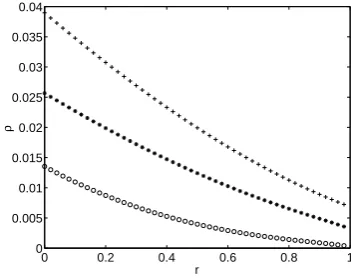
[image:7.595.47.291.161.435.2]In the following, we make three groups of experiments. In Figure 1, we test the relation betweenρandr, whenn=
100,ω1=ω2=1,r1=r2,α=2,q(m, 1) =3,q(m, 2) =2 and β=1, where “◦′′, “+′′and “∗′′denotes the spectral radius
ofP A,〈P A〉and A, respectively. In Table I and Table II, we report the spectral radius of iteration matrices with GPNUSAOR and GNUSAOR. The meaning of notations
ρ(Hˆ),ρ(H¨)and ρ(H)denotes the spectral radius ofP A,
〈P A〉 and A, respectively.
0 0.2 0.4 0.6 0.8 1
0 0.005 0.01 0.015 0.02 0.025 0.03 0.035 0.04
r
[image:7.595.338.514.285.424.2]ρ
Fig. 1. The Relation Betweenρandr, Whenn=100,ω1=ω2=1.
From Figure 1, Table I and Table II, we easily see that the preconditioned multisplitting relaxation USAOR methods discussed in this paper substantially have better numerical behaviours than the multisplitting relaxation USAOR methods studied in[9], which shows that our new methods are applicable and efficient.
TABLE I
COMPARISON OFSPECTRALRADIUSWHENα=2,q(m, 1) =2,q(m, 2) =1
n ω1,r1 ω2,r2 β ρ(H˜) ρ(H¨) ρ(H) 50 0.8,0.4 0.7,0.6 0.5 0.0098 0.0211 0.0542 50 1.0,0.6 0.9,0.6 0.8 0.0074 0.0172 0.0437
50 1.0,0.8 1.0,0.7 1 0.0059 0.0154 0.0286 100 0.8,0.4 0.7,0.6 0.5 0.0102 0.0255 0.0563 100 1.0,0.6 0.9,0.6 0.8 0.0085 0.0179 0.0475 100 1.0,0.8 1.0,0.7 1 0.0067 0.0172 0.0304
1000 0.8,0.4 0.7,0.6 0.5 0.0157 0.0312 0.0687 1000 1.0,0.6 0.9,0.6 0.8 0.0105 0.0234 0.0551 1000 1.0,0.8 1.0,0.7 1 0.0089 0.0202 0.0456
ACKNOWLEDGMENT
The authors would like to thank the anonymous ref-erees who made much useful suggestions that helped us to improve the quality of the paper.
IAENG International Journal of Applied Mathematics, 44:1, IJAM_44_1_06
TABLE II
COMPARISON OFSPECTRALRADIUSWHENα=2,q(m, 1) =3,q(m, 2) =2
n ω1,r1 ω2,r2 β ρ(H˜) ρ(H¨) ρ(H) 50 0.8,0.4 0.7,0.6 0.5 0.0025 0.0123 0.0354 50 1.0,0.6 0.9,0.6 0.8 0.0021 0.0111 0.0298
50 1.0,0.8 1.0,0.7 1 0.0018 0.0095 0.0213 100 0.8,0.4 0.7,0.6 0.5 0.0028 0.0145 0.0388 100 1.0,0.6 0.9,0.6 0.8 0.0026 0.0140 0.0364 100 1.0,0.8 1.0,0.7 1 0.0025 0.0136 0.0325
1000 0.8,0.4 0.7,0.6 0.5 0.0030 0.0151 0.0407 1000 1.0,0.6 0.9,0.6 0.8 0.0029 0.0146 0.0390 1000 1.0,0.8 1.0,0.7 1 0.0027 0.0142 0.0380
REFERENCES
[1] T. Z. Huang, X. Z. Wang, Y. D. Fu, “Improving Jacobi methods for nonnegative H-matrices linear systems,”Appl. Math. Comput.,vol. 186, pp. 1542-1550, 2007.
[2] Y. Zhang, T. Z . Huang, “Modified iterative methods for nonnegative matrices and M-matrices linear systems,”Comput. Math. Appl.,vol. 50, pp. 1587-1602, 2005.
[3] D. Noutsos, M. Tzoumas, “On optimal improvements of classical iterative schemes forZ-matrices,”J. Comput. Appl. Math.,vol. 188, pp. 89-106, 2006.
[4] A. Hadjidimos, D. Noutsos, M. Tzoumas, “More on modifications and improvements of classical iterative schemes for Z-matrices,”
Linear Algebra Appl.,vol. 364, pp. 253-279, 2003.
[5] A. Yasar Ozban, “On accelerated iterative methods for the solution of systems of linear equations,”Int. J. Comput. Math.,vol. 76, pp. 765-773, 2002.
[6] T. Z. Huang, G. H. Cheng, X. Y. Cheng, “Modified SOR-type iterative method for Z-matrices,”Appl. Math. Comput.,vol. 175, pp. 258-268, 2006.
[7] W. Li, “Comparison results for solving preconditioned linear sys-tems,”J. Comput. Appl. Math.,vol. 177, pp. 455-459, 2005.
[8] D. P. O’Leary, R. E. White, “Multisplittings of matrices and parallel solution of linear systems,” SIAM J. Alge. Disc. Math., vol. 6, pp. 630-640, 1985.
[9] L. T. Zhang, T. Z. Huang, et al, “Convergence of relaxed multisplit-ting USAOR methods for H-matrices linear systems,”Appl. Math. Comput.,vol. 202, pp. 121-132, 2008.
[10] Z. Z. Bai, “On the convergence domains of the matrix multisplit-ting relaxed methods for linear systems,” Applied Mathematics J. Chinese University,vol. 13b, No. 1, pp. 45-52, 1998.
[11] Z. H. Cao, Z. Y. Lin, “Convergence of relaxed parallel multisplitting methods with different weighting schemes,”Appl. Math. Comput,
vol. 106, pp. 181-196, 1996.
[12] M. Neumann, R. J. Plemmons, “Convergence of parallel multisplit-ting iterative methods for M-matrices,”Linear Algebra Appl.,vol. 88, pp. 559-573, 1987.
[13] L. Elsner, “Comparisons of weak regular splittings and multisplit-ting methods,”Numer. Math.,vol. 56, pp. 283-289, 1989.
[14] A. Frommer, G. Mayer, “Convergence of relaxed parallel multisplit-ting methods,”Linear Algebra Appl.,vol. 119, pp. 141-152, 1989.
[15] R. E. White, “Multisplitting with different weighting schemes,”
SIAM J. Matrix Anal. Appl.,vol. 10, pp. 481-493, 1989.
[16] D. R. Wang, “On the convergence of the parallel multisplitting AOR algorithm,”Linear Algebra Appl.,vol. 154-156, pp. 473-486, 1991.
[17] R. Bru, V. MigallSn, J. Penadds, D. B. Szyld,“ Parallel synchronous and asynchronous two-stage multisplitting methods,” Electronic Transactions on Numerical Analysis,vol. 3, pp. 24-38, 1995.
[18] D. B. Szyld, “Synchronous and asynchronous two-stage multi-splitting methods,” inProceedings 5th SIAM Conference on Applied Linear Algebra, (J. G. Lewis, Ed.), SIAM, Philadelphia, 1994.pp. 39-44,
[19] J. Mos, D. B. Szyld, “Nonstationary Parallel Relaxed Multisplitting Methods,”Line. Alge. Appl.,vol. 241-243, pp. 733-747, 1996.
[20] A. Berman, R. J. Plemmons, Nonnegative Matrices in the Mathe-matical Sciences,SIAM, Philadelphia, PA, 1994.
[21] R. S. Varga, Matrix Iterative Analysis,Prentice-Hall, Englewood Cliffs, NJ, 1981.
[22] L. Yu. Kolotilina, “Two-sided bounds for the inverse of an H-matrix,”Lin. Alg. Appl.,vol. 225, pp. 117-123, 1995.
[23] M. Benzi, D. B. Szyld, “Existence and uniqueness of splittings for stationary iterative methods with applications to alternating methods,”Numer. Math.vol. 76, pp. 309-321, 1997.
[24] A. J, Li, “A New Preconditioned AOR Iterative Method and Com-parison Theorems for Linear Systems,”IAENG International Journal of Applied Mathematics,vol. 42, no. 3, pp. 161-163, Aug. 2012.
[25] J. Y. Yuan, D. D. Zontini, “Comparison theorems of preconditioned Gauss-Seidel methods for M-matrices,”Appl. Math. Comput.,vol. 219, pp. 1947-1957, 2012.
[26] H. Saberi Najafi, S. A. Edalatpanah, “ Comparison analysis for improving preconditioned SOR-type iterative method,”Nume. Anal. Appl.,vol. 6, no.1. pp. 62-70, 2013.
[27] X. Z. Wang, “Block preconditioned AOR methods for H-matrices linear systems,”J. Comput. Anal. Appl., vol. 15, no.1, pp. 714-721, 2013.
[28] G. B. Wang, T. Wang, F. P. Tan,“Some results on preconditioned GAOR methods,”Appl. Math. Comput., vol. 219, no.11, pp. 5811-5816, 2013.