Supported by the Ministry of Agriculture of the Czech Republic (Project No. MZE-RO0719) and by the European Regional Development Fund (Project NutRisk Centre No. CZ.02.1.01/0.0/0.0/16_019/0000845).
In vitro
antimicrobial effect of palm oils rich in
medium-chain fatty acids against mastitis-causing
Gram-positive bacteria
Klára Laloučková
1,2, Lucie Malá
1,2, Paula Slaničková
2, Eva Skřivanová
1,2*
1Department of Nutritional Physiology and Animal Product Quality, Institute of Animal Science,Prague-Uhříněves, Czech Republic
2Department of Microbiology, Nutrition and Dietetics, Faculty of Agrobiology, Food and Natural Resources, Czech University of Life Sciences Prague, Prague, Czech Republic
*Corresponding author: [email protected]
Citation:Laloučková K., Malá L., Slaničková P., Skřivanová E. (2019): In vitro antimicrobial effect of palm oils rich in medium-chain fatty acids against mastitis-causing Gram-positive bacteria. Czech J. Anim. Sci., 64, 325–331.
Abstract: Various pathogens causing mastitis in dairy cattle are of serious concern due to their increasing anti-bacterial resistance and potential transmission to other cows, calves, and the environment, especially through the milking process. Therefore, alternative approaches to antimicrobial usage in the treatment or control of mastitis in dairy cattle are severely needed. The antibacterial effect of medium-chain fatty acids (MCFAs) is known to be sig-nificant for various pathogens, but there is only limited information about the activity of MCFAs on mastitis-causing pathogens. Moreover, no evidence about the antimicrobial effects of palm oils rich in MCFAs, such as coconut, palm kernel, and tucuma oil, can be found in the current literature. The aim of this study was to evaluate the in vitro antibacterial effect of palm oils rich in MCFAs, after cleavage by an exogenous lipase from Mucor javanicus, on bovine mastitis-causing strains (Staphylococcus aureus, Streptococcus agalactiae, Streptococcus dysgalactiae, and
Streptococcus uberis)by the broth microdilution method. All tested palm oils exerted antibacterial activity against eight tested bacterial strains in the range of 64–8192 µl/ml with Str. agalactiae being the most sensitive and S. aureus
being the most resistant species. The results of the present study demonstrate that palm oils rich in MCFAs can serve as an alternative to the predominantly used predip and postdip procedures in bovine mastitis control, but further in vivo studies are needed to confirm the findings for their possible applications.
Keywords: antibacterial; bovine; Staphylococcus;Streptococcus; vegetable oil
Bovine mastitis affects the dairy industry world-wide. Defined as “inflammation of the mammary gland”, mastitis is currently the most common rea-son for the use of antibacterials in lactating dairy cattle (Erskine et al. 2004). Van Boeckel et al. (2015) estimated that the global annual consumption of antimicrobials per kilogram of animal produced is 45 mg/kg in cattle. The economic impact of bovine mastitis is tremendous – the annual losses
The classical approach to cure mastitis in cattle is the use of antibiotics, but this treatment is ac-companied by various disadvantages, including a low cure rate, increasing occurrence of resistance, and the presence of antibiotic residues in milk (Gomes and Henriques 2016). Intramammary antibiotic therapy is a usual practice for mastitis treatment or control in dairy cattle herds. Com-monly used drugs include betalactams, macrolides and lincosamides (Barkema et al. 2006). Cure rates scarcely reach 50% in mastitis-causing S. aureus strains with currently available therapies (Ster et al. 2013). The antibiotic therapy of bovine mas-titis has been related to emerging antimicrobial resistance in various bacterial strains, including isolates from the infected cows, other animals from the same herd, and even from food products of infected/cured animal origin (Silva et al. 2018). The modern concepts of mastitis treatment and prevention include nonsteroidal anti-inflamma-tory drugs (Breen 2017) and intramammary teat seals (Kromker et al. 2014). Nevertheless, the occurrence of antibiotic resistance in dairy cattle mastitis isolates is still of serious concern and is a reason for seeking an alternative treatment in current research.
Organic acids are promising alternatives to an-tibiotics due to their antimicrobial activity in controlling bacterial contamination and their ability to boost animal production (Polycarpo et al. 2017). Unbranched saturated fatty acids with medium-chain lengths of carbons, namely caproic (C6:0), caprylic (C8:0), capric (C10:0) and lauric (C12:0) acids, are a group of antibacterials occurring naturally (e.g., in cow milk) (Legrand 2008). These fatty acids exhibit antimicrobial properties against a wide variety of pathogens, including Gram-positive bacteria (Hovorkova et al. 2018). Their bactericidal or bacteriostatic ef-fect is believed to occur through their ability to incorporate into bacterial membranes, increas-ing the fluidity of the membrane and resultincreas-ing in the leakage of internal content from the cells (Chamberlain et al. 1991). Medium-chain fatty acids (MCFAs) frequently occur in oils of tropi-cal palms native to tropitropi-cal and subtropitropi-cal areas (Van der Vossen et al. 2001). It has been proven by previous research that the antibacterial effect of palm oils rich in MCFAs, such as babassu (Attalea speciosa), coconut (Cocos nucifera), murumuru (Astrocaryum murumuru), palm kernel (Elaeis
guineensis), and tucuma (Astrocaryum vulgare) oils, is exerted only after their cleavage, meaning after their release from triglycerides; the most prevalent of the detected MCFAs is dodecanoic (lauric) acid followed by tetradecanoic (myristic) acid, with the total MCFA content higher than 50%, and saturated fatty acids content more than 80% in all the tested oils (Hovorkova et al. 2018). The antibacterial properties of free MCFAs and their monoesters against various pathogens (Bunkova et al. 2011), including staphylococci (Batovska et al. 2009) and streptococci (Schlievert and Peterson 2012), are well known. Nair et al. (2005) evalu-ated the in vitro antibacterial activity of capric acid and monocaprylin against major bacterial mastitis pathogens in milk and found it to be effec-tive. Unlike free fatty acids, palm oils are complex substances with enhanced sensory properties and lower prices, but there are no studies about the inhibitory activity of palm oils rich in MCFAs against bovine mastitis-causing bacteria.
The present research was carried out to evalu-ate the possible application of palm oils rich in MCFAs with the aim of decreasing the undesirable bacterial colonization of udders of dairy cows, especially during the milking process.
MATERIAL AND METHODS
activity at 2.73 mg/ml in culture media. The solu-tion consisting of tested oil, appropriate culture medium chosen according to the tested strain, and lipase from M. javanicus was then shaken in a water bath heated to 37°C for 1 h to release MCFAs from triglycerides and to facilitate their antibacterial action. Penicillin G (Sigma-Aldrich) was used as a growth control for bacterial cultures. A row of wells filled with medium only and a row with bacteria in medium without palm oil emul-sion were included in every microtiter plate as a negative control and positive bacterial growth control, respectively.
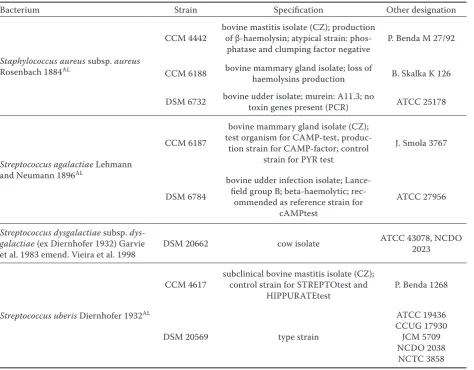
Bacterial cultures and their maintenance.To evaluate the antibacterial potential of the above-mentioned palm oils rich in MCFAs against bovine mastitis pathogens, 8 strains of bacteria, that were proven mastitis-causing pathogens, were chosen. The strains listed in Table 1 were purchased from the Czech Collection of Microorganisms and from
the German Collection of Microorganisms and Cell Cultures. Aliquots of bacterial cultures were stored at –80°C in 20% glycerol until use in TSB or TSB with yeast extract. Stock cultures of mi-croorganisms were cultivated in medium at 37°C for 24 h prior to testing.
Determination of the minimum inhibitory con-centrations.Minimum inhibitory concentrations (MICs) were determined using the guidelines of the Clinical and Laboratory Standards Institute (CLSI 2013) to evaluate the antibacterial activity of coconut, palm kernel, and tucuma oil against chosen Gram-positive bovine mastitis-causing strains. The in vitro broth microdilution method performed in 96-well microtiter plates was used to test the antimicrobial susceptibility of palm oils rich in MCFAs. The initial concentration of palm oils for susceptibility testing was 8192 µg/ml. Plates were inoculated by bacterial suspension to a final density of 5 × 10⁵ CFU/ml, which was
con-Table 1. Bacterial strains and their specification
Bacterium Strain Specification Other designation
Staphylococcus aureus subsp. aureus
Rosenbach 1884AL
CCM 4442 bovine mastitis isolate (CZ); production of β-haemolysin; atypical strain:
phos-phatase and clumping factor negative P. Benda M 27/92
CCM 6188 bovine mammary gland isolate; loss of haemolysins production B. Skalka K 126
DSM 6732 bovine udder isolate; murein: A11.3; no toxin genes present (PCR) ATCC 25178
Streptococcus agalactiae Lehmann and Neumann 1896AL
CCM 6187
bovine mammary gland isolate (CZ); test organism for CAMP-test, produc-tion strain for CAMP-factor; control
strain for PYR test
J. Smola 3767
DSM 6784
bovine udder infection isolate; Lance-field group B; beta-haemolytic;
rec-ommended as reference strain for cAMPtest
ATCC 27956
Streptococcus dysgalactiae subsp. dys-galactiae (ex Diernhofer 1932) Garvie
et al. 1983 emend. Vieira et al. 1998 DSM 20662 cow isolate
ATCC 43078, NCDO 2023
Streptococcus uberis Diernhofer 1932AL
CCM 4617 subclinical bovine mastitis isolate (CZ); control strain for STREPTOtest and
HIPPURATEtest P. Benda 1268
DSM 20569 type strain
[image:3.595.64.539.390.760.2]trolled using a McFarland Densitometer Biosan DEN 1 (BioTech, Czech Republic), and incubated at 37°C for 24 h. Bacterial growth before and after incubation was evaluated spectrophotometrically by a Tecan Infinite® 200 PRO microplate reader (Tecan Group Ltd., Switzerland) at a wavelength of 405 nm. MICs were expressed as the lowest palm oil concentration that resulted in 80% growth re-duction compared to the oil-free growth control. In addition, a susceptibility test of all strains to penicillin G was also performed by MIC determi-nation, like in the case of palm oils. All combina-tions of oil/penicillin G per strain were tested in three individual experiments, each of which was carried out in triplicate. The final MIC was de-termined as the mode of all values. In accordance with turbidity values measured in the wells of the microtiter plates before and after incubation of the stock solution of three tested palm oils and eight bacterial strains, MIC values for the selected oils and bacteria were calculated. No antimicrobial activity of palm oils was observed without prior lipase cleavage (Hovorkova et al. 2018); therefore, the results mentioned below apply only to oils after cleavage by a lipase from M. javanicus.
RESULTS
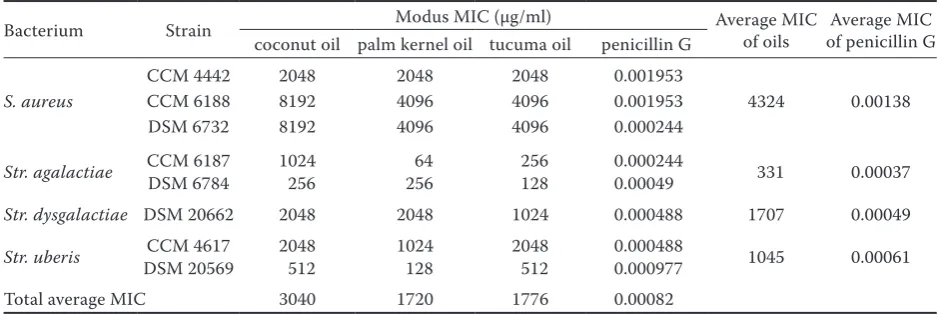
The minimum inhibitory concentrations (MICs) displayed in Table 2 show susceptibility of all tested Gram-positive bovine mastitis-causing pathogenic strains to the chosen palm oils in the concentration range of 64 (S. aureus)–8192 µg/ml (Str. agalactiae). The most sensitive of the tested bacterial strains
according to the lowest measured modal MIC value was Str. agalactiae CCM 6178 (64 µg/ml in the case of palm kernel oil), followed by Str. agalactiae DSM 6784, and Str. uberis DSM 20569 (128 µg/ml for tucuma and palm kernel oil, respectively). In the inhibitory activity, viewed as the average of the MIC values for each oil against all strains, palm kernel oil showed to be the most effective (average MIC 1720 µg/ml), followed by tucuma oil (average MIC 1776 µg/ml), and coconut oil (average MIC 3040 µg/ml). The most sensitive species of the tested bacteria was Str. agalactiae with an aver-age MIC value of 331 µg/ml for all tested oils, fol-lowed by Str. uberis (1045 µg/ml), Str. dysgalactiae (1707 µg/ml), and S. aureus (4323 µg/ml). Str. agalac-tiae was also the most sensitive species (average MIC 0.00037 µg/ml), and S. aureus was the most resist-ant species (average MIC 0.00138 µg/ml) to resist- antibi-otic control as demonstrated by penicillin G. The susceptibility pattern of the species to palm oils was similar to that of penicillin G, except for the switch between susceptibility of Str. dysgalactiae and Str. uberis.
DISCUSSION
[image:4.595.62.532.581.738.2]The increasing resistance to drugs in many bac-teria has resulted in a ban on the use of antibiotic growth promoters in livestock farming among the EU countries (Regulation EC No. 1831/2003 of the European Parliament and the Council of 22 September 2003 on additives for use in animal nutrition). As there is a potential threat of spread-ing antibiotic resistance genes between bacterial
Table 2. Minimum inhibitory concentrations (MIC) of tested palm oils (µg/ml)1
Bacterium Strain Modus MIC (µg/ml) Average MIC of oils of penicillin GAverage MIC coconut oil palm kernel oil tucuma oil penicillin G
S. aureus
CCM 4442 2048 2048 2048 0.001953
4324 0.00138 CCM 6188 8192 4096 4096 0.001953
DSM 6732 8192 4096 4096 0.000244
Str. agalactiae CCM 6187DSM 6784 1024 256 64 256 256 128 0.0002440.00049 331 0.00037
Str. dysgalactiae DSM 20662 2048 2048 1024 0.000488 1707 0.00049
Str. uberis DSM 20569CCM 4617 2048 512 1024 128 2048 512 0.0004880.000977 1045 0.00061 Total average MIC 3040 1720 1776 0.00082
strains causing mastitis in bovines, it is necessary to look for new natural antibacterial compounds acting specifically against mastitis-causing patho-gens. Plant (palm) oils containing medium-chain lipids can be found in natural products such as milk and are nontoxic to the mucosa while being able to inhibit a wide variety of human and animal pathogens (Churchward et al. 2018). Moreover, all MCFAs, their triglycerides, and coconut oil have the GRAS status meaning that they are generally recognized as save for use in human nutrition (FDA 2019).
A number of biological agents are already known to possess in vitro antibacterial activity against both contagious and environmental bovine mastitis-causing strains. These substances include extracts of various plants, such as Alternanthera brasiliana, Achillea millefolium, Baccharis trimera,Cedrus deodara, Curcuma longa, Eucalyptus globulus, Ocimum sanctum, Origanum vulgare, Solidago chilensis, Thymus vulgaris, etc. (Mushtaq et al. 2018).
MCFAs are well known to possess in vitro anti-bacterial properties against various pathogens, but to the best of our knowledge, there is no evidence about the antibacterial properties of palm oils rich in MCFAs against bovine mastitis-causing staphylococci and streptococci. Batovska et al. (2009) evaluated the antibacterial activity of MC-FAs against S. aureus 209, S. aureus 146 MR, and S. aureus ATCC 33862 USA by the agar well dif-fusion method and discovered that capric acid inhibits all three strains at concentrations of 250–500 µg/ml and that lauric acid inhibits S. aureus 209 at a concentration of 125 µg/ml. These concentrations inhibiting staphylococcal growth are approximately 10× lower than in the case of the palm oils tested in this study (2048– 8192 µg ml). In addition, Schlievert and Peterson (2012) evaluated the inhibitory activity of lauric acid – in the form of glycerol monolaurate (mono-laurin) – against 54 different S. aureus strains and found its MIC to be 300 µg/ml. Because palm oils are diverse combinations of fatty acids, not only MCFAs but also tocopherols, polyphenols, phytosterols, and phenolic acids (Srivastava et al. 2016), it can be assumed that these compounds interact due to their mechanisms of action and thus reduce the antibacterial activity of the oils themselves. Another reason for the decreased antibacterial activity of palm oils when compared to pure MCFAs can be due to their incomplete
release from triglycerides during the cleavage by lipase. This fact was confirmed in a trial by Nair et al. (2005), where the growth of 15 clinical isolates of mastitis-causing pathogens including S. aureus, Str. agalactiae, Str. dysgalactiae, and Str. uberis was inhibited by caprylic acid and monocaprylin. The authors concluded that the most effective concen-tration inhibiting the abovementioned mastitis-causing isolates in autoclaved milk was 100 mM (6.93 × 10⁻⁴ mg/ml) of caprylic acid and 50 mM (2.29 × 10⁻⁴ mg/ml) of monocaprylin. Monolaurin is effective against the growth of Str. agalactiae, as shown in a study by Schlievert and Peterson (2012), where glucose monolaurate had antibacterial activ-ity against three strains of this bacterium at MIC of 30 µg/ml. In our study, the effective concentration of oil against Str. agalactiae was up to 34× higher than that of glucose monolaurate in the case of coconut oil and the CCM 6178 strain, but only 2× higher in the case of palm kernel oil against the same bacterial strain. This difference could be due to the different degree of hydrolysis in both oils during the cleavage process. The susceptibility of S. aureus to the oils was significantly higher than the susceptibility of other species not only in the present study – average MIC 13× higher than in Str. agalactiae species – but also in other stud-ies, as mentioned above. The probable reason for the profound resistance of S. aureus is believed to be caused by its capsule which is composed of exopolysaccharides, and slime production has also been shown to exist in mastitis-causing strains (Baselga et al. 1994).
CONCLUSION
The potential health risk of foodborne trans-mission of antibiotic-resistant animal pathogenic bacterial strains has led to the need for new alter-native antibacterial sources in the dairy industry. In this study, the antibacterial effect of palm oils rich in MCFAs, namely coconut, palm kernel, and tucuma oil (after cleavage with a lipase from Mucor javanicus),was observed on eight bovine mastitis-causing pathogens in vitro. The results offer an alternative approach to mastitis preven-tion in cattle herds since oils rich in MCFAs are valuable antibacterial remedies suitable for use in teat preparation and treatment.
REFERENCES
Barkema H.W., Schukken Y.H., Zadoks R.N. (2006): Invited review: The role of cow, pathogen, and treatment regi-men in the therapeutic success of bovine Staphylococcus aureus mastitis. Journal of Dairy Science, 89, 1877–1895. Baselga R., Albizu I., Amorena B. (1994): Staphylococcus
aureus capsule and slime as virulence factors in ruminant mastitis. A review. Veterinary Microbiology, 39, 195–204. Batovska D.I., Todorova T., Tsvetkova V., Najdenski H.M.
(2009): Antibacterial study of the medium chain fatty acids and their 1-monoglycerides: Individual effects and synergistic relationships. Polish Journal of Microbiology, 58, 43–47.
Behiry A.E., Schlenker G., Szabo I., Roesler U. (2012): In vitro susceptibility of Staphylococcus aureus strains iso-lated from cows with subclinical mastitis to different antimicrobial agents. Journal of Veterinary Science, 13, 153–161.
Breen J. (2017): The importance of non-steroidal anti-inflammatory drugs (NSAIDs) in mastitis therapeutics. Livestock, 4, 182–185.
Bunkova L., Bunka F., Janis R., Krejci J., Dolezalkova I., Pospisil Z., Ruzicka J., Tremlova B. (2011): Comparison of antibacterial effect of seven 1-monoglycerides on food-borne pathogens or spoilage bacteria. Acta Veterinaria Brno, 80, 29–39.
Chamberlain N.R., Mehrtens B.G., Xiong Z., Kapral F.A., Boardman J.L., Rearick J.I. (1991): Correlation of carot-enoid production, decreased membrane fluidity, and resistance to oleic acid killing in Staphylococcus aureus 18Z. Infection and Immunity, 59, 4332–4337.
Churchward C.P., Alany R.G., Snyder L.A. (2018): Alter-native antimicrobials: The properties of fatty acids and
monoglycerides. Critical Reviews in Microbiology, 44, 561–570.
CLSI (2013): Methods for Dilution Antimicrobial Suscepti-bility Tests for Bacteria that Grow Aerobically. Approved Standard M07-A10. Clinical and Laboratory Standards Institute, Wayne, USA.
Erskine R., Cullor J., Schaellibaum M., Yancey B., Zecconi A. (2004): Bovine mastitis pathogens and trends in resis-tance to antibacterial drugs. In: Proc. National Mastitis Council (NMC) Annual Meeting, Verona, Italy, 400–414. FDA (2019): Electronic Code of Federal Regulations. U.S.
Food and Drug Administration, College Park, USA. Avail-able at https://www.ecfr.gov/cgi-bin/text-idx?SID=3ee 286332416f26a91d9e6d786a604ab&mc=true&tpl=/ec-frbrowse/Title21/21tab_02.tpl (accessed Feb 25, 2019). Gomes F., Henriques M. (2016): Control of bovine mastitis:
Old and recent therapeutic approaches. Current Micro-biology, 72, 377–382.
Hossain M.K., Paul S., Hossain M.M., Islam M.R., Alam M.G.S. (2017): Bovine mastitis and its therapeutic strat-egy doing antibiotic sensitivity test. Austin Journal of Veterinary Science and Animal Husbandry, 4, 1030. Hovorkova P., Lalouckova K., Skrivanova E. (2018):
Deter-mination of in vitro antibacterial activity of plant oils con-taining medium-chain fatty acids against Gram-positive pathogenic and gut commensal bacteria. Czech Journal of Animal Science, 63, 119–125.
Jingar S.C., Singh M., Roy A.K. (2017): Economic losses due to clinical mastitis in cross-bred cows. International Journal of Livestock Research, 8, 254–263.
Kasna E., Zavadilova L., Stipkova M. (2018): Genetic evalu-ation of clinical mastitis traits in Holstein cattle. Czech Journal of Animal Science, 63, 443–451.
Kromker V., Grabowski N.T., Friedrich J. (2014): New infec-tion rate of bovine mammary glands after applicainfec-tion of an internal teat seal at dry-off. Journal of Dairy Research, 81, 54–58.
Legrand P. (2008): Nutritional interest of different fatty acids from milk fat. Sciences des Aliments, 28, 34–43. Mushtaq S., Shah A.M., Shah A., Lone S.A., Hussain A.,
Has-san Q.P., Ali M.N. (2018): Bovine mastitis: An appraisal of its alternative herbal cure. Microbial Pathogenesis, 114, 357–361.
Nair M.K.M., Joy J., Vasudevan P., Hinckley L., Hoagland T.A., Venkitanarayanan K.S. (2005): Antibacterial ef-fect of caprylic acid and monocaprylin on major bacte-rial mastitis pathogens. Journal of Dairy Science, 88, 3488–3495.
Polycarpo G.V., Andretta I., Kipper M., Cruz-Polycarpo V.C., Dadalt J.C., Rodrigues P.H.M., Albuquerque R.
(2017): Meta-analytic study of organic acids as an alter-native performance-enhancing feed additive to antibiotics for broiler chickens. Poultry Science, 96, 3645–3653. Schlievert P.M., Peterson M.L. (2012): Glycerol monolaurate
antibacterial activity in broth and biofilm cultures. PLoS ONE, 7, e40350.
Schreiner D.A., Ruegg P.L. (2003): Relationship between udder and leg hygiene scores and subclinical mastitis. Journal of Dairy Science, 86, 3460–3465.
Silva J.G., Alcantara A.M., Mota R.A. (2018): Bovine mas-titis caused by Staphylococcus spp. Methicillin-resistant: Literature review. Pesquisa Veterinária Brasileira, 38, 223–228. (in Portuguese)
Srivastava Y., Semwal A.D., Majumdar A. (2016): Quanti-tative and qualiQuanti-tative analysis of bioactive components present in virgin coconut oil. Cogent Food and Agricul-ture, 2, Article 1164929.
Ster C., Allard M., Boulanger S., Boulet M.L., Mulhbacher J. (2013): Experimental treatment of Staphylococcus aureus bovine intramammary infection using a guanine riboswitch ligand analog. Journal of Dairy Science, 96, 1000–1008. Van Boeckel T.P., Brower C., Gilbert M., Grenfell B.T.,
Levin S.A., Robinson T.P., Teillant A., Laxminarayan R. (2015): Global trends in antimicrobial use in food animals. Proceedings of the National Academy of Sciences of the United States of America, 112, 5649–5654.
Van der Vossen H.A.M., Umali B.E., Oyen L.P.A., Jansen P.C.M. (2001): Vegetable oils and fats. In: Jansen P.C.M., Westphal E., Wulijarni-Soetjipto N. (eds): Plant Resources of South-East Asia, Volume 14. Backhuys Publishers, Leiden, the Netherlands, 13–170.
Wadhwani T., Desai K., Patel D., Lawani D., Bahaley P., Joshi P., Kothari V. (2009): Effect of various solvents on bacterial growth in context of determining MIC of vari-ous antimicrobials. The Internet Journal of Microbiology, 7, 1–13.